
By Lynn Venhaus

The underbelly of American nuclear families in affluent suburbia is exposed in the emotionally charged Alanis Morissette-inspired musical “Jagged Little Pill,” which can’t be wholly described in jukebox terms.

The show’s timeless message of showing up for people is emphasized, and Tesseract Theatre’s production focuses on pain, healing and empowerment. Director Brittanie Gunn features a smartly attuned cast in principal roles.

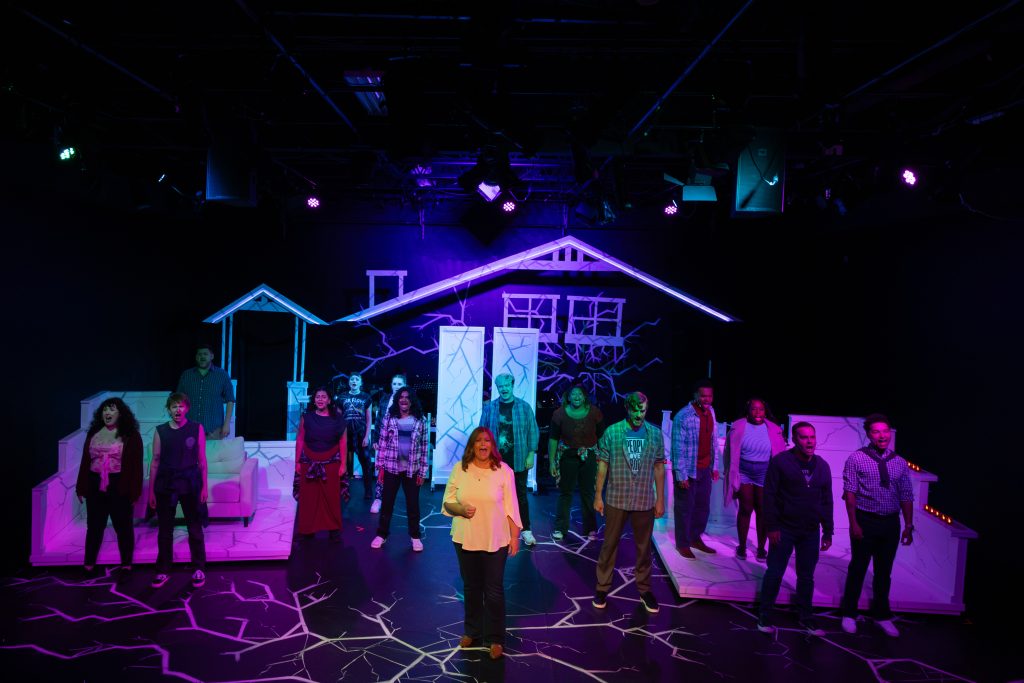
The landmark alt-rock album’s ‘90’s fueled angst is palpable as the fired-up energetic ensemble propels this professional regional theater premiere, featuring dynamic dancing, supple orchestrations and powerhouse vocals.

The recognizable musical score is well integrated into the issue-laden story, and includes other Morissette songs from later albums (“Supposed Former Infatuation Junkie,” “Under Rug Swept,” “Havoc and Bright Lights,” “Feast on Scraps,” and “City of Angels” soundtrack), and two new songs (“Smiling” and “Predator.”).

After the lead characters establish their troubled dilemmas in “All I Really Want,” pumped-up performers burst out with “Right Through You” and never let up until after the hard-fought “You Learn.” The company’s “Wake Up,” “Forgiven,” “Hands Clean,” and “Thank U” are commanding as well, especially the haunting “Uninvited.”
As the outwardly ideal mother unraveling inside, an affecting Loren Goudreau organically portrays Mary Jane “MJ” Healy – an authentic combination of fire and ice. Like most of the insulated moms nearby, MJ is a helicopter parent, aka control freak, and instead of protecting her two children, she’s smothering them.

MJ is also addicted to pain pills that she started abusing after a car accident and is pulling away from everyone who knows and loves her. Yet, she seems to realize what a fraud these shiny happy façades are, and the shallow suburbanites she’s in contact with around their snobby, judgy town.

Goudreau’s always in control in beautifully delivered vocals – “All I Really Want,” “Smiling,” and she crushes “Uninvited.” Her marital woes are aptly conveyed in “So Unsexy” and “Not the Doctor.” She shows her strength in a triumphant “You Learn.”

With a book by Diablo Cody, who won the 2021 Tony (and won an Oscar for the original screenplay “Juno”), Act I opens with MJ composing her annual Christmas letter telling everyone how perfect their family is.

Of course, it’s all big little lies. Her workaholic husband Steve (Kevin O’Brien), feeling neglected, spends time after-hours on porn sites. Their tenuous relationship appears on a downward spiral.
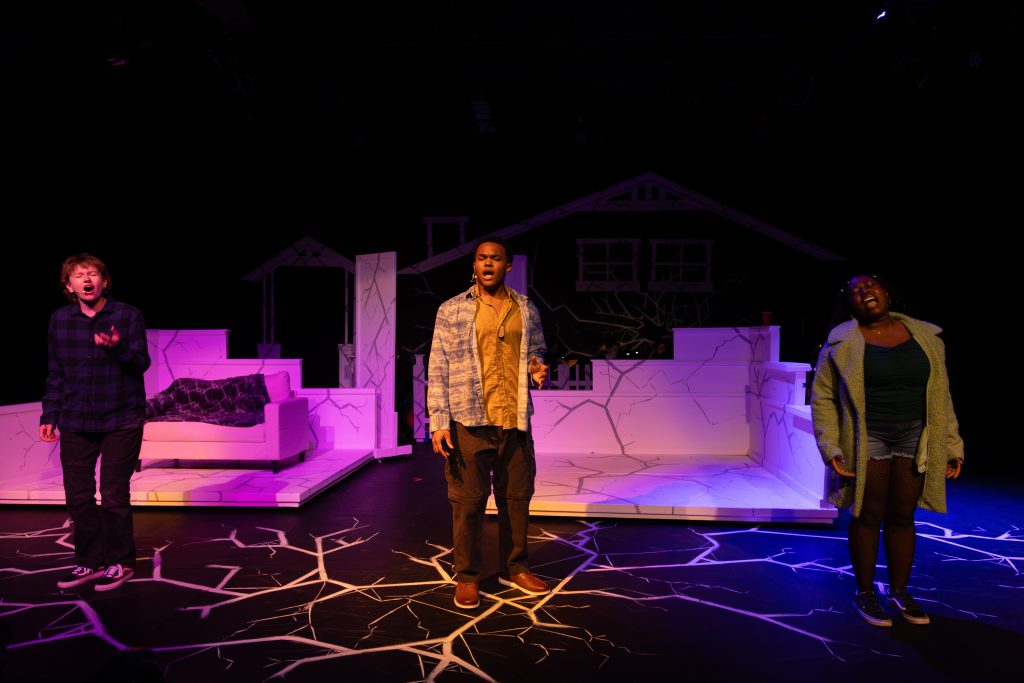
O’Brien, a remarkable actor, is unfortunately saddled with a standard perplexed dad role. For as superbly as the female characters are drawn, the men parts feel perfunctory. He does what he can with a poorly drawn character.

The heavy parental issues are complicated by the kids being teenagers, and moral dilemmas arise because of choices and circumstances. Hard life lessons are ahead as we go through a very stressful calendar year in Connecticut.

Son Nick was accepted into Harvard, and his future’s so bright that they all need to wear shades. Golden boy Nick, however, is feeling the pressure of being the ‘good’ son, the overachiever. So many expectations on his shoulders. He gets into a situation at a party where things go sideways, involving his classmates, and he is put to the test.

Stephen Henley, who is a young-looking 30 something, plays the high school senior, so one must suspend belief. Henley, a strong triple threat, can handle the emotional heft of the conflicted son. But like the movie cast of “Grease,” being a student is a stretch.

Daughter Frankie (Kinya Kairigi) is a budding social activist. She considers herself bisexual, and her best friend JoAnn “Jo” (Milo Garlich) is more than a buddy. Frankie, who is arguing more with mom, is trying to find her way – and becomes attracted to a sensitive student Phoenix (Jabari Boykin), who seems to ‘get her.’

It’s another fine showcase for Boykin, after commanding performances in Stray Dog Theatre’s “The Second Hurricane” and “Superhero.” His “That I Would Be Good” and the romantic first-love dip “Head Over Feet” show his vulnerability.
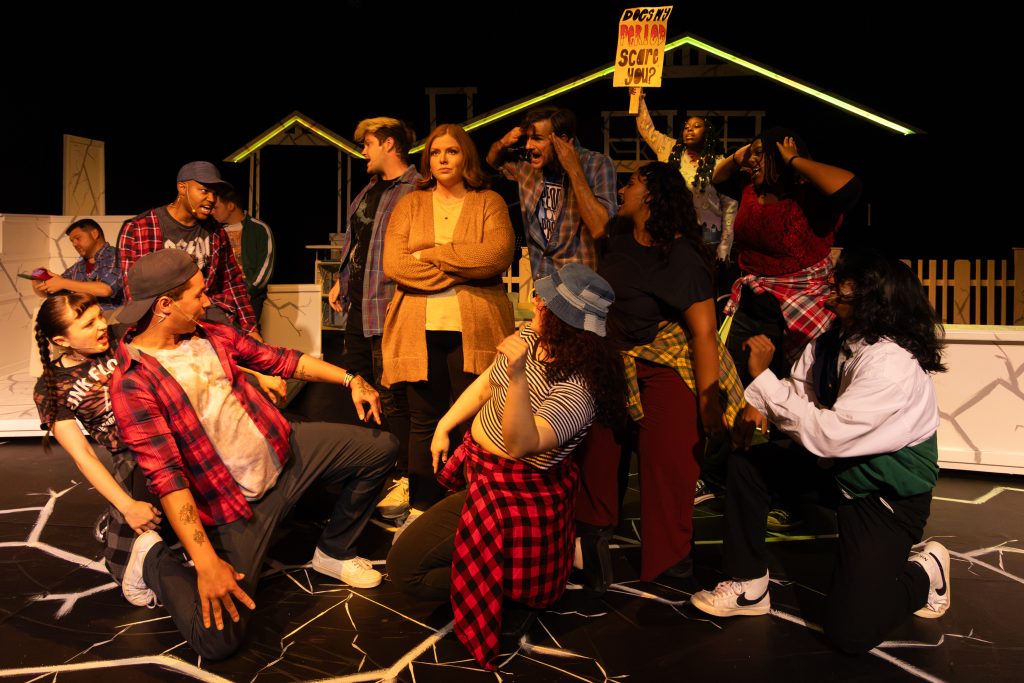
Frankie is adopted, black, and raised in a white Catholic family who didn’t think about exploring her culture but instead ignored it. ‘Better life,’ and all that. So, Frankie has some things to say about her upbringing, plus is a typical teenager ready to explode and rebel.

Kairigi, making her St. Louis debut, shows much promise, and can belt with the best of them. Her clever rendition of “Ironic,” which starts out as an essay/poem in English class and becomes a subject of debate by her sarcastic classmates, is a standout scene.

Garlich, a notable Motel in Fly North’s “Fiddler on the Roof,” has an impressive vocal range and is a passionate singer, especially on “You Oughta Know,” Morissette’s strongest anthem.

Lauren Tenenbaum’s heart-tugging portrayal of Bella Fox, the unconscious girl who is sexually assaulted at a wild holiday party, with photos circulating on social media, is another riveting aspect of the emotionally wrought show. Tenenbaum’s sincere vocals on “Predator” and “No” are noteworthy for its message.

Her tender storyline is also captured in lithe Lillian Cooper’s interpretive dance that adds a fascinating element to the presentation.

The compelling dance numbers overall, choreographed by Ella Drake and Ruben Medina, are among the show’s most memorable moments.

The ensemble – featuring Kiera Anderson-Pittman, Scott Degitz-Fries, David Hall Kaycee, David Joseph, Eesha Ved and Devynn Phoenix Yakel — is committed to getting us to feel their hurt, humiliation and outrage. Clayton Hamburg was not in the July 12 show reviewed here.

The music, by Morissette and Glen Ballard, with lyrics by Morissette, reminds us of her strengths as a groundbreaking female artist. She was only 22 when the album was released in 1995. Additional music is by Michael Farrell and Guy Sigsworth.

The album sold over 33 million copies worldwide, earned five Grammy Awards, including Album of the Year. The musical reinforces her legacy in American pop music, and the reminder is a welcome one.

Outstanding Music Director Leah Schultz is precise in conducting a very skilled band, determined to make these songs matter — not just “swallow it down.” After all, “Hand in My Pocket” promises “everything is going to be quite alright” (unless you are a cynic).

The seven-piece band sharpened the songs’ deliveries. The strings are a terrific addition, with Jill Hamill on violin and Mallory Golden second weekend, Chuck Evans on viola, and Micah Bounds on cello. Michaela Kuba is on bass, Jake Luebbert on drums, Adam Rugo on guitar, and Schultz on keyboards.

One can see how this musical garnered 15 Tony nominations, the most of any show that COVID-affected 2019-2020 season, and won two (Best Book and Best Supporting Actress). The show began previews on Broadway in November 2019 but closed due to the pandemic. It reopened on Oct. 21, 2021, and closed on Dec.17, 2021. It also won the Grammy Award for Best Musical Theater Album.

It’s easy to put this show into a time capsule, but the cast strives to make it relevant to today. The dysfunctional problems are confronted, and the solution is to start over and learn a new normal.

Lighting designer Kevin Bowman and sound designer Phillip Evans enhanced the moods while scenic designer Todd Schaefer created a fluid moving panels to anchor home, school, party, coffee shop, park and other locations. The cast helps in placing the movable pieces.

Costume designer Sarah Gene Dowling ensured the cast could move in casual looks, and rock band T-shirts helped establish the era, especially a couple classic Nirvana designs.

Other creatives included technical director Kevin Sallwasser, stage manager Abby Turner, fight choreographer Rhiannon Creighton, intimacy consultant Will Bonfiglio, and production manager Sarah Baucom.

Tesseract Theatre, as it often does, met this moment by aligning the dark topical issues to the exaggerated energetic staging. Now while the social issues are admirable, the show’s construction seems very busy.

The two-act musical is at its best when it galvanizes the intensely personal female-driven messaging and corrals the emotional landscape of adolescence in a relatable way, when it slows down to share raw, honest dialogue.

Those who respond to heartbreaking musicals like “Dear Evan Hansen” and “Next to Normal,” where personal growth and resilience occur, this is for you.

Life’s rough edges are captured in Morissette’s songs, which Cody weaves into an anxiety-ridden panoply of problems, mainly on gender and racial identities, not to mention addictions, sexuality, and suburban stereotypes. Cody’s humor is a much-needed component, too – and given the complexities of the contemporary issues, and emotional baggage, maybe not enough.

“Jagged Little Pill” can be an exhausting rollercoaster of importance, but it can also hit one in the feels. One open to this experience will discover the human condition in its moving, messy realities, set to catchy pop hooks, connecting on the Marcelle stage.

Tesseract Theatre Company presents “Jagged Little Pill” July 10 – July 26 Thursday through Sunday at The Marcelle Theatre in the Grand Center Arts District. For more information, visit www.TesseractTheatreco.org

By Lynn Venhaus
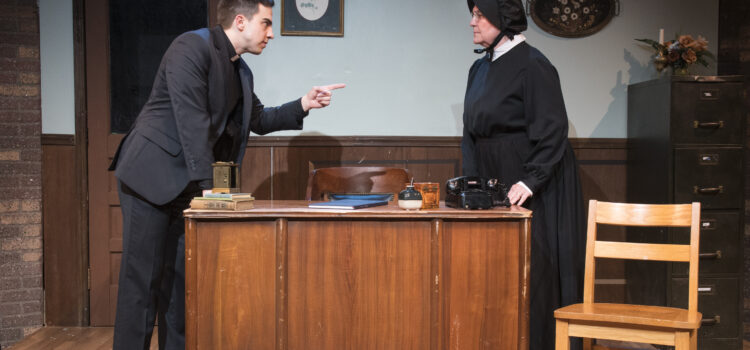
Strong performances mark Prism Theatre Company’s stirring interpretation of the fascinating and complex “Doubt: A Parable,” which pits a progressive well-liked young priest against a conservative rigid nun who is the feared school principal, plunging us into a nebulous gray area.

The year is 1964, a time when America was reeling from the assassination of President John F. Kennedy, the Civil Rights movement was emerging, and Catholics would be adapting to the monumental Vatican II (1962-65).

At a Catholic school in the Bronx, Sister Aloysius Beauvier suspects Father Brendan Flynn, also the physical ed teacher, of molesting an altar boy, scrutinizing every word and action of the parish priest. Without any evidence, she shares her accusation with Sister James, an eager and inexperienced young teacher.

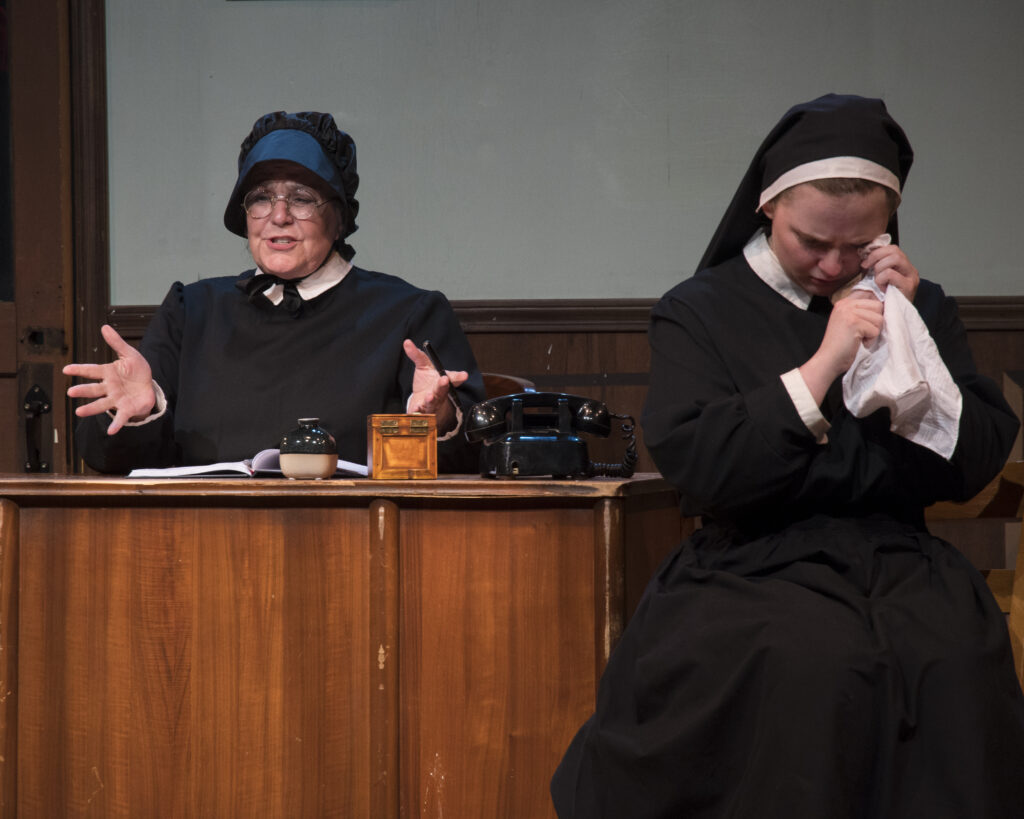
Sister James, sweet-natured, is drawn into her superior’s distrust with her own suspicions, and Rhiannon Creighton superbly reflects the naivete and people-pleasing character of Sister James.

Kate Durbin, Rhiannon Creighton. Photo by Kim Howland

In a fiery performance, Kate Durbin commands every scene she’s in as the embodiment of the typical strict take-charge disciplinarian we recall from our parochial school days. She is laser-focused in portraying the nun’s unbending resolve, and you feel her bristle at every example of what she finds offensive about the priest, who has opposing views to her black-and-white view of human nature. She’s as inflexible confronting modern ways as the priest is open to making the church more accessible.

Jeffrey David Thomas expertly conveys the assertive Father Flynn, making it clear his view of outreach is very different from Sister Aloysius. He projects the vibe of the ‘cool priest’ who thinks sister’s harsh opinions are a detriment to moving the church forward.

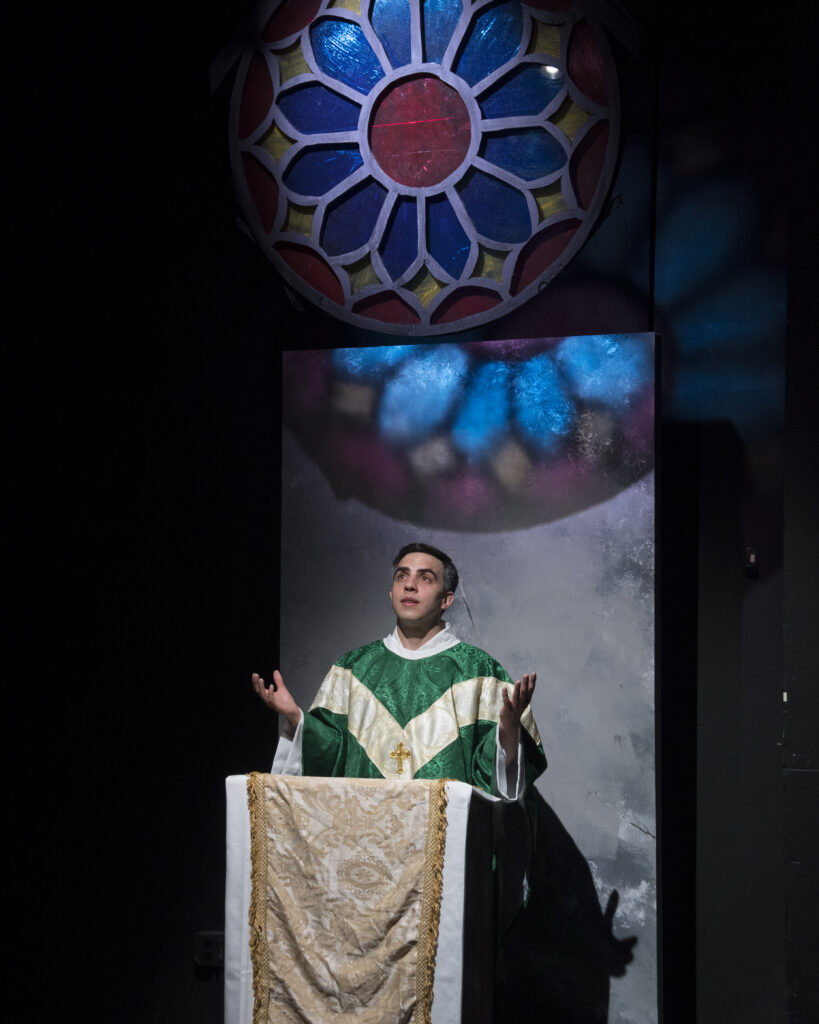
After all, the second Vatican council stressed renewal and unity, opening up participation with the laity and focused on what the pastoral needs of parishioners were. Flynn is convincingly committed to reach his ‘flock,’ and from the pulpit, communicates through sermons that are parables, not so much actual truths.

John Patrick Shanley’s masterful 2004 play, which won the 2005 Pulitzer Prize for Drama and the Tony Award for Best Play, always has made people uncomfortable, as they examine questions of faith, belief, traditions, and human behavior.

Shanley, Oscar winner in 1988 for his original screenplay of “Moonstruck,” has inserted some spot-on humor, particularly when the priest and the two sisters discuss plans for the school Christmas pageant. He wants to add a secular popular song. He also takes – gasp – three lumps of sugar in his tea.

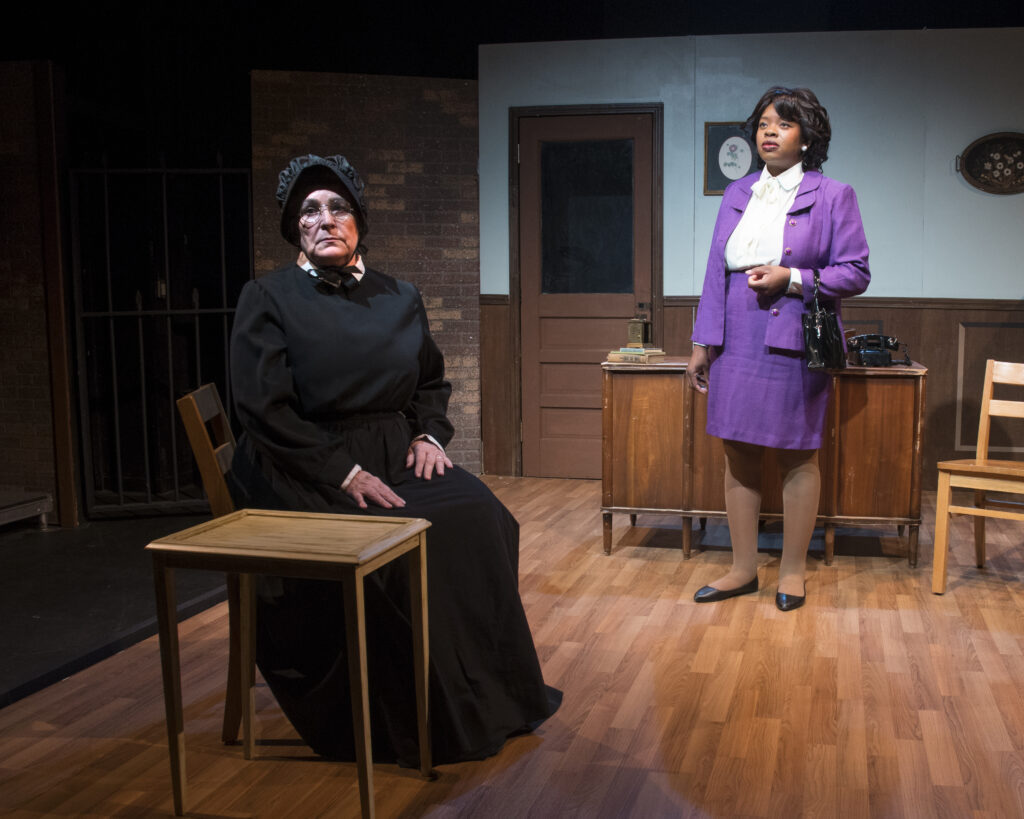
Kate Durbin, Laurell Stevenson. Photo by Kim Howland

Shanley cannily set this explosive story when the U.S. was undergoing political and social changes, which provides another intriguing angle to the layered narrative. In the Catholic Church, Pope John XXIII and Pope Paul VI addressed the needs of modern congregations.

In trying to make the parish more of a welcome guidepost, is Flynn hiding inappropriate behavior? Or is the principal twisting his views as a personal vendetta?

The pupil that is the target of his extra attention is the only black student in the school, Donald Muller, and Laurell Stevenson is riveting as his mother, who attends a meeting arranged by the principal. She knows her son’s challenges, pointing out that she values opportunities over innuendo. Without raising her voice, in her sole scene, she lays down real-world gravitas, and emotionally delivers a raw and honest analysis about her son thriving or failing at school and in life.

This battle of wills between two authority figures is deftly staged by director Trish Brown, who doesn’t waste a precious second in allowing feelings of uncertainty to seep into our collective conscience.

Because of the nuanced performances, tension effectively mounts, and – squirming may occur. It’s not-so-subtly unsettling, and the 85-minute play is presented without intermission. Does sister’s unwavering sense of duty triumph? We are meant to be the jury and the judge, and the debate isn’t always certain, depending on how powerful the production is.

(And it goes without saying, in light of the revelations of sexual abuse cases on a global scale in the Catholic Church in recent decades, we’re looking at this narrative through that rear-view mirror). That’s why the performances are so crucial to match the sharp dialogue.)

The dynamic exchanges between the cast take place in either the sister’s office or an outdoor garden on the grounds and scenic designer Matt Stuckel has admirably transformed the intimate confines of the Kranzberg black box theatre.

Jacob Baxley’s sound design, Tony Anselmo’s lighting design, Sam Hayes’ costume design and Caleb Long’s technical work strengthened the presentation.

This is a polished production that is convincing in its clarity, with memorable performances that will persuade you to continue the conversation.

Father Flynn. Photo by Kim Howland

Prism Theatre Company presents “Doubt: A Parable” April 21-23 and 28-30 at the Kranzberg Black Box Theatre, with Thursday through Saturday at 7 p.m. and Sunday at 2 p.m. It contains adult themes, suggestions of sexual abuse and some racist language that may be offensive to some viewers.

The box office opens 30 minutes before each performance or purchase tickets online at MetroTix by phone (314)534-1111 or at the Fabulous Fox box office.

By Lynn Venhaus

With its jaunty game-show music and kicky retro fashions, Moonstone Theatre Company’s staging of Neil Simon’s “Barefoot in the Park” is a throwback to amiable, innocuous 1960s-era sitcoms.

Only the Wayback Machine hasn’t been kind to Simon’s first major success in 1963, a fluffy lighthearted comedy about a couple with opposite personalities starting married life. They live in a fifth-floor walk-up apartment in Manhattan’s Greenwich Village, which becomes a running gag.

A smash hit that ran four years on Broadway, the breezy trifle was directed by Mike Nichols, garnered four Tony nominations and he won for directing. In 1967, the popular movie adaptation paired Robert Redford, the original Paul on stage, with Jane Fonda as the ditzy Corie, and the sublime Mildred Natwick recreated her scene-stealing timid mother role. The play went on to be a beloved staple of school, community, and dinner theater. It was a go-to during high school speech meets for duet-acting partners back in my day.

But that was then, and this is now.

Sixty years later, it’s flimsy rather than frothy — a period piece that probably wouldn’t make the cut for a 1960s-time capsule if selections were today, despite Simon’s hit-making machine status.

The antiquated attitudes on wives and mothers are hard to surmount – we’ve come a long way, baby. I suppose looking back at the pre-feminism years reinforces how times have changed. But engaging? Not so much.

The dialogue reflecting the time’s societal mores is sometimes cringy. Corie’s widowed mom advises: “Make him feel important. Give up a little of yourself. If you do that, you’ll have a happy and wonderful marriage — like two out of every 10 couples.”

Moonstone has set the show in 1966. The cast tries hard to toss off one-liners with some pizzazz but are hampered by how dated the wisecracks sound.

However, the cast gets the rhythm of Simon’s trademark patter, and the genial performers supply several bright spots because of their commitment to the characters.

Particularly funny are well-known veteran actors Chuck Brinkley, who plays the jovial telephone repairman – back when rotary dial was standard, and a Princess phone was fancy — and Bob Harvey, doing funny physical schtick as a huffing-and-puffing delivery man. Ever reliable, the old pros’ brief bits are amusing.

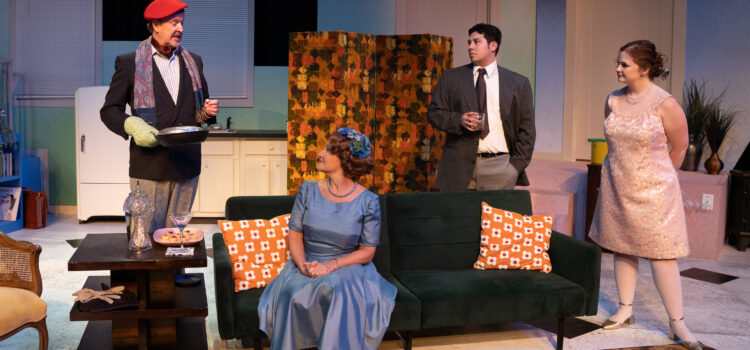
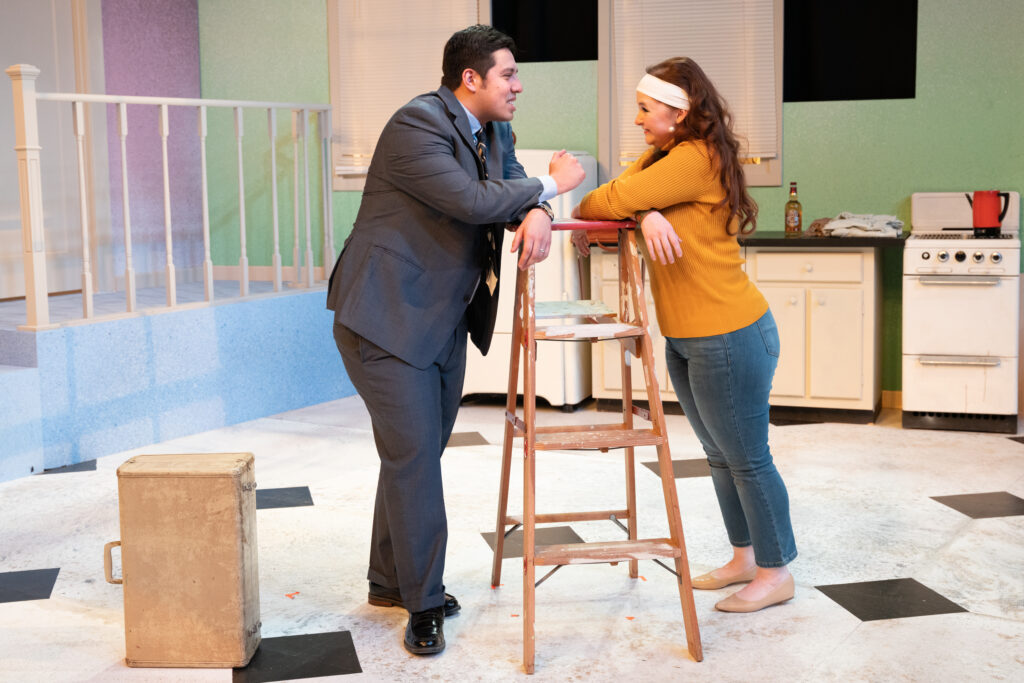
Appealing performers Luis Aguilar and Rhiannon Creighton convey the newlyweds and do what they can to enliven the creaky conversations, but the thinly drawn Mr. and Mrs. Bratter roles have never seemed so bland. They move in after a 6-day honeymoon, and all the character tics appear to aggravate.

This depiction, when the man was the breadwinner and the woman was the happy homemaker, is simply stale.

While cheery and sweet at times, bride Corie does come off as clingy, whiny, and shallow in other moments. Intended as an early image of Simon’s adored first wife Joan, Corie is not as interesting as screwball heroines of days gone by because there’s not much character development. She’s advertised as a ‘free spirit’ but seems tamer in retrospect.

Domestic bliss is threatened because she fears her fuddy-duddy lawyer husband, who is trying to concentrate on his job, will never be spontaneous, like she is. For instance, he wouldn’t walk barefoot in Central Park on a frigid winter day.

Luis Aguilar and Rhiannon Creighton. Photo by Jon Gitchoff

Faring better, although stuck in the tired stereotype of hovering suburban mom, is Jilanne Klaus as widowed Ethel. She’s in her 50s, an empty nester in New Jersey, and dull as dishwater. But she will soften and lighten up. Oh, the agism jokes! Let’s get the retirement home ready!

Corie’s perturbed that mom keeps sending wedding presents almost daily from Lord and Taylor. Oh, the horror.

The hijinks ramp up when Corie fixes up her uptight mother with the nutty neighbor Victor Velasco for a dinner double date. Starting off with exotic gourmet food and braggadocio, the eccentric Hungarian charms the ladies, but Paul immediately dislikes the international man of mystery.

And the night, fueled by assorted alcoholic beverages and dinner in Staten Island (offstage), gets wild and crazy – especially for the stick-in-the-mud mom and husband. But Corie and Victor are kindred spirits.

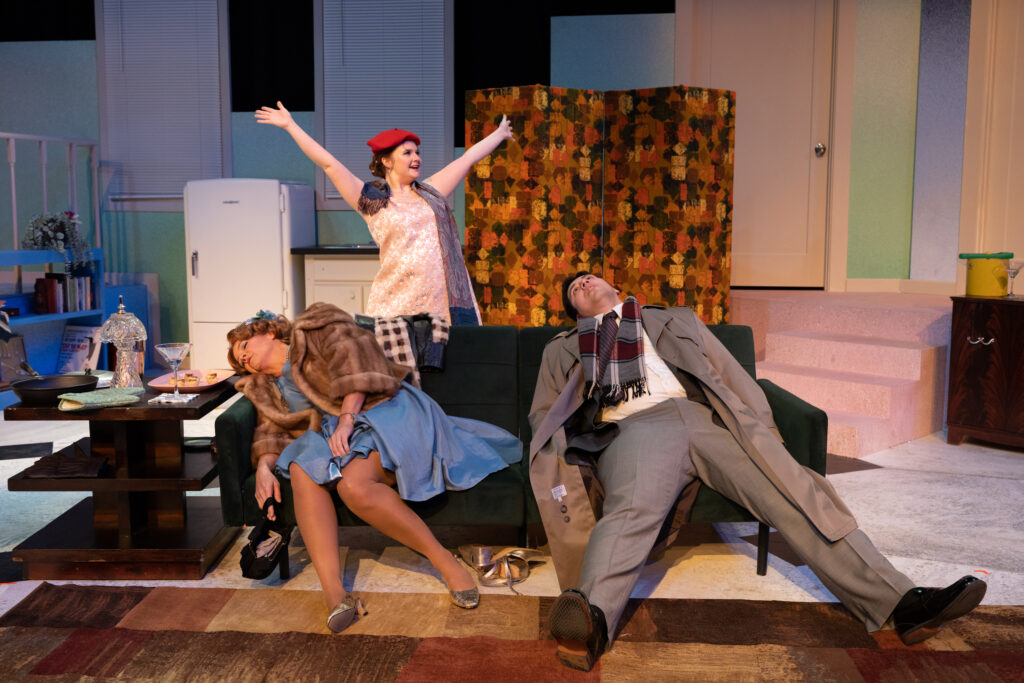
Slapstick-y wackiness ensues, and Aguilar deftly displays a flair for physical comedy. TJ Lancaster wisely decides not to go too over-the-top playing the live-wire lothario who lives in the attic. He and Klaus demonstrate they are smart, instinctual performers whose crisp comic timing and ease on stage is a plus.

Those two gave a master class in recalibrating their moves when the pair, mindful of a hump in the set’s area rug, acted nonplussed and went on with the show, careful where they stepped during Friday night’s third act.

When the inevitable blow-up occurs in act two – because Paul is a “watcher” and Corie is a “doer,” the couple’s bickering becomes tedious while we’re waiting for the happy-ever-after resolution. No suspense there. Although the fact they didn’t realize their differences before wouldn’t seem to bode well for the future (nevertheless, the Simons were married for 20 years until Joan’s death from cancer at age 41).

One of the most commercially successful playwrights of all-time, Simon, who started writing comedy sketches in the pioneering days of early television, made a career out of first world problems – only the world never really intruded into his work until the brilliant Eugene trilogy, starting with “Brighton Beach Memoirs.”

His customary white middle-class struggles were usually connected to relationship clashes, poking fun at human foibles and using self-deprecating humor, which frequently included Jewish characters in urban settings.

So, the pleasant bon mots and jokes on the squalor of a tiny big-city apartment are expected.

Only, the set isn’t so small. While acclaimed scenic designer Dunsi Dai’s work is a perfect palette of pastels reflecting the time, and his skylight is certainly a “Wow,” it’s too spacious for a supposedly cramped one-bedroom apartment. (If you have been in modest New York City apartments, you know, unless you assume they’re all like “Friends.”)

And the setting is not practical for stage movement, for Creighton must scamper quite a bit – it’s a good thing she’s energetic because we watch her take a lot of steps as she crisscrosses for unpacking, decorating and scene requirements. In a modern setting, she’d be killing it on Fitbit. Director Sharon Hunter’s blocking seems clunky because of the larger dimensions.

Patrick Sullivan’s striking lighting design capably illuminates the night sky, and Amanda Werre’s sound design is smooth.

Michele Siler’s costume designs are noteworthy, having ideally captured the period’s everyday apparel for the women, and Emily Fluchel nails the props – the suitcases, kitchen wares and knickknacks.

Despite it being Simon’s longest-running hit, this would be difficult to pull off in any 21st century theater because it feels synthetic. Nevertheless, the performers’ chemistry and nimble line delivery elicit laughs.

Like so many other plays that depend on a mundane premise to begin with, “Barefoot in the Park” is an unusual classic to present because of the shift in male-female dynamics. No amount of rejuvenation can resuscitate it, despite this likable ensemble and their earnest efforts.

Moonstone Theatre Company presents Neil Simon’s comedy “Barefoot in the Park” from Oct. 27 through Nov. 13 at the Kirkwood Performing Arts Center’s black box theatre, 210 E. Monroe Ave. Showtimes are Thursdays through Saturdays at 7:30 p.m. and Sundays at 2 p.m., except there is no show on Friday, Nov. 11, and two shows on Saturday, Nov. 12, at 3 p.m. and 7:30 p.m. For tickets or for more information, visit: www.moonstonetheatrecompany.com.

Jilanne Klaus, Rhiannon Creighton, Luis Aguilar. Photo by Jon Gitchoff

The Tesseract Theatre Company is moving to the Marcelle Theatre with two new plays by local playwrights. The St. Louis premieres of “The Length of a Pop Song” by Taylor Gruenloh and “All That Remains” by JM Chambers will open in July.

“The Length of a Pop Song,” directed by Karen Pierce and featuring the cast of Rhiannon Creighton, Donna Parrone, and Kelvin Urday, will run July 8 – 17.

“All That Remains,” directed by Brittanie Gunn and featuring the cast of Luis Aguilar, Melody Quinn, Morgan Maul-Smith, Nyx Kaine, Sherard Curry, and Victor Mendez will run July 22 – 31.

Performances will be Friday and Saturdays at 8 pm, Sundays at 4 pm.

The Length of a Pop Song by Taylor Gruenloh: Lex has no choice but to move back into her parent’s house after another incident of self-harm. Her mother wants to help prepare her for an upcoming trial against an adult website hosting non-consensual videos of Lex, but Lex can’t find a reason to look forward to tomorrow.

All That Remains by JM Chambers: Gary survives a school shooting and isn’t dealing with the trauma well. Gary’s wife Elaine is trying her best to hold it all together, take care of Gary, work, pay the bills, and deal with her own sadness. Gary and Elaine can’t go on living this way forever and soon they both reach a breaking point.

The Marcelle Theatre is located at: 3310 SAMUEL SHEPARD DRIVE, SAINT LOUIS, MISSOURI 63103

Tickets are available for both plays at MetroTix.com. $20 for general audience and $15 for students.

Questions can be sent to Tesseract Theatre at [email protected]