
By Alex McPherson

Director Jane Schoenbrun’s surrealist meta–slasher-satire-character-study “Teenage Sex and Death at Camp Miasma” is ambitious and wholly unique, even if occasionally muddled by the weight of its dense ideas.

We follow Kris Williams (Hannah Einbinder), an academic queer filmmaker hired by a big studio to direct a reboot of the “Camp Miasma” slasher-film franchise. The series has, over the years, become reduced to bargain-bin sequels and cultural irrelevance, beautifully visualized in a nostalgic, acerbic opening title sequence.

The villain, “Little Death,” wears an HVAC air vent on their head and carries a spear, skewering any poor soul who dares to stay at the titular camp.

Kris has always felt a special attachment to the series (“special attachment” is an understatement, as we later find out). She wants to make the original’s “Final Girl” Billy Presley (Gillian Anderson) the main character of this new outing. Studio reps and her agent (played by Sarah Sherman) aren’t thrilled, and are more interested in Kris sanitizing and “de-cancelling” the franchise’s transphobic core for a modern audience. 
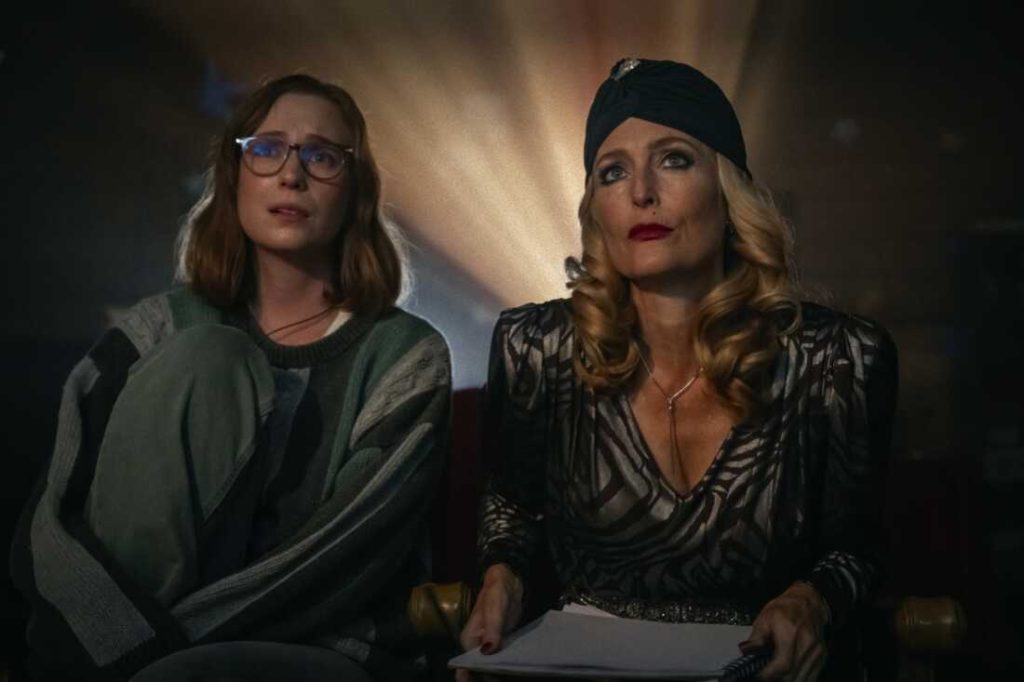
Hannah Einbinder and Gillian Anderson.

Billy retired from acting after the original film was released, but Kris sees an opportunity to capture that initial spark. It’s all the better, and weirder, that Billy now resides at a remote lakeside cabin in the Pacific Northwest at Camp Rivoli, the abandoned campground where the first “Miasma” was filmed.

Things are strange from the get-go, with Kris barely being able to find Camp Rivoli and wandering into a local cinema. A projector flickers to life and Kris watches the scene where young Billy (Amanda Fix) loses her virginity before being stabbed by Little Death — the sequence that stuck with Kris the most, even if she can’t quite identify why it has that effect on her. 

She then meets present-day Billy, who resembles Norma Desmond from “Sunset Boulevard” with a southern twang, seductive aura, and love of weed. The two quickly bond over a basket of KFC chicken tenders and grow closer from there.

They both deconstruct their attachment to the “Miasma” franchise and find new avenues to explore — namely, further unlocking desire, pleasure, and good ‘ole cinephilia amid the blood-drenched fantasy of Little Death.
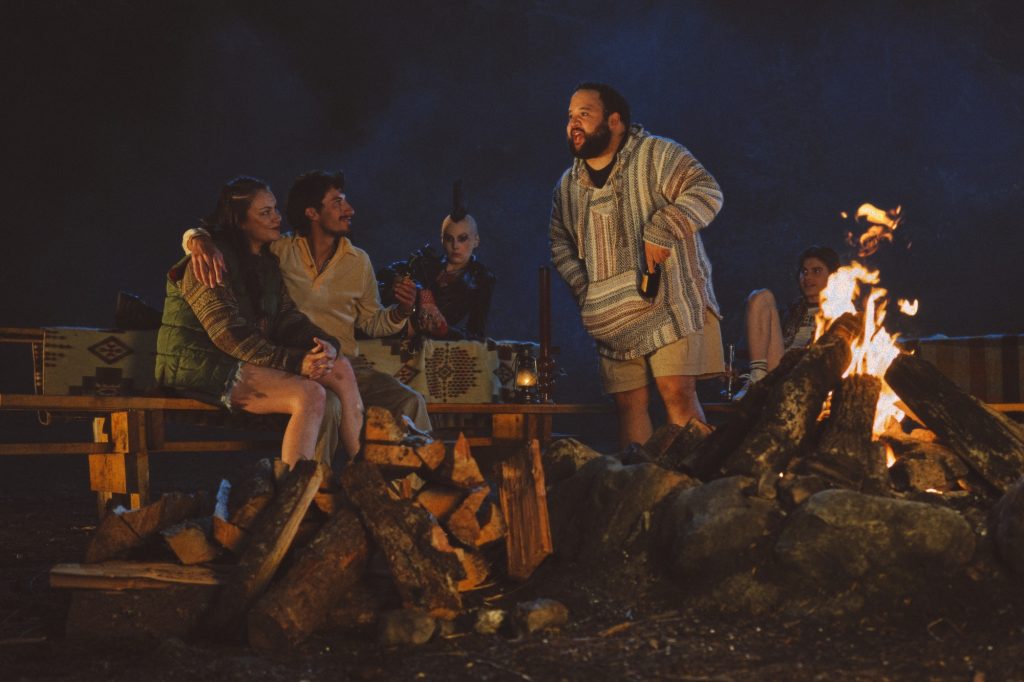
“Teenage Sex and Death at Camp Miasma” is, like Schoenbrun’s previous “I Saw the TV Glow,” not for all tastes, so obviously personal that it threatens to leave behind viewers who aren’t willing to go along with its swerving rhythms. 

Indeed, Schoenbrun’s latest project has a ton on its mind, from critiquing the slasher genre and the injustices of studio moviemaking to, most successfully, examining the powerful influence that films can have over our sense of self. There’s too much going on at any given point, but it’s a compulsively watchable mess that ultimately couldn’t be any other way.

Much of “Camp Miasma” rests on the shoulders of Einbinder and Anderson, and they’re both fully up to the task. Einbinder is the standout — able to show Kris’s evolution from high-strung, awkward, nerdy intellectual to someone gradually breaking through their shell to embrace their true desires. 

It’s a tough tightrope to walk, and it’s to Einbinder’s credit that Kris never becomes unlikable, just restrained by societal expectations and unsure of what they truly want in life; there’s also a deep connection to Billy and Little Death that defies traditional reason.
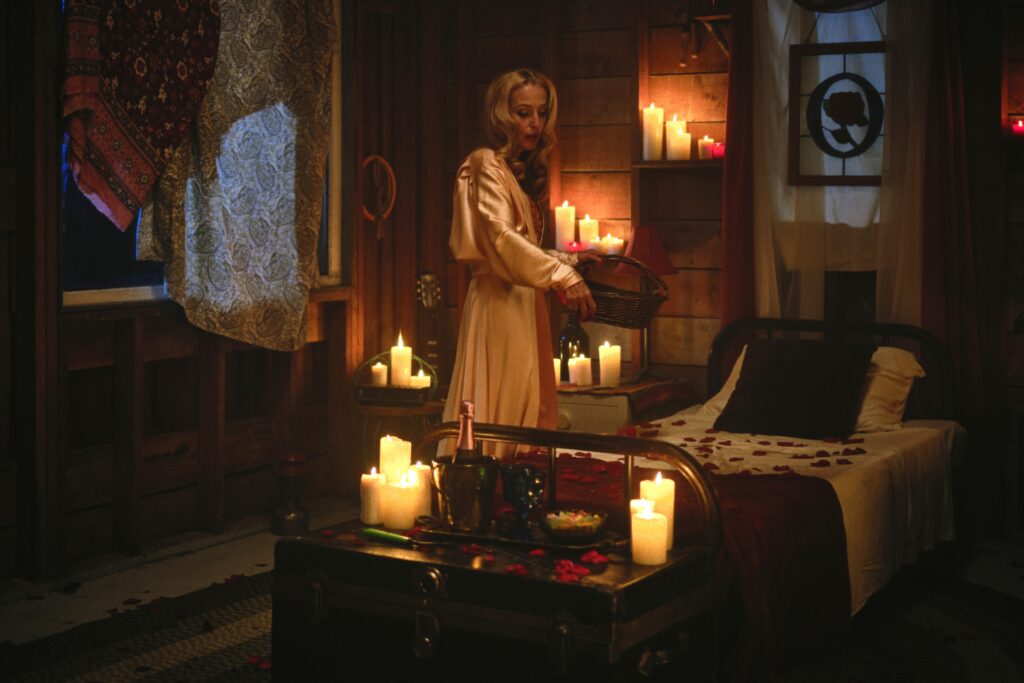
Einbinder is able to flex her comedic chops from time to time, but Schoenbrun’s screenplay treats her character arc seriously, maintaining a mostly successful throughline that continues Schoenbrun’s interest in the complex ways that media can shape us.

Einbinder and Anderson’s chemistry sizzles, and Anderson nails the balance between campiness and sincerity. Billy supports Kris from the jump, but she believes that Kris misunderstands the core of the “Miasma” series and its carnal appeals, which are more base but no less impactful.

Schoenbrun’s direction is, yet again, outstanding, making Camp Rivoli a setting out-of-time and existing in a liminal space between reality and fantasy, complete with dazzling matte paintings and an almost fairy-tale aesthetic. 

Much of the film is spent watching the film-within-the-film (with an ensemble including Eva Victor and Zach Cherry), similar to “TV Glow,” which Schoenbrun recreates with strong attention to period detail. They lean into the cheesiness inherent in its “Friday the 13th” and “Sleepaway Camp” influences while painting Little Death as exacting a sort of justified vengeance.

One ultraviolent sequence in particular, set to a melancholic country song, is cartoonishly gruesome and, perhaps counterintuitively, meditative.

There’s a certain point in Schoenbrun’s film, though, especially when the lines between fantasy and reality are blurred, that it becomes overwhelming and overstuffed. It loses some of its charm to the exhausting throes of self-indulgence. 

At these points, along with some perhaps overly broad commentary on the state of the movie industry, it seems like Schoenbrun throws everything at the wall to see what sticks (literally, in some cases). They sacrifice coherence for pure “feeling” — not inherently a problem, but alienating as new elements keep getting introduced that clumsily fit into the unruly tapestry Schoenbrun has been building.

So, while not as poignant as “TV Glow,” “Teenage Sex and Death at Camp Miasma” is still entirely like nothing else, another example of experimental filmmaking that deserves support whether or not its wild swings fully connect.

“Teenage Sex and Death at Camp Miasma” is a 2026 horror film directed by Jane Schoenbrun that stars Gillian Anderson, Hannah Einbinder, Eva Victor, Zach Cherry, Amanda Fix, and Sarah Sherman. It is rated R for bloody violence, gore, sexual content, graphic nudity, drug use and some language, and the run time is 1 hour, 52 minutes. It opened in local theatres Aug. 21. Alex’s Grade: B+
By Alex McPherson

Breezy, funny, and insubstantial, director Nicole Holofcener’s “You Hurt My Feelings” provides its ensemble ample room to flex their comedic chops, but remains emotionally limited by a low-stakes narrative aiming for profundity and arriving at something less than revelatory. 

Set within our dying planet in the bustling metropolis hellscape of New York City, “You Hurt My Feelings” revolves around Beth (Julia Louis-Dreyfus), a middle-aged author and teacher at The New School, who, all things considered, lives a pretty-damn-privileged existence. She has a new novel coming out — two years in the making — that she’s having trouble getting off the ground due to an unenthusiastic agent. It’s the follow-up to her moderately successful memoir that spotlighted her father’s verbal abuse, which instilled a huge layer of insecurity. 

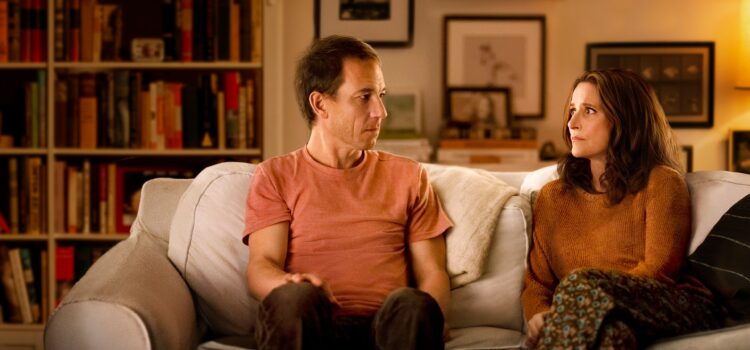
She’s sarcastic and judgy, but enjoys a happy marriage with her husband, Don (Tobias Menzies), a somewhat burnt-out therapist whose clients — played by real-life spouses Amber Tamblyn and David Cross, plus Zach Cherry in peak straight-faced hilarity — are becoming increasingly fed up with his lack of engagement and “results.”

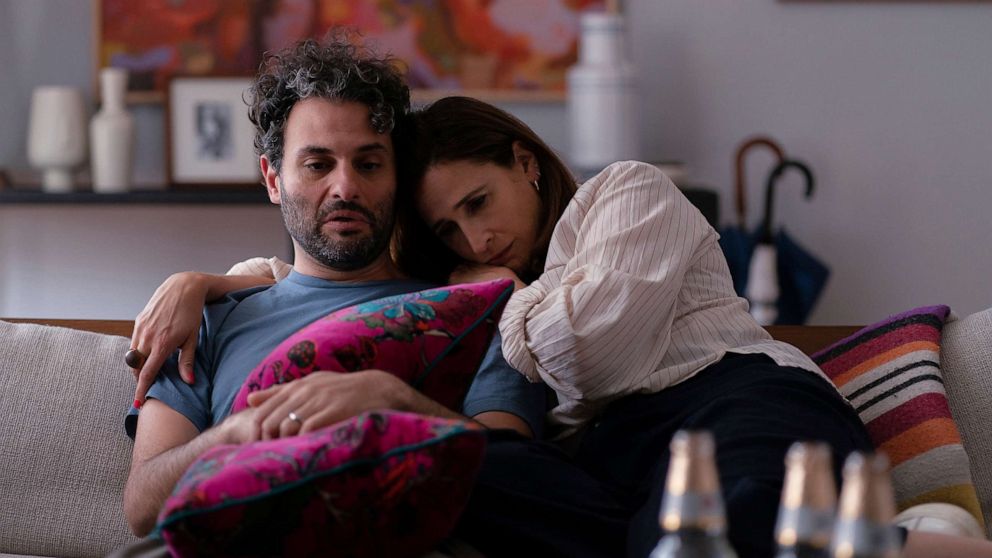
Their 20-something son Eliot (Owen Teague) is an aspiring playwright working at a weed dispensary, frequently annoyed that he feels like a third wheel around his parents. Beth’s sister, Sarah (Michaela Watkins), is a jaded interior designer with a sardonic wit. Her brother-in-law, Mark (Arian Moayed), is an actor with dreams of fame and fortune struggling to secure roles beyond a small part in a “pumpkin movie.”

Arian Moayed and Michaela Watkins

Suffice to say, everyone in this little circle is self-doubting, seeking validation and reassurance from those close to them. Our heroine, Beth, is particularly vulnerable. When she and Sarah overhear Don disclosing to Mark that he doesn’t like her newest novel and can’t stand reading draft after draft of it, Beth spirals — putting her marriage at risk as she grapples with this bombshell revelation.

Over the course of a 93-minute runtime, Beth gains greater understanding of how the “little white lies” we tell each other aren’t always that bad, along with how (shocker) we shouldn’t let our work or other’s reactions to our work define us and our well-being.

With Louis-Dreyfus inhabiting her character with an anxious, believable energy, “You Hurt My Feelings” remains an appealing watch, as Beth and company navigate rocky waters of communication and come to realizations that gently inform their existences going forward. This reflects life, in a sense, as some people change and some don’t, but the film still lacks heft. By the end, it takes a surprisingly light touch to its flawed characters, saying little of significance in the process.

That’s not to say the experience of watching “You Hurt My Feelings” isn’t enjoyable, though. Holofcener’s dialogue crackles with snarky wit, as Beth bumbles her way around NYC – casually critiquing plenty of people along the way, sometimes in offensive fashion. Beth herself, whether she realizes it or not, strategically deploys truths and little white lies in her day-to-day life — whether it’s half-heartedly volunteering at a church clothing giveaway to feel like a “good person,” to feigning interest in her students’ off-putting story ideas. 

Louis-Dreyfus sells Beth’s outwardly bubbly nature and conceitedness, friendliness belying a lack of self love and belief in her own abilities as a creative. Her mother, Georgia (the always excellent Jeannie Berlin), perpetuates Beth’s anxieties through humorous passive-aggressiveness.

Beth trusts Don more than anyone else, however, so his seeming “betrayal” hits her like a wrecking ball, which Louis Dreyfus neither undersells nor overplays; if anything, the film would have benefited from a more cartoonish expression of her panic. As it stands, it’s difficult to connect with her concerns: they’re monumental to her, but as outside observers, they seem trivial, and Holofcener never dives deeply into her background or creative drive to establish real pathos for her plight. 

She loves Don and Don loves her. Of course Don wants to be a supportive husband, of course he wouldn’t tell her his true feelings about her writing (which we’re never led as viewers to believe is actually praiseworthy), as he recognizes that his opinions are ultimately irrelevant: he’ll support her no matter what. This is evident from the outset, and, with some late-movie platitudes lacking nuance delivered by Teague (doing the most with a clichéd character), renders the core conflict of “You Hurt My Feelings” fairly shallow and predictable.

Aside from Beth’s unwarranted stressors, “You Hurt My Feelings” explores other facets of this idea, as people in her social bubble navigate similar waters of honesty and dishonesty, truth and lies, in their personal and professional bonds. Don, stressed about aging and exhausted from a string of demanding clients while putting on a brave face (which Menzies embodies with subtly-calibrated mannerisms), avoids admitting to his cataclysmic falsehood. This doesn’t pan out well, but guess what? Communication is key, as usual.

Sarah encounters her own challenges — her whole job involves appeasing finicky clients with artwork to adorn their homes, smiling and gritting her teeth, with plenty of unused insults at the ready under her breath. Mark struggles to find meaning and work as an actor, while Sarah stands behind him through thick and thin, notwithstanding she doesn’t think he’s all that good all the time.

Boosted by Holofcener’s zinger-filled screenplay and patient editing that zeroes in on expressions and awkward pauses, “You Hurt My Feelings” depicts these situations with a crowd-pleasing touch, but that doesn’t excuse that they aren’t all that compelling to watch in the first place. Indeed, the film’s muted style and inherent softness misses opportunities to critique its characters on a more foundational level, not fully selling their problems nor Beth’s gradual gaining of self-awareness. It’s not all that dramatic, or relatable, as we (im)patiently wait for the characters to catch up with reality.

Perhaps I’m the wrong demographic for this story, and perhaps the film’s lack of spectacle is the point, but it remains slight, less a meaningful story than a batch of gently amusing scenarios in service of relatable yet obvious messaging.

Julia Louis-Dreyfus

“You Hurt My Feelings” is a 2023 comedy-drama written and directed by Nicole Holofcener and starring Julia Louis-Dreyfus, Tobias Menzies, Owen Teague, Michaela Watkins, Arian Moayed, David Cross, Amber Tamblyn, Zach Cherry and Jeannie Berlin. It is rated R for language and runtime is 1 hour and 33 minutes. It opened in theaters May 26. Alex’s Grade: B-.