
By Alex McPherson

Representing less a defiant step forward into a new era of the DC Cinematic Universe than a retread of the by-the-books superhero fare of the past decade, director Craig Gillespie’s “Supergirl” flies along well enough but shoots out of memory soon afterwards.

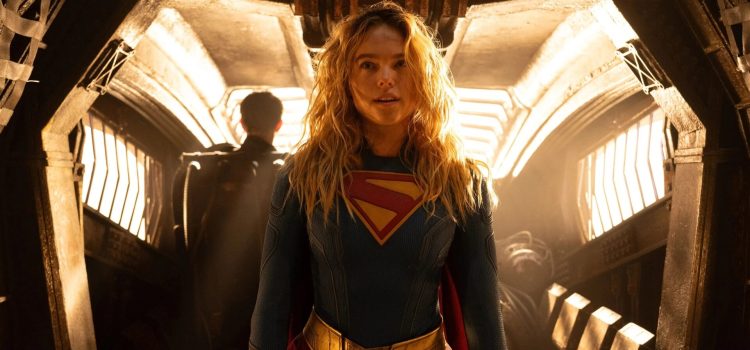
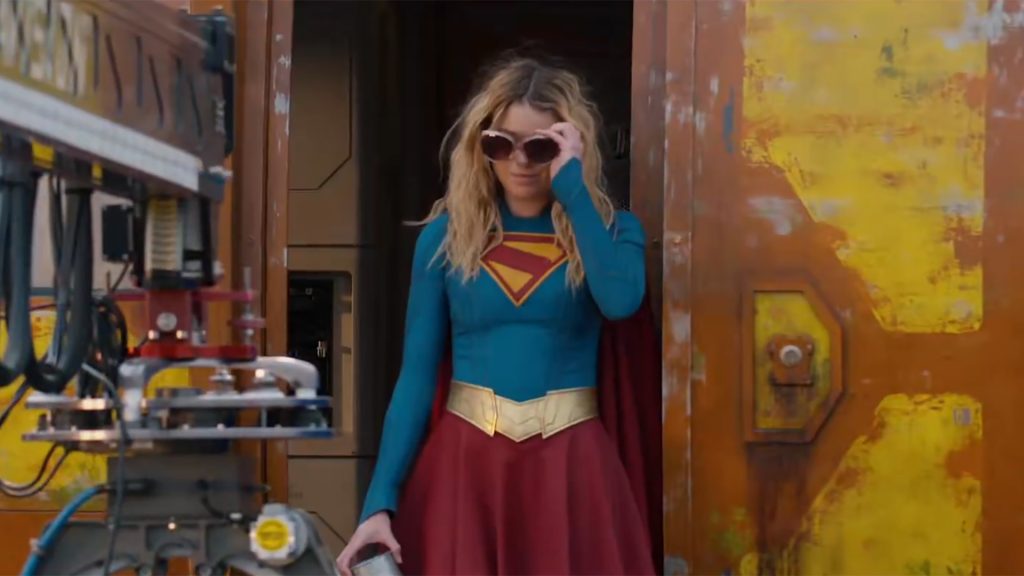
We first meet Kara Zor-El a.k.a. Supergirl (Milly Alcock) as she boozily zips from planet to wacky planet in celebration of her 23rd birthday. With the lovably destructive CGI dog Krypto in tow, Kara has a laissez-faire attitude toward life, clearly preferring to party than confront the trauma of her tragic backstory. She also avoids Earth at all costs — much to the frustration of Superman (David Corenswet), who’s increasingly worried she won’t ever “find her people.” 

Things take a turn for the explosive when Kara encounters Ruthye (Eve Ridley), a young woman seeking revenge after her family was murdered by Brigand leader Krem of the Yellow Hills (Matthias Schoenaerts). Kara saves Rutheye from a squelchy brute straight out of the “Star Wars” Mos Eisley Cantina, but refuses to help her track down the bloodthirsty trafficker.

Krem has other plans, though, when he hijacks Kara’s ship and shoots poor Krypto with a poisonous dart that gives the pup only three days to live. This motivates Kara to track him down to retrieve the antidote, and reluctantly take on Ruthye as her novice (but underestimated) sidekick. 

Kara is greeted by Superman when she comes to Earth with her puppy Krypto.

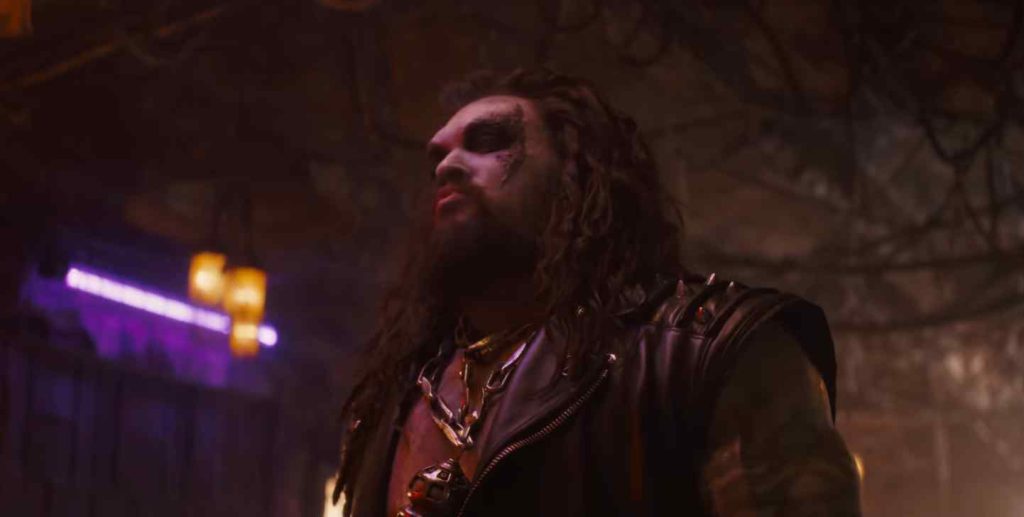
As the pair rush to track down Krem, they develop a friendship (wow!), each teaching the other about the power of community and reckoning with grief. They deal with bouts of punchtastic action and formulaic villainy along the way. Plus, an unhinged, motorcycle-riding Jason Momoa appears as the intergalactic bounty hunter Lobo!

If one expects  “Supergirl” to break the mold of what’s come before, get ready for disappointment. Gillespie’s film starts out strongly enough, decidedly wackier and more committed to showing a colorful galaxy than other recent outings, as well as establishing Alcock as a perfect fit for the role of Kara. 

Alcock’s dry comedic timing is spot-on, with Ana Nogueira’s screenplay leaning into her cynicism and dry wit in a way that never becomes tiresome, building a character far less “polished” than Corenswet’s Superman, and one that’s all the more enjoyable to watch for it. 

Sadly, before long, the film slides back into the template we’ve seen time and time again, awkwardly sandwiching humor between “sobering” backstory that’s clunkily assembled and largely bereft of earned poignancy.

Milly Alcock and Eve Ridley.

Gillespie ultimately trades the energetic personality of the opening for something far drearier and, crucially, blander, as the PG-13, green-screened violence kicks into high gear and we realize that, no, none of the heroes are truly in danger amid the swirl of crowd-pleasing clichés. 

Kara and Ruthye’s bond is believable, to an extent. Kara’s bond with Ruthye and seeing her hunger for revenge leads her to reflect on her own  past, gradually understanding herself and her deep-seated anger at the world as she eventually transforms into the “Supergirl” that she’s destined to become.

This is a passable arc — it’s just that Gillespie’s storytelling lets Kara down, awkwardly jumping into flashbacks that are rushed through without letting us sit and feel the sadness and disorientation that Kara experiences. Gillespie and Nogueira opt for a barebones outline instead of fleshing out her past in more detail, perhaps assuming that viewers already get the gist from the comics.

Jason Momoa as Lobo.

Fortunately, “Supergirl” moves along at a brisk enough clip. We’ve got the monstrous, albeit extremely one-note baddie Krem, the goofily out-there Lobo (Momoa understands the assignment), and plenty of quip-filled set-pieces complete with peppy needle drops. 

It’s just that, with such an excellent actor as Alcock in the starring role, doesn’t she deserve something more substantial to work with from a narrative standpoint? She’s even let down from an action perspective.

Matthew Schoenaerts as Krem.

Rob Hardy’s cinematography is often eye-catching and keeps the fighting coherent, but these sequences are unwilling to fully let Kara off the chain, too often kneecapping her powers just when she starts using them. They fall into a frustrating stop-start pattern that persists all the way through the final battle.

“Supergirl” is still an entertaining enough watch despite its numerous issues — the template is functional, after all, although the pointed social commentary of James Gunn’s “Superman” is definitely missed here.

There’s nothing offensively off-putting about Kara’s debut. It’s just an affirmation that, at their core, these films might never truly change.

“Supergirl” is a 2026 sci-fi action-adventure directed by Craig Gillespie and starring Milly Alcock, Matthias Schoenaerts, Eve Ridley, David Corenswet, Jason Momoa, Emily Beecham and David Krumholtz. It’s runtime is 1 hour, 47 minutes, and is rated PG-13 for sequences of strong violence, action, language, and smoking. It opens in theatres June 26. Alex’s Grade: C+

By Alex McPherson

Bringing together remarkable talent for an underbaked summer spectacle that trades nuance for naiveté, director Steven Spielberg’s “Disclosure Day” is neither compelling enough as popcorn entertainment nor fully invested in its existential ideas.

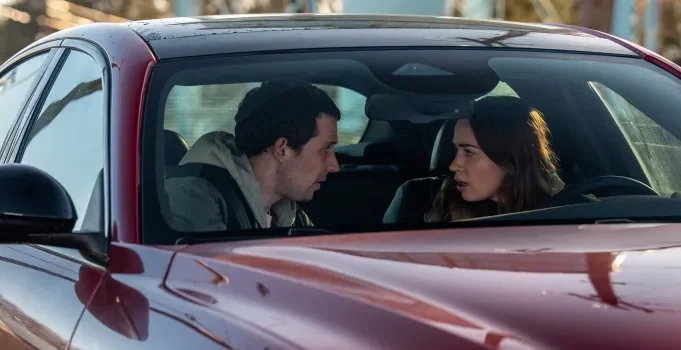
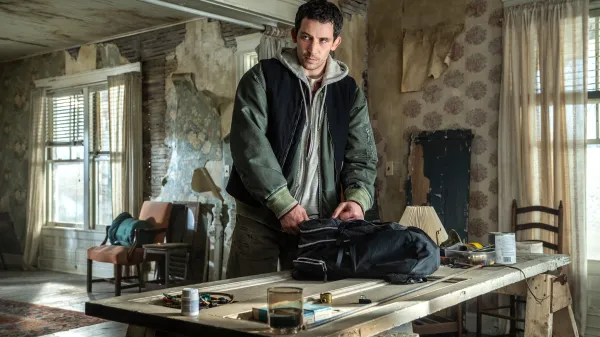
We’re thrown into the story in media res, as rogue cybersecurity specialist Dr. David Kellner (Josh O’Connor) is on the run with a backpack containing evidence of human-alien contact dating back to the Roswell Incident.

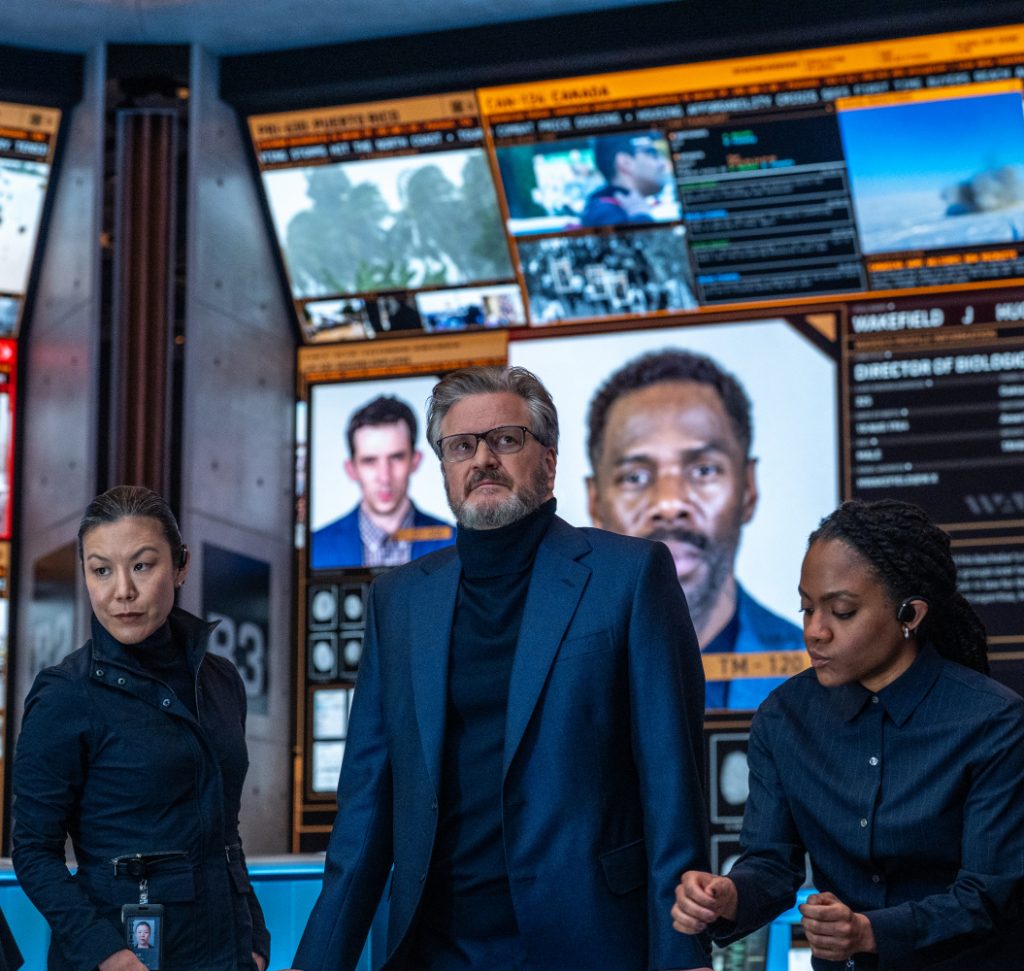
The Wardex Corporation, an arm of the US government led by the stiff-jawed Noah Scanlon (Colin Firth), desperately wants to keep the files hidden from the public.

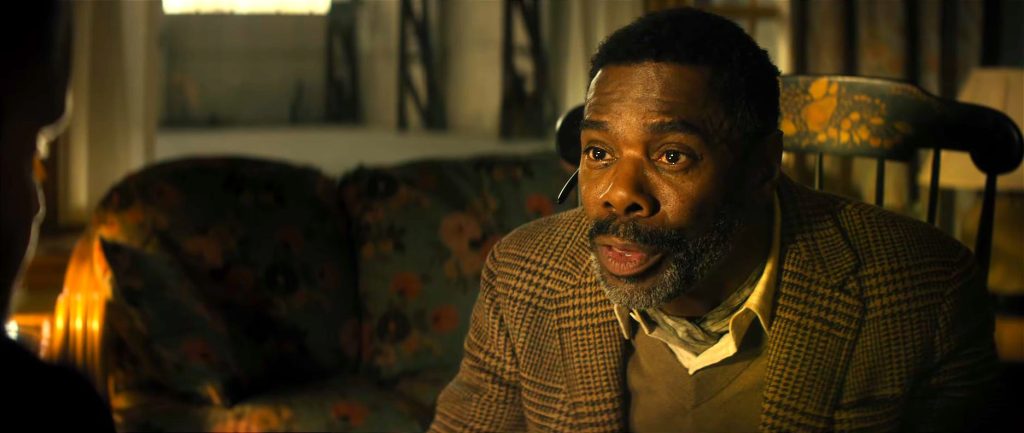
David, guided by the Morpheus-esque Hugo Wakefield (Colman Domingo), is determined for the world to know the truth, regardless of the ramifications — although society already seems on the brink of World War III due to some vague geopolitical conflict involving Russia and North Korea.

Josh O’Connor as a rogue cybertech expert.

David is accompanied by his girlfriend Jane Blankenship (Eve Hewson), who used to be a nun and is grappling with the potential consequences of what this alien “disclosure” would do for the devout’s belief in God.

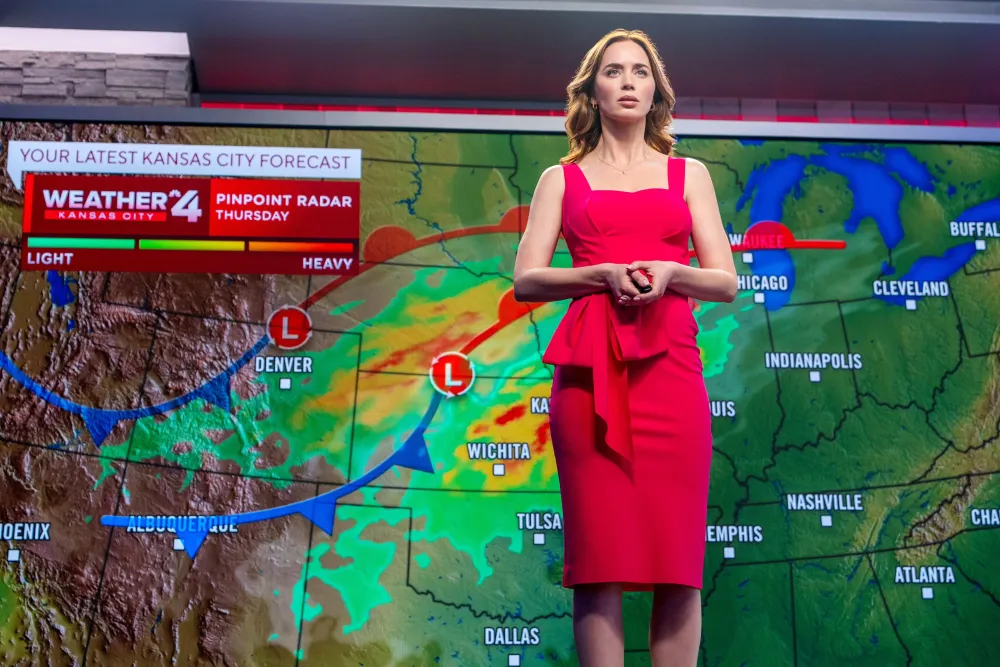
Meanwhile, Kansas City television meteorologist Margaret Fairchild (Emily Blunt) is preparing for work one day when a cardinal flies into the apartment she shares with her exhausted and passive-aggressive boyfriend Jackson (Wyatt Russell). After the bird leaves, Margaret seemingly has psychic abilities; she’s able to read minds and understand the emotions of anyone she comes across. 

She’s also able to speak any language, including a bizarre click-clacking extraterrestrial tongue that she deploys during the day’s broadcast. This catches the attention of Wardex, and, soon enough, Margaret is being pursued by them. She eventually crosses paths with David, who she learns she shares a world-altering connection with.

Can they get to safety and reveal the truth before Noah’s goons lock them up and forever relegate the files  to the realm of conspiracy theories?

Emily Blunt as KC weathercaster.

It’s an admittedly decent premise, especially considering the people involved. Spielberg directing, John Williams scoring, Janusz Kamiński lensing, O’Connor, Blunt, Firth, and Domingo among the cast — what’s not to like?

As it turns out, fundamental storytelling issues bring “Disclosure Day” down to size, abandoning the thorniness of “Close Encounters of the Third Kind” or even the lesser emotional pull of “The Fabelmans” for something decidedly messier and devoid of much novel to say.

It’s never less than watchable, but with Spielberg at the helm, shouldn’t we expect more than a boomeristic call for unity that forgets to give its characters much depth?

Five-time Spielberg collaborator David Koepp’s screenplay is wildly uneven, oscillating between broad, crowd-pleasing humor, bursts of cynicism, and blatant sentimentality that never coheres into a truly satisfying identity of its own.

Colin Firth (center, standing) in DISCLOSURE DAY, directed by Steven Spielberg.

To its credit, “Disclosure Day” is an ambitious film, exploring religion, childhood trauma, empathy, government surveillance, journalistic integrity, and extraterrestrial life, Spielberg’s favorite, just without digging into any topic with much detail. 

Characters pay lip service to ideas in exposition-heavy sequences where debates sometimes feel like each person is arguing with themselves, stumbling into revelations without the story unfolding organically.

And we don’t actually know that much about these people to begin with, especially David, as Spielberg drops us into the fray mid-chase and expects us to forge a bond on the fly as bits of backstory are periodically spelled out for us.

Margaret fares marginally better, mostly thanks to an excellent Blunt performance that walks an entertaining tightrope between comedy and drama as her character grapples with the fear and eventual determination stemming from her newfound powers.

Blunt has great comedic timing that makes her endearing regardless of the character’s blandness, as does O’Connor, who proves himself to be a capable Spielberg everyman who can shoulder action sequences effectively. Firth, given even less to work with from a narrative depth standpoint, chews scenery as the villainous Noah.

It might sound like “Disclosure Day” is a near-total misfire, but, on a pure, in-the-moment level, there’s too much impressive craft on display to ignore. Kamiński works overtime framing elaborate (perhaps overly elaborate) long takes and action sequences that are thrilling and full of slapstick carnage.

Williams’ score provides a fitting backdrop to this paranoid thriller, sans much separating itself from the master’s previous works. And Spielberg does take some wild swings here, complete with mind control and some questionably-animated CGI animals, that are unconventional, even if their cumulative effect is more goofy than profound. 

Colman Domingo helping lead the pro-alien faction.

Spielberg has a clear message to share — of how the spontaneous and unexpected can bring us together, and how, as a species, we need to learn to gradually bridge divides and “listen” to each other. “Disclosure Day” speaks to the current moment in 2026, albeit remaining old-fashioned in the ways it delivers its pleas, but it becomes difficult to take seriously amid its loopy, fragmented plotting.

It’s still mildly diverting if one can let the 145-minute runtime wash over them and not expect to have much “disclosed” that prompts more than smirks and eyerolls.

“Disclosure Day” is a 2026 supernatural sci-fi thriller directed by Steven Spielberg and starring Josh O’Connor, Emily Blunt, Colin Firth, Colman Domingo, Eve Hewson and Wyatt Russell. It is rated PG-13 for action/violence, some bloody images and strong language and the runtime is 2 hours, 25 minutes. It opens in theatres June 12. Alex’s Grade: B-

By Alex McPherson

A masterpiece of experiential filmmaking that mines palm-sweating anticipation from what’s lurking around the next corner, director Kane Parsons’ “Backrooms” is an ambiguous yet utterly engrossing horror film for those willing to tune into its otherworldly frequency.

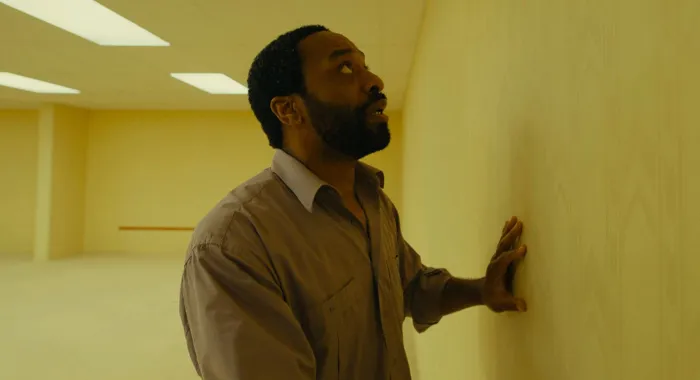
The film is based on 20-year-old Parsons’ YouTube series of the same name, which was inspired by the online liminal space “creepypasta” post on 4Chan from 2019. This newest iteration takes place in 1990 and focuses on Clark (Chiwetel Ejiofor), a failed-architect-turned-furniture-store-owner and alcoholic struggling after a recent divorce.

His ex-wife got the house, so Clark has taken up residence at the store. He’s seemingly resigned to a sad life running a defunct business and making embarrassing TV commercials where he’s dressed up like a pirate. 

He regularly has sessions with his therapist and self-help-book-author Mary (Renate Reinsve), who encourages Clark to reflect on his actions and break obsessive thought patterns. Mary is also a lonely soul who’s processing her own grief from a troubled childhood. She often zones out as haunted memories come flooding back.

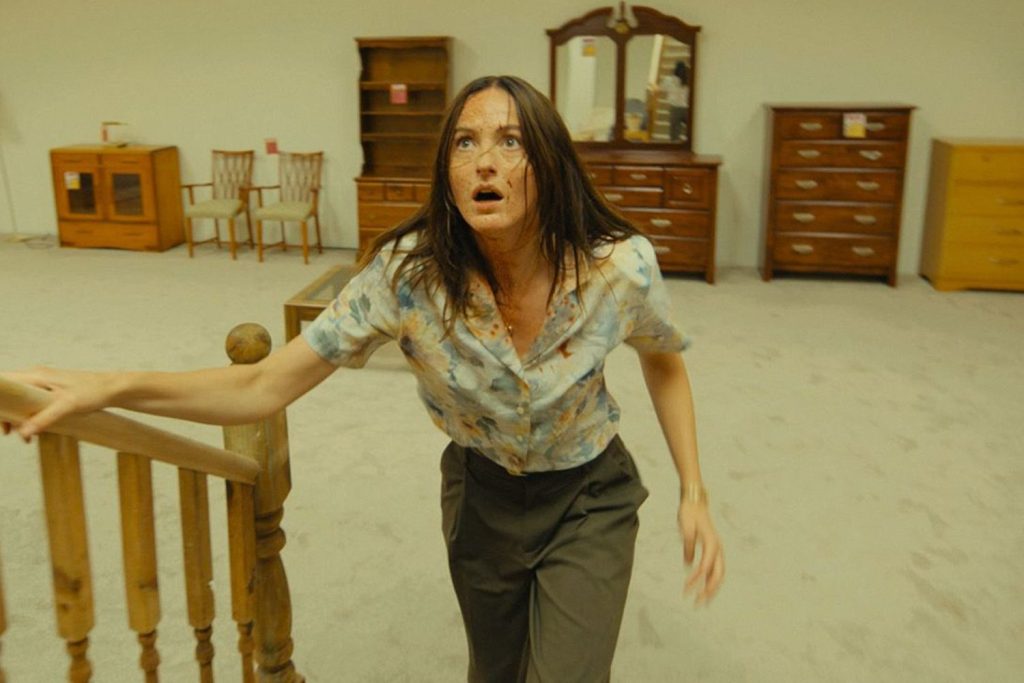
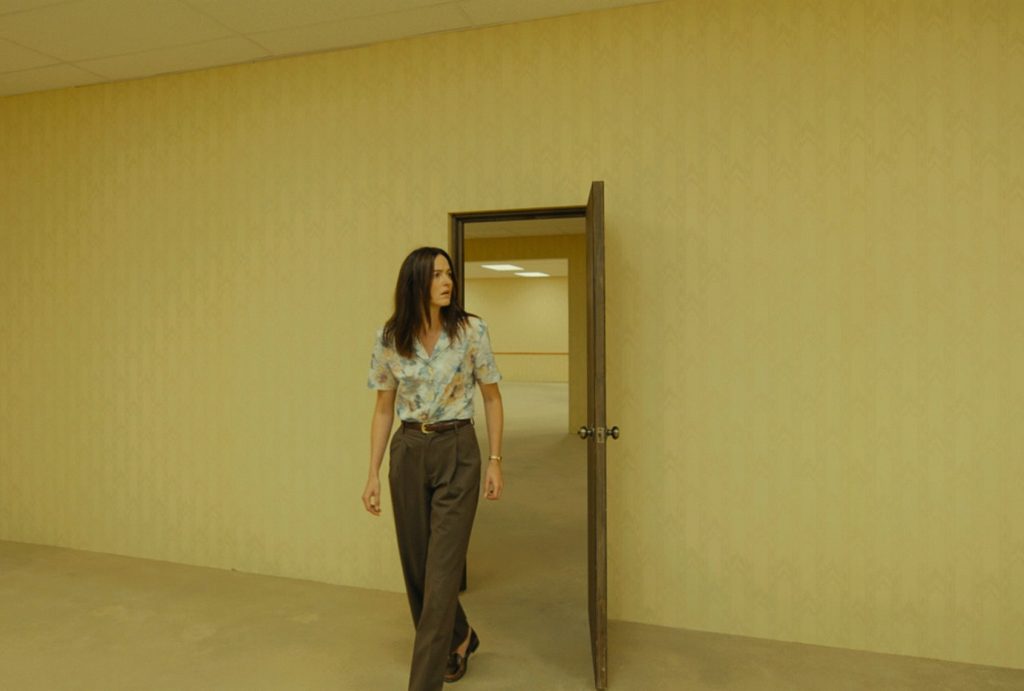
Clark notices some strange electrical issues at the store, which eventually leads him to the basement where he finds a hidden entrance to the titular Backrooms — an alternate dimension residing in the uncomfortably uncanny valley. 

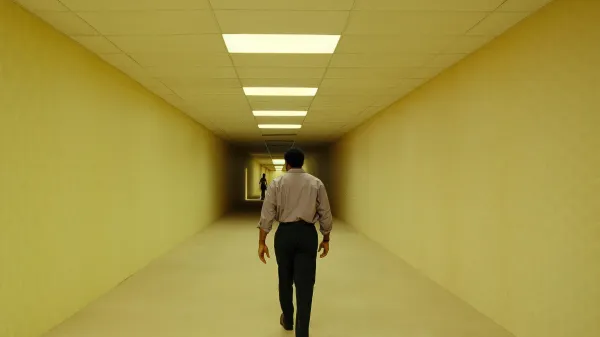
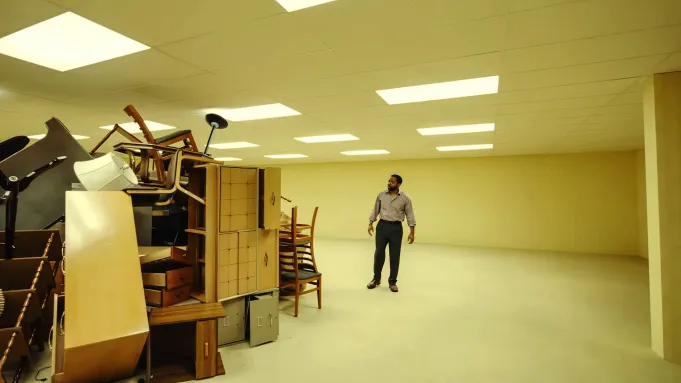
Claustrophobic, labyrinthine hallways and office spaces stretch on endlessly, enclosed by walls painted sickly yellow, lit with fluorescent lights, and littered with jumbled piles of furniture like some twisted contemporary art exhibit made by glitched-out AI software. A strange presence also stalks the premises that clearly doesn’t take kindly to visitors. 

Clark, and by extension us as viewers, are immediately thrown off kilter, but Clark becomes fascinated with this alternate universe and makes it his goal to unearth its mysteries.

Suffice it to say, dangers abound. Clark (and eventually Mary) find themselves way over their heads, becoming trapped in a place that can easily lead its inhabitants into spirals of insanity.

It might not have the most elegantly told story, but “Backrooms” is a relentlessly disorienting film, rich in oppressive atmosphere and dark absurdity, that prides itself on putting viewers in the shoes of its characters and letting the nightmarish world speak for itself.

Familiarity with Parsons’ web series isn’t needed to appreciate this film — above all else, “Backrooms” is a vibe, so stylistically assured that it conjures a universal, intoxicating sense of uneasiness.

Through a mixture of “found footage” camerawork and shots that keep us in lockstep with the characters, Parsons lets us feel the winding unknown and the relentless pressure of being chased through an unfamiliar environment without a clear exit. Although the camera generally adopts an omniscient viewpoint, we don’t jump ahead of the characters; we witness each new sight along with them.

And although Parsons does dole out some (rather cliché) themes, he keeps specific explanations vague, emphasizing the fact that this hidden world cannot be reasoned with. 

This approach, not unlike 2023’s horrifying “Skinamarink” (also made by a YouTuber turned feature film director), will prove alienating for viewers seeking a traditional narrative or characters that are easy to rally behind. 

The always reliable Ejiofor and Reinsve bring pathos and intensity to dialogue that rings intermittently too obvious and repetitive. Mary’s constant referencing of behavioral loops is an on-the-nose metaphor here, but the way Parsons brings in the existential weight of consumerism and the false promises of the American Dream are compelling threads left slightly underdeveloped.

The world and the filmmaking itself are the real stars of the show here, though — difficult to describe but viscerally felt: scenes patiently and deliberately build suspense before exploding in edge-of-your-seat set-pieces that cinematographer Jeremy Cox frames with frantic energy.

Parsons and Edo Van Breeman’s music is ingeniously woven into each sequence, feeling inextricably linked to the backrooms themselves in its rumbling, alien-like rhythms.

Sure, the film’s more traditional narrative elements feel undercooked, partly due to a rushed passage of time that feels at odds with the more deliberate approach Parsons takes in-the-moment. “Backrooms” shines in its unknowability and stumbles in the few moments when it panders to the masses, not committing to the bit quite as much as its forbears. 

Still, the feelings it conjures are indelible and specific — best experienced in a theater for maximum immersion. I can’t wait to dive back into “Backrooms” time and time again, and no, boomers, that’s not just because I’m Gen-Z.

“Backrooms” is a 2026 psychological horror film directed by Kane Parsons and starring Chiwetol Ejiofor and Renate Reinsve. It is rated R for language and some violent content/bloody images and runtime is 1 hour, 50 minutes. It opened in theaters May 29. Alex’s Grade: A.

By Alex McPherson
Disappointing in its simplicity yet chock-full of savage set-pieces, and featuring an awe-inspiring performance from Inde Navarette, director Curry Barker’s “Obsession” leaves a fittingly queasy impression.

We follow Bear (Michael Johnston), an insecure and socially awkward 20-something with a perpetual sense of self-loathing. He is working up the courage to ask out his best friend and music-store co-worker Nikki (Navarette), whom he has harbored a crush on for a long time but hasn’t known how or when to confess his feelings.

His buddy Ian (Cooper Tomlinson) forbids him from doing it during Trivia Night, which he, Bear, and Nikki attend with their other attractive co-worker Sarah (Megan Lawless). Sarah might have a crush on Bear, but Bear (whose cat has also just died unexpectedly) cannot wait.

After learning that Nikki lost a necklace, Bear decides to buy her a gift from a New Age store. He picks up a novelty trinket called a “One Wish Willow,” which claims to grant a wish to whoever snaps it in two. Later in the night when Bear drives Nikki home, the interaction doesn’t go as hoped.

Nikki asks him if he likes her, and, out of fear, Bear says no, leaving him feeling embarrassed and humiliated. After she’s dropped off, Bear impulsively uses the One Wish Willow himself. His wish? To make Nikki love him more than anything in the entire world. 

Almost immediately, Nikki is changed, taking a newfound romantic interest in Bear and quickly forming a relationship with him, even though she most assuredly is not the same person she was before. Everything seems fine for a while, as Bear gets to live out his fantasy, although Ian and Sarah become increasingly weirded out.

Things quickly spiral downhill, as Nikki’s fixation with Bear grows more obsessive, possessive, violent, and, frankly, batshit insane. Bear’s uneasiness causes Nikki to further devolve in an effort to make Bear love her back, no matter the bloody cost. Bear refuses to take responsibility and remains unable to do anything about the situation until nearly everything in his life is destroyed, one almost-NC-17-level head bash at a time.

“Obsession” is a deeply mean film with heavy-handed ideas about male loneliness, consent, and mental health that revels in making viewers uncomfortable. Barker, who got his start through online sketch comedy shorts with Tomlinson, seemingly designed the film to provoke strong reactions and make clippable sequences of craziness for our online age. I

t’s also relentlessly watchable despite its gruesome violence, largely thanks to a performance by Navarette that’s so full of twisted ingenuity that the film’s more facile, formulaic aspects are easier to overlook.

Indeed, although she isn’t technically the main character (although perhaps “Obsession” would have been more interesting if she had been), Nikki, and Navarette, are the real stars of the show. It’s an incredibly physical performance that Navarette portrays with unrestrained gravitas.

From the “Exorcist”-esque body gymnastics, to how conversations escalate from 0 to 100 in the blink of an eye, to the comical facial expressions, to the disturbingly poignant moments when the old, “true” Nikki breaks through the spell, crying out for help before being subsumed by the malevolent force reducing her to base instincts for Bear’s affection, Navarette has to do a lot.

She makes the film’s more nefariously twisted horror set-pieces tinged with melancholy and never lets us forget the real person trapped underneath the facade.

“Obsession” isn’t ultimately Nikki’s story, though, it’s Bear’s — a meek guy who desperately needs therapy and makes a selfish decision with wildly cascading consequences. Brought to life with maddening specificity by Johnston, Bear fails at nearly every turn to take responsibility for his actions out of both fear and a desperate sense of self-preservation as he robs Nikki of her life and agency.

Bear isn’t a monster, and arguably makes the initial wish without knowing if the trinket actually works, yet Barker’s screenplay zeroes in on his entitlement, his cowardice, and his repeated attempts to continue with life as normal even as he knows he’s actively destroying Nikki’s.

Regardless of the relevance of this thematic approach, though, it’s also limiting for “Obsession” — setting the stage for numerous memorably unhinged sequences at Nikki’s expense (and, admittedly, for our twisted enjoyment as an audience), but not developing much beyond the central conceit, and concluding in a feel-bad place that sits right at home with recent horror hits “Hereditary,” “Bring Her Back,” and “Talk to Me.”

That’s not to say Barker’s horror chops aren’t fully formed as a director; there are several sequences that won’t leave my mind any time soon, and the ways he deploys jump-scares and sterling use of darkness and claustrophobic framing are viscerally effective, along with the occasional burst of crowd-friendly, bone-dry humor.

“Obsession” still can’t quite capitalize on the sheer go-for-broke commitment of Navarette, though, falling back into tradition as she carves out her own place among the all-time greats like Mia Goth in “Pearl.” What’s here should satiate the bloodlust of horror aficionados nevertheless, and actively repel anybody with a weak stomach.

“Obsession” is a 2025 psychological horror-dark romance written and directed by Curry Barker and starring Michael Johnston, Inde Navarette, Megan Lawless, and Cooper Tomlinson. It is rated R for strong bloody violence, grisly images, sexual content, pervasive language, and brief graphic nudity, and its runtime is 1 hour, 48 minutes. It opened in theatres May 15. Alex’s Grade: B.

By Alex McPherson

Measured but pulsing with suspense, Ukrainian writer/director Sergei Loznitsa’s riveting new film “Two Prosecutors” underscores the all-seeing shadow of fascism in 1937 USSR while remaining scarily relevant today.

Based on a story by the Soviet dissident and physicist Gyorgy Demidov, the film takes place during Stalin’s Great Purge and revolves around Kornyev (Aleksandr Kuznetsov), a young prosecutor fresh out of law school who truly believes in the sanctity of the law. Kornyev’s idealism blinds him to the systemic conspiracies surrounding him.

One day, Kornyev receives a note scribbled in blood alleging abuse by the NKVD (Stalin’s secret police) from a “counter-revolutionary” inmate named Stepniak (Aleksandr Filippenko), who is being held in a prison in Bryansk. Stepniak’s note was miraculously smuggled out by an elderly prison laborer tasked with burning letters, and it wound up in his office.

Kornyev takes it upon himself to investigate, hoping to bring those culpable to justice, unaware of the jeopardy he’s putting himself in.

Upon arriving at the compound, which is layered with a never-ending series of locked doors, cramped hallways, and death-glare guards, Kornyev is uneasy but deadset in his mission to talk to Stepniak. He’s willing to wait alone in a room for hours and overlook not-so-subtle hints from prison officials that he’d better watch his back.

After finally getting access to Stepniak and hearing his story, Kornyev is emboldened to seek justice. He fully believes that higher-ups will want to hear the truth, ignorant of the fact that his government is, indeed, rotten to its very core.

Suffice to say, Kornyev’s mission doesn’t go according to plan. With a patient approach that ratches up tension, and fateful inevitability, by the second, “Two Prosecutors” paints a fable-like portrait of a society in the throes of totalitarian power. Our protagonist is always being watched and judged as an invading force to be put down.

Loznitsa also interrogates just how useful a legalistic approach is to counter the horror — wryly critiquing Kornyev’s stubborn insistence on following procedure when the law has been thrown to the wind. Even when Kornyev leaves the Bryansk prison, he never really leaves; walls of eyes surveille him wherever he goes.

“Two Prosecutors” takes its time, letting us sit and breathe in the harrowing situations Kornyev finds himself in. Whole conversations take place nonverbally: silent battles waged in stares and body language, dare Kornyev to back off and look the other way. Equally as frequent are trials of patience, where Kornyev is forced to wade through soul-crushing bureaucracy to an almost Kafkaesque degree. 

It’s to Loznitsa and cinematographer Oleg Mutu’s credit that the film is eminently watchable and incredibly suspenseful. We can immerse ourselves in the starkly still, desaturated tableaus, which sometimes resemble a stage-play, and experience the doomed clock ticking along with Kornyev in real-time.

The film’s ensemble is uniformly excellent, with Kuznetsov giving his admirably flawed character equal parts dignity and face-palming frustration. Kornyev ignores clues that are right in front of him while remaining steadfast in his beliefs of right and wrong, and who he assumes is on which side of the scale.
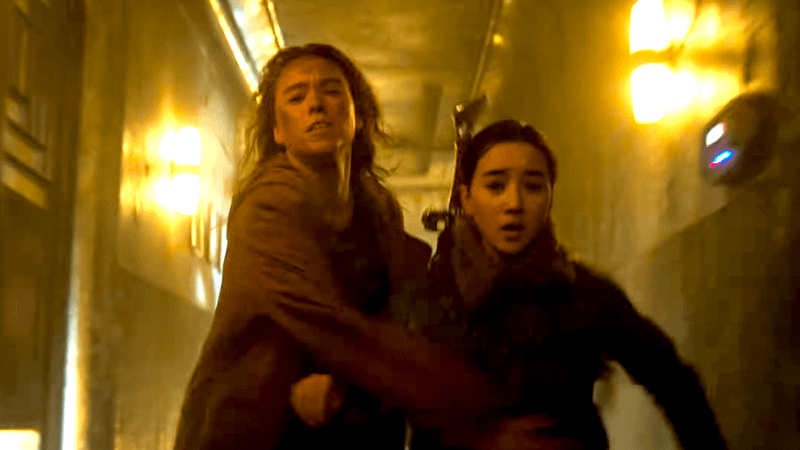
In this sense, Kornyev is a maddeningly flawed character that we desperately want to “wake up”; but his faith in government also reflects a deep-seated optimism that nobly counters the society, and film, that he’s a piece of. Many of the actors actually fled Russia following Putin’s 2022 invasion of Ukraine.

“Two Prosecutors” is a coldly engrossing watch. Its intense focus on the here-and-now and economical storytelling doesn’t bog us down in historical dumps or convoluted plotting.

Loznitsa’s film is quietly unrelenting — celebrating Kornyev’s determination while mocking his naivete (partially through some weirdly buoyant musical interludes); he’s existing within a dystopian system that cannot simply be dismantled by “doing the right thing.” 

Loznitsa paints obvious parallels to modern times, if we’re willing to look, and “Two Prosecutors” shouldn’t be missed.

“Two Prosecutors” is a 2025 legal thriller from Ukranian director Sergei Loznitsa and run time is 1 hour, 58 minutes. It plays Friday through Sunday, May 8-10, as part of the Webster University Film Series, which takes place om the Winifred Moore Auditorium, Webster Hall, 470 E. Lockwood, Webster Groves, MO 63119. Alex’s Grade: A

By Alex McPherson

Stunning, beguiling, and wholeheartedly its own thing, director David Lowery’s “Mother Mary” is a polarizing experience where pretentiousness is part of the charm.

This gothic-horror-romance-pop-song-chamber-drama follows the titular Mother Mary (Anne Hathaway), a world-famous, Taylor-Swift-adjacent popstar preparing a comeback tour after she experiences a harrowing onstage accident that we get a split-second glimpse of in the film’s opening moments.

Mary is exhausted and a hollowed-out shell of her former self. She has a panic attack during a costume fitting and rushes to the English countryside to make a surprise visit to her former best friend and costume designer Sam Anselm (Michaela Coel). Sam harbors palpable resentment after being ghosted (no pun intended) 10 years ago. 

Mary is desperate for Sam to make her a dress for the tour so she can “be herself” and find “clarity.” Sam — with a prickly, slyly wolfish demeanor — agrees to take on the challenge. She also sees an opportunity for Mary to address past wrongs in their professional and personal relationship.

Within a foreboding barn-turned-workshop, Sam and Mary get to work, with Sam gradually unspooling years of resentment. Social niceties give way to daggers (and scissors) as the two confront the end of their creative partnership:

Sam’s tireless work to support Mary’s celebrity persona has largely gone unrecognized; the pressures of fame and of constantly being in the spotlight have taken a massive toll on Mary’s psyche and eroded her sense of self. Still, there’s work to be done and a deadline to meet. At least, until things get trippily metaphysical.

Yep, this is definitely a film by the director of “The Green Knight” and “A Ghost Story.” It floats along on its own visually astounding wavelength that never loosens its grip on its insistence for weirdness.

“Mother Mary” is ultimately a difficult experience to pin down — unimpeachable in its craft elements and its central performances, but strangely simplistic in what the narrative boils down to: a whole lot of stylistic extravagance for a story whose emotional beats feel oddly schematic.

Still, Lowery’s latest is a bizarre experience made with such conviction that even when the story’s reach exceeds its grasp, the mesmerizing, phantasmagorical, genre-bending style never loses its impact. “Mother Mary” demands to be watched on the big screen.

It’s filled with gorgeous costumes, eardrum-busting concert numbers (featuring songs by Jack Antonoff, Charli XCX, and FKA Twigs), intensely intimate drama, gnarly horror, and spectral beauty, where the past elegantly blends with the present. 

The shadow-drenched barn becomes a portal to Mary and Sam’s history and imaginations, where their spiritual connection to each other is realized in ways both deeply earnest and unnerving. “Mother Mary” renders the force between the women literal as they each grapple with the weights of their connection and regrets; Daniel Hart’s score’s pulsing bass resembles a beating heart.

Hathaway and Coel are wholly up for Lowery’s wild swings, with Coel in particular commanding her every second onscreen. Cinematographers Rina Yang and Andrew Droz Palermo often frame her in close-up;

Coel’s face almost seems alien at times, her character’s sharp features, deep voice, and acid tongue intimidating and imposing (and sometimes darkly funny), although Sam herself is a heartbroken soul searching desperately for closure. 

Hathaway gives an equally excellent performance as the tormented celebrity. We see the years of expectations and regrets weighing her down, and her embracing a completely different persona onstage amid blinding lights and screaming fans.

One of the film’s best sequences involves Mary showing Sam her dance routine without music — monstrous and animalistic, hinting at the film’s increasingly supernatural influences.

It’s frustrating that “Mother Mary” doesn’t make the characters’ journeys quite as resonant. Indeed, while the film is – mostly – enigmatic to its benefit, Mary and Sam are too thinly-sketched as characters for their relationship to have the emotional thrust “Mother Mary” insists it does.

The main appeal is seeing just what elaborately hallucinatory set-piece Lowery has in store next, rather than investment in their (bluntly-spelled-out) inner battles. The film is so sincere, so earnest, about matters of the heart, but it opts for spectacle, which betrays the more nuanced drama that would truly let viewers into Mary and Sam’s worlds.

So, “Mother Mary” is a bit of a mixed bag, albeit one that deserves to be celebrated nevertheless — creativity and eccentricity like this should be supported, whether or not it fully lands. It’s a beautiful mess.

“Mother Mary” is a 2026 dramatic music thriller written and directed by David Lowery starring Anne Hathaway, Michaela Coel, Kaia Gerber, Hunter Schafer. and FKA twigs,, Its runtime is 1 hour, 52 minutes, and it is rated R for some violent content and language. It opened in theatres April 24. Alex’s Grade: B+.

By Alex McPherson

Sharp, spare, and icy to the touch, director Radu Jude’s latest indictment of modern society, “Kontinental ‘25” confronts complicity and learned helplessness within a crumbling world.

Jude’s film, which takes place in modern-day Cluj-Napoca in Northwest Romania, opens in a forested park exhibit featuring animatronic dinosaurs. The unhoused Ion (Gabriel Spahiu) scrounges for scraps of food, muttering obscenities.

Wandering around the rapidly gentrifying city looking for work, and largely being met with disdain from the populace, Ion (who used to be a famous Romanian Olympic athlete before becoming injured) is losing hope. He has been squatting in the boiler room of a building that’s slated to be torn down and replaced with a hotel called the Kontinental Boutique.

Orsolya (Eszter Tompa) is well-off, married-with-children, and working as a bailiff — she’s also Hungarian, which brings with it a bunch of cultural baggage. She is set to evict Ion from the premises with the help of her ready-for-action “ninja turtles” gendarmes.

Clearly enjoying the power she has over Ion as she informs him of his imminent eviction, she gives him 20 minutes to pack his things. Ion then kills himself. Orsolya is shocked. 

Even though she constantly reminds herself and everyone she talks to that she didn’t do anything “illegal,” Orsolya feels responsible for Ion’s death. She’s forced to face reality head-on, or, at least, mope around Cluj-Napoka looking for reassurance from coworkers, friends, and family while her husband and children go on vacation.
It’s a bleak premise, rendered in darkly comic fashion, with a lead character who’s equal parts maddening and relatable as she grows increasingly desperate to soothe her guilty conscience. Thanks to Jude’s characteristically provocative and gutting eye, “Kontinental ‘25” takes aim at not only Orsolya’s hypocrisies but also our own. A

fter all, Jude posits, we are inhabitants of this doomed planet, going about our days distracting ourselves from horrors many believe are out of our control.

These are happy days, indeed, brought to life as Orsolya’s psychological wounds are papered over with self-serving arguments that prize comfort over actual reflection. Meanwhile, gentrification, economic inequality, and deep-seated prejudice run rampant throughout Cluj-Napoca. History is rewritten by the “victors,” as wars rage across the globe.

Jude, whose previous films include “Dracula,” “Do Not Expect Too Much From the End of the World,” and “Bad Luck Banging or Loony Porn,” is unafraid to go for it and lean into his indulgences to show just how crazy modern life has become. “Kontinental ‘25” is no less fierce and biting at its core, but Jude takes a more social-realist approach this time around. 

Jude eschews stylistic extravagance for a stark approach that refuses to give Orsolya a heroic arc or distract from the main ideas at play — his anger and judgment practically seep off the screen. “Kontinental ‘25” is still full of acerbic wit and I-can’t-believe-they-just-said-that surprise, but the overall effect is a feeling of “tragedy of cruelty,” of how the status quo persists as time marches on.
That’s not to say the film isn’t also funny in a squirm-inducing way. “Kontinental ‘25” finds blunt ridiculousness in the matter-of-fact detachment of Orsolya’s interactions; each illuminates different ways of coping with her guilt and feelings of powerlessness.

The screenplay here is biting, harsh, and deadpan, with most conversations filmed in long-takes that let us marinate in uncomfortable silences and give us ample time to put ourselves in Orsolya’s shoes and reflect on our own place in the world. 

Do we donate to organizations about causes we care about in order to feel better about ourselves, or to actually make a difference? Do we let our prejudices and religious beliefs excuse happenings as inevitable? Do we indulge in drugs and alcohol to distract ourselves from our problems and avoid accountability? These are all questions that Orsolya grapples with, yet she is  never quite able to assuage her existential dread or “redeem” herself.

In Orsolya’s state of perpetual stasis, “Kontinental ‘25” can sometimes feel as if it’s spinning its gears along with her. The film is less a forward-moving narrative than a series of vignettes building towards, fittingly, not much at all in terms of her character. 

But Jude knows what really matters here, spending the first 20 minutes of the film solely with Ion, and ending with a heartbreaking montage of the transformation of Cluj-Napoka’s landscape. It’s the ever-present march of “development” at the expense of the vulnerable; an increasingly fragmented community that still resides under the same flag. This quietly powerful conclusion stands in contrast to the mostly empty language of the rest of the film, wordlessly conveying tragedy that will take large-scale action to reform.

Jude’s film is still definitely not for everyone; the mixture of nihilism and humanism is unusual, to say the least. It’s still a rich, confrontational text that leaves a nasty sting.

“Kontinental ’25” is a 2025 comedy drama from Romania, directed by Radu Jude and starring Eszter Tompa, Gabriel Spahiu, Adonis Tanta, Oana Mardare, and Annamaria Biluska. It is 1 hour, 49 minutes long. It was released in the U.S. on April 3. The film will play at the Webster University Film Series April 17-19. Alex’s Grade: A-.

By Alex McPherson

Playful and excoriating in equal measure, director Igor Bezinović’s documentary “Fiume o Morte!” (Fiume or Death!) examines the absurdity, horror, and sobering legacy of fascism, presenting an irreverent reframing of place and history that gives power back to the people.

Bezinović’s film takes place in his hometown of Rijeka, Croatia, a port on the Adriatic about 50 miles from Italy, with a tumultuous history. The city, once known as Fiume, was ruled by the Hapsburgs during World War I. After the War ended, it was left under the control of Yugoslavia, not Italy. This surprised many, including the vainglorious Italian aristocrat, poet, drug addict, womanizer, and army officer Gabriele D’Annunzio (a friend and inspiration for the young Benito Mussolini). 

In 1919, fueled by vanity and nationalism, D’Annunzio led an insurgency with 186 unemployed and hate-filled “legionaries” to occupy the city and claim it as an independent, pro-Italy city-state with himself as its supreme ruler. D’Annunzio’s leadership didn’t last long; he was forced out of power by none other than Italy itself in 1920. 

Bezinović aims to reckon with D’Annunzio’s complicated legacy on both sides of the Italo-Croatian border with “Fiume o Morte!” He also, just as importantly, cuts the failed despot down to size. 

Walking through a vibrant farmer’s market in present-day Rijeka, Bezinović asks passers-by whether they know who the man was — some have no idea, others are quick to label D’Annunzio a fascist, and others aren’t willing to make such sweeping statements, noting that he was also a “great poet and lover.” 

Bezinović reveals that he’s making a film about D’Annunzio’s coup, and he hires non-actor residents of Rijeka (including plumbers, musicians, and professors, some recruited directly from that farmers market, and at least one pet dog) to play every role and provide the film’s dry-humored narration, with several bald men recruited to play the (in)famously hairless D’Annunzio.

The historical reenactments themselves (which take up the bulk of “Fiume o Morte!”) treat D’Annunzio with the respect he deserves – that is, none at all. Performed with period-accurate costumes, keen attention to framing (Gregor Božič’s cinematography is beautiful), and a limited budget encouraging bucketloads of mocking comedy, Bezinović replicates scenes and tableaus from thousands of photographs and video footage documenting D’Annunzio’s “heroic” coup with a winking, anachronistic twist.

“Fiume o Morte!” jumps back-and-forth between these “grandiose” historical documents and a considerably less impressive present. The goofy yet faithful reenactments (in the same locations) seem out of place within the colorful hustle and bustle of modern-day Rijeka.

A photo of D’Annunzio speechifying before hundreds of onlookers turns into an aged non-actor revealed (via a slow zoom-out) to be speaking to an audience of two family members. A high-stakes meeting between generals concludes with D’Annunzio walking uphill to play rock music with his band as trucks leisurely drive by on their way to storm the city.

Some photos and videos — like a sword-wielding D’Annunzio posing naked draped with the Fiume flag, or homoerotic revelry on the beach with his unemployed legionaries — barely need exaggeration at all in the present-day. Sometimes onlookers stop to take pictures, others essentially ask “What the Hell are you doing?”

The reenactments are absurd and satisfyingly savage, emphasizing the ridiculousness of D’Annunzio’s occupation and putting his story in the hands of the community he attempted to suppress; a violent past juxtaposed by a resilient present that has endured and, as Bezinović keenly points out, is still grappling with D’Annunzio’s legacy and broader society’s continued cozying up to his fascist ideals.

Indeed, although “Fiume o Morte!” is often a breezy, immensely enjoyable viewing experience (particularly charming when narration highlights the backgrounds of each featured member of the ensemble), Bezinović never loses sight of the barbarity of D’Annunzio’s self-imposed mission, and the consequences of his violently prejudiced enterprise that helped pave the way for Kristallnacht. 

Bezinović is selective about what he chooses to recreate, in certain moments relying entirely on historical artifacts instead of reenactments to drive home the oppressiveness of D’Annunzio’s rule and the tragic consequences for the (especially non-Italian) citizenry, as well as painting clear parallels between then and now.

Not only do we get a clear picture of D’Annunzio’s hubris and failures, but also a spirited portrait of Rijeka and its diversity, and caustic reminders of how his memory lives (and, in terms of younger generations, dies) among the populace. Just nearby in the Italian city of Trieste, for example, statues are continuing to be erected of the bald buffoon to this day, more celebratory than critical.

“Fiume o Morte!,” then, works as an irreverent history lesson, a reclamation of storytelling by the community he claimed he conquered, and an example of how nationalism and pride distort the truth. And that art, liberating in its creative freedom, has the ability to both entertain and educate, empowering those whose stories were brushed over by forces of evil. 

This is a masterful documentary that’s enlightening and downright ingenious – an absolute must-watch that stands tall among the year’s best films thus far.

“Fiume o Morte!” Is a 2025 documentary directed by Igor Bezinovic. It was the official submission of Croatia for the ‘Best International Feature Film’ category of the 98th Academy Awards in 2026. It is 1 hour and 52 minutes run time. It can be seen at the Webster Film Series on March 8. Alex’s Grade: A+

By Alex McPherson

Far less lively than its premise promises, director John Patton Ford’s “How to Make a Killing” has a sturdy dramatic framework but forgets to have much fun along the way — it’s an Eat-the-Rich satire that commits the unfortunate sin of being dull.

Inspired by the 1949 film “Kind Hearts and Coronets,” “How to Make a Killing” centers around Becket Redfellow (Glen Powell), a man on death row with four hours until execution who relays his life story to a priest (Sean C. Michael). The film, guided, er, dictated, by Becket’s narration, jumps back and forth in time.

Becket, with a wry smile, insists that his story is a “tragedy,” as he reveals that his family has a 28 billion dollar fortune that he was willing to kill his seven other relatives to acquire. For Becket, it’s personal.

His mother was banished from the family by the mysterious patriarch Whitelaw (Ed Harris) after becoming pregnant with Becket as a teenager with a man of “lower class,” who quickly disappeared from the scene.

She raised Becket in a working class New Jersey neighborhood, occasionally immersing him in rich-adjacent activities like archery (featuring Chekhov’s bow and arrow), and, until her dying day, insisting that Becket has a legal claim to the Redfellow fortune and that he “deserves” it. 

It’s at one of these functions that a young Becket meets the uber-wealthy Julia Steinway (later played by Margaret Qualley). The two are drawn to each other, although they drift apart as they grow up in different social spheres.

In present-day New York City (before his arrest), Becket works at a men’s suit store and runs into Julia, who strikes up a flirtation (even though she’s engaged), and reminds him that he is a Redfellow.

After being abruptly demoted, and recognizing the sad unfairness of his current non-uber-wealthy living situation, Becket decides to take action, setting out to eliminate his relatives and do away with most of his morality. 

The group includes party boy Taylor (Raff Law), smug goofball artist Noah (Zach Woods), “philanthropist” Cassandra (Bianca Amato), Richard-Branson-esque McArthur (Alexander Hanson), rock star megachurch pastor Stephen (Topher Grace), and Becket’s surprisingly kind uncle Warren (Bill Camp) who hires Becket to work at his brokerage firm, plus the intimidatingly shady Whitelaw (Harris).

Quite a few folks to get through, but Becket’s greed and hunger for retribution motivate him, to the detriment of his personal relationships and sanity.

There’s a recipe for a crackling, twisted little thriller here, but Ford’s film is frustratingly milquetoast, possessing the skeleton of a strong narrative without putting in the work to give its story poignancy, momentum, or memorably crazy set pieces.

“How to Make a Killing” feels restrained as Becket flies further off the deep end, taking the easy way out instead of leaning into the lunacy, with derivative social commentary and subplots clunkily smashed together. It’s a shame, because the foundation is there. Powell remains an appealing leading man who brings charisma in spades.

Still, he feels underutilized, as Ford’s screenplay jumps through time erratically and often resorts to blatant exposition dumps (via Becket’s prison-set narration) that attempt to streamline the film while robbing it of textural detail.

Powell’s performance is sturdy enough on its own merits, particularly when the film slows down to briefly highlight his twisted satisfaction at his various killing schemes (which occur, puzzlingly, mostly off-screen) and to develop his relationship with the beautiful Ruth (Jessica Henwick), who is first attached to Noah.

Henwick and Powell have great chemistry, yet Ford treats their dynamic as more of a plot device than anything else — the tension between happiness/comfort and the pesky pull of greed and revenge.

It’s a conflict rendered too schematic to pack much emotional punch, worsened by dialogue that spells out Becket’s “choice” in eye-rollingly obvious fashion.
Qualley, to her credit, understands the assignment more than most of the ensemble, leaning into her character’s femme-fatale cartoonishness, periodically appearing to encourage Becket to continue his murderous mission and attempt to seduce him (for love or for the money?).
f only the rest of “How to Make a Killing” was as committed to the bit as Qualley who, regardless of whether you love or hate her performance, is definitely making choices and helping to momentarily excavate the film from generic territory.

Perhaps the biggest issues with Ford’s film revolve around its “tell, don’t show” philosophy. We don’t really feel Becket’s inner turmoil, nor do we fully buy why he feels compelled to push forward even when his life seems pretty damn good, all things considered. Nor do we get any flashy moments of R-rated violence, odd considering that the film is indeed called “How to Make a Killing.”

 Ford’s film does have eye-catching production design and stylistic use of light and shadow. But its conclusions are largely standard, a morality tale with a clearly telegraphed destination, and a laissez-faire approach to distinctive storytelling.

“How to Make a Killing” is a 2026 dark comedy-psychological thriller directed by John Patton Ford and starring Glen Powell, Margaret Qualley, Ed Harris, Bill Camp, Jessica Henwick, Zaff Law, Zach Woods, Bianca Amato, Topher Grace, and Alexander Hanson. It’s run time is 1 hour, 45 minutes, and it is rated R for language and some violence/bloody images. It opened in theatres on Feb. 20. Alex’s rating: C.

By Alex McPherson

Furious and scattershot, director Gore Verbinski’s madcap sci-fi parable “Good Luck, Have Fun, Don’t Die” has numerous incisive ideas about humanity’s dependence on technology but muddles them with a heavy dosage of smug humor.

One cannot accuse Verbinski of not being ambitious, though, with his latest effort bringing to mind a range of films including “Groundhog Day,” “The Terminator,” and “Everything Everywhere All At Once.” The film takes place in a near-future in which humanity’s addiction to technology has created a society of apathetic, homogenous-seeming beings doing nothing to stop society’s descent into tech company servitude. 

We open with an extended sequence featuring a disheveled, sardonic Man From the Future (Sam Rockwell) bursting into Norm’s Diner in Los Angeles in search of people to join him on an epic quest to prevent the AI apocalypse. He claims to have a bomb strapped beneath his transparent raincoat and launches into a speech about how technology has ruined modern life, insisting that time is of the absolute essence. 

This isn’t the Man’s first rodeo, though; it’s actually his 117th attempt with this same batch of disbelieving patrons. All of his previous 116 attempts have ended in death for everyone involved (except him), with the Man “resetting” and trying to find the right combination of people necessary to complete his mission. This time could be different, though. 

The group the Man pseudo-forces to participate includes Mark (Michael Peña) and Janet (Zazie Beetz), a couple going through a rough patch who recently started new jobs as high school teachers. They are increasingly disturbed by their students’ obsession with their smartphones and cynical detachment from the outside world, even during a school shooting, which is treated like “just another day.”

There’s also Susan (Juno Temple), a mother who lost her son in that same shooting and whose grief is brushed away — there is, as a squad of local mothers tells her, a company that specializes in creating clones of children who died in school shootings. Yikes. 

There’s Ingrid (Haley Lu Richardson), a severely depressed woman wearing an off-brand Disney princess costume who is literally allergic to Wi-Fi and smartphones. Along with a few other people who aren’t given much meaningful character development, the Man and his team embark on an increasingly loony journey.

Mixing madcap sci-fi action with a decidedly nihilistic streak, “Good Luck, Have Fun, Don’t Die” is alternately amusing and exhausting over its 135-minute runtime. For all of Verbinski and screenwriter Matthew Robinson’s sharp thoughts on our technological hellscape (did you see how many SuperBowl ads were about AI?), there’s a shakiness to the film that draws you in and subsequently pushes you away. 

The film mines plentiful deadpan humor from the populace’s matter-of-fact reactions, whether it be judgy, entitled high schoolers glued to their phones, or Susan’s newly-cloned kid who is “ad-supported,” all while nobody is taking action to turn things around.

Even so, the film can’t decide between championing these idiosyncratic, reluctant heroes and reveling in the tech-addicted nastiness that surrounds them. Poignant moments are offset by edgelord, shock-value humor that is deeply proud of itself and leaves a cold aftertaste.

Rockwell is the perfect choice to play this snarky antihero. He’s goofy and sometimes callous but strong in his convictions, with an increasing desperation creeping in as he nears closer to finally stopping the horrors of an AI-controlled future.

The rest of the cast aren’t anywhere near as dynamic to watch as Rockwell, but they get the job done, effectively emphasizing their feelings of displacement with an environment that refuses to recognize their empathy and, indeed, their humanity.

Verbinski and Robinson take ample time to provide backstory for the “core group,” structured in “Black Mirror” -esque flashbacks that periodically break up the immediate action of the Man and co. escaping from Norm’s and venturing to their next objectives.

This vignette structure works well enough (albeit padding the runtime to an excessive degree), and helps illuminate the personal costs of living in this reality that’s not all that dissimilar from our own. Less impactful are the labyrinthine multiversal shenanigans that arise in the finale, difficult to follow and messy in a decidedly hand-made way.

“Good Luck, Have Fun, Don’t Die,” then, is a rickety experience that’s still impossible to discount. Verbinski and Robinson take rightful aim at the devices and companies that are hijacking our attention and transforming us into passive, homogenous consumers rather than informed people with agency over our own lives.

The crafts, too, are noteworthy, especially James Whitaker’s energetic cinematography and a techno score by Geoff Zanelli that pulses with rambunctious life.

Verbinski and Robinson are clearly interested in sounding a 5-alarm fire about doing something now rather than waiting until all hope is lost. The messiness of living in the real world, the film says, is worth fighting for, even when the digital one offers an illusion of safety and happiness.

There’s definitely merit to that message in 2026, although “Good Luck, Have Fun, Don’t Die” is ultimately a mildly entertaining, pitch-black yell at the Cloud.

“Good Luck, Don’t Die, Have Fun” is a 2025 sci-fi action-adventure horror comedy directed by Gore Verbinski and starring Sam Rockwell, Juno Temple, Haley Lu Richardson, Michael Pena, Zazie Beetz, Georgia Goodman, and Asim Chaudhry. It is rated R for pervasive language, violence, some grisly images and brief sexual content and runs 2 hours, 14 minutes. Opens in theatres Feb. 13. Alex’s Grade: B-.