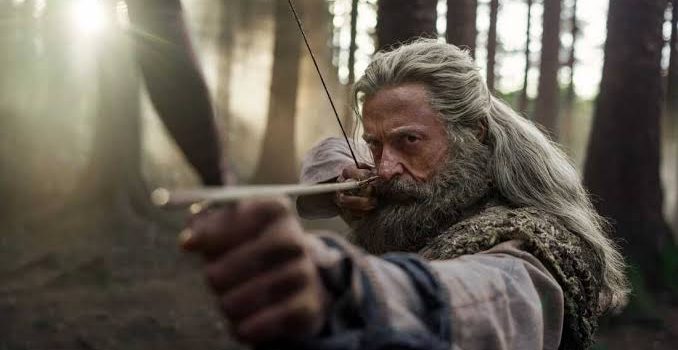
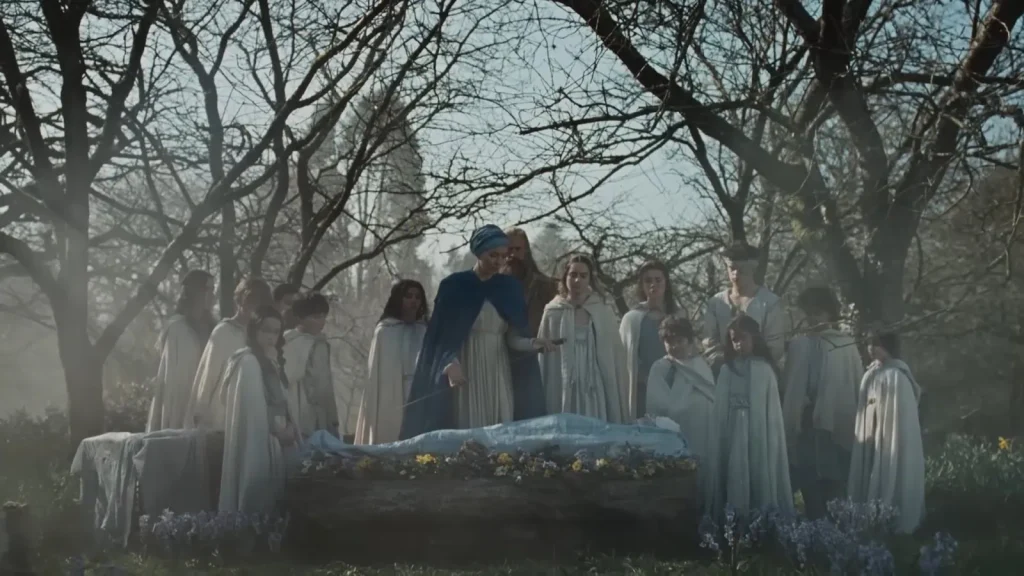
By Lynn Venhaus Dark, dour and dreary, “The Death of Robin Hood” is a revisionist take on the legendary folk hero without any merry men or noble derring-do – or much of a pulse.
After a chaotic life of crime and murder, a battle-scarred and weather-beaten Robin Hood (Hugh Jackman) is roaming the austere heaths of medieval England. The year is 1247, and he’s not seeking redemption nor reconciling his past — yet. He announces: “I’m tired.”
Writer-director Michael Sarnoski has adapted a 17th century ballad, “Robin Hood’s Death,” to bust the myth about the outlaw that the common man cheered for, “stealing from the rich and giving it to the poor.”
Presenting himself as “no hero,” Robin grapples with being a heartless bandit and not a good guy glorified in folklore. He doesn’t have an altruistic bone in his broken body, and he is irked about the romanticized version because he can’t live up to expectations nor does he want to try.
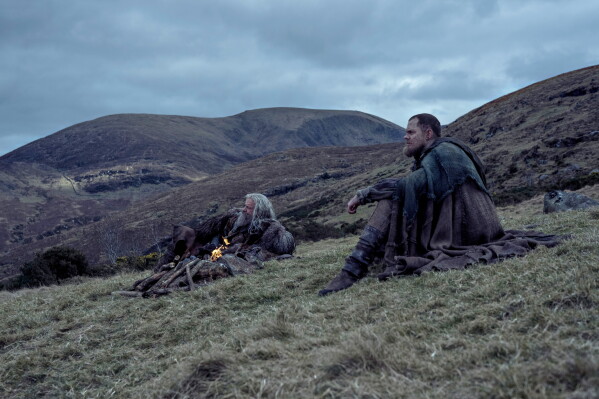
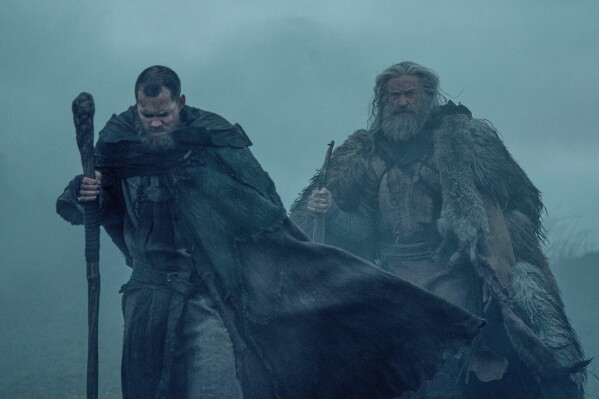
Along the way, he encounters people affected by his slicing and dicing: Arthur (Noah Jupe), a young man seeking revenge for his slain family; his longtime friend Little John (Bill Skarsgard), now a family man calling himself Edward, who wants Robin’s help in a vicious attack; and little Margaret (Faith Delaney), a traumatized orphan who latches on to him.
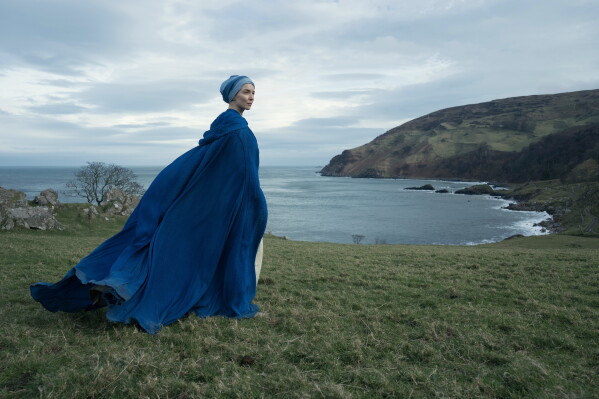
Grizzly and growling, Jackman’s sullen Robin is without aspirations. While enacting vengeance at Little John’s coaxing, Robin is gravely injured. He wakes up in the Priory of St. Clement, being nursed by Sister Brigid (Jodie Comer), an angel of mercy, calls himself Randolf.
Forget every screen incarnation, from silent swashbuckler Douglas Fairbanks in 1922 to Taron Egerton as a gritty Robin of Loxley in 2018, with Errol Flynn, Sean Connery, Kevin Costner, Russell Crowe, Cary Elwes, Disney animation and even Frank Sinatra as “Robbo” in a Rat Pack musical comedy in between.
While Tony Award winner and Oscar nominee Hugh Jackman has carried big-themed films before, playing an introspective elder confronting his ghosts is quite a departure from the superhero Wolverine and musical icons Jean Valjean, P.T. Barnum and Neil Diamond that he’s known for, although one can point to “Logan” for another tough-guy reflecting on his mortality.
Emmy and Tony Award winner Jodie Comer lends a quiet strength to Sister Brigid, a kind, caring woman who believes in the good, and devotes her life to the afflicted and orphans.
Sarnoski employs such a top shelf cast that you want to care about their characters, but drawn only as sketchy outlines, it’s difficult to be convinced of this slow story’s merit.
Heralded for his outstanding debut feature, “Pig” in 2021, Sarnoski followed with a fine studio blockbuster, “A Quiet Place: Day One,” in 2024. Now he is poised to be one of A24’s arthouse darlings.
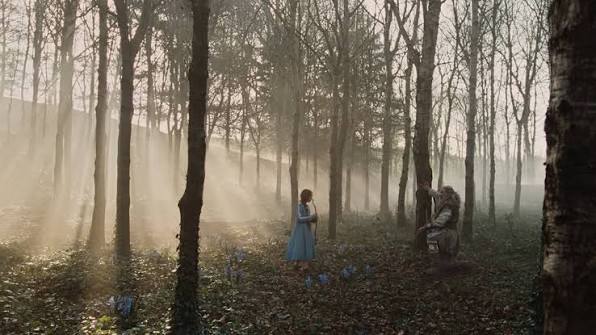
In his grim re-imagining, Sarnoski focuses on moody misty landscapes, terse dialogue and shocking violence. His reinvention is in the same vein as David Lowery’s “The Green Knight” and Robert Eggers’ “The Northman.”
The austere elements are visually interesting– cinematographer Pat Scola and production designer David Lee captured the harsh Northern Ireland landscape, contrasting it with the safe space of the monastery. But Sarnoski’s philosophical approach is one-note, that somber ambience soaking this plodding adventure.
A distinctive element is the mournful score composed by Tony Lewis and folk singer Jim Ghedi that is haunting throughout the film’s 122 minutes.
Sarnoski has decided that backstories are not necessary, so there’s no evidence of a kinder, gentler swashbuckler hardened by his brutality. No mention of the Crusades or Sherwood Forest, or the cruel corrupt monarchy (Prince John and his henchman Sheriff of Nottingham and Sir Guy of Gisbourne) that spurred the Robin Hood saga in the Middle Ages.
Supporting players arrive, merely trying to survive the harsh conditions. This is mud, blood, slings and arrows – an eye for an eye.
At the monastery, one of the castoffs is a compassionate bandaged leper played by Murray Bartlett, Emmy winner as resort manager Armond in the first season of “White Lotus.” He dispenses hard-fought wisdom and seems to pierce Robin’s impenetrable demeanor, as does Sister Brigid and young Margaret.
The leper encourages Robin to let go of his violent past and become part of the sanctuary community. But is he too late for salvation? In theory, this moral dilemma sounds interesting, but its subdued execution makes this film tough to embrace. And the hushed, mumbling delivery of all characters, with dialects, makes understanding the exposition even harder.
Sadly, “The Death of Robin Hood” is more a desolate dirge than a profound philosophical statement.
“The Death of Robin Hood” is a 2026 action-drama written and directed by Michael Sarnoski and starring Hugh Jackman, Jodie Comer, Bill Skarsgard, Murray Bartlett, Noah Jupe and Faith Delaney. It is rated R for strong bloody violence and the runtime is 2 hours, 3 minutes. It opens in theatres June 19. Lynn’s Grade: C-
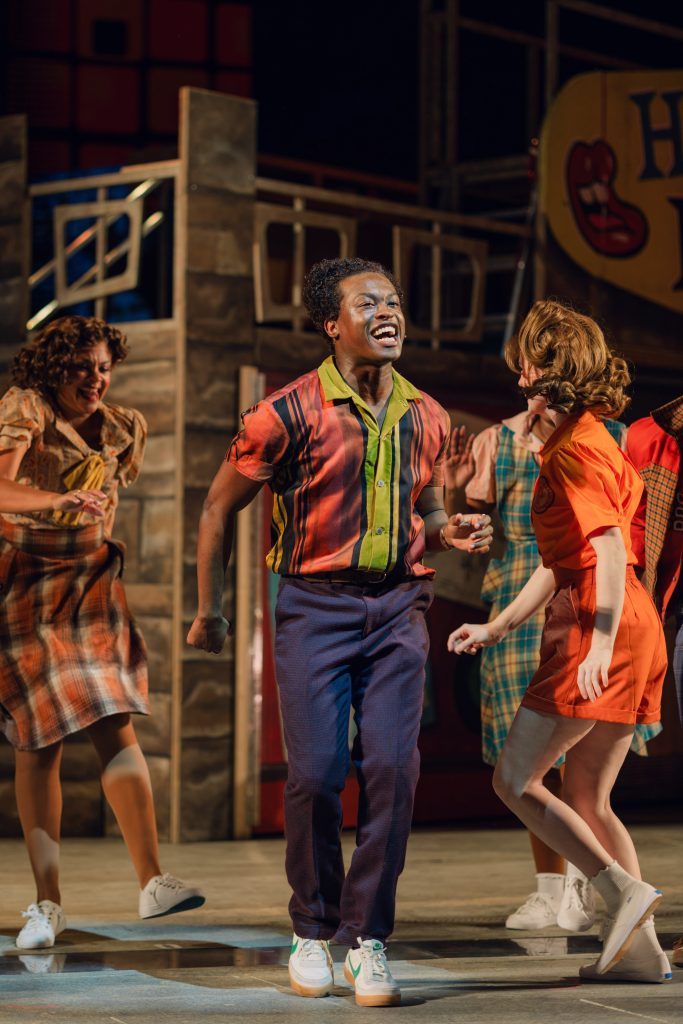
With magical Muny moments aplenty, the joy juggernaut “Hairspray” launched the 108th season with heart, humor and humanity.
Stacked with stand-out performances, this production celebrates change agents, set on the cusp of the monumental cultural shifts that would define the 1960s, and is a kicky, kitschy kaleidoscope of comical zingers and 60s beats.
Director Seth Sklar-Heyn brought out the infectious dance-party energy, and his fast-paced show is just pure fun! A flawless, turbo-charged cast demonstrates why this 2002 Tony-winning musical continues to defy tradition with its cheeky wit, upbeat approach and timeless freedom of expression theme.
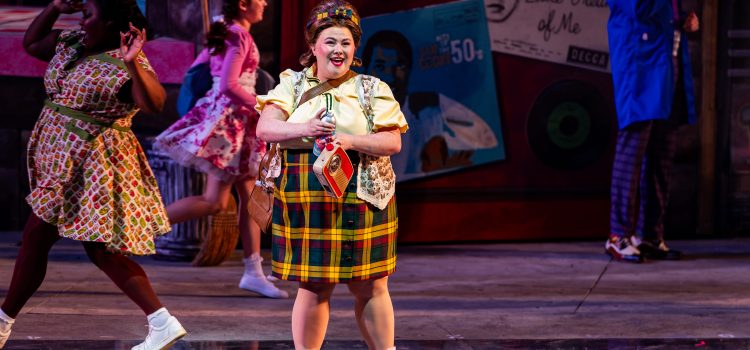
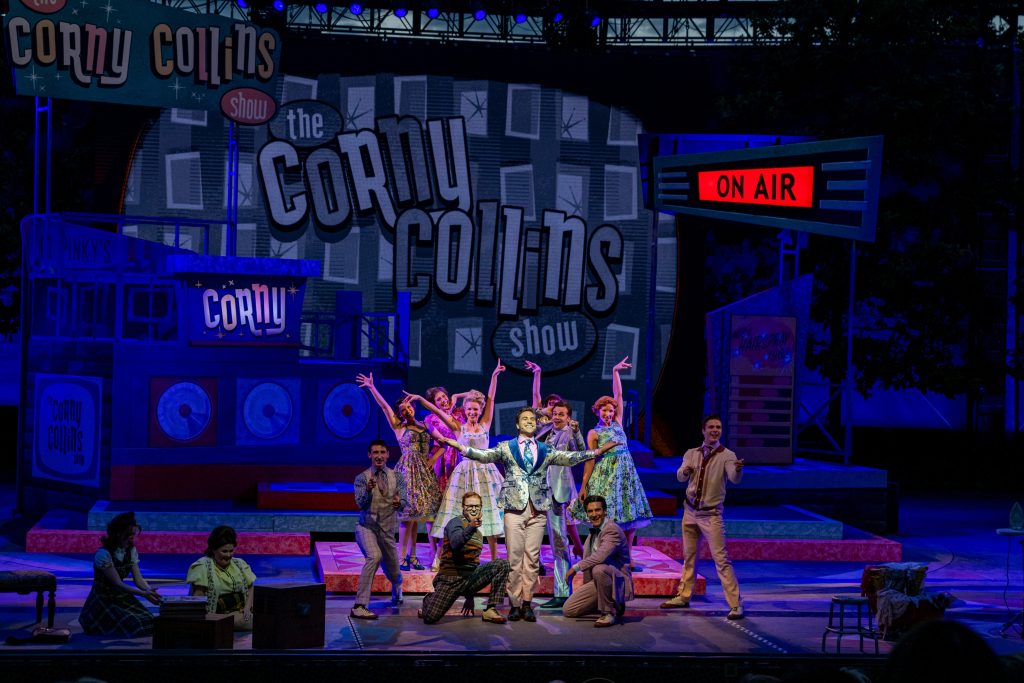
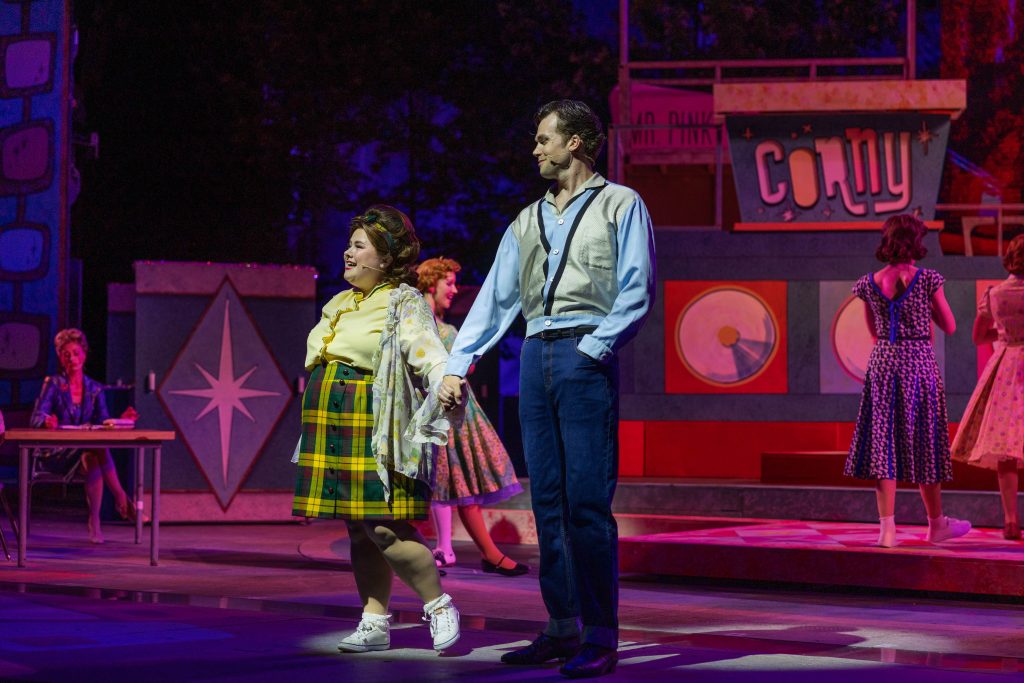
Let’s hear it for the outsiders – and Tracy Turnblad’s optimism! Set in 1962 Baltimore, plus-size teenage Tracy has a dream – to dance with the cool kids on the popular TV program “The Corny Collins Show.” With her slick moves, she earns a spot and winds up leading a movement for racial integration. Oh — and gets the cute guy!
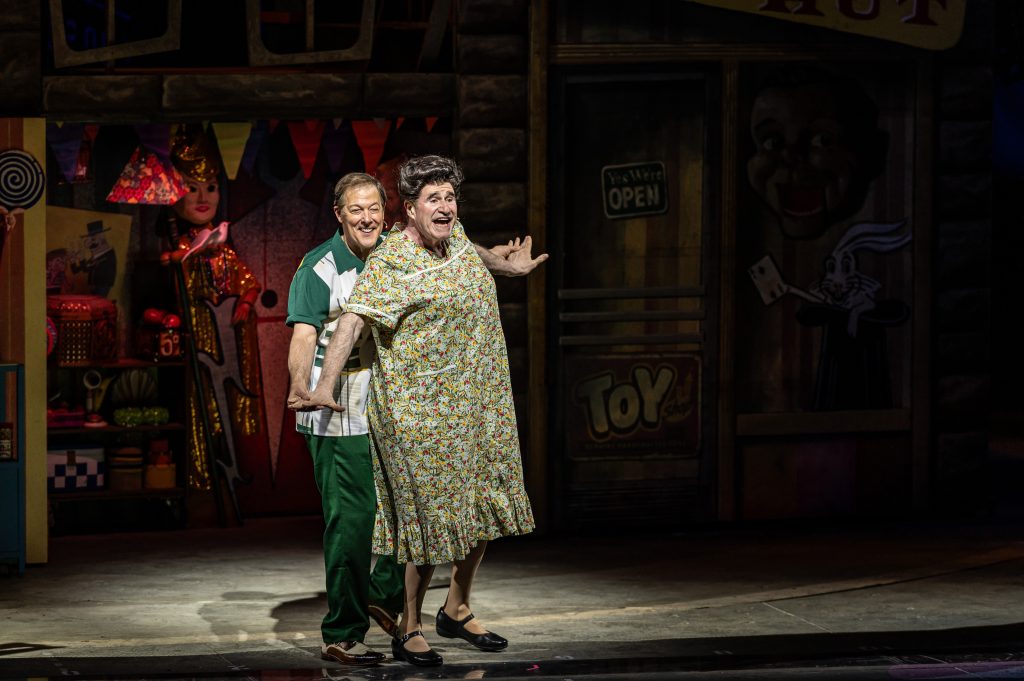
Paul Schwensen (center) and the company of the 2026 Muny production of “Hairspray.” Photo by Phillip Hamer
“I just don’t understand why we can’t all dance together,” she says to the black teens who’ve become her friends (in detention and dancing at platter parties).
A marvel in motion, the indefatigable Katy Geraghty embodied Tracy with unadulterated glee. A scene-stealer in the Muny’s “Sister Act” and “Bring It On!,” Geraghty endeared as a triple treat, whirling, twirling and unfurling Tracy’s positivity in her signature songs: “Good Morning Baltimore” and “I Can Hear the Bells,” in addition to leading the company in “Welcome to the ‘60s” and an exuberant “You Can’t Stop the Beat.”
Also defying America’s narrow beauty standards is marquee headliner Richard Kind as Tracy’s big-hearted but insecure laundress mother Edna. Kind, star of stage and screen, embraced this distinctive gender-flipped role by warmly revealing Edna’s many facets – her insecurities, confident transformation, and devotion to her daughter and husband Wilbur (a sensational John Bolton).
With his raspy voice and expressive face, the beloved Kind is a natural as this larger-than-life figure. A Drama Desk Award winner and Tony nominee, his Swiss-watch comedic timing is impressive.
John Bolton (left) and Richard Kind in the 2026 Muny production of “Hairspray.” Photo by Phillip Hamer
Commanding the stage in the finale, Kind charmed as shiny happy Edna, clad in snazzy red sequins, a wondrous sight to behold. His sweet duet with Bolton, “You’re Timeless to Me,” is a highlight.
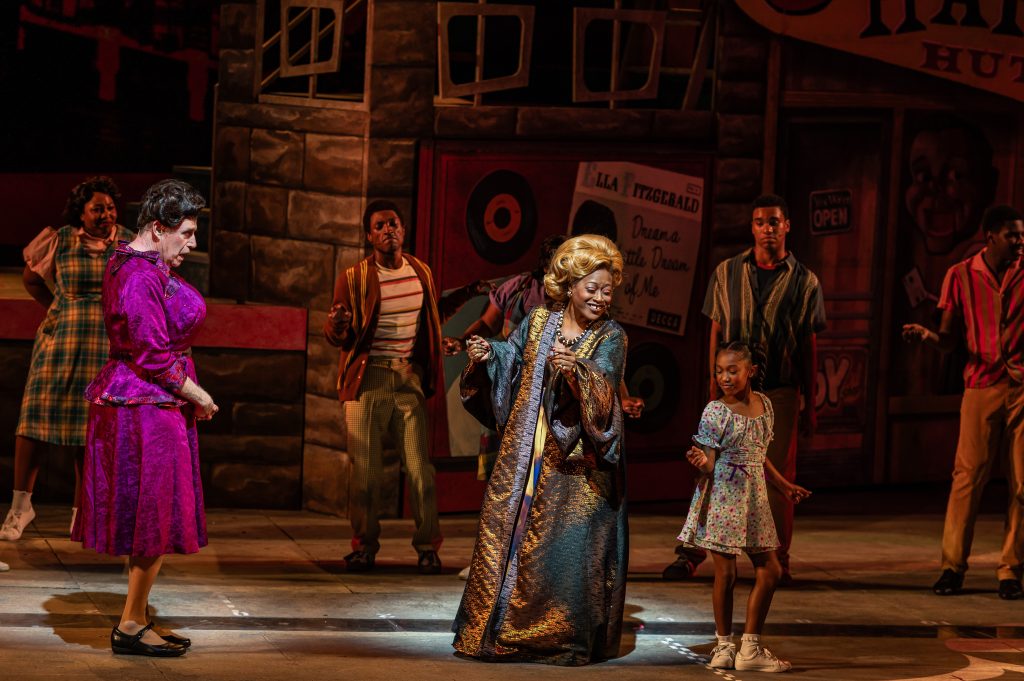
From the principal parts to the chorus, this spirited well-cast ensemble is one of the strongest to grace the Muny stage in recent memory. Besides the terrific Turnblad trio, Charity Angel Dawson and the appropriately named Joy Elizabeth Rhodes knocked it out of Forest Park as Motormouth Maybelle and Little Inez, a mother-and-daughter powerhouse from the record shop on ‘the other side of town.’
Dawson brought the house down with the soulful ‘11 o’clock number’ “I Know Where I’ve Been” and joined the bluesy anthem “Big, Bold and Beautiful” with Rhodes.
The pint-sized dynamo Rhodes belted out “Run and Tell That” with her brother Seaweed J. Stubbs (marvelous sparkplug Nicholas A. Wilkinson), showing tremendous poise. A star is born.
From left: Richard Kind, Charity Angél Dawson and Joy Elizabeth Rhodes in the 2026 Muny production of “Hairspray.” Photo by Phillip Hamer
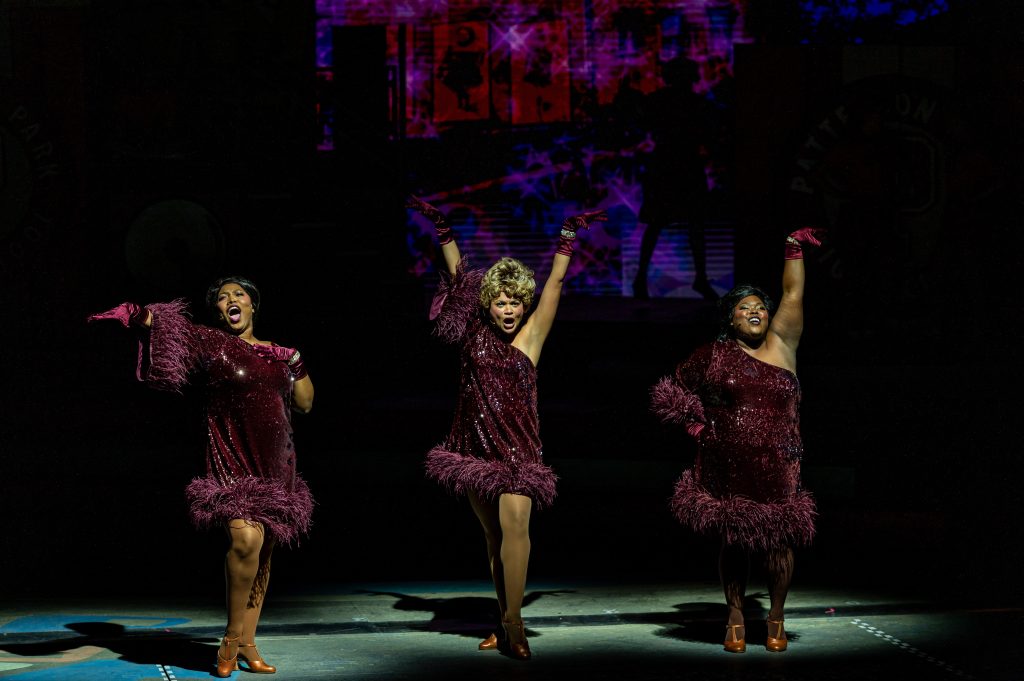
Special mention to The Dynamites, that stylish trio of Taylor Colleton as Shayna, Indya Lincicome as Judine and Tatiana Lofton as Kamilah, swirling in costume designer Tristan Raines’ sparkly girl-group finery.
Raines’ vibrant vintage style is spot-on, a SweeTARTS palette of pastels, plaids and floral prints that pop in 50s A-line dresses and bouncy skirts, before the mod look of Carnaby Street arrived. Integral are the period-specific wig designs by Ashley Rae Callahan, for the teased bouffant hairdos, pageboys, and flips.
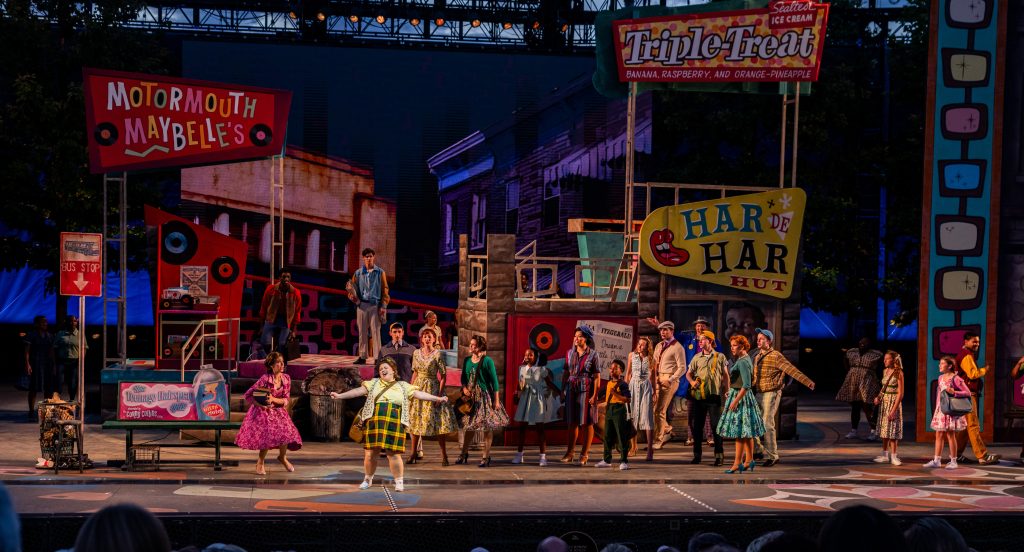
Scenic designer Christine Peters smartly chose bright retro colors and contributed eye-catching vintage signage for the storefronts in Baltimore, including Wilbur’s novelty joke shop the Har-de-Har Hut and Motormouth Maybelle’s record shop.
(A nice nostalgic nod is the Sealtest Ice Cream sign, which was a national brand produced at the former St. Louis Dairy Company location where Energizer Park is now, known for its massive iconic clock for decades).
From left: Taylor Colleton, Indya Lincicome and Tatiana Lofton in the 2026 Muny production of “Hairspray.” Photo by Phillip Hamer
Sklar-Heyn’s staging, using the turntable, is seamless, and Nathan Scheuer’s fluid black-and-white video design added depth to the storytelling (and flying pink flamingos!). So did Rob Denton’s lighting design, which amplified the feel-good atmosphere, and Joshua Hummel’s sound design, which reinforced the musical’s peppy rhythm.
The girl power is noteworthy, with perky Ashlyn Maddox as Tracy’s sheltered best friend Penny Pingleton, who gets more animated on her personal liberation journey, while Hannah Solow is funny as her overbearing, ultra-conservative mother Prudy.
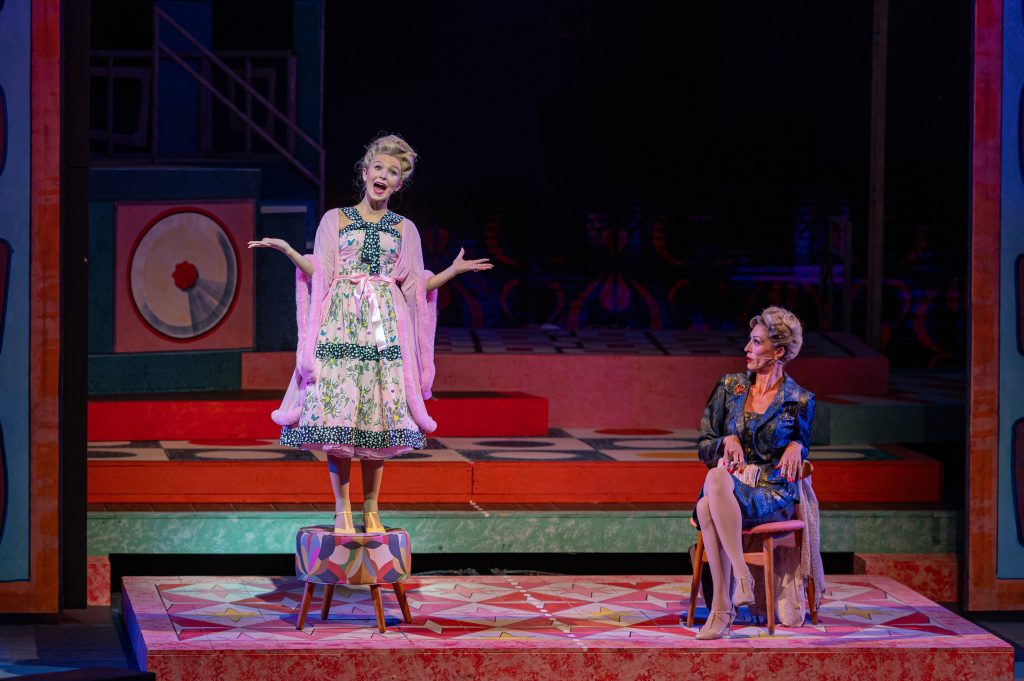
The vain blonde villains Amber and Velma Von Tussle (Madison Thompson and Sara Gettelfinger) look like magazine-cover models but are despicable in their devious ways, trying to block Tracy at every turn, and resorting to underhanded methods. Thompson and Gettelfinger are convincing in their exaggerated evil, especially awful Velma with “Miss Baltimore Crabs” and “Velma’s Revenge,” and bratty Amber in “Cooties.”
The guys they push around are the dreamboats Link Larkin, aka “The Elvis of Baltimore” (Ben Jackson Walker), and host Corny Collins (Paul Schwensen), who come to see the light, not unlike the throwback teen heartthrobs (Ricky Nelson, James “Moondoggie” Darren, Fabian and Frankie Avalon).
Nicholas A. Wilkinson and Ashlyn Maddox in the 2026 Muny production of “Hairspray.” Photo by Phillip Hamer
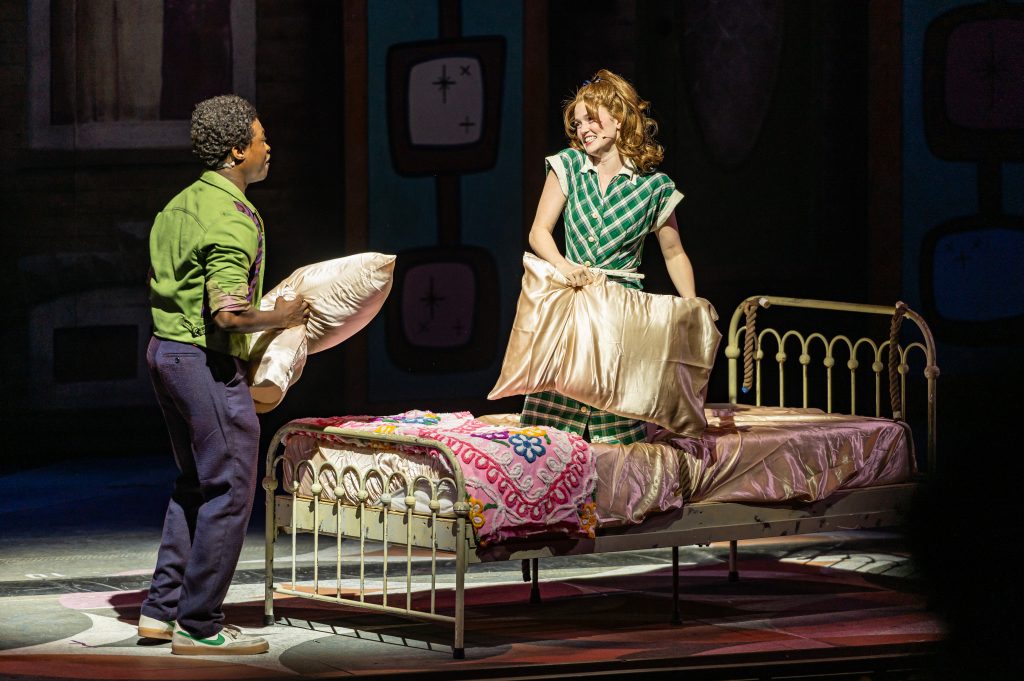
Walker nailed Larkin’s breezy likability, smoothly dueting with Geraghty on “It Takes Two” and “Without Love.” So does Schwensen as the polished boy-next-door host, leading the clean-cut company in “The Nicest Kids in Town,” the line-dance song “The Madison” and “It’s Hairspray” at the Ultra-Clutch sponsored Miss Teenage Hairspray Pageant.
Music Director Evan Roider masterfully maintained those swinging melodies, leading a mega-cast including a youth ensemble and singers off-stage, and 24 musicians as the orchestra conductor.
Those nice kids, aka “Council Members,” are the 10 camera-ready idolized teens on the dance floor. They couldn’t be more vivacious in choreographer Jesse Robb’s peppy-retro style: Matt Dean, Olivia Windley, TJ McCarthy, Brooke Cox, Matthew Varvar, Chloe Chamberlin, McKinley Knuckle, and Audrey Curdo. Jennifer Florentino deserves mention as assistant choreographer and dance captain (and swing, along with Jack Sippel).
Same goes for the hip kids allowed to dance on the once-a-month “Negro Day,” including Jonah Taylor, Trevor “Tjay” Groce, J’Khalil and Leah Joy Ifill.
Nicholas A. Wilkinson in the 2026 Muny production of “Hairspray.” Photo by The Muny | MaryKatherine Patteson
Character actor Kevin Zak amusingly filled multiple roles – Mr. Pinky, Mr. Spritzer, principal and guard, while Solow played the gym teacher and matron too.
While “Hairspray” initially was a blast from the past for Baby Boomers, who lived through the social and cultural revolution of the ‘60s, accompanied by the unmistakable pop and rhythm ‘n blues music soundtrack of our lives, all generations can identify with the characters’ struggles and triumphs – especially with its empowering message of individuality and acceptance. It remains relevant today.
Director John Waters has focused on marginalized people in his subversive social satires, and his 1988 film “Hairspray” (starring Ricki Lake, Divine, Jerry Stiller, Sonny Bono and Deborah Harry) struck a universal chord to become a cult classic.
Waters had based it on his youth in Baltimore, where “The Buddy Deane Show” enthralled teenagers, not unlike Dick Clark’s “American Bandstand” and “St. Louis Hop” here on KSD-TV with host Russ Carter from 1958 – 1973. (Fun Fact: St. Louis’ local show was nationally recognized as the first racially integrated teen dance program in U.S.). Oh, how we looked up to those groovy gals doing the twist, pony and mashed potato moves.
Producer Margo Lion enlisted composer Marc Shaiman – who had scored the 1999 “South Park” film — to adapt “Hairspray,” so he and co-lyricist Scott Wittman wrote the catchy songs in the music styles of that fabled era. Writers Mark O’Donnell and Thomas Meehan tackled the real-world bullying and segregation issues with frankness, finesse and wicked humor. (FYI – Shaiman and Wittman showed up at Monday’s Muny opening!)
Katy Geraghty and Ben Jackson Walker in the 2026 Muny production of “Hairspray.” Photo by The Muny | Emily Santel
The show opened on Aug. 15, 2002, and ran for more than six years, closing on Jan. 4, 2009, after 2,642 performances. It won eight Tony Awards from 13 nominations in 2003 and touring productions have been around the world. A wildly popular movie musical was released in 2007 with an all-star cast, and a live television event was broadcast in 2016. The show was performed at the Muny in 2009 and 2015.
The racial harmony aspect still resonates today, and the casting reflects a changing society, breaking down traditional images of femininity. The fact that youth activism can power social change is a potent takeaway, too, for the Muny retelling captured the optimism of a generation. The emphasis on dreamers is notable too, for one can look at this as an aspirational tale.
Mike Isaacson, executive producer and artistic director, always thinks big, and this show is no exception. Noting the Muny’s priority on community in his season opening remarks, he talked about why the special experience year in and year out is still unique.
For we dreamers come together in this summer reunion, connecting with the stories shared by people making their collaborative creative and performing efforts as personal as they can. The Muny saves space for all of us.
Katy Geraghty and the company of the 2026 Muny production of “Hairspray.” Photo by Phillip Hamer
The Muny presents “Hairspray” from June 15 to 21 at 8:15 p.m. nightly on the outdoor stage in Forest Park. For tickets and more information, visit www.muny.org
Madison Thompson (left) and Sara Gettelfinger in the 2026 Muny production of “Hairspray.” Photo by Phillip Hamer
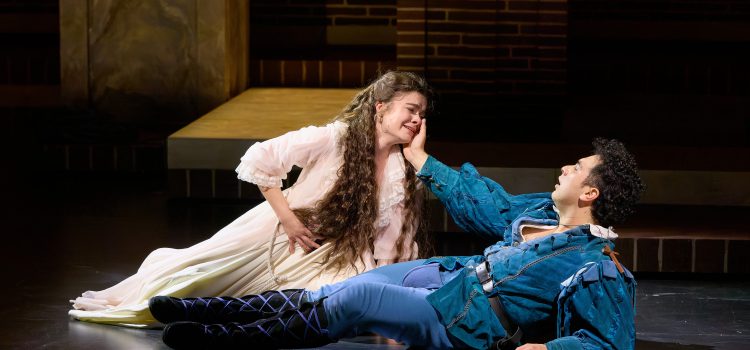
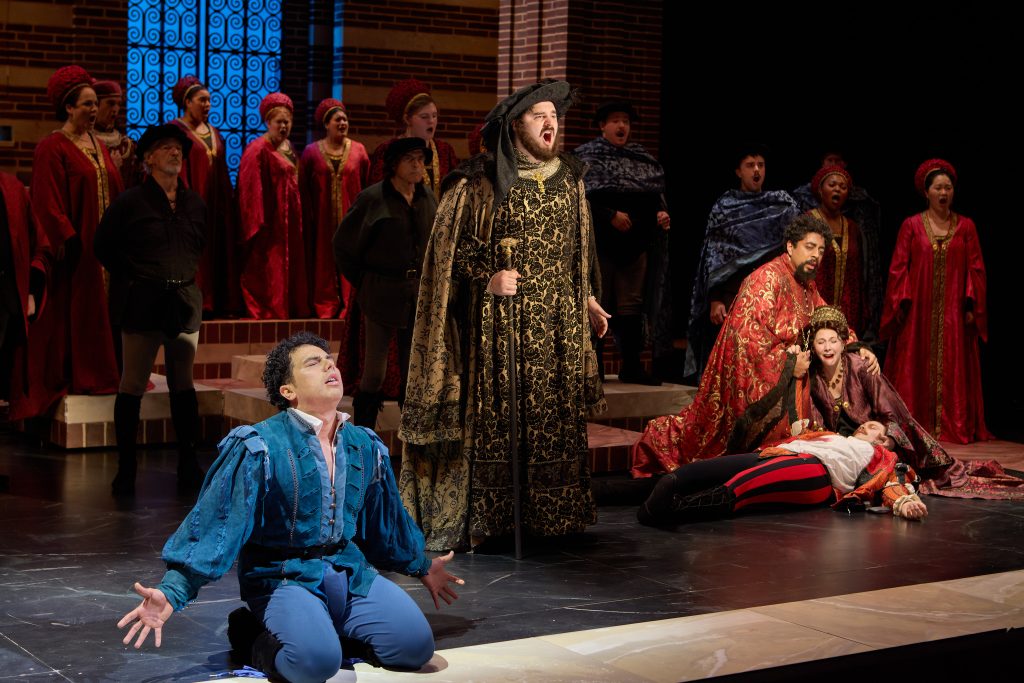
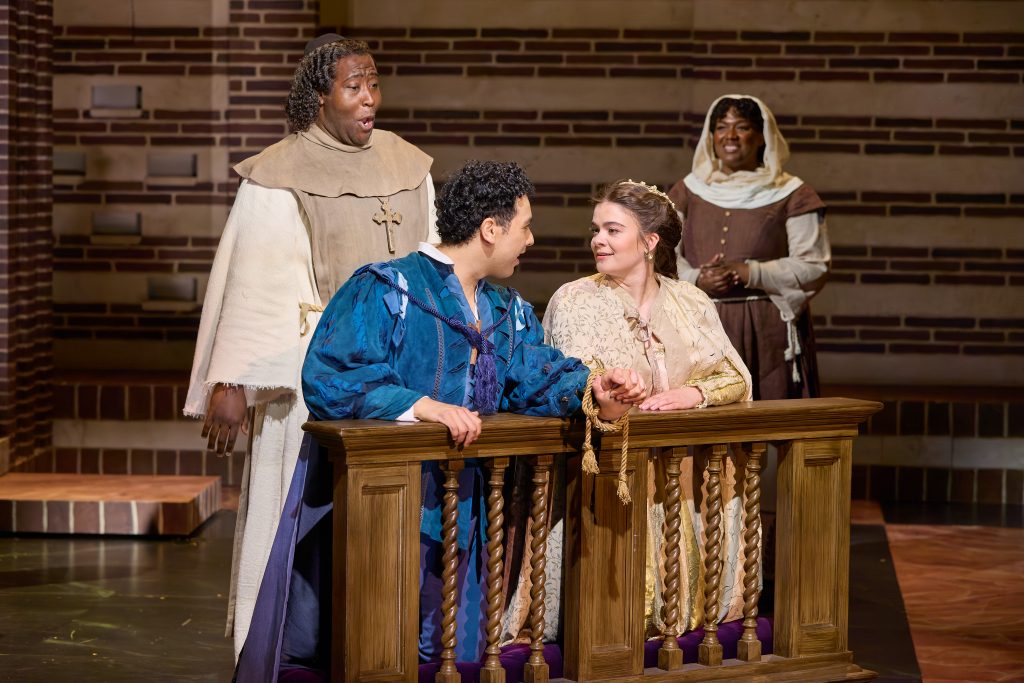
Opera Theatre of Saint Louis closes its 2026 festival season with a production of Charles Gounod’s “Romeo and Juliet” that understands exactly what makes the opera work.
Director Keturah Stickann, conductor Ramón Tebar and a superb cast place the relationship between the young lovers at the center of the evening. Every scene, every duet and nearly every design choice serves that relationship, allowing the opera’s final moments to land with uncommon emotional force.
Emma Marhefka and Leonardo Sánchez establish that foundation from their first encounter at the Capulet ball. Over the course of four duets, attraction deepens into devotion, devotion deepens into intimacy and intimacy collides with tragedy. By the opera’s final moments, the fate of Romeo and Juliet feels like a personal loss.
Although the opera bears the lovers’ names, this production finds its emotional center in Juliet. Marhefka charts the evening’s most significant journey, carrying Juliet from youthful exuberance and certainty toward hard-won understanding. Her buoyant “Je veux vivre” captures a young woman delighted by life’s possibilities and confident in her place within them.
Marhefka uses the aria to establish the emotional ground beneath the entire performance. Experience, loss and consequence gradually reshape that confidence, and Marhefka traces every step of the transformation.
Sánchez proves an ideal partner in that journey. His clear, ardent tenor and openhearted stage presence ground Romeo’s devotion in genuine feeling. He also captures the impulsiveness that repeatedly transforms emotion into action and action into consequence. Together, Marhefka and Sánchez accomplish the production’s central task. They make the relationship real.
Stickann follows the emotional architecture that Gounod built into the score. The four great duets become milestones in the relationship’s evolution. At the ball, attraction arrives with the force of discovery.
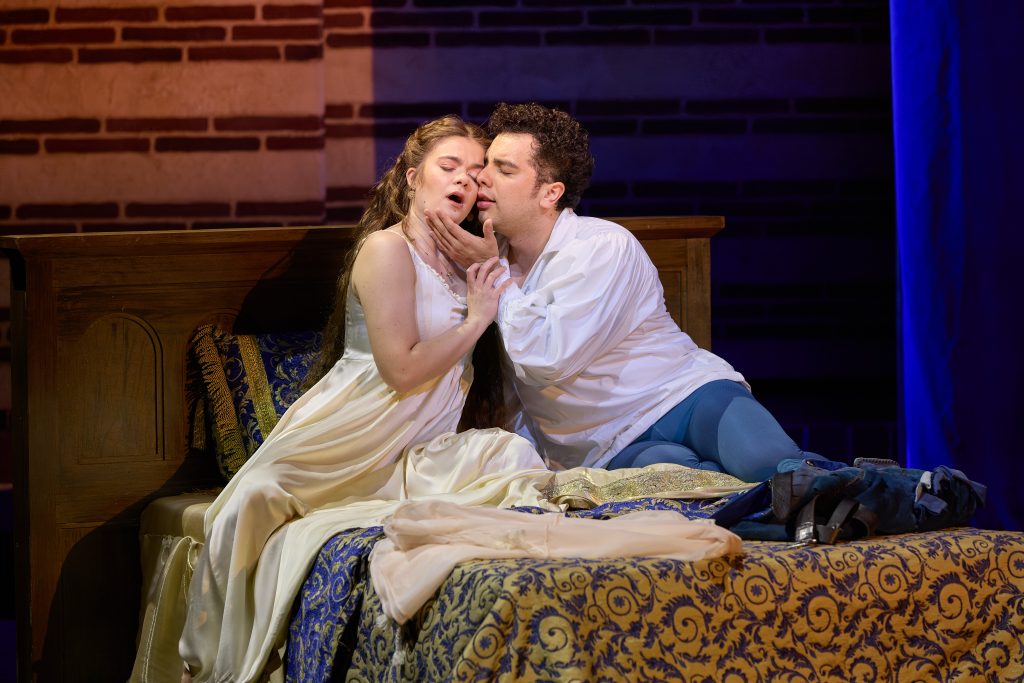
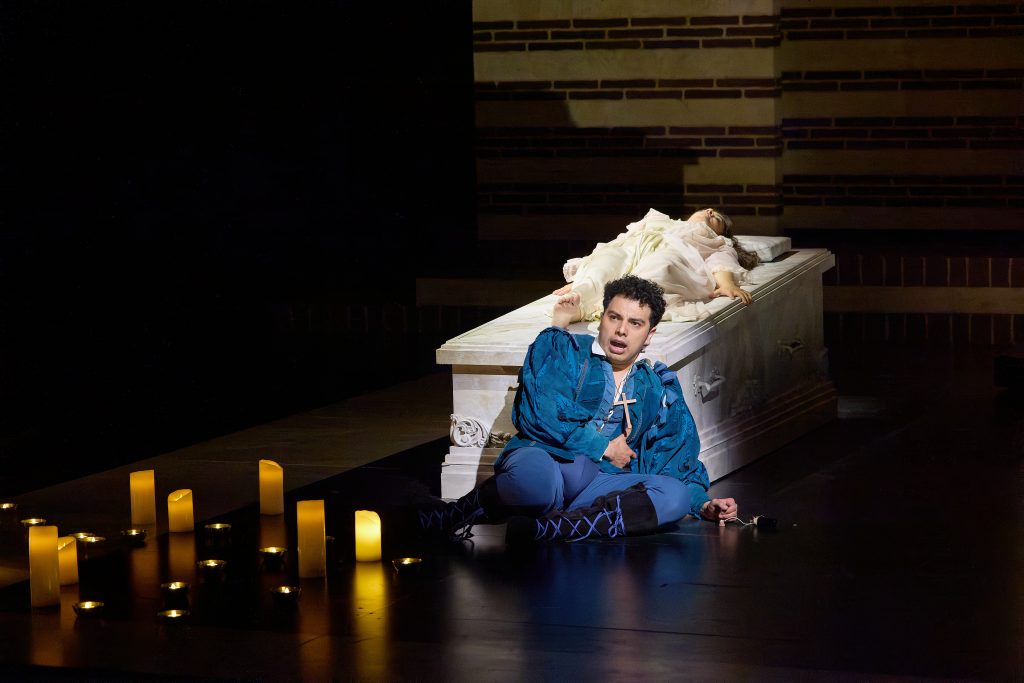
At the balcony, discovery deepens into commitment. In the bedroom, longing yields to intimacy. In the tomb, intimacy confronts consequence. Marhefka and Sánchez make each stage feel earned, allowing the relationship to grow before our eyes rather than simply advancing it from one familiar scene to the next.
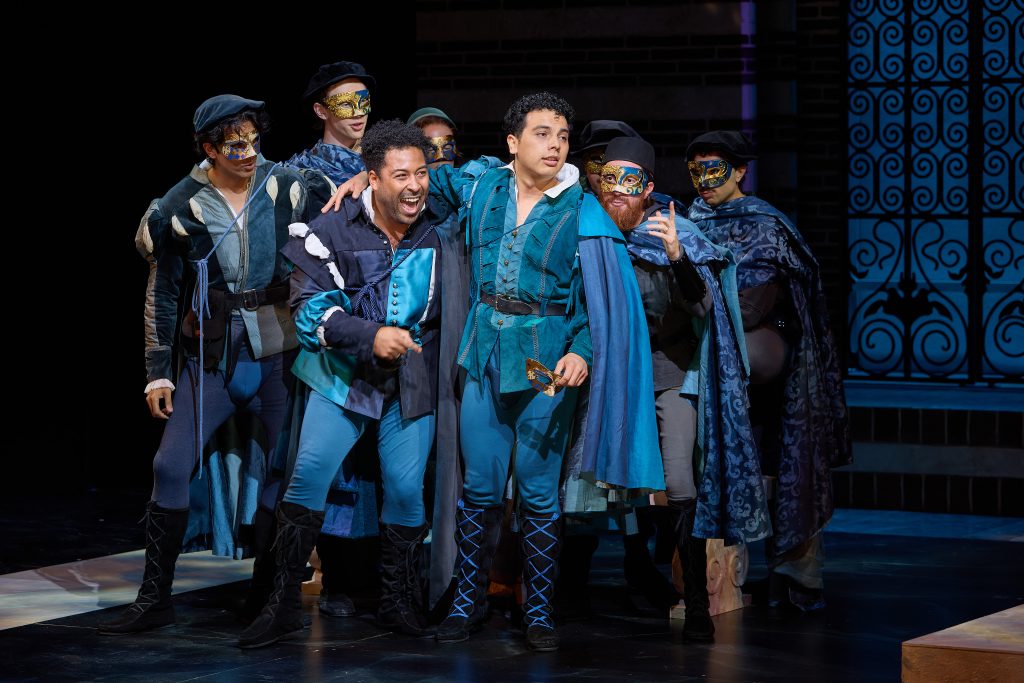
The masked ball pulses with youthful energy. Seán Curran’s choreography fills the stage with movement while Marhefka and Sánchez create an immediate connection that feels spontaneous and authentic.
The balcony scene narrows the world around them. Family loyalties, social obligations and old grievances lose their hold as the lovers construct a private universe of their own making. They move forward with complete certainty. They trust feeling to overcome circumstance.
The bedroom scene reveals the relationship at its fullest expression. The lovers move beyond longing and into intimacy. Reality waits outside the room. Neither lover recognizes how quickly it will arrive.
By the tomb scene, reality has arrived in full. The final duet devastates because the production earns it. Marhefka and Sánchez carry the emotional weight of everything that came before. The audience mourns two people rather than two symbols.
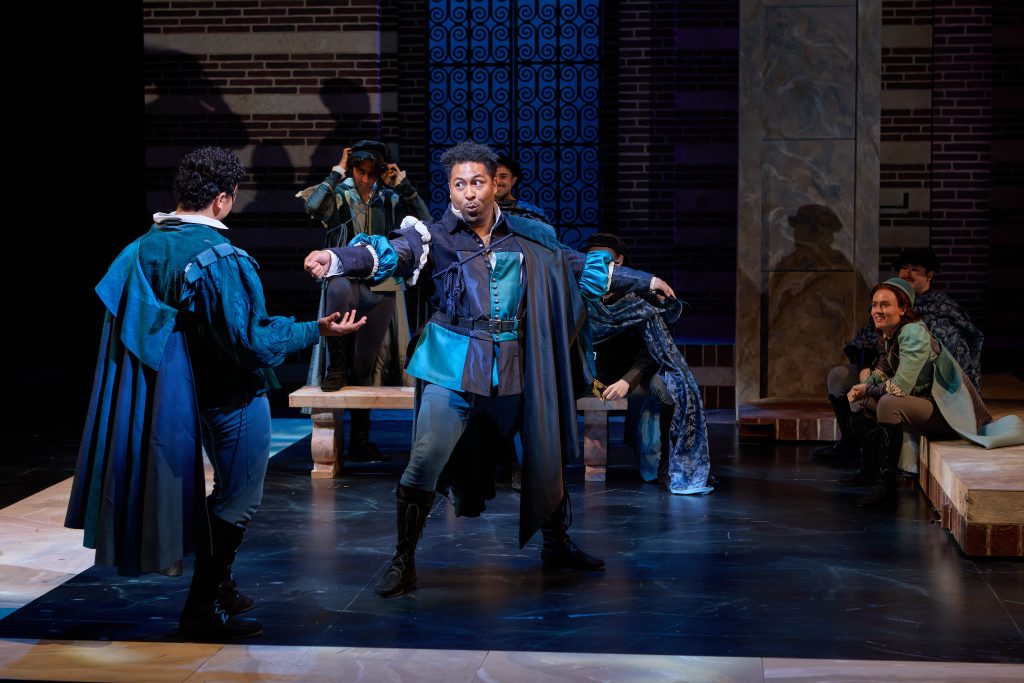
The supporting cast defines the forces pressing against that increasingly fragile private world. Benjamin Taylor’s Mercutio embodies the exuberance the production spends its first act celebrating and its remaining acts dismantling.
His Queen Mab scene sparkles with wit, confidence and youthful vitality. His death shifts the emotional temperature of the evening and signals that the world surrounding the lovers has begun to harden.
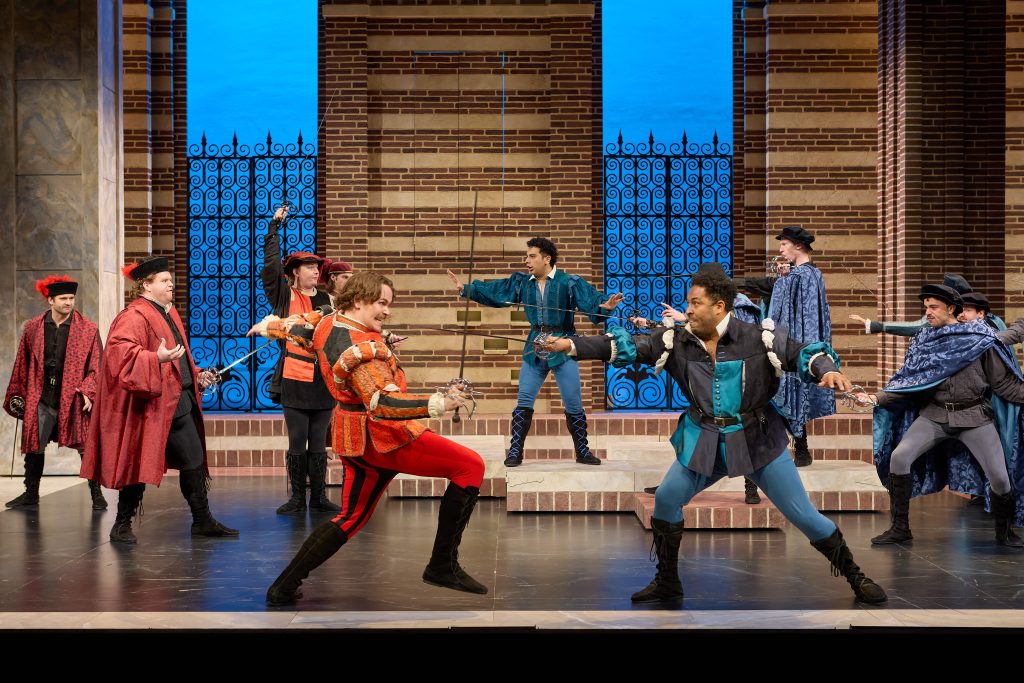
Micah Perry’s Tybalt burns hot and fast. His bright tenor matches a temperament that seems incapable of imagining a future beyond the next insult, challenge or grievance. The emotions arrive with the same force as his blade. Perry captures the moment when youthful certainty hardens into catastrophe.
Nicholas Newton gives Friar Laurence the confidence of a man who believes wisdom and planning can master events. The opera steadily exposes the limits of that confidence.
Vinicius Costa commands the stage as Lord Capulet, embodying the expectations and obligations that increasingly constrain Juliet’s choices. The certainty of the older generation proves no more reliable than the certainty of the younger one.
Edmond Rodrigues brings quiet steadiness to Benvolio, while Veronica Siebert’s spirited Stephano, Imara Ashton’s warm Gertrude, Jason Edelstein’s authoritative Duke of Verona, Cole Bellamy’s Paris, Julia Mariah Johnson’s Lady Capulet and Kevin Douglas Jasaitis’ Gregorio give shape and texture to the world surrounding the lovers.
Tebar understands that Gounod often advances the drama by suspending it. Again and again, the orchestra creates moments in which time seems briefly to stop and attention narrows to the emotional lives of the lovers. Tebar draws feeling from melody, phrasing and texture rather than sheer volume. The St. Louis Symphony Orchestra illuminates the drama without overwhelming it.
Stickann’s collaborators reinforce the production’s focus on emotional clarity. Scenic designer Liliana Duque Piñeiro embraces fluidity and metaphor. At first glance, the set’s broad expanse of masonry and geometric forms resembles a public swimming pool emptied of water.
As the evening unfolds, however, its logic reveals itself. Steps, balconies, platforms and even convenient toe holds for Romeo gradually emerge from the design, creating a flexible environment for the opera’s succession of intimate encounters. Large movable columns continually reshape the playing space, suggesting both a divided society and shifting emotional terrain.
Their movement occasionally draws attention to the mechanics of the staging, but never enough to pull the audience from the drama. The architecture rarely competes for attention. Instead, the eye naturally returns to the performers and Robert Perdziola’s richly colored costumes.
Costume designer Robert Perdziola externalizes the feud through color. The Montagues inhabit a world of blue while the Capulets move through shades of red, rose and violet. The visual contrast immediately clarifies the barriers the lovers spend the evening attempting to cross.
Eric Southern shapes mood and focus through light, while Andrew Whitfield’s chorus establishes the conflict that shadows the lovers from the opening moments.
The achievement of OTSL’s “Romeo and Juliet” lies in how completely it earns its emotional ending. By the time the lovers reach the tomb, the exuberance that animated the ball has collided with the realities waiting outside the lovers’ private world. The story remains familiar. The ending still hurts.
“Romeo and Juliet” runs June 7-26 at Opera Theatre of Saint Louis. The production concludes OTSL’s 2026 festival season, which features all four productions in rotating repertory at the Loretto-Hilton Center on the campus of Webster University. For tickets and additional information, visit Opera Theatre of Saint Louis at opera-stl.org.
Bringing together remarkable talent for an underbaked summer spectacle that trades nuance for naiveté, director Steven Spielberg’s “Disclosure Day” is neither compelling enough as popcorn entertainment nor fully invested in its existential ideas.
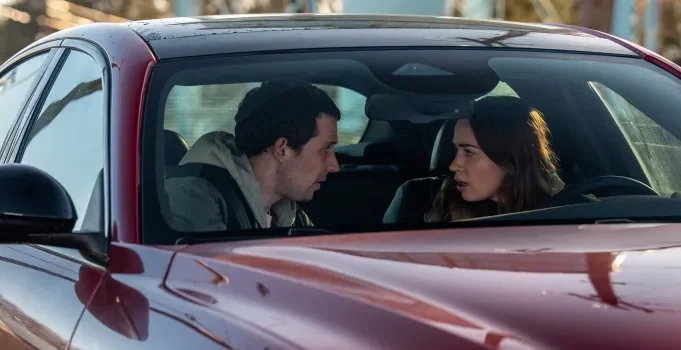
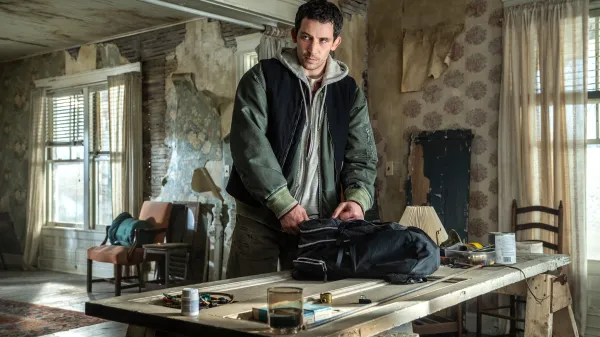
We’re thrown into the story in media res, as rogue cybersecurity specialist Dr. David Kellner (Josh O’Connor) is on the run with a backpack containing evidence of human-alien contact dating back to the Roswell Incident.
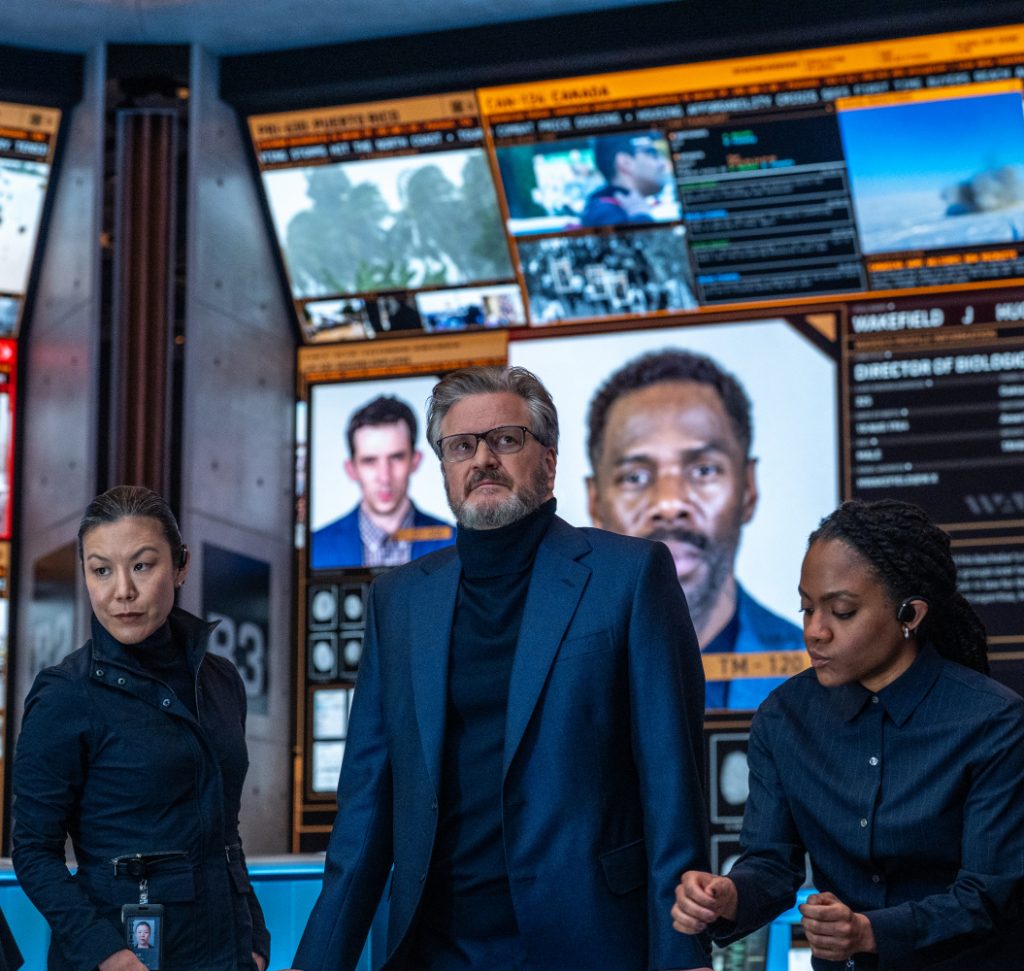
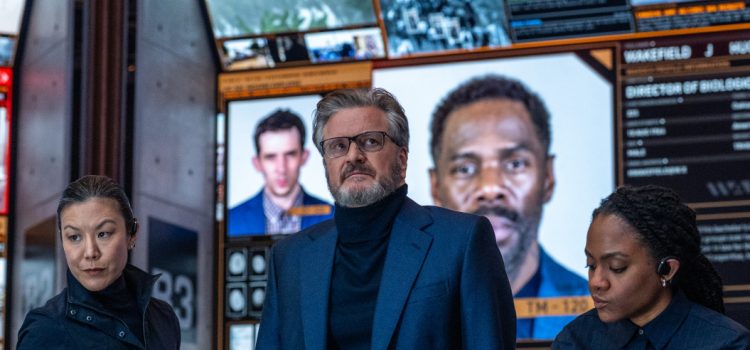
The Wardex Corporation, an arm of the US government led by the stiff-jawed Noah Scanlon (Colin Firth), desperately wants to keep the files hidden from the public.
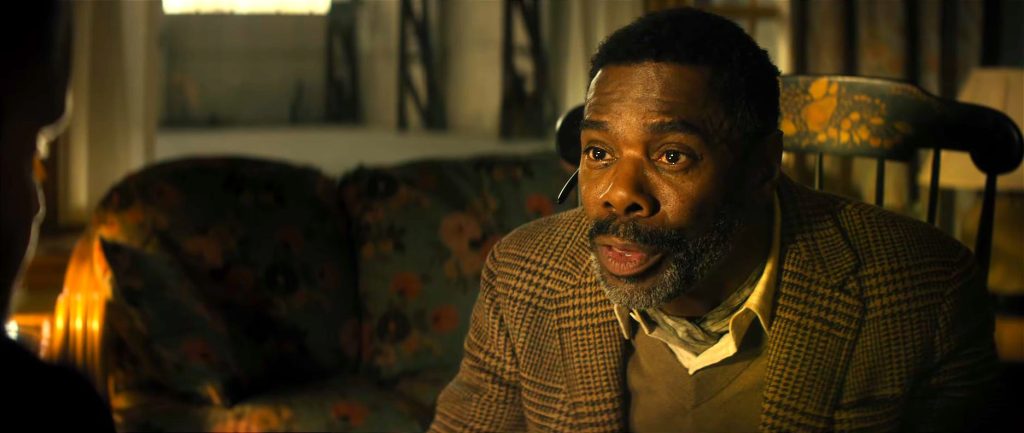
David, guided by the Morpheus-esque Hugo Wakefield (Colman Domingo), is determined for the world to know the truth, regardless of the ramifications — although society already seems on the brink of World War III due to some vague geopolitical conflict involving Russia and North Korea.
Josh O’Connor as a rogue cybertech expert.
David is accompanied by his girlfriend Jane Blankenship (Eve Hewson), who used to be a nun and is grappling with the potential consequences of what this alien “disclosure” would do for the devout’s belief in God.
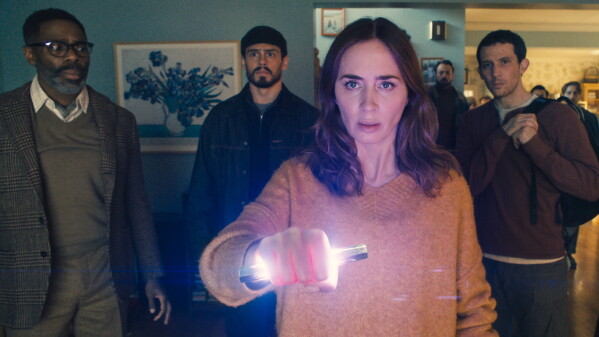
Meanwhile, Kansas City television meteorologist Margaret Fairchild (Emily Blunt) is preparing for work one day when a cardinal flies into the apartment she shares with her exhausted and passive-aggressive boyfriend Jackson (Wyatt Russell). After the bird leaves, Margaret seemingly has psychic abilities; she’s able to read minds and understand the emotions of anyone she comes across.
She’s also able to speak any language, including a bizarre click-clacking extraterrestrial tongue that she deploys during the day’s broadcast. This catches the attention of Wardex, and, soon enough, Margaret is being pursued by them. She eventually crosses paths with David, who she learns she shares a world-altering connection with.
Can they get to safety and reveal the truth before Noah’s goons lock them up and forever relegate the files to the realm of conspiracy theories?
Emily Blunt as KCweathercaster.
It’s an admittedly decent premise, especially considering the people involved. Spielberg directing, John Williams scoring, Janusz Kamiński lensing, O’Connor, Blunt, Firth, and Domingo among the cast — what’s not to like?
As it turns out, fundamental storytelling issues bring “Disclosure Day” down to size, abandoning the thorniness of “Close Encounters of the Third Kind” or even the lesser emotional pull of “The Fabelmans” for something decidedly messier and devoid of much novel to say.
It’s never less than watchable, but with Spielberg at the helm, shouldn’t we expect more than a boomeristic call for unity that forgets to give its characters much depth?
Five-time Spielberg collaborator David Koepp’s screenplay is wildly uneven, oscillating between broad, crowd-pleasing humor, bursts of cynicism, and blatant sentimentality that never coheres into a truly satisfying identity of its own.
Colin Firth (center, standing) in DISCLOSURE DAY, directed by Steven Spielberg.
To its credit, “Disclosure Day” is an ambitious film, exploring religion, childhood trauma, empathy, government surveillance, journalistic integrity, and extraterrestrial life, Spielberg’s favorite, just without digging into any topic with much detail.
Characters pay lip service to ideas in exposition-heavy sequences where debates sometimes feel like each person is arguing with themselves, stumbling into revelations without the story unfolding organically.
And we don’t actually know that much about these people to begin with, especially David, as Spielberg drops us into the fray mid-chase and expects us to forge a bond on the fly as bits of backstory are periodically spelled out for us.
Margaret fares marginally better, mostly thanks to an excellent Blunt performance that walks an entertaining tightrope between comedy and drama as her character grapples with the fear and eventual determination stemming from her newfound powers.
Blunt has great comedic timing that makes her endearing regardless of the character’s blandness, as does O’Connor, who proves himself to be a capable Spielberg everyman who can shoulder action sequences effectively. Firth, given even less to work with from a narrative depth standpoint, chews scenery as the villainous Noah.
It might sound like “Disclosure Day” is a near-total misfire, but, on a pure, in-the-moment level, there’s too much impressive craft on display to ignore. Kamiński works overtime framing elaborate (perhaps overly elaborate) long takes and action sequences that are thrilling and full of slapstick carnage.
Williams’ score provides a fitting backdrop to this paranoid thriller, sans much separating itself from the master’s previous works. And Spielberg does take some wild swings here, complete with mind control and some questionably-animated CGI animals, that are unconventional, even if their cumulative effect is more goofy than profound.
Colman Domingo helping lead the pro-alien faction.
Spielberg has a clear message to share — of how the spontaneous and unexpected can bring us together, and how, as a species, we need to learn to gradually bridge divides and “listen” to each other. “Disclosure Day” speaks to the current moment in 2026, albeit remaining old-fashioned in the ways it delivers its pleas, but it becomes difficult to take seriously amid its loopy, fragmented plotting.
It’s still mildly diverting if one can let the 145-minute runtime wash over them and not expect to have much “disclosed” that prompts more than smirks and eyerolls.
“Disclosure Day” is a 2026 supernatural sci-fi thriller directed by Steven Spielberg and starring Josh O’Connor, Emily Blunt, Colin Firth, Colman Domingo, Eve Hewson and Wyatt Russell. It is rated PG-13 for action/violence, some bloody images and strong language and the runtime is 2 hours, 25 minutes. It opens in theatres June 12. Alex’s Grade: B-
They say write what you know, and Gary F. Bell and Robert L. White, former roommates in New York City, have done just that.
They have collaborated on an original broad farce, “3 Sheets to the Wind,” which is about throwing different personalities together in a cramped three-bedroom apartment in New York City.
What happens when three ex-lovers converge in the same space, where neighbors and an out-of-town theater troupe breeze in and out? Wackiness ensues. It’s a familiar plot device not unlike popular sitcoms “The Odd Couple,” “Three’s Company” and “Will & Grace.”
Bell, founder and artistic director of Stray Dog Theatre in 2003, has built a loyal following at the intimate Tower Grove Abbey, producing a season of comedies, dramas and musicals. He and White premiered another collaboration in 2015, an original musical “Spellbound! A Musical Fable.”
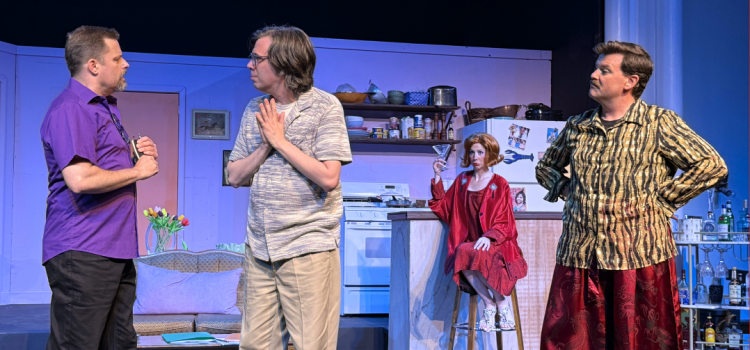
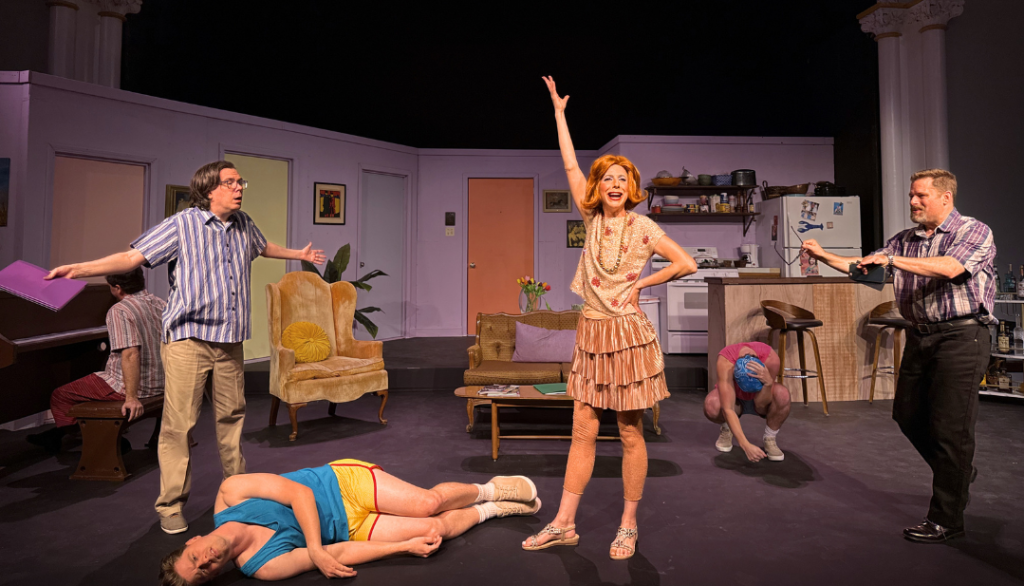
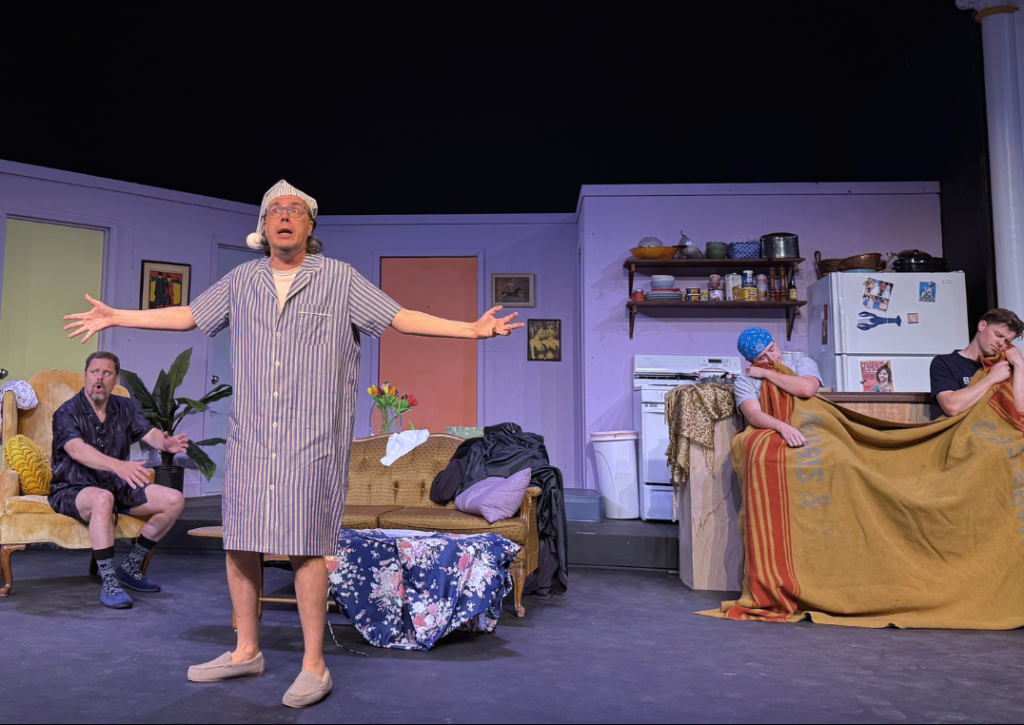
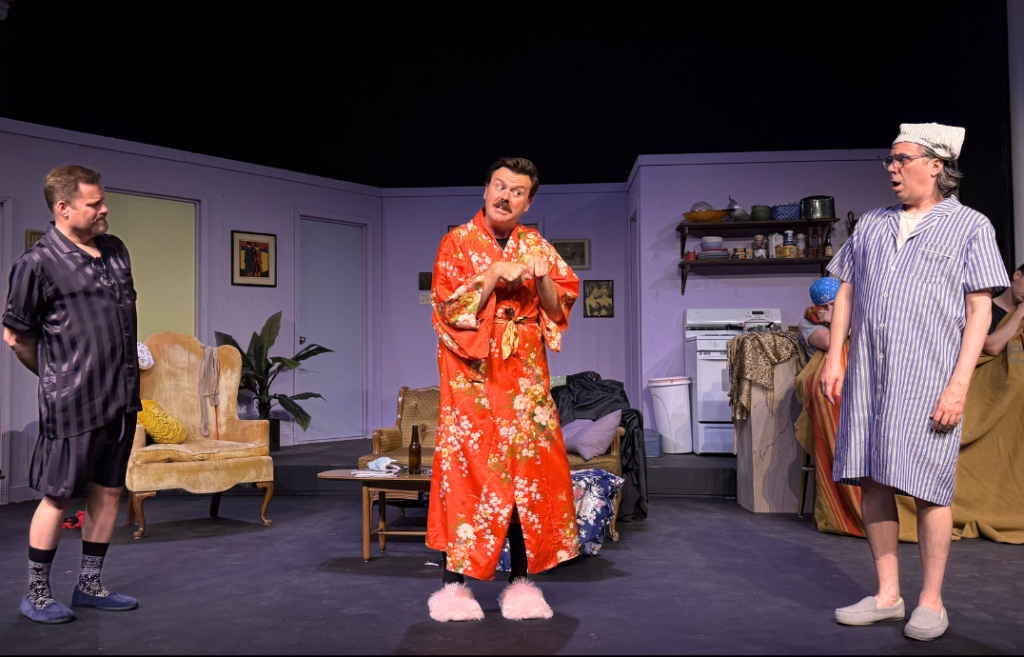
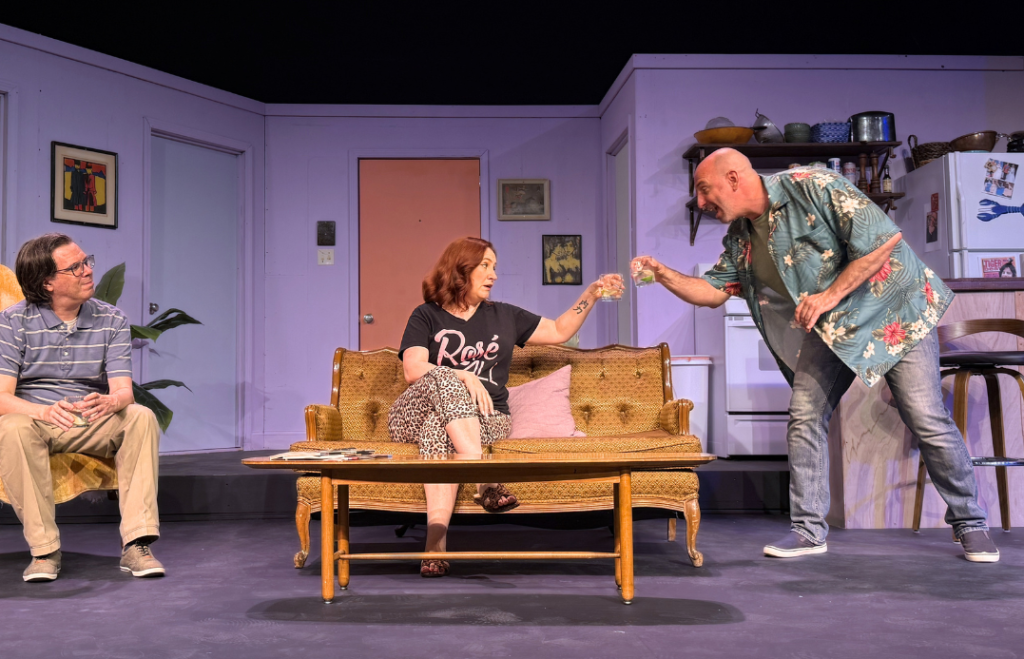
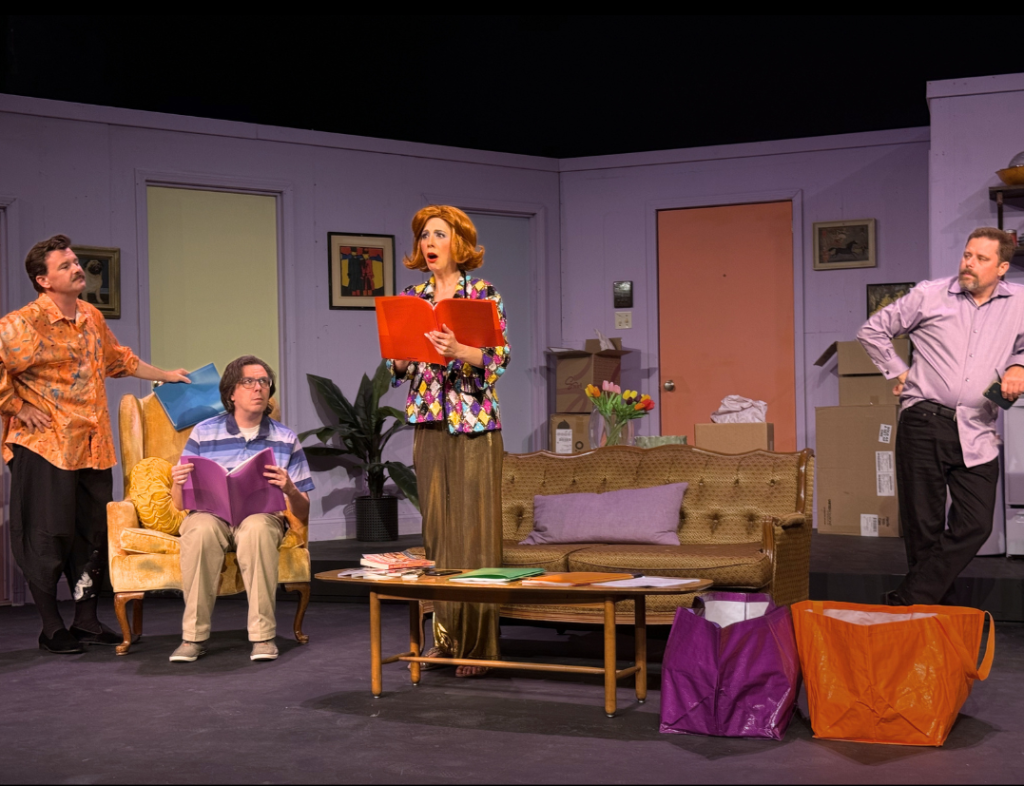
Joe Garner, Brady Stiff, Sarah Polizzi, Zack Huels and Jeffrey M. Wright. Stray Dog Theatre photo.
Long a fan of the camp style of playwright and drag queen legend Charles Busch, Bell has directed with great verve the wildly popular “Red Scare on Sunset,” “Psycho Beach Party” and “Vampire Lesbians of Sodom.”
Favoring that type of template, Bell and White blend melodrama with parodies of soap operas and Broadway musicals for this show, sprinkling witty pop culture references – especially clever theater ones – into the dialogue.
But what started out as an interesting premise dissolve into a messy story with too many over-the-top characters that have either too little to do or are entangled in nonsense, so they pull focus away from an already flimsy story.
Sadly, as good as these performers are on paper, the roles are a mixed bag of either over or under-written cartoonish characters that fail to sustain interest through two acts with an overlong runtime of 2 hours, 40 minutes with a 10-minute intermission.
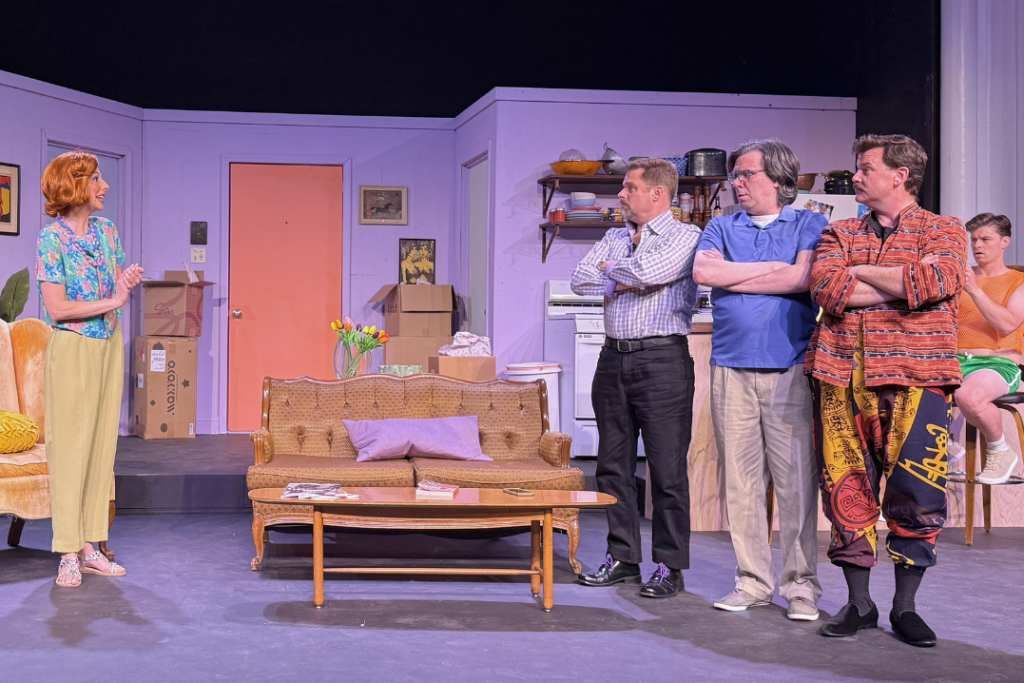
The more may not be merrier in ‘3 Sheets to the Wind.” Stray Dog Theatre photo.
The 9-member cast, a hefty blend of remarkably talented local theater artists, some with St. Louis Theater Circle nominations and wins to their credit, are not having their finest hour, even though they appear to be giving each part their all as consummate professionals.
Improv master Joe Garner, as struggling writer Oliver Morton, and versatile Jeffrey M. Wright, as television therapist Aaron Addison, for lack of a better word, are playing the ‘straight’ guys in this oddball circus. They’re the only ones whose characters seem bland, their wild pajamas notwithstanding.
Aaron plans to move back in with Oliver, as platonic roommates, to help with Oliver’s dire financial straits. Wright, now a reality TV personality, tells Oliver that he and his partner are on the rocks.
Enter the goofy, very theatrical Danny Winslow, embodied by the nimble comic actor Mike Wells, who’s fast-talking spiel is a cross between Harold Hill in “The Music Man” and the con artists in “Dirty Rotten Scoundrels.”
Wright, Mike Wells, Garner. Stray Dog Theatre photo.
He arrives needing a place to stay, because he’s brought good news with him. Once a couple, the pair collaborated on a high-concept musical, which flopped, leaving Oliver in massive debt (and very angry). Lo and behold, Danny announces that a wealthy benefactor wants to remount the show in Guam and Yap, part of Micronesia in the Western Pacific.
But Danny is not alone — he has three actors in tow: a flamboyant diva and two young very fit dancers. Danny’s raring to revise their songs with Oliver, as the clock is ticking.
But more may not be merrier. Larina Delagostino (Sarah Polizzi) is an unfiltered prima donna without any boundaries who specializes in treating everyone like servants, drinking too much, yammering about her life in the theater, and dipping in not-safe-for-work territory.
That type of exaggerated role is Polizzi’s forte, but the character is so off-putting and rambling that she can’t muster any sympathy, and her affectations are a cross between Norma Desmond in “Sunset Boulevard” and a Southern belle, sporting an ill-fitting red wig. Larina is soon wearing out her welcome, not to mention the cringy bathroom humor at her expense.
Oliver with his neighbors Maddie and Cal O’Connor (Sarajane Clark and Jason Meyers. Stray Dog Theatre photo)
Oliver’s busybody and TMI neighbors, Maddie and Cal O’Connor (Sarajane Clark and Jason Meyers), stop by, either for cocktails or to dish, as Maddie is fond of telling everyone else what they should do. The two young guys trying to make sense of all the chaos are Zack Huels as Abe Feldman and Brady Stiff as Jake Hershman.
Wells, clad in outlandish outfits designed by Colleen Michelson, incorporates physicality as this silly trickster, an extreme sidekick in the mold of Cosmo Kramer. But he is dead serious about one thing – Danny recommends the playwrights ‘kill their darlings.’ He encourages Oliver to nip and tuck, and that’s good advice for the play itself.
Rob Lippert’s set design includes multiple doors, a la “Lend Me a Tenor” and “Noises Off!”, for comedic purposes. Tyler Duenow took care of the lighting design. As usual, sound designer Justin Been selected peppy and upbeat musical transitions including TV theme songs.
Wells, Garner, Polizzi, Wright. Stray Dog Theatre Photo.
For “3 Sheets to the Wind” to work, the well-intentioned playwrights need to tighten the rambling story, for when Liz Michel shows up as Russian-accented emissary Zolda (think Natasha of “Rocky and Bullwinkle”) near the two and a half hour mark, it goes off the rails.
Suddenly, we have spies, a dictator who’s madly in love with Larina, and a charade about why the show is going overseas, all told in a very long-drawn-out monologue. Shades of the Cold War? Isn’t Guam a U.S. territory? What am I missing? By this point, connecting the dots has become confusing, and the sound isn’t helping these dialogue-heavy sequences, especially with accents in play.
In this case, less would be far more appealing. Snip some tangents and characters for a less bumpy dynamic and inject more likability to connect with the audience.
Stray Dog Theatre photo.
Besides the shenanigans going on, the play takes place in the present-day, in August and September, when NYC is experiencing a heat wave. Is that weather factor necessary?
Old partners working again on a show after much time apart, when old resentments surface and new acquaintances appear, would be a terrific starting point going back to workshop.
Stray Dog Theatre presents “3 Sheets to the Wind” from June 4 through 20 at Tower Grove Abbey, 2336 Tennessee Avenue, St. Louis. Performance dates are Thursday through Saturday at 8 p.m., with Sunday matinee performances at 2 p.m. on June 7 and 14. For more information, visit www.straydogtheatre.org
A personality-powered gem, “The 25th Annual Putnam County Spelling Bee” is a rambunctious musical comedy that celebrates American meritocracy, eccentric nerds and freak flag waving.
Produced with extra oomph by Stages St. Louis, a sagaciously cast sextet has nimbly mastered wordplay and improvisations in this offbeat musical that’s as accessible to logophiles as it is to class clowns.
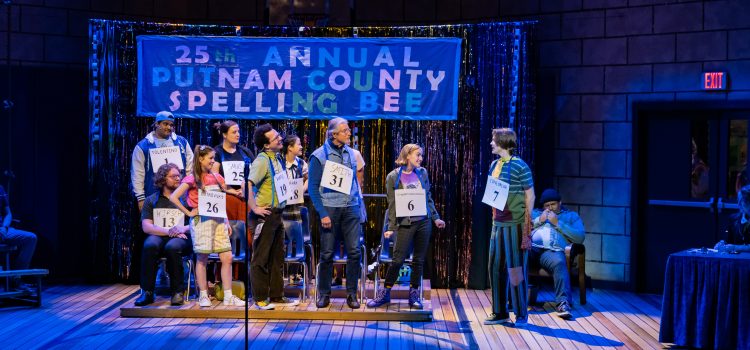
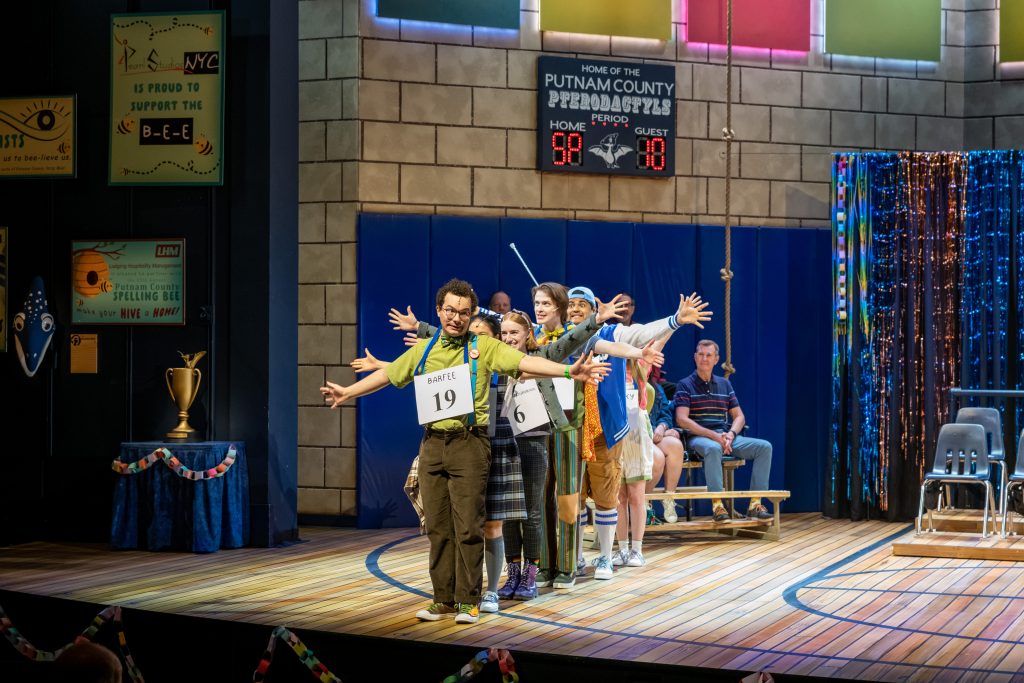
Inside a typical middle school gymnasium, dweeby sixth graders compete for a $200 savings bond, a shot at the national bee, and a towering trophy.
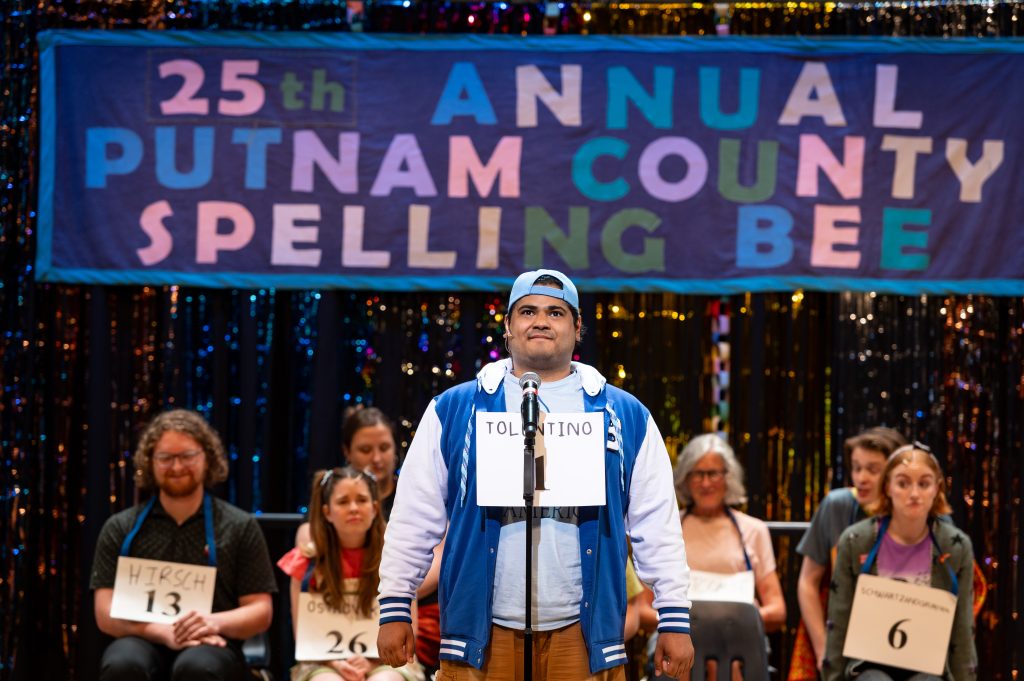
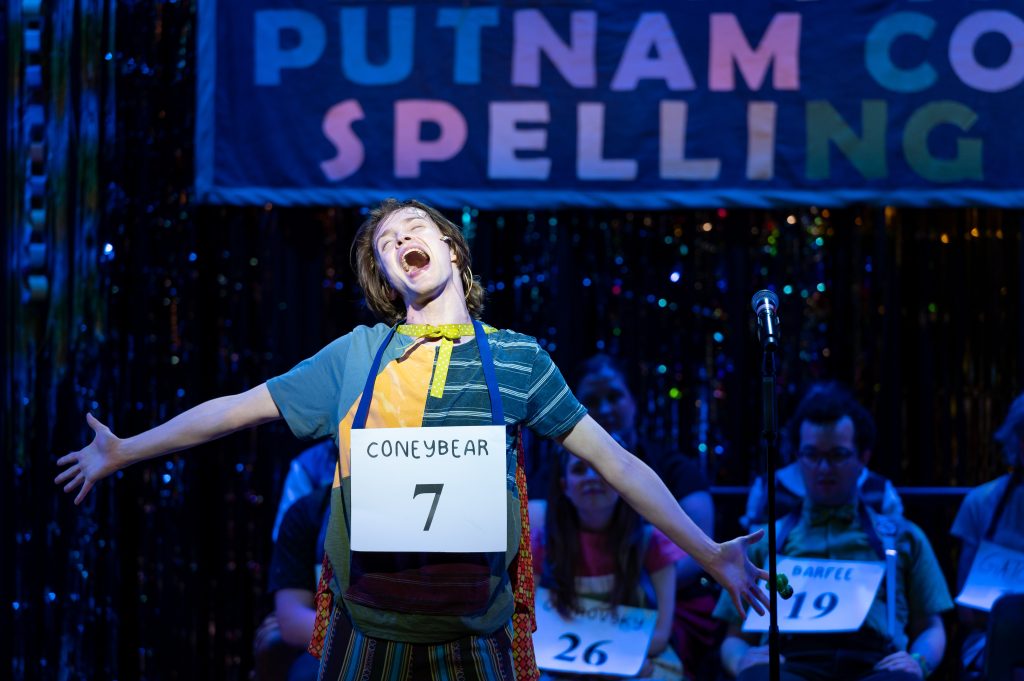
All triple threats, this enthusiastic cast has got game – showing heart, humor and humanity. The boys are Michael Schimmele as returning champ Charlito “Chip” Tolentino, who is struggling with puberty; Matthew Cox as Leaf Coneybear, the wide-eyed home-schooled son of hippies; and Bryce A. Miller as showboating misfit William Morris Barfee.
The Spellers are ready to rock. Photo by Phillip Hamer.
A running gag is the constant mispronunciation of Bar-Fay, because of an accent aigu, and not Bar-Fee.
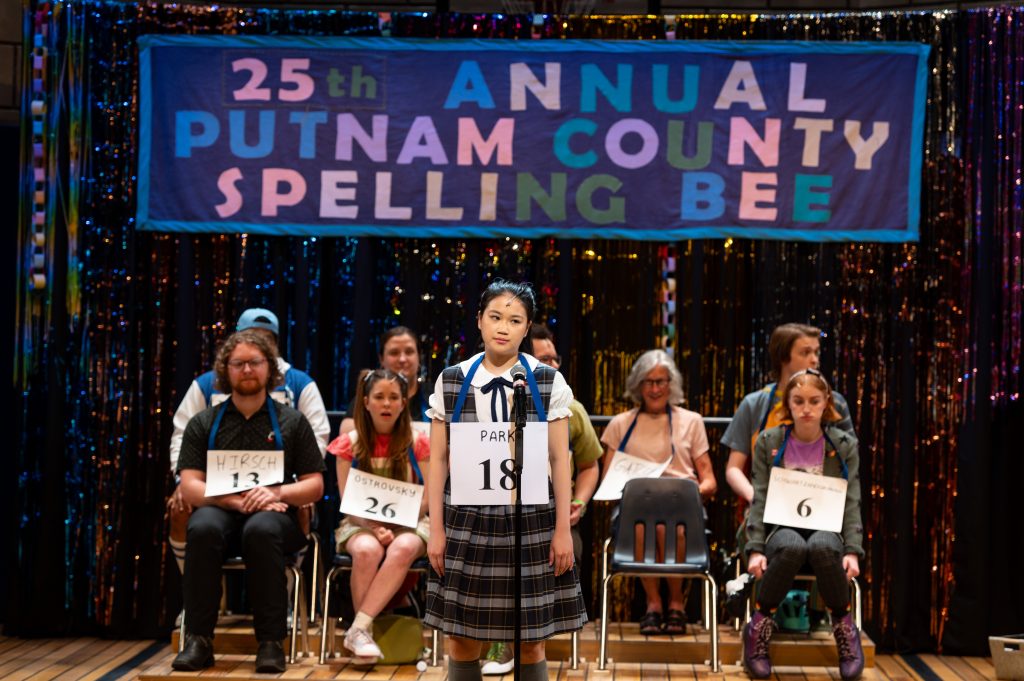
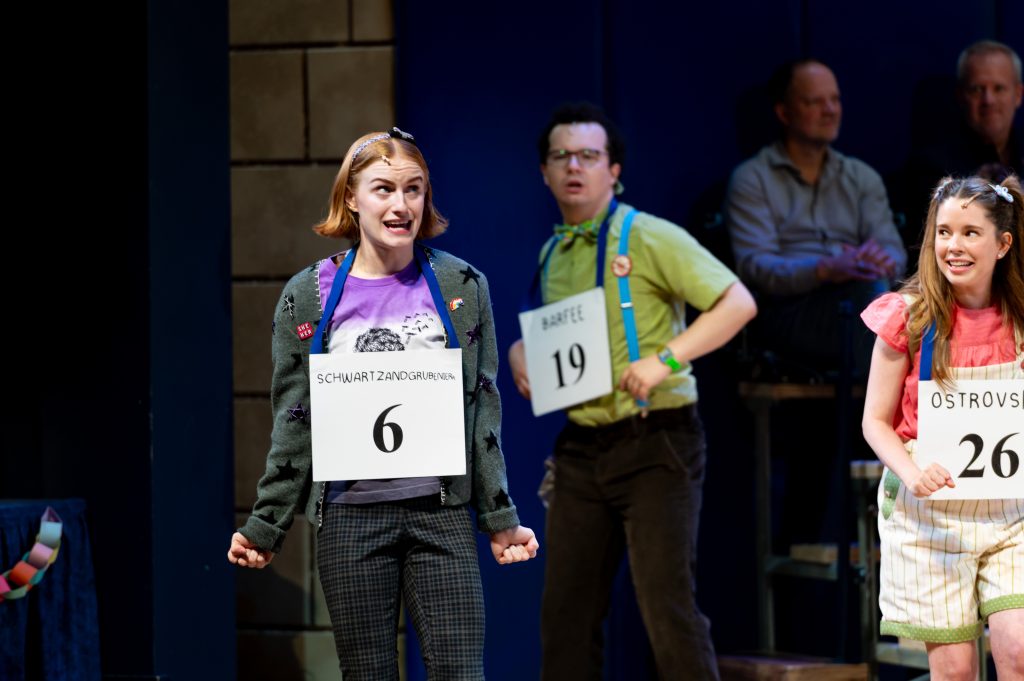
The girls are Abigail Isom as high-strung Logainne SchwartzandGrubenierre, a positive political activist pushed by her two dads to be best; Alexis Kinney as exuberant wordsmith Olive Ostrosky, whose mom is in India and dad is always working; and Sarah Wilkinson as pedantic Marcy Park, an over-achieving transfer student.
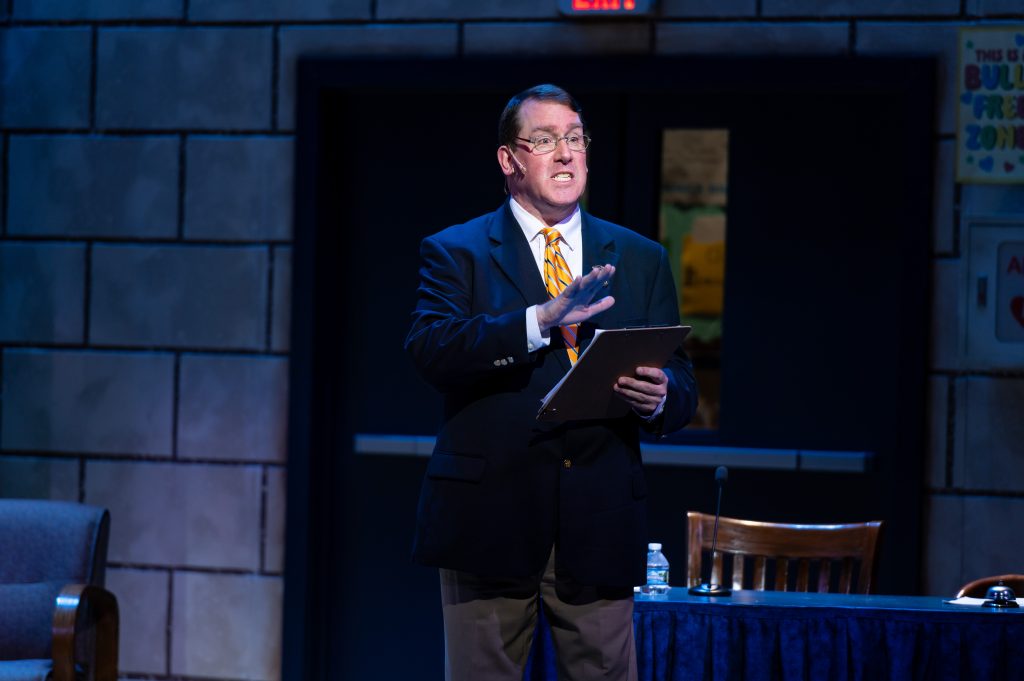
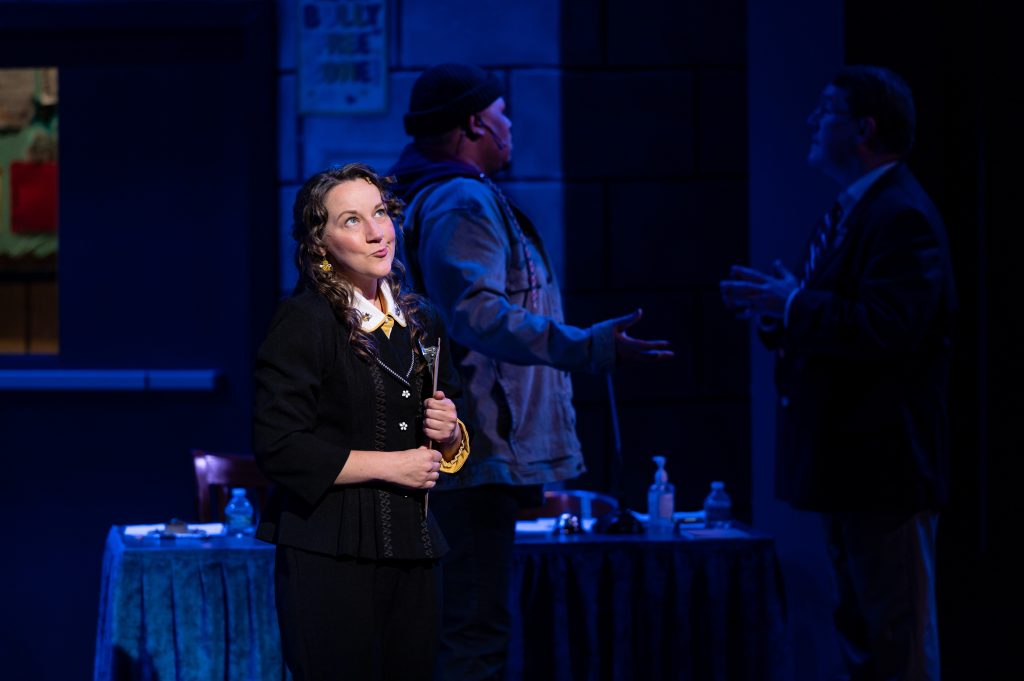
The annual event is a big deal in the town, with three adults in charge – ‘comfort counselor’ Mitch Mahoney (Omega Jones), an ex-con who gives the eliminated contestants a juice box and a hug; former champ and returning moderator Rona Lisa Peretti (Jennifer Theby-Quinn), a successful realtor who enjoys reliving her glory days; and Vice Principal Douglas Panch (Christopher Hickey), who has returned as a judge after personal time off to work out some ‘things.’
Their innuendos and double entendres elicit laughs – and the show’s mature content is aimed for a PG-13 audience.
Christopher Hickey as vice-principal. Photo by Phillip Hamer.
The catchy music and lyrics by William Finn, of “Falsettos” and “A New Brain,” give each character their moment to shine and explain their character’s drive or idiosyncrasies.
Their signature songs are Leaf: “I’m Not That Smart.” Olive: “My Friend, The Dictionary.” Marcy: “I Speak Six Languages.” Logainne: “Woe Is Me” and Chip: “Chip’s Lament.”
The coming-of-age stories about their home lives are poignantly delivered, and they perform the funny parts with gusto. The spellers have crafted realistic kids – not to mock but to enjoy their characteristics and identify with their emotions, and you root for them to stay golden.
Barfee, unfortunately hampered by one working nostril, has a peculiar way of spelling out the words – with his “Magic Foot.” (Fun fact: Dan Fogler, of “Fantastic Beasts,” won a Tony Award for originating the role).
Sarah Wilkinson as Marcy Park. Photo by Phillip Hamer.
The convivial show, workshopped into an off-Broadway hit, transferred to Broadway in 2005 – and was nominated for six Tony Awards, winning two (book by Rachel Sheinkin, featured actor). It was originally conceived by Rebecca Feldman and based upon “C-R-E-P-U-S-C-U-L-E,” a play by her improv collective, The Farm. Additional material was supplied by Jay Reiss.
The fluid script allows producing companies to insert topical and local references. It also includes audience participation, and patrons can fill out a slip in the lobby before the show.
Four names are drawn backstage, so no one is tipped off in advance, and they join the spellers to take their turn at the microphone. All good sports, this is a key element to the fun, producing good-natured laughter from the audience. No special treatment – they might get to spell “Cow” or a consonant heavy four-syllable word.
The crowd’s perspicacity was evident on opening night June 3 and embraced the experience. The ingenious construction keeps it fresh, and that spontaneity is appealing.
Abigail Isom, Bryce A. Miller and Alexis Kinney. Photo by Phillip Hamer.
Detail-oriented co-directors Ron Gibbs and Gayle Seay also co-choreographed the show, achieving a terrific level of energy. The upbeat title song introduces the characters, and “The Spelling Rules” brings out their quirks and “Pandemonium” is just that.
In stand-out moments, dynamic Wilkinson showcases her gymnastic skills in her peppy number “I Speak Six Languages” and her prayer for change, “Jesus,” while gifted comic actors Miller and Kinney display charming chemistry leading up to and including their duet “Second.”
Another highlight is the tender ballad “The I Love You Song” that heart-tugging Kinney sings with her parents – as the absentee mom, Jennifer Theby-Quinn’s strong mezzo-soprano is in lovely harmony with workaholic dad Omega Jones’s warm vocals.
As Rona, Theby-Quinn confidently commands the stage in “My Favorite Moment of the Bee,” and in two reprises. As Mitch, Jones demonstrates expressive vocals in “The Prayer of the Comfort Counselor” and in “Woe Is Me” reprise with the vivacious Isom.
Michael Schimmele as Chip. Photo by Phillip Hamer.
And Schimmele is a trouper with his sudden onset of a puberty issue, and feigning discomfort in his public humiliation. If you know, you know. (Refer to mature rating).
The junior high vibes are boosted by scenic designer Rachel Seabaugh’s school gymnasium set that is a nifty flashback to every community event ever, with sly nods to the civic organizations and school sports teams that are delightful to notice.
Lighting Designer Sean M. Savoie’s expertise is apparent in the harsh gym glare, which shifts to the warm intimate interaction moments. Sound designer Hankyu Lee’s work is remarkably crisp, without any dead spots in the KPAC’s Ross Family Theatre.
Costume Designer Cat Lovejoy has jauntily defined every character through their distinct outfits, and the addition of a makeshift cape and roller-sneakers for Leaf Coneybear is inspired. Cox gives his movements extra flair with those accessories.
Matthew Cox as the free-spirited Leaf Coneybear. Photo by Phillip Hamer.
Music Director Michael Kaish smoothly kept the tempo on track, and is on one keyboard, joined by Randon Lane on a second keyboard, Lea Gerdes on reeds, Marcia Erwin on cello and Jonathan M. Taylor on percussion.
The Bee is a buzzy, playful communal experience, one that celebrates smart kids without any stigma – a proud revenge of the nerds, and the relatable rituals of youth. To be a part of the glee expressed by cast and crowd alike will lift spirits of any age.
Note: Understudies include Julie Hanson, Lillie Self-Miller, Bradford Rolen and Connor Kelly-Wright.
Stages St. Louis presents the musical “The 25th Annual Putnam County Spelling Bee”through June 28. Performances take place at the Kirkwood Performing Arts Center, 210 E. Monroe Ave. For more information: stagesstlouis.org.
Jennifer Theby-Quinn as Rona, with Omega Jones as Mitch in background. Photo by Phillip Hamer.
Earthlings, we may not be alone. If you believe that aliens have visited our planet, “Disclosure Day” reinforces that opinion. Just don’t expect the big-ideas film to effectively connect dots or spark much wonder.
Unlike director Steven Spielberg’s superior supernatural sci-fi thrillers, the classics “E.T.: The Extra-Terrestrial” and “Close Encounters of the Third Kind,” this mostly incoherent and inconsistent ramble fails to pull heartstrings and mutes the director’s trademark shock and awe.
Spielberg front-loads the action with shadowy figures at breakneck speed, when whistleblower Dr. Daniel Kellner (Josh O’Connor), rescues his girlfriend Jane (Eve Hewson) from black-clad goons working for the Wardex Corporation.
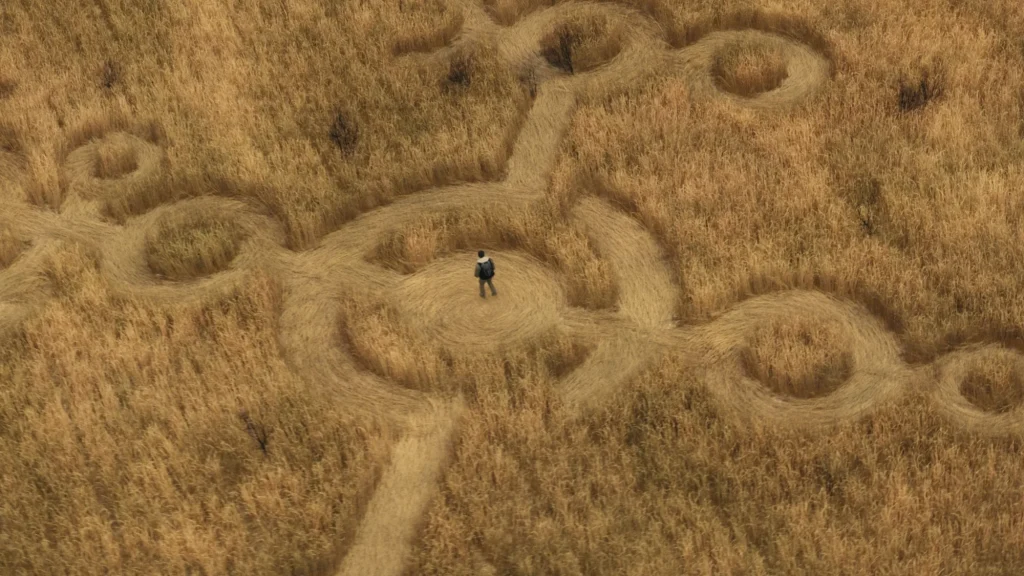
As part of a rogue movement led by virtuous Hugo (Colman Domingo), Kellner has absconded with archival film footage of aliens here since the ‘alleged’ UFO crash in Roswell, N.M. in 1947. They plan to tell the world at the same time, but Wardex is in cahoots with the government to make sure the evidence remains top secret.
Josh O’Connor plays a cybersecurity expert on the run in “Disclosure Day.”
The chase is on, from farmhouses to backroad motels, and even a convent. Colin Firth is the stony but dapper villain Noah Scanlon, who doesn’t think the world can handle the truth and gets doomsday vibes.
This heartless honcho hell-bent on covering up can manipulate space and time, and is in possession of some alien teleporter gizmo, not without side effects (or explanations).
Meanwhile, Emily Blunt is Margaret Fairchild, an ambitious meteorologist who lives with her musician boyfriend Jackson (Wyatt Russell) in Kansas City. One morning, a red-feathered Cardinal flies into their spacious loft, stares her down, and afterwards, she can speak foreign languages and telepathically knows what is happening in people’s hearts and minds.
Whoa. That is a gamechanger, and she and Daniel are destined to team up. They share an inexplicable psychic bond, similar childhood memories, and keep running.
Emily Blunt is a meteorologist in Kansas City.
O’Connor’s Daniel is a man of many secrets, and his girlfriend has a few too, but backstories are slim – and Firth’s stony villain only glowers, glares and inflicts pain. While this cast of heavy hitters is appealing, no one stands out besides Blunt. It’s one of her best performances.
After 2 hours and 25 minutes of clunky detours, screenwriter David Koepp’s dense mystery, from a story by Spielberg, mercifully wraps up in an iconic yet implausible Spielbergian way. But lacks a wow factor, to leave us wanting more.
This brainiac blockbuster ultimately fumbles because it has too many elements to process. Koepp, one of the most successful screenwriters in the modern era (“Jurassic Park,” and last year’s taut thriller “Blackbag”) has missed before – “Indiana Jones and the Dial of Destiny” and “Indiana Jones and the Kingdom of the Crystal Skull” among them.
The search for intelligent life in the universe is a staple of pop culture sci-fi, and “The X-Files” kept us riveted for years. In recent years, government agencies have posted records on UAP (Unidentified Aerial Phenomena), no longer referred to as UFOs, to identify mysterious events in the sky. There is that reality check.
Colman Domingo, Tommy Martinez, Emily Blunt and Josh O’Connor are part of an all-star cast.
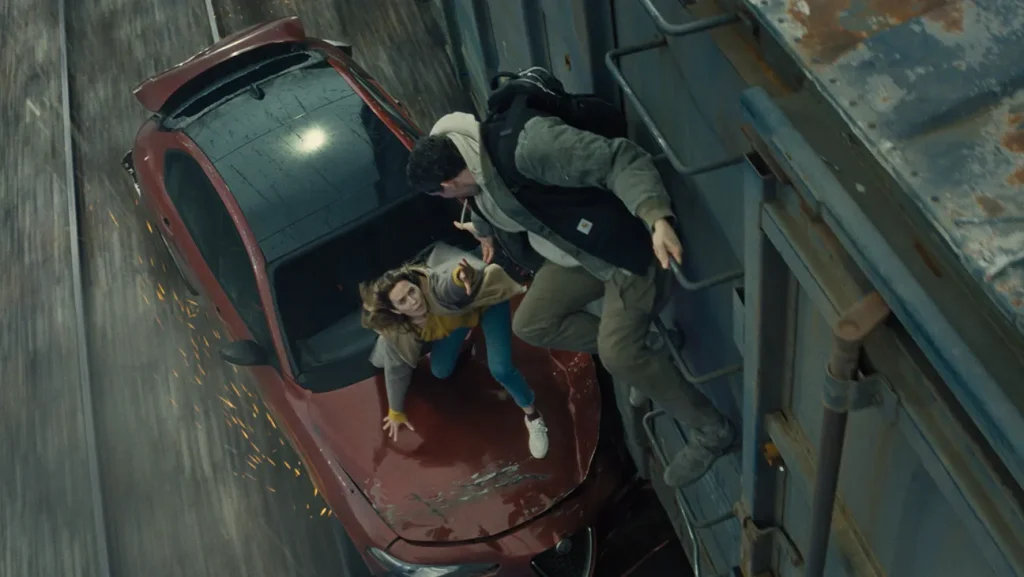
It’s easy to be dazzled by the dream team cast and the elite artisans who worked on creating a spectacle – Janusz Kaminski’s camerawork is impeccable, and so are Adam Stockhausen’s production designs. A nail-biting car-train collision is shades of Indiana Jones in his prime, but fleeting moments do not make a movie.
For his 30th feature film collaboration with Spielberg, John Williams composed a subtler, more minimalist score rather than his familiar grand sweeping melodies.
Arguably among the Mount Rushmore of directors, Spielberg’s best films extol ordinary people in extraordinary situations. But he doesn’t always reach the stars (“The BFG,” “Ready Player One,” “1941.”) Here, the all-important heart-tugging beats are missing.
Are we seeing anything fresh, or just a fictional rehash of myths and weaponizing misinformation? The truth is out there, but will we ever know it?
Big action scene in a very long chase movie..
And why would belief in other life forms be a dealbreaker for your faith? And why do aliens only visit America? Too many questions and not enough answers, but then again, I tend to overthink science fiction plots.
For those expecting Spielberg magic, the highly anticipated “Disclosure Day” is a letdown.
“Disclosure Day” is a 2026 supernatural sci-fi thriller directed by Steven Spielberg and starring Josh O’Connor, Emily Blunt, Colin Firth, Colman Domingo, Eve Hewson and Wyatt Russell. It is rated PG-13 for action/violence, some bloody images and strong language and the runtime is 2 hours, 25 minutes. It opens in theatres June 12. Lynn’s Grade: C.
Patricia Racette’s production finds operatic scale, emotional truth and remarkable balance in Williams’s enduring tragedy.
By CB Adams
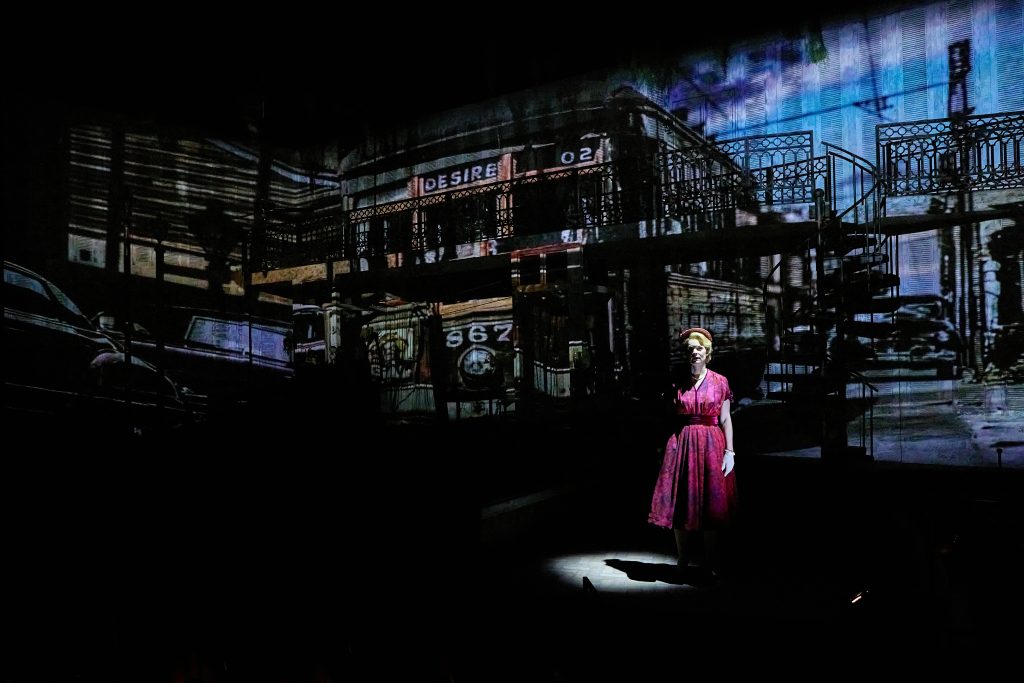
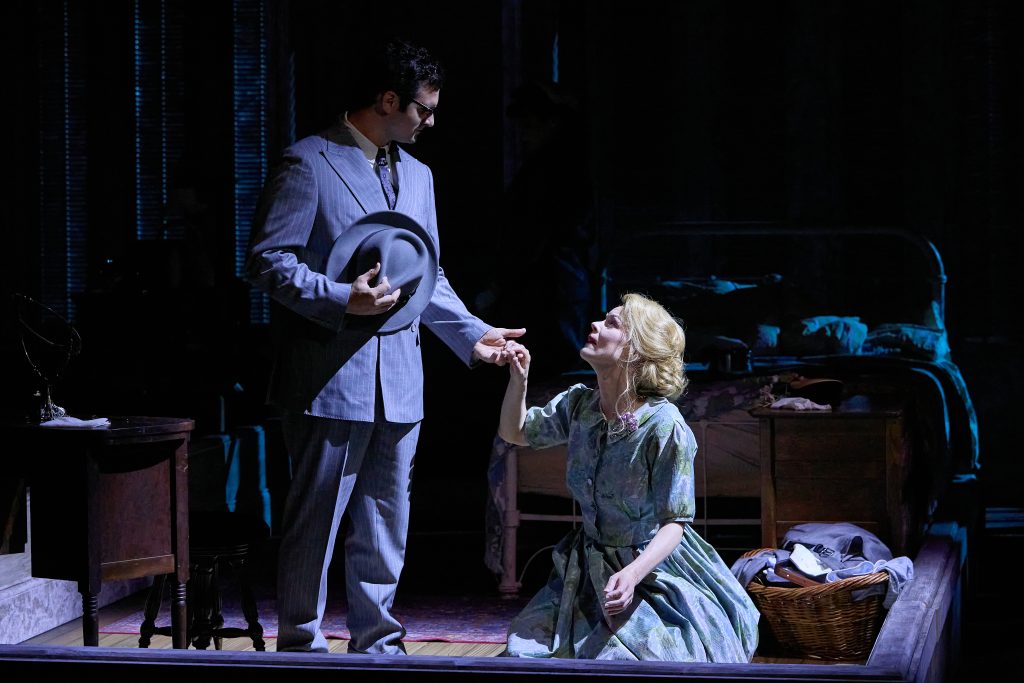
Andrew Boyce’s scenic design announces Opera Theatre of Saint Louis’s intentions before a note is sung. Towering walls of weathered white shutters dominate the stage, instantly evoking New Orleans while suggesting something more confining.
Projected across those walls, a black-and-white montage culminates in a huge streetcar lumbering toward the audience with the slow, inexorable force of a locomotive.
It is a striking image and an honest one. We know where this story is headed. Racette and Boyce embrace that inevitability from the outset. There is no attempt to disguise the destination. Some productions try to improve the classics. This one trusts one.
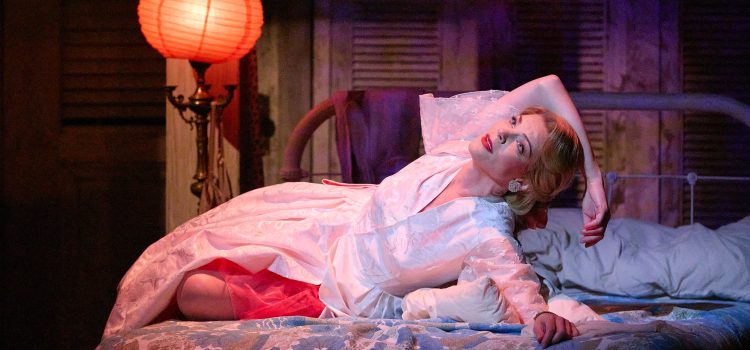
André Previn’s opera, with a libretto by Philip Littell, remains remarkably faithful to Williams’s play. Racette embraces that faithfulness as an artistic choice. She trusts Williams’s characters, conflicts and hard-earned understanding of human weakness. The result never feels preserved under glass.
Blanche DuBois (Sara Gartland) arrives in New Orleans. Photo by Eric Woolsey.
Daniela Candillari leads the St. Louis Symphony Orchestra with equal command. Previn’s score moves beneath the action like an unseen current, deepening tension and longing without overwhelming the drama unfolding onstage. Candillari maintains an ideal balance between pit and stage. The orchestra remains firmly in service to the story.
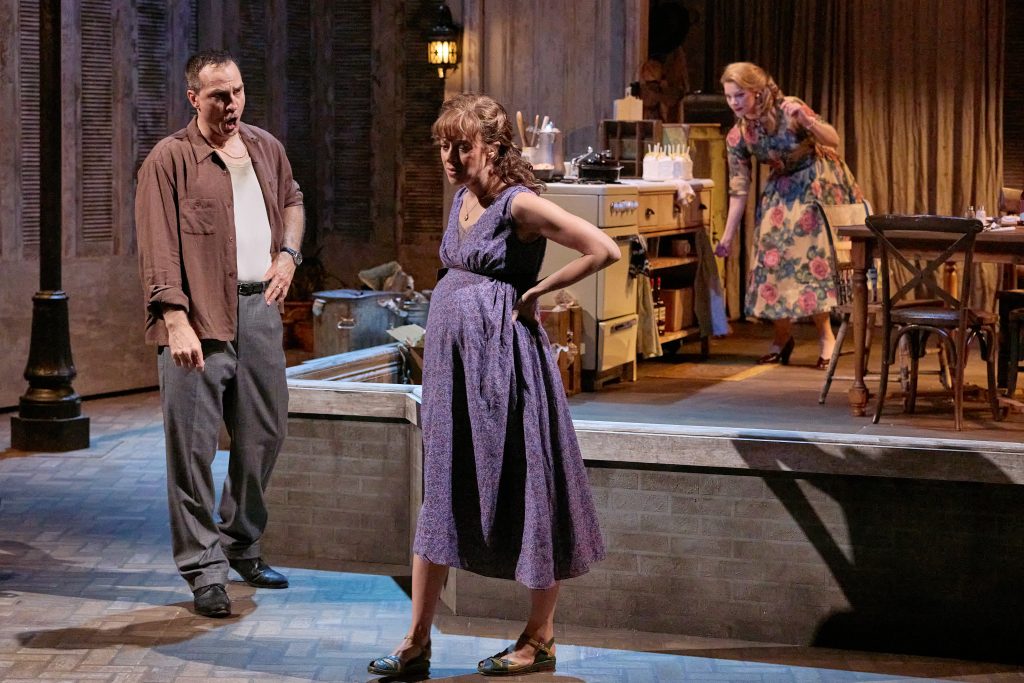
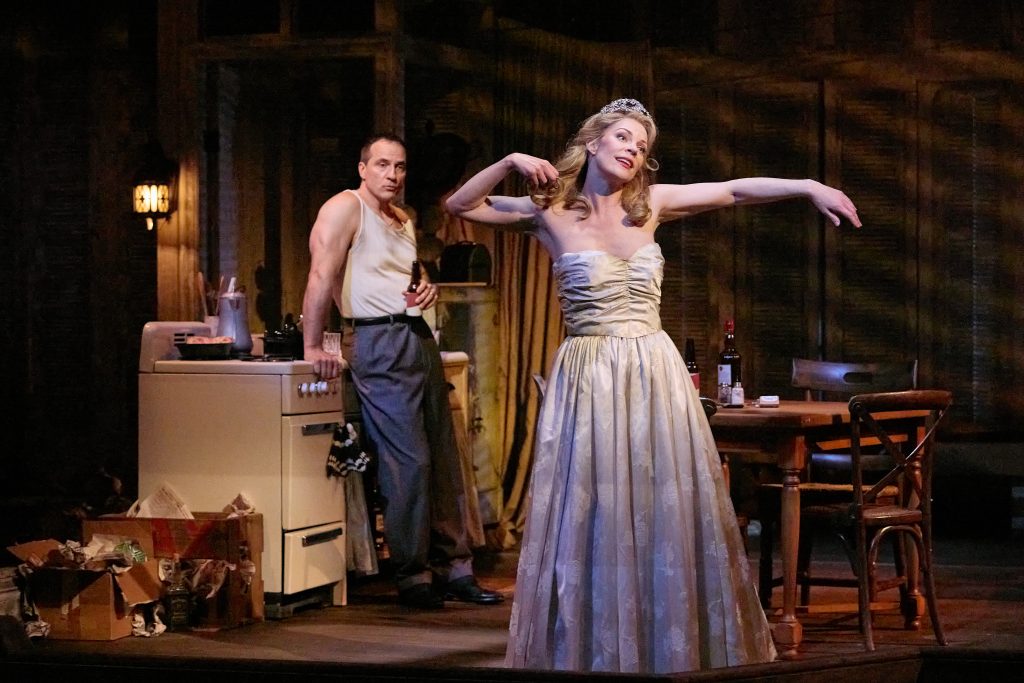
The production’s dramatic engine is the ongoing contest between Sara Gartland’s Blanche DuBois and David Adam Moore’s Stanley Kowalski. They spar like star pugilists across Williams’s language and Previn’s score, each encounter carrying as much psychological force as vocal power.
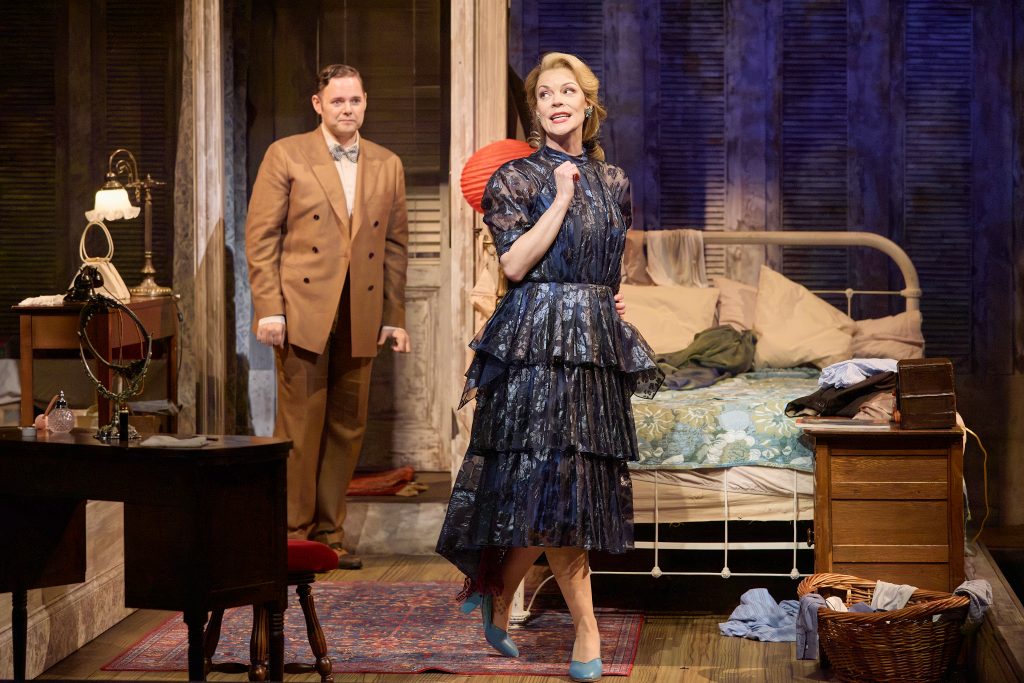
Gartland captures Blanche’s contradictions without simplifying them. Under Racette’s careful guidance, her Blanche remains vain, vulnerable, manipulative, frightened, self-aware and self-deluding, often simultaneously.
Moore faces the equally difficult task of making Stanley more than a brute. He succeeds. Stanley’s eventual victory remains disturbing, but Moore preserves enough magnetism and humanity to make it believable.
(L to R) David Adam Moore as Stanley, Lauren Snouffer as Stella, and Sara Gartland as Blanche in “A Streetcar Named Desire.” Photo by Eric Woolsey.
Racette allows Stanley’s appeal to remain visible even when his behavior becomes reprehensible. His spoken dialogue, used sparingly throughout the opera, sharpens the realism of the surrounding music rather than interrupting it.
Just as important is Lauren Snouffer’s Stella. More than a participant in Blanche and Stanley’s struggle, she becomes the emotional fulcrum of the evening, giving equal weight to Stella’s love for Blanche, desire for Stanley and determination to survive the impossible position in which she finds herself.
The relationship between the sisters is rendered with uncommon care, while Stella’s marriage to Stanley remains equally persuasive. Those relationships feel lived-in rather than merely dramatic.
Boyce’s towering shutter walls evoke New Orleans architecture while functioning as a kind of emotional enclosure. At times they resemble prison bars, at others the walls of memory closing around Blanche. Their scale is distinctly operatic, creating a world far larger than the cast occupying it.
Blanche (Sara Gartland) flirts with the smitten Harold “Mitch” Mitchell. Photoby Eric Woolsey.
Yet Gartland, Moore, Snouffer and their colleagues fill that space through voice, presence and sharply defined characterizations. They do not merely survive the set. They complete it. In a production with relatively few principals, there is nowhere to hide. Every performer must command the space. They do.
The supporting cast contributes significantly to that achievement. Bille Bruley’s Harold Mitchell brings warmth and humanity to the role, while Ashlyn Brown’s Eunice provides an earthy, clear-eyed counterpoint to Blanche’s unraveling. Her nurturing support of Stella reinforces one of the production’s central relationships and helps ground the emotional reality of Elysian Fields.
The ensemble consistently strengthens Williams’s world. Kim Stanish is especially memorable as the Nurse in the final scene. Her prolonged struggle to restrain Blanche avoids melodrama and instead underscores the heartbreaking finality of the character’s collapse, a moment Racette allows to linger rather than rush past.
Blanche (Sara Gartland) begins to unravel under Stanley’s (David Adam Moore) menacing presence. Photo by Eric Woolsey.
The production’s scenes of violence and sexual assault are staged with careful restraint. Racette, intimacy coordinator Delaney Piggins and fight choreographer Shaun Sheley convey the ugliness of Stanley’s actions with just enough physical detail to communicate their impact without lapsing into sensationalism.
The projections prove equally effective throughout the evening. Most haunting is the appearance of Blanche’s young husband, whose portrait looms over the stage just as relentlessly as his memory looms over her life.
Throughout the evening, projections become another actor in the drama, carrying memory and desire across Boyce’s towering walls. By the time Blanche reaches her final music, Gartland and the production have earned every note of it.
“A Streetcar Named Desire” continues at Opera Theatre of Saint Louis through June 26 at the Loretto-Hilton Center on the Webster University campus as part of OTSL’s 2026 Festival Season. Ticket information, performance schedules and additional production details are available on the Opera Theatre of Saint Louis website.
A shattered Blanche (Sara Gartland) is gently led away by a doctor (Erik DeMario). Photo by Eric Wooley.
What happens when a long-dormant dream resurfaces in your life, and it’s within your reach, only to have cruel fates snatch it away?
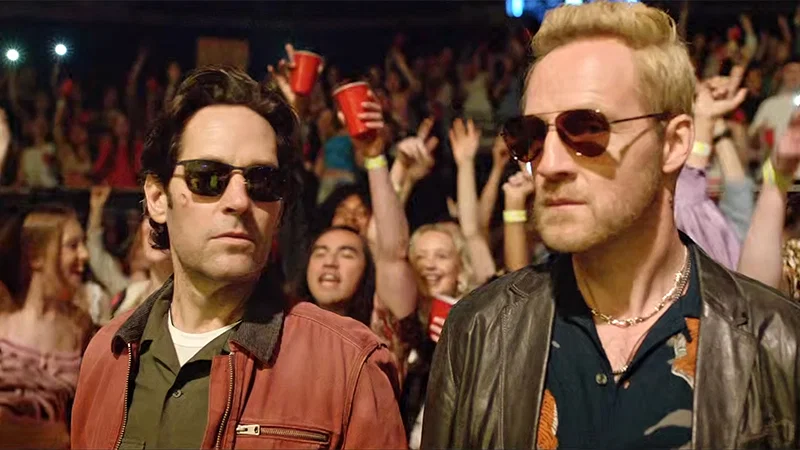
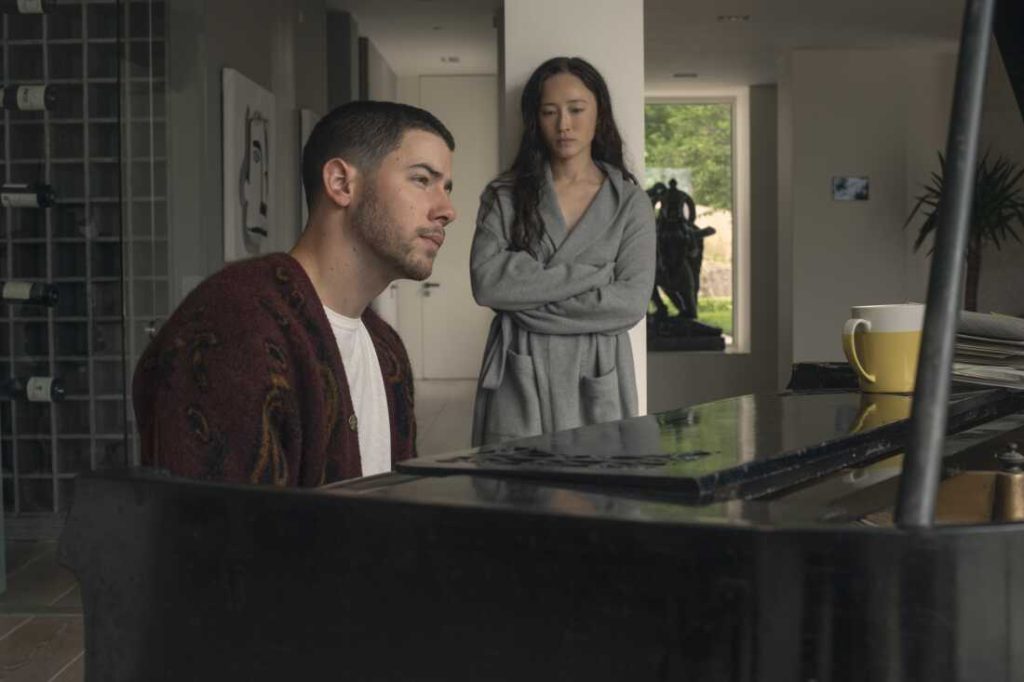
Ah, the twists of fate. And when dueling singers Rick and Danny are played by effortlessly charming Paul Rudd and charismatic Nick Jonas in the John Carney Musical Universe, the result is a shaggy look at ambition, what matters in life and how music connects us.
After 20 years of modern musical movies, writer-director John Carney returns with another uplifting journey of self-discovery that has many fine emotional beats, moving us with natural conflicts that veer into farcical territory.
Maybe the two tones don’t always mix well together, but this clever story, co-written with Peter McDonald, who also appears as Rick’s lovably quirky bandmate Sandy, has a sincere beating heart that tackles contemporary music business issues.
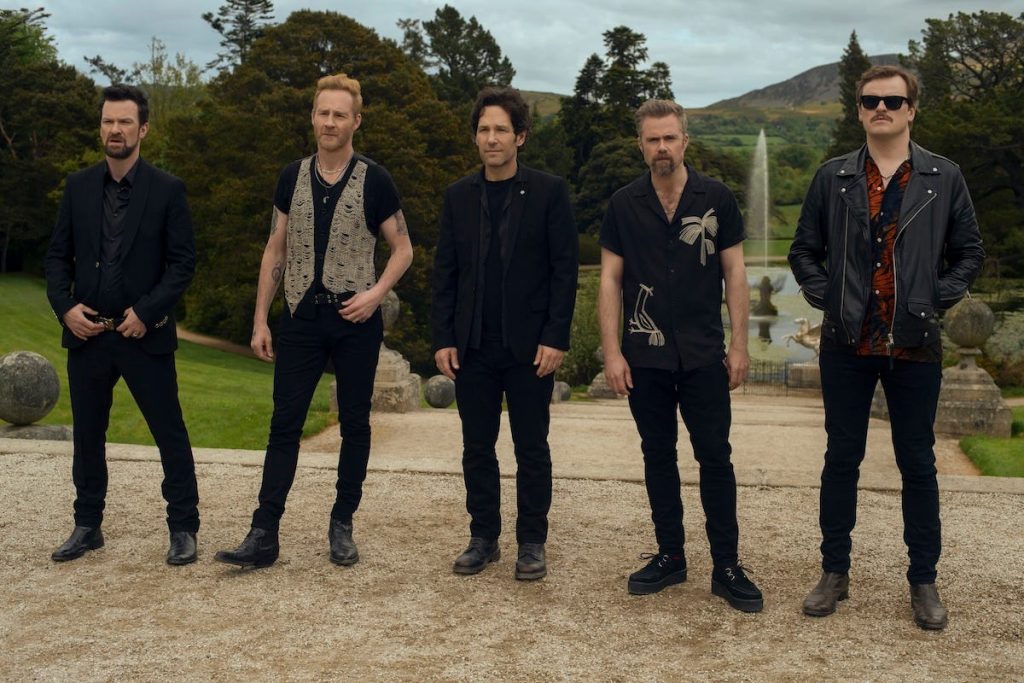
Wedding bandmates in The Bride & Groove.
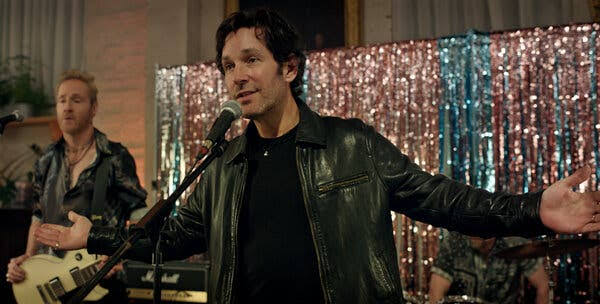
The middle-age bandmates in Ireland’s grooviest wedding band, “The Bride & Groove,” get everyone up on the dance floor with the pop hits of the ‘80s and ‘90s, but there is a restlessness to lead singer Rick.
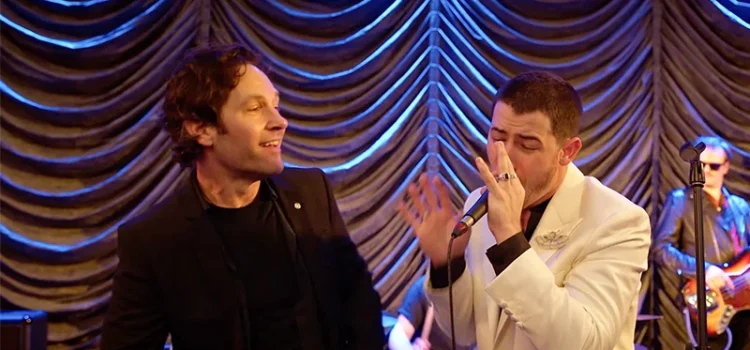
When a wedding guest is former boy-band member Danny Wilson (Nick Jonas), he’s invited to join the band onstage, and he and Rick hit it off singing Stevie Wonder’s “I Wish.”
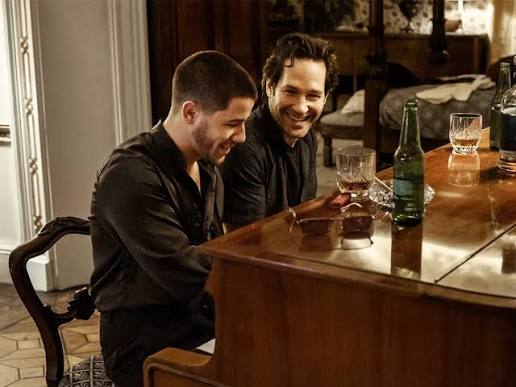
Keeping that spark between them, collaboration ensues during their own after-party, where they play music and drink into the wee hours of the morning. They share dreams, their creative processes, what drives them and more.
You feel their connection, so when things don’t later end on a high note, it becomes a series of unfortunate incidents that put the pair on very different trajectories.
Nick Jonas and Paul Rudd jam.
Once back in L.A., Danny’s solo songs aren’t grabbing his record label, and manager Mac (Carney regular Jack Reynor) gives him the tough talk about falling down the relevant scale. The pressure to get back in the game is enormous, especially after the other boy band members have been successful.
So, he steals Rick’s heart-on-his-sleeve intimate acoustic tune and spiffs it up, creating a global smash pop hit and reclaiming the big time – selling out arenas and living the good life.
Shopping in a mall one day, Rick hears the song playing, to his surprise, but can’t prove he wrote it, so his behavior becomes erratic and combative. When Danny won’t return his calls, he takes drastic measures, and heads to L.A. for a confrontation.
One thing is certain. The song in question, “How to Write a Song (Without You)” is an instant catchy earworm. Could it follow Oscar-winning “Falling Slowly” from “Once” as a Best Song candidate?
Paul Rudd and Peter McDonald go from “Dublin to L.A.”
Everyman Rudd, whom audiences usually root for, isn’t afraid to play a flawed character whose behavior at times is questionable. His wife Rachel (Marcella Plunkett) and daughter Aja (Beth Fallon) are baffled but love him, for better or worse.
And Jonas, whom everyone pegs as a scoundrel, is a more conflicted guy, so the lines between hero and villain are blurred.
Carney, the director of “Once,” “Begin Again,” “Sing Street” and “Flora and Son,” is in familiar territory. But he looks at the price of ambition through an older lens here.
And nobody is as perceptive about music’s redemptive impact. In his raw and real explorations, Carney has created authentic characters and original songs that meet the moments.
Nick Jonas as Danny and Havana Rose Liu as Marcia in Power Ballad. Photo Credit: David Cleary
The weathered Dublin setting is cozy and comfortable, while the L.A. paradise is framed as shallow and sterile. The realistic look at musicians and their struggles, how they fit into the world, is one of Carney’s hallmarks. How natural the characters interact is another.
After all, he is the bassist to The Frames. Carney and his longtime songwriting partner Gary Clark penned 12 original songs for the movie. The soundtrack also includes the wedding reception staple “Celebration,” plus nostalgia nods “The Power of Love,” “Summer of ’69,” “Message in a Bottle,” “Maneater,” and “The Boys Are Back in Town.”
For those who believe music unites us, “Power Ballad” is a heart-tugging, funny look at the ever-changing tides in life.
The 2026 musical comedy-drama is directed by John Carney and stars Paul Rudd, Nick Jonas, Peter McDonald, Marcella Plunkett and Beth Fallon. It is rated R for language throughout and some drug use and runtime is 1 hour, 38 minutes. It opened in theatres on June 5. Lynn’s Grade: B+.
On a remote island far, far away, a mischievous mix of magic and mayhem mark “The Tempest,” which is the St. Louis Shakespeare Festival’s flagship production now anchored in Forest Park’s Shakespeare Glen.
William Shakespeare’s drama-tinged romantic comedy takes place after a violent storm has washed ashore a merry band of revelers, upending the inhabitants on this island – and nothing is as it seems. Perhaps, someone’s bad dream is another’s hopeful voyage. In any case, there is perceptible verve.
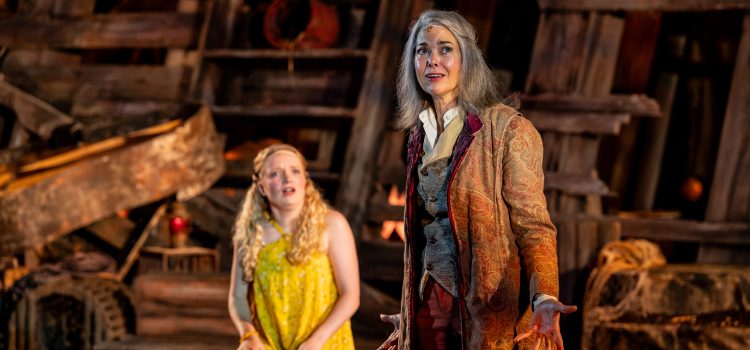
Think of this as a way-back machine “Survivor,” where everyone must outwit, outplay and outlast the people who want power. And Prospero (Nancy Bell) is manipulating a chess game.
A mother and sorcerer, Prospero rules this mystical place, and tensions rise between her, her teenage daughter and now the brother who messed up her future and has reappeared. Haunted by his betrayal, she has vengeance on her mind, for she was once Duke of Milan.
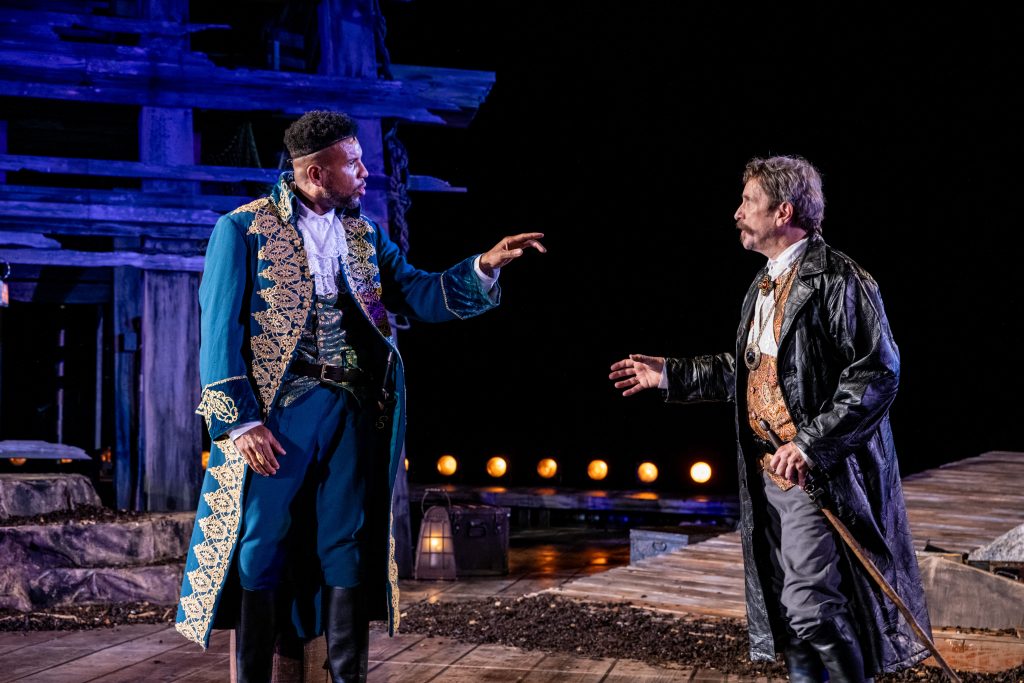
Reginald Pierre and Jeff Cummings as Prospero’s evil brothers. Photo by Phillip Hamer.
Through royal chicanery, Antonio (Jeff Cummings) usurped the title, and with the help of another brother, Alonso (Kathryn Bentley), King of Naples, she was banished 12 years earlier. But they can’t be trusted because another ambitious brother, Sebastian (Reginald Pierre), wants the king’s crown himself.
Ariel (Eliza Pagelle) is a shape-shifting spirit on the island that aids Prospero. Through her occult preoccupation, the boss finds out that her nefarious brothers are on their way from Tunis to Italy, so she conjures a squall, and they wind up where she is. Mama Bear thinks she is in control.
It won’t be long until old wounds resurface and new challenges arise. Oh, be careful what you wish for, as Alonso’s honorable son Ferdinand (an earnest Zay Williams) spies Miranda (Sigrid Wise) and falls in love.
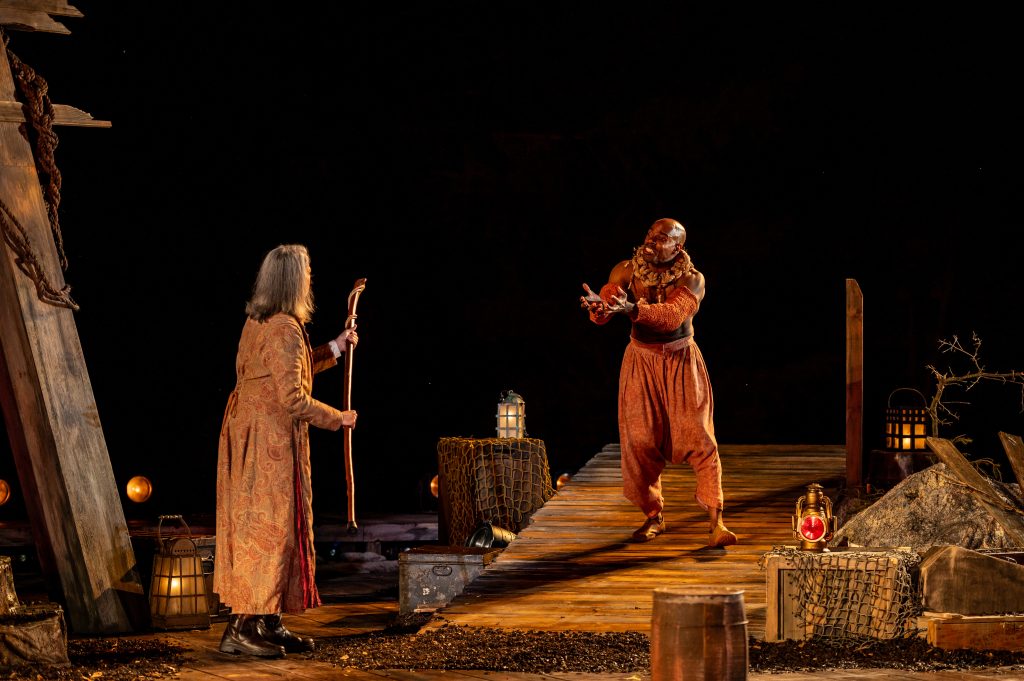
Caliban (Chauncy Thomas) is the only true island inhabitant, a witch’s son, and resents being overtaken by Prospero, who imprisoned him so he doesn’t get too close to her daughter.
A fierce Thomas musters all his fury as a resentful native. Formerly of St. Louis, Thomas is always a welcome addition when he returns, now for the sixth time.
Bell and Chauncy Thomas as Caliban. Photo by Phillip Hamer.
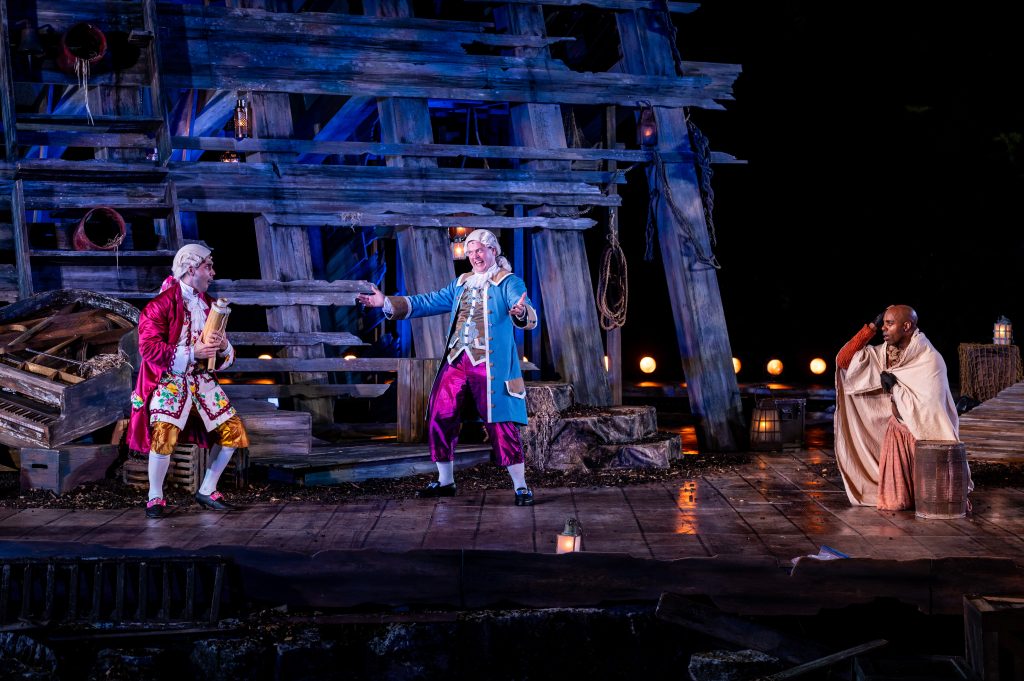
The ensemble includes kindly Gonzalo (veteran Whit Reichert), an elderly Neapolitan lord who helped Prospero survive exile (but secretly), and comic buffoons Stephano (Michael Dougherty) and Trinculo (Jose Sabillon), Alonso’s butler and court jester. That daffy duo plots with Caliban to take over.
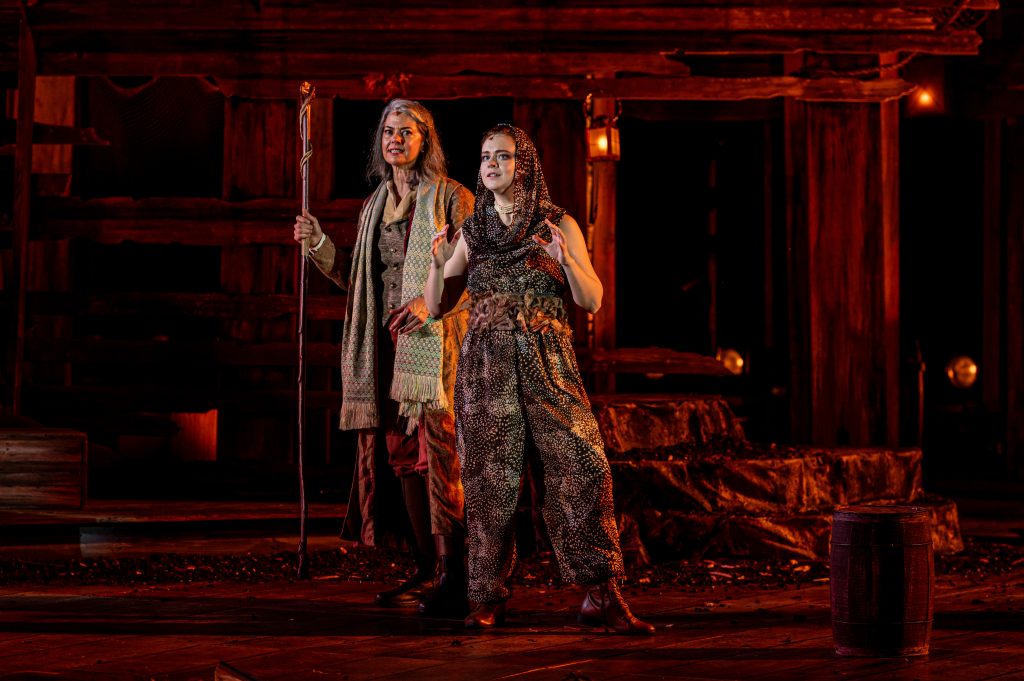
Mother and daughter have been marooned since the girl was 2 years old, so one can imagine her naivete and innocence – and yearning to break free of the overbearing parent. Nevertheless, the protective mom wants her daughter to marry for love and position.
Wise, enchanting as the isolated Miranda, is as luminous as she was as Juliet in “Romeo and Juliet” in 2018 and was part of “The Winter’s Tale” the year before. She has tangible chemistry with Williams as a decent prince who can be trusted.
Through her instincts and technique, Bell is a formidable Prospero – and as much of an impact she has had on Shakespeare in this city, one must note that this is her first leading role outdoors in Shakespeare Glen.
Bell and Eliza Pagelle as Ariel. Photo by Phillip Hamer.
(As Playwright-in-Residence, Bell wrote several “Shakespeare in the Street” productions, earning Best New Play awards from the St. Louis Theater Circle for “The World Begun” and “Old Hearts Fresh,” and two years ago, directed the award-winning “As You Like It.” She also founded the Confluence New Play Festival.)
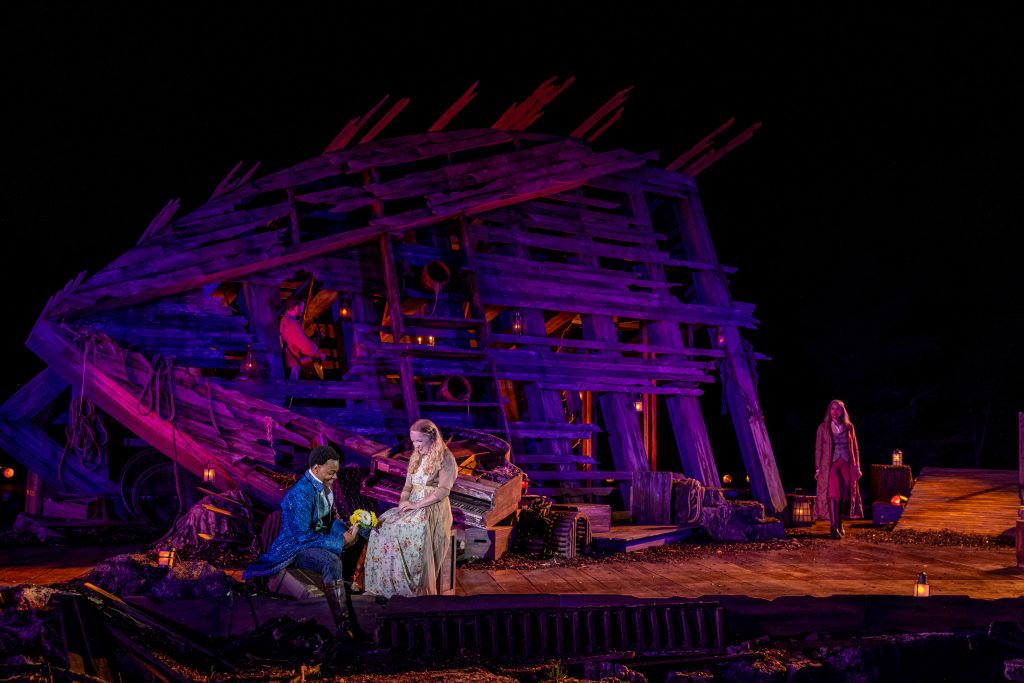
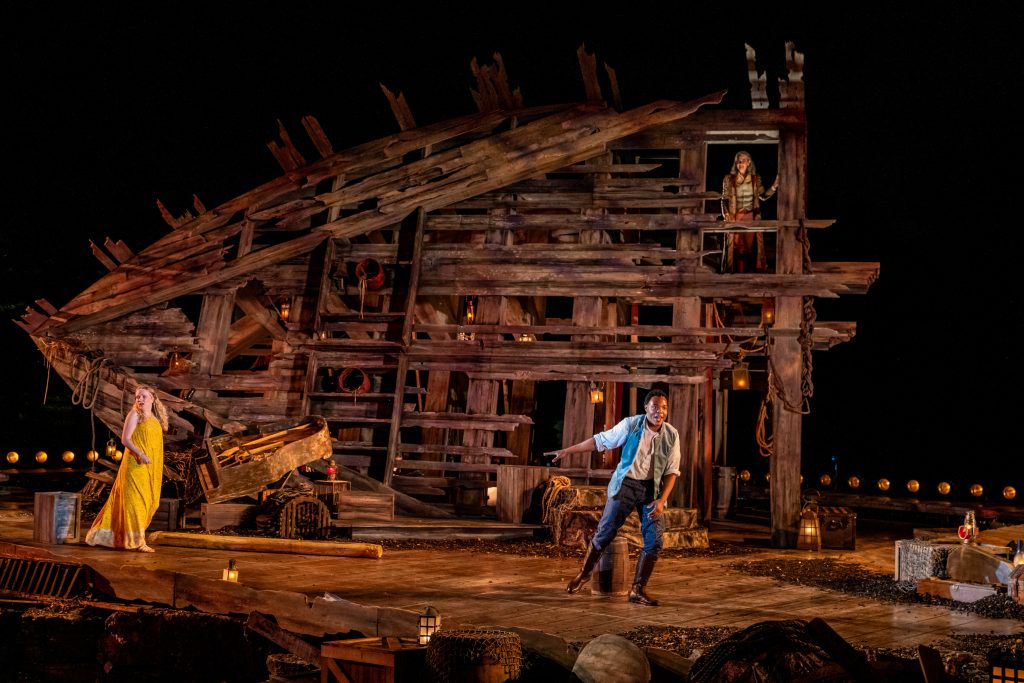
The Circle’s most awarded theater artist, for acting, writing and directing, Bell commands attention from various vantage points perched on the decaying hull of a shipwreck. Her character must find a way to forgive on this journey.
Director Rick Dildine shrewdly showcases Prospero’s dominance by staging Bell’s position at different heights – when she’s talking to others. It’s rare when she’s on the same level of this imposing set, masterfully adorned with functional nooks and crannies.
The former director of St. Louis Shakespeare Festival (2009 – 2017) emphasizes nature’s impact as well as the colonial-era themes. Dildine’s version is a breezy 90 minutes without an intermission.
Goofballs Jose Sabillon and Michael Dougherty with Thomas. Photo by Phillip Hamer.
He is aided by a talented squad — assistant director Lize Lewy, producer Colin O’Brien, production company Blank Slate, stage manager Sarah Luedloff, and assistant stage manager Britteny Henry.
Dildine won a Circle award for directing a shimmering “A Midsummer Night’s Dream” in 2016 where sound, lighting and scenic design enhanced the production, especially the original music.
The storytelling here is boosted by those same elements. The artisan MVPs who blended music and storm effects to elevate the experience included music director Michael Grieve, sound designer Melanie Chen Cole, lighting designer Jeff Behm and scenic designers Justin and Christopher Swader, all making impressive debuts, as were costume designer Kathleen Geldard and props designer Katherine Stepanek.
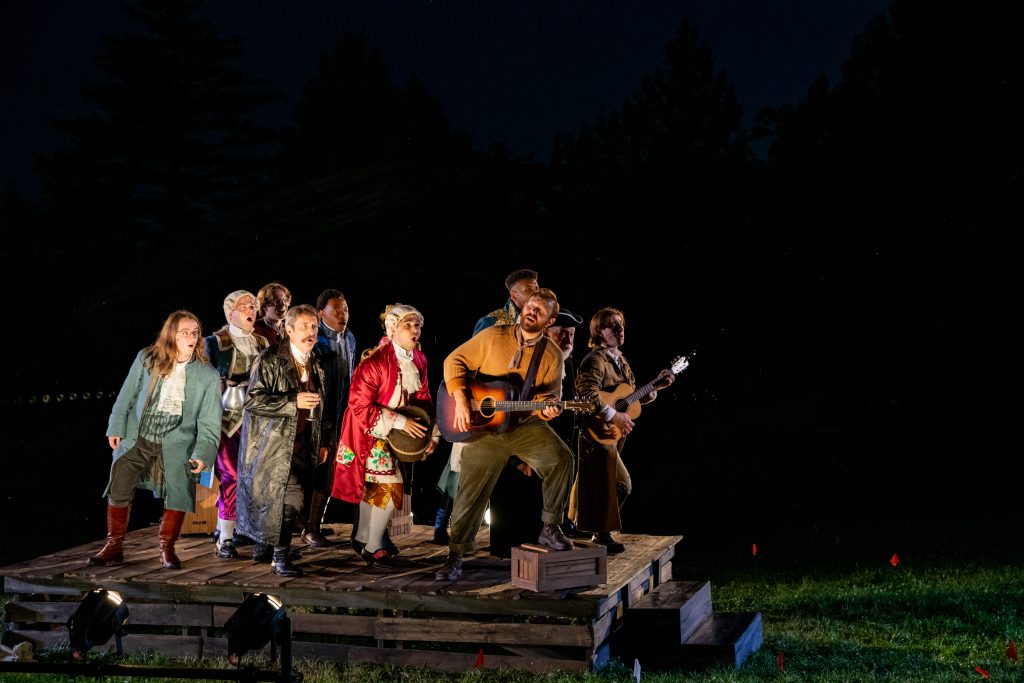
Grieve’s captivating immersive upbeat music is a zesty blend of roots music, sea shanties and folk melodies, with lively musicians Harrison Farmer, Crayton Haney and Otto Klemp, also in supporting roles, as is Grieve.
Musicians and partiers aboard a vessel. Photo by Phillip Hamer.
An original prologue on a satellite stage creates a festive atmosphere at Alonso’s daughter Claribel’s wedding, which kicks off the show (starting at 8 p.m.). Paul Dennhardt has provided interesting moves for the musicians and guests. All that’s swept away in the tempest.
Regarded as Shakespeare’s last play, when he was in his late 40s, this tale of forgiveness has the compassion of an experienced man looking at what’s important in life. And that is expressed well in this vibrant setting.
Dildine’s focus on nature’s capacity to heal is a key component to this 26th annual outing in the park, a year after a destructive tornado tore through Forest Park. He interprets that resiliency in the aftermath, as we all weather calm seas and violent storms in life.
A portion of the donations collected during “The Tempest” will go towards the tornado relief funds for the St. Louisans hit the hardest. And thanks to the parks department and Forest Park Forever, we are sitting today in these hallowed grounds of immense cultural importance.
Zay Williams and Sigrid Wise as Ferdinand and Miranda while Bell looks on. Photo by Phillip Hamer.
St. Louis Shakespeare Festival presents “The Tempest” May 27 – June 21 at 8:15 p.m., Tuesdays through Sundays, in Shakespeare Glen in Forest Park, 6604 Fine Arts Drive (next to the Art Museum). Admission is free and accessible to everyone. The Glen opens at 6:30 p.m. and the Teen Green Show takes place at 7:15 p.m. Thursday through Sunday. For more information, visit www.stlshakes.org