By Lynn Venhaus

Messy and unflinching, “The Mercy Seat” is a complicated relationship play between two New Yorkers in the immediate aftermath of Sept. 11, 2001. At the time of a monumental national tragedy, lovers Ben Harcourt and Abby Prescott are preoccupied with their own lives, not the missing and dead as those numbers climb.

In the Neil LaBute two-hander, first staged in 2002, the thorny dynamic between these two is difficult because the characters are morally bankrupt. And the uncomfortable setting is often claustrophobic, as intended.

After the 25th anniversary commemorating the lives lost that day on Friday, anyone seeking reflection or comfort may be shocked by this unexpected selfish take, for this doesn’t reflect mourning or any insight into universal 9-11 grief, or commentary on national unity.

But those familiar with LaBute’s signature edgy plays won’t be surprised by this brutal battle of the sexes as they sort out or attempt to make sense of being together. Because of the unprecedented attack on the nearby World Trade Center the day before, right at their doorstep, the world has changed overnight.
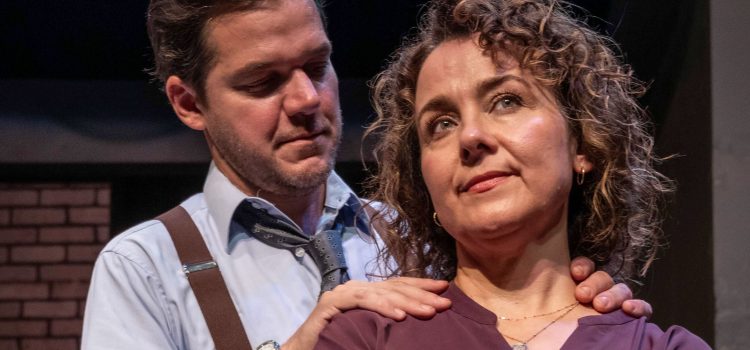
Franklin Killian as Ben and Kelly Schnider as Abby. Photo by Patrick Huber.

This pair, once in a thorny situation, may have more options available because of everyone’s disrupted lives. But how opportunistic are these thoughts and ideas? And how awful are they to even think of a convenient solution?

Franklin Killian and Kelly Schnider, making their St. Louis Actors’ Studio debut, are remarkably adept at the playwright’s rapid-fire dialogue, which creates a certain kind of rhythm that is emphasized in John Pierson’s direction.

Pierson’s nimble staging makes the most of the Gaslight Theatre’s intimate black-box space. The conversation is a power struggle that features frank sex talk and explicit language. Ben is cynical, Abby is bitter– and vice versa.

She is his superior, and older. He is married with children. In the Old Testament, “The Mercy Seat” carries the idea of the removal of sin. But they’re not getting off easy here.

The rawness of the bruised feelings, the surprise – and anguish – of what the other is thinking, and saying out loud, is apparent in the emotional interactions. Nothing is important and everything matters; such is the way LaBute creates the ebb and flow between two strong personalities flailing about on a day after the nation went numb.
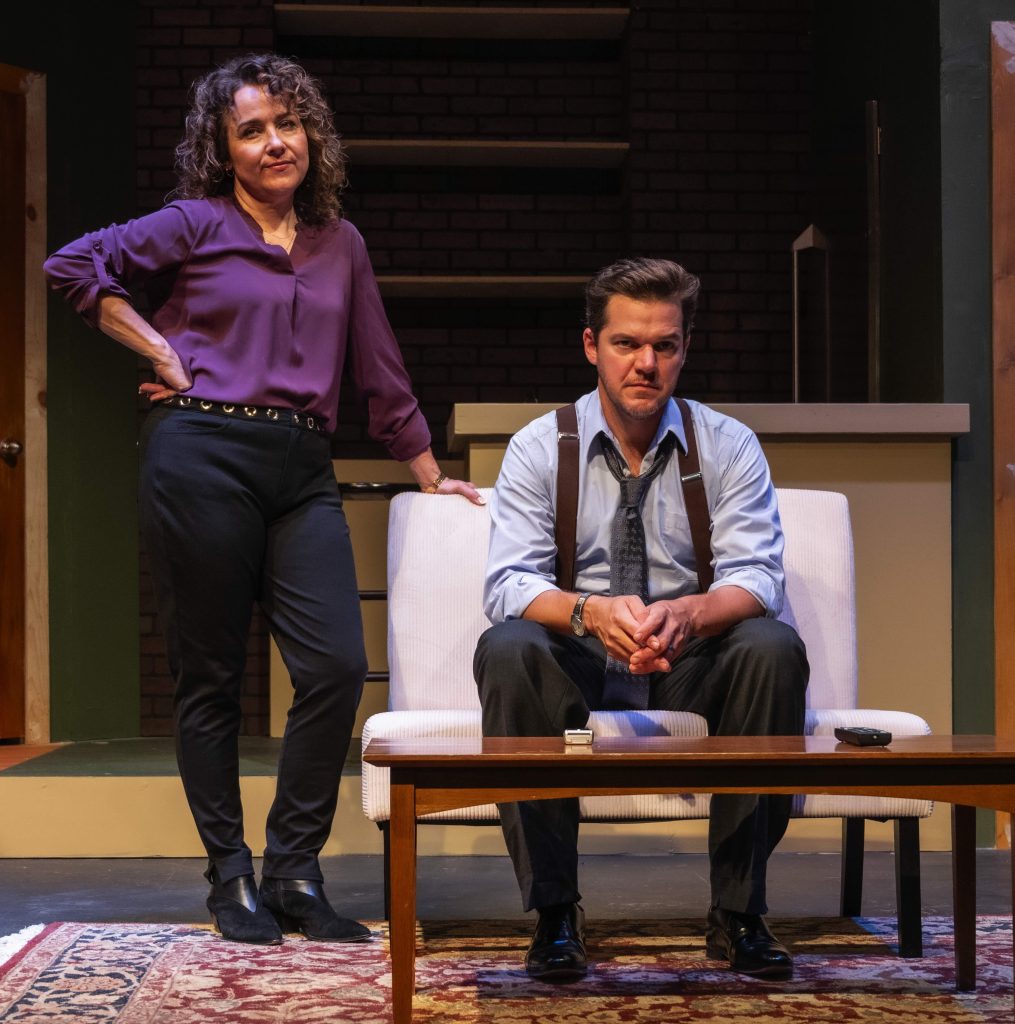
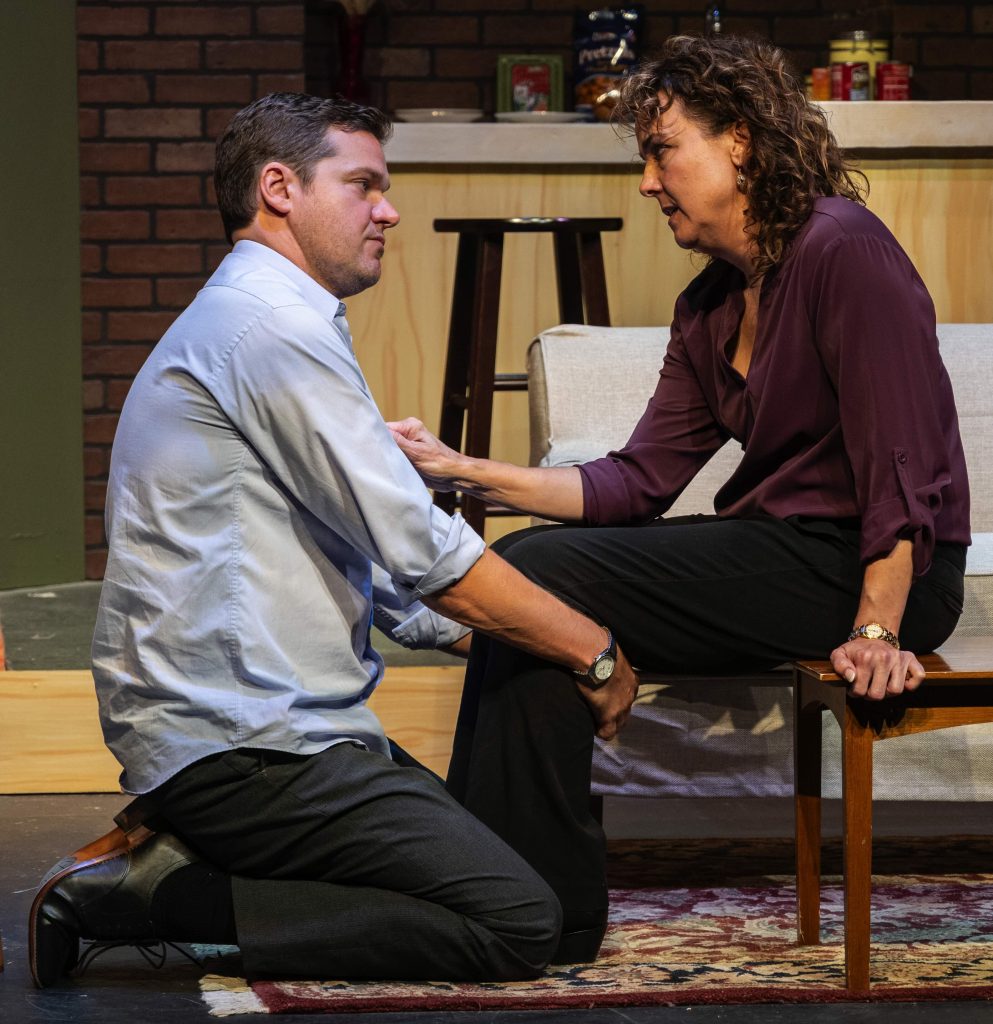
Abby and Ben bicker in “The Mercy Seat,” featuring Kelly Schnider and Franklin Killian. Photo by Patrick Huber.

In momentary panic, each blurts out thoughtless remarks at each other, capitalizing on what they view as character flaws. What is it that they ever liked about each other – is it only sexual desire? And how self-absorbed is that? Are they both manipulating each other?

In the new upside-down interrupted world, is it worth maintaining their affair, breaking off or making a deeper commitment? Endgame questions that seek immediate answers. The wordplay is intense, and even in a twisty finish, prioritizes themselves.

Set and lighting designer Patrick Huber has created an efficient apartment setting without any windows on the world – but there is a door where a neighbor in need knocks. As the couple navigates between the kitchen and living room, the walls appear to close in on them.

Pierson also designed the sound, and the outside world intrudes through sounds of sirens and an occasionally ringing cellphone that Ben never picks up. Abby has ventured out to a store, which is no longer a simple task. Casual costumes provided by Teresa Doggett.

Kline and Killian fearlessly operate at a high level of verbal volleying, shifting tones throughout with this discomforting dialogue. LaBute intends to make us squirm – he maintains that clever, cavalier approach, and you’re either appalled or questioning your own impulses.
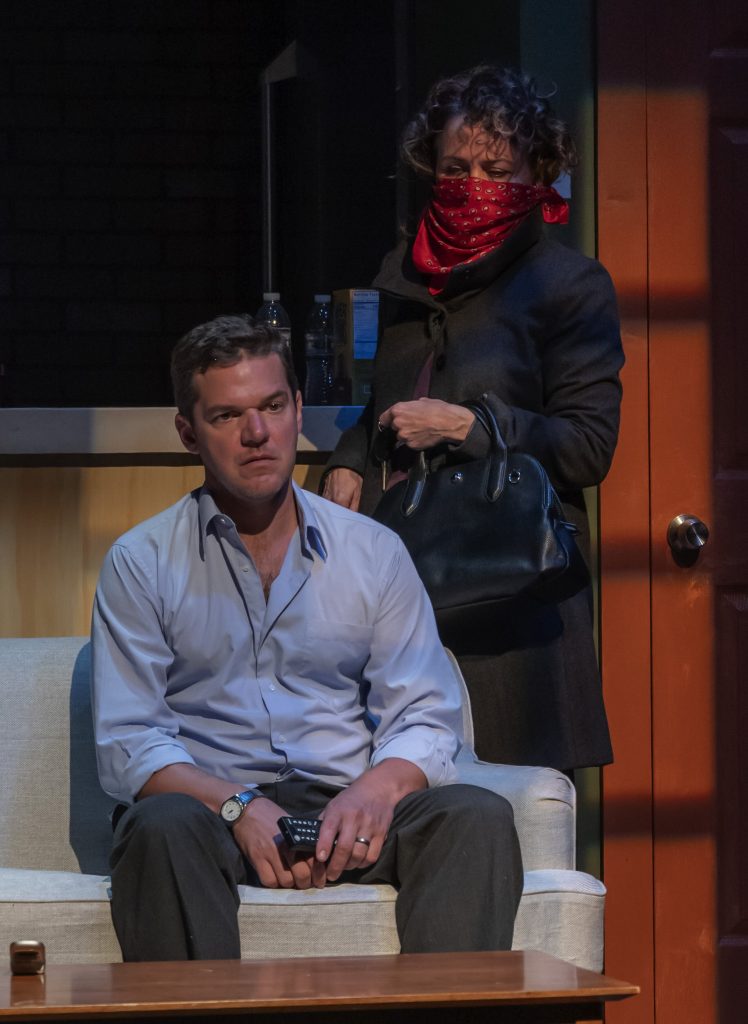
A couple at crossroads in “The Mercy Seat.” Photo by Patrick Huber.

The characters aren’t sympathetic, and those involved in the production are fully aware of the ugliness of human nature and how emotionally draining this work is. But LaBute has made a career of subverting people’s expectations (“The Shape of Things,” “Fat Pig,” “Reasons to be Pretty”).

“The Mercy Seat” premiered Off-Broadway at the Acorn Theatre in an MCC Theater production on Dec. 18, 2002, and closed on Jan. 15, 2003. Directed by LaBute, it starred Liev Schreiber and Sigourney Weaver

Because of his longstanding relationship with St. Louis Actors’ Studio since the creation of the LaBute New Theater Festival in 2013, which features curated short plays, he premieres a one-act every summer.

STLAS has also performed his full-length shows, including “Comfort” in 2022 and “The Way We Get By” in 2017, and his short plays have had lasting impact: “The Possible,” “Here We Go ‘Round the Mulberry Bush,” “Kandahar,” “Hate Crime,” “The Fourth Reich,” “Great Negro Works of Art,” “Unlikely Japan,” “Who’s on First,” and “Brunch” among them.

At 95-minutes without intermission, this unsettling confrontation in a lower Manhattan apartment is an often-fascinating narrative that at times is repetitive, and the sheer verbosity can be tedious.

One can’t shake the feeling that outside, on the ash-covered streets, traumatized New Yorkers are looking for the missing and answers. But inside, this self-centered couple bypasses universal selflessness and collective grief by thinking only of soothing their disillusioned selves.

St. Louis Actors’ Studio presents “The Mercy Seat” by Neil LaBute, Sept. 11-27 at The Gaslight Theater. Performances are on Thursday (second and third week), Friday and Saturday evenings at 8 p.m. and on Sundays at 3 p.m. For more information or to purchase general admission tickets, visit stlas.org or email [email protected].

By Lynn Venhaus

A tragic day that we will never forget in America inspired our Far North neighbors, the Canadian town of Gander in Newfoundland, to provide overwhelming needs over the course of five days for 7,000 world travelers, the “come from aways,” stranded on 38 international planes diverted to the airport there.

That raw reminder of our shared humanity has been turned into an unforgettable work of art, the award-winning, big-hearted, crowd-pleasing musical “Come From Away.”

If ever we needed to be uplifted and reminded of people’s capacity for empathy, it is now.

What an enduring and fitting tribute to 9-11 that a recording of the staged musical will be released on the eve of the 20th anniversary.

In the aftermath, the FAA had closed the airspace in the U.S. and those passengers had nowhere to go.

This Canadian musical with book, music and lyrics by Irene Sankoff and David Hein tells what transpired in the week that followed when the Gander residents sprung into action and provided clothing, food and housing for 7,000, which doubled the town’s population — and there were 19 animals in cargo too. This is the true story of some of the real people who were caregivers and passengers then.

It premiered on Broadway in March 2017 and this remarkable example of the kindness and generosity of strangers in the face of great adversity struck a chord. The musical is a celebration of how resourceful and resilient we can be when we all come together. A community stepped up when they were called upon to do so.

Even in the darkest of times, people experienced beacons of light. Some of them even formed lifelong friendships and would return 10 years later to Gander for a reunion.

Looking back, the mayor said: “Tonight we honour what was lost, but we also commemorate what we found.”

It was filmed, with multiple cameras, before a live audience – some were 9-11 survivors and frontline workers — in May at the Gerald Schoenfeld Theatre in New York City, where it had become the longest-running Canadian musical in Broadway history.

Originally planned as a feature film adaptation on location in Newfoundland, the coronavirus pandemic impact shifted it to a live recording in the theatre.

Full of memorable characters, a script brimming with humor, and a tuneful score using folk, country and pop to bring on lumps in the throat, the filmed recording retains the vitality of this one-act musical that had been playing to sold-out audiences until the pandemic forced its shutdown in March 2020.

The musical returns to Broadway on Sept. 21, and will resume its national tour in October, which began in the fall of 2018.

When it played at the Fox Theatre in St. Louis in May 2019, I was prepared for its emotional wallop, but I didn’t realize how much these characters would touch my soul.

The film reminded me of all the good the play had spotlighted. It truly is one of the best musicals of the past five years, destined to be a classic, and grabs one immediately with the rousing “Welcome to the Rock” opening number. I still get goosebumps every time I hear their big voices, and their passion and pride about their community.

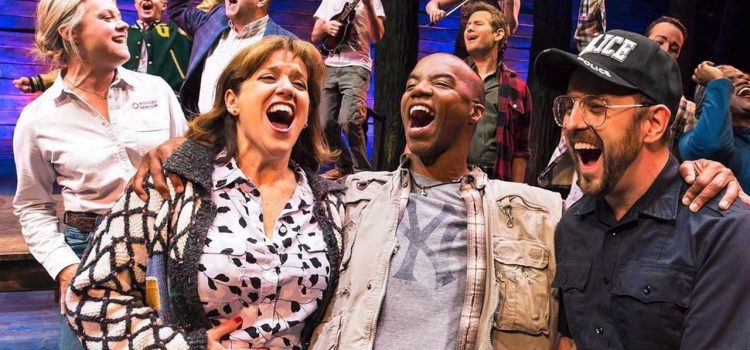
The cast also brought out the bridging of various cultures, and the memories of how we all felt that day was put back into focus. The ensemble is a mix of the original and current Broadway casts.

The original cast starring in this work include Petrina Bromley as Bonnie Harris, Jenn Colella as pilot Beverley Bass, Joel Hatch as the mayor Claude Elliott, Caesar Samayoa as Kevin Jung and Ali, W. Smith as Hannah O’Rourke, Astrid Van Wieren as Beulah Davis and Sharon Wheatley as Diane Gray.

New are De’Lon Grant as Bob, Tony LePage as Garth and Kevin T., Emily Walton as Janice Mosher, Jim Walton as Nick Marson and Doug, and Paul Whitty as Oz Fudge. Everyone plays multiple roles. Dressed like ordinary people and displaying various personality types, the cast is relatable and familiar.

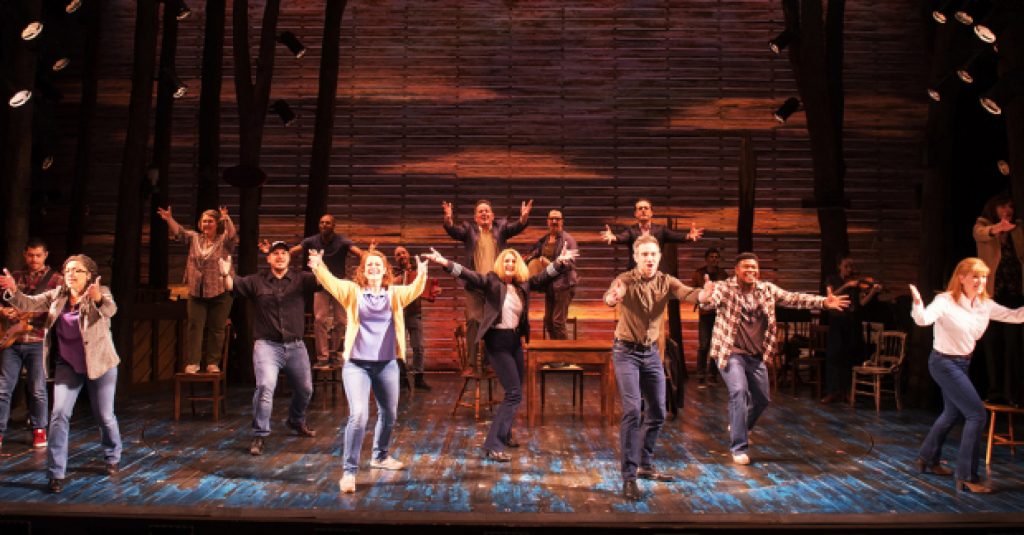
The execution of all the elements to make it a vibrant live theater experience is another reason it stands out. Besides a committed cast who honors every real person or composite character that they are asked to play, we have innovative, fluid staging by director Christopher Ashley and vivacious choreography by Kelly Devine.

The singers showcase exceptional harmonies in these emotionally wrought songs by Sankoff and Hein that provide context and advance the action.

A Celtic-influenced band stays on stage and entertains the crowd after the show has ended with an instrumental “Screech Out.” Their enthusiasm is contagious.

Ashley, who oversaw the filming, won the Tony Award for directing in 2017, when the seven-times nominated show had lost mostly to the juggernaut that is “Dear Evan Hansen.” including Best Musical. His staging is clever and conveys intimacy and connection – from the plane’s close quarters to the cozy town settings.

As we were transfixed to television sets watching the horror unfold that beautiful fall day in 2001, we did not think about the passengers that were stranded by the shutdown of flights, and the challenges they faced trying to get home. What a compelling story!

The composers met the people affected in Gander in 2011, at the 10-year reunion, and they shared their stories. We, in turn, get to know Claude the mayor, Oz the police constable, Beulah the teacher and Bonnie the SPCA worker.

The passengers were kept on the planes for hours – 14 becomes 28 – and in the dark about what happened in New York City, Washington D.C. and Shanksville, Penn. Once permitted to leave the planes, they watched the news – as stunned as we were. Frightened, they try to reach their families, including the mother of a New York firefighter who is unable to locate her son.

The fear and tensions ease somewhat as the townsfolk make them welcome and comfortable, and in the company of these quirky islanders, they bond. Some let their hair down at a local bar, and even participate in an initiation rite involving kissing a codfish.

The gravity of the situation is never far from people’s minds – and they eventually are allowed to leave, but the world is different, and so are they. One couple develops a romance while another breaks up under the stress. A Muslim chef faces growing prejudice and is forced to endure a humiliating search before boarding for home.

Jenn Colella, Tony-nominated for Best Featured Actress in a Musical, is impressive as the first woman pilot for American Airlines. She beautifully sings “Me and the Sky” about how her love of aviation drove her career aspirations, but now her workspace has been weaponized.

Ten years later, the crew and passengers reunited to celebrate these friendships forged during the worst of times, a forever band of brothers. We experience these people at their best. Their makeshift hospitality at an unspeakably grim, fearful and anxious time will make you cry, laugh and marvel at how kindness can be a tonic.

Cast from “Come from Away”

Like the documentary on Mister Rogers, “Won’t You Be My Neighbor?”, this heartwarming tale makes you want to become a better person.

“Come From Away” is a musical recorded as a live theatrical production on a Broadway stage, directed by Christopher Ashley. The cast includes original and current cast members. It is rated TV-MA and runs 1 hour, 46 minutes. It is streaming on Apple TV + beginning Sept. 10. Lynn’s Grade: A.