
By Alex McPherson

An aggressively unpleasant experience that traps viewers within its protagonist’s tortured psyche, director Mary Bronstein’s “If I Had Legs I’d Kick You” throws us into the void and leaves us to flail. A feverishly commanding performance from Rose Byrne guides us through the pressures of parenthood and a largely uncaring world.

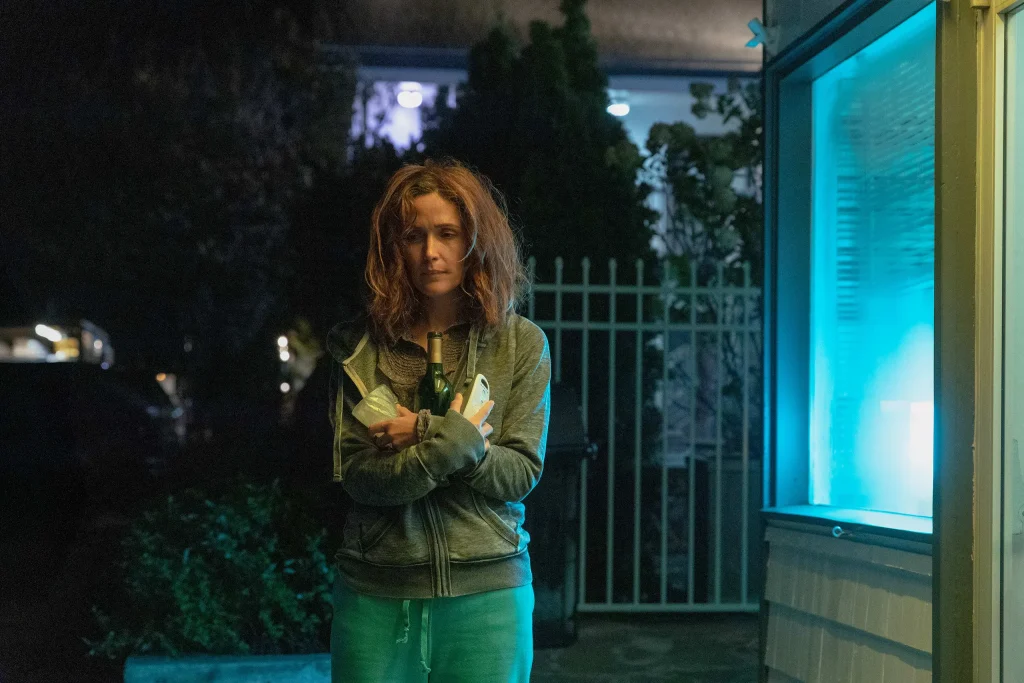
The film focuses on Linda (Byrne), a therapist in Montauk, New York, who is stretched beyond her limits. Her daughter (Delaney Quinn) has a mysterious illness that causes a severe aversion to food and requires a feeding tube apparatus that Linda maintains and monitors every night. Linda’s ungrateful husband, Charles (Christian Slater), who’s in the Navy, is away on a two-month assignment.

It is of course during this time that a leak causes their bedroom ceiling to collapse and flood the house. This gaping hole makes the house unlivable, requiring Linda and her daughter to stay in a seedy motel. It also becomes a metaphorical window into Linda’s traumatic memories

Linda desperately wants doctors to remove her daughter’s feeding tube, but a nurse informs her that her daughter is not meeting her weight requirements, and threatens to “re-evaluate the level of care” that Linda can give her. She’s scolded every day when she double-parks at the daughter’s facility.
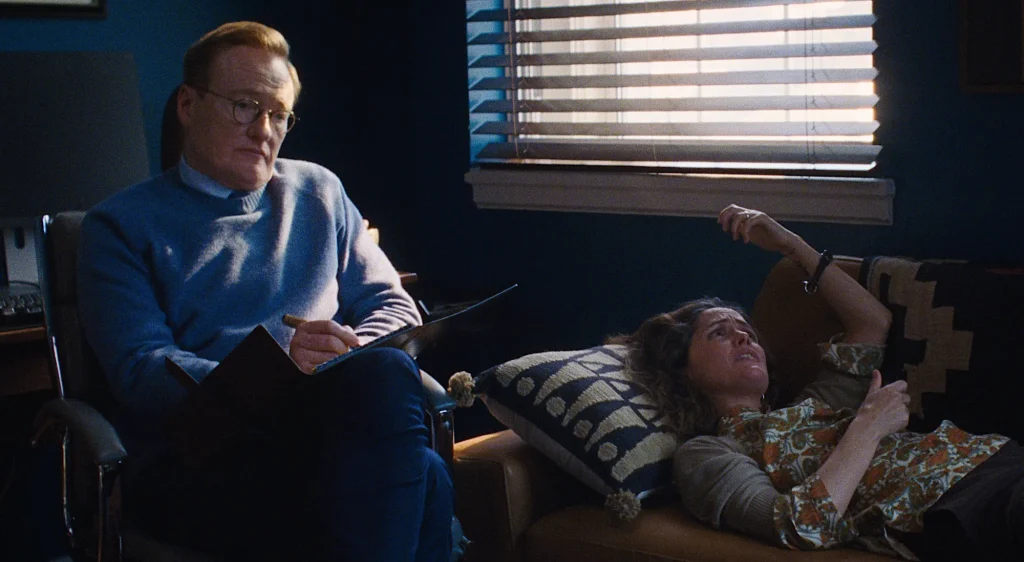
Her own patients take a toll (one of them, concerned about motherhood, is clearly on a dark path), and Linda’s own therapist down the hall (a surprisingly intense Conan O’Brien) refuses to take her swirling thoughts seriously. 

The snarky motel clerk (Ivy Wolk) refuses to sell Linda wine late at night, and the curious superintendent (A$AP Rocky) takes a liking to her and wants to strike up a friendship (which Linda immediately refuses). Everything is happening to Linda and she cannot catch a break, as barely-repressed psychological wounds resurface and send her already tenuous illusion of control veering drastically off course.

Catastrophe is around the corner, and Linda — lacking any clear support system — is headed right towards it.

Definitely not all sunshine and rainbows. Through Linda’s perpetually escalating crises, Bronstein explores the crushing psychological weight that Linda faces in every avenue of her life, trapping Linda in a version of Hell that she feels guilty for existing within. Bronstein’s film firmly roots us in Linda’s world, forcing us to view it through her eyes and never providing a sense of catharsis or release. I

t’s an exhausting watch (with an overlong runtime), but its maximalist stylings are viscerally, hauntingly tangible. Byrne’s performance is so strong, and heartbreaking, too, that no matter how intentionally off-putting “If I Had Legs I’d Kick You” gets, it’s difficult to look away.

Byrne  inhabits her  character, who makes impulsive, often questionable decisions that leave her paralyzed despite being constantly in motion. Linda is a complicated, emotionally fractured presence who’s on edge from frame one, barely holding on to her sanity as proceedings grow further frenzied.

Byrne’s comedic chops are put to use through Linda’s acerbic wit, yet we can see the damage being wrought upon Linda’s mind as she code-switches from role to role, trying, unsuccessfully, to keep her mounting dread at bay.

Bronstein keeps the chaos level high from start to finish, with cinematographer Christopher Messina (also the DP on Josh and Benny Safdie’s “Good Time”) remaining uncomfortably closed-in on Linda. This lends a palpable, subjective sense of peril to her actions; we’re seeing her struggles through her eyes.

Sound design plays just as big a role here — we never actually see Linda’s daughter’s face. Instead, we hear her nagging demands and meltdowns off-screen like a burdensome creature that requires Linda’s constant attention.

Sequences within Linda’s house have a horror-esque feel, complete with impressively effective jump-scares, disorienting visual effects, and the mocking, ironic jingle that plays whenever Linda’s office door opens. 

Indeed, “If I Had Legs I’d Kick You” is an alarming cacophony of noise and stress punctuated with bursts of pitch-black humor and sobering poignancy. Parenthood, depression, skewed gender dynamics, isolation, and the pressure that therapists feel are all under Bronstein’s magnifying glass — confronting aspects of motherhood, especially, that aren’t typically portrayed in media, and that people are often too nervous to address. 

The main issue with “If I Had Legs I’d Kick You” is that it starts at such a high key that there’s little crescendo throughout the 113-minute runtime. The domino effect of issues grows almost comical at times (poor hamster), and, after a while, the film starts to spin its gears and become repetitive — complete with a grueling finale that’s both inevitable and deeply distressing.

Still, Bronstein’s film shines as an acting showcase and a manifestation of pure, no-holds-barred cinematic panic. You might just feel completely drained afterwards.

“If I Had Legs I’d Kick You” is a 2025 psychological drama written and directed by Mary Bronstein and starring Rose Byrne, A$AP Rocky, Christian Slater, Delaney Quinn and Conan O’Brien. It’s runtime is 1 hour 53 minutes and it is rated R for for language, some drug use and bloody images. It opened in theatres Oct. 31. Alex’s Grade: B+
By Alex McPherson

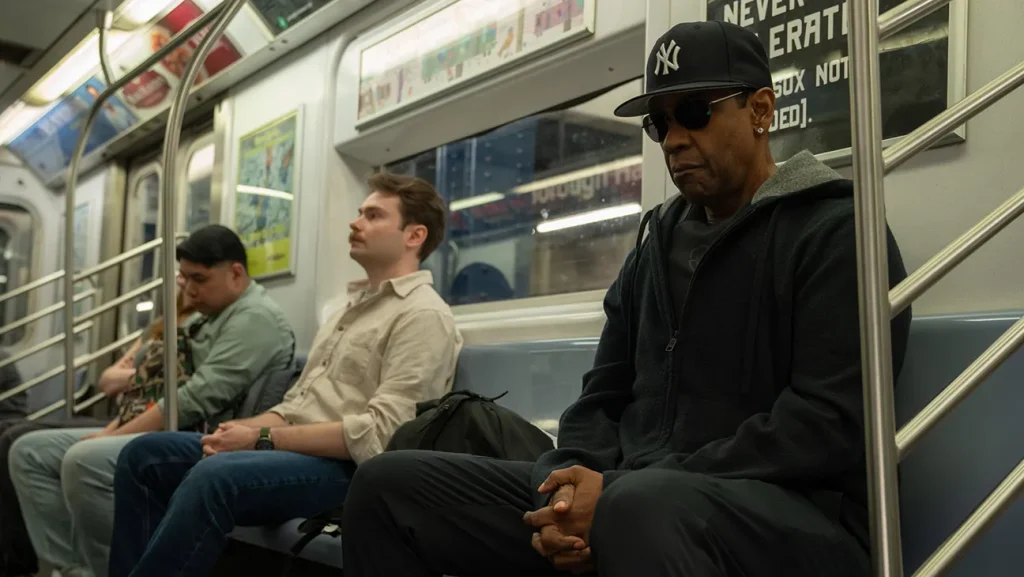
Although initially coasting along at a remove and not possessing the urgency of his other recent work, director Spike Lee’s  “Highest 2 Lowest” is a lively experience, featuring first-rate performances from Denzel Washington and Jeffrey Wright.

A “reimagining” of Akira Kurosawa’s masterful 1963 film “High and Low,” the film follows David King (Denzel Washington), an uber-successful music mogul living in a lavish penthouse in Brooklyn with his wife, Pam (Ilfenesh Hadera), and their teen-aged son, Trey (Aubrey Joseph).

David’s label Stackin’ Hits Records is at risk of being subsumed, via an impending corporate merger, into a compromised world of “soulless,” AI-composed music. David wants to preserve the art-focused Black identity of the company that he’s cultivated over the years and plans to buy back the majority of the label’s shares, although he quietly ignores new talent and is growing increasingly distant from his family.

He’s also drifting further away from the passion that drove him to the music business to begin with, even as music-star-hopefuls line up to show him what they’re capable of.

Denzel Washington and Ilfenesh Hadera

David’s plans to counteract the merger are foiled by a kidnapping — not of Trey, but, per a mix-up on the kidnappers’ part, the son of his chauffeur Paul (Wright), who has essentially become a member of the King family. Thus, David is at a crossroads: pay a $17.5 million dollar ransom to rescue Paul’s son from a potentially grisly fate, or save Stackin’ Hits. 

It’s a crisis of conscience that David is forced to reckon with in various capacities, re-discovering what he ultimately stands for in the process as the plot twists and turns in characteristically pointed, but somewhat mild directions.

Indeed, “Highest 2 Lowest” represents a lesser effort from Lee both stylistically and thematically, largely due to a sluggish first act that lacks dramatic urgency and almost feels like the work of a different director entirely.

The film is oddly restrained until we break out of the opulent confines of the King residence and hit the New York City streets — it’s here where “Highest 2 Lowest” sings as a tribute to the Big Apple, and as a cautionary tale about the allure of fame and wealth at the expense of morals in today’s parasocial world.

Washington, in his fifth Lee collaboration, brings the gravitas we expect from such a legendary performer, imbuing David with a sense of warmth belying vanity, the cracks in his facade of wealth and confidence being chipped away at as he breaks down and gradually rebuilds himself again, contemplating what he truly values.

Jeffrey Wright as Paul.

Wright’s Paul, even more so than David, provides the emotional core of the film. Wright (as usual) steals every scene he’s in, delivering Lee’s signature eclectic, lyrical dialogue with delicious flair while subtly illustrating the economic and power divide that separates him from David despite their years of closeness.

Supported by a strong-enough ensemble — including turns from “Mayhem” himself Dean Winters as a shady cop and, more notably, A$AP Rocky as main kidnapper “Yung Felon” — “Highest 2 Lowest” has all the ingredients for compelling, edge-of-your-seat drama, but Lee takes a more subdued approach, at least for the first 40 minutes or so. 

Washington’s performance, in particular, is hamstrung by direction, editing, and cinematography in the first act that doesn’t fully capitalize on the volatile situation David is in — creating a glossy, distancing effect. Pivotal character moments are almost drowned out by Howard Drossin’s score which, while strong on its own merits, furthers a sensation of drifting through scenes without getting fully immersed.

Lee holds back on his characteristic verve while David remains in his penthouse (decorated with Lee’s own art collection), disguising his fiery directorial instincts behind a too-pristine veneer that gradually morphs into a different, far more entertaining beast entirely as both David, and the film itself, move towards a sense of self-actualization.

Denzel delivering the ransom.

There remains no excuse for such a slow start and, even when things start to click into place at the halfway point, “Highest 2 Lowest” never fully recovers.

Still, once David and company hit the streets in an energizing chase sequence — intercut with a vibrant Puerto Rican parade — “Highest 2 Lowest” pulses with colorful Lee flair and confrontational, at times experimental, filmmaking that stands in stark contrast to the “safe” presentation of David’s life of privilege leading up to it.

David’s world is turned upside-down, and so is, eventually, “Highest 2 Lowest,” incorporating David’s eroding cynicism and paradigm shift into the storytelling itself in thrilling fashion. 

Like most of the film’s elements, though, there’s a caveat, and the themes ultimately don’t hit home with much force. Lee is less interested in interrogating the nature of wealth and wealth inequity than emphasizing the (obvious) moral and artistic responsibility of those who possess it, in this case a prominent Black family, and the ways that our interconnected world breeds hatred between strivers and those who have already “made it.”

The sons – Aubrey Joseph and Elijah Wright.

Lee misses an opportunity to dig deeper into David and, especially, Paul — veering into predictability and sanding down the more complex aspects of their characters in the service of a morality tale that impresses more in its telling than the messages contained therein.

“Highest 2 Lowest,” then, is far from Lee’s strongest effort, but there’s still nobody quite like him working today. It’s worth watching on the big screen for Washington and Wright’s performances alone, and the select moments where it becomes the savory Spike Lee Joint we need right now.

“Highest 2 Lowest” is a 2025 crime thriller directed by Spike Lee and starring Denzel Washington, Jeffrey Wright, (Ilfenesh Hadera), A$AP Rocky, Aubrey Joseph, Elijah Wright, LaChanze, Fred Weller, Dean Winters, Michael Potts, and John Douglas Thompson, It is rated: R for language throughout and brief drug use and run time is 2 hours, 9 minutes. Opened in theatres Aug. 15, streaming on Apple TV+ on Sept. 5. Alex’s Grade; B+.

A$AP Rocky as Yung Felon.

=