By Lynn Venhaus

A story of uncommon courage and grace while facing deeply rooted cruelty and oppression, “The Color Purple” is a momentous achievement for the Black Rep.

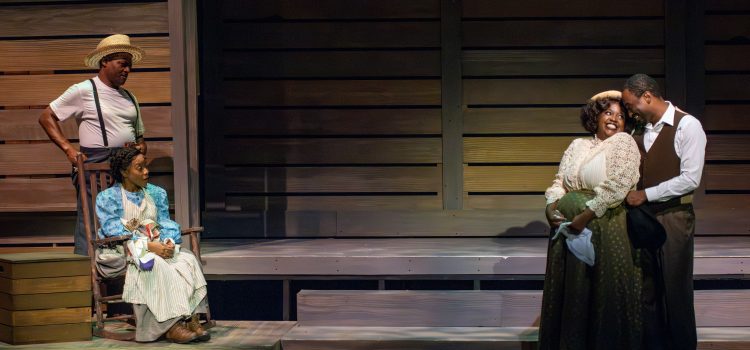
Through Celie’s harrowing emotional journey, a stunning Angela Wildflower leads a passionate ensemble who gives it all through the musical’s sorrows, love, pain and ultimately, triumph.

In a tour de force performance, Wildflower is the heart and soul of this deeply felt production, directed with considerable flair and impact by Daniel Bryant.

In the St. Louis Black Repertory Theatre’s premier that opened its landmark 50th season, the affection for the storytelling was palpable between the audience and the artists. The spirited cast’s voices soared, starting with powerhouse Anita Jackson and the other two ebullient Church Ladies Amber Rose and Olivia Neal with the opening.

The vibrant, roots-infused score includes gospel, jazz, ragtime, blues, and African beats, with songs by Brenda Russell, Allee Willis, and Stephen Bray that bring out the purpose and yearnings.
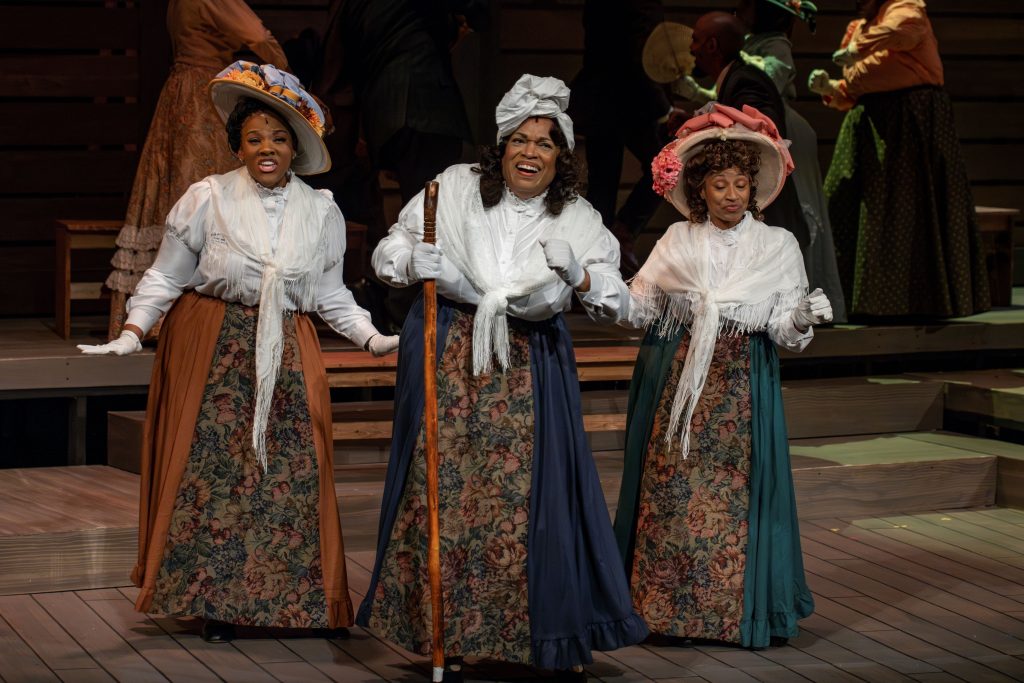
The Church Ladies Amber Rose, Anita Jackson, Olivia Neale. Photo by Arieona Phillips

In 1909, Celie, 14, is a humble, hard-working poor black girl living in rural Georgia, who has delivered two babies whose father is her father, and Pa (J. Samuel Davis) has taken them away.

Several years later, he makes a deal to give Celie to Albert “Mister” Johnson (sturdy Kelvin Roston Jr.), an emotionally and physically abusive widower and farmer, to care for his unruly children and serve him.

By her sacrifice, she spared her sister, Nettie (a tender Morgan Taylor), so that she could follow her dream of being a teacher. Unbeknownst to Celie, for many years, the compassionate Nettie winds up with a missionary family in Africa. When Morgan and Angela sing together, it’s magical, especially “Our Prayer.”

Celie has gone from one house of horror to another. But her faith sees her through, as do the people who raise her up. That community will return her kindness.
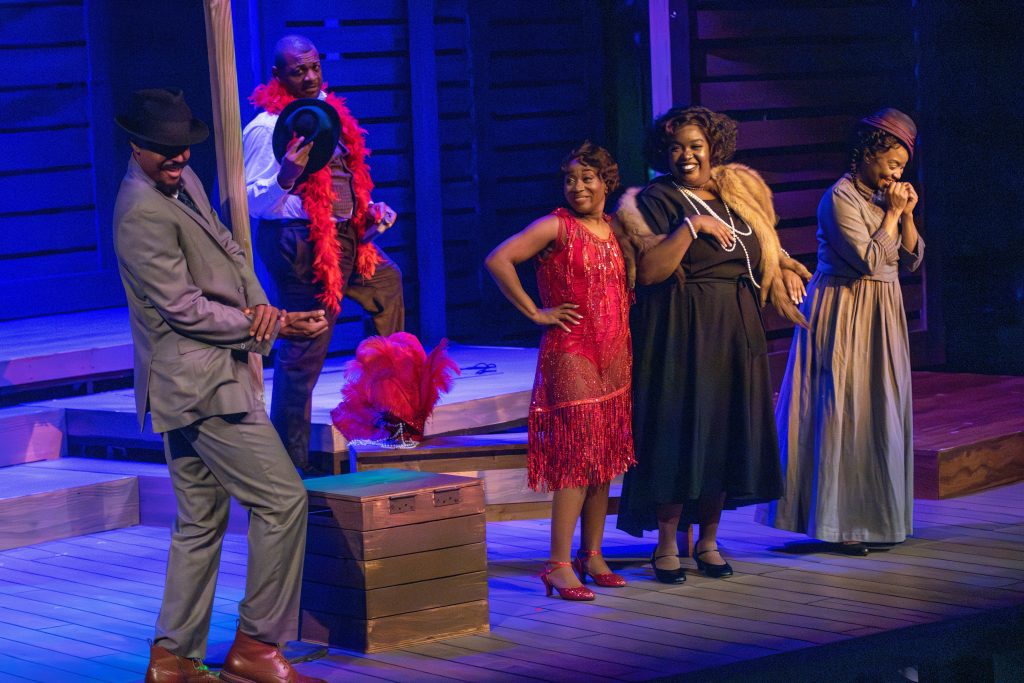
Push Da Button. Photo by Arieona Phillips

While taking care of Mister’s home, the nurturing Celie meets the glamorous and worldly nightclub chanteuse Shug Avery (dynamic Alexis J. Roston). They share romance and a deep bond.

Wearing a snazzy red outfit, Roston sashays with confidence in “Push Da Button” and she shines in “Too Beautiful for Words” and “What About Love?”

One of Mister’s grown children, Harpo (versatile Brian McKinley), marries Sofia (powerhouse Adrienne Spann). Spann, impressive in her Black Rep debut, is strong as the feisty free spirit, known for her independence and speaking her mind. She stands out with her phrase (and song) “Hell, no!”

Tyler White is comical as the irrepressible Squeak and Olajuwon Davis, Dajuan Davis and Samantha Madison are well-rounded, adaptable ensemble members.

Marsha Norman wrote this musical adaptation of Alice Walker’s Pulitzer Prize-winning touchstone novel, a National Book Award winner in 1982. It debuted on Broadway in 2005 and then was revived in 2015.
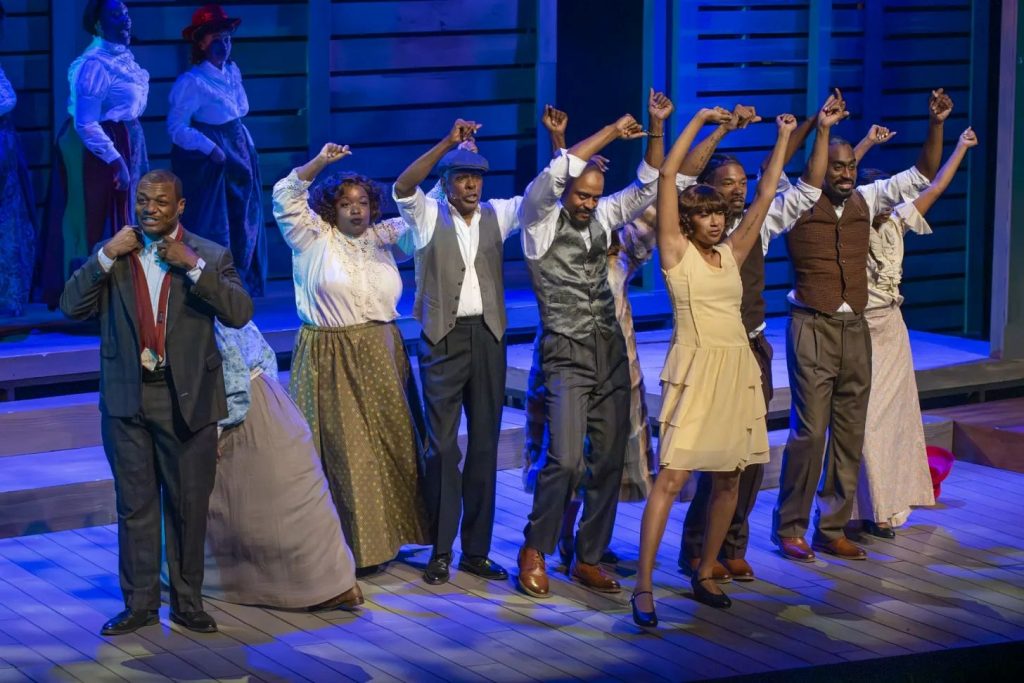
Photo by Arieona Phillips

In the two film adaptations, first in 1985 by Steven Spielberg, which garnered 11 Academy Award nominations, and then a 2023 musical version, they brought out the dignity and virtues of a trauma survivor.

Wildflower brought down the house with “I’m Here” – which was interrupted three times by applause, a goosebump moment.

With this stellar cast, the finale, reprising “The Color Purple,” is heartfelt and affecting, reminding us of the mighty power of love, healing and resilience.

The staging is simple and Heather Beal’s choreography is supple, well-suited for this nimble ensemble. They have fun with the juke joint dance – and ‘Uh Oh.” Special mention to fight choreographer Paul Steger. The energetic African dance number is an ideal way to open the second act.
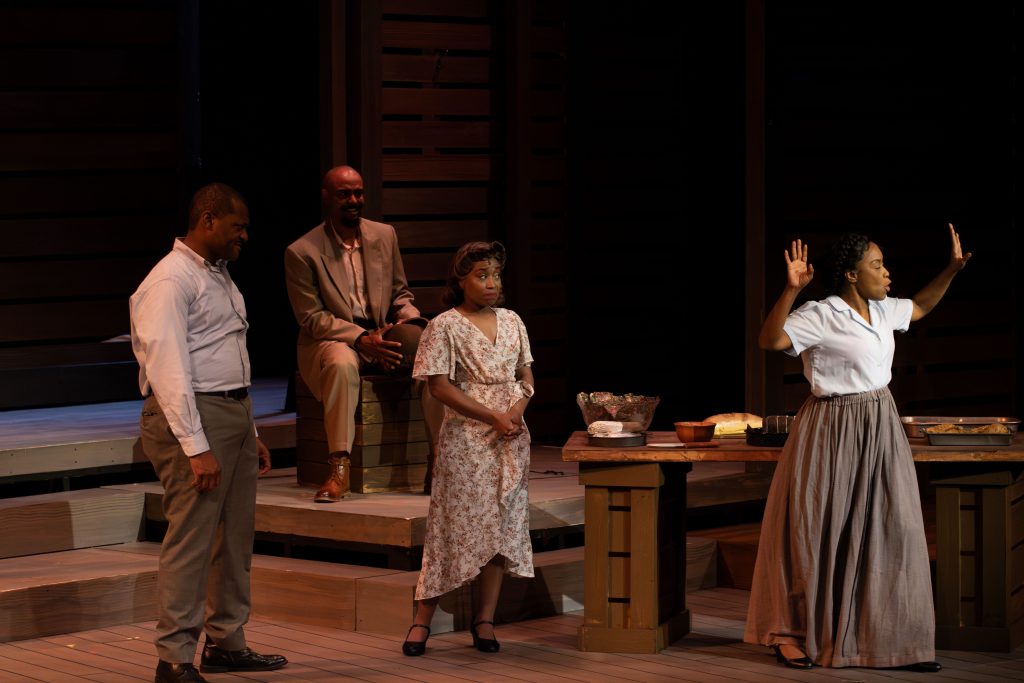
Photo by Arieona Phillips

Using cultural soundscapes beautifully, Music Director Jermaine Manor fluidly leads an eight-piece orchestra, with Zach Neumann on keyboards, Stan Coleman and Alex Macke on reeds, Dennis Brock on guitar, Willem von Hombracht on bass, Des Jones on drums, Gerald “Babtunde” Williams on percussion, and Manor on keyboards, too.

Resourceful scenic designer Tim Jones’ flexible scenic design uses an ancestral tree as a backdrop focal point, with nods to 20 Century South and Africa, and lighting designer Michael Sullivan created atmospheric notes, as did Justin Schmitz’ sound design. Mikhail Lynn did his customary excellent work on props.

With a story spanning 40 years, costume designer Jarrod Barnes’s stylish vintage wear reflects the periods and the economic level of the characters, with Sunday best church clothes and fancier juke joint attire. Nettie’s gorgeous white Victorian dress rivals Shug’s dazzling pieces, and all the trousers are fun for “In Miss Celie’s Pants.”
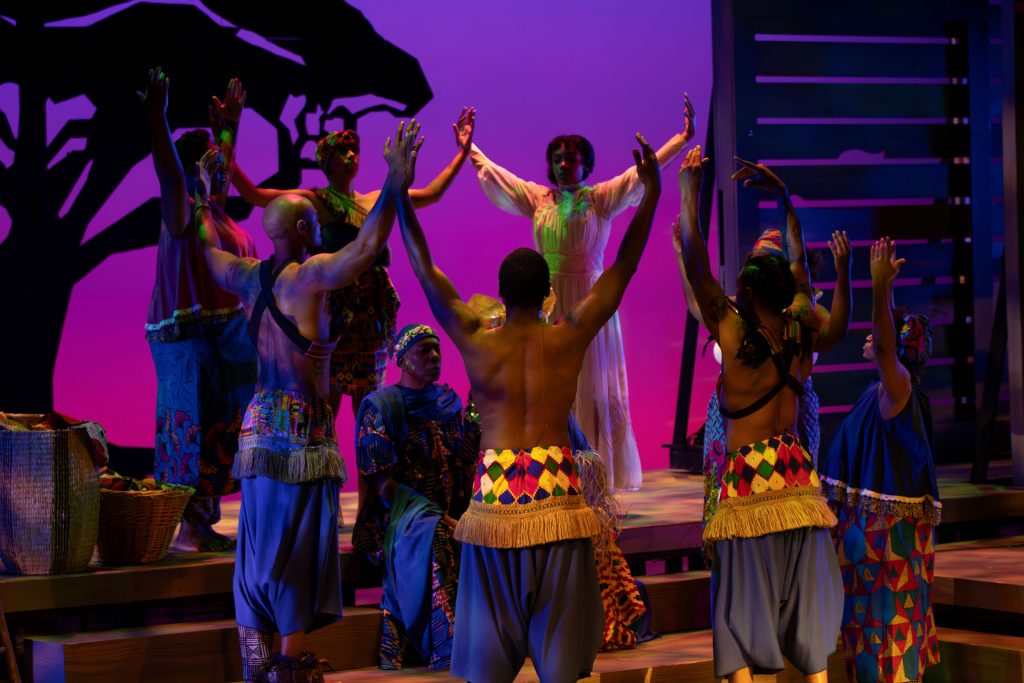
African Dance. Photo by Arieona Phillips

Of note, purple symbolizes strength, transformation, power, wisdom, bravery — and all meanings can be applied here.

What is most personal is also the most universal, and it shows in The Black Rep’s expertly produced, very moving musical.

The Black Rep presents “The Color Purple” Sept. 9 – 27 at The Edison Theatre at Washington University in St. Louis. For tickets, visit The Black Rep’s website, www.theblackrep.org.
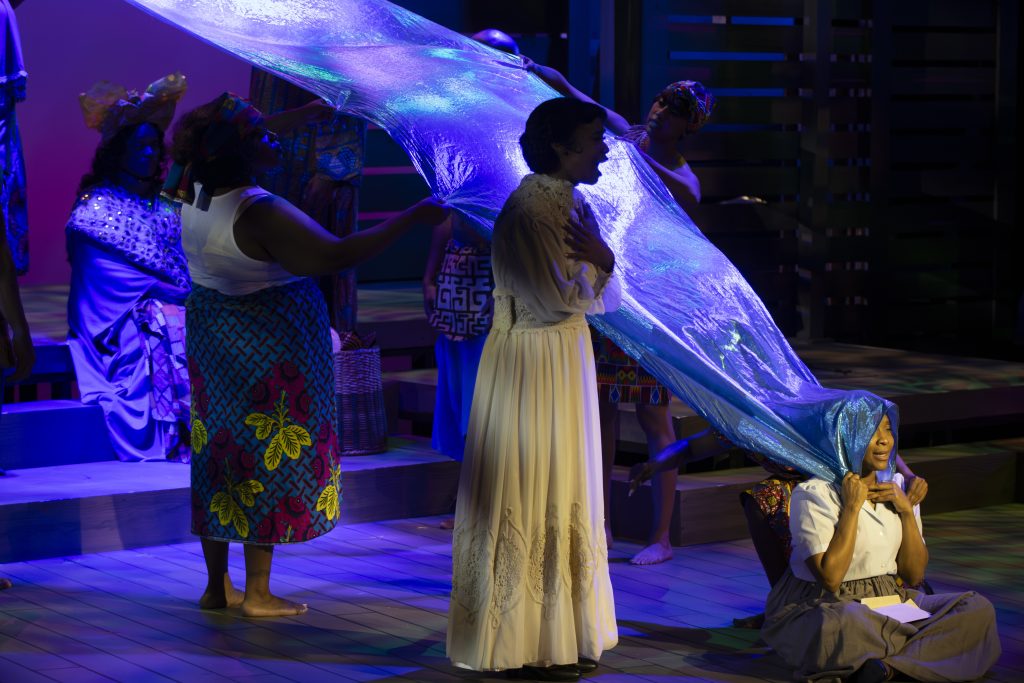

Photo by Arieona Phillips

By Lynn Venhaus

An electric cast brings to life Green Day’s turbo-charged punk rock opera “American Idiot,” accompanied by an exceptional group of eight musicians whose propulsive rhythms invigorate New Line Theatre’s 98th production.

New Line first presented this youthful alienation statement as a regional premiere in 2016, and with a fresh crop of performers, has turned The Marcelle Theatre into a scorching experience that ramps up passion and urgency. Heads will be banged.

Green Day’s 2004 Grammy-winning rock album “American Idiot,” its seventh, is combined with additional songs from their “21st Century Breakdown” album in 2009 and previously unreleased material.

For the stage adaptation, it was formatted as a coming-of-age tale that delved into disillusionment in post-9-11 America. The explosive, in-your-face 2010 Broadway show was nominated for three Tony Awards, including best musical, and won two – for scenic and lighting designs.

Frontman Billie Joe Armstrong collaborated with director Michael Mayer to write the book, which attacked George W. Bush’s presidency, corporate greed, warmongering (“the War on Terror” in Afghanistan and Iraq), hypocrisy in politics, and being submissive, paranoid and apathetic, fueled by mass media.

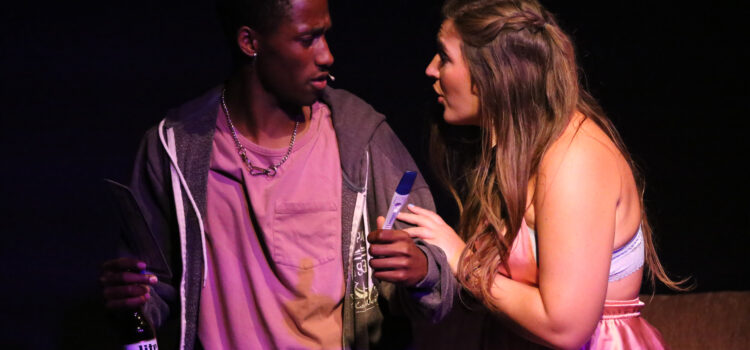
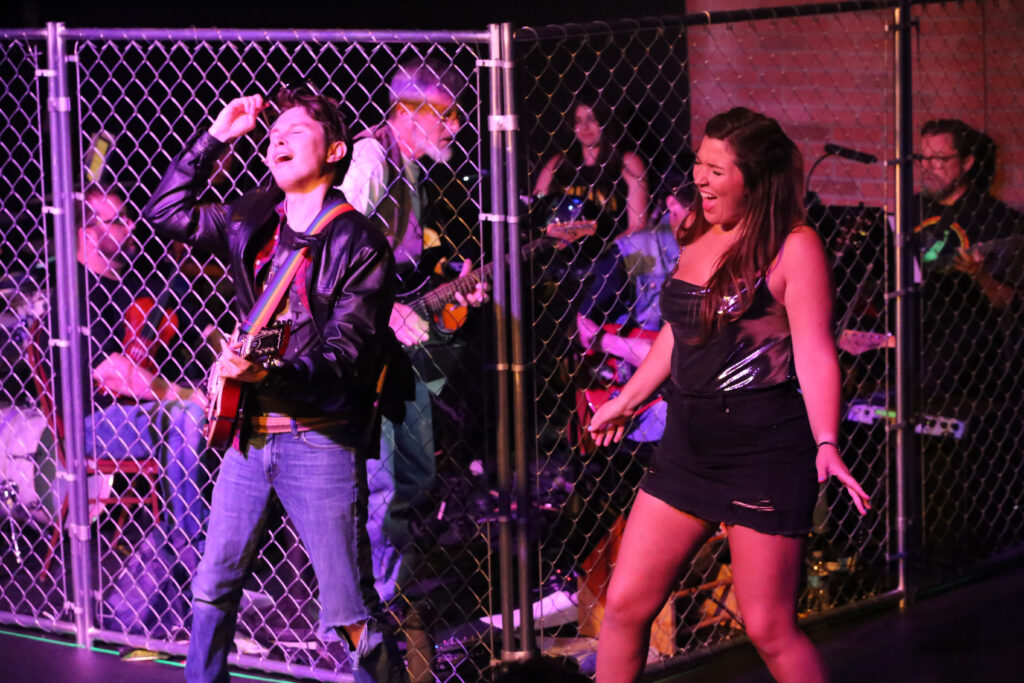
Clayton Humburg and Bee Mecey as Johnny and St. Jimmy. Photo by Jill Ritter Lindberg

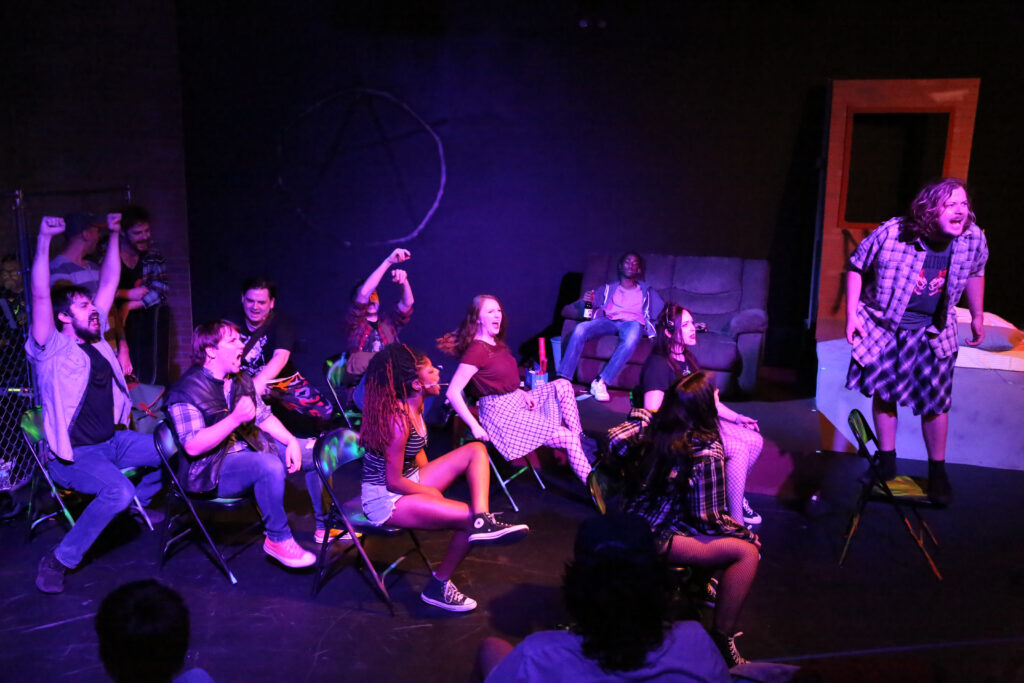
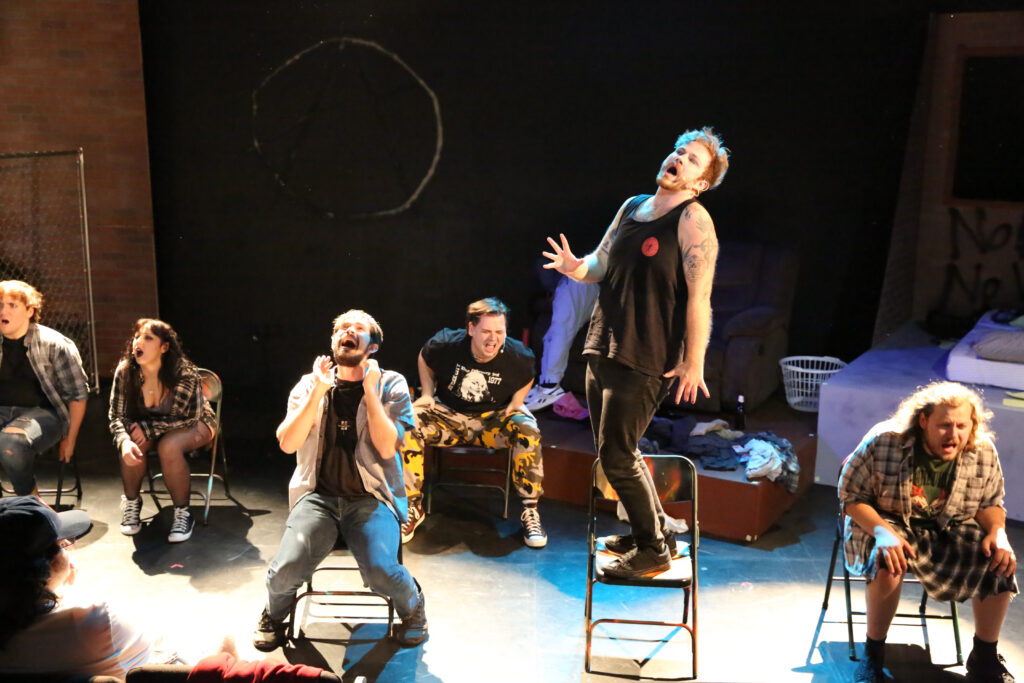
Guided by familiar songs that are rooted in realism, the ensemble is full of energy and attitude, snarling and in pain, confused about their lives’ directions as they struggle to find meaning. They hit the ground running with the title song “American Idiot” and crank it up to 11 from there. You always feel their convictions, no matter how dark it gets.

The ensemble’s momentum is strong in the group numbers, but also in the small vignettes that presents snapshots of lives in transition. Because there is minimal dialogue, the emotions must be conveyed to fill in the blanks about their confusion and malaise.

Temptations beckon ‘in the big city,’ relationships are messy, and the women seemed destined for disillusionment – with strong vocal showings from Lauren Tenenbaum as Whatshername, Adrienne Spann as Extraordinary Girl, and Rachel Parker as Heather.

Directors Chris Moore and Scott Miller have focused on the constant motion aspect of the material, where the band’s raw punk power is maintained, and the performers’ vibrancy comes through, even when playing angsty, restless characters.

Triple threats Clayton Humburg, Rafael DaCosta and DeAnte Bryant are a tight-knit trio of friends — Johnny, Tunny and Will, who are alternately angry and apathetic young men seeking to flee the stifling conformity of suburbia.

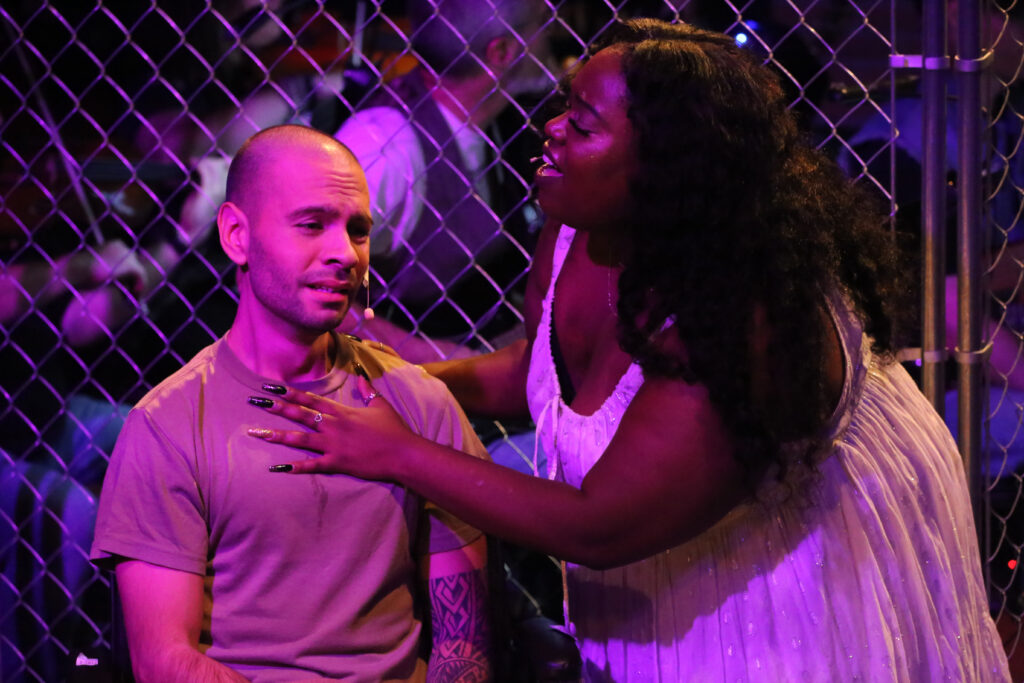
Rafael DaCosta, Adrienne Spann as Tunny and Extraordinary Girl. Photo by Jill Ritter Lindberg

Their robust voices harmonize as they verbalize their distress in “City of the Damned” and “I Don’t Care,” and their feelings coalesce in the soulful ballad “Wake Me Up When September Ends” with the company.

They are visibly agitated in several numbers, including “Tales of a Broken Home” trying to make sense of a world that keeps spinning and not in good ways.

Rebel without a cause, Johnny aka “Jesus of Suburbia,” just wants to be anesthetized and escape in most situations, saying yes to drugs and no to hygiene: “Give Me Novacaine” but shows a hopeful side in “Last of the American Girls” and “She’s a Rebel.”

Living in squalor, wallowing in drug hazes, not being nice to his “dream girl” that gets away, and wrestling inner demons, he hooks up with bad idea drug dealer St. Jimmy.

As a hero’s journey lynchpin, Johnny isn’t a sympathetic character, but Humburg’s verve for every role he takes on comes through, so that he demands you pay attention: Will he self-destruct or get it together? And he’s a naturally compelling performer, so you hope Johnny moves beyond cynicism.

Humburg, Lauren Tenenbaum. Photo by Jill Ritter Lindberg.

Tenenbaum becomes a forceful match for Johnny. At first, seductive Whatshername is misguided, then she grows bolder and more resourceful before she’s gone. In one of the show’s best numbers, Tenenbaum is a standout in the company’s “21 Guns.” She then leads the women in a feisty “Letterbomb.”

Trouble always comes by when St. Jimmy is around, and those pesky drugs that Whatshername is a willing participant in taking. She’s in the number with St. Jimmy and Johnny “Last Night on Earth.”

Bee Mecey is full of swagger as St. Jimmy, equal parts cocky and creepy. Mecey leans into the bombastic, snarling delivery of the vocals, and is an unremorseful ‘son of a gun’ in “The Death of St. Jimmy.”

Tunny joins the military, recruited for the Army by Favorite Son (a noteworthy Jordan Ray Duncan, who bears a striking resemblance to actor Paul Dano). DaCosta and Duncan are powerful in “Are We the Waiting,” joined by others, then they discover they are in for a rude awakening.

These scenes of combat and convalescences are the most powerful. After he is severely wounded in the War on Terror, Da Costa’s torment is palpable, and he agonizes about a crazy world — “Before the Lobotomy.” He attempts to adapt with help from the compassionate Spann, whose silky voice soars in “Extraordinary Girl.”

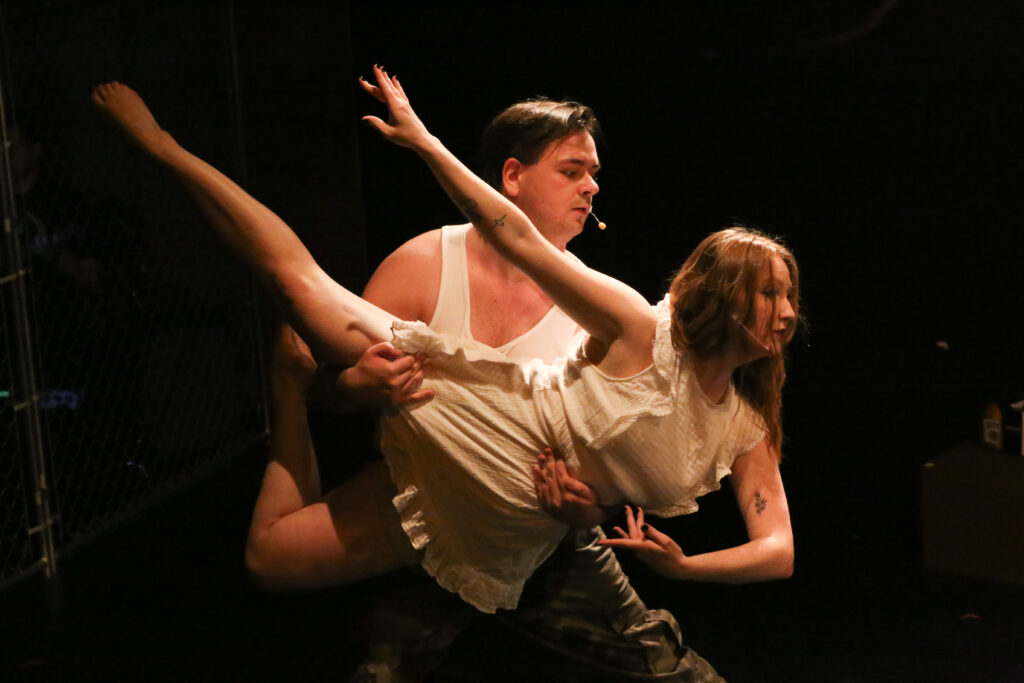
Gabriel Anderson, Kaylin Penninger. Photo by Jill Ritter Lindberg.

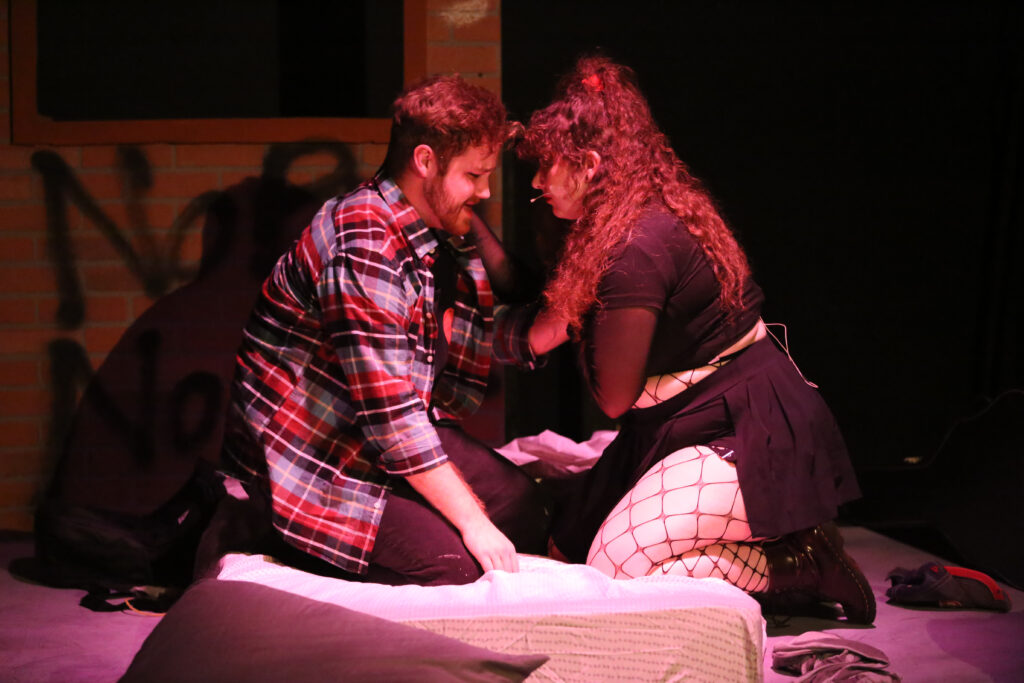
Bryant displays his shock at becoming a father when his girlfriend Heather (Parker) becomes pregnant. They clash as they deal with parenthood, and Parker is moving as she wrestles with Will’s lack of interest and the demands of a baby.

Parker’s sturdy vocal work is impressive as she delivers a rollercoaster of emotion. Her “Dearly Beloved” is a cry for help, her exasperation evident, while “Too Much Too Soon” reveals her frustration and desperation, and in a defiant “Rock and Roll Boyfriend,” she clearly has moved on from Will dragging her down.

As the characters grow, the band of brothers reunite for “We’re Coming Home Again,” and Johnny is sincerely regretful in “Whatshername.”

The zealous company includes Gabriel Anderson, Kaylin “Kat” Penninger, Alex Giordano, Amora Marie, Ian McCreary, Nathan Mecey, Hannah Renee and Vanessa Simpson. They do a fine job raging at the machine.

Anderson and Penninger are impressive as graceful and skilled featured dancers, and they were also the dance captains. Choreographer Chelsie Johnston pushed a passionate intensity in the movements, which brought out the group’s fire and never let up.

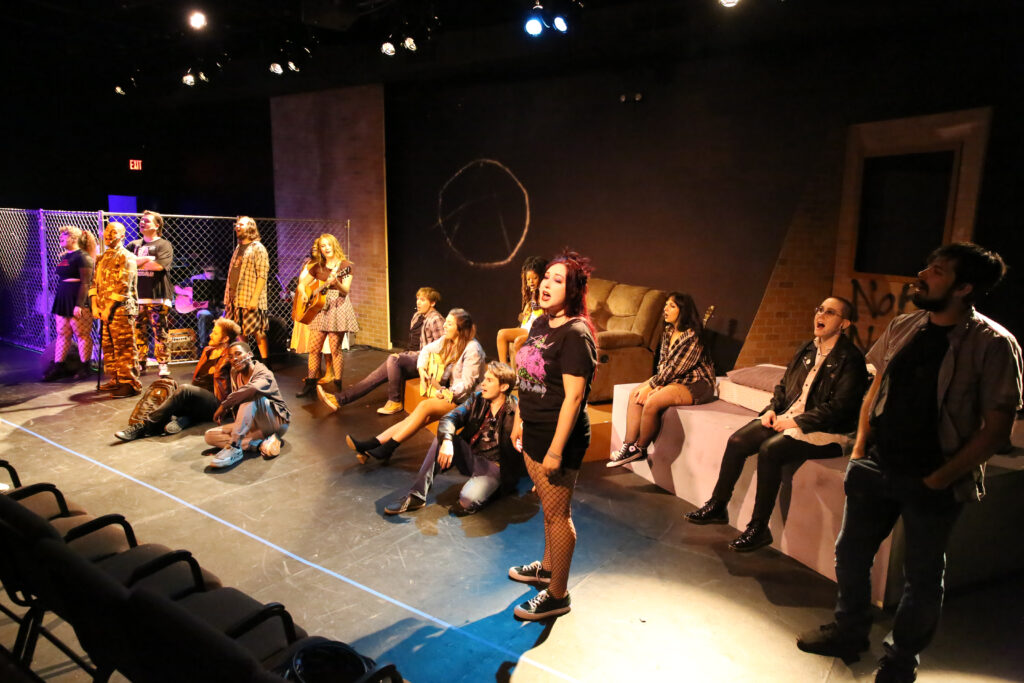
The finale is effectively staged, having the cast sit or stand scattered on the floor, singing a heartfelt “Good Riddance (Time of Your Life).” It is a surprisingly emotional ending after the group has poured out their hearts and souls into this rousing material.

Alex Giordano and Rachel Parker in “Rock and Roll Boyfriend.” Photo by Jill Ritter Lindberg.

Green Day was organized by lead vocalist and guitarist Billie Joe Armstrong in the Bay Area of California in 1987, and musicians Mike Dirnt (bassist) and Tre Cool (drums) came aboard awhile later. They are best known as a rock band that brought punk out of the underground and into the mainstream, starting with breakout success in 1994.

Thirty years later, they’ve sold 75 million records worldwide, been nominated for 20 Grammy Awards, winning five, and were inducted into the Rock ‘n Roll Hall of Fame in 2015, their first year of eligibility.

Bassist John Gerdes’ pulsing power chords are a definite highlight, as are the strings that add so much – violin, viola and cello, along with the robust rock beats of the guitars and drums.

The musicians are a tight group that maintained a driving pace important to the Green Day sound, and carry out the throbbing musical arrangements and orchestrations by Broadway composer Tom Kitt

Gerdes was an outstanding music director, capably getting the best from conducting Chelsea Zak on keyboards (also assistant music director), Adam Rugo and Xander Gerdes on guitars, Jake Luebbert on drums, Steve Frisbee on violin, Mallory Golden on viola, and Marie Brown alternating with Michaela Kuba on cello.

Ensemble in “Holiday.” Photo by Jill Ritter Lindberg.

Ryan Day’s sound design is bold, Ryan Thorp’s lighting design is effective, Lauren Smith Bearden’s costume design captures the club scene and scruffy daily casual. Rob Lippert’s scenic design sets up three distinct areas for the action, with minimal set pieces.

Nathan Mecey put the pieces together as tech director, Mallory Golden mastered the props, and Ashwini Arora was the intimacy coordinator. Gabriel Scott Lawrence is listed as the directing intern.

Every generation has its seminal rock operas – like the Boomers’ “Hair” and “Tommy,” Gen X’s “Rent” and Millennials’ “Spring Awakening.” Millennials identify with Green Day, although there are shades of Gen X’ers too, so its multi-generations.

This cast shows their bond as mostly Gen Z’ers presenting a specific era. It’s hard to think of “American Idiot” as a period piece, for it remains relevant with its blistering screeds and hopeful ballads.

Johnny leads the company in “East 12th Street.” Photo by Jill Ritter Lindberg.

With a complexity that you may not have thought about while hearing the music in radio play or through sound systems, “American Idiot” shakes things awake in a rant against complacency and manipulation – and that can be heard loud and clear at any age.

New Line Theatre presents “American Idiot” from Sept. 12 to Oct. 5 on Thursdays through Saturdays at p.m. at the Marcelle Theatre, 3310 Samuel Shepard Drive, St. Louis. There is no performance Sept. 14. This 90-minute show is presented without intermission and is the 33rd season opener.

Tickets: Metrotix: 314-534-1111 or visit the Fox Theatre box office or the MetroTix website. Discounts: for students, educators and military. For more information, visit www.newlinetheatre.com.

There are 10 free seats for every performance that are open to any college student with a valid student ID. It is valid only at the door.

There is a lighted parking lot across the street from the theatre, and there is lots of free street parking. There is no dress code and there are refreshments available in the lobby, including alcohol.

Company in “Good Riddance (Time of Your Life).” Photo by Jill Ritter Lindberg.