.By Lynn Venhaus

Good trashy fun, “The Housemaid” is a psychological domestic thriller with a dash of dark comedy that is ideal alternative programming this holiday season when all the prestige awards-hopefuls are released.

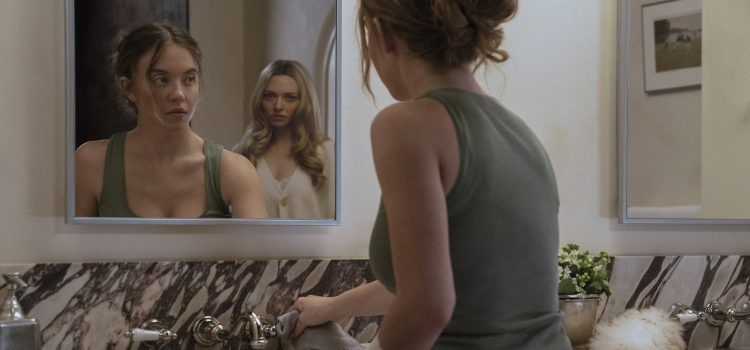
Millie (Sydney Sweeney), a plucky young woman with a secret criminal past, takes a live-in job as a housekeeper for the wealthy Winchester family – high-powered wife Nina (Amanda Seyfried) and handsome husband Andrew (Brandon Sklenar). While they look perfect, her new employers have secrets of their own.

None of the three stars – currently having moments – will be on year-end awards shortlists for their performances, yet they lean in and act with an intensity that merits them serious kudos for their earnest approach to over-the-top melodrama.

Let the mind games begin! As Nina, the suburban princess living luxuriously, Seyfried can fly into Defcon 5 rage with a frightening ferocity and assuredly drives this effort.

Knowing what’s at stake is her forte here. To watch her alternate wild histrionics with an icy-cold façade as a Real Housewife archetype is amusing.

Sweeney’s star has risen ever since “Euphoria” shook up streaming and may tie with Josh O’Connor for having the most movies released this year, even besting Pedro Pascal. She plays forlorn Millie just-right with a shaggy poor-girl-trying-to-please demeanor and a palpable desperation to escape her past.

Sklenar, who was swoon-worthy as the rugged hero Spencer Dutton in Taylor Sheridan’s “Yellowstone” prequel “1923,” is in yet another handsome, chiseled guy role. This time, he’s Andrew, a gracious, well-mannered scion of an influential family, flashing his pearly whites often.

It’s a perfect threesome for this type of suburbanites’ unraveling story. For fans of the popular 2022 page-turner by Freida McFadden, you know the delectable unpredictable twists. But for those of us in the dark, the reveals are a surprise – and boost the audience-participation feel of the film.

Smartly directed by Paul Feig, whose comedy pedigree is stellar (“Freaks and Geeks,” “Bridesmaids,” and episodes of “The Office”) and his thriller portfolio is gaining traction after “A Simple Favor,” he is one step ahead of us as we uninitiated try to figure out where these deceptions are leading.

He also strikes the right engrossing tone, mixing suspense, shock and silliness to guarantee gasps and build momentum. The screenplay by Rebecca Sonnenshine, a two-time Emmy nominee as a writer on “The Boys,” draws us into the chills by smoothly weaving backstories in, adding gaslighting and tension in the home.

Elizabeth Jones’ lavish production design is Martha Stewart-worthy in a sprawling, airy McMansion in Great Neck, N.Y. As the live-in housekeeper, Millie’s bedroom is a cozy A-frame attic nook that has a door that locks from the outside.

In shades of Stepford wives, supporting players are stereotypical privileged upper-class women who are condescending of others not in their same social register – and even if they are, finding ways to be critical. Millie overhears the local elitist moms gossiping about Nina, which is unexpected, as are other remarks by ‘the help’ in the community.

Those are interesting nuggets that illuminate what’s happening – or not – but it keeps us guessing as the plot thickens. The dialogue is often cheesy, but that’s part of the fun, too. This material is far from Tolstoy or Chekhov – it’s “Dynasty” glammed up for the 21st century.

It’s best to know as little as possible going into the movie, so no spoilers here.

Elizabeth Perkins has a few defining moments as Andrew’s snobby mother Evelyn Winchester, dismissive of her daughter-in-law and demanding in snide ways. After all, she’s more concerned with appearances than anything else.

Young actress Indiana Elle is the Winchester’s snotty, indulged daughter Cecelia “CeCe,” whose sense of entitlement shows signs of creating a monster, but whose actions later indicate she’s been paying attention. It would have been nice to have more character development in that regard.

Michele Morrone, who played Emily’s fiancé Dante in Feig’s “Another Simple Favor,” is well-cast as mysterious handyman Enzo, but sadly, it’s an underdeveloped character.

“The Housemaid” is nothing more than a pulpy “popcorn” thriller, well-suited as escapist fare, especially during a dreary winter and in a disconcerting world. It’s a film that knows exactly what its mission is, and how it fits into the entertainment landscape.
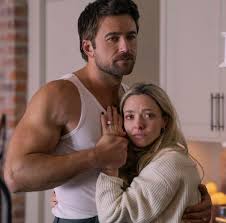
“The Housemaid” is a 2025 psychological thriller directed by Paul Feig and starring Amanda Seyfried, Sydney Sweeney, Brandon Sklenar, Elizabeth Perkins, Michele Morrone and Indiana Elle, Its runtime is 2 hours, 11 minutes, and it’s rated R for strong/bloody violent content, sexual assault, sexual content, nudity and language. It opens in theaters Dec. 19. Lynn’s Grade: B.

By Lynn Venhaus

A poorly constructed storyline squanders a good cast in “Things Heard & Seen,” an unsatisfying adaptation of the bestselling novel “All Things Cease to Appear” by Elizabeth Brundage.

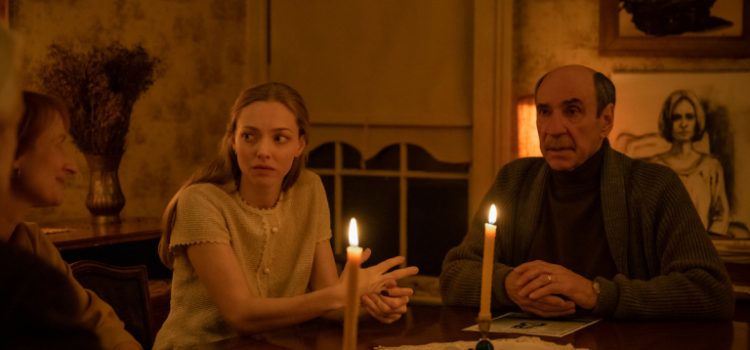
When George Claire (James Norton) accepts a teaching offer at a small liberal arts college in the Hudson Valley, he relocates his wife, Catherine (Amanda Seyfried), a Manhattan artist, and their 4-year-old daughter Franny (Ana Sophia Heger) to an old farmhouse. The home has a dark history and sinister things start happening.

Shari Springer Berman and Robert Pulcini seem to be odd choices to write and direct this multi-generational story that abandons that idea. They were Oscar-nominated for the screenplay of “American Splendor,” which they directed.

However, they can’t make up their mind whether to concentrate on being a paranormal activity horror film or a thriller about a sociopathic husband. Pick a lane, people – and neither is convincing.

James Norton, a British actor last seen as Meg’s husband in Greta Gerwig’s 2019 “Little Women,” is an implausible cad with a wandering eye – picking up chicks at the local library with his daughter in tow. He is built up as a golden boy, a hotshot art historian whose students worship him, but then turns deceitful on a dime.

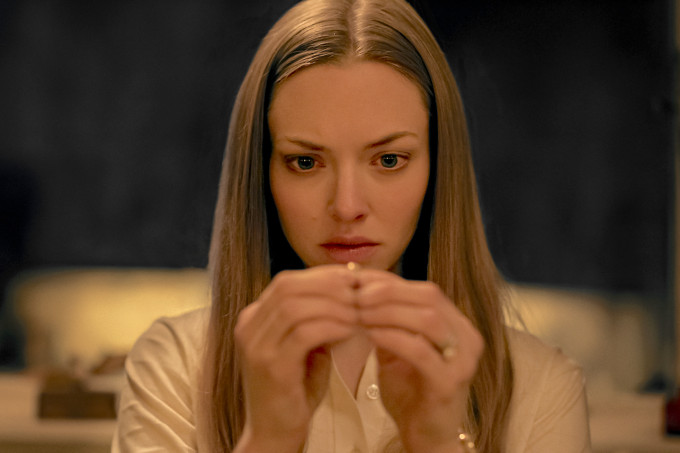
Of course, he doesn’t believe his wife about her supernatural suspicions. A feeble Amanda Seyfried, whose character is bulimic, seems lost in this stale role. A controlling George thinks she’s losing it – no surprise there. And she is thoroughly in the dark about his duplicitous double life. When she starts suspecting a crack in his façade, the ghosts turn into sympathetic pals.

The old house is another character, with signs of ghosts that are often used in unimaginative genre films. The set-up early on is where someone should scream “Get out of the house now!” Naturally, the rambling homestead is a remote place, and set in 1980, there is no modern technology that could be used for rescues.

The supporting cast includes Oscar winner F. Murray Abraham as the erudite art department chair, Rhea Seehorn as a sassy weaver on the faculty, Karen Allen as the town realtor, Michael O’Keefe as her husband, also the town sheriff, and Natalia Dyer as a cynical coed. You’d expect that they would have more to do, but nope – rather wasted instead of serving the plot.

With a few genuine moments of suspense, you see where it had potential, but several teases of substantive developments go nowhere, leading to one of the more ridiculous endings in recent memory.

As the third act rushes to conclusion – and people wind up injured or dead after confronting the horrible husband about his misdeeds – one figures out that this has been a huge waste of time.

The only way to enjoy any part of this movie is to revel in the bad dialogue. If you go in realizing that this film is trash, you might have fun with it.

Otherwise, the lack of cohesiveness will be frustrating.

Amanda Seyfried

“Things Heard & Seen” is a 2021 horror-thriller directed by Shari Springer Berman and Robert Pulcini, starring Amanda Seyfried, James Norton, F. Murray Abraham, Rhea Seehorn, Natalia Dyer, Karen Allen, Michael O’Keefe. It runs 2 hours, 1 minute and is rated TV-MA. It is now streaming on Netflix. Lynn’s Grade: D-

By Lynn Venhaus
An unflinching look at the old studio system during the height of Hollywood’s Dream Factory persona, “Mank” is more than a backstory on “Citizen Kane,” pulling back the curtain on some unsavory wheeling-and-dealings of the era.

“Mank” follows screenwriter Herman J. Mankiewicz’s tumultuous development of Orson Welles’ iconic masterpiece in 1941, with flashbacks to old Hollywood in the 1930s, including labor disputes, politics and the studio tycoons.

Director David Fincher, known for his obsessive control, has carefully crafted a portrait of the complicated screenwriter Herman J. Mankiewicz, who died of alcoholism at age 55 in 1953. Mank, a newspaperman from New York, was one of the well-known Algonquin Round Table writers who migrated to Hollywood. He joined such luminaries as playwright George S. Kaufman, humorist S.J. Perlman and Ben Hecht as screenwriters under contract.

 While recovering from a broken leg, Mank is set up at a dusty, desolate ranch in Victorville, Calif., to write the screenplay with a 60-day deadline, free of distractions and surrounded by secrecy. 

John Houseman, who is part of Orson Welles’ fabled Mercury Players, has been assigned to watch over him. Houseman, who really won Best Supporting Actor for “The Paper Chase” in 1974, didn’t seem to be particularly fussy, but Sam Troughton plays him that way. Wunderkind Welles (Tom Burke) will tussle with Mank, but it is their crowning achievement.  

While best known for winning an Oscar for the screenplay of “Citizen Kane,’ which he reluctantly shared with Orson Welles – and was the only winner out of nine nominations, Mank also wrote “Dinner at Eight” and “The Pride of the Yankees,” among dozens of titles, and produced such Marx Brothers movies as “Duck Soup.”

The man himself was a prickly personality, an uncompromising writer with a sardonic wit and a wicked pen, disgruntled by the studio system and the guys who ran them. He did not suffer fools and was wary of those in power. Heavy drinking and gambling had sullied his reputation, but no one could deny his talent.

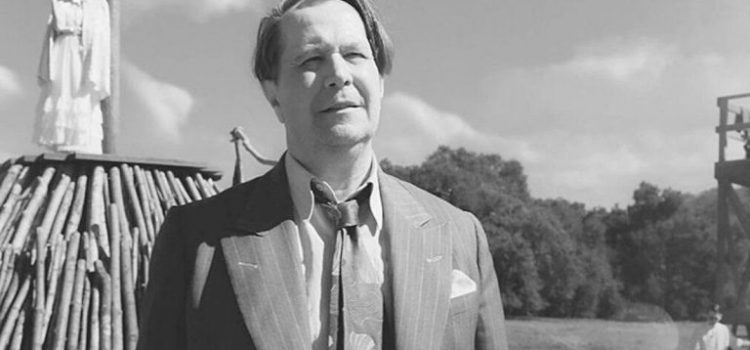
The cast is one of the finest assembled this year, helmed by Gary Oldman as the bruising wordsmith. It’s a towering portrayal—would we expect anything less from the Oscar winner? Oldman has affected an old-timey delivery for his epic battles with just about everyone but his long-suffering wife, dubbed “Poor Sara” (nicely portrayed by Tuppence Middleton).

The multi-layered story focuses on the ruthless movers-and-shakers – including a terrific Arliss Howard as cunning Louis B. Mayer at M-G-M and a steely Charles Dance as shrewd newspaper publishing magnate William Randolph Hearst.

At his castle in San Simeon, Hearst threw lavish dinner parties attended by the show business elite. One of his favorite guests, no matter how drunk or boorish he got, was Mank. The outspoken screenwriter was pals with Hearst’s mistress, actress Marion Davies, who is played by Amanda Seyfried in her best performance to date.

Other noteworthy performances include Ferdinand Kingsley as producer Irving Thalberg, Lily Collins as stenographer Rita Alexander, Jamie McShane as Shelly Metcalf and Ozark’s Tom Pelphrey as Joseph Mankiewicz, Herman’s brother who was also in the business (and wrote “All About Eve.”)

The score by Fincher’s go-to duo of Atticus Ross and Trent Reznor captures the period jazz and Big Band, and

While the meticulous production values are stunning, with its luxe black-and-white cinematography by Erik Messerschmidt, glamorous costume design by Trish Summerville and the grand production design by Donald Graham Burt, the dense plot of “Mank” is likely to keep some moviegoers at a distance. 

As it sprawls beyond the studio gates, the filmd takes detours into the 1934 gubernatorial race in California and industry politics, convoluting an already verbose narrative.

If you are not familiar with the backstory about the making of “Citizen Kane” or the real people on whose lives the characters are based, this may be a problem in digesting “Mank,” a very inside look at Hollywood as an industry who aimed at a market devastated by the Depression.

The director ‘s late father, Jack Fincher, who died in 2003, wrote this screenplay in the 1990s, for the film originally was supposed to be made after “The Game” in 1997. Rumor has it that Eli Roth did some polishing, but whether that’s true, the original script must have had to be reworked at some point.

One thing is certain, Hollywood loves to make movies about the making of movies. Fincher’s lens creates a bigger picture while concentrating on a few key players.

Fascinating, infuriating and rich with details, “Mank” the film is like Mank the person – hard to pin down but worth the time.

“Mank” is a biography-drama directed by David Fincher and starring Gary Oldman, Charles Dance, Arliss Howard, Amanda Seyfried, Tuppence Middleton, Lily Collins and Tom Pelphrey. Rated R for language, “Mank” is 2 hours and 11 minutes’ long. Lynn’s Grade: B-