
By Lynn Venhaus

Laying the foundation for the palace intrigue in Shakespeare’s tragic “Hamlet,” the original play “Elsinore” is an interesting interpretation of those familiar characters in an affecting prequel.

Known for its bold choices, local theater company Chorus of Fools has mounted artistic director Eric Satterfield’s 2021 play updated by co-playwrights David Nonemaker and Satterfield, who also directed.

How did Denmark become so rotten? Satterfield wants answers and his strong cast will tell a more nuanced story.

Through compelling performances, this ensemble delves into the unraveling of the royal family and how the political scheming escalates, which eventually leads to the kingdom’s instability and headed to war with Norway.

Most remarkable is how much the language sounds like the Bard in tone and tempo. Smartly written with style, wit and theatricality, “Elsinore” plausibly imagines the backstories.
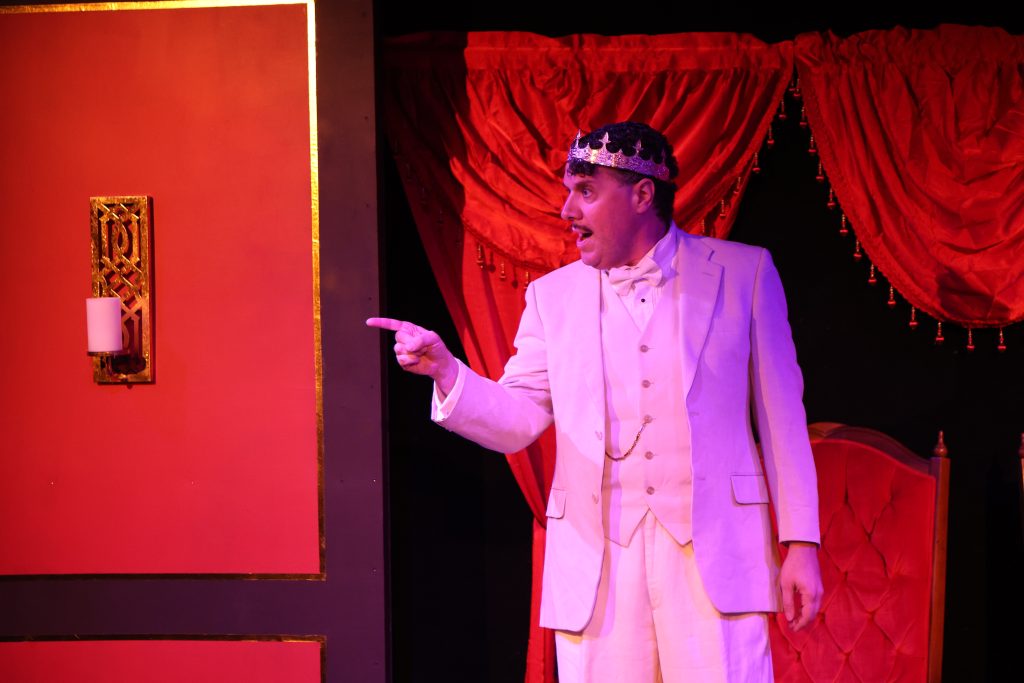
John Wolbers is the domineering King Hamlet. Photo by David Nonemaker.

The playwrights obviously have read and studied Shakespeare, presenting a new angle on one of literature’s most influential works. After all, “Hamlet” has been adapted in many ways (“The Lion King,” anyone?)

A rewarding aspect is its exploration of many of the same universal themes, such as making one’s mark, duty, honor, loyalty, destiny and revenge. However, in these earlier incarnations, character transformations and motivations give the actors a juicy challenge.

We may think we know these characters, but by the time Shakespeare crafted them, they had been developed by circumstances, revealing their true nature.  In the prequel, they are forging their paths.

While the prince of Denmark has always been fascinating, in the before times he is secondary to Claudius, who has the most complex character arc. Joseph Garner, one of the region’s most versatile performers, has been a formidable stage presence in supporting roles. As the king’s brother and emissary, he delivers a dynamic characterization rich in detail.

Initially, a dedicated selfless royal, Claudius undergoes personal tragedies and moral dilemmas that lead to his stunning power-grab as he ascends to the throne while breaking up his brother’s family.
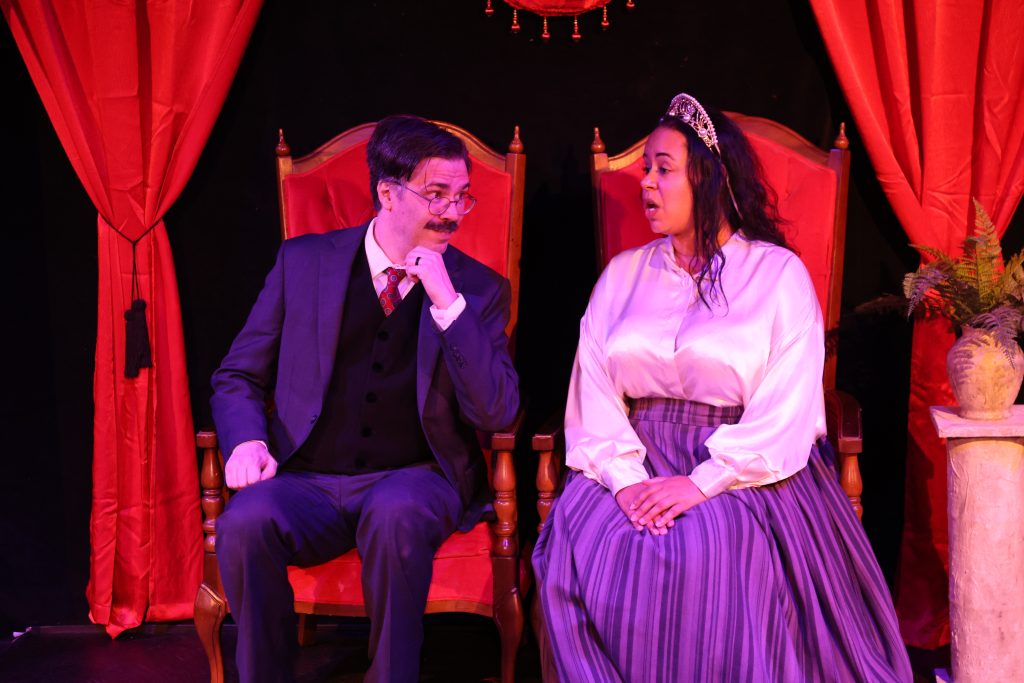
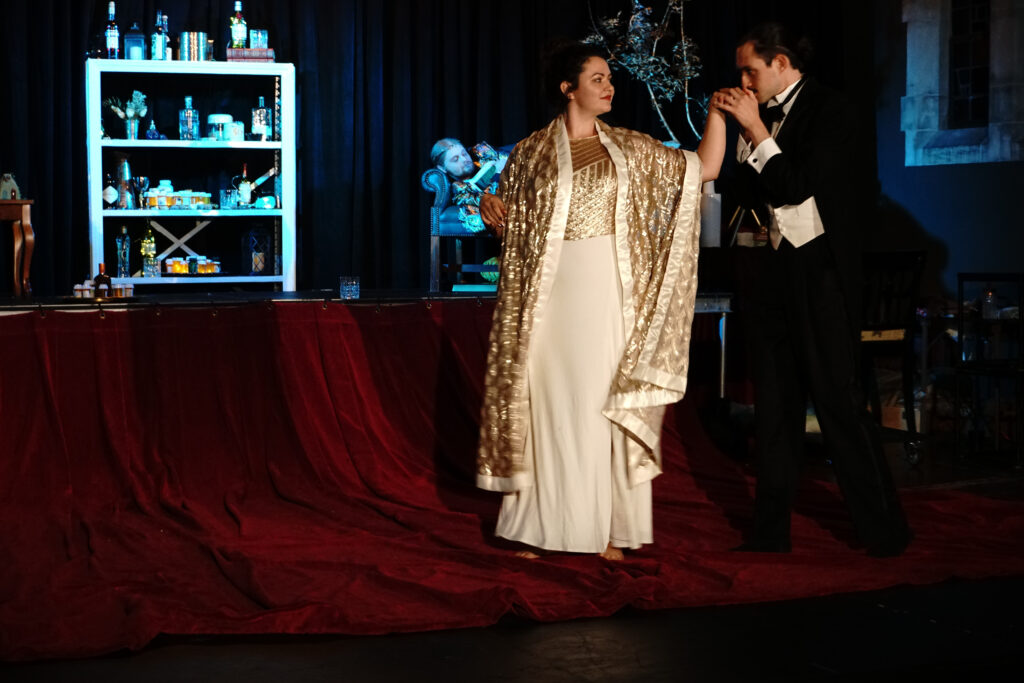
Joseph Garner and Jocelyn Padilla as Claudius and Gertrude. Photo by David Nonemaker.

King Hamlet is not a benevolent ruler. John Wolbers portrays him as imperious and devious, and with his son Hamlet, he is demanding and impatient. The young heir is finding his way, clashing with his father and being more comfortable around his uncle.

He starts brooding, and Andre Eslamian gives the intense, rebellious lad an emotional depth while conveying quicksilver moods. He’s confused and angry in interactions with his father, merry with his goofy friends Rosencrantz and Guildenstern, playful with his cousin Claudius, and tender with Ophelia.

His father is not fond of his childhood pals, and Xander Huber, as Rosencrantz, and Zach Pierson, as Guildenstern, display why. As the bumbling buddies, they demonstrate sharp comic timing and play off each other well, adept at slapstick.

Chuck Brinkley, equally good at comedy and drama, adds moments of daffiness to the garrulous Polonius, who is Claudius’ trusted advisor. But he’s capable of conniving. (And what a trouper — he really did break his ankle, hence the assistance.)

Madness has not yet affected major players. Ophelia becomes a handmaiden for Queen Gertrude. She is an intelligent, curious girl, devoted to her father Polonius and gives her heart to Hamlet. Hannah Geisz plays her as a spirited, virtuous member of the court – but one who won’t be an afterthought.
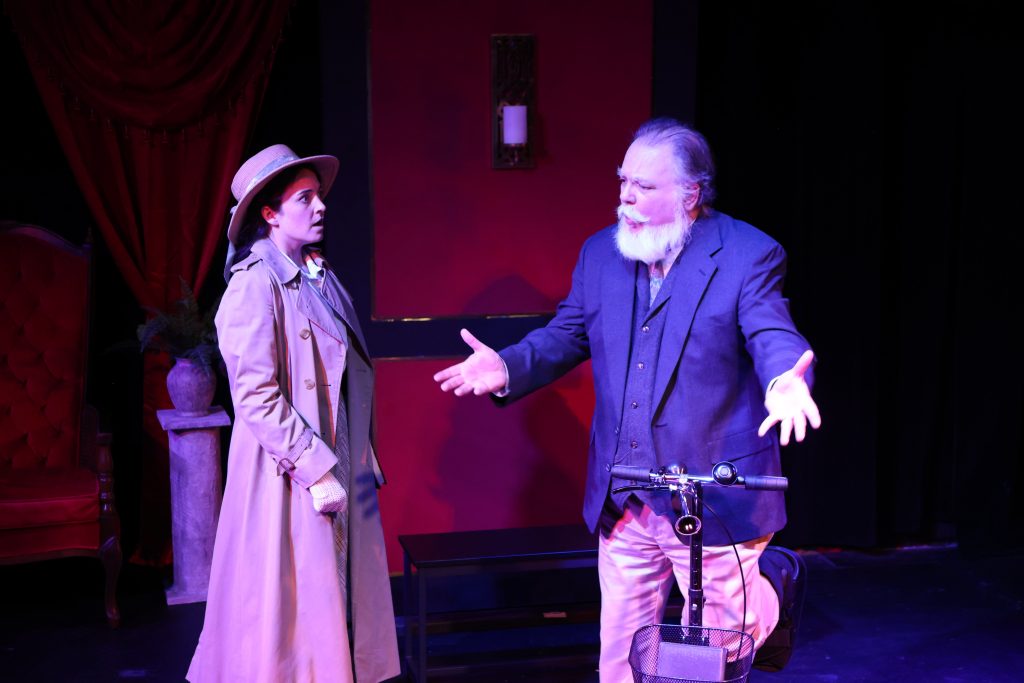
Hannah Geisz and Chuck Brinkley as Ophelia and Polonius. Photo by David Nonemaker.

As Gertrude, Jocelyn Padilla is an obedient wife and dutiful mother. She is hurt by the king’s gruff treatment of her, and after his untimely death, brightens under the gaze of Claudius.

Huber and Pierson each fill another role – Huber is Lord Waldemar and Pierson as young Claudius. Joe Kercher handles three brief roles – Lord Olaf, Laertes and a hooded figure. Rose Reiker is Osric, a courtier and messenger.

Claudius, who becomes a widower after his loving wife Colette (Lexie Johnson) and their beloved son Claudius (Zach Pierson), died in a shipwreck, has somewhat of a reset.

He has lost faith after those devastating losses, becoming bitter and angry. He disagrees with his brother’s decisions and ruthlessly sets a course to takeover.

“Hamlet” was Shakespeare’s longest play, and this version is in three acts, with two intermissions. The second act resumes 14 years later, and the third is one year after that.
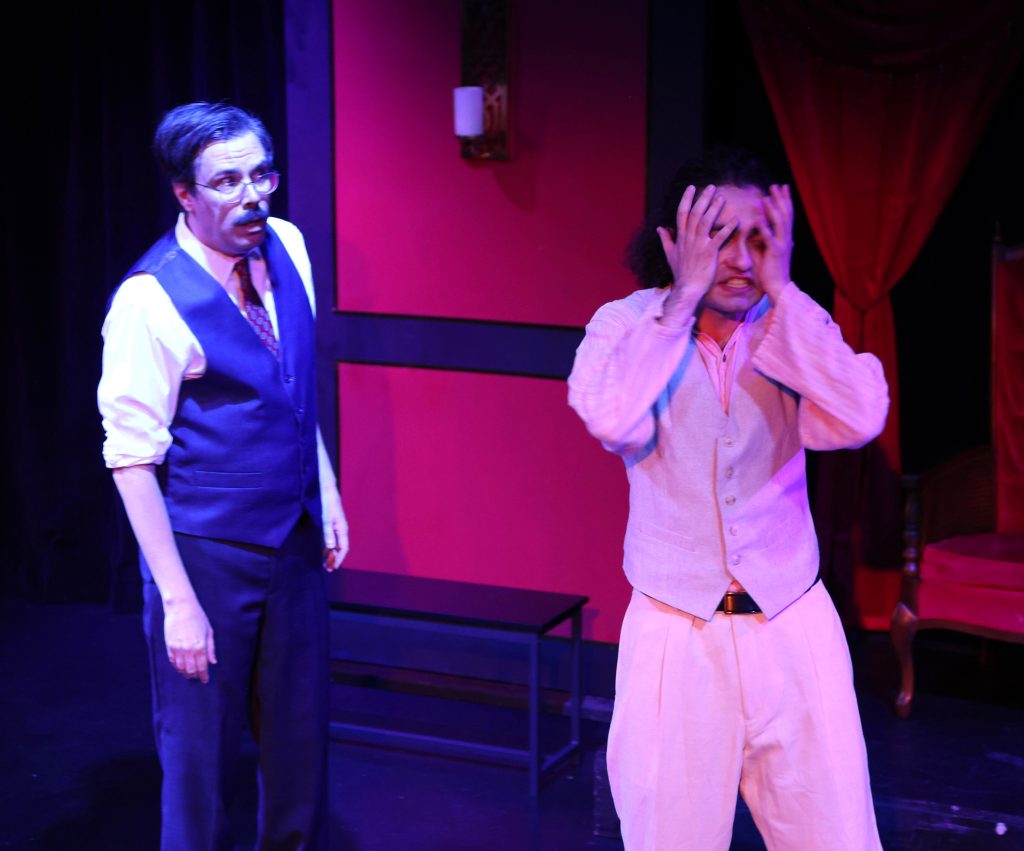
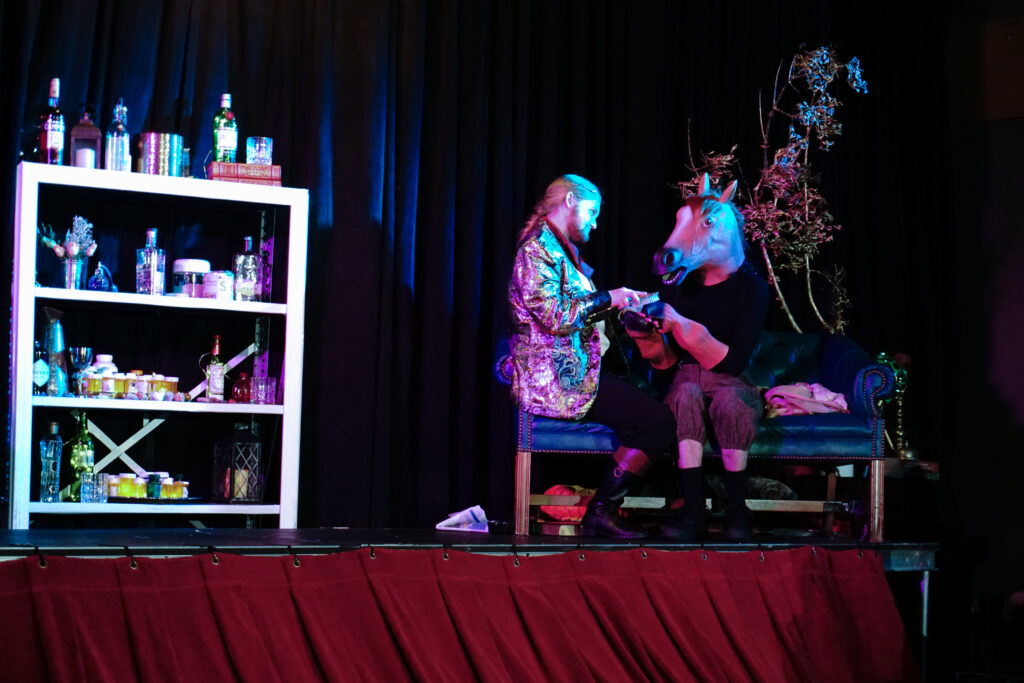
Joseph Garner, Andre Eslamian as Claudius and Hamlet. Photo by David Nonemaker.

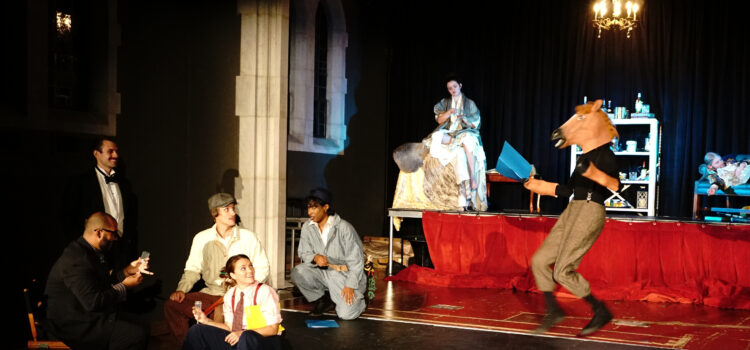
The small company, with a modest budget, cleverly depicts the castle’s throne room, Claudius’ family sitting room, and the orchard where King Hamlet often napped. Vickie Delmas worked on the set design with Satterfield, and took care of props..

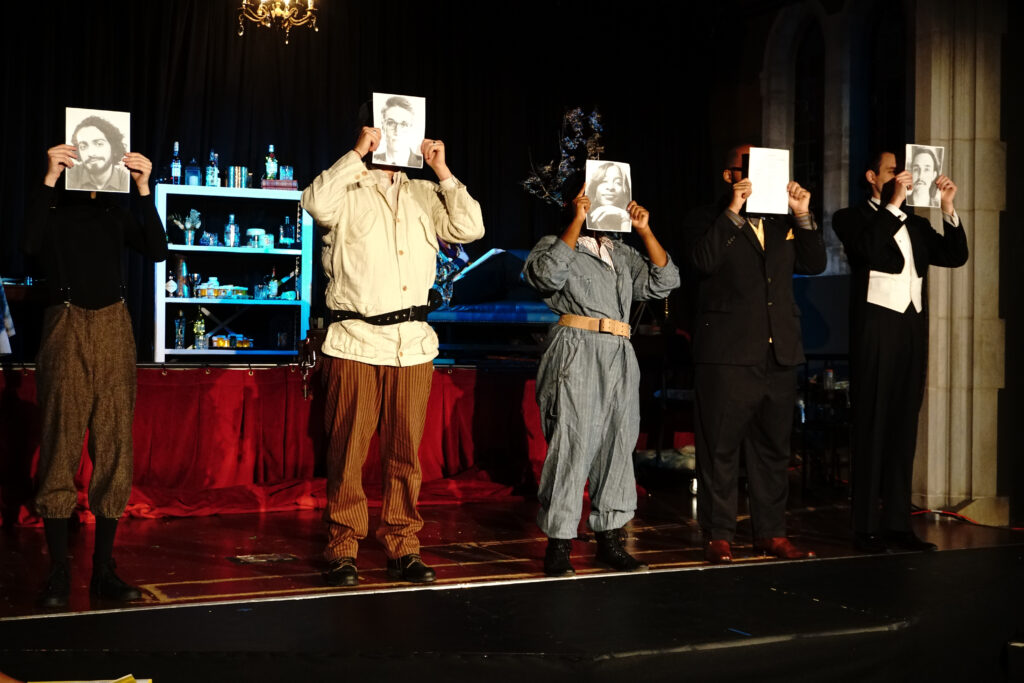
With its “Downtown Abbey” inspired Edwardian setting and period costumes, “Elsinore” creates an insular world where loyalty is demanded while secrets and lies are part of the growing corruption.

Costume designer Celeste Gardner paired different textures together to appropriately outfit the characters, with her work particularly noteworthy for Ophelia and Gertrude.

Bradley Rohlf’s atmospheric lighting design highlighted an impending doom, while giving the ghosts an other-worldly illumination. Satterfield’s outstanding sound design included imaginative needle drops and a regal music score to reflect the spreading darkness.

Other contributors were Ryan Lawson-Maeske, fight choreographer; Jen Kerner, accessibility consultant; Tress Kurzym, intimacy director; and Nikki Pilato, dramaturg (and also assistant director). Moira Healy was the stage manager.

With a castle community sensibility, the savvy cast transported us to a troubled time that has been examined through the ages, and managed to engage us with different, interesting angles. They skillfully conveyed Satterfield’s and Nonemaker’s intentions in a smart, entertaining presentation.
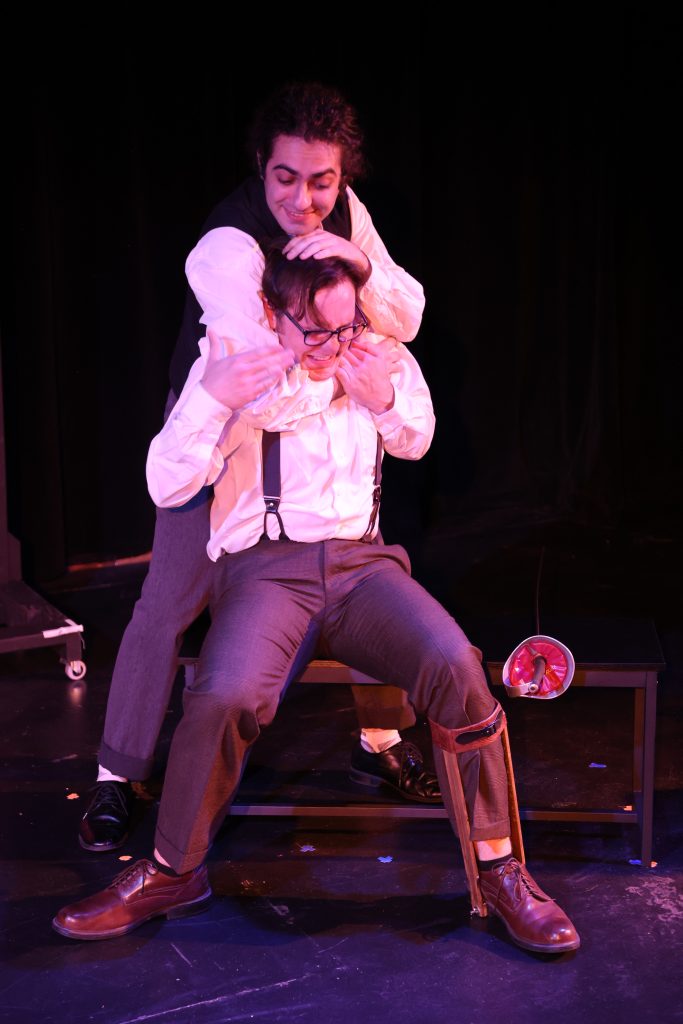
Andre Eslamian, Zach Pierson as the young Hamlet and young Claudius. Photo by David Nonemaker.

Chorus of Fools presents “Elsinore” Thursdays through Saturdays at 7:30 p.m. from Oct. 9 through Oct. 19 at The Greenfinch Theatre and Dive Bar, 2525 S. Jefferson. For more information: greenfinchstl.com/events

By Lynn Venhaus

A trio of ragtag revolutionaries cling to their cause and their rules as they hide from an authoritarian regime in the very quirky and vague-on-purpose “Pictures from a Revolution” (Quadri di una rivoluzione) by Sicilian playwright Tino Caspanello.

Strange but intriguing because of the agile skills of the acting quartet, this U.S. premiere is uneven in tone, perhaps because of the English translation by Haun Saussy, but then again, Caspanello is committed to keeping us guessing and in the esoteric structure with the sketchiest details.

While the men – called by numbers, initially act like the Three Stooges, they are in a serious battle to maintain their resistance against totalitarian forces in an unidentified country.

While living inside the walls of a stadium, they take turns being on guard, convinced enemies are lurking outside, waiting to capture the rebels. They make grand gestures and believe there is a purpose to their righteous anger. After all, they are following their rules.

What do they stand for, and why are they still fighting? They’re hungry, tired and cranky, debating actions to take. J. Samuel Davis, in a wonderfully comic role, is the sage 584, the oldest of the group. He decides to journey outside their encampment in hopes of lassoing a cow – for milk and eventually meat. His slapstick is a delight.

Isaiah DiLorenzo and Andre Eslamian. Photo by ProPhotoSTL

Instead, he has captured an unnamed woman (Lizi Watt), who ferociously fights him like a caged animal on the attack. They are confused by her then eventually won over by her charms. She changes her story but begs them to believe her. She must stay or they may be found out.

Watts is impressive in this fierce and fearless role that she tackles with robust physicality. Should they trust her or is she dangerous? She throws off the dynamic of the trio – Isaiah DeLorenzo is at his idiosyncratic best as 892, the chief. He likes to pontificate about ideals and how important their mission is. We don’t really know who the enemy is.

As the youngest rebel 137, Andre Eslamian has another fine turn after strong work in Lize Lewy’s “Longing” last summer and in SATE’s “The Palpable Gross Play: A Midsummer adaptation” the year before. His character seems the most pragmatic and tends to a garden.

Director Philip Boehm has added a performance art quality to the production by his artful staging, and using dance-like movements for all characters, which become more pronounced as the 90-minute play unfolds. Cecil Slaughter was the movement coordinator, and the ensemble is elegantly in sync.

Another unusual aspect of this play is its inclusion of 11 works of art by some of the world’s most famous painters – shown as slides, with Boehm narrating as if he’s teaching an art history class. Among them: “The Night Watch” by Rembrandt, “Leda Atomica” by Salvador Dali, “The Bride Stripped Bare by Her Bachelors, Even” by Marcel Duchamp, “Ballet Rehearsal on Stage” by Edgar Degas and “Cornfield with Crows” by Vincent Van Gogh.

Lizi Watt as The Woman. Photo by ProPhotoSTL.

The scenes often echo the themes of the famous painting being shown before it, which is interesting. Patrick Huber’s projection work is fluid in presenting the paintings. He also worked on the scenic design, fashioning an enclave for the squatters that has a lived-in feel, aided by propmaster Rachel Seabaugh.

Because the dialogue is fanciful, and the situation almost surreal like, there is little emotional connection, and the conflicts are both petty and daunting. Much bickering wears down one’s goodwill — but the funny situations do elicit laughs.

The technical work is uniformly first-rate, with Michele Friedman Siler’s costume design giving each man a distinctive look and outfitting The Woman in a slinky dress, an evening bag and nice heels, so that questions are raised by her appearance.

Boehm and Huber also handled the intricate sound design while Steve Carmichael took care of the lighting design, reflecting the different times of day. Joe Schoen worked as a vocal consultant.

“Pictures from a Revolution” continues Upstream Theater’s commitment to exploring thought-provoking works from around the globe that are universal in its themes. At times, it seems like theater of the absurd, while other moments are dark comedy.

And the cast’s commitment to bringing different elements of humanity to their roles is admirable, which is why their performances stand out, not only individually, but as a quartet.

Upstream Theater presents “Pictures from a Revolution” from Jan. 24-26, Jan. 30-31, Feb. 1-2, and 6-8, at The Marcelle Theater, 3310 Samuel Shepard Drive, St. Louis. There is a 2 p.m. matinee and an 8 p.m. performance on Saturday, Feb. 8. The play runs for 1 hour, 30 minutes without intermission. This play contains language that some may find offensive and well as discussion of mature themes. For tickets, contact metrotix.com. For more information, visit www.upstreamtheater.org.

Photo by ProPhotoSTL.

By Lynn Venhaus

With full moon magic this week, step into the unique and absurd world created by the imaginative minds at SATE ensemble theatre for “This Palpable Gross Play: A Kind-of Midsummer Night’s Dream.”

It’s Shakespeare flipped inside out, an end-of-summer trifle that follows SATE’s award-winning “Bronte Sister House Party” last year and Equally Represented Arts (aka ERA) with their thoroughly clever “The Residents of Craigslist.”

This ensemble is an appealing, adroit, and gifted group that is fully committed to appearing as if they are self-absorbed, clueless, temperamental, needy, and incompetent actors as the Mechanicals, in addition to feuding royals, and mismatched lovers.

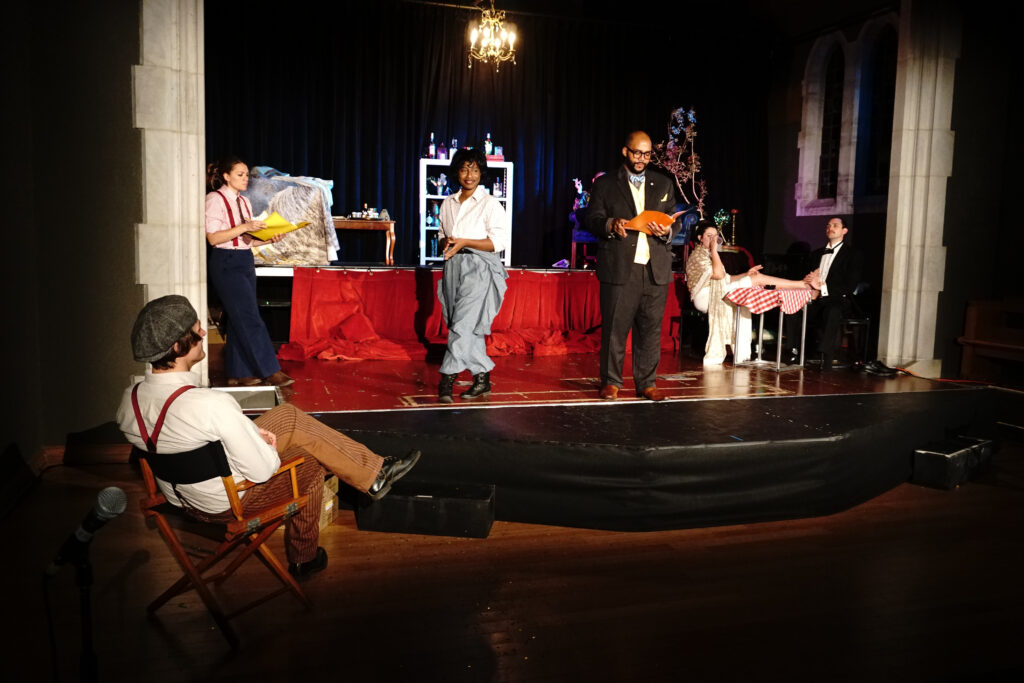
The Mechanicals. Photo by Joey Rumpell.

The innovative Lucy Cashion, in a class all by herself, directs here with a touch of whimsy and a focus on the quirky. She is particularly good at dissecting classics and putting her own spin on them, such as “Trash Macbeth” in 2016 for ERA (St. Louis Theater Circle Award for directing) and “Oedipus Apparatus” for SATE in 2017.

She teams up here with the multi-hyphenate Ellie Schwetye, a distinctive writer also good at different takes on Jane Austen (“First Impressions,” St. Louis Theater Circle Award for Best New Play in 2018), who has adapted this version of Shakespeare’s beloved 16th century comedy.

Normally, the play starts with royal wedding planning, gets sidetracked with love potions and mixed-up pairings, and features a troupe of inept actors rehearsing a play as the special occasion entertainment. Instead of being the side hustle, the Mechanicals have the spotlight, and they shine in all their peculiar glory.

So, dive into their world, not knowing where you will go. You may think you know this play, but here, they’re steering the ship into uncharted, yet kinda familiar, waters. And that’s the fun of it.

The Mechanicals are referred to as skilled manual laborers, and others look down on them. But for this amateur troupe, there’s no way to go but up. Kayla Ailee Bush is bellows-mender Francis Flute, Andre Eslamian is weaver Nick Bottom, Anthony Kramer Moser is joiner Snug, Joshua Mayfield is tinker Tom Snout, Ross Rubright is tailor Robin Starveling, and Kristen Strom is carpenter Peter Quince, the director. Strom’s presiding over the circus as if she’s Orson Welles directing the Mercury Theatre.

Victoria Thomas and Ross Rubright. Photo by Joey Rumpell.

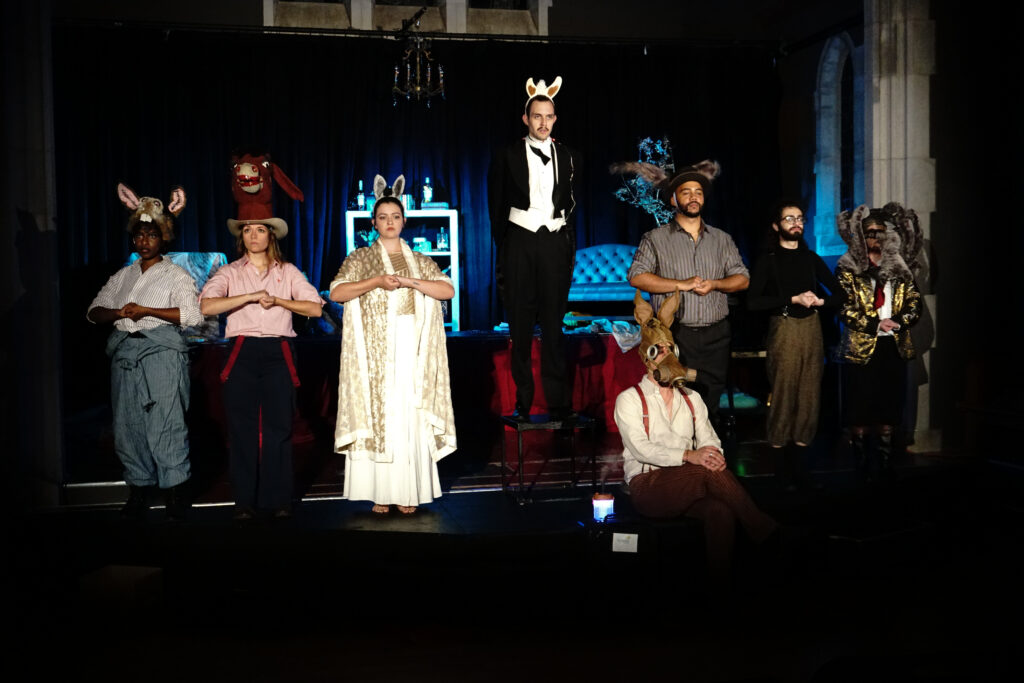
Moser is very funny getting into his lion role, and with the others, their idiosyncrasies emerge as they develop the characters for the tragic love story of “Pyramus and Thisbe,” set in Babylon. Andre Eslamian plays Bottom as an insufferable know-it-all. Joshua Mayfield’s Tom Snout is perturbed about how he’s moved around, and so is Kayla Ailee Bush’s Francis Flute. (The sextet is so bad, the audience thinks it’s a comedy). Master thespians, you know.

Well, they may be delusional, but they are giving it their all as they prepare to mount the play-within-a-play, hopeful of entertaining at Theseus and Hippolyta’s royal wedding. Of course, they question their parts, bicker with castmates and Quince, trying to get the attention they need and ‘deserve.’  

Now, in context, we don’t see Theseus and Hippolyta here, but they are the toast of the town, as he is the Duke of Athens and she is the Queen of the Amazons.

I digress.

Puck/Robin Starveling (Ross Rubright), Titania (Victoria Thomas) and Oberon (Spencer Lawton) are outfitted to look like old-timey movie stars of the silent era, extras in “The Great Gatsby,” or maybe Puck is the bartender in “The Shining.”

They have an aristocratic air, and wear Liz Henning’s gorgeous period attire beautifully. As the king and queen of the fairies, Titania and Oberon are estranged and feuding, and Thomas and Lawton make that obvious, as if they are reciting lines in a Noel Coward play.

In another flip, Oberon falls in love with Bottom, who’s now costumed as a donkey. Hee-haw! Eslamian and Lawton display deft physical comedy skills during this turn of events.

Oberon and Bottom. Photo by Joey Rumpell.

Dapper in tails, Ross Rubright introduces himself as Robin Starveling as he welcomes the audience. The tall Rubright is visually striking, and then he begins his contrasting monologues, as if auditioning, and reads a commercial for Lunesta, a prescription sleep aid, including a long list of side effects. It sets the mischievous mood beautifully.

Rubright may not be sprite-size, but as Puck, he smoothly moves around creating dazed and confused mayhem with his lantern, wafting potion, and magic powers.

That iconic butterfly logo will be referred to several times and its shimmering wings used in another ‘wow’ vision from Henning.

Now the star-crossed lovers make an appearance too, as the cast doubles roles: Hermia (Bush), Lysander (Moser), Helena (Strom), and Dementrius (Mayfield). In Shakespeare’s original, Hermia is in love with Lysander, but her father wants her to marry Demetrius, who is in love with her, but Helena is in love with him. It’s complicated.

The creative team is first-rate, too, with Erik Kuhn’s atmospheric lighting design noteworthy. Joe Taylor’s original music score is a delightful throwback to such ‘30s styles as “Moonlight Serenade” and Cole Porter.

 Cashion and Schwetye collaborated on the scenic design – a summer house’s study where Titania and Oberon are ensconced, and use front space for the woodland where rehearsals are staged. Jimmy Bernatowicz, the stage manager, and Rachel Tibbetts, the co-producer, also contributed to the overall experience.

The Mechanicals. Photo by Joey Rumpell.

The play has a fantasy quality reminiscent of the 1935 movie, which is mesmerizing in its depiction of the glistening fairies frolicking in the forest created through rudimentary visual effects back then. (The casting is memorable too – James Cagney is Nick Bottom and Mickey Rooney is Puck!)

“This Palpable Gross Play” is tantalizing with its witty take on illusions and theme of metamorphosis. The folly is fun, thanks to the harmonious cast and crew’s efforts. Adventurous theatergoers can applaud their good fortune at seeing a fresh interpretation of an enduring classic.

Note: The script of “This Palpable Gross Play” will also receive productions with Clayton High School and with Prison Performing Arts.

SATE is presenting “This Palpable Gross Play: A Kind-of Midsummer Night’s Dream” Aug. 16 through Sept. 2, with performances Wednesday through Saturday at 8 p.m. at The Chapel, 6238 Alexander Drive. It is 90 minutes without an intermission. Tickets are $25 and can be purchased through Eventbrite. For more information, visit www.satestl.org.

Photo by Joey Rumpell.