By Lynn Venhaus
Bursting with vitality, The Muny’s latest heart-tugging interpretation of “West Side Story” emphasizes its potency as a cultural snapshot and the exceptional elegance of its buttery vocals.
Arthur Laurents’ 1957 contemporary slant on Shakespeare’s “Romeo and Juliet” brims with pulse-pounding tension as rival ethnic gangs, The Jets and Sharks, fight on the mean streets of Manhattan’s pre-gentrified Upper West Side while you root for forbidden yet fairy-tale hopeful love.
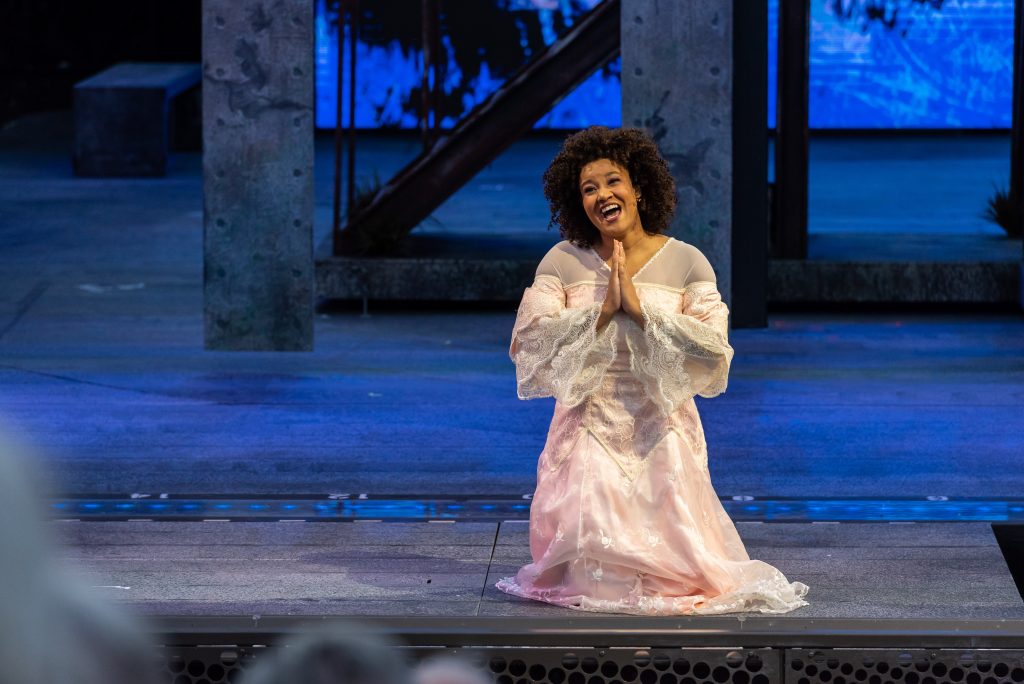
As the star-crossed lovers Tony and Maria, Christian Douglas and Kanisha Feliciano will break your heart and their lush vocals will melt it. Their duets “Tonight” and “One Hand, One Heart” are exquisite, as is standout Douglas exuberant in “Maria” and projecting the longing in “Something’s Coming.”
The timeless music score again demonstrates its power as one of the greatest American musicals of all-time. Some 66 years earlier, Leonard Bernstein’s supple orchestrations and 27-year-old Stephen Sondheim’s brilliant lyrics forged unforgettable songs – including poignant “Somewhere,” vibrant “America,” propulsive “The Jet Song,” comical “Gee, Officer Krupke” and the fervid “Cool.”
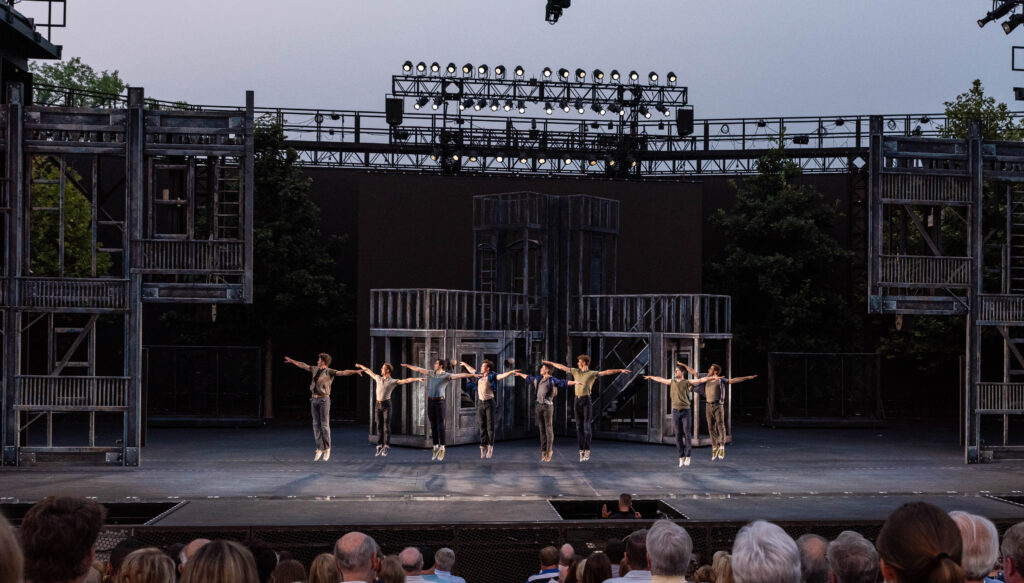
Rob Ruggiero seamlessly directs the musical with compelling urgency, stressing the emotional weight of an ‘us vs. them’ culture clash, an ingrained blind hatred that fuels the tumultuous turf wars of entrenched ‘white’ lower-class locals vs. Puerto Rican immigrants.
As is his custom, Ruggiero is a master at stripping down a show to its essentials, deconstructing a piece and making us see it through new eyes. He’s been the go-to guy for definitive productions of “Sweeney Todd” (2022), “Gypsy” (2018), “Hello, Dolly!” (2014) and “South Pacific” (2013) at the Muny, and transplendent productions of Sondheim’s “Sunday in the Park with George” and “Follies” at The Repertory Theatre of St. Louis.
When the musical first debuted on Broadway, while spellbinding and integrating those visionary dance scenes, audiences didn’t know how to take such a dark story that resulted in two major characters killed off before intermission. Tragedy wasn’t a forceful plot point in those golden era musicals – hence, “The Music Man” defeating it for Best Musical at the Tony Awards.
However, through the years, its appeal has grown, and several Broadway revivals have enhanced its stature, including a heralded 2009 reworking, with contributions by Lin-Manuel Miranda for more Latino authenticity.
The landmark 1961 film, the top-grosser that year, was nominated for 11 Academy Awards, and won 10, including Best Picture, making it the record-holder for movie musicals. The film is second only to “Singin’ in the Rain” on American Film Institute’s list of Greatest Movie Musicals.
Sixty years after its release, director Steven Spielberg reimagined this gritty street symphony in 2021, earning critical acclaim and seven Oscar nominations, with Ariana DeBose winning Best Supporting Actress as Anita.
The film first captured my heart on the big screen, as a reissue in fall 1968 before being sold to television, and I was immediately entranced at age 13. After multiple repeat viewings, a special anniversary DVD, and devouring all sorts of behind-the-scenes materials, it still holds my heart.
While the original hasn’t aged well in the millennium with a predominantly white cast, bad makeup and some dubbed voices, it does capture a moment in time, and the 2021 adaptation corrected the egregious.
Eager to experience the magic again, this electric production did not disappoint Sunday night. The last Muny one, in 2013 with Kyle Dean Massey and Ali Ewoldt, was epic and became my gold standard, so a high bar. Let’s just say the Muny has come a long way since the first time I saw it there in 1982, as a season ticket holder, with Barry Williams, aka “Greg Brady,” as Tony. Ah, those old days of stunt casting.
This is the ninth time “West Side Story” is at the Muny, and retains its grip with such vigor, alive with possibility. It draws out the sadness because optimism is thwarted by ill-fated violence.
This run coincides with the 60th anniversary of the Muny’s first staging in 1963. It returned for a two-week run in 1967, and was seen again in 1982, 1990, 1995, 2000, 2005 and then 10 years ago.
While some of the dialogue is insipid in that ‘50s daddy-o way, the stage musical continues to take me to my happy place as my all-time favorite. It does still pack an emotional punch in its truth and remains relevant today.
Why did this version make me fall in love with it all over again, after seeing it countless times on tour, in regional, community and youth theaters? Let me count the ways.
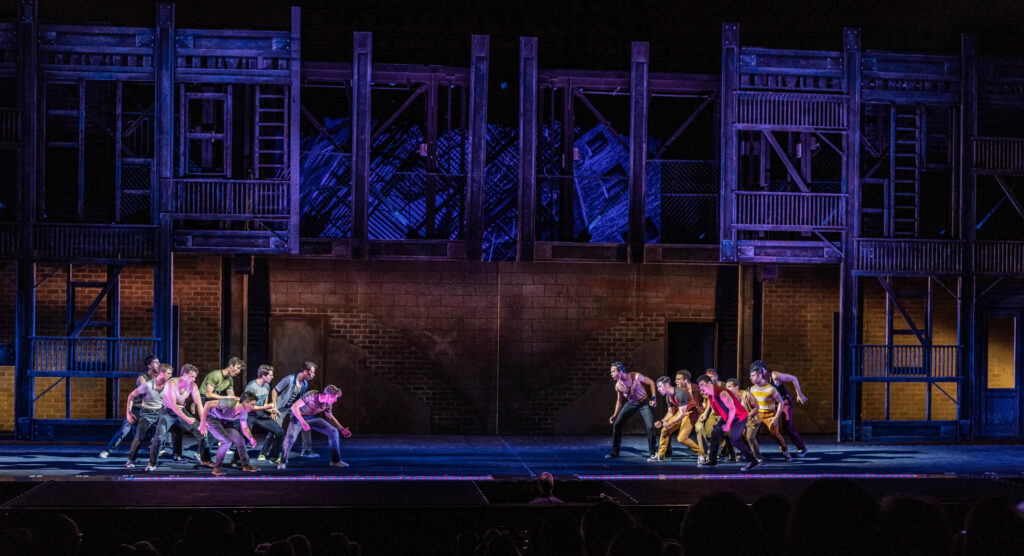
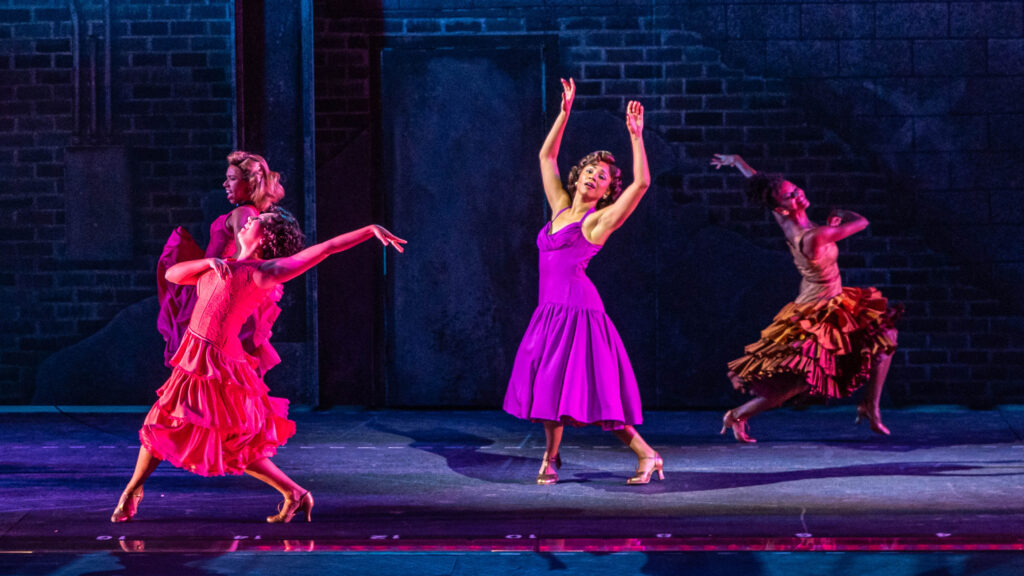
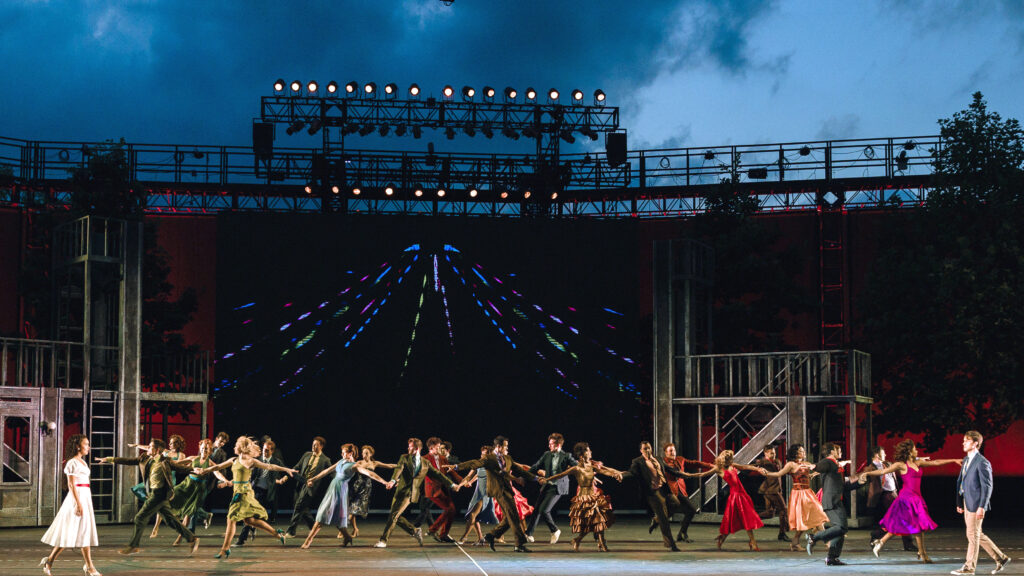
Jerome Robbins’ original stylized dance numbers are precisely reproduced by choreographer Parker Esse – the enthralling “Prologue,” “Dance at the Gym,” “America,” and “Cool” and the muscular, balletic ensemble leapt on the ginormous stage in breathtaking fashion. The staging of the “Somewhere” dream ballet pulls the heartstrings, enhanced by Grace Marie Rusnica’s affecting vocal.
It’s a thing of lyrical and kinetic beauty to see those polished, passionate performers burn bright with red-hot intensity. Their version of the “Tonight” Quintet and Chorus is magnetic.
Arguably, there is not a better musical score, and the numbers are admirably delivered. Music Director James Moore is such a graceful conductor that a few bars into the overture, and his artistry has you hooked with his expertly orchestrated pieces. You may recall his luxurious skills in conducting Sondheim before – “Sweeney Todd,” “Gypsy,” and the last “West Side Story.” He makes you feel the music.
Performers familiar with their role’s challenges boost the show’s dynamics. Yurel Echezarreta is the seething, smoldering Bernardo, and it’s his seventh “West Side Story,” including Spielberg’s movie.
In his fifth Muny show, Kyle Coffman brings the heat as a limber Riff, the cocky, driven leader of the Jets and Tony’s best friend “womb to tomb.” He was Ice in Spielberg’s movie and part of the 2013 ensemble.
Making her Muny debut, Jerusha Cavazos is a fiery Anita, and along with her lissome dancing, she conveys a solid chemistry with Feliciano’s Maria, including the sublime duet, “A Boy Like That/I Have a Love.”
Caylie Rose Newcom is a feisty Anybodys, the tomboy Jet, and Ethan David Steph as hothead Action, Ethan Van Slyke as greenhorn Baby John and Daniel Assetta as explosive A-rab are also notable.
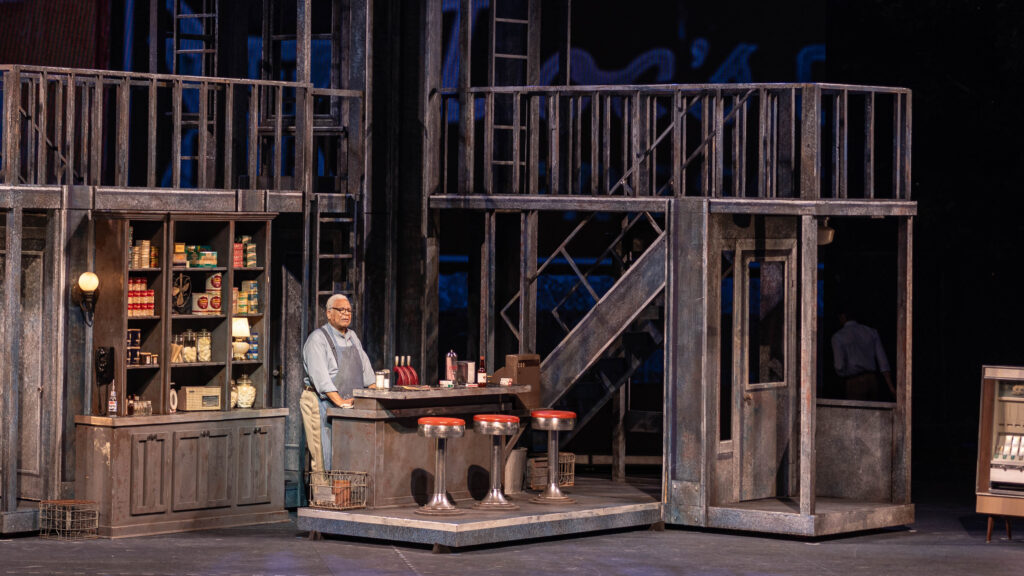
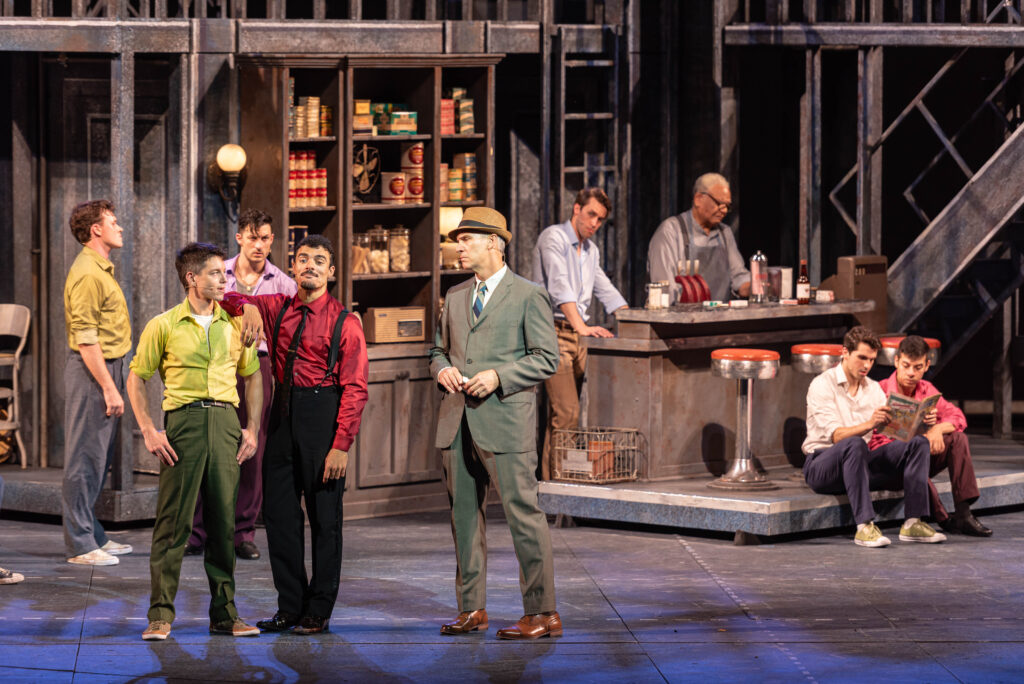
Local actors elevate the standard “adult” roles, with revered Muny all-star Ken Page touching as the kind, frustrated Doc, Tony’s boss and drugstore owner. Versatile veteran Michael James Reed portrays Lt. Shrank with a disquieting hostile edge and what a pleasure to see outstanding dramatic actor James A. Butz making his Muny debut as the sweaty, ineffectual Officer Krupke.
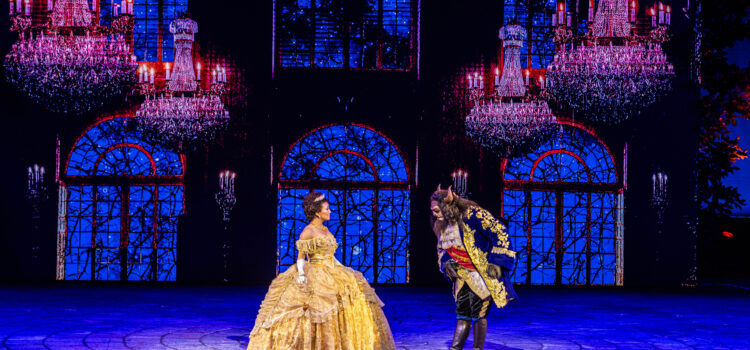
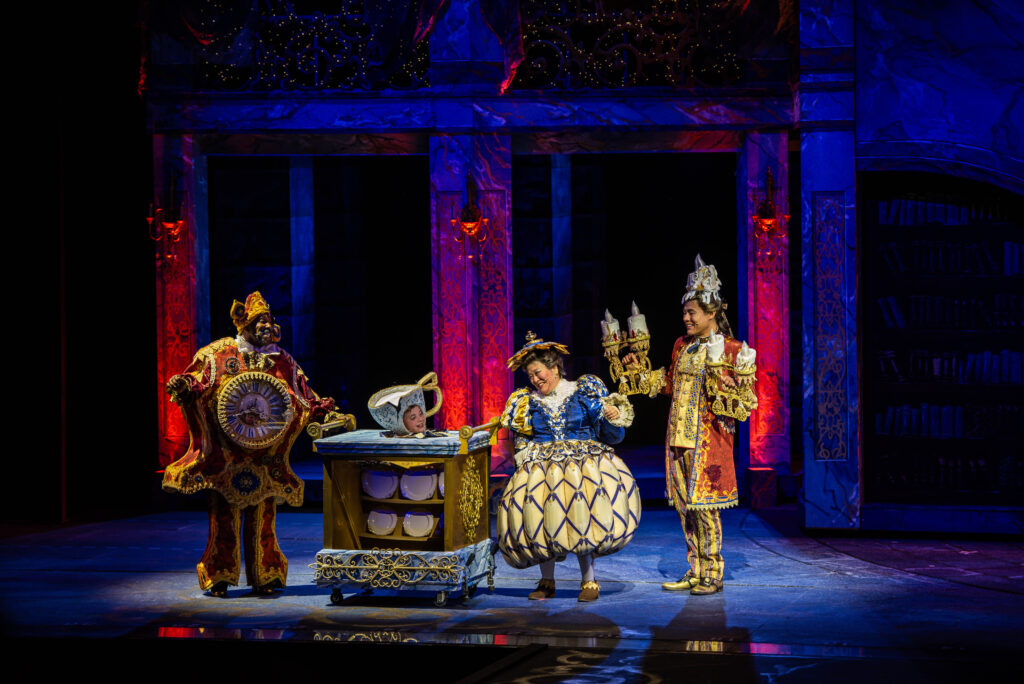
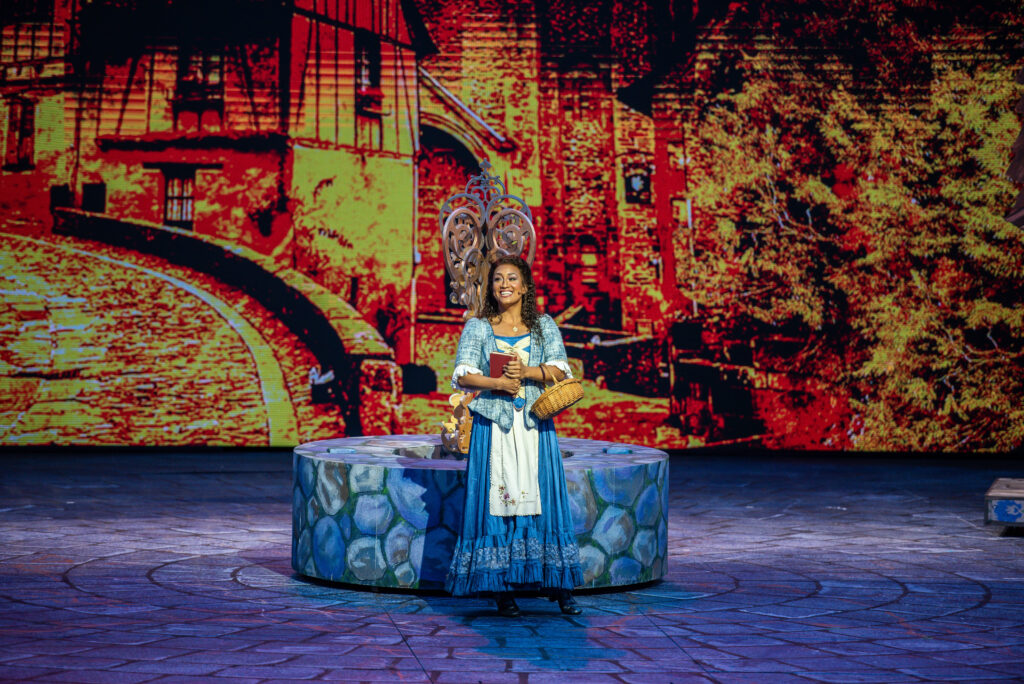
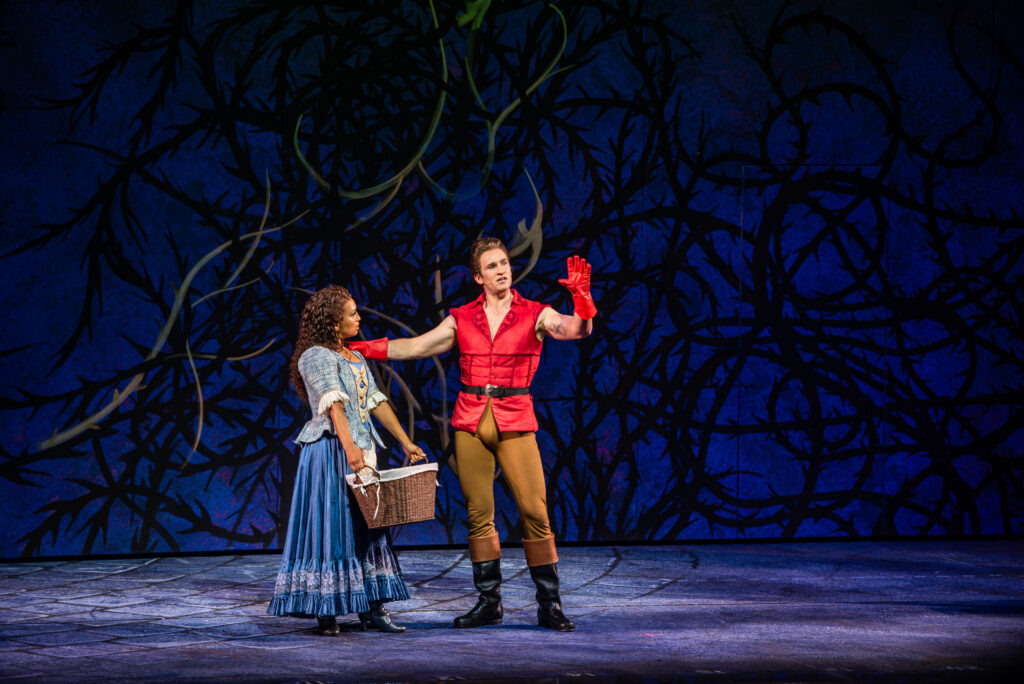
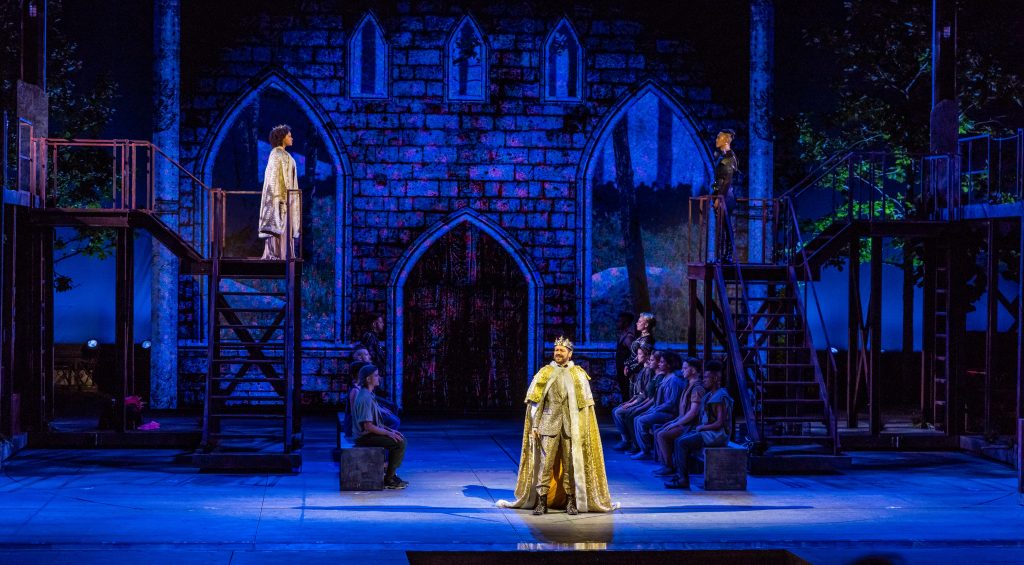
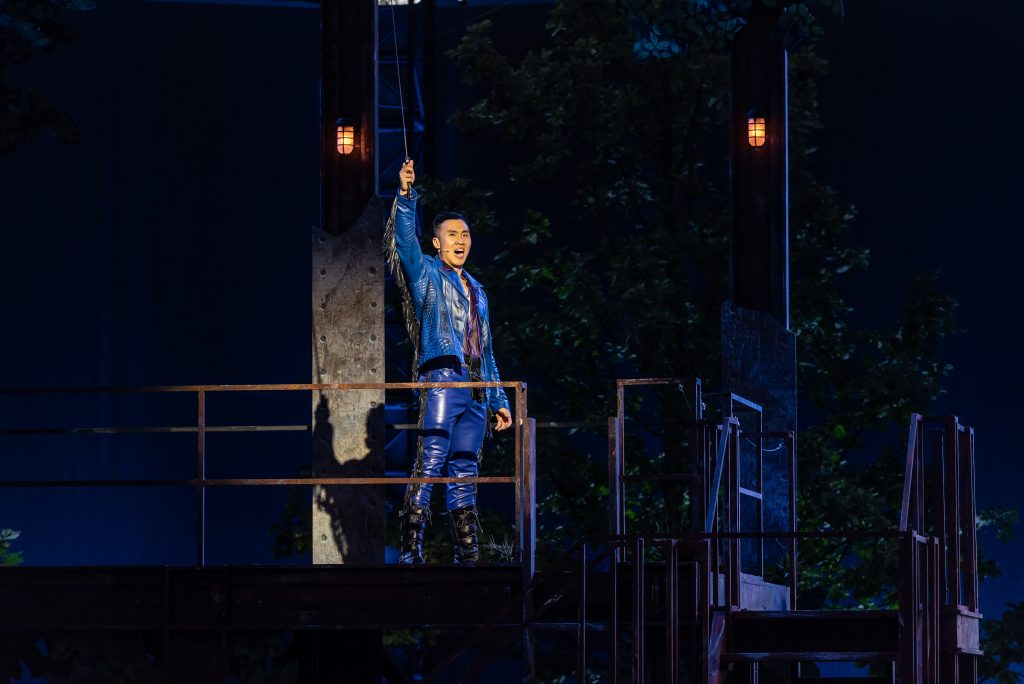
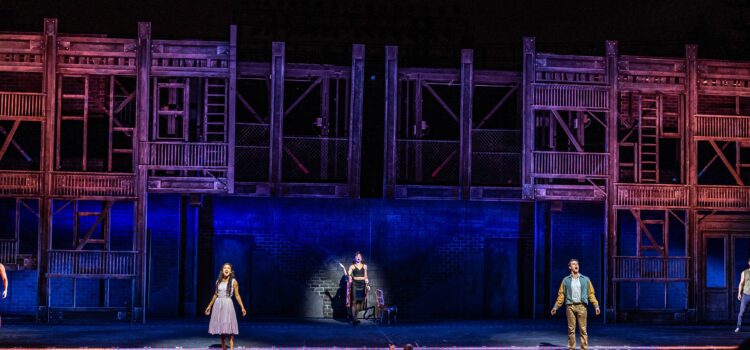
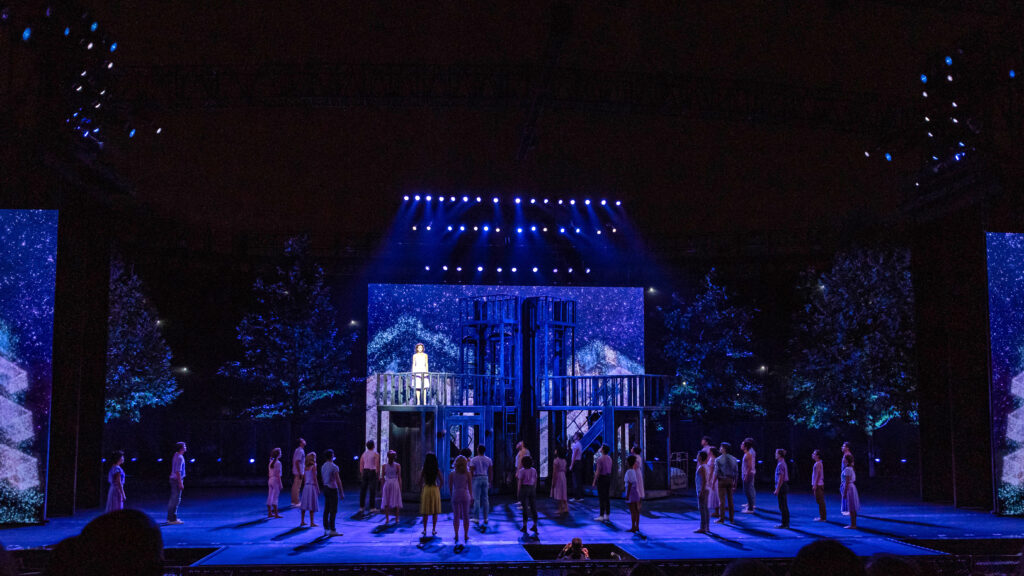
Ann Beyersdorfer’s scenic design is a striking urban jungle grid, depicting the decaying tenements that would be later torn down for Lincoln Center and such. Her set pieces – the dress shop, Doc’s drugstore – are smartly detailed, and both fluid and functional. Beyersdorfer is from Belleville, Ill., and this is her third show at the Muny, after this season’s opulent “Beauty and the Beast” and last year’s earthier “Camelot.”
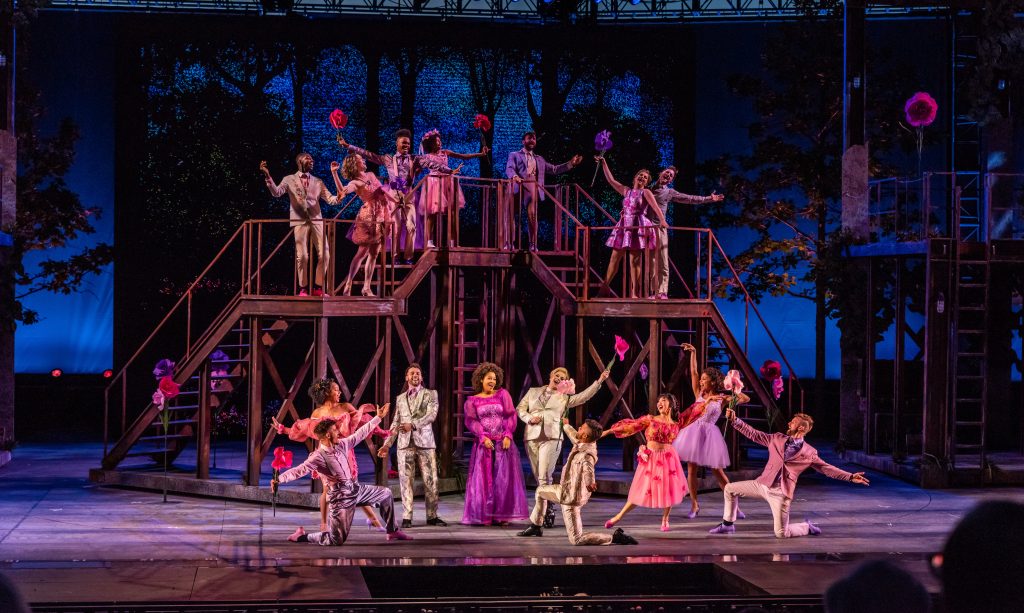
Other noteworthy designs include the vintage costumes from Gail Baldoni, who has selected specific muted color palettes for the Jets and the Sharks and crafted a stunning white dress as Maria’s iconic outfit for the dance. Her bright fuchsia-violet shades for the Sharks’ girls in the “Mambo” and “America” scenes are eye-catching and enliven the dances.
And John Lasiter’s lighting design takes us from sweltering summer playgrounds to moonlit fire escapes to desolate concrete battle grounds while Shawn Duan’s video design punctuates exteriors and interiors.
“West Side Story” endures as a idealistic love story dashed by the gut-punch of tragic circumstances of gang war because of the reality we live. At a time when we hear of tribal sparring daily across the nation, this story is a reminder that decades after this social commentary pointed out what misguided hostilities can lead to, this musical provides a glimmer of hope that fists won’t stay clenched, and headlines won’t point out another young gun-related death.
Whether you have never seen it or have sat under the stars mesmerized multiple times, this season’s “West Side Story” entices – it has a significant snap and pop to it, and the care involved in its presentation is perceptible. We may be dreamers, but love is a powerful tool. And these soaring vocals will give you goosebumps.
.
The Muny presents “West Side Story” nightly at 8:15 p.m. from July 15 to 21 on the outdoor stage in Forest Park. For more information, visit muny.org.

Lynn (Zipfel) Venhaus has had a continuous byline in St. Louis metro region publications since 1978. She writes features and news for Belleville News-Democrat and contributes to St. Louis magazine and other publications.
She is a Rotten Tomatoes-approved film critic, currently reviews films for Webster-Kirkwood Times and KTRS Radio, covers entertainment for PopLifeSTL.com and co-hosts podcast PopLifeSTL.com…Presents.
She is a member of Critics Choice Association, where she serves on the women’s and marketing committees; Alliance of Women Film Journalists; and on the board of the St. Louis Film Critics Association. She is a founding and board member of the St. Louis Theater Circle.
She is retired from teaching journalism/media as an adjunct college instructor.