By Lynn Venhaus

Marked by twists, turns and a “Twilight Zone” flair, Albion Theatre Company’s latest whip-smart production “I Have Been Here Before” ponders the construct of time in a shrewd yet abstract way.

An adroit ensemble of six piques our curiosity, each one developing layers of their characters’ personalities and motivations. They seamlessly embody different classes, all at crossroads (whether they realize it or not).

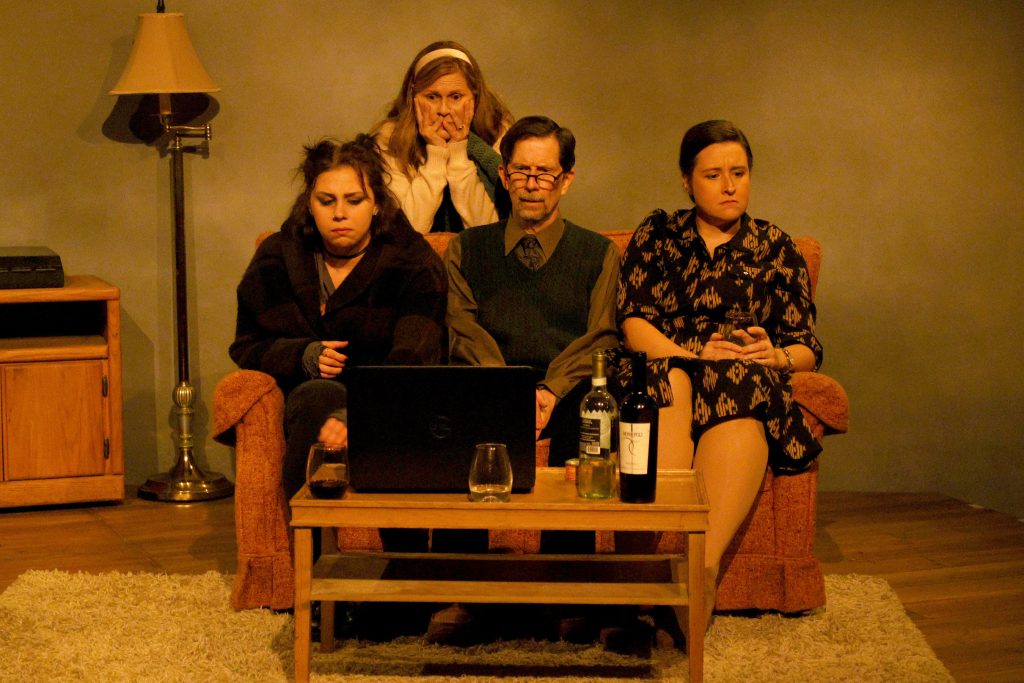
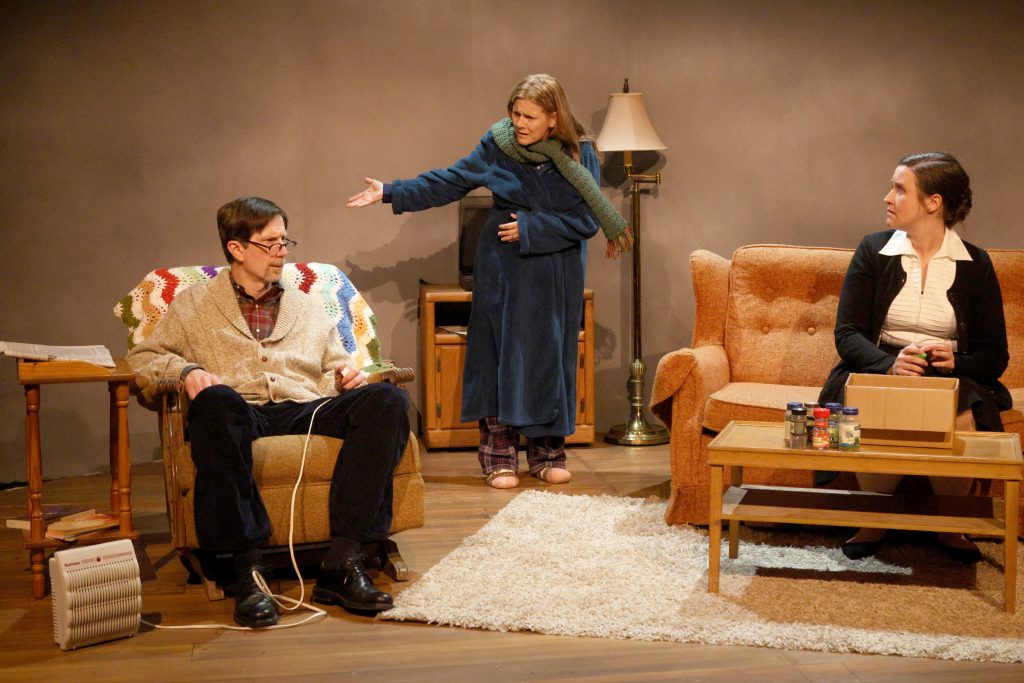
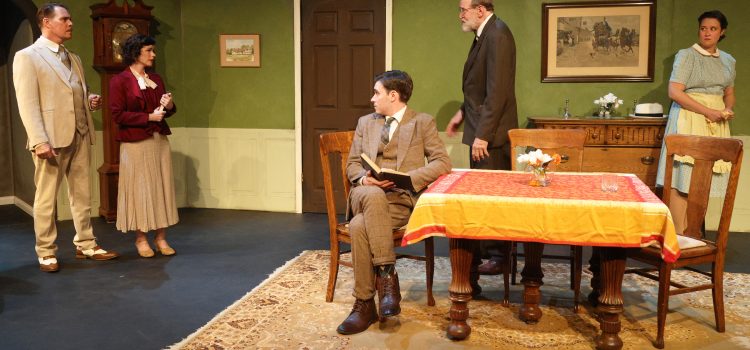
The Black Bull Inn in Grindle Moor, part of the remote Yorkshire countryside, is where the story takes place in 1937. Set designer Rachel St. Pierre has fashioned a cozy, modest parlor, with Brad Slavik the astute set builder and Gwynneth Rausch specific in appropriate time-period props.

They have effectively set the period and place, so that co-directors Robert Ashton and C.J. Langdon were able to keep the characters on the move, so they weren’t as stodgy as they probably were nearly 90 years ago.

The six accomplished performers were notably well-rehearsed with distinct dialects and physically nimble in their mannerisms, driving the story with more verve than playwright J.B. Priestley’s dated drama indicated.
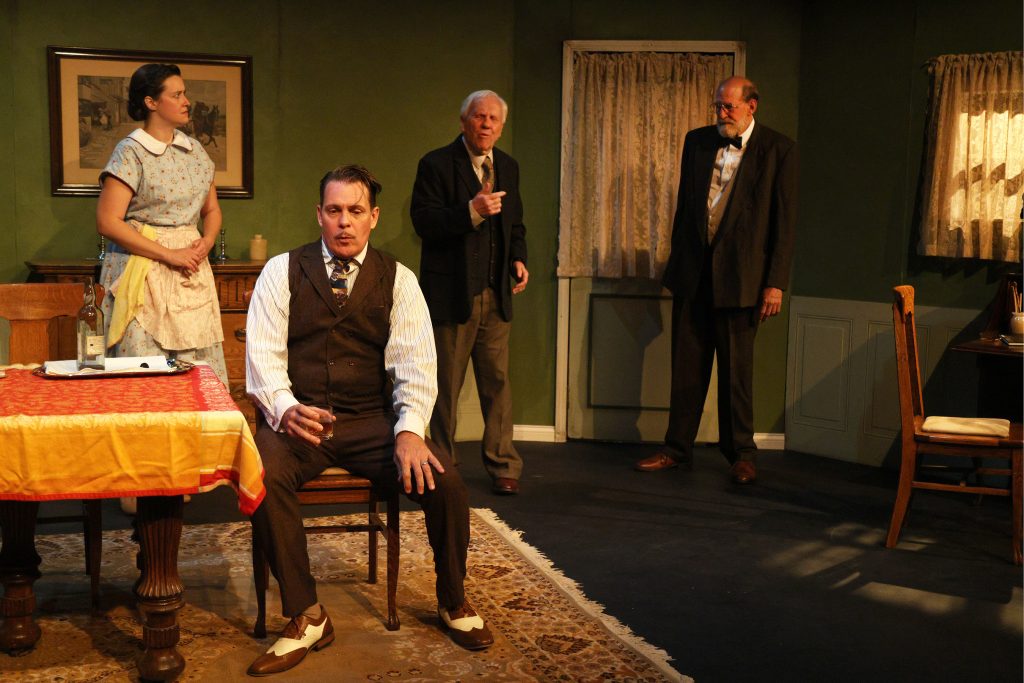
Photo by John Lamb

Today, the show hasn’t aged as well or is as suspenseful as an Alfred Hitchcock classic or even an Agatha Christie drawing room mystery. The set-up in the first act is intricate and lengthy, then has more engaging action in second act, while the third act teeters on implausible. Nevertheless, the sheer will and the skills of the actors make this watchable.

Priestley continued his fascination with theories of time here; one of the 39 he wrote. “Time and the Conways” and “Dangerous Corner” were among his most successful plays about time – he wrote seven.

He believed different dimensions could link past, present and future, and philosophizes, using Russian teacher P.D. Oupensky’s theory of eternal recurrence, which are life circles or spirals.

Robert Ashton and Anna Langdon are the reliable Sam Shipley and Sally Pratt, father and daughter innkeepers. He’s amiable, she’s pragmatic in their portraits. They are expecting three guests while a quiet but agreeable young headmaster, Oliver Farrant (Dustin Petrillo), is already spending a vacation there, for a rest. He relaxes by reading and going for long walks.

The upcoming holiday is known as Whitsuntide, around the time of the Christian holy day the Pentecost. In the south of England, it was the first official holiday of the summer (until replaced in 1971).
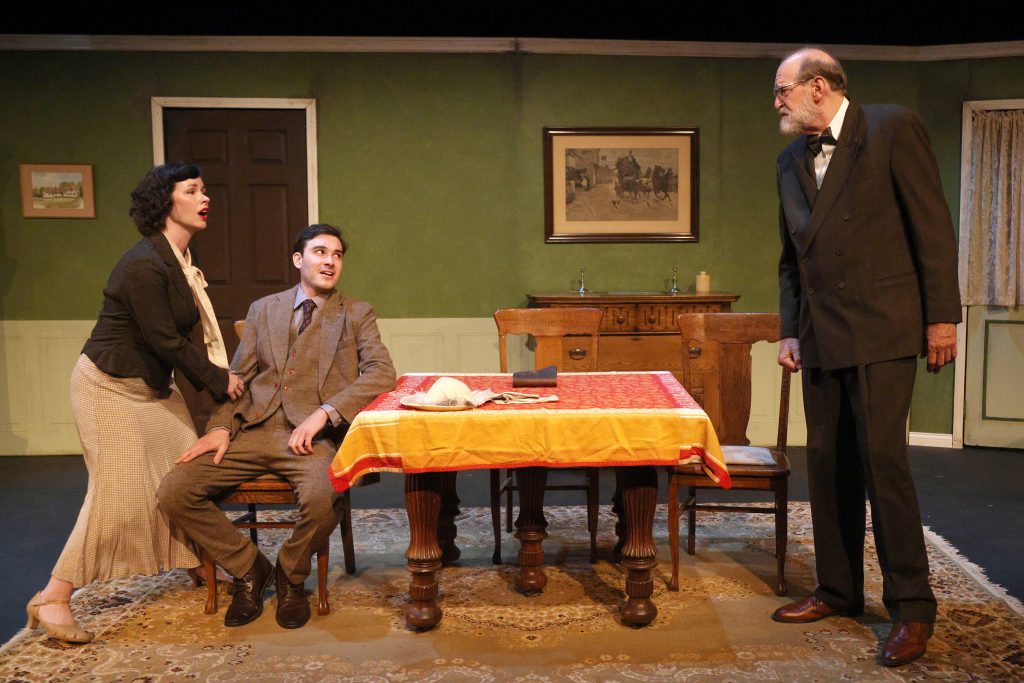
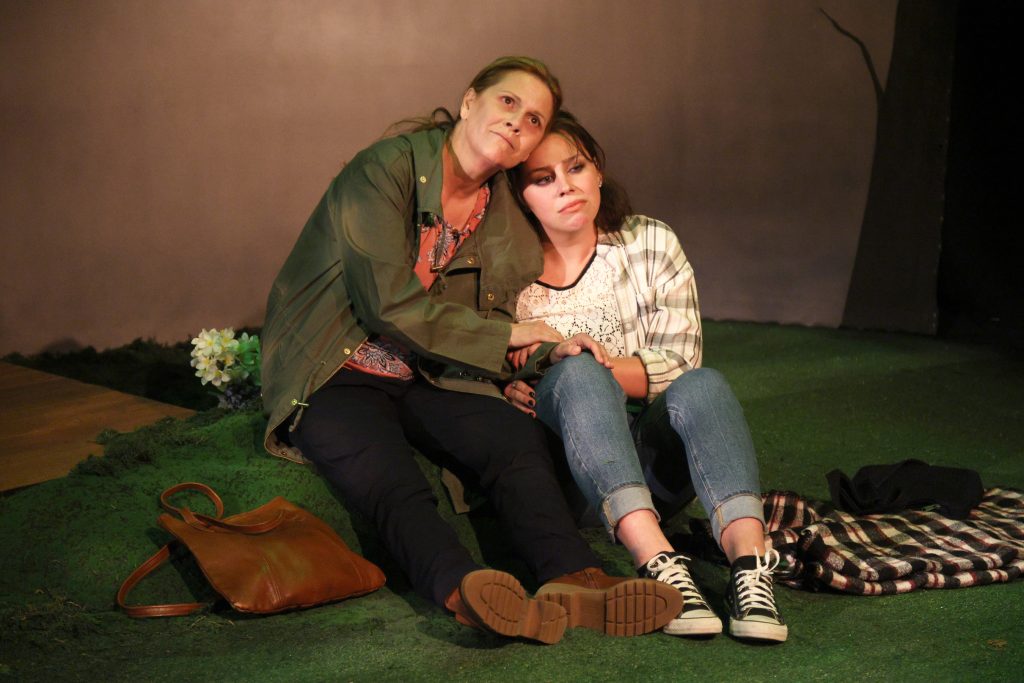
Photo by John Lamb

But the guests that reserved the rooms have cancelled. That allows a foreign guest, professor Dr. Gortler, (Garrett Bergfeld) and a wealthy businessman and his stylish wife, Walter and Janet Ormund (Jeff Kargus and Bryn McLaughlin), to book separate rooms.

Tall, gruff and exiled from Nazi Germany, the mysterious professor has already startled Sally by practically predicting future outcomes. He seemed to know who would be staying and not who originally booked rooms.

Are they thrown together by chance or is it on purpose?  That is one of the many questions raised as the plot thickens. It is rather odd that somehow, they seem inter-connected. Their decisions could have consequences that would affect others.

There is a nagging feeling that they may have lived through this experience before. But how could that be? The cosmic undertones seem to rattle some cages, especially suspicious Sally.

 An expert in math and science, Gortler is blunt at asking perceptive questions, revealing predictions, and shares a precognitive dream describing preposterous occurrences between everybody there. Dun dun dunnn!
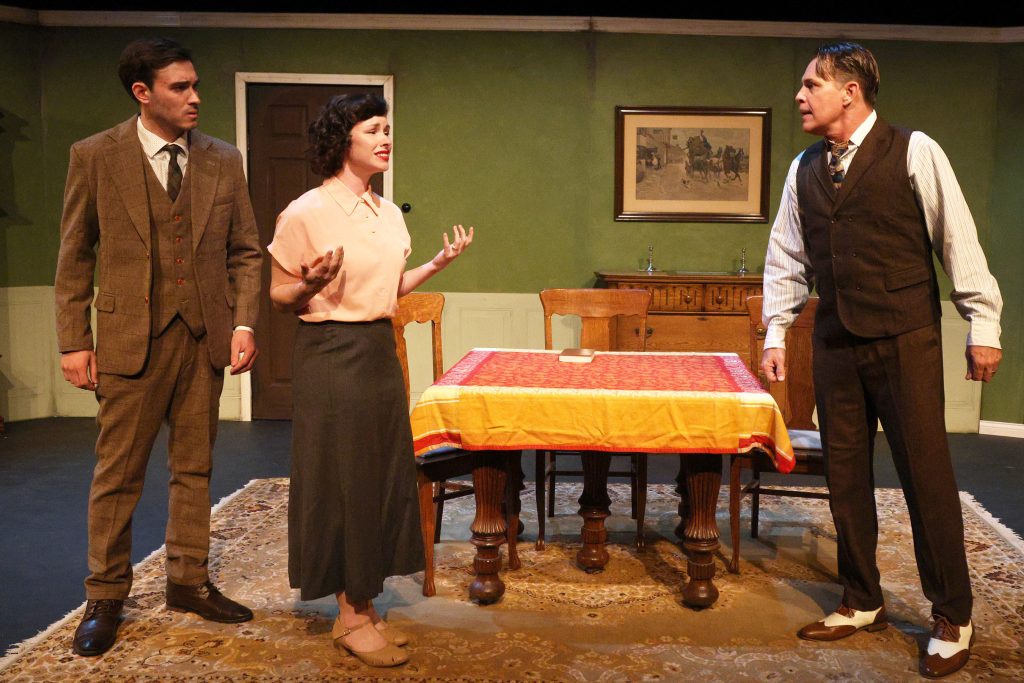
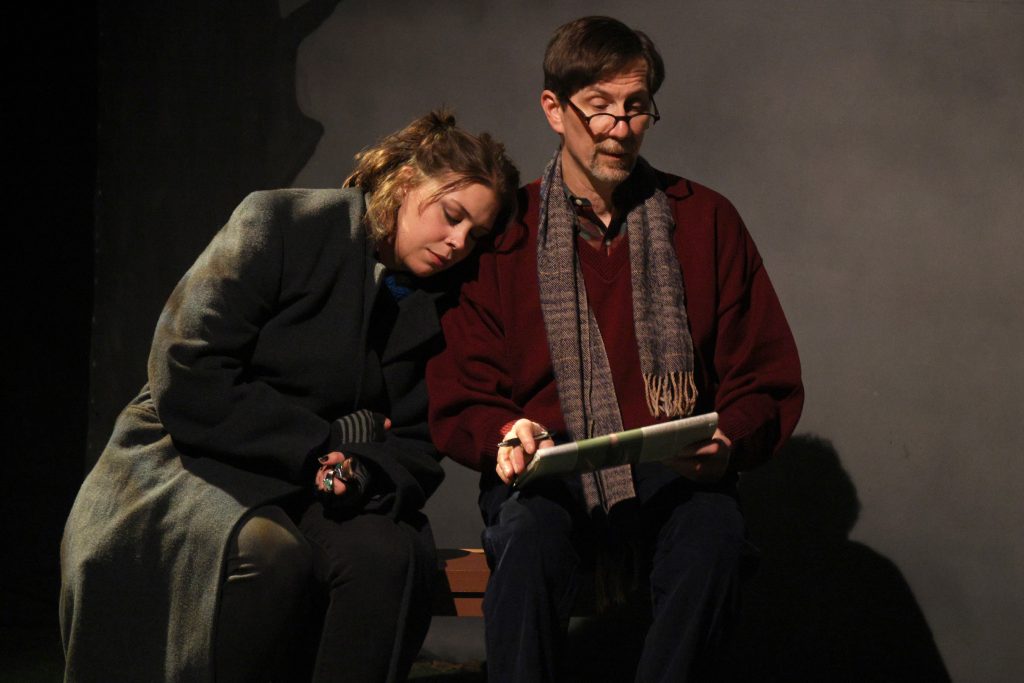
Photo by John Lamb

Quite surprising is an assured, imposing performance by Garrett Bergfeld as the enigmatic professor. It’s been 20 years since he stepped on a stage, and one hopes it will continue.

Dustin Petrillo, who is always authentic in his portrayals, displays emotional depth and an unmistakable connection with Mrs. Ormund, who is unhappy with her workaholic – and alcoholic – husband.

Petrillo and Bryn McLaughlin worked together beautifully as husband and wife in “The Immigrant” at New Jewish Theatre two years ago, and they smoothly convey an ease with each other.

As restless Janet, McLaughlin contrasts her comfort with Farrant by showing unease with her inattentive husband.

Jeff Kargus is striking as the swaggering Ormund, used to getting what he wants and believably upper crust in speech and movement. He commands the stage, appearing as a manipulative mover and shaker, giving off shady vibes. One wanted to know more about these puzzling people.
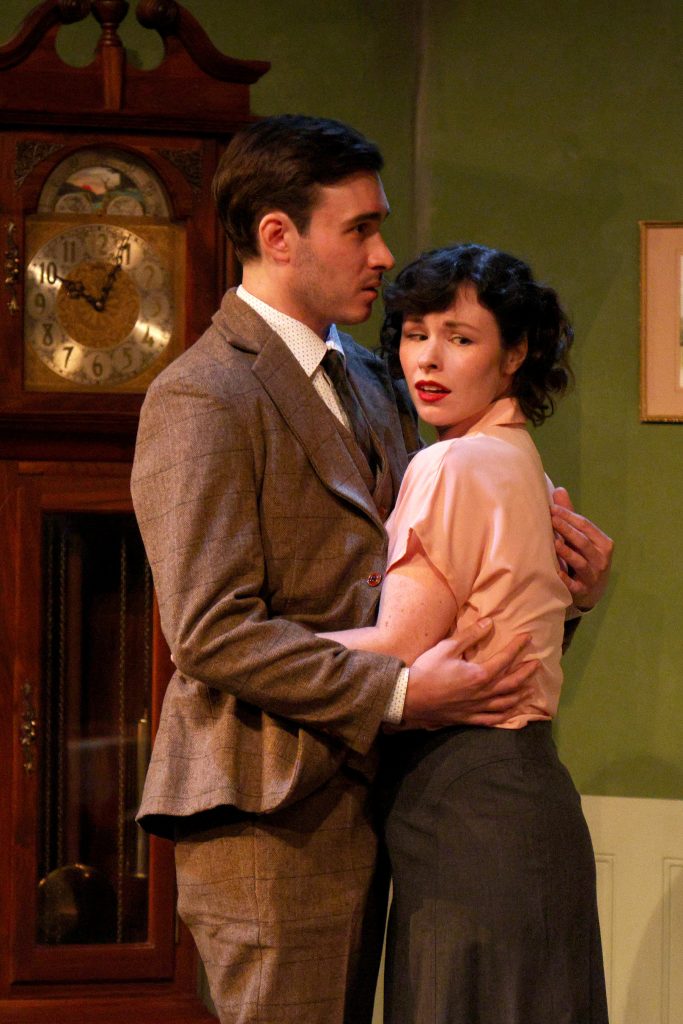
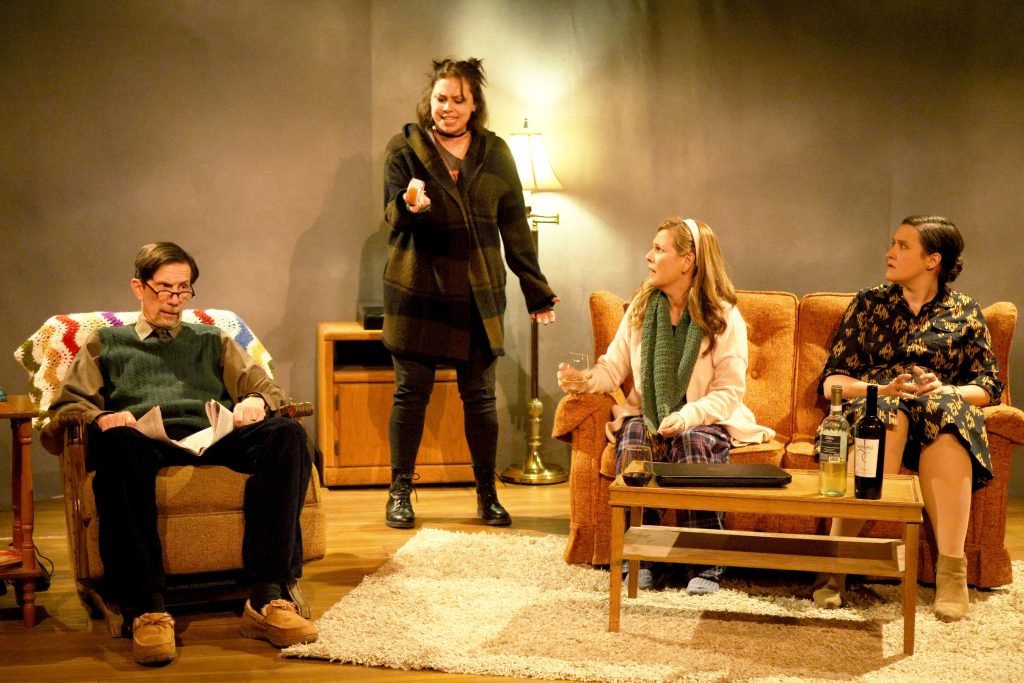
Photo by John Lamb

As impressive as the actors are, so is the creative team that collaborated on a well-worn look, including the aforementioned scenic/prop designers. Costume designer Tracey Newcomb, whose work is always memorable, has economically created status in her ideal apparel choices. Lighting designer Eric Wennlund and sound designer Leonard Marshell set the mood well.

In 1970, rock group Crosby Stills Nash and Young released an album, “Déjà vu,” including a song of the same name.

If I had ever been here before
I would probably know just what to do
Don’t you?
If I had ever been here before on another time around the wheel
I would probably know just how to deal
With all of you

It later ends with the lyric, “We have all been here before” repeated several times. (“It’s déjà vu all over again,” in the words of an epic St. Louis philosopher-raconteur Yogi Berra.)

I was frequently reminded of those lyrics, as the play attempted to explain unnatural phenomenon. Had it followed through with a more convincing ending, it would have stuck the landing, but this is an observation in hindsight 90 years later.

Priestley worked with what was known at the time, and his own viewpoint on another life ahead as a do-over. Food for thought, to be sure.

In their customary fine fashion, Albion presented an unfamiliar play effectively, driven by excellent performances and strong contributions by local artisans.

 Albion Theatre presents “I Have Been Here Before” Thursday through Saturday at 7:30 p.m. and Sundays at 2 p.m., on Oct. 23-26, 30-31; Nov. 1-2 at the Black Box Theatre at the Kranzberg Center, 501 N. Grand in Grand Center. The show runs 2 hours, 30 minutes, with two 10-minute intermissions. For more information: albiontheatrestl.org.

By Lynn Venhaus

As we all accept that we will die, confronting our own mortality seems to be a lifelong journey – and often tip-toed around with family and friends. How we deal with the inevitability of our end and the loss of our loved ones leads to interesting debates.

Such is the case with Albion Theatre’s latest offering – “Colder Than Here” by Laura Wade. The British playwright sensitively tackles the tricky subject matter, as a terminally ill cancer patient plans her funeral, selects her final resting place, and attempts to discuss the topic with her family.

Grief mixed with humor? Yes, it’s tactful, situational and conveys both pain and love, as does exploring complex family relationships. With utmost delicacy, director Robert Ashton has gracefully staged this comic drama in the intimate Kranzberg Black Box Theatre.

Ashton has cast a quartet that can carry the weight of these characters and still be likable, starting with Susan Wylie as the mom staring at her own fate with clear eyes and an open heart.

The family – LIvy Potthoff, Susan Wylie, David Wassilak and Anna Langdon. Photo by John Lamb.

In typical Mom fashion, Myra is the caretaker, but now others must take care of her. Wylie is convincing as the kindhearted and considerate mother who is trying to nudge her family into accepting what’s ahead. She balances Myra’s inner strength with the outward effects of bone cancer on a human body and does so subtly in an exceptionally well-modulated performance.

Her family’s reluctance to accept the inevitable is understandable as they each have different ways of dealing with the impending loss — but exasperating for her. As Myra becomes sicker, she is aware of the ticking clock, if others aren’t, and she wants matters confirmed. She has even prepared a Power Point with fancy fonts, which garners mixed reactions.

Her husband, Alec, in a skillfully nuanced portrait by David Wassilak, is a taciturn sort used to blocking out the cacophony of three women in the house. Of course he cares for them, but like most dads, he has his routines. He really doesn’t want to talk about anything beyond the immediate issues, like the chilly house because of a wonky boiler.

Now, the daughters are grown, live on their own, but return for visits or temporary stays. How daughters Harriet and Jenna cope with adulting is a mixed bag. They couldn’t be more opposite in appearance and attitudes.

Wylie and Livy Potthoff. Photo by John Lamb.

Anna Langdon is Harriet, the more level-headed, ‘settled’ one, and Livy Potthoff is the rebellious unfiltered Jenna, an impressive debut in a showier part – the daughter who everyone is used to ‘acting out.

The girls express their worries, sadness and guilt, and it is frightening new territory. While they bicker, they still care for each other amd realize they will need each other..

Langdon conveys Harriet’s attempts to maintain control but her anxiety is manifested through eczema. Jenna, who has overcome an eating disorder but not boyfriend troubles, becomes a reliable companion for her mom when checking out cemeteries. You just never know how people will respond.

Wade’s first published play opened in London in 2003, and it’s obvious she has experienced grief and loss, for she created authentic dialogue and believable situations to offer poignant reflection.

Anyone who has gone through similar situations will relate. Grief is a very personal experience, and one can often take comfort with others going through the same thing – or shut down. Everyone is different in how they handle it.

Livy Potthoff and Wassilak. Photo by John Lamb.

A family can grow closer, which happens here. They go through feelings of denial, despair, rage, isolation and helplessness. In finally talking about it, they share warm family moments that lead to empathy, understanding and perspective.

Trying not to be morose or maudlin, Wade successfully integrated gentle humor into the mix. And comic relief is welcome, in any circumstance but important here as a coping mechanism.

In newsroom parlance, gallows humor is resorted to when headlines are routinely horrific, so to continue working on tough subjects, someone will crack an inappropriate joke that makes people laugh, thus releasing tension.

The play’s funniest sight gag is a painted and decorated cardboard coffin sitting in the living room (kudos to set builder Jeff Kargus).

We’re not talking a gut-busting farce like the legendary “Chuckles the Clown” funeral episode of “The Mary Tyler Moore Show,” or even the amusing Monty Python ditty “Always Look on the Bright Side of Life,” now featured in the musical “Spamalot,” which incidentally is the most requested song at British funerals.

Wassilak, Potthoff, Wylie and Anna Langdon. Photo by John Lamb.

But the humor lands, and it’s a nice component. The cast’s emotional journeys are natural as they each grapple with reality, eventually coming together in their shared grief. And because of the mom’s efforts, they can start to heal.

Instead of projections used to show different cemetery grounds, Gwynneth Rausch is a narrator who explains where each setting is and what it looks like.

The simple performance space features a living room with ‘dad’s chair’ and a sofa, and the outdoor gravesites are represented by Astroturf-type grass. The well-appointed set is designed by Kristin Meyer, with construction help from Kargus.

Michelle Zielinski’s lighting design astutely captured the atmosphere, and Ted Drury’s sound design – and Power Point presentation (kudos for the Papyrus!) are excellent. Rausch handled the props and costume designer Tracey Newcomb comfortably outfitted the characters in age-appropriate attire. CJ Langdon was the assistant director.

“Colder Than Here” is a candid account of what people experience on a daily basis, and is sensitively handled so that the points are well-taken. It helps that everyone involved in the project brings an admirable level of commitment to telling this story in a helpful, heart-warming way. And as always, with Albion’s plays set in the UK, the dialect work is impeccable.

When going through difficulties, the only real answer is Love. Do love, never forget to remember. It won’t change the outcome, but it will help get through another day. And that’s a good takeaway from Wade’s play and Albion Theatre’s thoughtful efforts.

Albion Theatre presents “Colder Than Here” June 13-29 at the Kranzberg Black Box Theatre, 501 N. Grand Blvd., St. Louis. The performances are Fridays and Saturdays at 8 p.m. and Sundays at 2 p.m. The play is presented as a one-act in 90 minutes without intermission. For more information, visit www.AlbionTheatreSTL.org.

Wassilak, Wylie and Langdon. Photo by John Lamb.

By Lynn Venhaus

A pair of farce specialists aim for over-the-top in spectacular style in “Ruthless! The Musical,” a kitschy, campy stage mom-showbiz melodramatic throwdown that emphasizes big – in ambition, voices, and stylistic flourishes.

Very funny Sarah Gene Dowling and Sarajane Clark trade wits as the clashing divas who challenge each other in this small-scale musical spoof. It features an all-female cast and a scheming fame-obsessed jazz-hands kid.

This is the first pairing of the Stray Dog Theatre favorites – think Bea Arthur and Angela Lansbury in “Mame,” and they easily affect an exaggerated form of movie-star acting that’s part early soap opera, part “Saturday Night Live” and “The Carol Burnett Show” sketch imitations.

The silliness is carefully controlled chaotic fun, deftly directed by veteran Justin Been, as Stray Dog continues its penchant for broad comic material resembling the Charles Busch plays that they’ve previously produced: “Psycho Beach Party,” “Red Scare on Sunset,” “Die, Mommy, Die!” and “Vampire Lesbians of Sodom.” 

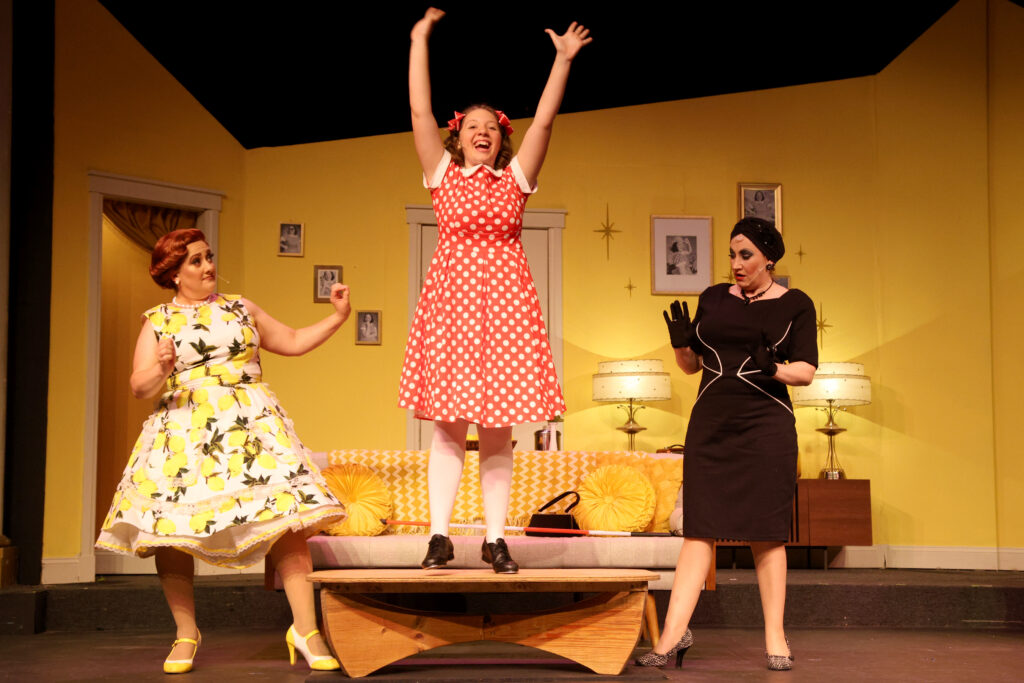
Dowling, looking like she stepped out of the pages of “Ladies’ Home Journal,” is stereotypical ‘50s housewife Judy Denmark, who answers her always-ringing landline by identifying herself as “Tina’s Mom.”

Any similarities with super moms of that golden era – Donna Reed, Harriet Nelson, Jane Wyatt and Barbara Billingsley — is intentional.

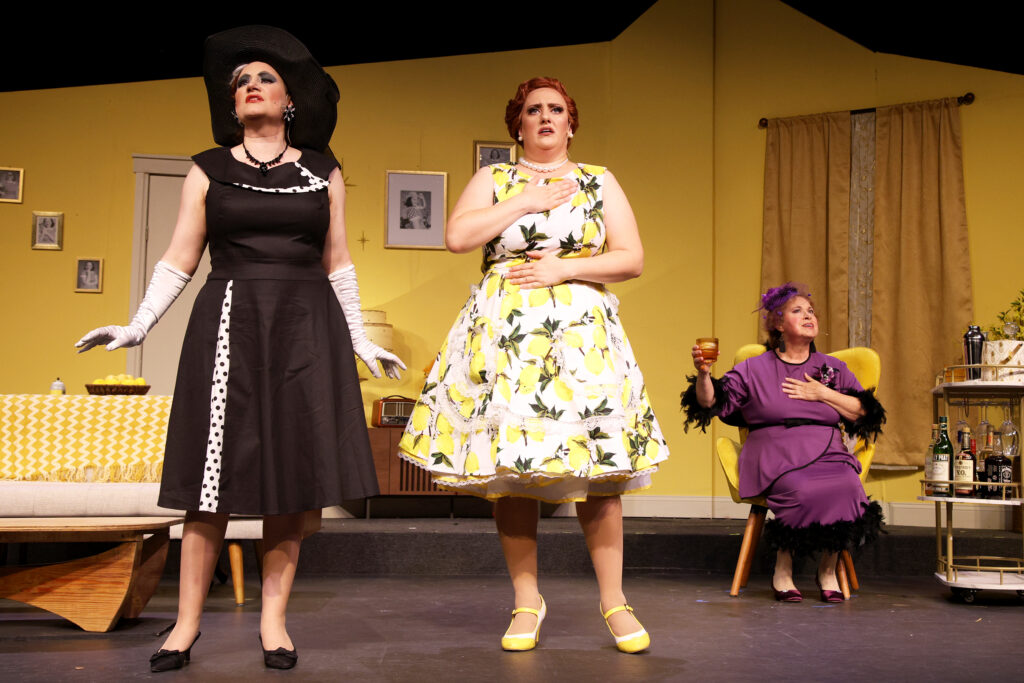
Sarajane Clark, Sarah Gene Dowling and Laura Kyro in ‘Ruthless!” Photo by John Lamb.

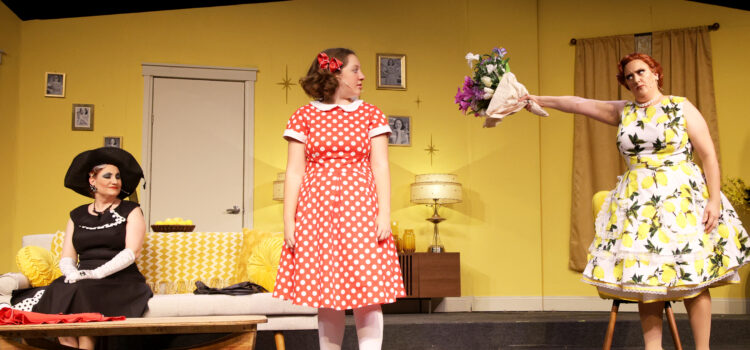
In scenic designer Rob Lippert’s carefully appointed mid-century modern home decked out in canary yellow, Judy keeps it spotless by her obsessive house-cleaning. Judy professes to be content, and a running gag is her affection for Pledge furniture spray.

But when a mysterious talent agent, Sylvia St. Croix, rings her doorbell, things are going to take a few turns. As Sylvia, Clark, who can out-Joan Crawford anyone, conjures bygone Hollywood glamour through stunning black-and-white outfits, complete with matching hats and turbans.

Costume designer Colleen Michelson has assembled an outstanding panoply of Audrey Hepburn-worthy ensembles for Clark, and Dowling’s retro floral print dress is perfection.

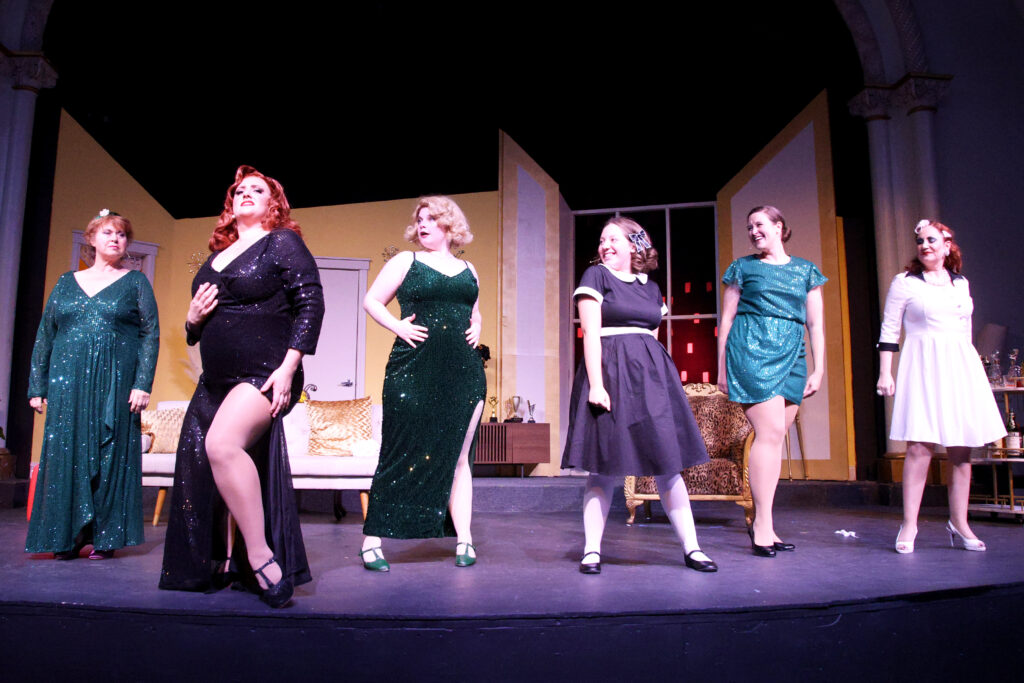
But some of the other women’s dresses are too short or ill-fitting, such as Eve’s tight emerald-green dress that she keeps tugging at while she’s flitting about.

You know this is going to be a wacky romp by reading the program: “Please Note: This production contains smoke effects, replica firearms, loud noises, and children doing very bad things. Viewer discretion is advised.”

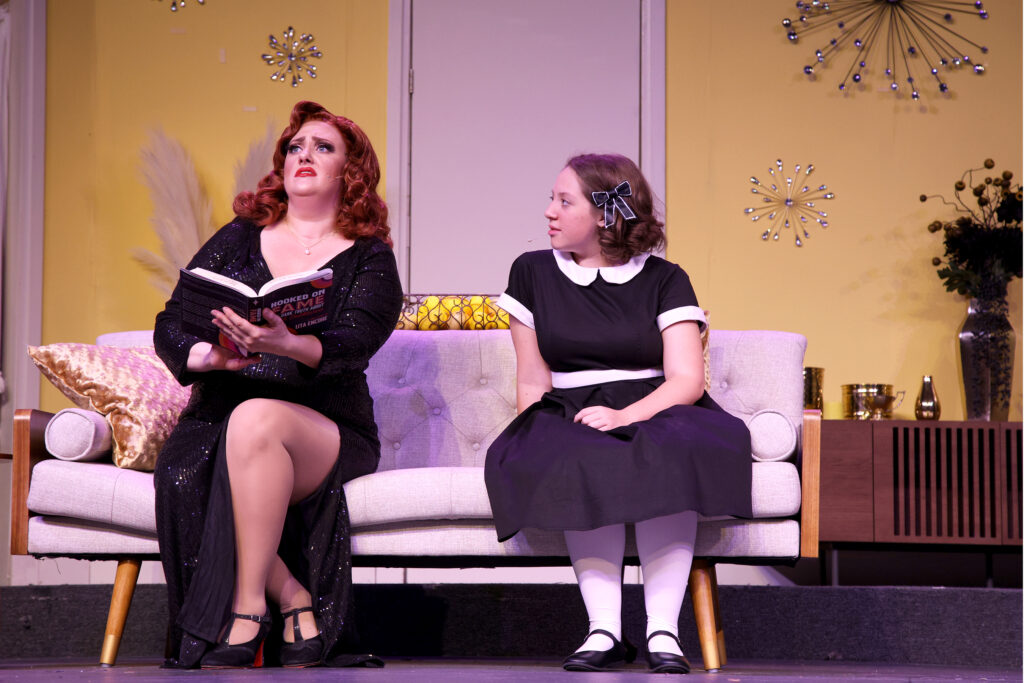
In a daffy debut, Finley Mohr is poised as chipper “8-year-old” Tina, who won’t let anyone stand in the way of her becoming a star. When she isn’t cast as Pippi Longstocking in her school musical, hell hath no fury like a sociopathic stage brat spurned.

Is she another “The Bad Seed” who looks like Little Orphan Annie? For she takes aim at her rival, Louise Lerman, played with comedic flair by Sarah Lantsberger as a far less talented kid. Louise’s parents secured her the lead through third-grade teacher Miss Myrna Thorn, and nimble performer Anna Langdon is the very dramatic instructor who is also a conniving and frustrated actress.

Laura Kyro goes all in as haughty Lita Encore, a self-important theater critic who hates musicals – and pours her loathing, Ethel Merman-style, into an “I Hate Musicals” number. When she shows up to review “Pippi in Tahiti,” we learn she has ties to the Denmarks. Dun dun duuun!

Sarah Gene Dowling and Finley Mohr. Photo by John Lamb.

These bizarre six degrees of separation are revealed at various times, giving the feeling of whiplash, and old-timey melodramas that once were staged on showboats. The plethora of plot twists are a mix of destiny and flimsy fictional tropes.

Before the first act wraps, we discover Judy is the daughter of Ruth Del Marco, a Broadway star who supposedly took her own life after a scathing review by Lita. Turns out the talentless Judy discovers her gifts and becomes a very different character in the second act.

The book and lyrics by Joel Paley and music by Marvin Laird are a blend of John Waters snark, Douglas Sirk 1950s ‘women’s pictures’ and nods to “All About Eve,” “Gypsy,” and other show-bizzy tales.

The show debuted off-Broadway in 1992, then was revised in 2015 into a streamlined 90-minute version without an intermission. This production is performed in two acts, with a 10-minute intermission, and is more than 2 hours’ long, which drags out the jokes.

The second act takes place in a New York City penthouse, where vainglorious prima donna Ginger Del Marco (Dowling) is ensconced with her manipulative assistant Eve (Lantsberger).

Del Marco is free of the constraints of being a wife and mother, for Tina has been sent away to the Daisy Clover School for Psychopathic Ingenues. Ginger has won a Tony Award and has become devious and insufferable in her narcissism.

The supporting women come and go, playing various characters – and it’s best to be surprised by the identities and ensuing shenanigans.

The six females are all belters and have big Patti LuPone moments to sing out, mostly tongue-in-cheek style. Clark’s signature number “Talent” is reprised with the confident Mohr, whose cutthroat showbiz aspirations are the point of “Born to Entertain” and “To Play This Part.” The beaming Mohr can tap dance too, and Sara Rae Womack handled the choreography,

Laura Kyro, Sarah Gene Dowling, Sarah Lantsberger, Finley Mohr, Anna Langdon and Sarajane Clark. Photo by John Lamb.

Dowling and Mohr work well as the mother-daughter duo, and feign affection in “Kisses and Hugs,” “Angel Mom” (with Sylvia) and “Parents and Children.”

Clark teams up with Dowling on “Where Tina Gets It From” and delivers a Cruella de Ville-type number “I Want the Girl.”

Each character has at least one showcase number – Langdon on “Teaching Third Grade,” and Lantsberger on “A Penthouse Apartment” as Eve and “The Pippi Song” as Louise.

Musical director Randon Lane sleekly leads the four-piece band: Mike Hansen on percussion, M. Joshua Ryan on bass, Mary Jewell Wiley on reeds, and he’s on keyboards. Been has doubled as sound designer, and his snippets of swelling-strings movie scores add to the atmosphere, as does Tyler Duenow lighting designs.

“Ruthless!” is brash in its trashy escapades, with pleasing production elements that involved creative collaboration. Designed to tip its hat to the showbiz dreams all theater-loving folks grew up on, the peppery parody is performed with noteworthy zeal by blithe spirits. The sharp six are clearly having a blast playing together in the sandbox.

Dowling, Mohr, Clark. Photo by John Lamb.

Stray Dog Theatre presents “Ruthless! The Musical” from Aug. 1-24 at the Tower Grove Abbey, 2336 Tennessee Avenue, St. Louis. Showtimes are Thursdays through Saturdays at 8 p.m., with additional performances at 2 p.m. Sunday, Aug. 11, and Sunday, Aug. 18. Gated parking is available. For more information and ticket reservations, call 314-865-1995 or visit www.straydogtheatre.org.

Accessible Performances — ASL Interpretation: The 8/2, 8/9, 8/16, and 8/23 performances will be presented with ASL interpretation by students from Southwestern Illinois College. ASL interpreted performances are suitable for audience members who are deaf, deafened, or have hearing loss. They can also be valuable for people who are learning ASL.