By Lynn Venhaus
Fans of whodunits who’ve never seen Ira Levin’s clever tale of murder and betrayal should have a good time in the cozy confines of Tower Grove Abbey as “Deathtrap” unfolds with its scathing wit and intricate surprises.
Ira Levin, author of “Rosemary’s Baby” and “The Stepford Wives,” knows his way around a suspenseful shocker, and his 1978 play “Deathtrap” holds the record for longest running comedy thriller on Broadway.
It ran for more than four years — 1,793 performances, which is a remarkable accomplishment. Fun fact: It was Victor Garber’s first major role on Broadway (as Clifford). A film adaptation starring Michael Caine and Christopher Reeve followed in 1982. Its only revival was in London’s West End in 2010 that featured Simon Russell Beale and Jonathan Groff.
Besides its ingenious construction, the dark comedy is also highly theatrical, peppered with artistic merit in-jokes and catty remarks about show business, talent and success – plus snarky gossip on friends and neighbors in upscale Westport, Conn. (The lead’s favorite play is “Angel Street,” which is a sly nod to the film “Gaslight.” Chew on that).
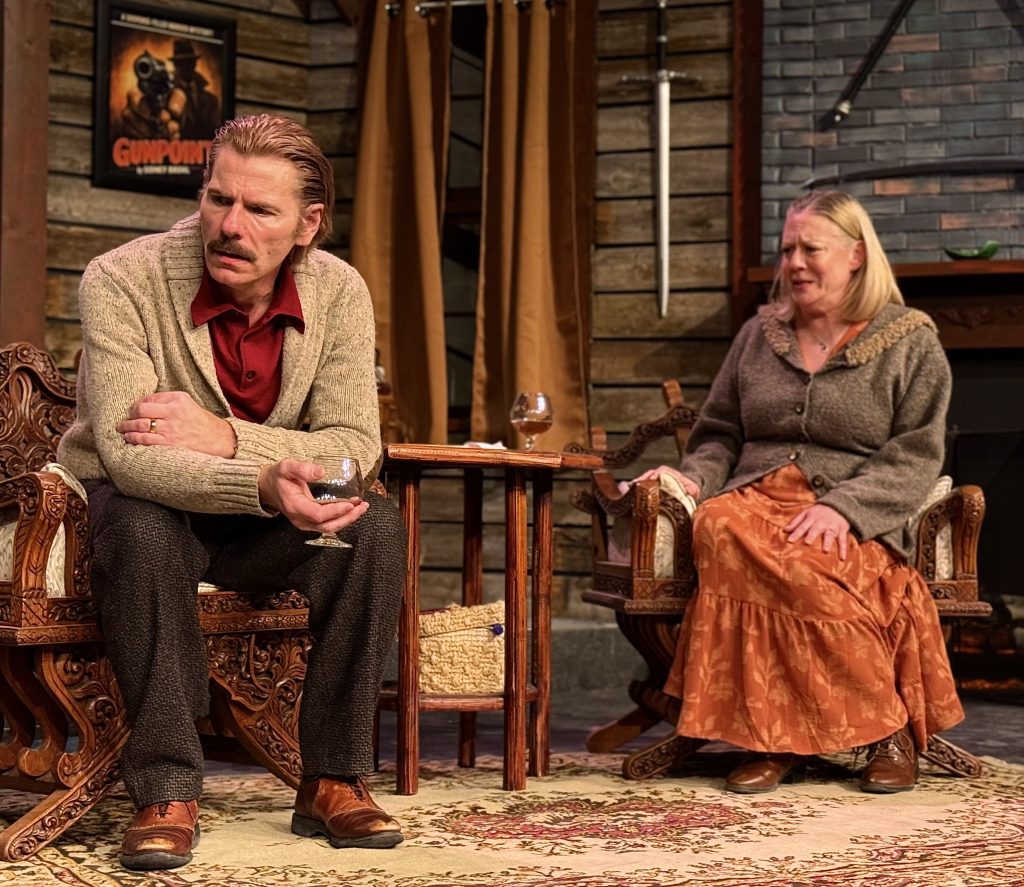
Sidney Bruhl (Stephen Peirick), a once successful playwright, hasn’t had a hit in a long time. He reads a play by Clifford Anderson (Victor Mendez), a former student at one of his writing seminars, and tells his wife Myra (Anne Vega) about how envious he is of this young inexperienced man’s craft. He predicts “Deathtrap” will be a sure-fire hit and make Anderson very rich.
Casually, he jokes about a ‘what if” scenario – he could get away with murder if he timed it just right and then claimed the work as his own. His sleuthing skills could hatch a foolproof crime.
Myra, naturally, is horrified. He laughs at his audacity, but is he really showing his devious nature? Let’s just say the plot thickens and evil lurks.
Covering his tracks, Sidney lures the talented pupil to his country home, and they dissect writing mechanics, particularly when plotting mysteries. Sidney is a condescending mentor to Clifford’s boyish hero worship.
In small but integral supporting roles, Liz Mischel is a psychic neighbor Helga ten Dorp and David Wassilak is attorney friend Porter Milgrim.
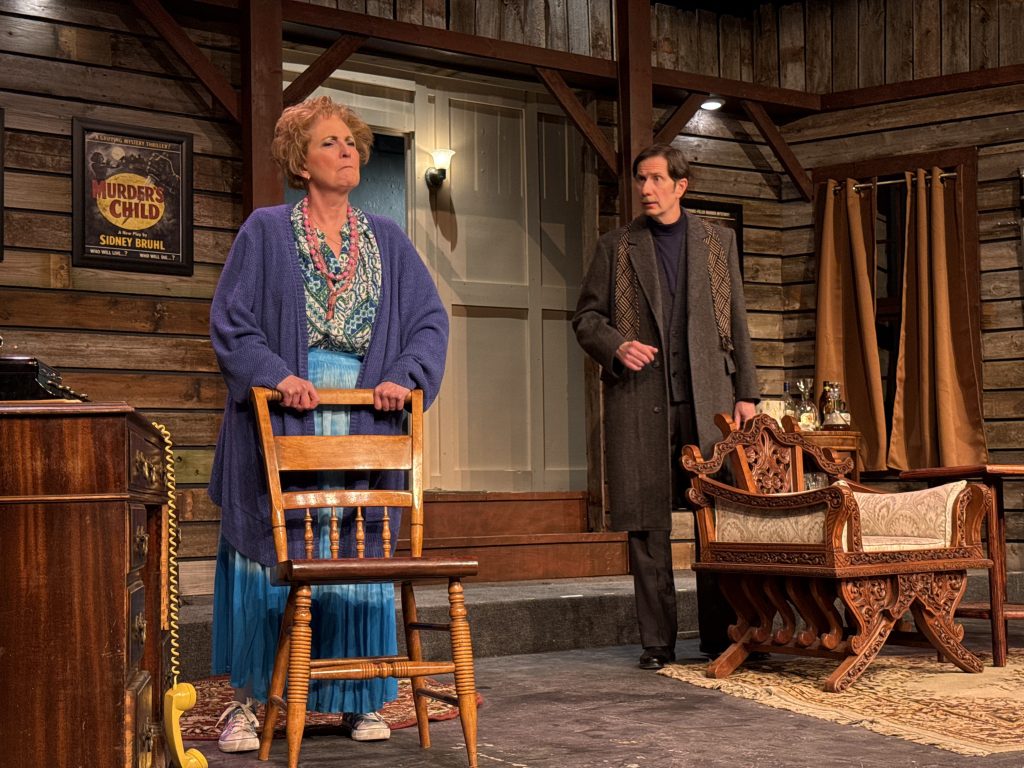
The only way this plot works in the 21st century is to keep the setting in the past — where people still use typewriters, carbon paper and landlines, without any digital accessories. So, a few of the cultural references are dated, but don’t detract. Levin has thrown in a dark and stormy night for good measure.
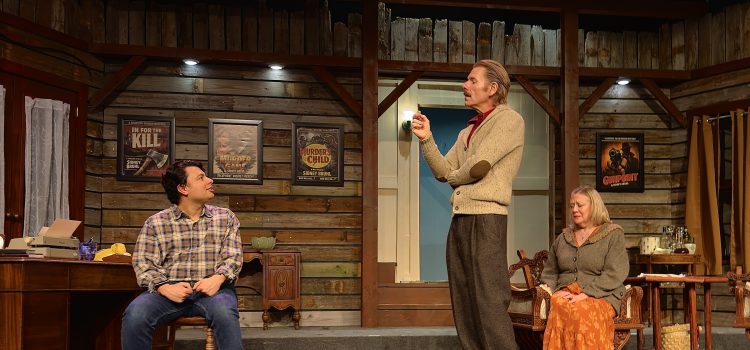
The technical elements are superb, providing an unsettling atmosphere for the disturbing behavior about to happen. Rob Lippert’s striking scenic design makes the bad vibes come alive — a rustic study renovated from a stable, with framed theatrical ‘window cards’ that are Bruhl’s greatest hits and reflect classic film noir posters.
A prominent display of antique weapons, a collection of props from his hit shows, includes gruesome pieces that look like from “Games of Thrones” and the board game Clue — guns, axes, swords, knives, crossbow, club, morning star and handcuffs.
Tyler Duenow’s lighting design is effective and precisely timed while Justin Been’s sound design adds another layer of eeriness. He’s always spot-on with his music interlude choices.
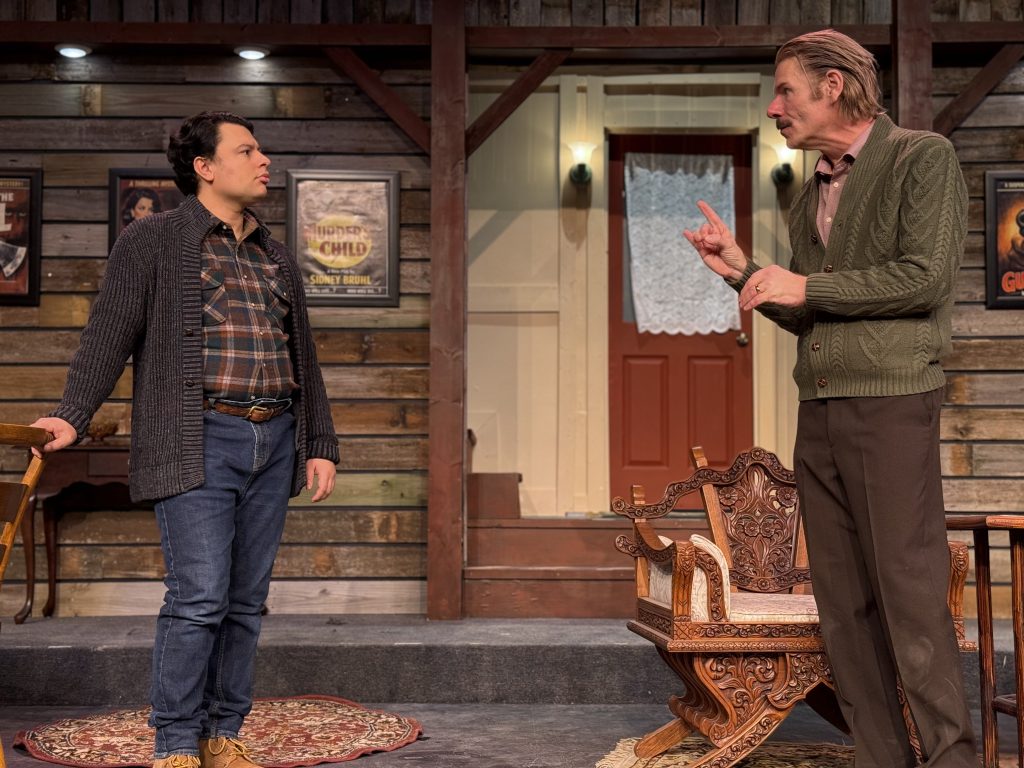
While the mood changes, the characters are one-dimensional, so the performers are one-note, and that makes investing in their welfare difficult. Peirick, a dedicated all-in leading man, is the insufferable blowhard Sidney.
The pompous playwright is written as the smartest guy in the room and never lets you forget it, but he is supposed to have some charm, although it’s not apparent on stage. Peirick exaggerates his dialogue while pontificating on writing and human behavior to such an extent that the affectation is stretched out, affecting the show’s pace.
As Clifford, Mendez depicts earnestness but isn’t as convincing when his deception becomes apparent. And that façade needs to slowly crumble, from eager to underhanded.
While loving and supportive, Myra is described as sophisticated and upper-class but Vega, despite showing her sweetness, is dressed frumpily. Vega is the show’s conscience and projects that well.
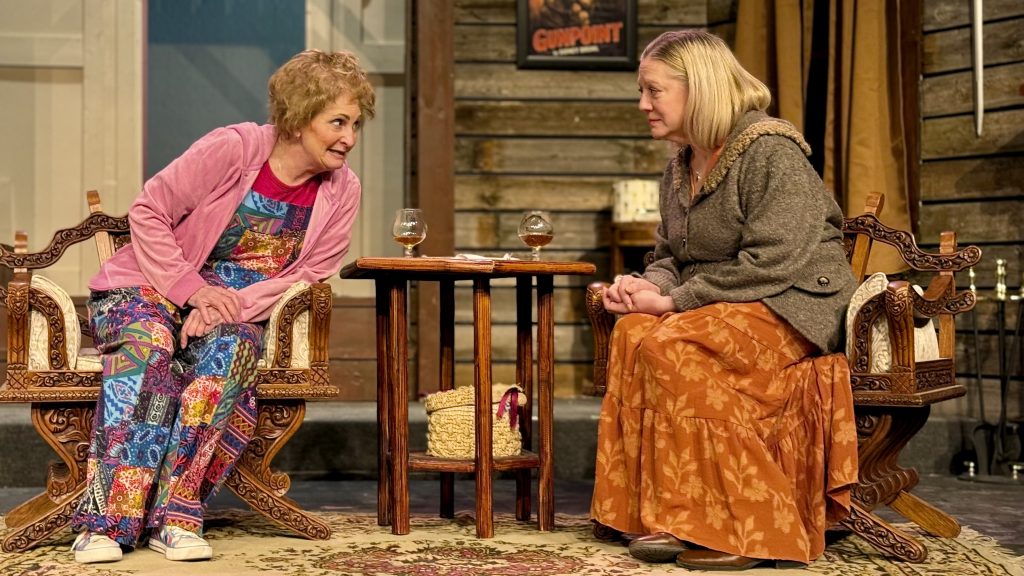
Mischel is ideally suited as the flamboyant psychic with an elaborate Dutch accent and a colorful wardrobe, because the over-the-top character wants to always pull focus to her. Think Madame Arcati in “Blithe Spirit.”
Wassilak is his customary professional self as Sidney’s shrewd attorney and Westport, Conn. friend.
The tangled web indicates people are never what they seem to be, some more conniving than others. And there are enough developments to keep everyone guessing through two acts.
Director Gary F. Bell uses shadows and light to punctuate this very smart murder mystery, and his crisp execution of the twists and turns is noteworthy, steadily building tension.
Yet craft is everything in this 48-year-old chestnut, because the designs are as important as the shocks.
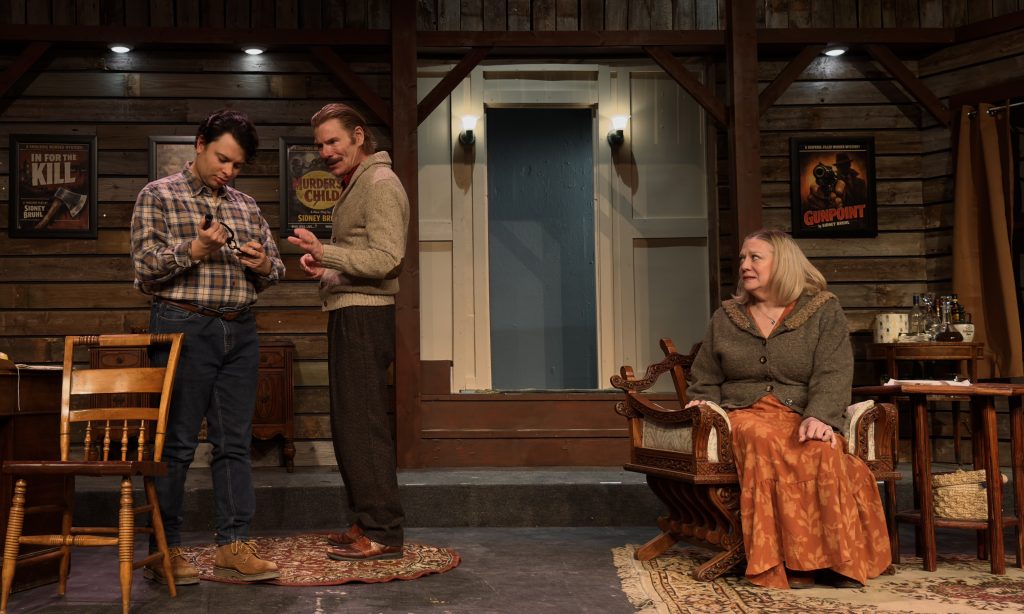
For those of us who’ve seen it multiple times, you anticipate the turns so you see the cracks, and it’s no longer as fascinating, but for newbies, it’s a huge crowd-pleaser. Murmurs went through the audience when key revelations happened.
The genre piece may not have aged as well as say an Agatha Christie ‘s “The Mousetrap” or Anthony Shaffer’s “Sleuth,” but as an examination of the seven deadly sins through a modern human nature lens, remains entertaining.
Stray Dog Theatre presents “Deathtrap” Feb. 5-21, Thursdays through Saturdays at 8 p.m. and Sundays Feb. 8 and 15 only at 2 p.m. Performances take place at Tower Grove Abbey, 2336 Tennessee in Tower Grove East. For more information: www.straydogtheatre.org.
This production contains the use of replica weapons and firearms, loud noises, and flashing lights. The play is nearly 3 hours in length, with one 10-minute intermission.

Lynn (Zipfel) Venhaus has had a continuous byline in St. Louis metro region publications since 1978. She writes features and news for Belleville News-Democrat and contributes to St. Louis magazine and other publications.
She is a Rotten Tomatoes-approved film critic, currently reviews films for Webster-Kirkwood Times and KTRS Radio, covers entertainment for PopLifeSTL.com and co-hosts podcast PopLifeSTL.com…Presents.
She is a member of Critics Choice Association, where she serves on the women’s and marketing committees; Alliance of Women Film Journalists; and on the board of the St. Louis Film Critics Association. She is a founding and board member of the St. Louis Theater Circle.
She is retired from teaching journalism/media as an adjunct college instructor.