By CB AdamsContributing WriterThere’s no easy way to say this: Union Avenue Opera’s season-ender production of Tom Cipullo’s true story Glory Denied is not easy to recommend because it is “not” many things.
It’s not a familiar, time-tested story arc (dare we say, post-modern?). Like most operas, it doesn’t examine a happy subject (war, torture, dissolution, hatred substance abuse, suicide, etc.), but unlike most operas, it ends despairingly rather than tragically, hopefully or even poetically.
Because it is not an opera that takes fictional specifics and reaches out for the universal — it’s an adaptation of the eponymous book by Tom Philpott, Glory Denied presents the very real specifics of a very real man (husband, father, Army colonel, America’s longest-held prisoner of war, alcoholic, etc.) and turns those specifics deeply inward – into gut shots rather than navel gazing. Nor is it filled with likeable characters; it’s especially hard to identify with or have much true empathy for either version of the wife, Alyce, despite Cipullo’s best efforts to present her side of the story.
And it’s not about America at its best – no rose-colored, rah-rah,
flag-waving, patriotic boosterism in this story. This is an opera about an ugly
war, an ugly time in America and the ugly way that both the government and our
fellow citizens dealt with its ugly details and aftereffects. On stage, the
horrific details keep adding up like those nightly body counts on the evening
news during the Vietnam War.
The first act deals primarily with the eight-year
imprisonment and physical abuse that Floyd James “Jim” Thompson endured,
followed by the second act examining how his post-war life was just as
tortuous, albeit in very different ways. (For plot details, do a quick internet
search – it debuted in 2007 and has had more than 20 productions since then.)
And yet, it is precisely because of all of the things that Glory Denied is not that makes it precisely
why UAO’s production deserves an audience – and certainly one better attended
than the August 17 performance (c’mon, St. Louis theater goers in general and
opera goers in particular!). Not everything worthwhile is easy and not
everything can be sugarcoated to help the bitterness go down. Glory Denied (in its St. Louis debut), should
be seen for exactly what it is: a cautionary tale. It serves the same purpose
as the uncomfortable “aversion therapy” scene in A Clockwork Orange – the one where the lead character, Alex, is
forced to watch violent images while his eyes are clamped open.
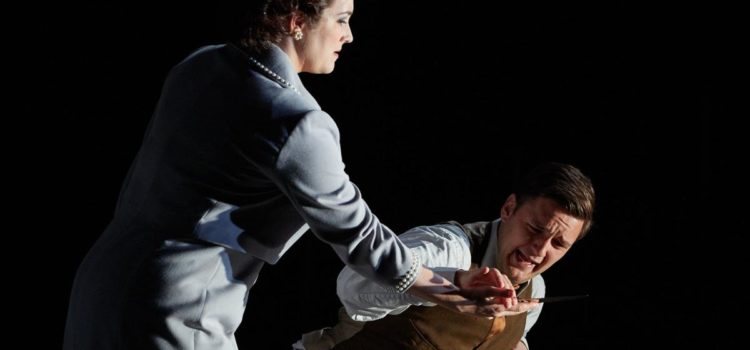
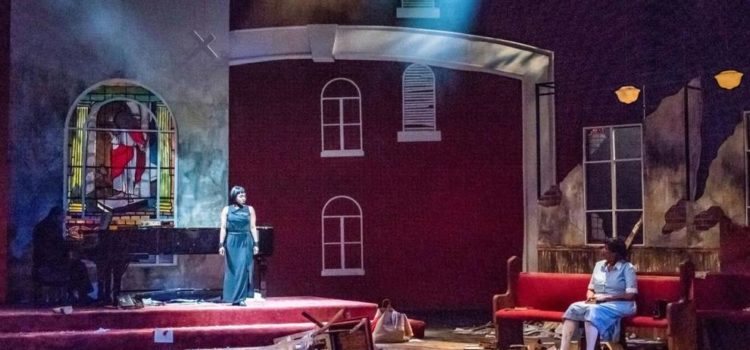
Union Avenue Opera’s Glory Denied dress rehearsal on August 13, 2019.Kudos and a tip of the hat to UAO for taking a chance, pushing the boundaries of our local audiences and supporting the work of a modern composer. The company showed extraordinary commitment to this production. As part of a PNC Arts Alive Grant, UAO presented a free panel discussion about Glory Denied and the Vietnam War on August 13 at Soldier’s Memorial.
Tom Cipullo attended the opening weekend of the opera and led talk-back presentations after the performances. Veterans were eligible for free general admission tickets and active military could see the production for $15. There was even a special room reserved for those who might have an anxious reaction during each performance.
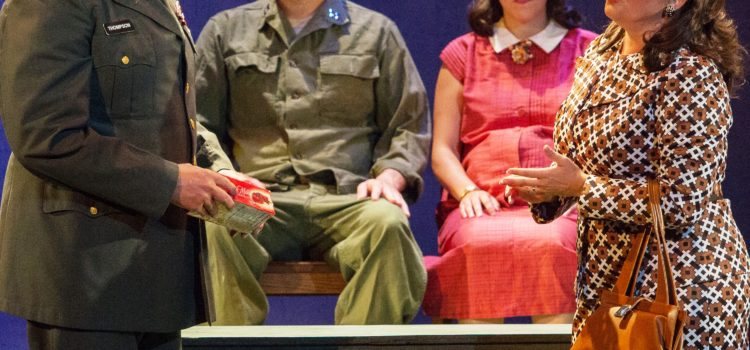
Befitting the intimate nature of the story, Glory Denied relies on a cast of just four portraying two versions of the same character under the direction of St. Louis native Dean Anthony, making his UAO debut. David Walton portrays Younger Thompson and Peter Kendall Clark (making his UAO debut, though he has sung the role previously) plays the central character, Older Thompson.
Thompson’s wife is portrayed by Karina Brazas as the Younger Alyce and Gina Galati as Older Alyce. Brazas and Galati deserve some sort of operatic hazard pay for meeting the challenges of portraying such unlikeable characters so well – it makes their accomplishment that much more appreciated. That same appreciation applies to the entire ensemble as they work with a script consisting entirely of lines from actual interviews, correspondence and other research materials.
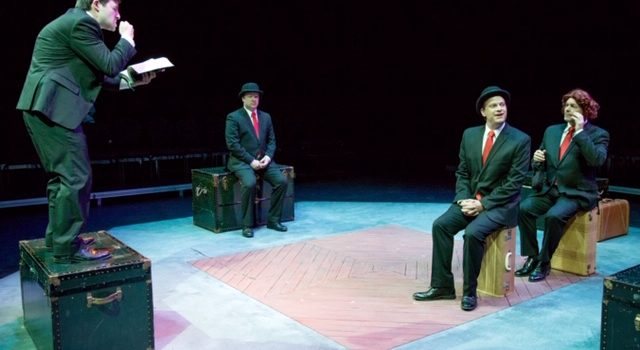
The music – sometimes jarring, discordant, atonal – was energetic and robust as conducted by UAO artistic director Scott Schoonover. The minimalist set design by Roger Speidel, while spare, provided appropriate details to convey time and indicate place. He made especially good use of foot lockers and many forms of paper, such as letters, government memoranda, newspapers and magazines as they were thrown, dropped and flung throughout the stage.
The peak performance of the evening was Clark’s bellicose
rendition of “Welcome Home,” which has some of the tightest, strongest and
angriest writing in the opera – even though it borrows the same ironic, rapid-fire structure
created by Bob Dylan’s “Subterranean Homesick Blues,” Billy Joel’s “We Didn’t
Start the Fire,” and REM’s “It’s the End of the World as We Know It (And I Feel
Fine).”
Yes, Glory Denied is a tough sell, especially if all you seek is passive escapism (there’s a new Lion King for that) rather than a production that asks you to actively, intellectually consider one of the true costs of war – and not just the Vietnam War.
Union Avenue Opera’s Glory Denied dress rehearsal on August 13, 2019.
It’s a bit like being required to read William Faulkner’s Absalom, Absalom! orHerman Mehlville’s Moby Dick. Sure, they look dense and imposing sitting unopened – and maybe you won’t love every single sentence – but there’s a satisfaction when you make it to the end. Glory Denied deserves that much respect and deserves a fuller audience than last Saturday’s – even if it is a bitter pill.
Union Avenue Opera presents “Glory Denied” August 16, 17,
23 and 24 at 8 p.m. at Union Avenue Christian Church. For more information,
visit www.unionavenueopera.org.

Lynn (Zipfel) Venhaus has had a continuous byline in St. Louis metro region publications since 1978. She writes features and news for Belleville News-Democrat and contributes to St. Louis magazine and other publications.
She is a Rotten Tomatoes-approved film critic, currently reviews films for Webster-Kirkwood Times and KTRS Radio, covers entertainment for PopLifeSTL.com and co-hosts podcast PopLifeSTL.com…Presents.
She is a member of Critics Choice Association, where she serves on the women’s and marketing committees; Alliance of Women Film Journalists; and on the board of the St. Louis Film Critics Association. She is a founding and board member of the St. Louis Theater Circle.
She is retired from teaching journalism/media as an adjunct college instructor.