By Lynn Venhaus

With extra oomph in every song and dance number, Stages St. Louis delivers a festive confection in “Guys and Dolls.”

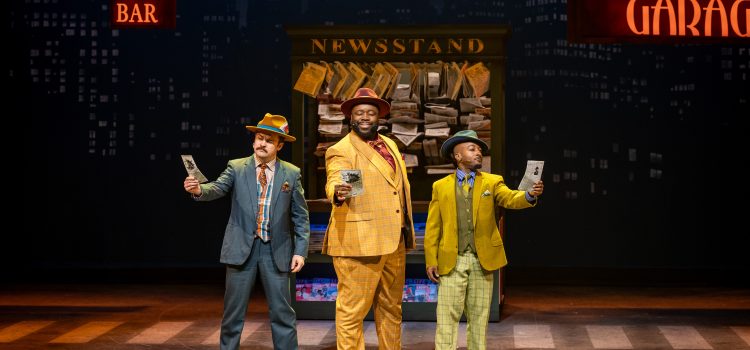
The snazzily attired ensemble looks like they’ve walked out of an idyllic vintage postcard of 1950s Times Square, bringing to life the exciting rhythms and zip of New York City. The colorful characters move in synchronized fashion, striking poses as this mix of pickpockets, cops, tourists, card sharks, and evangelists breeze by.

The look of “Runyonland” transports us to the bustling energy of midtown Manhattan and signals that we’re in store for one of the best musicals from the golden age. Ann Beyersdorfer’s resplendent scenic design, in tandem with lighting designer Sean Savoie’s bright neon lights, makes the skyline glow.

Costume designer Tim Kent’s stunning work is an integral element of this show, with outfits that dazzle in the Hot Box numbers – eye-popping elegance in “Take Back Your Mink” and glitzy in the fizzy “A Bushel and a Peck,” and boost the wise-guys pizzazz. Even every accessory, including outstanding hats and pocketbooks, are a marvel to see. Kent, a former designer of over 40 musicals at Stages from 1990-1997, has returned with an unmistakable flair.
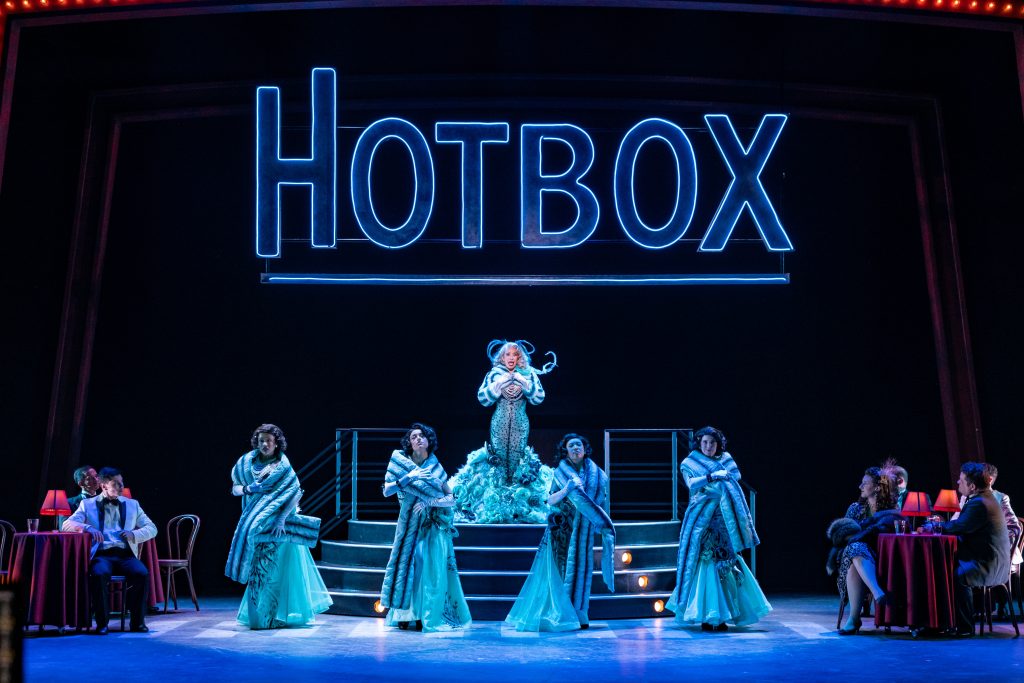
Adelaide and the showgirls in “Take Back Your Mink.” Photo by Phillip Hamer.

Once we hear that unforgettable score, with muscular music and lyrics by Frank Loesser, we’re off to the races with the overlapping witty banter of “Fugue for Tinhorns,” and the robust ensemble piece “The Oldest Established” soon follows.

The entertaining book by Jo Swerling and Abe Burrows, based on journalist Damon Runyon’s short stories, features these gamblers, hustlers and gangsters in their Prohibition era habitat. This romanticized ‘underworld’ is taken from Runyon’s “The Idyll of Miss Sarah Brown,” “Blood Pressure,” and “Pick the Winner.”

They have names like Nathan Detroit (Matthew Schatz), Benny Southstreet (a sensational Wesley J. Barnes), Big Jule (Zoe Vonder Haar), Rusty Charlie (Reagan Pender), Harry the Horse (Aaron Fried) and Angie the Ox (Patrick Blindauer). The performers have mastered the distinctive slang called Runyonese, and director James Monroe Iglehart has defined this theatrical and funny production with an exaggerated chaotic kinetic energy.

Iglehart’s brisk guidance, and the collaborations to evoke this bygone era’s sentimental atmosphere, are key to this show’s appeal. Through a superb fusion of modern dance, jazz and ballet, choreographer Lindsay Joy Lancaster has created a style that gives this “Guys and Dolls” revival its signature. Pulsing with musicality, Lancaster’s dance moves in ‘Havana” and “Crapshooters Ballet” are the show’s MVP.
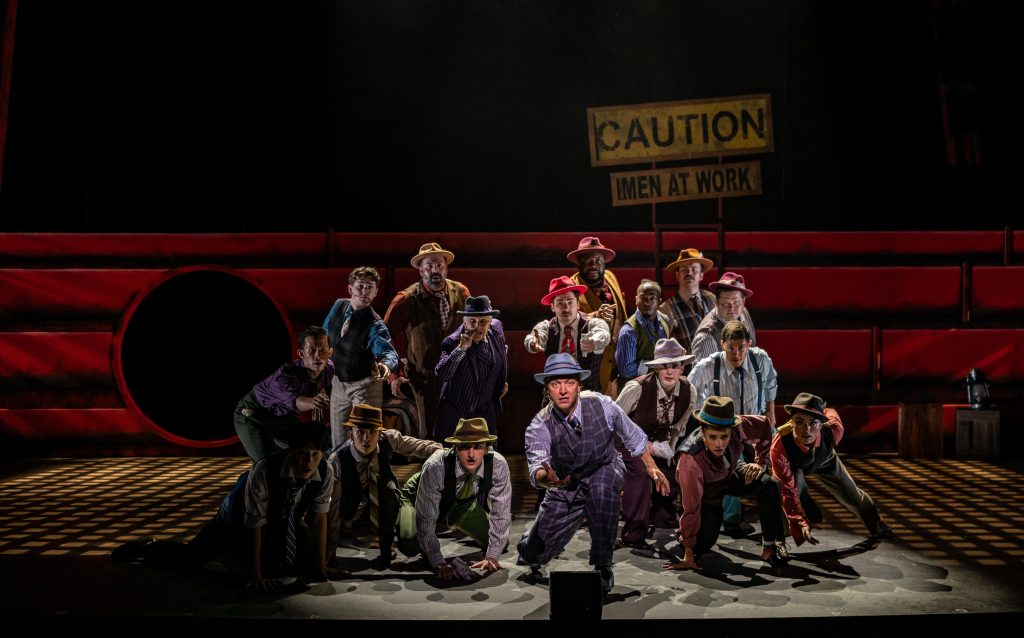
“Luck Be a Lady.’ Photo by Phillip Hamer.

The storytelling remains sweet and funny, especially the long-engaged dancer Miss Adelaide (Katerina Papacostas), who is tired of fiancé Nathan’s stalling, and yearns for a stable life. Papacostas is a rare find and steals the show with her feisty take on the iconic role. She takes charge in “Adelaide’s Lament” and comically bickers with her betrothed in “Sue Me.”

With those pre-feminism roles of the ‘50s, the female leads of that era have been mainly “need a man to take care of me” but Adelaide is no pushover, and it’s refreshing. Neither she nor Sarah are passive this time around. We’re just going to ignore the sexist tropes of that day here (you know, dolls and dames).

As Nathan, Schatz affably embodies the fast-talking, good-natured con man, and he and Papacostas, despite his commitment phobia, have a winning chemistry. He just values his illegal dice game more.

Unfortunately, the other principal pair, Sky Masterson (Sam Harvey) and Sarah Brown (Lindsay Roberts Greene), do not have any spark with their forced connection. High-roller Sky tries to woo the uptight, idealistic sergeant at the Save-a-Soul Mission because of a bet, but then they wind up falling for each other. That aspect proves that cool cat Sky can’t control love, and neither can Sarah.
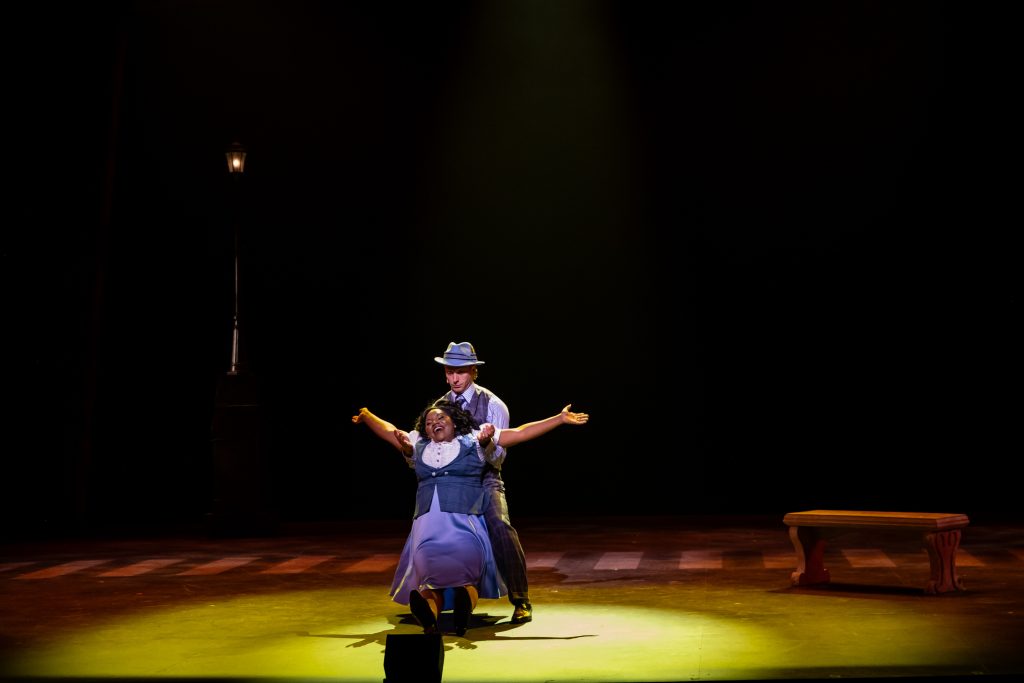
Sam Harvey and Lindsay Roberts Greene in “If I Were a Bell.” Photo by Phillip Hamer.

Seen at Stages as the slick Danny Zuko in “Grease” in 2019, Harvey delivers smooth vocals as the suave Masterson, especially city love letter “My Time of Day” and the swinging splashy “Luck Be a Lady” in the high-stakes crap game that takes place in the city’s sewer.

Greene has a beautiful voice and sings her solos “I’ll Know” and “If I Were a Bell” with aplomb. But she and Harvey are mismatched in “I’ve Never Been in Love Before,” and do not click vocally.

The cast’s harmony comes together in the showstopping “Sit Down, You’re Rockin’ the Boat,” one of the all-time great ensemble pieces, and this high-spirited cast raises the roof. It’s Tamar Green’s time to shine as the cheerful Nicely-Nicely Johnson, Nathan’s loyal sidekick.

A welcome presence, Greene is a natural force whose expressive, rich tenor has made him a standout as George Washington in “Hamilton” on Broadway, and a tower of strength as Coalhouse Walker in Stages St. Louis’ “Ragtime,” for which he won the St. Louis Theater Circle Award in 2025.
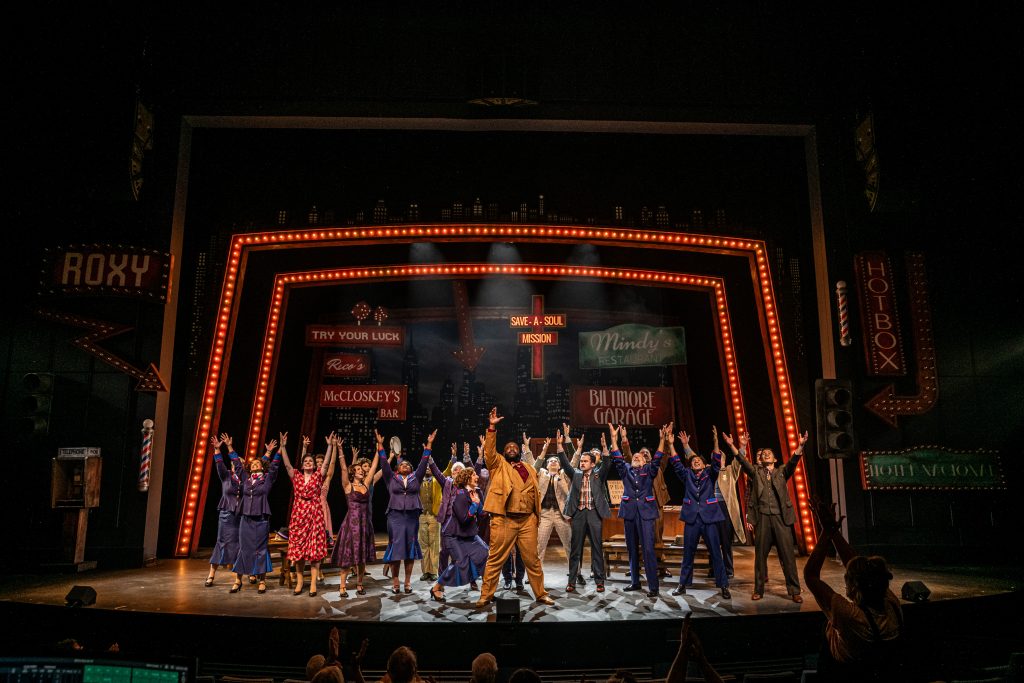
“Sit Down You’re Rocking the Boat.” Photo by Phillip Hamer.

The ‘Sit Down’ foot-stomping, hand-clapping revival-style number always brings down the house so that “Marry the Man” duet between Sarah and Adelaide that follows always feels like an after-thought, but it leads to the inevitable happy ending.

Supporting characters of note include St. Louisan John Flack, an ideal fit as Arvide Abernathy, the kindly loving grandfather of Sarah Brown, and the bass drum player in the mission band. His warm, heart-tugging ballad “More I Cannot Wish You” is one of the show’s highlights.

Another high point is local treasure Zoe Vonder Haar as Chicago high roller Big Jule – what fun! Other veteran local performers who grace the stage include Steve Isom as gruff Lt. Brannigan, Pam Reckamp as no-nonsense General Cartwright, and Blindauer as a comical Angie the Ox.

The swaggering guys (previously not mentioned) include Paul Giarratano, Josiah Gundersen, Philly Kang, Connor Kelly-Wright, and Jack David Mullen, while the sprightly dolls were Teah Juliette Bell, Anna Chin, Marjorie Failoni, Cara Palombo and Maya Santiago. Swings include Aubrey Aldag, James Caposito and Mason Hensley. They find the sweet spot, not too seedy or campy, as the saints and sinners.
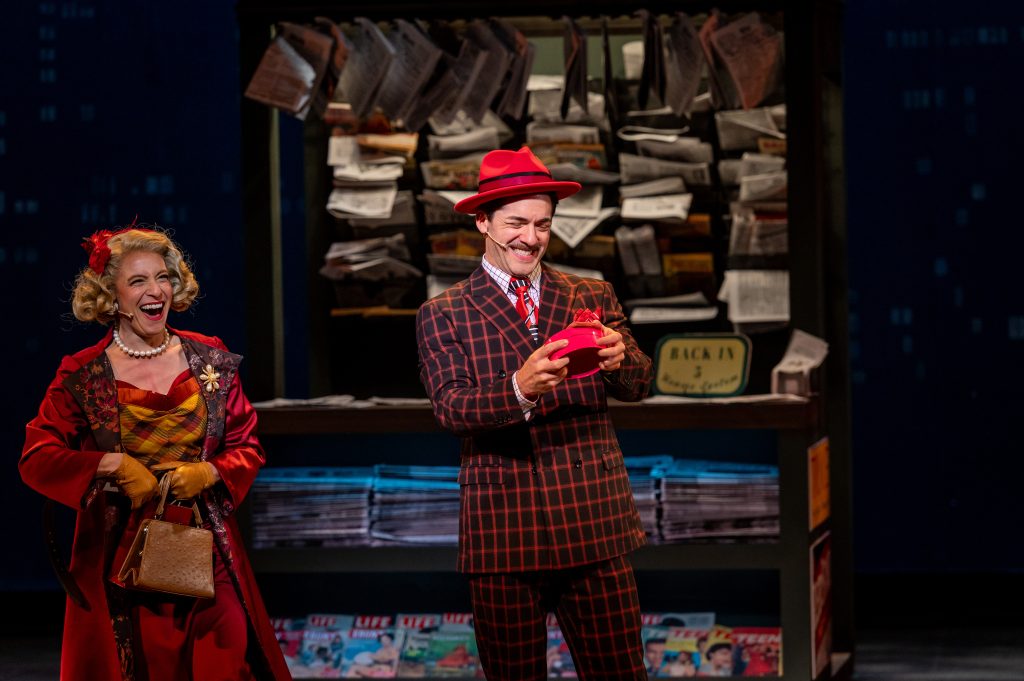
Katerina Papacostas and Matthew Schatz as Miss Adelaide and Nathan. Photo by Phillip Hamer.

Musical director Dolores Duran-Cefalu buoyantly leads an orchestra that includes Jonathan M. Taylor on drums and percussion, Adam Anello on bass, George Manning on trombone, Chris Miller and Dan Smith on trumpets, Lea Gerdes, Joseph Hendricks and JD Tolman on reeds, Fiona Brickey on violin, and Mark Maher and Duran-Cefalu on keyboards.

Other contributions include terrific wig and hair design by Paige Stewart, clear sound design by Breanna Fais, and sharp stage managing by E. Sara Barnes.

Let’s face it, this musical comedy fable is such a staple in school and community theater that you’d be hard-pressed to find someone who hasn’t seen it, been on a crew or acted in it. Nearly everyone who has a connection to the play looks back on it fondly, as you just can’t find fault with those peppy numbers, no matter how times have changed.
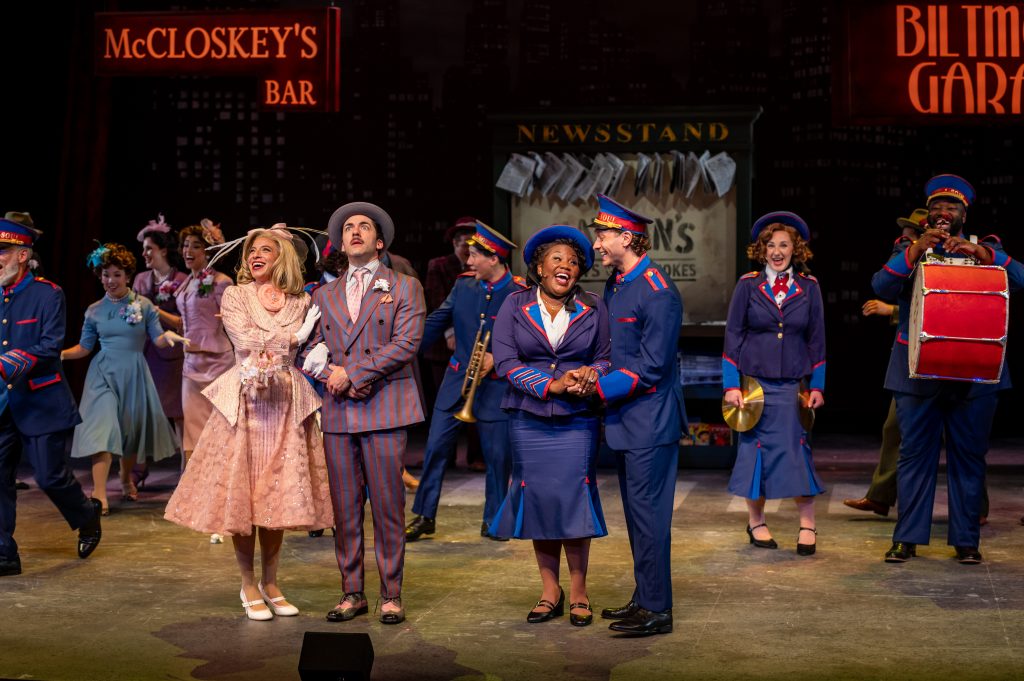
“Guys and Dolls.” Photo by Phillip Hamer.

The Tony-winning musical premiered on Broadway on Nov. 24, 1950, and ran for 1,200 performances. It has been revived numerous times – 1955, 1965, 1976, 2009, and most notably, the 1992 revival that won four Tony Awards and ran for 1,143 performances. And there was that 1955 movie starring Marlon Brando and Frank Sinatra.

Laced with nostalgia, Iglehart’s delightfully crisp and snappy production comes alive with intention and demonstrates why this quintessentially American musical has staying power and a devoted audience.

Stages St. Louis presents “Guys and Dolls” July 24 through Aug. 23, with performances daily except for Mondays, at the Kirkwood Performing Arts Center, 210 E. Monroe Ave. For more information: stagesstlouis.org
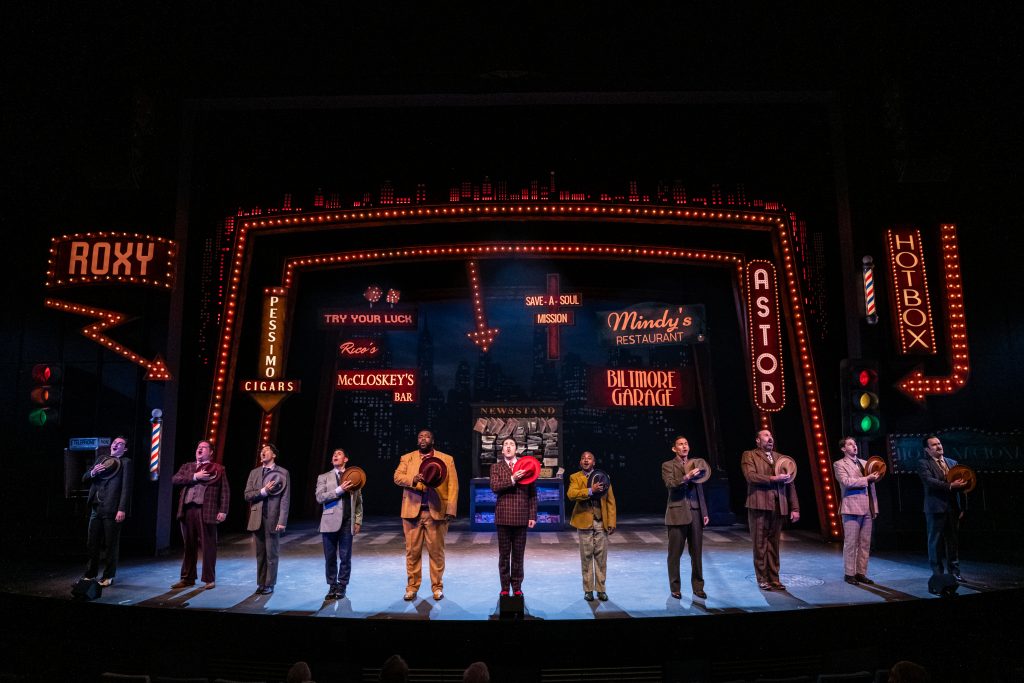

“The Oldest Established.” Photo by Phillip Hamer.

By Alex McPherson

An eye-popping feast for the senses whose visual inventiveness can’t compensate for a restrictive middle-chapter narrative, “Spider-Man: Across the Spider-Verse” is consistently engaging but will play best for those already well-versed in Spider-Man lore.

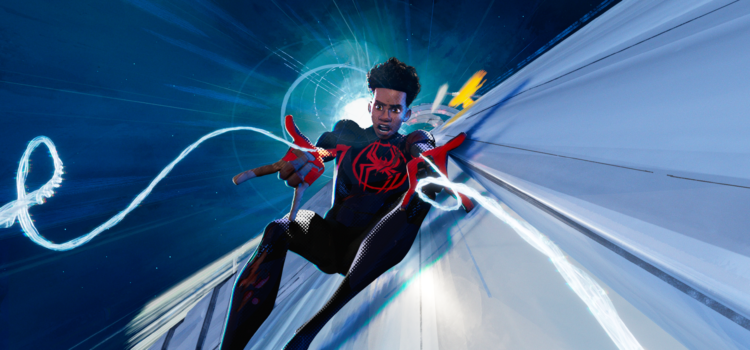
Taking place 16 months after the events of “Into the Spider-Verse,” the film follows the exploits of 15-year-old Miles Morales (Shameik Moore), who struggles to balance his superhero role as Spider-Man with the more traditional responsibilities (i.e., attending classes) expected by his strict yet loving parents, Rio (Luna Lauren Velez) and the soon-to-be-police-chief Jeff (Brian Tyree Henry), who are unaware of his alter ego.

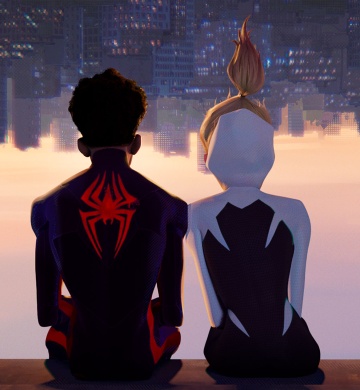
Miles, a rebellious teenager experiencing loneliness and heartbreak from his (literally) “out of this world” spider-people companions, including badass crush Gwen Stacy (Hailee Steinfeld), feels adrift and unable to fully express himself — yearning for freedom and belonging.

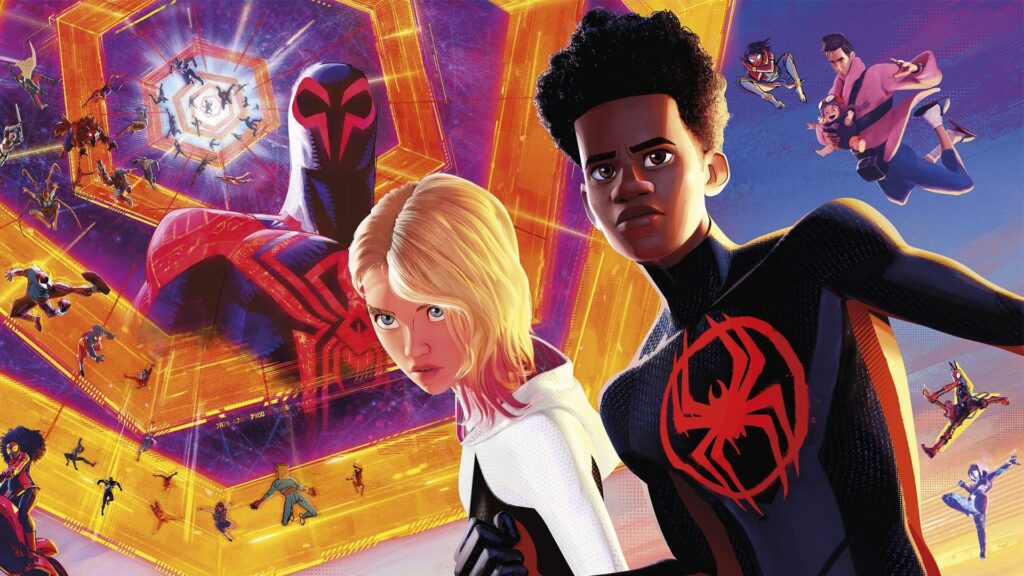
Gwen, in her own dimension, is similarly struggling to find acceptance and meaning; her father, George (Shea Whigham), a police chief, discovers her identity as Spider-Woman and blames her for the death of her timeline’s Peter Parker. After battling a monochromatic variation of The Vulture, Gwen is recruited by a team of Multiverse protectors — including the motorcycle-riding Jessica Drew (Issa Rae) and the brooding Spider-Man 2099, a.k.a. Miguel O’Hara (Oscar Isaac) — running from her now-perilous bond with her father. Soon enough, however, she’s called back into Miles’ orbit to tackle a new threat.

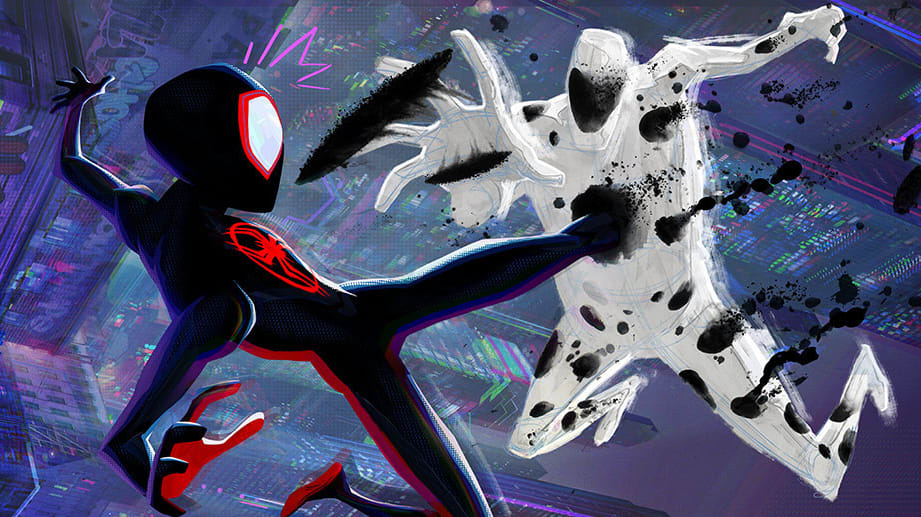
A bespeckled, self-deprecating foe named The Spot (Jason Schwartzman) shows up in Miles’ reality — brimming with hatred for Miles due to a past wrong that left him covered with holes through which he can teleport across great distances. He’s champing at the bit to become Miles’ “nemesis,” getting stronger by the moment in his fierce desire for revenge. 

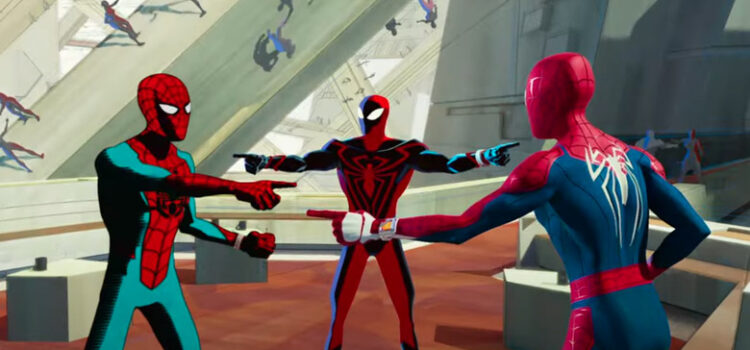
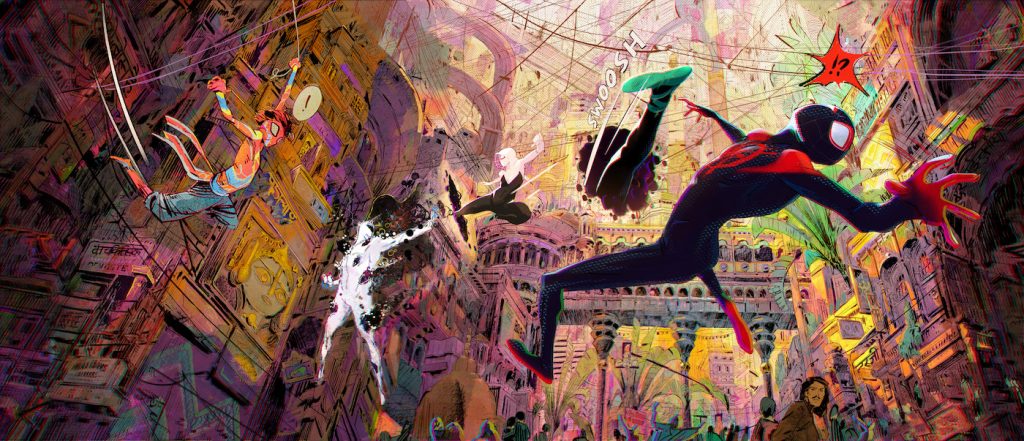
Things get even more complicated when Gwen shows up, reigniting her situationship with Miles, and prepares to leave once The Spot teleports elsewhere. Miles ends up following her into an interdimensional portal revealing a whole society of Spider-Beings, including the jovial Spider-Man India (Karan Soni), the unruly, punk rock Hobie Brown (Daniel Kaluuya), seemingly assembled from scraps of paper, and a hulking Spider-Tyrannosaurus, each manifested through different animation styles.

It’s not all sunshine and rainbows, though, as not only has The Spot gained enough power to pose a tangible threat to the Multiverse as they know it, but Miles must continue to fight against fatalistic, predetermined beliefs that restrict his free will on a universe-altering level.

Indeed, “Across the Spider-Verse” certainly has a boatload of information to convey to viewers, and to be honest, some of it soared over my head. This remains the sequel’s greatest flaw: no matter how excellent it looks and how well the talented ensemble brings these characters to life, the film remains ham-strung by a desire to be bigger in the classic sense, leaving its most compelling thread dangling by the end as we wait for the next installment in 2024. 

Directors Joaquim Dos Santos, Justin K. Thompson, and Kemp Powers certainly have a keen sense of spectacle, seamlessly blending art styles together that reflect characters’ specific views of the world and their distinct, variably layered personalities. From a watercolor backdrop melting from mournful blue to hopeful pink with the thawing of emotions, to a brief detour into stop-motion animation straight out of “The Lego Movie,” and frantic action sequences throwing characters of all styles at the screen at once, packing in multitudes of nerd-culture references along the way, “Across the Spider-Verse” is equal parts mesmerizing and fatiguing by the end of its 136-minute runtime, boosted by a thumping, energetic score by Daniel Pemberton and a catchy soundtrack. The passion poured into this project by everyone involved is apparent from start to finish, at least from a presentation standpoint.

“Across the Spider-Verse” still falls prey to sensory overload in its second half, just like its predecessor, but is refreshingly focused on human relationships in its beginning stretch, particularly regarding Miles’ bond with his parents. Moore, Lauren, and Tyree Henry lend real pathos to their roles in these slower sequences, tenderly and believably navigating difficult choices along Miles’ transition into adulthood. Steinfeld is also excellent, particularly in early scenes with her alienated father: vulnerable and courageous, bitter and earnest. Gwen’s not defined by her will-they-won’t-they romance with Miles, but rather by her personal strength to confront her demons and fight for what she believes in.

It’s somewhat disappointing, then, that as Miles and company journey through the Multiverse, encountering bazillions of Spider-Beings, that “Across the Spider-Verse” reverts so frequently to exposition dumps and rushed characterizations that allow little time to be fleshed-out beyond the surface level.

Talk of so-called “canon events” (the expected happenings of each Spider-Man story) are interesting in a meta-textual sense, but the film leaves the concept’s thornier elements dangling, hopefully to be explored down the road, in favor of simplistic messaging. The Spot, too, idiosyncratically brought to life by Schwartzman, is sidelined for most of the second half, a Big Bad seemingly too big for the already overstuffed film to address.

No matter how likable the characters, or thrilling the animation, “Across the Spider-Verse” is unable to break free from the expectations of tradition: a story whose ideas of empowerment and individuality are only broached but not fully delved into, set-up for greater things in the future. Perhaps “Beyond the Spider-Verse” will rectify these qualms, but as it stands, “Across the Spider-Verse” can’t match its breathtaking presentation with equally strong storytelling.

“Spider-Man: Across the Spider-Verse” is a 2023 animation-fantasy film directed by Joaquim Dos Santos, Kemp Powers, and Justin K. Thompson and starring (voices): Shameik Moore, Hailee Steinfeld, Luna Loren Valez, Oscar Isaac, Issa Rae, Jake Johnson, Jason Schwartzman, Rachel Dratch, Brian Tyree Henry, Shea Whigham, Karan Soni, Daniel Kaluuya, J.K. Simmons, and Mahershala Ali.
It is rated PG for sequences of animated action violence, some language and thematic elements and the runtime is 2 hours and 20 minutes. It opens in theaters on June 2. Alex’s Grade: B

By Lynn Venhaus
Pop art, quantum physics and pathos collide in a grand superhero spectacle, resulting in this “Spider-Man: Across the Spider-Verse” sequel being a mind-blowing amalgamation of next-level animation like but surpassing the 2018 original.

In this second installment of an animated film trilogy, Miles Morales (Shameik Moore) catapults across the multiverse, where he encounters a team of Spider-People charged with protecting its very existence. When the heroes clash on how to handle a new threat, Miles must redefine what it means to be a hero.

However inventive and clever it is, though, about half of the storyline is incoherent and panders to fan service — and the sensory-overload-on-steroids style is overwhelming and exhausting. Yet, we’re all locked in.

This 2 hour and 20- minute eye-popping extravaganza takes place across six dimensions, has 240 characters in it and had over 1,000 animators working on it – the most ever.

The Spider-Man mythology, easily relatable for teens who understood creator Stan Lee’s metaphors for figuring out their place in the world, began as a socially inept high school student who was bitten by a radioactive spider, and thus developed superpowers. That was in 1962, and in fighting crime in his subsequent Marvel Comics issues, Peter Parker would eventually learn “with great power comes great responsibility.”

Since 2002, there have been eight live-action Spider-Man movies, plus his role in “The Avengers” franchise, not to mention a past TV series, Broadway musical, video games and books.

The three co-directors Joaquim Dos Santos, Kemp Powers, and Justin K. Thompson mash parts of the old films with elements of the comic books. That comic imagery, added in with drawing and painting styles of the 20th and 21st centuries, results in a visually stunning work. Art historians will be in for a treat.

And comic book fans will be delirious about the Easter eggs – no doubt courtesy of cheeky producers Phil Lord and Chris Miller who finally won an Oscar for directing the first movie (previously robbed for “The Lego Movie”) but only co-wrote this script with David Callaham, a veteran of the first and “Shang-Chi and the Legend of the Ten Rings.”

I understand their desire to throw in as many gags for the super-fans, but that darn muddled narrative lets the rest of us down. And their need to fiddle with the Spider-Man canon to keep it fresh and interesting. Sure, there are compelling human emotional touches (dead relatives, loved ones in peril), but the hyper-kinetic storytelling weakens the overall effect for those ‘not in the zone.’

Another sticking point is that the middle entry in this animated world ends with a cliffhanger, then states Miles will return in “Spider-Man: Beyond the Spider-Verse.” It is set for a March 29, 2024, release — frustrating to viewers who like things resolved before waiting for another one, because this one just ends without a resolution.

And if you did not see “Spider-Man: Into the Spider-Verse” released four and a half years ago, you will be lost here. As a quick recap, Miles Morales, a black Hispanic Brooklynite, was juggling his life between being in high school and a Spider-Man, but when Wilson “Kingpin” Fisk uses a super collider, he finds out that others from across the Spider-Verse have been transported to his dimension.

This time, 15-year-old Miles remains on Earth – 42, but as he discovers more multi-verses, he meets dozens of other Spider-People. In this global take, we meet a Spider-Man India (Karan Soni), a cockney street punk Spidey named Hobie (Daniel Kaluuya), a snarling, hulking vampire Spidey Miguel O’Hara (Oscar Isaac), and a pregnant Spider-Woman, motorcycle mama Jessica Drew (Issa Rae). Saving the world is tough business, and there are existential crises happening.

Miles’ mentor, Peter Parker (Jake Johnson), is shown as a young father, married to MJ (Zoe Kravitz), who brings his baby along for the adventures. Sad girl Gwen Stacy (Hailee Steinfeld) is a combo grrrl rocker and a Spider-Girl whose anguished storyline is equal to Miles’.

Spidey and The Spot

While one can applaud the energy and the dazzling visuals of non-stop action, characters are often frazzled, and the pace is so frenetic that you feel like you are trapped in this parallel universe too. Who’s good, who’s evil, and who may be both?

Shameik Moore has returned to voice Miles, and he’s dandy as the angsty teen who is exasperating to his parents because of his time-management skills (they don’t know he’s keeping the bad guys in check, at least in his neighborhood).

His parents are voiced by Brian Tyree Henry and Luna Loren Valdez, joining a slate of major talent whose vocal work is solid but does not immediately identify them. Yet, it’s easy to place J.K. Simmons as J. Jonah Jameson, SNL’s Rachel Dratch as the principal, and Jason Schwartman as the revenge-seeking villain “The Spot” (a standout).

Hyper and hypnotic, “Spider-Man: Across the Spider-Verse ” has pushed forward the genre and is a fun fan experience. The propulsive score by composer Daniel Pemberton is also a plus. I give the animation an A+ but the story a B-.

It’s a lot to juggle sci-fi, action, adventure, family, comedy, drama, and fantasy in one animated feature, and this film does display heart, even if the movie can’t stand on its own.

After two decades of superhero comics ruling the bombastic blockbuster box office, what’s next? Has art opened another dimension? One of the Spider-Verse’s greatest strengths is that it still surprises, and these multiverses show no signs of maxing out.

One thing is for certain, the enthusiasm for this head-spinning series is not waning anytime soon (even with the grumbling about waiting for the next sequel). It’s as if we’ve hopped on one of the wildest amusement parks rides ever, and we need to see where it leads.

“Spider-Man: Across the Spider-Verse” is a 2023 animation-fantasy film directed by Joaquim Dos Santos, Kemp Powers, and Justin K. Thompson and starring (voices): Shameik Moore, Hailee Steinfeld, Luna Loren Valez, Oscar Isaac, Issa Rae, Jake Johnson, Jason Schwartzman, Rachel Dratch, Brian Tyree Henry, Shea Whigham, Karan Soni, Daniel Kaluuya, J.K. Simmons, and Mahershala Ali.
It is rated PG for sequences of animated action violence, some language and thematic elements and the runtime is 2 hours and 20 minutes. It opens in theaters on June 2. Lynn’s Grade: B

This review also appeared in the Webster-Kirkwood Times’ Reel World with Kent Tentschert.