By Lynn Venhaus

An extraordinary work of vision, power and poetry, “The Brothers Size” is one of The Repertory Theatre of St. Louis’s finest achievements to date.

Because of a cohesive collaboration between some of the most talented artists in St. Louis, this spiritual exploration of brotherhood and the black male experience has a dramatic impact that may leave you emotionally spun and moved to tears.

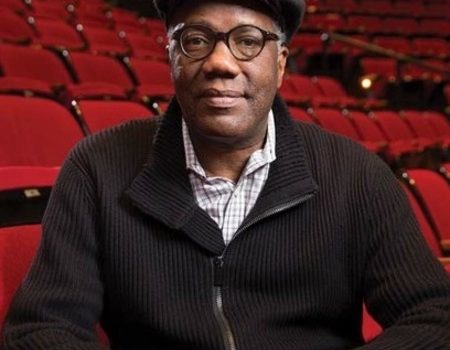
Directed with grace and deep understanding by multi-hyphenate Jacqueline Thompson, Metro Theater Company’s artistic director and winner of multiple St. Louis Theater Circle Awards for acting and directing, this gritty tale is staged in a lean, deliberate manner.

This immersive triumph is enhanced by the muscular choreography of Kirven Douthit-Boyd, artistic director of Saint Louis Dance Theatre; the memorable music composition and sound design of Tre’von Griffin and David A. N. Jackson; and the atmospheric lighting of Jayson Lawshee.
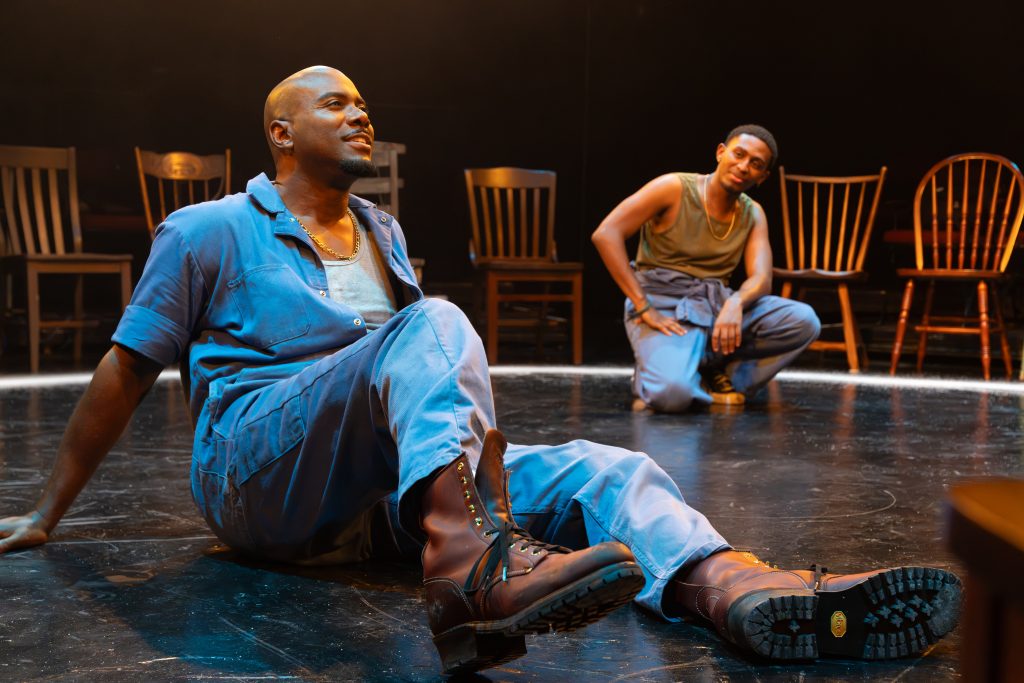
Nic Few as Ogun and Christian Kitchens as Oshoosi. Photo by Jon Gitchoff.

Their artistic vision, along with other artisans behind-the-scenes and the dynamic performances of Nic Few, Christian Kitchens and Donald Jones Jr., make this an unforgettable presentation.

They strived to make this resonate emotionally and do so in waves, for it grows in intensity and richness. Artistic consultant LaWanda Jackson and dramaturg Taijha Silas helped make that happen.

In his signature lyrical style, playwright Tarell Alvin McCraney, who won an Oscar for the screenplay of “Moonlight,” unfolds a common man story, with heart and humor, in the Louisiana bayou, which he wrote 20 years ago.

He examines the complex bonds of family, how love and loyalty affect relationships, the ripple effects of crime and punishment, systemic racism, and the hard road to healing.
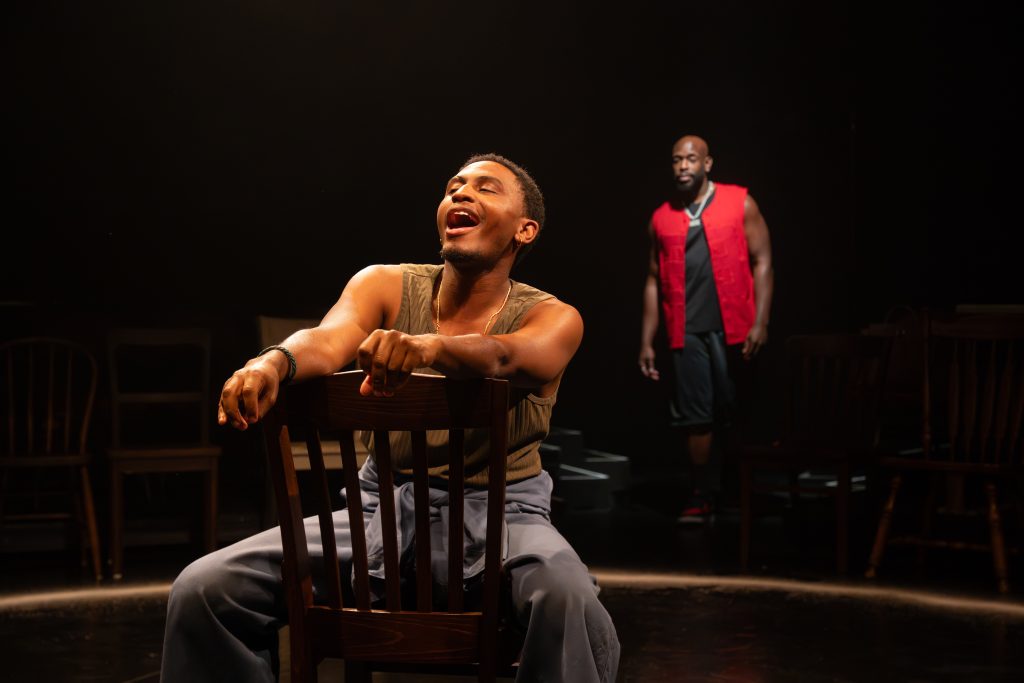
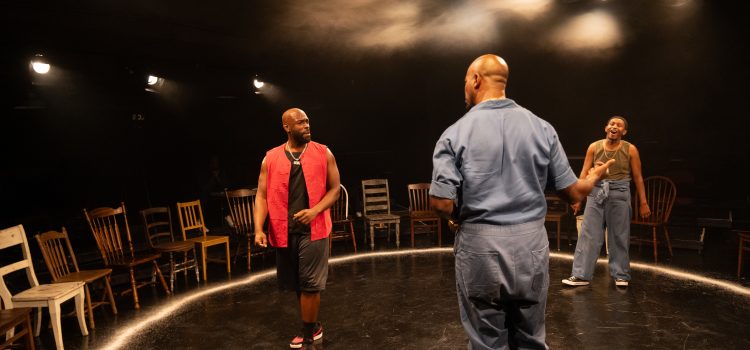
Christian Kitchens and Donald Jones Jr. Photo by Jon Gitchoff.

Nic Few is big brother Ogun, a responsible, hard-working auto mechanic whose younger brother Oshoosi (Christian Kitchens), has been released from prison. He’s restless, impulsive, trying to carve out a new life.

Can they reconnect or will the youngest return to his old habits when his ex-con friend Elegba (Donald Jones Jr.), his former cellmate, comes by for visits.

Ogun is tough on Oshoosi, annoyed by his swagger and aimlessness, and that chafes his little brother. It’s complicated when the oldest wants stability and the youngest is content to be carefree, tempted by a friend who’s a bad influence.

The brothers are eager to succeed, but they tussle often, like many siblings. Their temperaments are different – Few embodies fierce physicality and weighted down by the world and Kitchen imbues his part with musicality and a lightness of being.
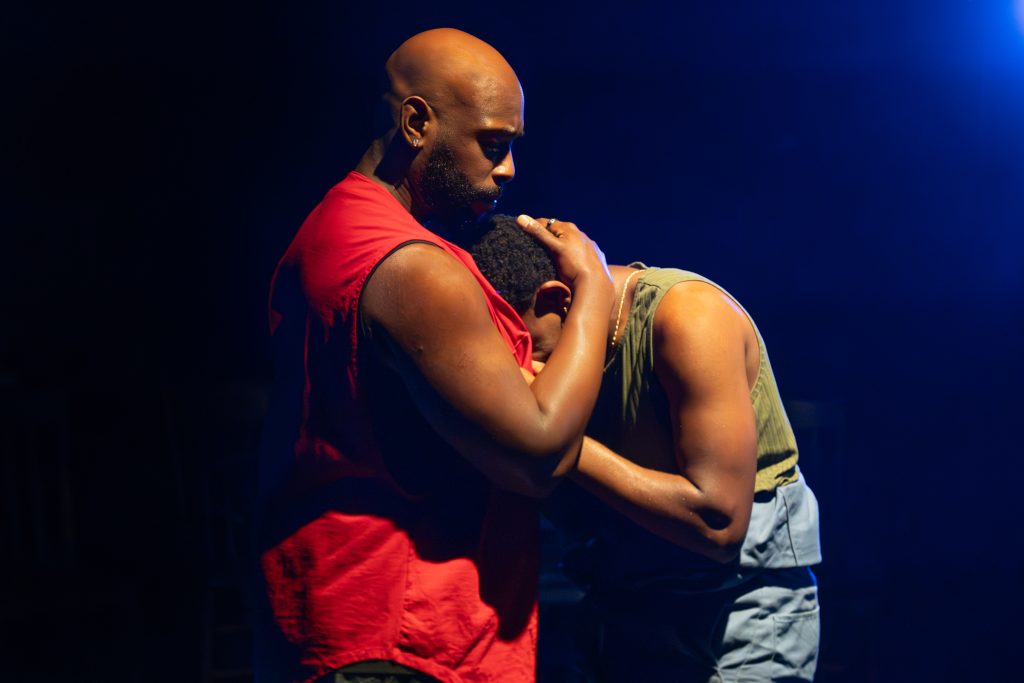
Photo by Jon Gitchoff.

The charming Elegba seems to want the same things but actually is a detriment to Oshoosi and Ogun’s goals. Ogun is suspicious but Oshoosi is faithful. Are we our brother’s keeper?

The effects of incarceration and the never-ending fight to be free, to make something better for their futures, shape this raw portrait. When danger lurks, they wrestle with decisions (Shades of “Nickel Boys.”)

Few, Kitchens and Jones corral an electrical charge to deliver honest characterizations that are physically and emotionally demanding. Their chemistry personifies their close ties. They are natural in their interactions – arguing, goofing off, trash talking, soul-singing, dancing and expressing their feelings.

Thompson was determined to find entry points for everyone watching, illuminating what could be considered abstract elements. The trust between everyone is obvious, their artistry elevated through her guidance.
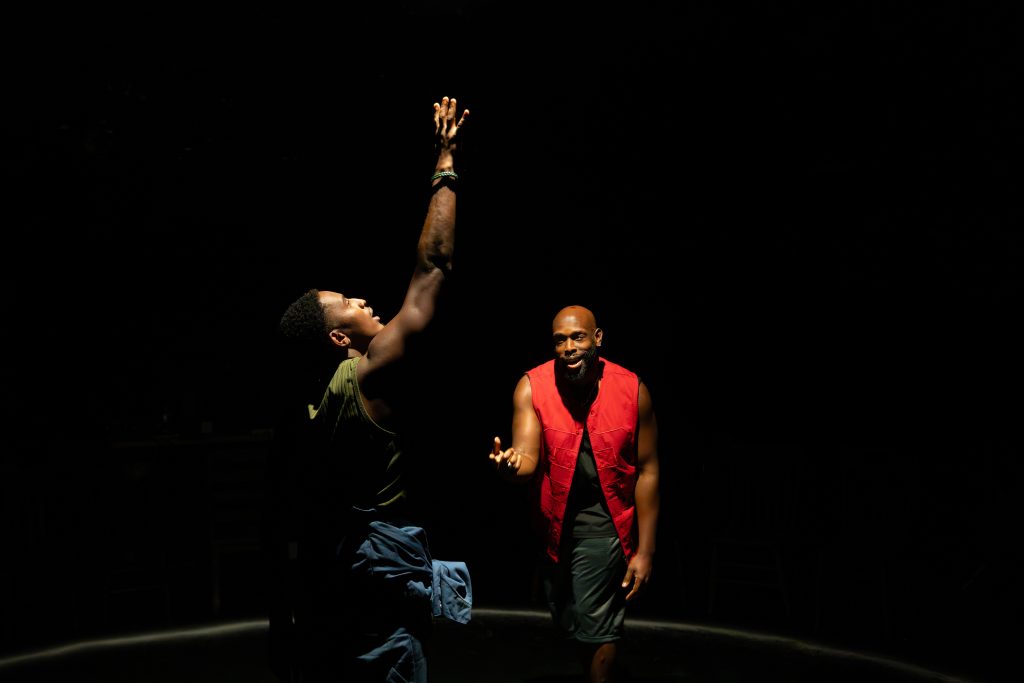
Photo by Jon Gitchoff.

The minimalist staging, with action taking place within a circle, is reflected in Kristie C. Osi’s costume design, Jayson Lawshee’s scenic design and Eric William Barnes’ props design.

A regional premiere, “The Brothers Size” is the first time one of McCraney’s plays are staged in St. Louis. Considered a modern-day fable, “the script includes stage directions in the dialogue to heighten the encounter between the actor and the audience.

McCraney was inspired by the Yoruba people of West Africa – their rituals and religion, so he incorporated symbolism. His stylistic choices are rhythmically distinctive, seamlessly blending verse and conversation. In his original way, he aims for a mythical quality, making it about something larger than our daily lives. That adds a potency and an urgency.

The first show this season in the Steve Woolf Studio Series, it’s a play that was made for the intimate space and the series, praised for its risk-taking. The former artistic director, who retired in 2019 after 33 years at The Rep and died during the pandemic in 2021, encouraged theatregoers to be adventurous with newer works and unknown playwrights. What a fine legacy.
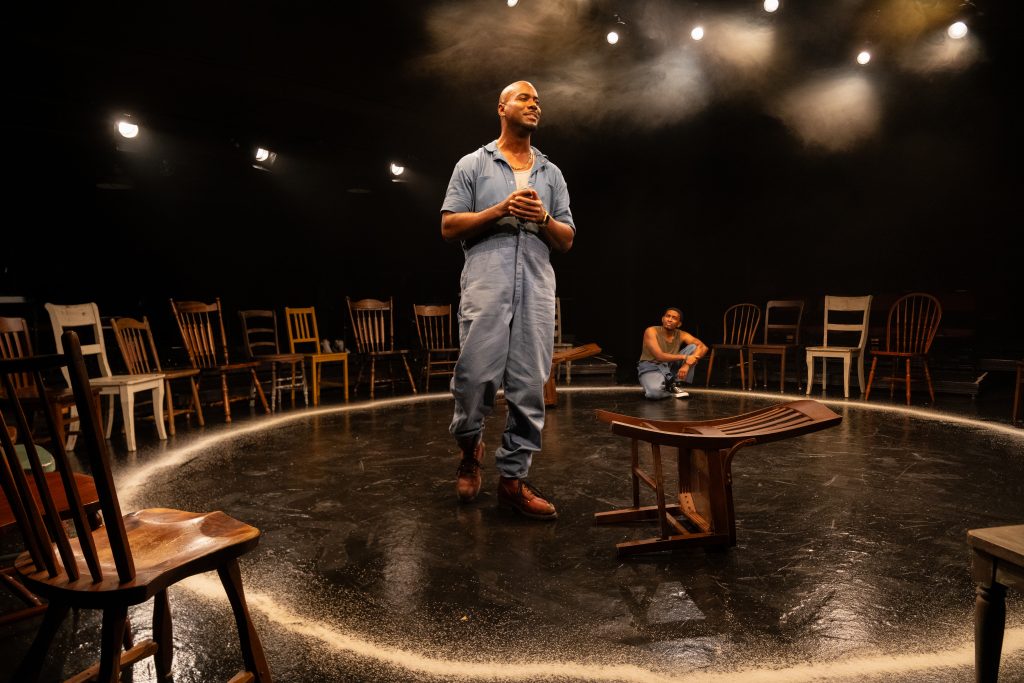
Photo by Jon Gitchoff.

Opening night bristled with electricity, the kind of buzz that marks a big deal event. After this profound, gut-wrenching experience, the audience leapt to their feet as soon as it ended, with an outpouring of love and thunderous applause. It was indeed a moment (well, several).

“The Brothers Size” boldly represents The Rep’s vision and demonstrates their commitment to produce works of daring imagination and transformative symmetry with exceptional casts and crews.

The Repertory Theatre of St. Louis presents “The Brothers Size” from Oct. 22 to Nov. 16 as part of the Steve Woolf Studio Series in the Emerson Studio of the Loretto-Hilton Center, 130 Edgar Road, St. Louis.

The play is 90 minutes without intermission. A post-show discussion follows the performance on Sunday, Nov. 2, at 2 p.m.

To purchase tickets, visit www.repstl.org or call the box office Monday through Friday noon to 5 p.m. at 314-968-4925.
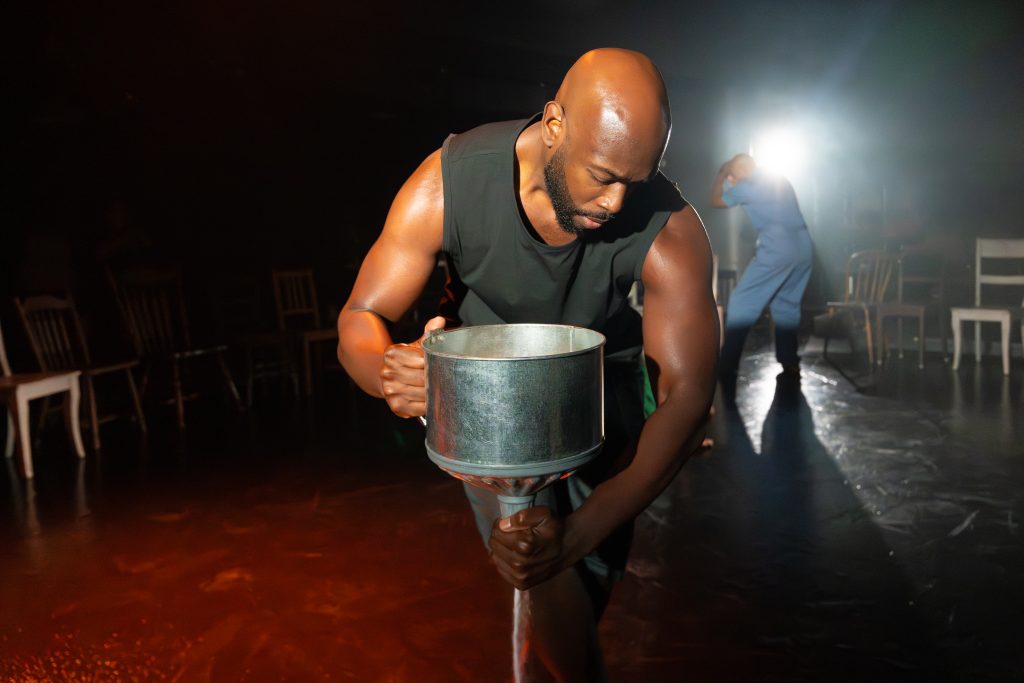

Photo by Jon Gitchoff.

By Lynn Venhaus
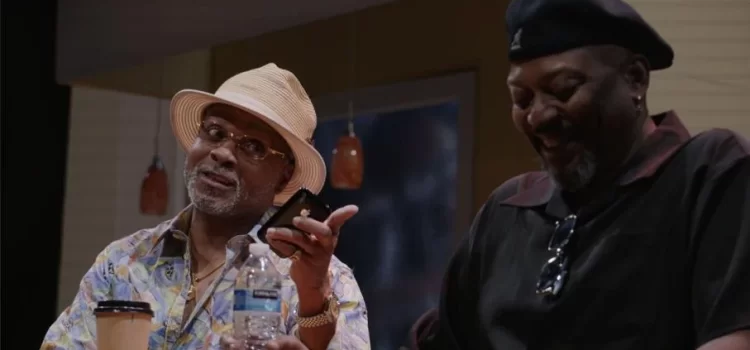
Four retired guys sitting around talking and drinking coffee at a Chicago McDonald’s is intriguing food for thought –a delectable slice-of-life scenario that immediately draws us in to the play “Coconut Cake.”

Playwright Melda Beaty’s flair for dialogue, humor and seamlessly integrating social commentary in her dramedy is irresistible in a compelling and thoughtful presentation in The Black Rep’s intimate A.E. Hotchner Studio Theatre at Washington University.

Because of the caliber of its five-male cast, this character-driven work makes a swift and memorable connection. Their nimble delivery and interactions under the skilled direction of Geovonday Jones enhances their personal relationships as their struggles are revealed over the course of the two-act 2-hour show.

As they explore issues of manhood, racism, mental health and offer advice over games of chess, they show genuine affection — and aggravation — with each other but offer convincing immersive characterizations and realistic camaraderie. It’s set in the summer of 2010.

A fifth character, an unhoused man they call Gotdamnit, interrupts their mornings asking for money and offering his philosophical and spiritual words of wisdom. He’s considered a pest, but there is a surprising backstory and as suspected, more to the guy than his appearance indicates. Lawrence Evans is riveting as a marginalized man.

While the women in their lives are discussed, not seen, vivid portraits of the female characters emerge as they factor into the men’s disparate demeanors. Two characters in particular – a classy, attractive woman that has caught their eye, whom they watch as she walks to work from the Mickey D’s window, and property owner Joe’s mysterious new tenant, Ms. Brulee, who is a baker that makes a divine coconut cake, which happens to be Eddie’s nostalgic childhood favorite.

Richard E. Waits and Joe Hanrahan listen to Duane Foster. Photo by Keshon Campbell

Eddie Lee, a handyman, is the most agitated guy – upset about his wife’s escalating threatening behavior and discloses personal details about his troubled marriage. Everyone knows he has not been faithful, and that complicates matters. Duane Foster is strong as a guy whose life is falling apart but he’s not taking responsibility for the reasons why.

Marty is often the voice of reason, and his faith has kept him grounded. He’s a deacon in his church and devoted to his family, friends and congregation. As Marty, Richard E. Waits is firm, but measured, in the advice he gives, and it’s not always welcome.

The characters show different sides of them as husbands, fathers, sons and friends. Their individual stories mesh well, and the play offers unexpected twists and turns that add poignancy.

Each man has a significant emotional journey, and their textured portrayals give us richer story arcs as they bring up cherished memories and confide secrets.

Marty has brought along his brother-in-law Hank, a white guy who was married to his sister, who died a year ago. As played warmly by Joe Hanrahan, the widowed Hank is lonely and comes along for companionship and something to do. He’s learning chess, and he beams talking about his family, as his daughters and granddaughters try to keep him busy.

The outspoken Joe likes to needle Hank, calling him “Republican,” and increases his pot shots and cruel jabs. Richard Harris is a feisty live wire as the loud, swaggering Joe, a flashy blowhard who brags about his money and conquests. He’s never married but has a couple baby mamas.

Richard Harris is the outspoken Joe. Photo by Keshon Campbell.

As the very opinionated Joe, Harris can change his mood quickly. His accusations get heated and personal, especially if the other guys give him some lip about his boasts. His colorful wardrobe, often referred to as ‘fly’ in urban slang, is an indicator of his perceived status (kudos to costume designer Brandin Vaughn for the stylin’ attire).

Because Joe’s disposition can turn on a dime, his pointed barbs take on a hostile, accusatory tone in the second act, after he endures some setbacks.

All accomplished actors, the five bring nuance and shades of gray to our assumptions and give us deeper insight into these complicated men. They eventually must grapple with the consequences of their choices during their lifetimes.

Scenic designer Tammy Honesty has presented elements of a typical nook at a 2010-era McDonald’s, well-lit by designer Tony Anselmo, that allows Jones to move the action to wherever the guys are sitting.

When Joe struts in, he commands attention by seemingly holding court. Eddie is too restless to sit down most of the time, and Marty and Hank are often hunched over their chess board.

Lawrence Evans as Gotdamnit and Joe Hanrahan as Hank. Photo by Keshon Campbell.

Sound designer Alan Phillips incorporated people chattering at times and assembled an appealing soundtrack of catchy pop hits. Christian Kitchens was an assured technical director, and Mikhail Lynn provided the minimal props.

This isn’t the first time The Black Rep has presented the play, because during the pandemic in September 2020, they made a virtual Zoom reading available from The Ensemble Theatre in Houston, which featured founder Ron Himes as a major character, Eddie Lee.

In 2022, Beaty received the second annual Sylvia Sprinkle-Hamlin Rolling Premiere Award by the International Black Theatre Festival. Because of that, this play is being produced by five theaters, including the Black Rep. It is a welcome return.

With its engaging cast, a captivating funny-sad bittersweet narrative, and noteworthy technical know-how, “Coconut Cake” is a satisfying production to savor.

(At intermission, a coconut cream cheese pound cake is available for purchase too, along with other snacks. Just sayin’, if you get a hankering for a sweet treat.)

Richard Waits and Joe Hanrahan are brothers-in-law playing chess. Photo by Keshon Campbell.

The Black Rep presents “Coconut Cake” Feb. 5 – March 2 in the AE Hotchner Studio Theatre at Washington University. For tickets and more information, visit www.theblackrep.org

The St. Louis Black Rep rounds up its season of virtual programming with a final mainstage production of an original work.  Do I Move You? –  based on a collection of poetry by Dr. Jonathan Smith, Vice President for Diversity and Inclusion Saint Louis University and President of The Black Rep Board of Directors – will stream on Vimeo June 15-30.

Smith’s collection of poetry, music, and dance pulls inspiration from Jazz, religion, love, family, and some of the greatest musicians of our time –  Donny Hathaway, Louis Jordan, and Marvin Gaye. Conceived by Producing Director Ron Himes, using devised theatre, Black Rep Director and Choreographer Heather Beal weaves a web of music, dance, and poetry. Themes of betrayal, identity, discovery, and love flow throughout the performance, culminating to answer one very important question, “Do I Move You?”

Produced at the Edison Theatre on the campus of Washington University in St. Louis, the production features the Black Rep’s Acting Intern Company Kentrell Jamison, Christian Kitchens, Theorri London, Brian McKinley, Tyler White, Jesmelia Williams, and Christina Yancy. Also featured are local Vocalist and Musical Director, Amber Rose, Dancer Samantha Madison, Percussionist Bernard Long Jr, Bass Player Jeffrey Anderson, and Lead Guitarist Dennis Brock. With scenic and projection design by Peter and Margery Spack, lighting design by Sean Savoie, costume design by Ellen Minch, sound engineering by Kareem Deanes, editing by Avatar Studios, and Kasey Dunaski as Stage Manager.

Tickets for Do I Move You? are available at theblackrep.org or by calling our Box Office at 314-534-3807. Streaming free on demand, a suggested donation of $25 will directly help support the theatre company and its artists.