By Lynn Venhaus

 “Extremities” starts with a jump scare – a violent home invasion, and the situation is every bit as horrific as it would seem. In a pulse-pounding few minutes, Marjorie (Claire Coffey) becomes a victim of a sexual assault.

William Mastrosimone’s intense 1980 play grapples with difficult issues surrounding violence against women, the legal system, personal agency, revenge and morality. This is an uncomfortable, tough watch that will spark discussions afterwards.

Although police procedures have changed in the 46 years since the play premiered, and viewpoints too, especially after #MeToo in 2017, its potency is in how ordinary people act and react in extraordinary circumstances.

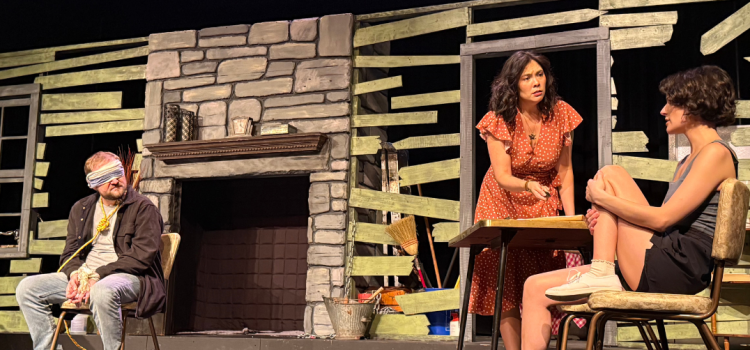
Stray Dog Theatre’s production, which is presented as a period piece, takes place in a remote farmhouse. Scenic designer Rob Lippert has created a fragmented, broken-wood set to be a visual representation of the characters’ emotional lives.
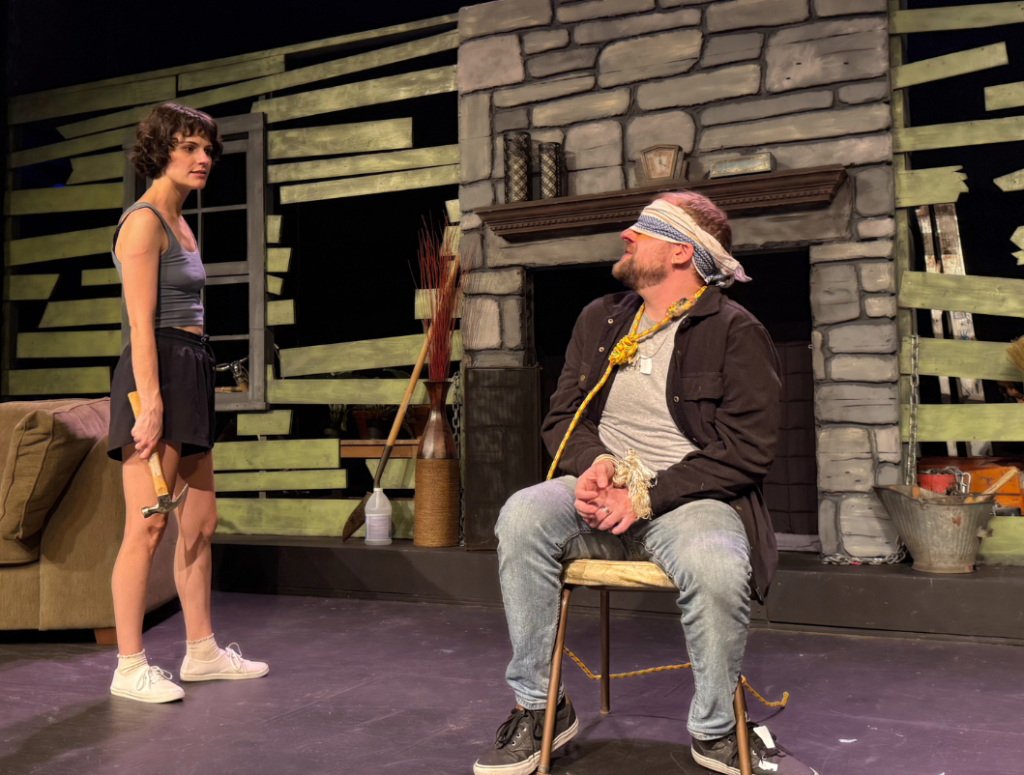
Claire Coffey and Andrew Woodard in “Extremities.” Photo by Stray Dog Theatre.

As director Gary F. Bell described in a program note: “lives that have been slowly fractured and damaged by fear, violence, guilt, anger, and the inability to escape the consequences of what has happened.”

In this show, Bell and assistant director Jude Hagene focus on fear, what ifs, and the revenge fantasies going through Marjorie’s traumatized mind.

In a raw, real and relatable performance, Coffey is convincing as a desperate, terrified woman who turns the tables on her attacker and becomes an avenger. During the past few years, Coffey has often portrayed accomplished, confident women, in everything from “Bell, Book & Candle” and “The Mousetrap” to “A Doll’s House, Part 2” – and here she also demonstrates a fierce physicality.

A strong, independent woman, Marjorie is alarmed when Raul walks into her home, looking for a “Joe.” His stories keep changing, he keeps advancing, his tone is sinister, her announcement that her husband’s asleep upstairs is flimsy, and he attacks her.
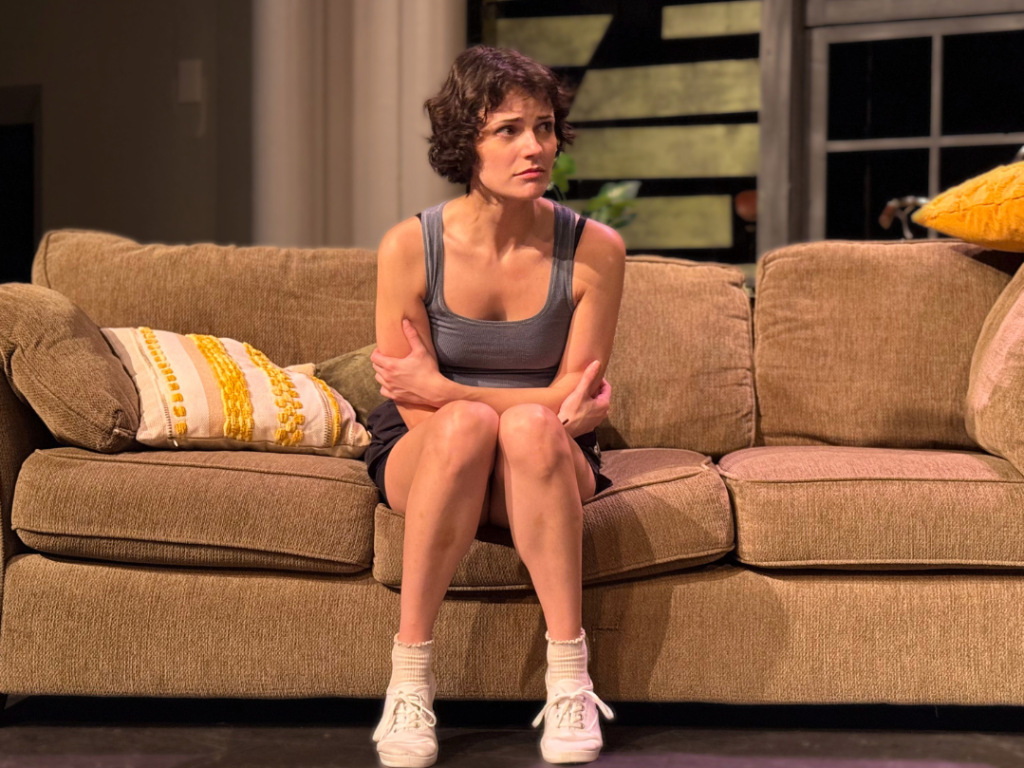
Claire Coffey as Marjorie in “Extremities.” Photo by Stray Dog Theatre.

In a graphic depiction, he pins her down, forces her to say ‘I Love You,’ demands she touch him, follow his orders or he’ll smother her with a pillow, which he has demonstrated several times.

She fights back, grabbing a can of insecticide and sprays his eyes. Forceful, she subdues him by tying him up in the fireplace. But she can’t call the cops because he’s pulled the phone out (in those days, landline only).

Oh, she rages. What would we do? Would we become the judge, jury and executioner?

 In his Stray Dog Theatre debut, Andrew Woodard is chilling as the sleazy attacker Raul. An unreliable narrator, he makes up his narrative, but he appears to be a psychopath who has been stalking her.

A slick criminal used to bending rules his way, Raul aggressively taunts her, saying because he didn’t rape her, lack of evidence means he will probably be let go. He flaunts the burden of proof argument. (Back then, a woman’s sexual history was still admissible in court.)
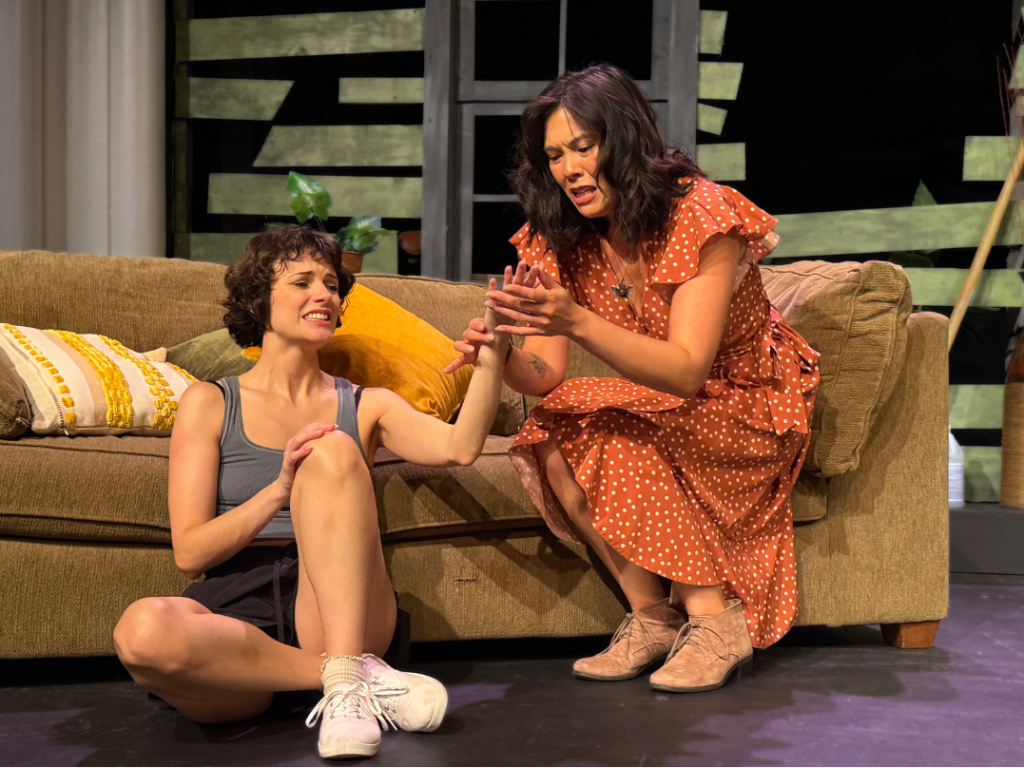
Claire Coffey and Lynett Vallejo in “Extremities.” Photo by Stray Dog Theatre.

She’s terrified of the consequences and that he will return someday. The power struggle continues, her methods blurring lines, and this difficult situation becomes a tug-of-war between justice and revenge.

One of the most important duties here is the intimacy/combat choreographer Lisa Fischel. The attempted rape is very graphic – and disturbing. In the aftermath, fighting and torture includes kicks, ropes, boiling water, and a knife. Strong stuff.

One can only imagine the psychological and physical toll of mounting this production – and the stamina the four actors must summon.

Marjorie’s roommates eventually return from work separately, and each has a different response. They are dragged into an impossible situation, and nerves become frayed. Shaken up are Lisa Hinrichs as Terry and Lynett Vallejo as Patricia.

The three women are challenged like never before in their adult lives – shocked, frightened, hysterical, confused. They worry about justice, safety, and civil liberties.
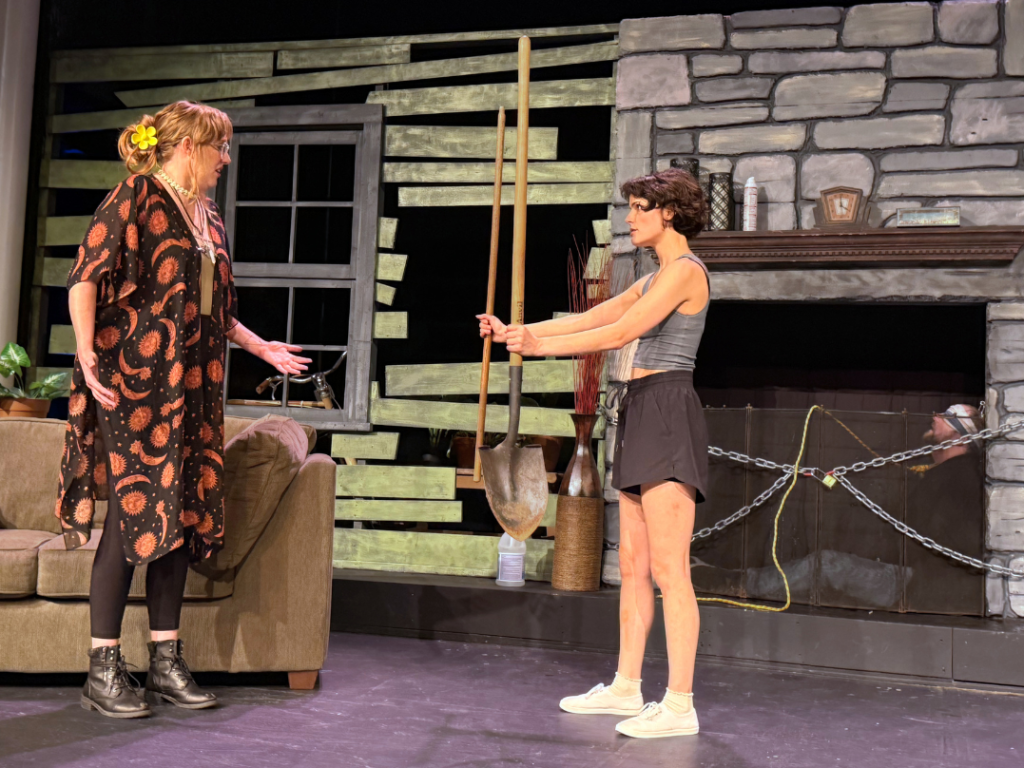
Lisa Hinrichs and Claire Coffey in “Extremities.” Photo by Stray Dog Theatre.

When Raul masterfully manipulates each roommate to gain sympathy, it’s obvious he is gaslighting them, but Terry and Patricia aren’t thinking clearly and take pity on him. He cunningly divides their loyalties.

Kill? Help? Feed? Treat wounds? These possibilities can be debated, as the women argue and insult, and one wonders how credible the playwright’s logic is. Sure, the point is to examine and discuss society’s attitudes and stigmas.

Terry has a secret to share about her own experience, and Patricia, being a social worker, is presented as a ‘liberal’ who respects the law.

Mastrosimone’s backstory includes hearing a rape victim’s story – she identified the rapist but lost in court because of “insufficient evidence.” She wondered if she should have seized her own justice?

Writing from that perspective, one hears and feels his rage. But we don’t have much character development to go on, and what we do know isn’t much. The dynamic is complicated because it’s dated.
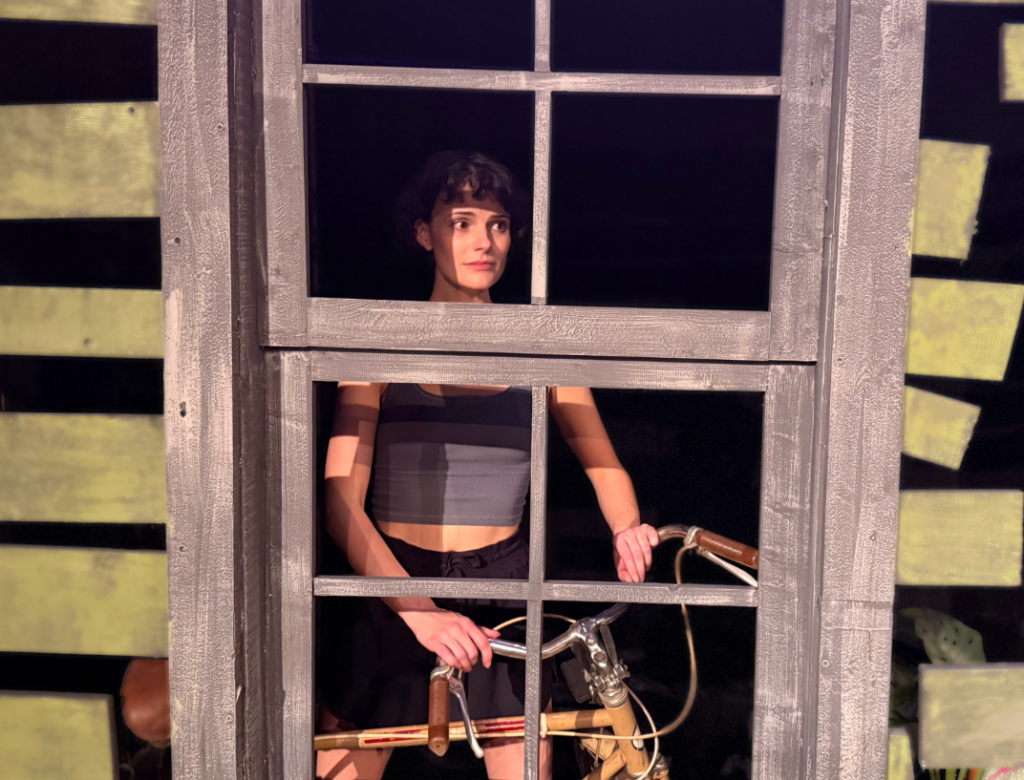
Claire Coffey in “Extremities.” Photo by Stray Dog Theatre.

The play, first performed at Rutgers Theatre Company in July 1980, eventually premiered off Broadway in December 1982, starring Susan Sarandon. A 1986 film adaptation starred Farrah Fawcett. Actor James Russo portrayed Raul both off-Broadway and in the film.

It’s meant to be a jolt, a shock to the system. Yet, there are exasperating moments too — When the roommates criticize Marjorie for wearing clothes inviting attention, that’s when it went off the rails. We’re really going there?

Predatory behavior is unsettling, and if we could only view women’s behavior as courageous — but the playwright has added all these gray areas: the blame game, asking for it, objectification and exposing society’s prejudices to create a murky environment.

That lengthens the play, and it’s disconcerting to put the women through this shame cycle, too. The emotions escalate, but the actresses sensitively handle their roles.

The reality of Raul’s story is never presented, so we don’t know what to believe, but he is tortured, and behaves like a trapped animal, then works the situation to his advantage (or so he thinks). That’s believable, but his transformation toward the end is questionable. Sure, he has lost his dominance once he plays the victim card. But should we view him as pathetic?
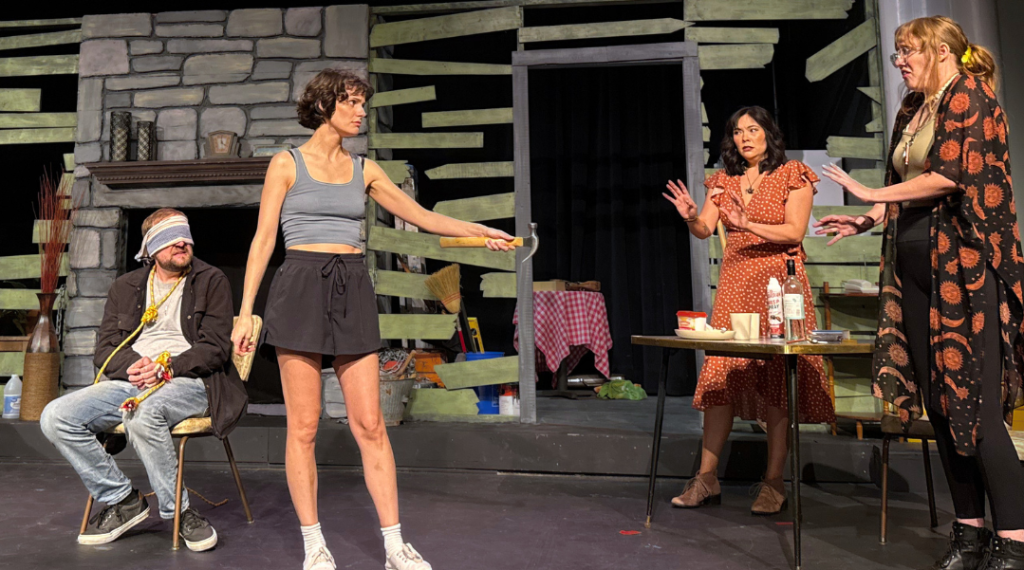
Andrew Woodard, Claire Coffey, Lynett Vallejo and Lisa Hinrichs. Photo by Stray Dog Theatre

Technical work – lighting design by Tyler Duenow and sound design by Justin Been – adds to the harrowing atmosphere.

This powerful show is for adults only and is unflinching in its difficult storytelling. Triggers may occur with victims of trauma, so that is something to be mindful of – and something not to be taken lightly.

A note on the program states: “This production contains mature themes and intense subject matter, including an attempted sexual assault, physical violence, strong language, restraint, and psychological trauma. The production features emotionally charged scenes that may be distressing for some audience members, viewer discretion is advised.

Stray Dog Theatre’s production of “Extremities” is being presented Aug. 6 to Aug. 22, with performances Thursday, Friday and Saturday at 8 p.m., and special matinees on Sundays, Aug. 9 and 16 at 2 p.m. All performances take place at the Tower Grove Abbey, 2336 Tennessee Avenue, St. Louis. The show is in two acts with a 10-minute intermission and is for mature audiences. For tickets or more information, visit www.straydogtheatre.org.
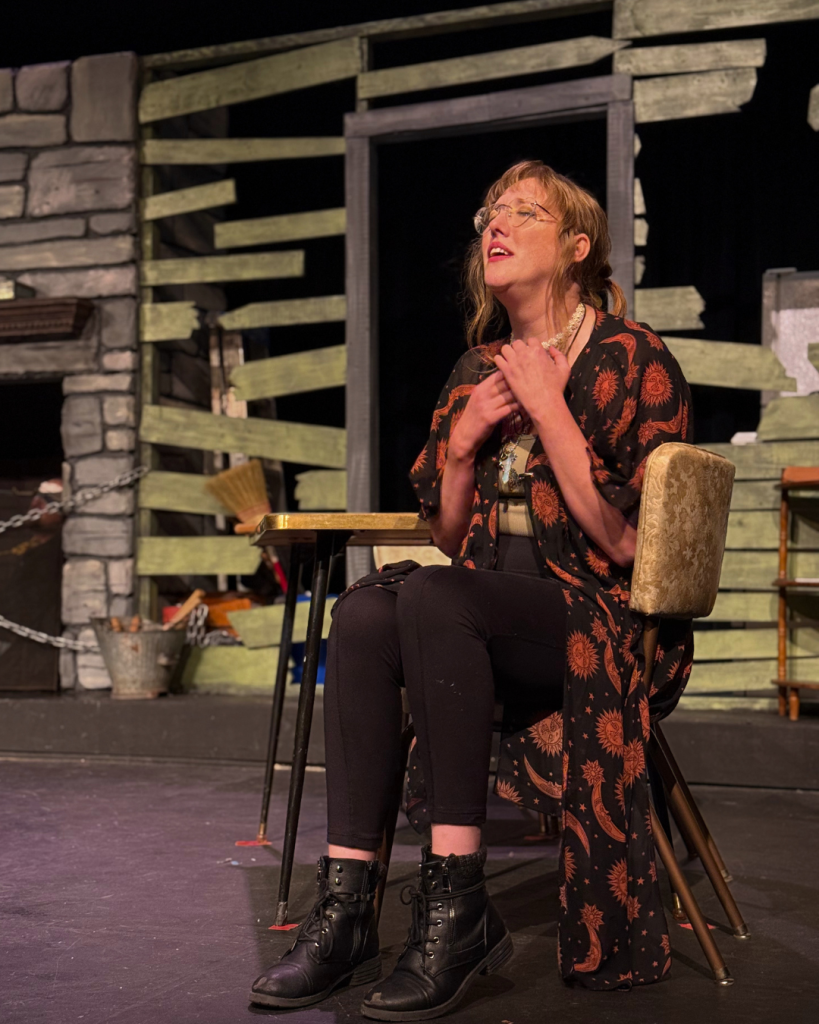

Lisa Hinrichs as Terry. Photo by Stray Dog Theatre.

By Lynn Venhaus
Noteworthy for different perspectives and original approaches, a mostly female-forward selection of one-act plays are the highlights of this year’s LaBute New Theater Festival.

Another interesting development is a noticeable female and non-binary presenting team on stage and behind the scenes crew that offer crisp performances and assured contributions. And that’s no dig to the men’s expertise. It’s refreshing to see uncommon fresh voices involved.

The festival, now in its 11th year, and established in 2013, is a unique collaboration between St. Louis Actors’ Studio and Neil LaBute, the renowned playwright, screenwriter, and director of theater and film.

This innovative endeavor introduces and supports new work from across the country. LaBute not only lends his name, but he is part of a 10-member panel that selects the plays from hundreds of submissions, often emerging professional playwrights, and from a vast swath of locations.

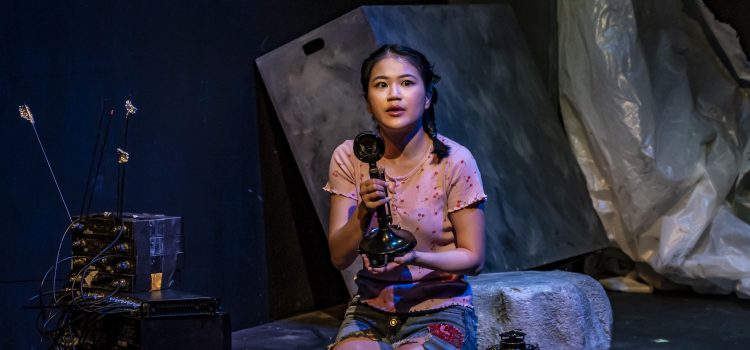
This year’s most outstanding work is a gripping sci-fi horror thriller in the vein of the best “Twilight Zone” anthologies called “TEOTWAWKI.”

More than an acronym used by R.E.M. in a song about “The End of the World as We Know It (And I Feel Fine),” this panicky doomsday piece written by two-time finalist Aleks Merilo of Palo Alto, Calif., has taut, carefully crafted layers that have a palpable urgency.

 Deftly directed by Bryn McLaughlin, she effectively builds suspense in a haunting and satisfying way. Sarah Wilkinson is pitch perfect as the spunky, scared, sweet young woman trying to find someone still alive. Every day, she talks on a ham radio, desperately trying to locate fellow survivors.

The likable Wilkinson, a St. Louis Theater Circle Award winner who continues to show her versatility on stage – in primarily musicals and comedies, now adds chilling drama to her growing list of credits.

This terrifying snapshot of a catastrophic event that has led to the collapse of modern society lingers, and Wilkinson is a standout in the introductory piece, and in two others.

Four of the one-acts that follow are uniformly solid, a potent mix of edgy whip-smart farce, audacious parody of corporate greed, cynical tone-deaf privilege on display during daily commutes to work, and a modern poignant reflection on human chemistry and connection.

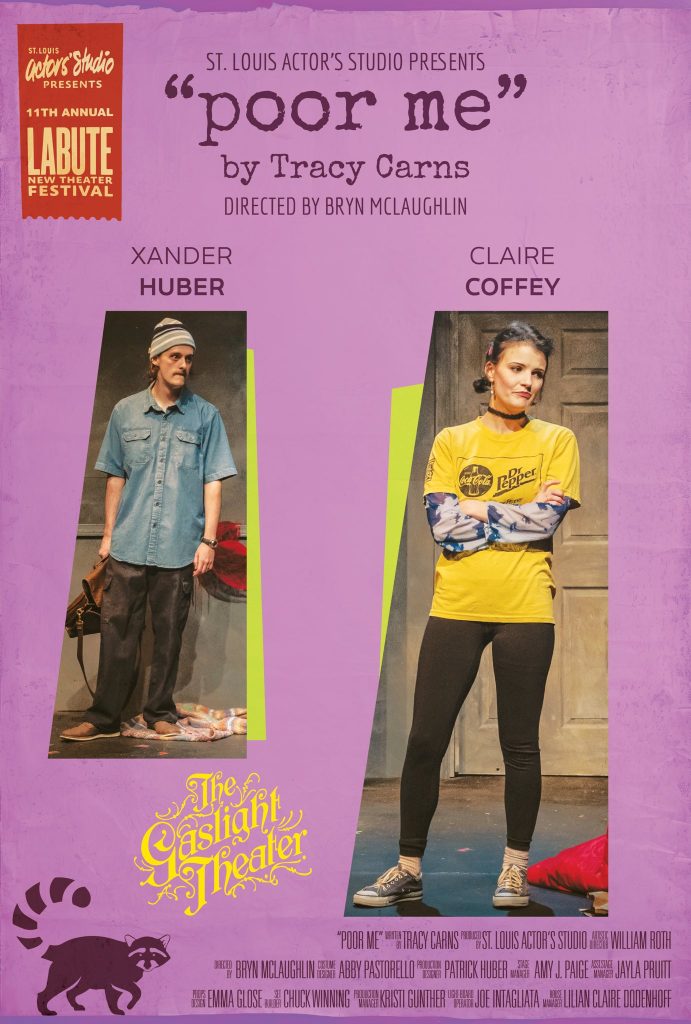
The one that didn’t quite land in the way it was intended was a rather whiny two-hander, “Poor Me,” by Tracy Carns of New York, who pitted former roommates and supposed friends in the awkward position of one having to tell the other to vacate a residence.

Despite savvy performances from Claire Coffey as defiant Cleo and affable Xander Huber as a nervous, reluctant Tad, the play focuses on a self-absorbed laid-off marketer who is squatting in an apartment building owned by Tad’s father.

She used to live there with Tad and his girlfriend, her friend, but now they are expecting a baby and have since moved away. Cleo’s still there, despite nudges and pleadings, the apartment building is going to be renovated, and they need her to find another place.

She is adamant about staying. Refusing the ultimatum, it’s a frustrating standoff where you have little sympathy for either party, even with Huber’s hangdog expression, especially after revelation of some ugly truths. However, the ending, which appears tacked on, is a head-scratcher.

Coffey, effortlessly poised, excels in three other works – “Hungry Women,” “Carpool” and “Scenes from a Bookstore,” as do the other shrewd performers.

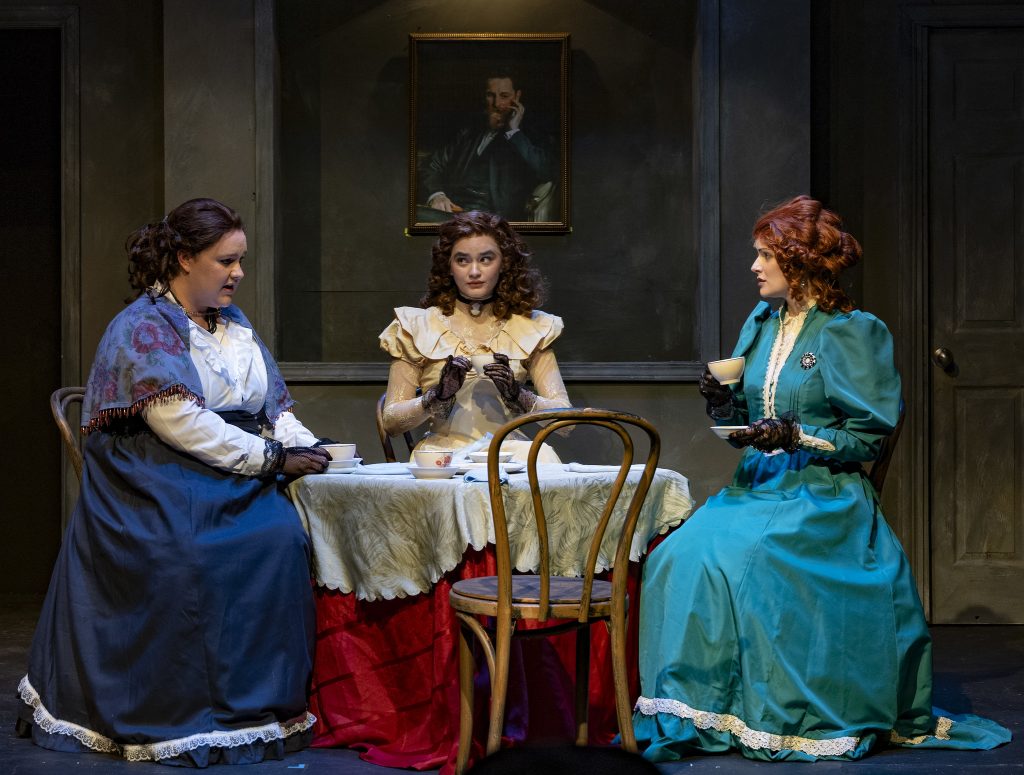
Reagan Posey-Mank, MacLean Banner and Claire Coffey in “Hungry Women.” Photo by Patrick Huber

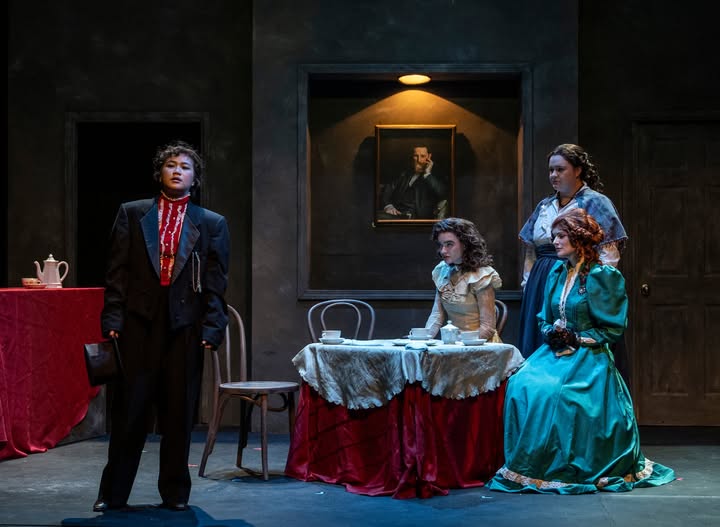
A cross between “The Gilded Age” and “Yellowjackets,” “Hungry Women” is an unusual satirical look at widows contending with being on their own and going through a famine. Four women, all in well-to-do finery, meet for lunch, and reveal the horrors that have upended their lives.

While explanations aren’t that much a part of Melissa Maney’s witty flip of gender expectations and feminism enlightenment, the quartet of amenable actresses are primed to be brave and fervent.

Maney, of Hillsborough, N.J., gives the actresses meaty roles to have fun with, and Wilkinson again confidently shines in the part of Vic, requiring moxie and swagger — big determined energy.

MacLean Banner and Reagan Posey-Mank are newcomers to the Gaslight Theatre, and as Mary and Eden, project congeniality with Wilkinson and Coffey as Ruth (also newbies) in their dressy layers and coiffed hairstyles. Special mention to costume and wig designer Abby Pastorello for the period pieces.

Sarah Wilkinson as Vic with Blanner, Posey-Mank and Coffey. Photo by Patrick Huber.

The mannered housewives have fun feigning shock at some morally outrageous developments and make their transformations believable.

Director Avery Harrison leaned into the pearl-clutching humor, and the performers boldly followed suit.

Banner, a formidable presence as Disney princesses in big splashy musicals and an insightful director of youth group summer productions, flexes different instruments in her toolbox in three of the one-acts.

Taylor Crandall and MacLean Blanner in “Scenes from a Bookstore.” Photo by Patrick Huber.

She is most impressive as a young wife and mother in Neil LaBute’s “Scenes from a Bookstore.” She and Tyler Crandall have convincing chemistry as two people who may share a history and unexpectedly reconnect in a Hudson Valley bookstore.

LaBute has slyly built a ‘will they or won’t they’ dynamic as the two keep running into each other, some obviously planned encounters. She has taken a part-time job there as the play unfolds.

The charismatic Crandall and naturally appealing Banner offer nuanced portraits of these two, coyly named “Him” and “Her.” Coffey, who easily fits into an elegant female role, plays ‘the’ wife, “She,” who drops into the business. Think of it as a relationship lens in the manner of Ingmar Bergman’s intimate “Scenes from a Marriage,” with much implied and less spoken aloud.

McLaughlin directed this layered work without ever tipping the scales. It may be a conversation-sparker afterwards, as it’s the last piece in this thought-provoking line-up. LaBute contributes a one-act every year.

The play also has precise technical cues too, and production manager Kristi Gunther, set and lighting designer Patrick Huber, and props designer Emma Glose seamlessly communicated the times and dates as the story progressed.

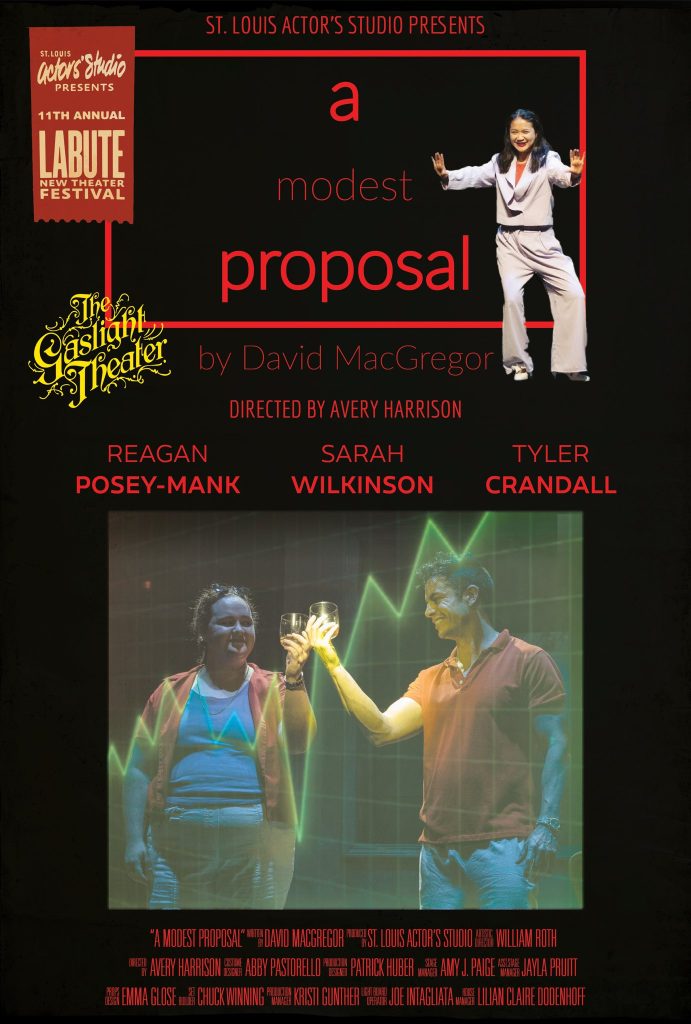
A laugh-out-loud audacious work is “A Modest Proposal” by David MacGregor of Howell, Mich. Smoothly helmed by Harrison in a nondescript office, MacGregor humorously ratchets up the out-of-control disparity between the haves and the have-nots.

A feisty self-assured consultant, played with relish by Wilkinson, proposes something so absurd as a solution to their bottom-line profitability that the egomaniac bosses, Crandall as an arrogant CEO and Posey-Mank as a condescending CFO, are seriously considering it.

Under Harrison’s distinctive direction, Wilkinson is smooth and silky as the persuasive salesman whose far-fetched plan is guaranteed to push buttons.

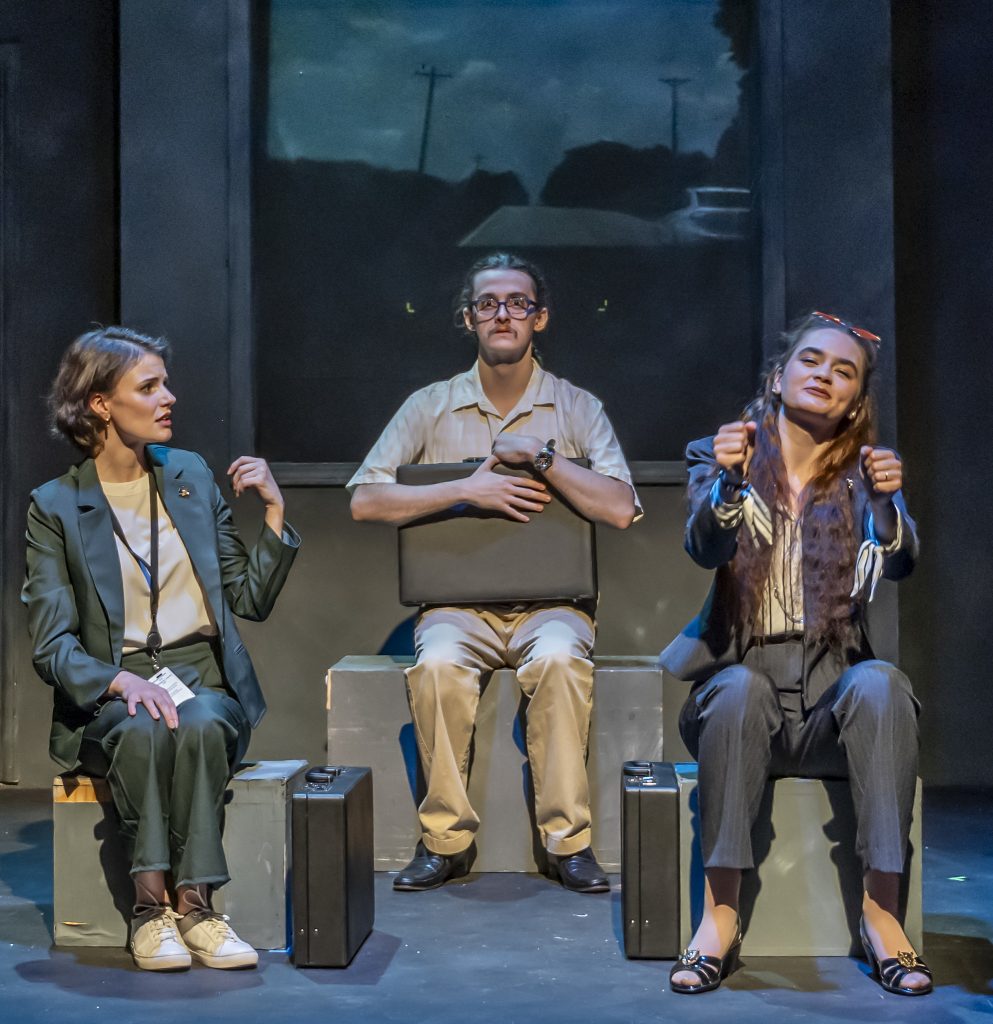
Claire Coffey, Xander Huber and MacLean Banner in “Carpool.” Photo by Patrick Huber.

Dave Carley’s script for “Carpool” is subtle, taking a familiar routine and enlivening it with co-worker interactions. Banner is the driver, known as A, Coffey is riding shotgun, known as B, and Huber is a mostly silent uncomfortable intern whose expressions speak volumes.

Then, Carley, from Ontario, Canada, adds some quirky twists, and director Harrison shapes it to be an amusing, off-beat piece.

A benchmark of this year’s festival is the quality of the performers and the writing, and these artists adroitly worked together.

Stage manager Amy J. Paige and her assistant Jayla Pruitt efficiently move things along, and the team pitches in for quick, minimal set changes, usually with splendid needle drops.

In the always intriguing festival’s annual execution, the contemporary pieces are stimulating, with authentic characters created by writers who have something to say, engagingly acted and modestly presented in The Gaslight Theatre’s intimate black box. This year’s offerings demand attention.

St. Louis Actors’ Studio presents the 11th annual LaBute New Theater Festival July 11 to 27, with performances at 8 p.m. Thursday through Saturday and at 3 p.m. on Sundays at The Gaslight Theater on North Boyle in the Central West End. General admission tickets are available via Ticketmaster or at the theater box office one hour before show time. For more information, visit www.stlas.org.

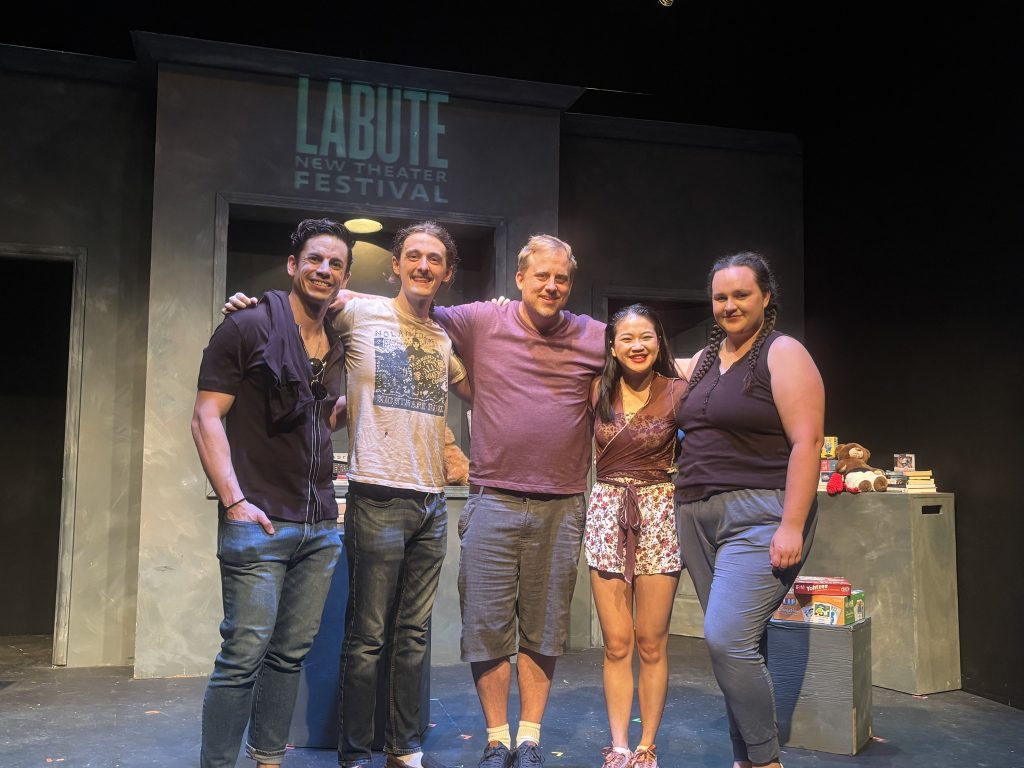
Tyler Crandall, Xander Huber, Sarah Wilkinson and Reagan Posey-Mank pose with playwright Aleks Merilo (center) at LaBute Festival. Photo by Patrick Huber.

By Lynn Venhaus

A sweet and tender-hearted foray into found families, “The Curious Savage” is brought to vivid life with warmth by an eclectic cast of 11 characters.

Reminiscent at times of the screwball antics of “You Can’t Take It with You,” this 1950 amiable comedy by playwright John Patrick kicks off Stray Dog Theatre’s season with a heartwarming effort.

Set in a live-in psychiatric center called The Cloisters, Ethel Savage has been placed there by her three awful stepchildren. Greedy, self-centered and rude, the trio are cartoonish villains played in over-the-top characterizations by seasoned pros Matt Anderson, Sarajane Clark and Joseph Garner, who have great fun being despicable.

Anderson is a condescending senator, Clark is a vain actress who has been married six times, and Garner is a haughty judge. All display degrees of entitlement and indignation, for they think their father’s second wife is mentally unstable. She inherited $10 million and wants to give it to people who want to pursue their dreams.

The bratty kids want the money for themselves, therefore, wreak havoc at the sanitarium by badgering her, bullying the staff and disrupting the fragile ecosystem among the patients.

Tyson Cole, Liz Mischel, Gansner and Lindsey Grojean. Photo by John Lamb.

In an amusing performance, Liz Mischel excels as a crazy-like-a-fox senior citizen, whose compassion and kindness is in stark contrast to her stepchildren’s demanding threats.

Ethel quickly ingratiates herself with the staff and the residents, and bonds form with the damaged/broken people whose mental trauma resulted in a sanitarium stay.

Director Gary F. Bell deftly directed this piece to bring out The Cloisters’ characters’ goodness and dignity, and the staff’s humanity. While what they say is often funny, they are not punchlines to any cruel jokes and are treated as individuals. The well-cast performers are convincing in portraying their characters’ issues, and they all gel as a satisfying ensemble.

Lindsey Grojean is delightful as the childlike Fairy May, who is unfiltered and funny, while Anne Vega is a caring mother, Florence, whose loss of her infant son caused a breakdown. She believes John Thomas is still alive.

Camille Fensterman is tormented Mrs. Paddy who professes to “hate everything” and delivers laundry lists of things she dislikes, but she doesn’t speak other than those litanies, only painting seascapes in a corner.

Tyler Cole plays a skittish World War II veteran Jeffrey, who was a pilot who survived a crash while all his men perished. He’s convinced he has a horrible facial scar and holds his hand to his face hiding it.

Gansner is helpful statistician Hannibal, who lost his job to an electronic calculator. He plays the violin, badly. The characters have personal quirks, such as Miss Paddy who gave up electricity for Lent, and is turning off the lights at inopportune times.

David Wassilak is Dr. Emmett, the matter-of-fact and fair doctor-administrator, while Claire Coffey is pleasant Miss Willie, who helps with patients. She also shares a secret.

Over the course of three acts, we are charmed by this smart, intuitive ensemble, portraying lovable characters with a great deal of heart, and the bad guys who are at their grumpiest and at times, histrionic. The joke is often on them.

Lz Mischel, David Wassilak, Anne Vega, Joseph Garner, Matt Anderson and Sarajane Clark. Photo by John Lamb.

The playwright has become a favorite of community and school theaters, and the most famous of his works is “The Teahouse of the August Moon,” which won a Pulitzer Prize for drama and a Tony Award for best play in 1954.

The only drawback to presenting a 75-year-old play is its outdated views on mental illness and mental health but does make strong points about the insanity on the outside that wields ugly power in society.

Think of it as a period piece, like the classic “Harvey” and other old chestnuts. Costumer Colleen Michelson has gathered frocks and casual attire from the 50s era, while dressing Lily Bell in scarlet dresses. As Ethel, Liz wears a dandy gaudy hat.

As is customary, Bell, as scenic designer, created a cozy interior on stage, while lighting designer Tyler Duenow and sound designer Justin Been enhanced the atmosphere.

A thoughtful and enjoyable approach to a heart-warming comedy, “The Curious Savage” is a comical kiss to kindness elevated by captivating performances.

Camille Fensterman, Lindsey Grojean, David Wassilak. Photo by John Lamb

Stray Dog Theatre presents “The Curious Savage” Thursdays through Saturdays at 8 p.m., Feb. 6-Feb. 22, with additional performances at 2 p.m. Sunday, Feb. 16, at Tower Grove Abbey, 2336 Tennessee Avenue, St. Louis. There are two 10-minute intermissions. For more information: www.straydogtheatre.org.

By Lynn Venhaus
A classic murder mystery always seems like a wise wintertime choice, and inside Tower Grove Abbey, a pair of novice innkeepers welcomes six strangers to their cozy Monkswell Manor guesthouse. Let the secrets unfold and the ear-piercing screams commence, for Agatha Christie’s “The Mousetrap” is an absorbing time-tested whodunit that Stray Dog Theatre aims to polish until it’s gleaming.

As well it should. This well-cast and well-acted ensemble honors the Grand Dame of suspense’s longest-running play in the world by injecting some spry bits of humor, corralling the momentum of this cleverly constructed drama.  

In the remote English countryside, a snowstorm is raging while a young married couple, Mollie and Giles Ralston (Claire Coffey and Sean Seifert), nervously prepare for their first visitors, who are an eclectic and mostly eccentric group, with a few hiding sordid pasts that eventually will be revealed.

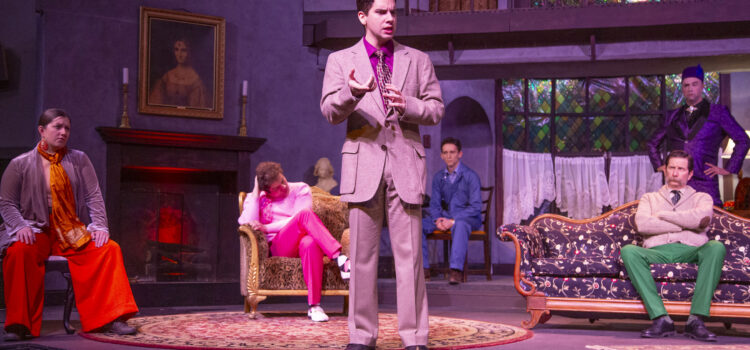
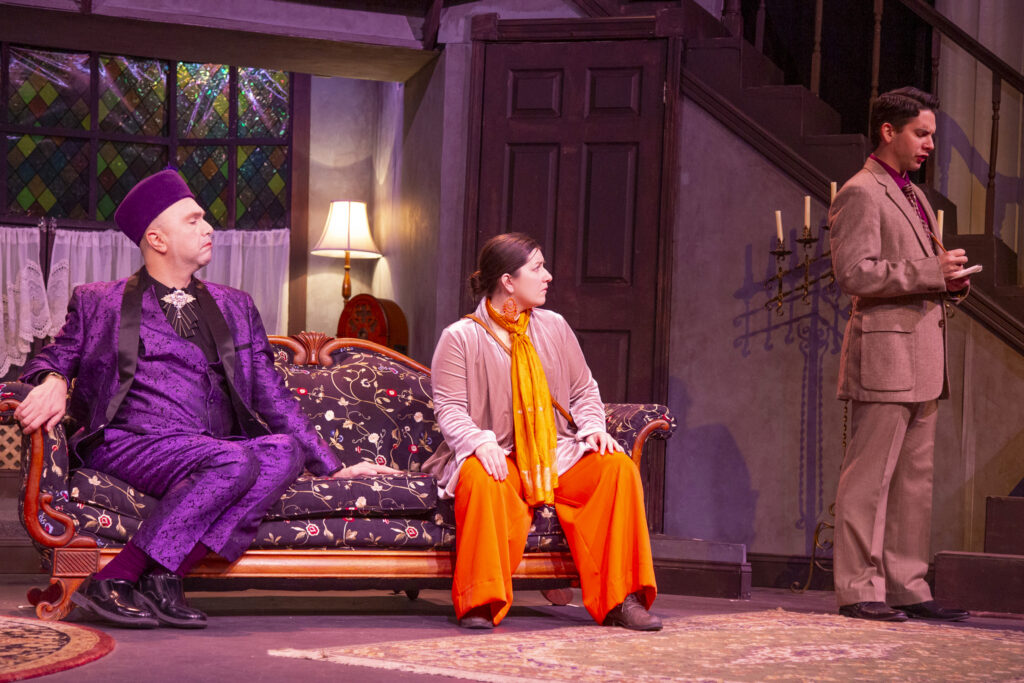
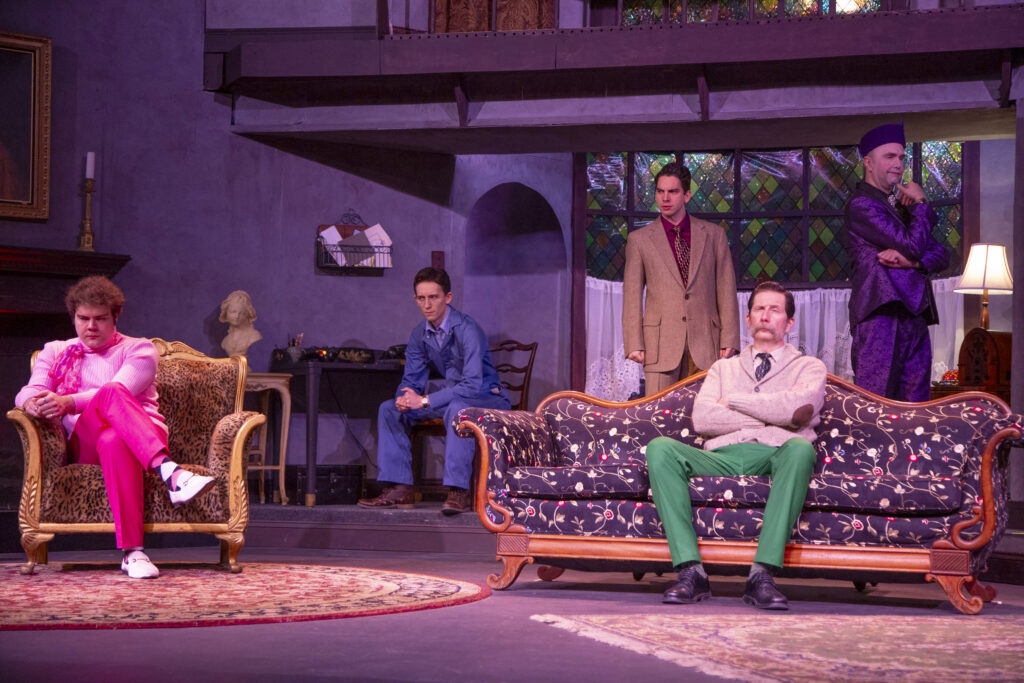
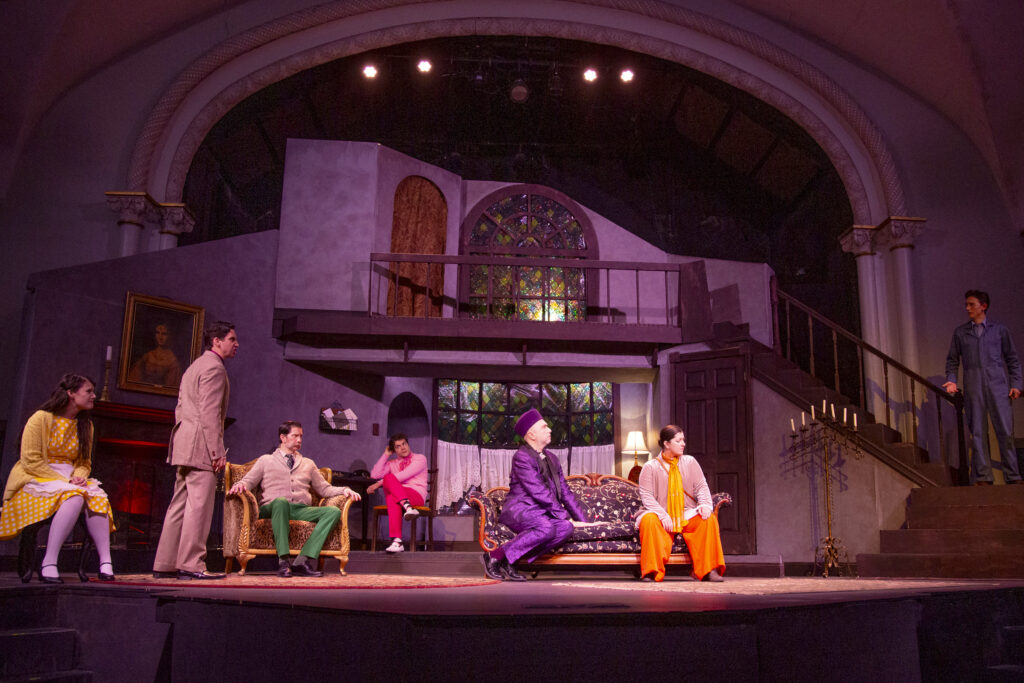
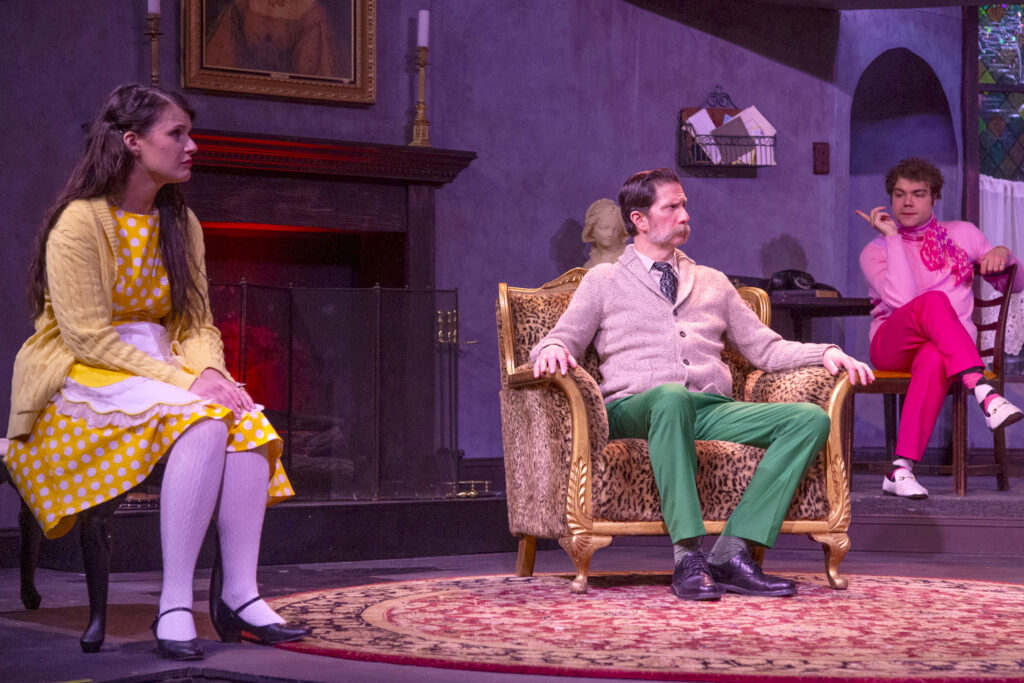
The colorful cast includes neurotic Christopher Wren (Jayson Heil), snooty Mrs. Boyle (Julie Healey), steadfast Major Metcalf (David Wassilak), reserved Miss Casewell (Shannon Campbell), and flamboyant Mr. Paravicini (Matt Anderson), who make grand entrances not unlike Halloween trick-or-treaters in their neon-colored outfits.

Matt Anderson, Shannon Campbell, Drew Mizell. Photo by John Lamb

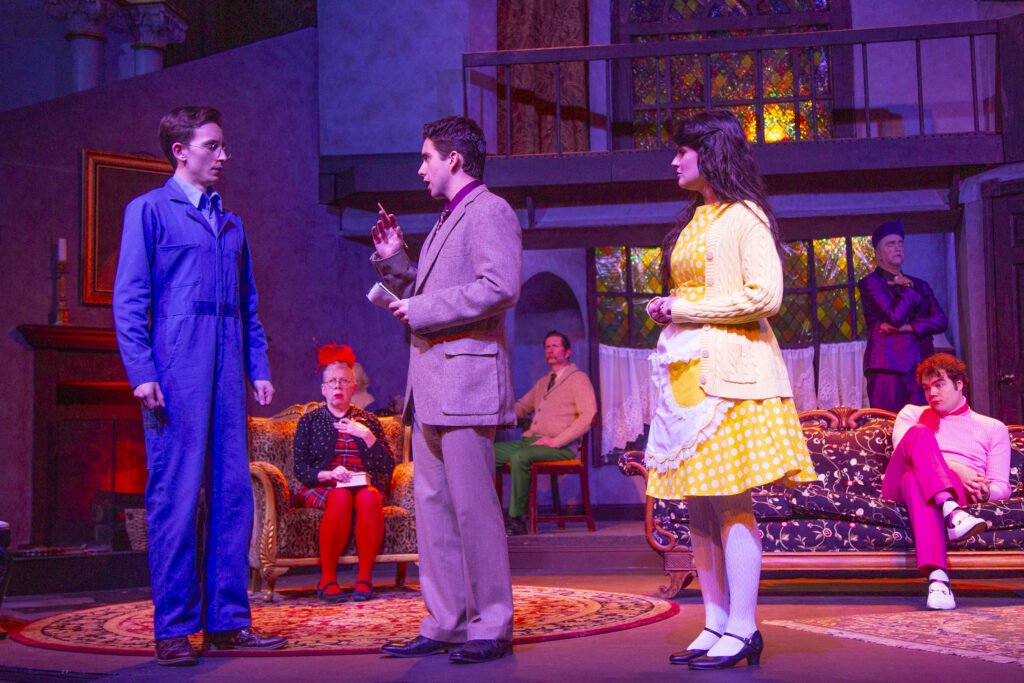
It just so happens that news of a murder in London has spread, and with a killer on the loose – the prime suspect was wearing a dark overcoat (!), nerves start to fray. A determined police detective, Sergeant Trotter (Drew Mizell), unexpectedly shows up to interview the guests, and his interrogations are making everyone nervous.

Could there be a murderer in their midst? It doesn’t matter if you’ve seen this play before or it’s your first time, the intricate plot twists keep one invested.

Director Gary F Bell has astutely focused on the different characters while nimbly moving them around, so the action never dulls. As attention and suspicions shift, the actors crisply deliver their lines with admirable well-rehearsed accents (not all sounding the same either).

The performers memorably personalized their roles, so they each stood out. Heil is a bright spot as chatty Christopher Wren, all nervous energy and exuberance, while Healy purposely annoys as overcritical Mrs. Boyle, who finds fault with their hosts’ inexperience and complains constantly.

Wassilak and Campbell are solid as affable Major Metcalf, a retired Army officer, and stand-offish Miss Casewell, while Anderson is intentionally hammy as the peculiar Mr. Paravicini, exaggerating a strong Italian accent and having fun taunting by repeating “Three Blind Mice,” an ominous earworm.

Jayson Heil, Sean Seifert, Drew Mizell, David Wassilak, Matt Anderson. Photo by John Lamb

When Trotter enters the room, sniping begins as everyone becomes a suspect, and even the congenial Mollie is caught off-guard by her husband’s jealous behavior. Coffey and ever- reliable Seifert maintain an off-kilter rhythm, skillfully conveying their unease as things go bump in the night.

Mizell is tough as Trotter, his steely resolve evident as he probes the case, asking uncomfortable questions and keeping everyone on edge.

As misery escalates, cracks uncover backstories and highlight current actions, so that the crimes will be solved in what’s considered a brilliant surprise ending.

The program says the time is 1955 in Berkshire, 30 minutes outside of London, but the costumes don’t reflect the period. Instead, they feature a puzzling color scheme comparable to the comic mystery players in “Clue.” Wren could be Mr. Hot Pink and Paravicini as Signore Electric Grape.

It’s a perplexing bold statement costume design by Colleen Michelson. A few outfits are odd choices – Miss Casewell had extra-large wide-leg bright orange palazzo pants that distracted from the action (I was worried she’d be tripped up on the staircase), and Mollie had an unflattering yellow apron to match her too-spring-y yellow dress that looked like a pair of granny panties were attached instead of frilly pockets. .

Splendid technical elements added to the unsettling mood, with Justin Been’s impeccable sound design, complete with Bernard Herrmann-like music, and Tyler Duenow’s lighting design made the striking Great Hall set claustrophobic. Designed by Richard Brown and Dominic Emery, the stained-glass window and staircase were terrific additions to the old-fashioned lounge.

A foundation for many other mysteries, “The Mousetrap” premiered on Oct. 6, 1952, and after a brief tour, opened in London’s West End at the Ambassadors Theatre on Nov. 25, where it ran until March 23, 1974, when it transferred to the larger St. Martin’s Theatre, which was next door, and continues to this day. But on March 16, 2020, it was forced to shut down for 14 months because of the global coronavirus pandemic and resumed on May 17, 2021.

Christie based the now iconic play, originally written for radio as “Three Blind Mice” in 1947 and a short story, on the Dennis O’Neill case of foster child abuse — just like the kidnapping in “Murder on the Orient Express” (1934) resembled the Lindbergh baby case, for a reality-based starting off point.

This satisfying production is a fine example of how a 70-something air-tight structured detective fiction can be spruced up and entertain both longtime mystery fans and curious newcomers.

Claire Coffey, Drew Mizell, David Wassilak, Jayson Heil, Matt Anderson, Shannon Campbell and Sean Seifert. Photo by John Lamb

Stray Dog Theatre presents “The Mousetrap” Feb. 1 through Feb. 17 at the Tower Grove Abbey, with performances Thursday through Saturday at 8 p.m. with a special Sunday matinee at 2 p.m. on Feb. 11 at the Tower Grove Abbey, 2336 Tennessee Avenue, St Louis 63104. Gated parking is available. For additional information and ticket reservations, call 314-865-1995 or visit www.straydogtheatre.org. Tickets for adults are $35, with seniors age 65+ and students $30.

ASL Interpretation: The 2/2, 2/9, and 2/16 performances will be presented with ASL interpretation by students from Southwestern Illinois College. ASL interpreted performances are suitable for audience members who are Deaf, deafened, or have hearing loss. They can also be valuable for people who are learning ASL.

Hanging at Monkswell Manor. Photo by John Lamb