
By Alex McPherson

Representing less a defiant step forward into a new era of the DC Cinematic Universe than a retread of the by-the-books superhero fare of the past decade, director Craig Gillespie’s “Supergirl” flies along well enough but shoots out of memory soon afterwards.

We first meet Kara Zor-El a.k.a. Supergirl (Milly Alcock) as she boozily zips from planet to wacky planet in celebration of her 23rd birthday. With the lovably destructive CGI dog Krypto in tow, Kara has a laissez-faire attitude toward life, clearly preferring to party than confront the trauma of her tragic backstory. She also avoids Earth at all costs — much to the frustration of Superman (David Corenswet), who’s increasingly worried she won’t ever “find her people.” 

Things take a turn for the explosive when Kara encounters Ruthye (Eve Ridley), a young woman seeking revenge after her family was murdered by Brigand leader Krem of the Yellow Hills (Matthias Schoenaerts). Kara saves Rutheye from a squelchy brute straight out of the “Star Wars” Mos Eisley Cantina, but refuses to help her track down the bloodthirsty trafficker.

Krem has other plans, though, when he hijacks Kara’s ship and shoots poor Krypto with a poisonous dart that gives the pup only three days to live. This motivates Kara to track him down to retrieve the antidote, and reluctantly take on Ruthye as her novice (but underestimated) sidekick. 

Kara is greeted by Superman when she comes to Earth with her puppy Krypto.

As the pair rush to track down Krem, they develop a friendship (wow!), each teaching the other about the power of community and reckoning with grief. They deal with bouts of punchtastic action and formulaic villainy along the way. Plus, an unhinged, motorcycle-riding Jason Momoa appears as the intergalactic bounty hunter Lobo!

If one expects  “Supergirl” to break the mold of what’s come before, get ready for disappointment. Gillespie’s film starts out strongly enough, decidedly wackier and more committed to showing a colorful galaxy than other recent outings, as well as establishing Alcock as a perfect fit for the role of Kara. 

Alcock’s dry comedic timing is spot-on, with Ana Nogueira’s screenplay leaning into her cynicism and dry wit in a way that never becomes tiresome, building a character far less “polished” than Corenswet’s Superman, and one that’s all the more enjoyable to watch for it. 

Sadly, before long, the film slides back into the template we’ve seen time and time again, awkwardly sandwiching humor between “sobering” backstory that’s clunkily assembled and largely bereft of earned poignancy.

Milly Alcock and Eve Ridley.

Gillespie ultimately trades the energetic personality of the opening for something far drearier and, crucially, blander, as the PG-13, green-screened violence kicks into high gear and we realize that, no, none of the heroes are truly in danger amid the swirl of crowd-pleasing clichés. 

Kara and Ruthye’s bond is believable, to an extent. Kara’s bond with Ruthye and seeing her hunger for revenge leads her to reflect on her own  past, gradually understanding herself and her deep-seated anger at the world as she eventually transforms into the “Supergirl” that she’s destined to become.

This is a passable arc — it’s just that Gillespie’s storytelling lets Kara down, awkwardly jumping into flashbacks that are rushed through without letting us sit and feel the sadness and disorientation that Kara experiences. Gillespie and Nogueira opt for a barebones outline instead of fleshing out her past in more detail, perhaps assuming that viewers already get the gist from the comics.

Jason Momoa as Lobo.

Fortunately, “Supergirl” moves along at a brisk enough clip. We’ve got the monstrous, albeit extremely one-note baddie Krem, the goofily out-there Lobo (Momoa understands the assignment), and plenty of quip-filled set-pieces complete with peppy needle drops. 

It’s just that, with such an excellent actor as Alcock in the starring role, doesn’t she deserve something more substantial to work with from a narrative standpoint? She’s even let down from an action perspective.

Matthew Schoenaerts as Krem.

Rob Hardy’s cinematography is often eye-catching and keeps the fighting coherent, but these sequences are unwilling to fully let Kara off the chain, too often kneecapping her powers just when she starts using them. They fall into a frustrating stop-start pattern that persists all the way through the final battle.

“Supergirl” is still an entertaining enough watch despite its numerous issues — the template is functional, after all, although the pointed social commentary of James Gunn’s “Superman” is definitely missed here.

There’s nothing offensively off-putting about Kara’s debut. It’s just an affirmation that, at their core, these films might never truly change.

“Supergirl” is a 2026 sci-fi action-adventure directed by Craig Gillespie and starring Milly Alcock, Matthias Schoenaerts, Eve Ridley, David Corenswet, Jason Momoa, Emily Beecham and David Krumholtz. It’s runtime is 1 hour, 47 minutes, and is rated PG-13 for sequences of strong violence, action, language, and smoking. It opens in theatres June 26. Alex’s Grade: C+

By Lynn Venhaus

A messier, edgier alien superhero has arrived in “Supergirl,” with all its expected over-reliance on CGI visual effects and its anticipated female-forward power dynamic. What is surprising is Milly Alcock’s spunky, punky portrayal of the party girl from Krypton.

Alcock, who portrayed Princess Rhaenyra Targaryen in the first five episodes of HBO’s “House of The Dragon” prequel to “Game of Thrones” and as insecure sister Simone in Netflix’s limited series “Sirens,” brings considerable heart and vulnerability to Kara Zor-El’s backstory.

The origin story is in a flashback detailing  her solo grief-stricken journey to Earth. An only child, her parents (Emily Beecham, David Krumholtz) became terminally ill when they were sent to live in Argo City after Krypton’s demise. Her father is Zor-El, brother to Superman’s father Jor-El.

Alcock’s present-day Kara is angsty, sassy, and sarcastic, and needs to find a compelling reason to put the suit back on and do good for mankind. Instead, she  stumbles and mumbles through life only clad in a Blondie t-shirt and a rumpled trench coat until she is called upon to be heroic. Her self-destructive tendencies have masked her pain and she questions her purpose. 

Kara Zor-El lands on Earth to be welcomed by cousin Kal-El.

She must rise to her destiny when she reluctantly joins forces with Ruthye (an impressive Eve Ridley), whose family was slaughtered by the monstrous villain Krem of the Yellow Hills (Matthias Schoenaerts).

As the sole survivor, she seeks vengeance. Kara reluctantly takes her under her wing on an interstellar journey, where they planet-hop between red, yellow and green-designated planets.

Hot on their trail, Krem, devoid of any humanity, injures Krypto, Kara’s beloved rascally pet, with a poison dart. Supergirl has three days to find the antidote, so that ramps up her motivation. The scalawag bounty hunter Lobo (colorful Jason Momoa) becomes an unlikely ally.

.As a follow up to DCU’s “Superman” reboot last summer, this “Supergirl” presents a different, grittier spin on Clark Kent’s younger first cousin (eight years apart). Magnetic David Corenswet returns as the noble Man of Steel, and he’s a terrific addition to James Gunn’s new vision for the DCU.

Milly Alcock as Supergirl with her beloved pet Krypto.

The return of fan-favorite Krypto is another welcome sight. As the clock ticks, Ruthye becomes a wily companion, and anti-hero Lobo steals every scene he’s in as an “immortal” with glowing eyes and a big, bad, brassy demeanor.

The entertaining actor, best known as DC’s “Aquaman,” is now a go-to for extended cameos in action films in the same way Jack Black shows up in comedies to add his over-the-top sauce.

With his hulking physique, gravelly growling voice, and riding a tricked-out motorcycle, Momoa fits into this grimy aesthetic that resembles the chaotic “Mad Max: Fury Road” and the irreverent “Guardians of the Galaxy.” The film features a visually striking motley crew of space creatures that look like an even gnarlier collection of “Star Wars” cantina revelers.

This renegade-like adventure is capably directed by Craig Gillespie, who helmed such standout darkly comedic films as “I, Tonya,” “Cruella,” and “Dumb Money” in recent years, after his breakout indie “Lars and the Real Girl” that’s among his eclectic resume..

Waiting for a bus.

Based on Tom King’s 2021-22 comic book mini-series, “Supergirl: Woman of Tomorrow,” the screenplay was written by Ana Nogueira, who focused on emotional depth, cheeky wit, a found-family connection, and an underground vibe. Where the story is weakest is its villain, Krem.

Supergirl first showed up in a DC comic in May 1959, created by Otto Binder and artist Al Plastino for the story “The Supergirl from Krypton.” If you are unfamiliar with the source materials, no worries. The plot isn’t so dense that you can’t figure out what drives the super-powered Kryptonians to save the universe, one epic battle at a time.

St. Louis native Gunn, creator of Marvel’s vastly successful “Guardians of the Galaxy,” took over the reins of DC Studios as co-chair and co-CEO with Peter Safran in 2022, and he is the creative leadership for the film, TV and animation slate.

As writer-director of the 2025 “Superman,” Gunn restored the iconic American superhero to his altruistic roots and did considerable world-building. He also teased the new Supergirl coming this summer, when Kal-El was headed for the Fortress of Solitude, and she returned to fetch Krypto.

Supergirl (Milly Alcock) face to face with villain Krem (Matthias Schoenaerts).

Gunn is up next writing and directing “Superman: Man of Tomorrow,” which is set for release July 9, 2027, with Corenswet back and Nicholas Hoult reprising his role as arch-villain Lex Luthor.

Memorable villains are always key to how good a movie holds up, and Krem is bland. It’s not that Schoenaerts isn’t a good actor, because the Belgian has been noteworthy in acclaimed international films (“Bullhead,” “Rust and Bone”), as a thug in the vastly underrated “The Drop” and as a prisoner seeking redemption in “The Mustang.”

But written as a one-note demonic space pirate, he’s not interesting. His physique is imposing as a sadistic killing machine, but there is not much to work with here.

Jason Momoa as “Immortal” antihero Lobo.

The last “Supergirl” live adaptation feature was in 1984, as a spin-off of Christopher Reeve’s Superman movies, and bombed, with Helen Slater in the title role.

Three decades later, Supergirl re-appeared as a popular television series on the CW from 2015 to 2021, starring Melissa Benoist. Since then, the character appeared as an alternate-universe Kara in the crossover 2023 film “The Flash,” played by Sasha Calle.

While this “Supergirl” is not without flaws, it still is a promising start to the new direction, and has enough characters to care about, particularly the lovable scruffy floppy-eared, white furry mutt, and the resourceful and determined Ruthye. The female protagonists both deal with trauma in an identifiable way.

Milly Alcock as Kara Zor-El and Eve Ridley as Ruthye Marye Knoll.

“Supergirl” is a 2026 sci-fi action-adventure directed by Craig Gillespie and starring Milly Alcock, Matthias Schoenaerts, Eve Ridley, David Corenswet, Jason Momoa, Emily Beecham and David Krumholtz. It’s runtime is 1 hour, 47 minutes, and is rated PG-13 for sequences of strong violence, action, language, and smoking. It opens in theatres June 26. Lynn’s Grade: B

By Alex McPherson

An immersive cinematic experience that isn’t quite as profound as it thinks it is, Christopher Nolan’s “Oppenheimer” is thrilling and overwhelming.

The film, based on the biography American Prometheus: The Triumph and Tragedy of J. Robert Oppenheimer by Kai Bird and Martin J. Sherwin, centers around the titular Oppenheimer (Cillian Murphy), the infamous, enigmatic, and enterprising physicist who led the secret weapons laboratory of the Manhattan Project in the creation of the atomic bombs dropped on Hiroshima and Nagasaki.

The bombs were believed to have ended World War II, but left unimaginable devastation in their wake: they released a monster that threatens to destroy humanity to this day. In typical Nolan fashion, “Oppenheimer” unfolds non-chronologically in dual timelines, spliced together non-sequentially, each playing with color schemes, aspect ratios, and perspectives. 

One, presented in color and labeled “fission,” takes place from Oppenheimer’s perspective and follows a 1954 security hearing in which Oppenheimer’s clearance is being questioned by a kangaroo court of politicians wanting to strip him of power due to his opposition to the H-Bomb program and his past leftist associations.

Flashbacks chart Oppenheimer’s career from an unruly yet “brilliant” student at Cambridge who has fiery, apocalyptic visions to his tenure as a popular professor at Berkeley; his tumultuous romantic life; his eventual recruitment as head of the weapons laboratory of the Manhattan Project, and the Trinity bomb test; and the grim aftermath of the bombs being dropped in Japan.

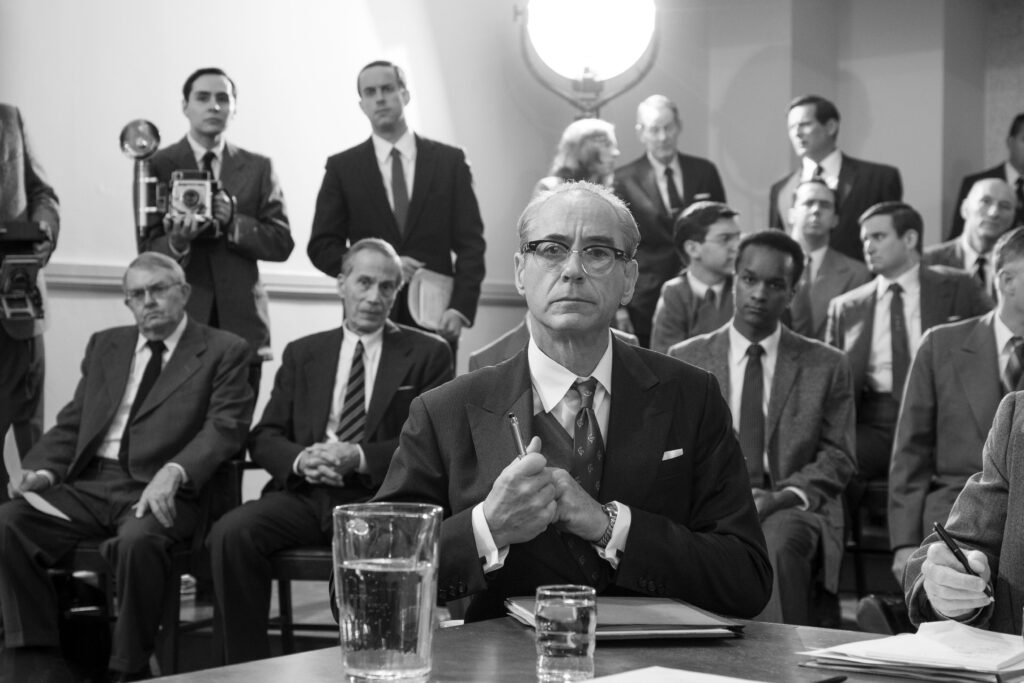
The other framing device, labeled “fusion,” is presented in black-and-white and focuses on the 1958 confirmation hearings for Commerce Secretary Lewis Strauss (Robert Downey Jr.), former head of the Atomic Energy Commission and admirer-turned-bitter rival of Oppenheimer. Strauss’s past associations with Oppenheimer are questioned, and viewers observe the systemic and personal motivations that turned Oppenheimer’s country against him.

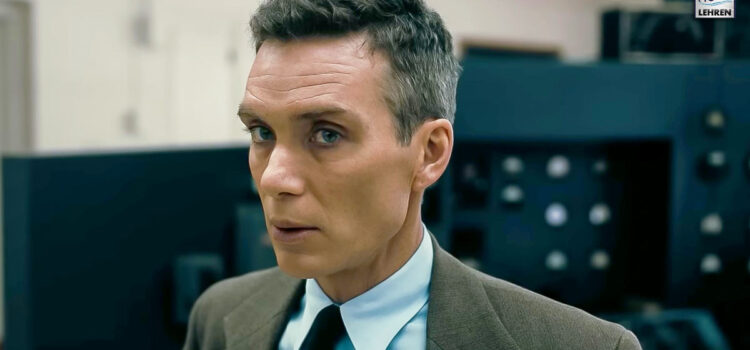
Cillian Murphy as J. Robert Oppenheimer

Nolan’s weaving together of time periods emphasizes a cyclical, pessimistic view of humankind and covers as much thematic ground as possible — far more (for better or worse) than a traditional biopic. In its fatalistic structure forever linking cause and effect, thought and execution, ego and ruin, “Oppenheimer” is ultimately a cautionary tale about invention and heroism, the perilous nature of advancement in pursuit of exceptionalism, the sacrifice of morality for power, and the perilous nature of science (and the public’s reaction to science) when it serves or doesn’t serve them.

Meaningful themes, for sure, but ones most of us have seen played out time and time again in media and our current political hellscape.

Anchored by excellent performances and Nolan’s bombastic, unrelenting direction, “Oppenheimer” is always engaging to watch on a purely technical and sensory level, if lacking the soul that creates a lasting impression. Indeed, the film’s three-hour barrage of information, characters, and stylistic showmanship lessens its intimacy. Nolan’s storytelling is too focused on being ambitious rather than letting us sit and reflect, disappointingly distant when it should be enveloping, rendering “Oppenheimer” more satisfying on an intellectual than emotional level.

Murphy, in his first time headlining a Nolan production, is captivating and mysterious. Cinematographer Hoyte van Hoytema’s camera — capturing the halls of academia, sun-swept Los Alamos, and claustrophobic bureaucratic corridors in crisp detail, involving cinema’s first use of IMAX black-and-white analogue photography, enhanced by sterling production design and costuming — absolutely adores his peculiar facial structure, letting us observe this charismatic, arrogant, naive man become hollowed out by his own brilliance. Murphy is expressive yet measured, reflecting Oppenheimer’s contradictions.

Oppenheimer frequently seems pulled between various extremes, rarely committing himself to one point of view. He’s interested in leftist philosophies without ever fully aligning himself with them, he has difficulty navigating a turbulent love life with his alcoholic wife, Kitty (Emily Blunt, underused yet getting one crowd-pleasing moment near the end), and his troubled mistress, Jean Tatlock (Florence Pugh, also underused), while being simultaneously drawn towards and petrified by his own genius. Nolan depicts him as neither hero nor villain, but something in between, with Murphy commanding the screen with empathetic, tortured unknowability.

Robert Downey Jr. as Lewis Strauss

Downey Jr., able to stretch his actorly wings in a role separated from his usual Tony Stark persona, also excels portraying Strauss, a power-hungry politician willing to throw his peers under the bus to come out on top. While Nolan’s zinger-heavy screenplay paints Strauss rather simplistically compared to Oppenheimer — there isn’t much ambiguity left regarding Strauss’s arc by the end, it’s a persona that, though based in truth, we’ve seen before — Downey Jr. lends power and malevolent dignity nevertheless.

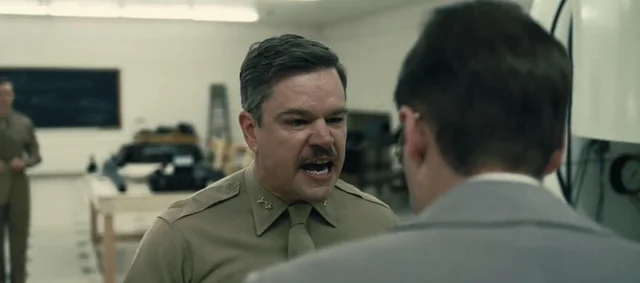
Matt Damon, as Leslie Groves, the Army officer who recruits Oppenheimer to lead the Los Alamos laboratory, provides most of the film’s comedic relief in his plain-spoken, nationalistic differences with Oppenheimer, and the rest of the stacked ensemble — featuring such (perhaps overly) recognizable faces as Rami Malek, Benny Safdie, Alden Ehrenreich, Jason Clarke, Casey Affleck, Kenneth Branagh, and Gary Oldman, among dozens of others, including Tom Conti as Albert Einstein — delivers the goods, some only with one or two scenes.

Nolan’s directing is typically strong, of course, with a booming score by Ludwig Göransson that keeps tension taut throughout, and bone-rattling sound design that effectively puts us in Oppenheimer’s fractured headspace. The Trinity bomb-test sequence, as previously mentioned, is almost unbearably suspenseful — the hellish plume of fire folding around itself in silence before surging with ear-shattering noise (thank god for earplugs), while Oppenheimer utters “Now I Am Become Death, the Destroyer of Worlds.”

Some expressionistic touches (like Oppenheimer being stripped naked as his interrogators discuss his romantic past) are difficult to take seriously, and dialogue veers heavily between overly expository and Aaron-Sorkin-lite, but “Oppenheimer” still bears the mark of one of cinema’s greatest directors.

It’s unfortunate that Nolan isn’t able to merge these various elements into a truly impactful whole. With so much ground to cover, the film only sometimes pauses to let us sit and reflect with the characters. Jennifer Lame’s precisely propulsive editing zips us along like we’re watching a montage. I can’t help but feel that a more traditional telling of Oppenheimer’s story, taking place entirely from his perspective without jumping timelines and points-of-view, would have a more organic evolution of his dreams and struggles.

As it stands, there’s much to think about, but little that tugs at the heart save for a few brilliantly directed sequences of Oppenheimer’s guilt visualized, the aforementioned bomb-test, and a sobering gut-punch of an ending. Perhaps a rewatch will prove otherwise, but qualms aside, “Oppenheimer” is quite a beast of a film, if one that’s not as effective or groundbreaking as it’s being heralded to be.

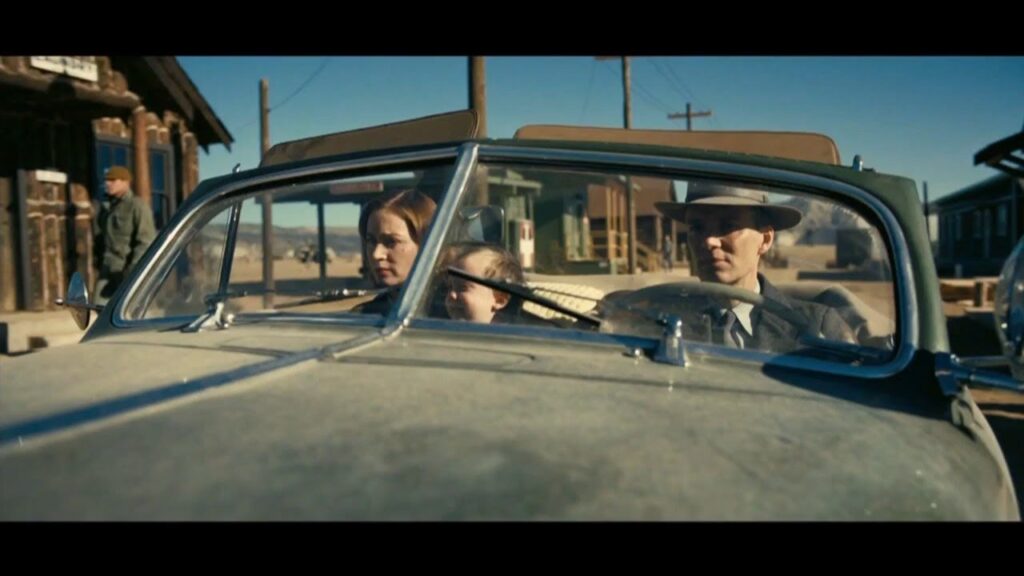
Emily Blunt and Cillian Murphy

“Oppenheimer” is a 2023 drama-thriller-biography written and directed by Christopher Nolan and starring Cillian Murphy, Emily Blunt, Matt Damon, Robert Downey Jr., and Florence Pugh. It is Rated R for some nudity, sexuality and language and runs 3 hours. It opens in theaters on July 21. Alex’s Grade: B+

Note: this review was written during the 2023 WGA and SAG-AFTRA strikes. Without the labor of the writers and actors currently on strike, the movie being covered here wouldn’t exist.

Matt Damon is Leslie Groves in OPPENHEIMER, written, produced, and directed by Christopher Nolan.

By Lynn Venhaus
One of the best films of the year, “Oppenheimer” is a stunning achievement in sight, sound, story, and scope.

Brilliantly directed and written by Christopher Nolan, his first biopic about the “Father of the Atomic Bomb” is his magnum opus. He not only delivers a fascinating historical drama on the genius theoretical physicist J. Robert Oppenheimer’s research and development, but he has crafted it like a big-stakes psychological thriller with many pieces of a puzzle becoming clear over its three-hour runtime.

It was exhilarating to see something this intelligent, lucid, and well-constructed.

Based on the 2005 Pulitzer Prize-winning book, “American Prometheus: The Triumph and Tragedy of J. Robert Oppenheimer” by Kai Bird and the late Martin J. Sherwin, Nolan’s adaptation focuses primarily on the scientist’s rise in the hallowed halls of revered institutions, the U.S. government’s interest in his quantum mechanics work, directing the Los Alamos Laboratory during World War II, his role in organizing the Manhattan Project, and the aftermath of building a nuclear weapon.

This erudite character study explains much in its sharp dialogue that didn’t feel heavy or highbrow, and thanks to the actors’ snappy delivery, naturalistic.  Nolan’s verbal dexterity is crucial to this becoming edge-of-your-seat good instead of an academic exercise, and through meticulous detail, infuses a compelling biography with big-picture questions.

Nolan has created some of the best films of the 21st century since “Memento” in 2000, and is known for his cerebral storytelling, nonlinear style, and visual mastery.

Oscar-nominated five times for picture and director for “Dunkirk,” picture and screenplay for “Inception” and screenplay for “Memento,” his films have won mostly technical awards. He has thrilled with his Batman trilogy, impressed with “The Prestige,” and confounded with “Tenet” and “Interstellar,” gaining a fervent fan base.

Even those not as enamored will begrudgingly admit to admiring his commitment to big, bold cinematic grandeur, rarely relying on digital effects. (For instance, no computer-generated graphics in “The Dark Knight.”)

While weaving a grand-scale intricate narrative that flashes back and forward across decades, Nolan creates tension that leads to the “Trinity” code-name bomb-testing that’s one of the most astonishing sequences ever captured on film as he manipulates sight and sound for the Big Bang.

After the bomb is used and the government takes it over from there, the film raises issues about actions causing reactions, scientific advancement, and government responsibility as Oppenheimer is swept into the maelstrom of moral, ethical, and political debates unleashed after the bomb’s use to end World War II.

The story is framed with an unsettling hearing in 1954, the U.S. Atomic Energy Commission, which stripped Oppenheimer of his security clearance, a kangaroo court depicting the post-war Red Scare paranoia. With his leftist leanings, connections to people that were avowed (past) Communists, and fretting over nuclear proliferation, he was accused of being a Soviet spy and became an unfortunate scapegoat.

Nolan uses this backroom thrashing as a look back, intertwining science with politics by effectively alternating color and black-and-white film. It’s a master storyteller at the peak of his craft.

A key element is a mega-cast that features everyone giving their all, creating authentic portraits of people that played a part in history, from Alden Ehrenreich depicting a Senate aide to British actor Tom Conti unrecognizable as Albert Einstein and Gary Oldman’s sly work as President Harry S Truman in one scene.

A longtime fan of Cillian Murphy, I’m happy to see the Irish actor finally taking center stage in a part that seems tailor-made for him, and he’s on screen nearly the entire time. It’s such a virtuoso lived-in portrait, his career best, and he superbly unfolds multiple layers – showing many facets of Oppenheimer’s personality.

Murphy’s most well-known work is as crime boss Tommy Shelby in the Netflix series “Peaky Blinders” (2013-2022), which is about a gangster family in 1900s England. In 2002, he broke through in the Danny Boyle sci-fi masterpiece “28 Days Later,” and has been featured in six Nolan films, starting with “Batman Begins” in 2005 as DC Comics’ villain Dr. Jonathan Crane/Scarecrow.

As the two complicated women in his life, Emily Blunt is bulldog-like in her support, portraying his alcoholic biologist wife Kitty, unapologetic as a stressed-out mom, and Florence Pugh is troubled longtime girlfriend, psychiatrist Jean Tatlock.

Robert Downey Jr. stands out in a shrewd performance as Lewis Strauss, a founding commissioner of the U.S. Atomic Energy Commission and ambitious political climber, and Matt Damon is strong as General Leslie Groves Jr., director of the Manhattan Project.

Josh Hartnett, who fell off mainstream movie radar, roars back as pioneering American nuclear scientist Ernest Lawrence, who worked with Oppenheimer at University of California-Berkeley, and Benny Safdie is once again surprising as theoretical physicist Edward Teller, who disagreed with Oppie on the hydrogen bomb.

A litany of recognizable actors portraying either scientists, military brass or support staff includes Casey Affleck, Kenneth Branagh, Jason Clarke, Dane DeHaan, Tony Goldwyn, David Krumholtz, Rami Malek, Matthew Modine, and Alex Wolff.

You might also be familiar with Dylan Arnold, who plays Robert’s brother Frank Oppenheimer, Michael Angarano as good friend-physicist Robert Serber, David Dastmalchian as William Borden, who filed a complaint with the FBI, Gregory Jbara as Senate Chairman Magnuson, and Macon Blair as Oppenheimer’s defense attorney Lloyd Garrison.

This film leaps to being either a frontrunner or contender in many awards categories, figuring into the year-end conversations. It will be in mine – considerations for film, director, adapted screenplay, lead actor, supporting actor (Downey), supporting actress (Blunt), cinematography, editing, music score, visual effects, production design, costumes, hair and makeup, and sound nominations.

Nolan’s go-to cinematographer Hoyte Van Hoytema, Oscar nominee for “Dunkirk” and showing his keen eye in “Nope,” reaches new heights here, groundbreaking actually. He shot the film partially in black-and-white, and in doing so, made history. In a combination of IMAX 65 mm and 65 mm large-format film photography it includes, for the first time ever, sections in IMAX black and white analogue photography.

L to R: Matt Damon is Leslie Groves and Cillian Murphy is J. Robert Oppenheimer in OPPENHEIMER, written, produced, and directed by Christopher Nolan.

So that the sections of the movie could be shot in the same quality as the rest of the film, Kodak developed the first ever black and white film stock for IMAX.

Composer Ludwig Goransson, who won an Oscar for his “Black Panther” score, distinctively guides the tone and the tempo with savvy music choices.

The artisan work is exceptional – especially Jennifer Lame’s decisive editing, and the sound editing and mixing technicians’ advanced capabilities (Richard King, Michael W. Mitchell, Kevin O’Connell, Gary A. Rizzo leading the way.)

Luisa Abel’s expert makeup and prosthetic department’s aging visages appear realistic, and costume designer Ellen Mirojnick’s looks for tweedy academia, active soldiers, swanky party guests and ‘40s housewives are spot-on, factoring in desert, Northern California, and New England climates.

Ruth De Jong’s production design spans decades and locations with accurate retro recreations, as Nolan moves from ‘20s grad school in Germany to ‘30s UC-Berkeley classrooms, to ‘40s Princeton, deserts and mountains, wartime New Mexico and McCarthy-era Washington D.C.

“Oppenheimer” harkens back to those mammoth blockbusters of old, those sweeping epics filmed by David Lean that captured our fancy. It is rare to see a movie of this magnitude be this satisfying, but it is nuanced filmmaking at its finest. Go see this big-brained movie on the biggest screen possible.

“Oppenheimer” is a 2023 drama-thriller-biography written and directed by Christopher Nolan and starring Cillian Murphy, Emily Blunt, Matt Damon, Robert Downey Jr., and Florence Pugh. It is Rated R for some nudity, sexuality and language and runs 3 hours. It opens in theaters on July 21. Lynn’s Grade: A.

Note: this review was written during the 2023 WGA and SAG-AFTRA strikes. Without the labor of the writers and actors currently on strike, the movie being covered here wouldn’t exist.