By Lynn Venhaus

It’s hard to say who had a better time at “Shrek the Musical” – the parents or the children, often green-clad and gleefully giggling at the daffy antics. The Muny’s annual family favorite ‘Kids Show’ delighted across generations with its irreverent humor, impressive pop vocals, and infectious energy in a funky, funny, fluffy un-Disneyized fairy tale musical.

It’s not your classic prince-rescues-princess tradition, and that’s the fun of it, what sets this storytelling apart. In the comical land of Far, Far Away, the unlikely hero is a smelly, grumpy ogre, accompanied by his chatty sidekick Donkey, his feisty true-love Princess Fiona and his merry band of misfits.

The ensemble opens with the catchy “Big Bright Beautiful World” and you’re off on an unusual adventure. Lord Farquaad demands Shrek rescue Princess Fiona from a dragon-protected tower in exchange for the deed to his swamp, for the despicable despot wants to marry her. Once upon a time wasn’t ever this raucous.

First released as an animated film in 2001, “Shrek” fractured happily-ever-after fairy tales in this DreamWorks Animation smash hit that won the first-ever Oscar for Best Animated Feature Film. Breaking industry rules and becoming a cultural phenomenon, the film adaptation of William Steig’s slight 1990 children’s picture book “Shrek!” has earned $500 million globally. It has four sequels (a fifth is due out next year), two Puss ‘n Boots spin-offs, and just announced is an Eddie Murphy-led “Donkey” spinoff for 2028.
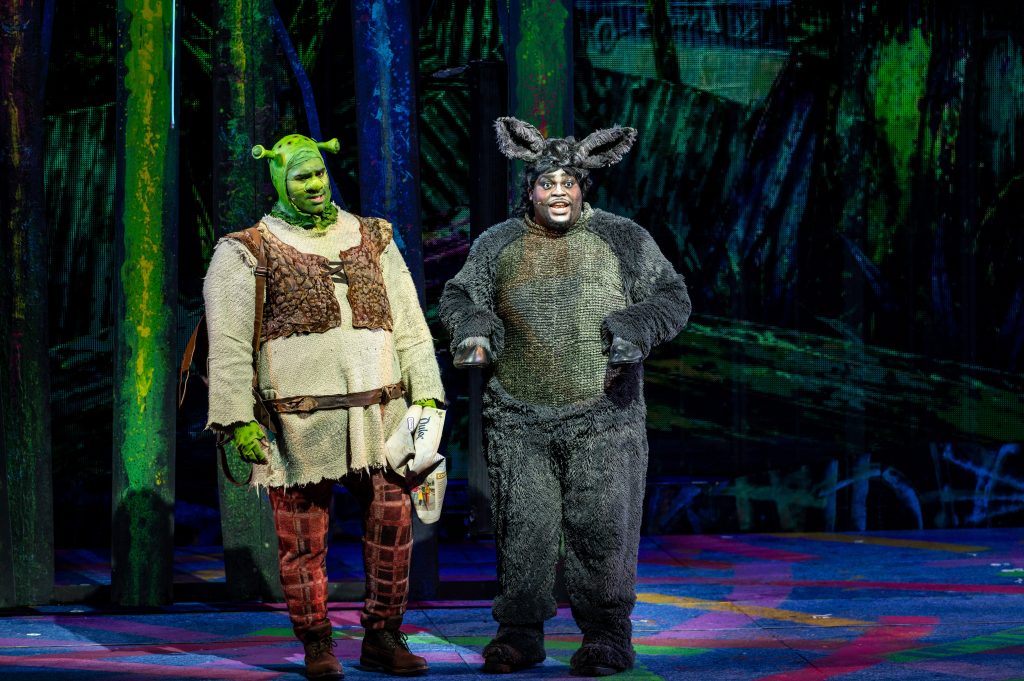
Nik Walker (left) and Marcus M. Martin in the 2026 Muny production of “Shrek The Musical.” Photo by Phillip Hamer

Of course, Broadway beckoned. “Shrek the Musical” took off in 2008, with Tony-nominated book and lyrics by Pulitzer Prize winner David Lindsay-Abaire, whose wicked wit is apparent in this adaptation, adding more backstory and mischief. With his absurdist, blunt humor paired with Jeanine Tesori’s clever and upbeat songs, they pulled apart musical theater tropes.

Lindsay-Abaire has incorporated elements of the movie sequels, too – “Shrek 2” and “Shrek Forever After.” After the Broadway run of 441 performances, they have since revised the musical several times.

With a large fun-loving ensemble, the Muny presents a jolly good road trip to the swamp, Duloc, and beyond. In its second staging here, the first since 2013, the casting is impeccable, their performances vigorous and the whimsical world-building is dazzling by director John Tartaglia and his unconventional team of dreamers and doers, celebrating the ‘different.’

The Tony-nominated and Emmy-winning Tartaglia, who directed “Shrek” thirteen years ago – and originated the role of Pinocchio on Broadway, has infused this playful version with bigger and bolder choices but keeping his trademark heart at the center. It’s the 10th show he’s directed, and he’s very comfortable incorporating puppetry into all his visionary productions.
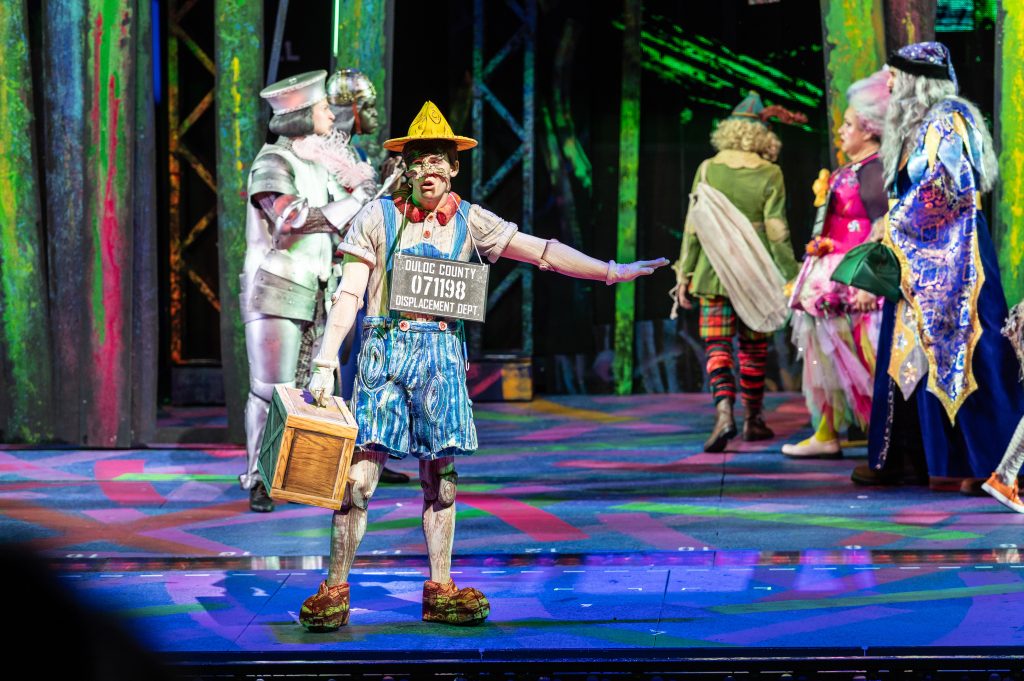
Tyler Joseph Ellis in the 2026 Muny production of “Shrek The Musical.” Photo by Phillip Hamer

After all, he was promoted several weeks ago to be the vice president of development and production at The Jim Henson Company, focusing on television and live theatrical projects. He serves as the primary creative supervisor for the Fraggle Rock brand (and started his career at “Sesame Street.”)

The magnificent giant pink fire-breathing Dragon is a stunning addition.  Designed by James W. Wojtal Jr. and his team, with Eric Wright of Puppet Kitchen the puppet director, five puppeteers create magic on stage. Jim Henson’s Creature Shop designed and built Gingy, the dancing rats and the exploding bird. 

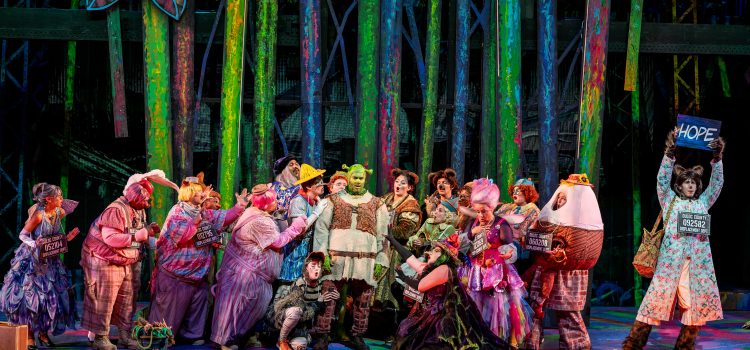
Maintaining the Disney departure feel, Tartaglia followed through by envisioning a grungier, not gleaming, kingdom, but also favored a lively, captivating 90s glam-rock concert look, with a nod to punk rock, too.

It reminded me of late ‘60s and early ‘70s television variety shows like “The Sonny and Cher Show” and “The Smothers Brothers Comedy Hour” with sparkly high-energy performers and cheeky humor.
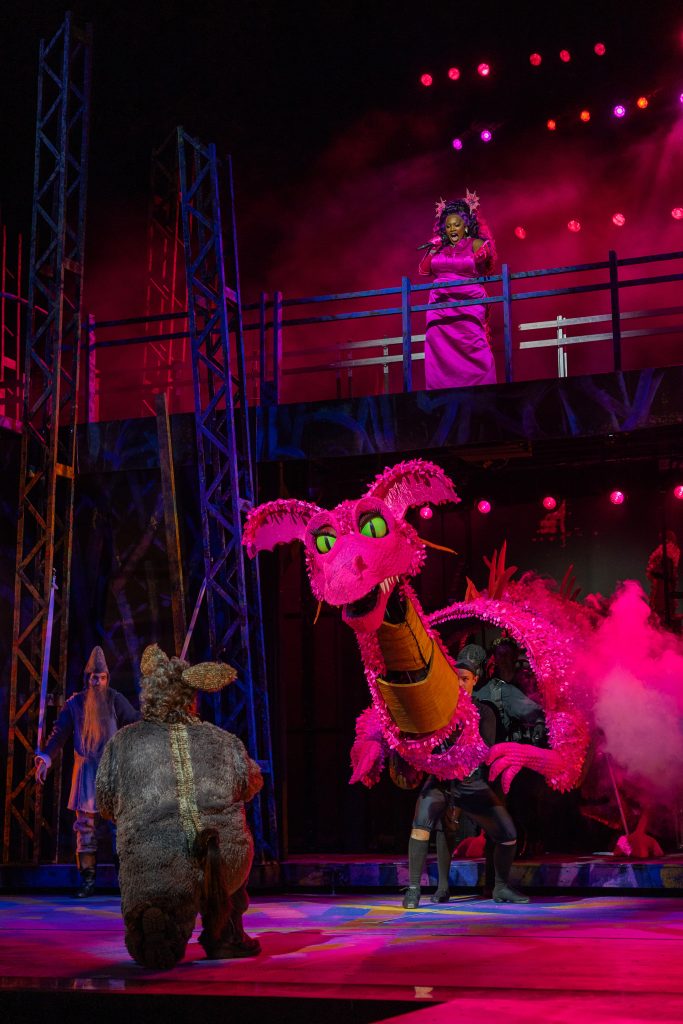
Marcus M. Martin and Salome Smith in the 2026 Muny production of “Shrek The Musical.” Photo by The Muny | Emily Santel

The well-integrated designs add to the showbizzy and make-believe worlds, including musical Easter eggs that subvert the usual tropes (Can you spot “Les Miserables,” “A Chorus Line,” “Gypsy,” “The Lion King,” “Wicked” and “Chicago”?). Nothing’s going to bring him down, Lord Farquaad sings!

Adam Koch’s vivid set design incorporated a new-to-the-Muny technique, using a screen to great effect, especially when Donkey and Fiona have a heart-to-heart in a ‘cave.’ His grid-and-forest design took us immediately into an interesting new world.

The exceptional trio of Nik Walker, Marcus M. Martin and Kara Lindsay headline as Shrek, Donkey and Fiona, and corralled us into their corner from their entrance, with deeply expressive voices, crisp comic timing and tangible chemistry.

Delightful Troy Iwata once again raises the bar on comical scene-stealing performances. Previously the guffaw-inducing housekeeper Jacob in last year’s “La Cage Aux Folles” and adorably amusing as beat-to-a-different drummer Ogie in “Waitress,” he makes the most of tyrannical narcissist Lord Farquaad and his shortcomings.
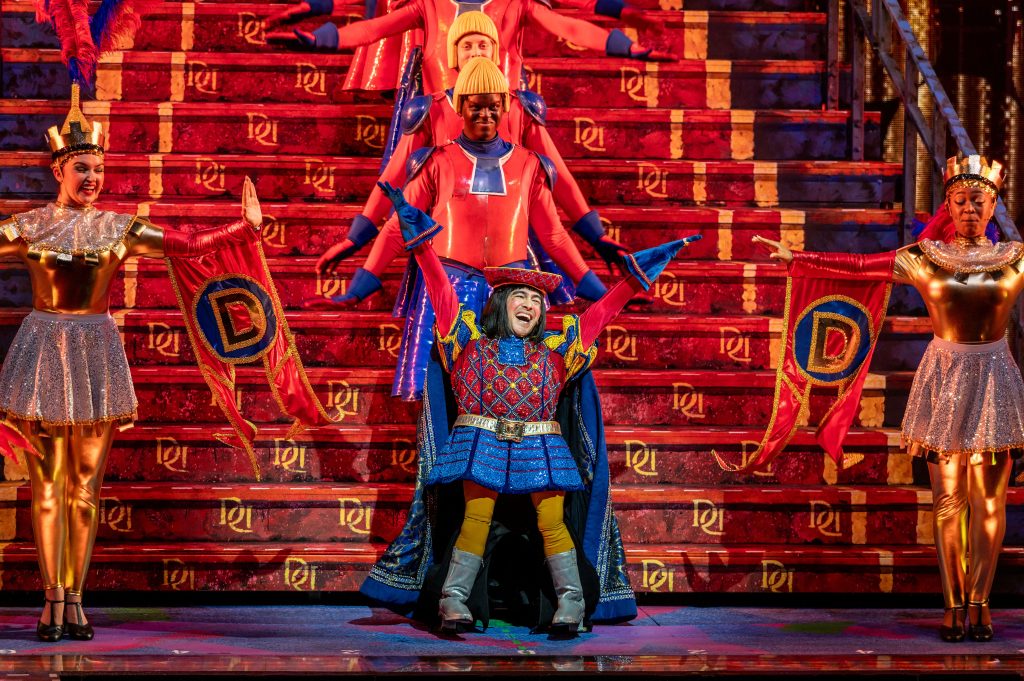
Troy Iwata (as Lord Farquaad) and the company of the 2026 Muny production of “Shrek The Musical.” Photo by Phillip Hamer

His sheer physicality is mind-boggling, cavorting by wearing a special costume with tiny legs attached and primarily walking on his knees. His “What’s Up, Duloc!” and “Ballad of Farquaad” are hilarious, as are his farcical movements.

Add a zany Aymee Garcia as outspoken Gingerbread Man, aka Gingy, and a spry Tyler Joseph Ellis, who hits the right falsetto notes as rabble-rouser Pinocchio, to the ‘social outcast’ mix. Mighty Salome Smith is a showstopper as the booming voice of the Dragon, belting out “Forever” like a Dreamgirl.

All the principals, except for Iwata, are making their Muny debut. The peppy ensemble, a mix of vets and newbies, is very strong – and busy. They’re up to the rigorous routines that dynamic choreographer Patrick O’Neill, associate choreographer Bryan Thomas Hunt and assistant choreographer Kelly Sheehan challenge them with, and it shows in the major dance numbers: “Story of My Life,” my favorite “Freak Flag” with its winking at “Les Miz,” “What’s Up, Duloc!” and the glorious tap routine “Morning Person.”
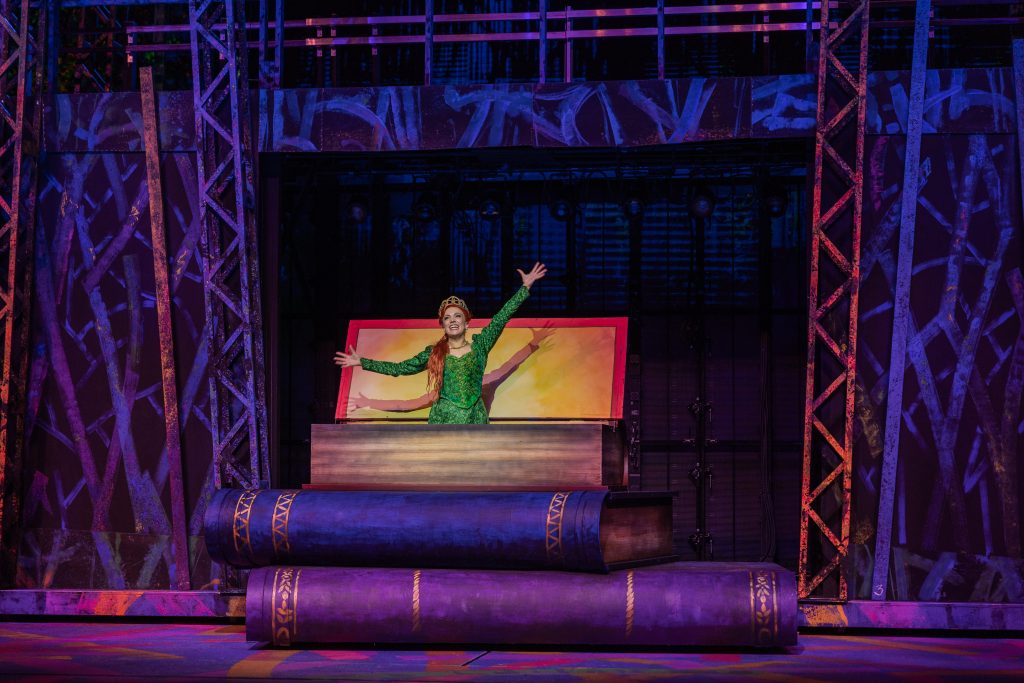
Kara Lindsay in the 2026 Muny production of “Shrek The Musical.” Photo by The Muny | Emily Santel

Martin has fun leading the spirited divas Three Blind Mice (Monique Churchill, Kylie Edwards and Abby Linderman) in the R&B “Make a Move.” Inserting “I’m A Believer” from the movie for the wedding reception dance-party finale is as jubilant a curtain call as can be. Another catchy visual by inventive video designer Kylee Loera includes photo booth snapshots.

In his 18th show as music director/conductor, master maestro Ben Whiteley leads 24 musicians, and keeps the joyous tempo on track, with fluid orchestrations throughout.

For her 14th show, costume designer Robin L. McGee, a Highland, Ill., native, created an eye-popping assortment of outfits, based on original costume design by Tim Hatley. Just look at the close-up detail in production photos, making the fairy tale characters recognizable, but also able to easily move.

Jeff Knaggs’ wig designs completed the look, and those who helped with padding and prosthetics deserve shout-outs too. Lighting designer Jason Lyons and sound designer Joshua Hummel worked in tandem to capture the atmosphere, and the human noises had to be perfectly timed, as did the swamp sounds.
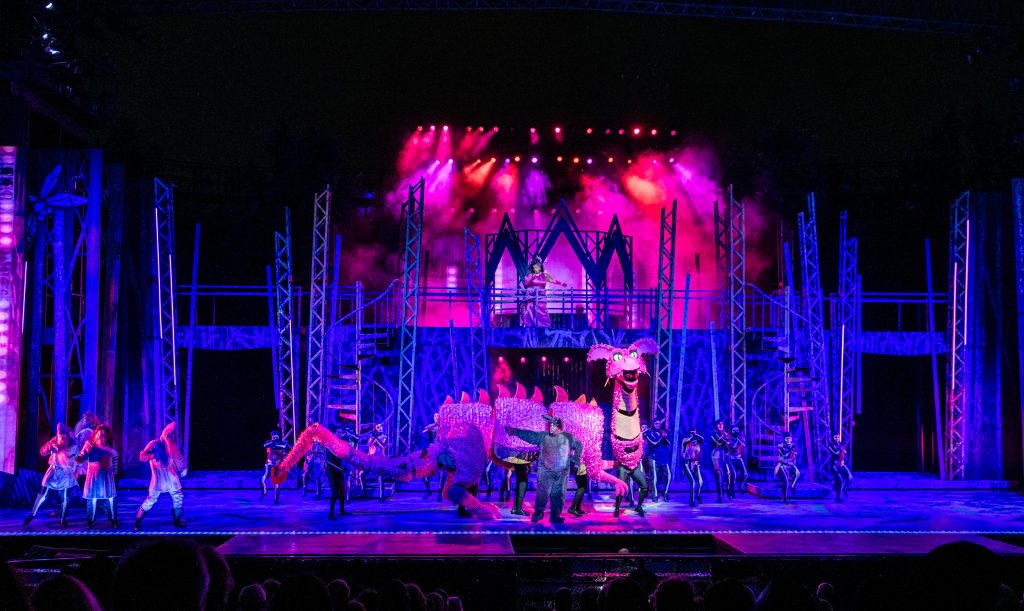
Salome Smith (above), Marcus M. Martin and the company of the 2026 Muny production of “Shrek The Musical.” Photo by Phillip Hamer

Now, there is frequent use of potty humor, so you are warned – particularly fart jokes. “I Think I Got You Beat” is an outrageously silly flatulence and burping contest between Shrek and Fiona.

Skilled at physical comedy, the ensemble also included Mathew Blasio, DeShawn Bowens, Matthew Davies, Ryan Fitzgerald, Matt Gibson, Jack Gimpel, Shelby Griswold, Michael Harp, Gwen Hollander, Sean McManus, Shelby Ringdahl, Trevor Michael Schmidt, Kelly Sheehan, Caitlin Stebelman and Jonah D. Winston.

They appeared as such familiar childhood characters in forests and fauna – Pied Piper, Fairy Godmother, Peter Pan, Wicked Witch, Tweedledum, Mama Bear, Ugly Duckling, Big Bad Wolf and others.

The company was joined by the adorably costumed Muny Kids and Teens youth ensembles. Fine young performers Solomon Rosenthal and Lake Schultz play Young Shrek and Young Fiona, while Amelie Lock was Teen Fiona. The trio of Fionas combine for the poignant “I Know It’s Today,” yearning for their escape.
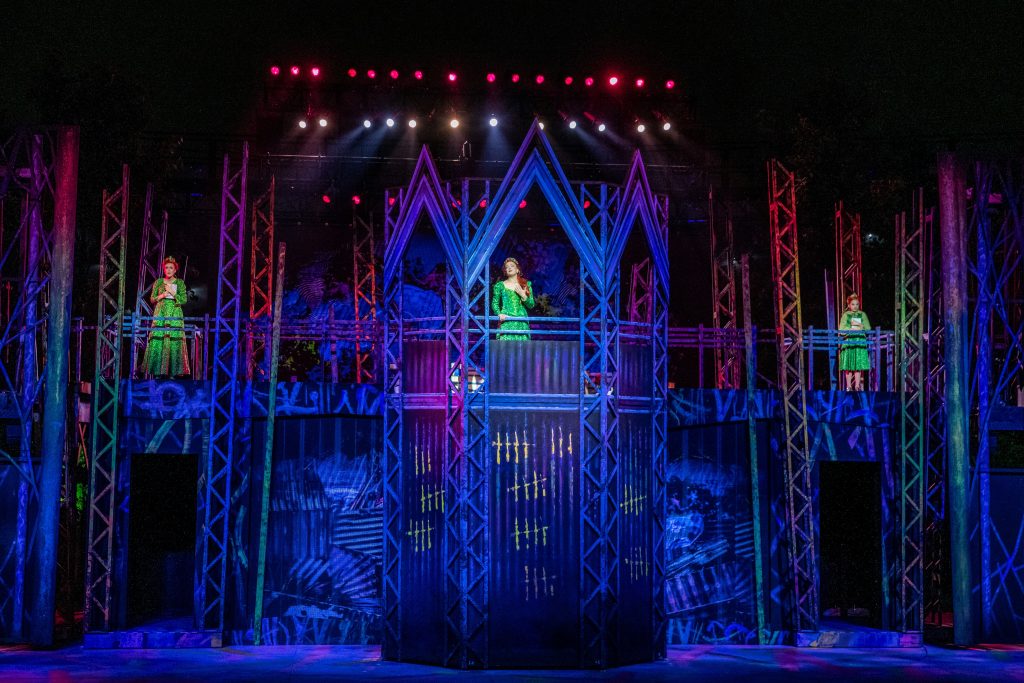
Amelie Lock, Kara Lindsey, Lake Schultz. Photo by_Phillip Hamer

In such duets as “Don’t Let Me Go” and “Travel Song,” Walker and Martin show their mapcap skills, and when paired with Fiona in “This Is How a Dream Comes True” and the anthem “Who I’d Be,” it calls for heightened emotions.

The most important takeaway is the show’s message about self-acceptance. Some songs focus on inner beauty, self-worth and being comfortable in your own skin. Shrek’s a-ha moments include “When Worlds Fail,” “Build a Wall” and “Beautiful Ain’t Always Pretty.”

While the songs are melodious and superbly delivered, some of the numbers seem repetitive, stretching out the inevitable, and these ballads, while heartfelt and moving, created some restlessness from the little ones around me. The musical’s structure has some pacing issues, but this cast kept it as breezy as possible.(Special mention to stage manager Larry Smiglewski). It is a 2.5-hour experience with intermission.

In “Shrek the Musical,” we can still BELIEVE in the comforting magic of fairy tales, and that everyone is worthy of love and friendship. With “biggish” ideas, the Muny has crafted a refreshing show that’s suitable for all – on two different levels. For adults, the parodies and un-cutesy theme land while the kids can revel in the slapstick and goofy characters.
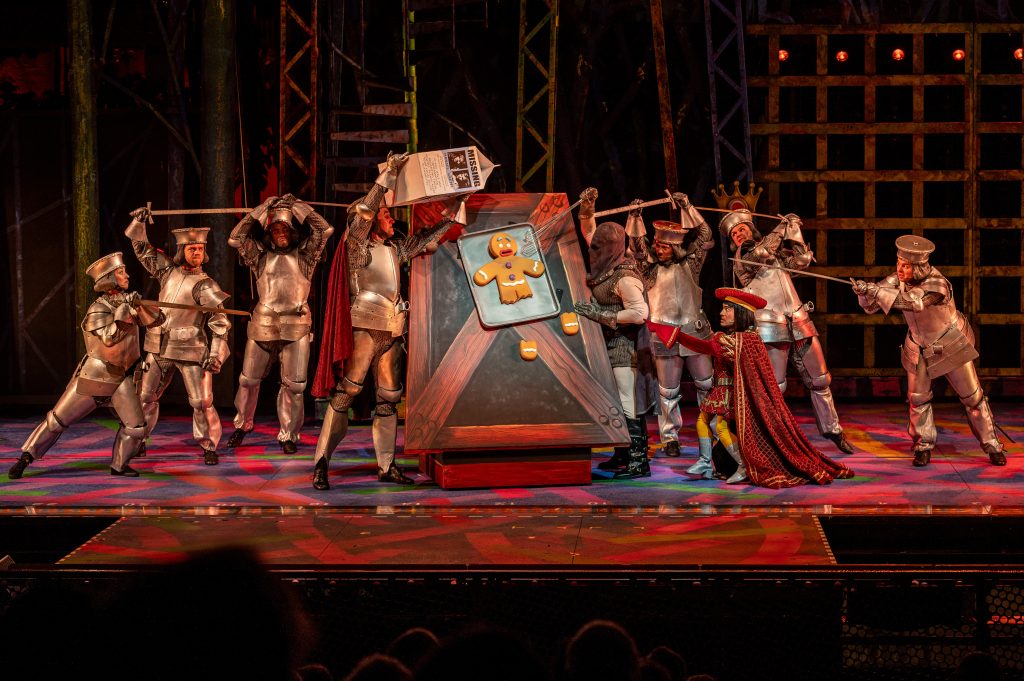
Aymee Garcia (Gingy puppeteer), Troy Iwata (as Lord Farquaad) and the company of the 2026 Muny production of “Shrek The Musical.” Photo by Phillip Hamer

The Muny presents “Shrek the Musical” from June 25 through July 2 nightly at 8:15 p.m. at its outdoor theatre in Forest Park. For more information, visit www.muny.org
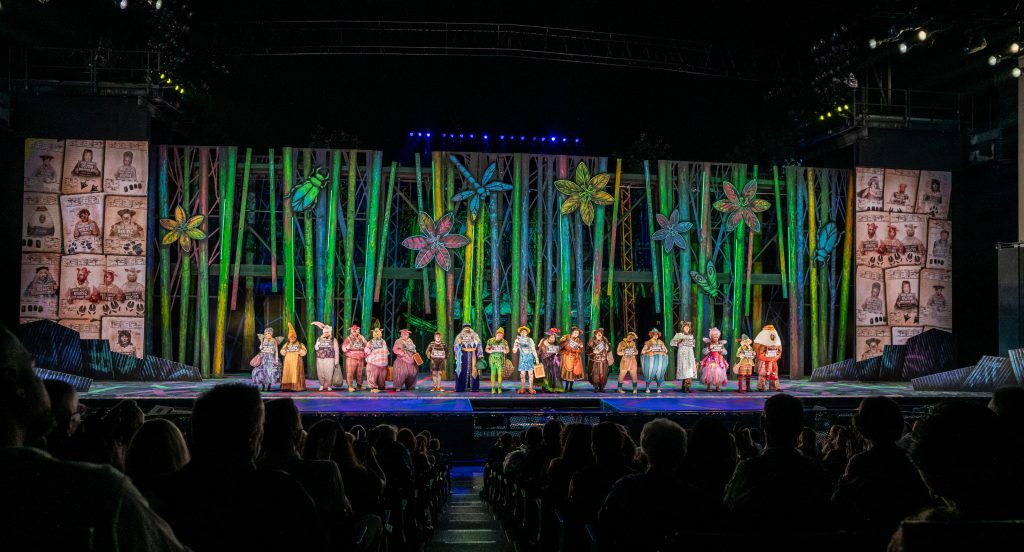

THe company of the 2026 Muny production of “Shrek The Musical.” Photo by Phillip Hamer

By Lynn Venhaus

Winning performances enliven a slickly produced “Ripcord” that sprinkles poignant moments among well-executed broad physical humor.

In the vein of classic sitcoms like “The Golden Girls” and the evergreen Neil Simon smash hit “The Odd Couple,” Stray Dog Theatre’s latest play is relatable because of a finely tuned ensemble convincing in a clash of temperaments and wills.

This 2015 comedy from the acclaimed playwright David Lindsay-Abaire is not as emotionally gut-wrenching as his Pulitzer-Prize winning drama “Rabbit Hole,” or as piercing as his social commentary “Good People,” but its familiar beats entertain.

Last year’s Tony winner for Best Book and Score (Lyrics) of a Musical for “Kimberly Akimbo,” Lindsay-Abaire has adapted “Shrek” and “Cinderella” into hit musicals with a populist flair.

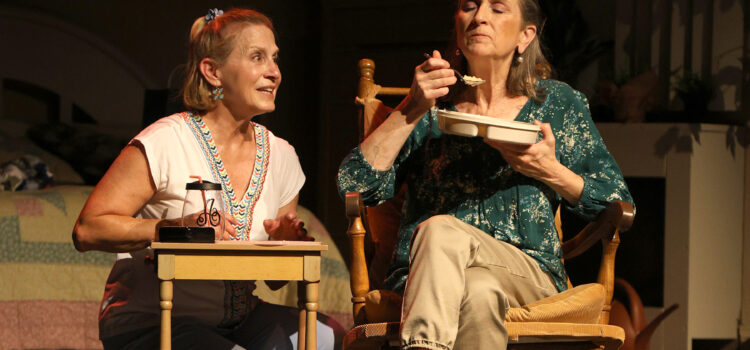
Sprightly Annie Bayer and Jan Mantovani play the two warring widows at the center of this good-natured work, keeping a brisk pace with graceful movements and snappy banter.

Matt Anderson, Donna Parrone, Jan Mantovani. Photo by John Lamb.

Mantovani is delightful as an endlessly chipper Marilyn whose sunniness annoys the perpetually grouchy Abby (Bayer), her new roommate at an assisted living center. They deliver zingers with aplomb as their differences and life stories emerge.

However, because Abby is such a prickly personality and unrelentingly dour, Bayer’s character comes across as more one-note, but she will have opportunities to provide some backstory context to her behavior.

It’s obvious from how it’s written that one is immediately drawn to the agreeable Marilyn and unsympathetic to the constantly complaining Abby, who doesn’t play well with others.

When Abby exhausts the conventional means to have Marilyn moved to a different room, the pair lay their cards on the table. They make a bet with each other, with the prize this plum second-floor real estate. Marilyn can have the bed closest to the window overlooking a park if Abby makes her angry, and she’ll move out if she can scare Abby.

The dirty tricks escalate – some hurtful and mean – until a winner is declared. While the sweet-and-sour duo play off against each other well, it is the addition of sharp supporting players that swiftly moves the story along.

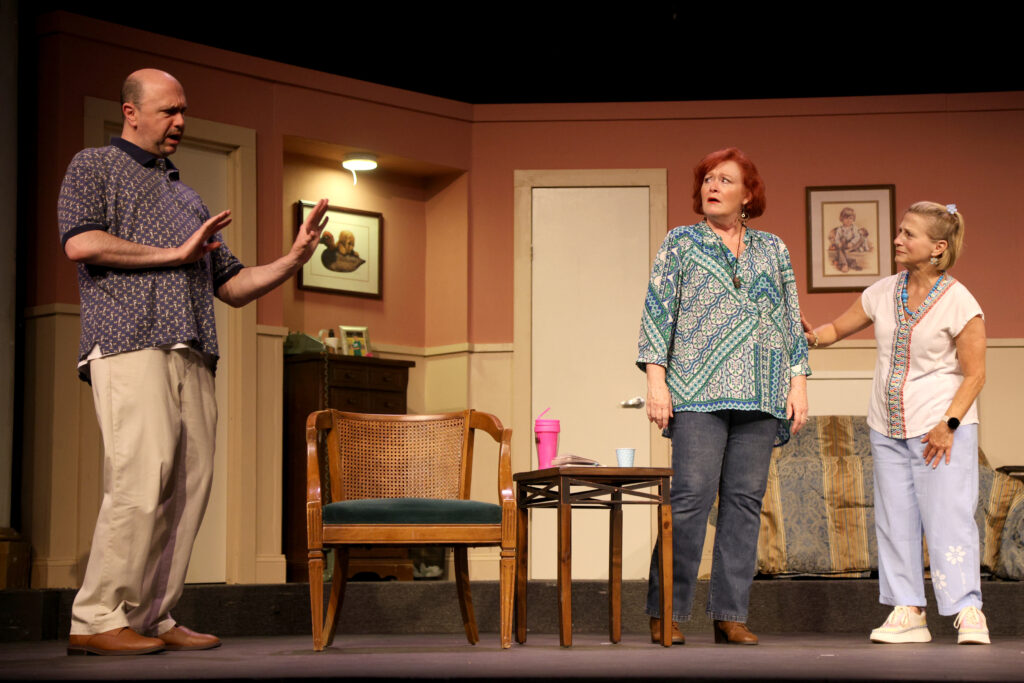
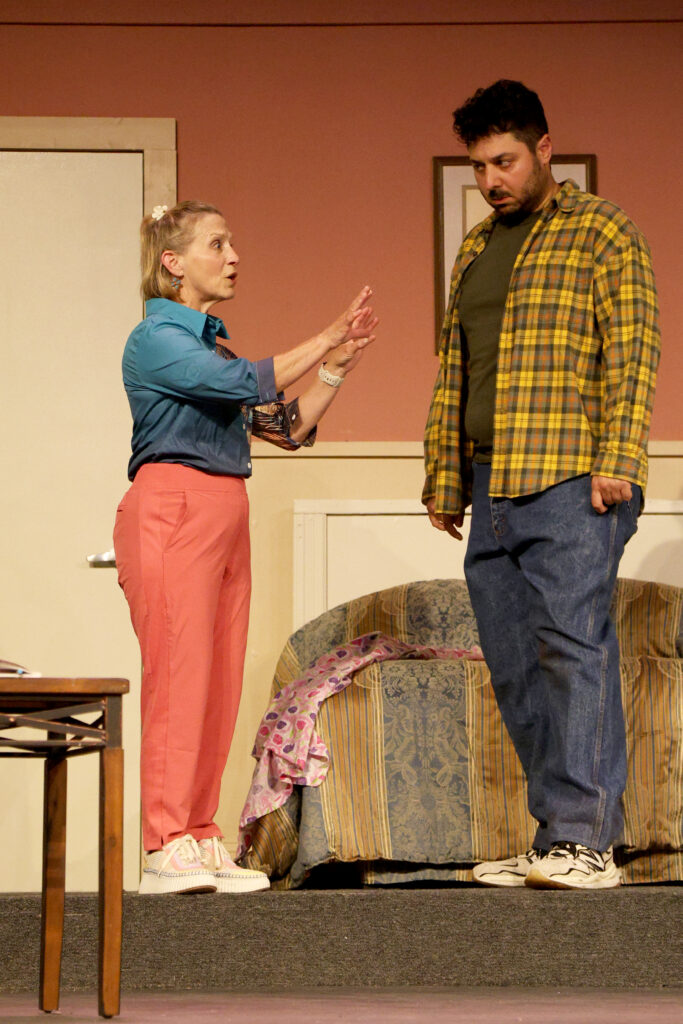
Victor Mendez is the pleasant aide Scotty, an aspiring actor, who connects the dots to the facility’s staff and procedures. Donna Parrone is Marilyn’s loving daughter, Colleen, and Matt Anderson is her goofy but well-meaning husband Derek. They’re supportive and assist with the schemes.

Jan Mantovani, Jeremy Goldmeier. Photo by John Lamb.

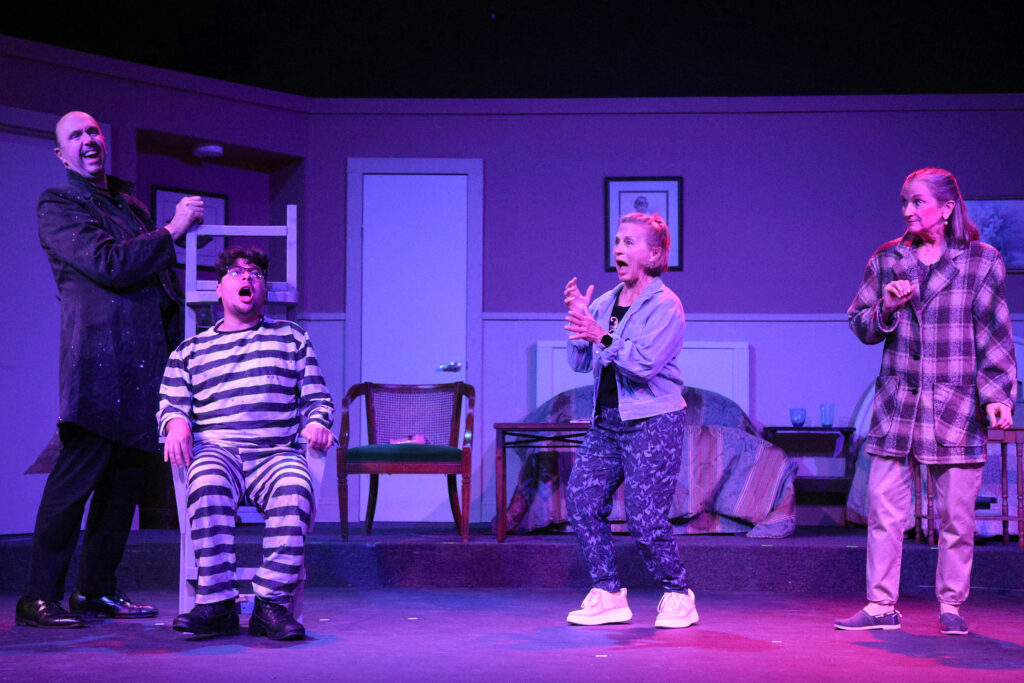
Anderson and Parrone also humorously double as part of a very theatrical trio of actors trying to frighten people at a bargain-basement haunted house. Jeremy Goldmeier joins them in this wildly overzealous troupe. He also adroitly flips the switch as Benjamin, Abby’s estranged son.

Their expert comic timing is a plus as slapstick-y shenanigans are nimbly staged.

Gary F. Bell skillfully directs in a light-hearted style, emphasizing humorous exchanges and surprising developments. The pranks look fun to pull off, and the actors keep the action fresh and the element of surprise genuine.

Rob Lippert’s set design depicts a standard double-bed room, with ubiquitous institutional décor, and has smoothly indicated scene changes involving a haunted house and skydiving experience.

Costume designer Colleen Michelson has selected appropriate casual attire for each character, and Tyler Duenow’s lighting design is effective.

Of special note is Justin Been’s sound design, which is a tad more complicated than one would think, given the play’s simple senior living setting. But he masterfully weaves in authentic sounds incorporating skydiving and a dramatic spooky scenario, not to mention a music score that compliments the story.

The cast engages and the crew’s efforts to polish this production are evident. The play may lack the substance featured in Lindsay-Abaire’s other works, but it satisfies because of an earnest team caring to make it personal.

Stray Dog Theatre presents “Ripcord” from June 6 to June 22, on Thursdays through Fridays at 8 p.m., with a special matinee at 2 p.m. on Sunday, June 16, at the Tower Grove Abbey, 2336 Tennessee Avenue, Saint Louis, MO 63104. Gated Parking.

Tickets: Adults $35 / Seniors (65+) & Students $30 (Cash/Checks/All Major Credit Cards). Additional Information and Ticket Reservations: Call (314) 865-1995 or visit www.straydogtheatre.org. Box Office/Will Call opens 1 hour prior to performance. Tower Grove Abbey is a “general seating” theatre.

Matt Anderson, Victor Mendez, Jan Mantovani, Annie Bayer. Photo by John Lamb.

By Lynn Venhaus

Our turfs and our tribes. It’s what defines us.

Well, we like to think that, but maybe it’s our choices that shape us. David Lindsay-Abaire’s “Good People,” a brilliant examination of class, good fortune, and the struggles of those left behind, is getting a stimulating treatment at Stray Dog Theatre.

Talk about a conversation starter! With a superb cast led by the incomparable Lavonne Byers, the gritty “Good People” bluntly spells out the wide divide between the haves and have-nots, and not just financially, but in word, thoughts, and deeds.

Margie Walsh is a Southie, for she lives in South Boston’s Lower End, a primarily working-class Irish American neighborhood where the playwright grew up. So, he wrote with deep understanding and connection.

Byers conveys Margie’s toughness and anxiety, with an undercurrent of desperation that she tries not to show. Her weapon is sarcasm. Hardened by a hardscrabble life, she has fought, clawed, and scratched in a dog-eat-dog world. Stubborn and proud, sometimes she has made life more difficult for herself because she will not rely on anyone, but she is loyal to a fault.

After high school, she became a caretaker. It’s a lifetime ago, and that’s when her dreams died, if she had any. As the single working mother of a developmentally disabled adult daughter, she plugs away at minimum-wage jobs. After being late too many times waiting for her daughter’s sitter to show up, she is fired from working as a cashier at the dollar store.

Friends and neighbors gather at the church hall for Bingo in hopes of winning the jackpot and to socialize. Stephanie Merritt is amusing as ballsy Jean, mouthy but well-meaning; Liz Mischel is defensive as the indifferent landlady Dottie, who is also Joyce’s unreliable sitter; and Stephen Henley projects a sweetness as the decent, practical Stevie, her compassionate ex-manager.

The Southie accent is a difficult one, so the dialect work is to be commended, because it’s evident that the ensemble worked on getting it right.

Stephen Peirick and Lavonne Byers. Photo by John Lamb.

About to be evicted, Margie is hanging by a thread. She is not “lace curtain Irish.” Jean knows she needs a break and mentions that she ran into Margie’s old high school flame, Mike, now a doctor. Why doesn’t she ask him for a job, or his help in finding one?

“Mikey” is now a fertility specialist, and he lives with his elegant African American wife Kate and their daughter in Chestnut Hill, an affluent village six miles from downtown Boston. He doesn’t have any office openings. Caught off-guard by the visit 30 years after he last saw her, he prefers not to be reminded of his rough-and-tumble upbringing. She forces an invitation to his wife’s party. Maybe someone else can help with employment.

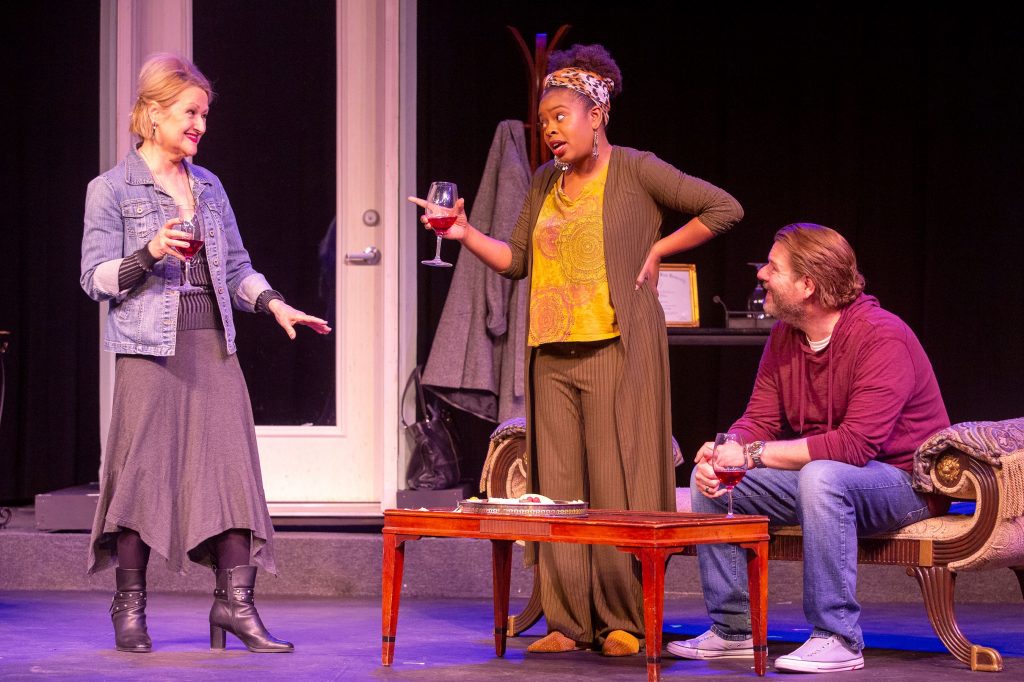
It’s cancelled, their daughter is sick, but Margie thinks he is blowing her off, and shows up anyway at the door, and Kate mistakes her for the caterer.

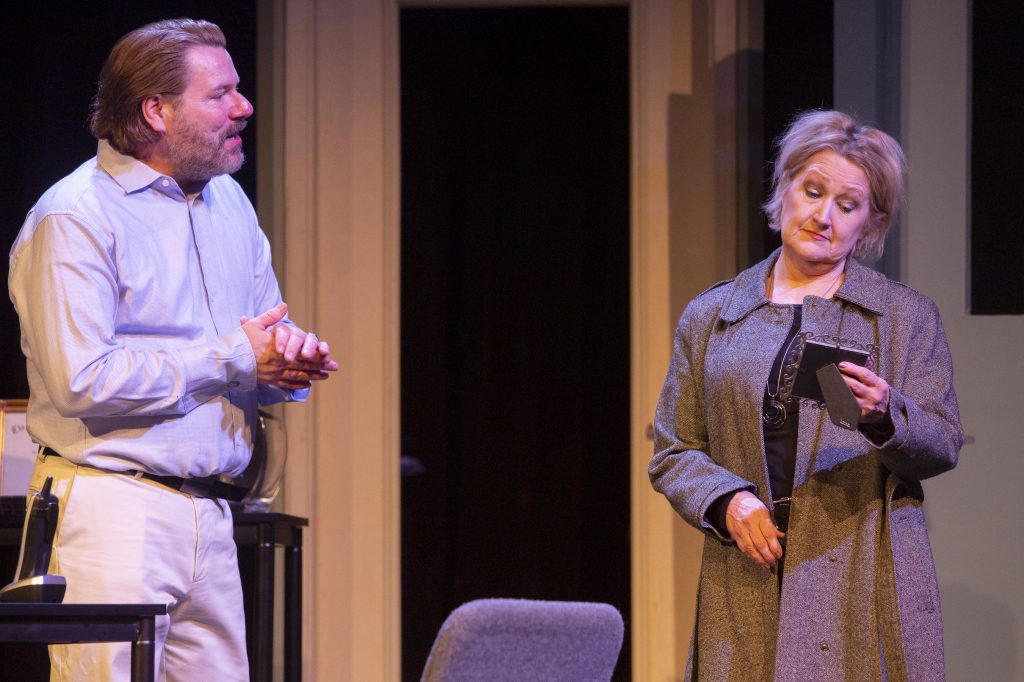
Stephen Peirick is Mike, now “Michael,” and Laurell Stevenson is Kate, who live comfortably, although see a couples’ therapist. Their nouveau riche lifestyle is worlds apart from his humble formative years in South Boston. Humble, he’s not.

There is more to the story, but it’s best the audience discover the developments on their own. Just know that pleasant social graces disappear when a confrontation gets ugly. Initial warmth gives way to a chilling coldness.

Under Gary F. Bell’s savvy direction, the trio nimbly escalates emotions that lead to a cruel climax. Peirick, not often playing a jerk, indicates “Michael” is increasingly uncomfortable to be confronted with his past with Margie’s presence.

With her customary confidence, Byers shows how Margie, while agitating, has more integrity in her pinkie finger than the arrogant Michael does. Although Kate is civil at first, and a liberal, she lives in a bubble. And who is ‘self-made’ here, anyway?

Bell heightens the tension while emphasizing “the sides,” and the actors maintain the on-edge feeling throughout the second act, especially in their body language.

At first unassuming but then richly textured, “Good People” is an outstanding production that accentuates that character matters. Your opinion may shift about who is ‘good people.’

Margie, with a hard “g,” clings to her dignity, hoping for a fresh new start, but realizing the dead end is likely where she will stay. She is at once hard to figure out but also completely recognizable.

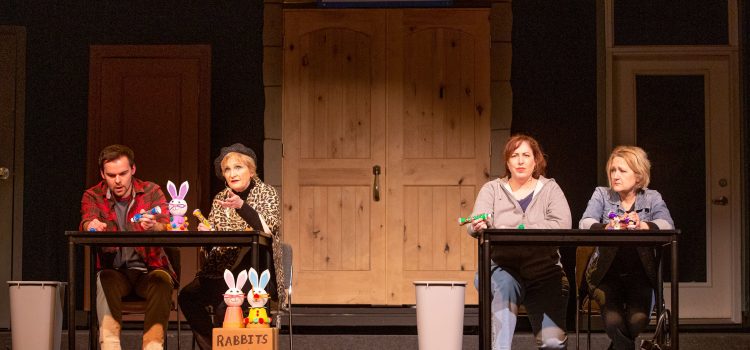
Scenic designer Josh Smith’s economical set takes a back seat to the human drama unfolding, although there are certain props that are meaningful, such as googly-eyed bright pink bunnies that Dottie makes as her side hustle, and a very expensive vase in Dillon’s upscale home.

Justin Been’s sound design and Tyler Duenow’s lighting design are first-rate.

Lindsay-Abaire, who won a Pulitzer Prize for Drama in 2007 for “Rabbit Hole,” draws his characters well, especially women, for Frances McDormand won a Tony for Lead Actress as Margie in “Good People” in 2011 and Cynthia Nixon won as Becca in “Rabbit Hole.”

In the 11 years since the play was produced on Broadway, the gulf seems wider, and the play, which was excellently produced at The Repertory Theatre of St. Louis in January 2013, seems more pertinent than ever about struggles in hard times.

This is a cast that meets the challenge, and Stray Dog meets the moment in a tautly constructed drama of uncomfortable truths.

Lavonne Byers, Laurell Stephenson, Stephen Peirick. Photo by John Lamb

Stray Dog Theatre is presenting “Good People” Feb. 10-26 at 8 p.m. Thursday through Saturday and an additional 2 p.m. matinee on Sunday, Feb. 20, in the Tower Grove Abbey, 2336 Tennessee Avenue, St. Louis, Mo. 63104. For tickets or more information, visit. www.straydogtheatre.org

Special guidelines are in place for the health and safety of guests, actors and staff: Masks are required of all guests, regardless of vaccination status. They still encourage physical distancing throughout the theater. They recommend, but do not require, that all guests be vaccinated.