
By Lynn Venhaus
Five original voices made their auspicious LaBute New Theater Festival debut this year, along with the fest’s esteemed namesake with another intriguing new one-act.
The festival, established in 2013, is an active collaboration between St. Louis Actors’ Studio and Neil LaBute, the renowned playwright, screenwriter, and director of theater and film.
In its 12th year, the festival’s quality, in terms of performers and writing, remains top-notch. Six nimble actors – returning Anthony Wininger, Tyler Crandall and Xander Huber join newcomers Nick Barrows, Jade Cash and Caitlin Mickey – for an engaging exploration into the comedy and drama of being.
Presented in The Gaslight Theatre’s intimate black box as one of the company’s signature offerings every season, the line-up features authentically drawn characters by writers who have some thought-provoking points to make.
This year’s assortment are delivered with aplomb by veteran directors Eric Dean White and Wendy Renee Greenwood, who helmed three apiece, and their keen perceptions are crystal clear.
The evening of one-acts’ six titles include suspense, mystery, pitch-black comedy, whimsy, an interesting family dynamic, childhood trauma, a missing spouse, and grave diggers with a grisly task. All but one are in present day.
The well-rehearsed performers establish a comfortable rhythm in their interactions that draw us into each new world and are paired well in four two-handers and two trios.
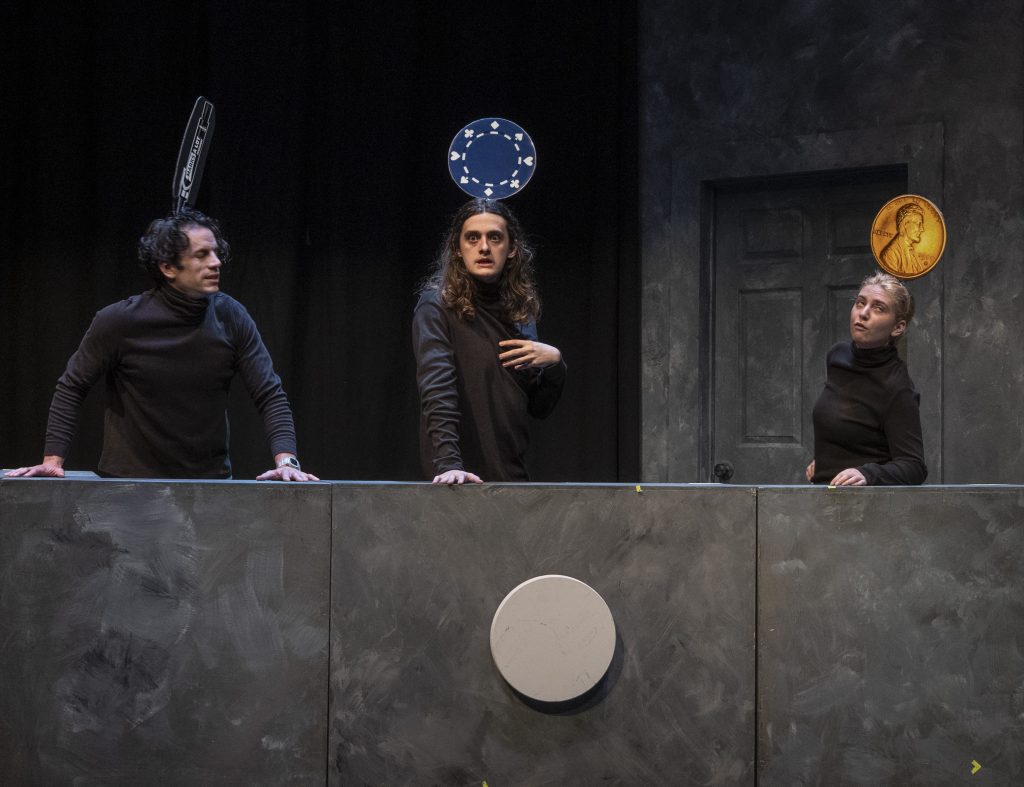
In the clever “Junk Drawer,” playwright Erin Fitzgerald of Kentucky started on a lighthearted note. It sounds as fun as it is. White directed Cash as a penny, Huber as a poker chip, Crandall as a dried out magic marker, and Wininger as a boot strap. He leaned into the witty wordplay that made this assured piece work well and the actors joyfully gave the objects personalities like Pixar does in the “Toy Story” movies.
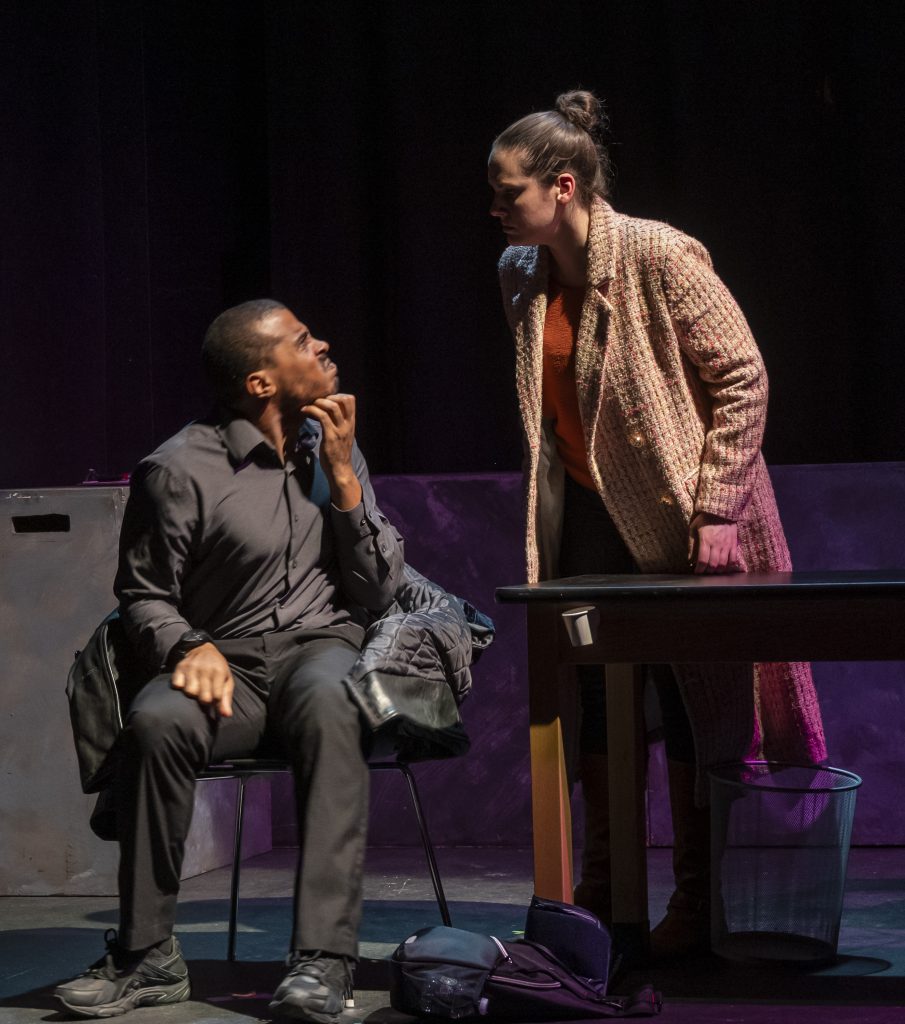
Switching the mood to contentious, a slow-burn “Go Fish” followed from Cameron Michles, a New York-based playwright who doled out dollops of information as a guarded interaction occurs between Caitlin Mickey as Chloe and Nick Barrows as Whittaker, in an impressive St. Louis theater debut.
The pair meet after considerable time has passed in their lives, but has it really for these two? It’s awkward, apologetic – and icky-awful. A few of the flashback techniques aren’t clear until the final gut-punch.
When we finally realize what happened, it’s chilling. Greenwood skillfully directed so that the present encounter builds in tension, hurt, anger and regret, and the actors carefully modulated their feelings so as not to get ahead. The program gives a content warning for “depiction of violence, sexual violence, and molestation.”
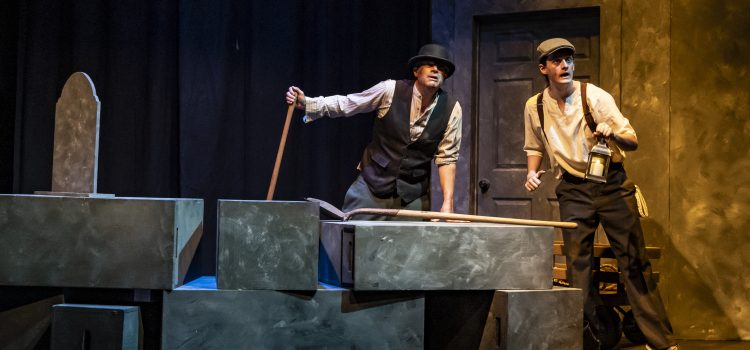
In “Resurrection Men,” playwright Nicholas Dunn revived an underground and illegal body-snatching enterprise that occurred in the United Kingdom in the 18th and 19th centuries, before Parliament passed the Anatomy Act of 1832, which made grave-robbing illegal for medical schools.
This was at a time when cadavers were necessary for medical qualifications. (After that, these med schools were allowed to use unclaimed bodies at workhouses, prisons and hospitals).
Dunn, from Salt Lake City, created a time crunch for Hatt (Wininger) and newbie Fitz (Huber), while a doctor, Knox (Jade Cash), anxiously waited for them to deliver. White kept the action moving, as the two men, looking to make a buck and on the lookout for cops or nosy tattletales, keep their shovels busy. Fitz is nervous, Hatt is the seasoned veteran, and interaction escalated until there is a surprising turn.
Huber and Wininger work well together, committed to the characters, but the play lacked the heft that other offerings possessed.
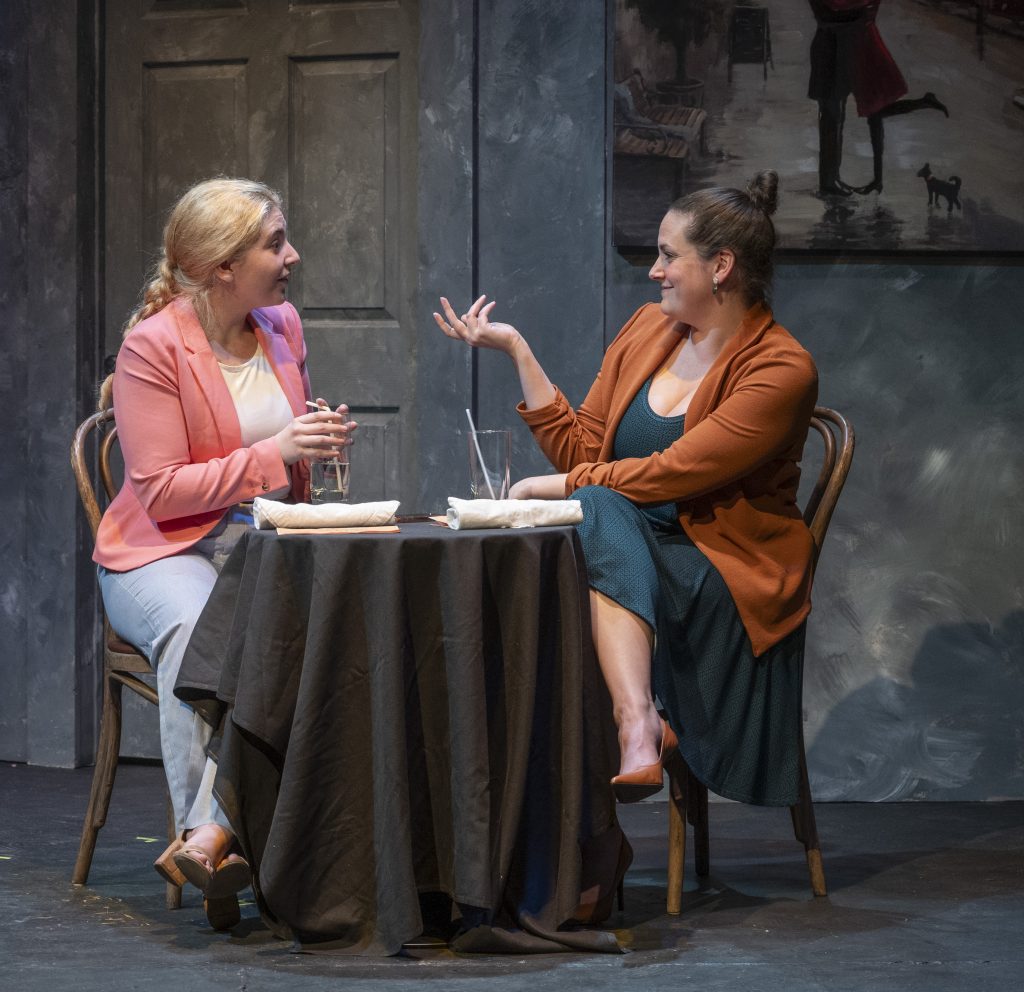
After intermission, LaBute’s dandy dialogue-driven “Brunch” involved two friends – Candice (Mickey) is dealing with a cold criminal case, while Shasta (Cash) listens, feigning interest and sympathy. She asks questions, but it is what she doesn’t say that implies otherwise.
As Mickey revealed the backstory – her husband has been gone without a trace, the spotlight shifted to Shasta’s reactions. Slyly directed by Greenwood, Cash’s body language is priceless.
LaBute, a master at ambiguity, knows how to layer dark and light material, and this contemporary piece is sharply constructed with a delicious undercurrent of uncomfortable.
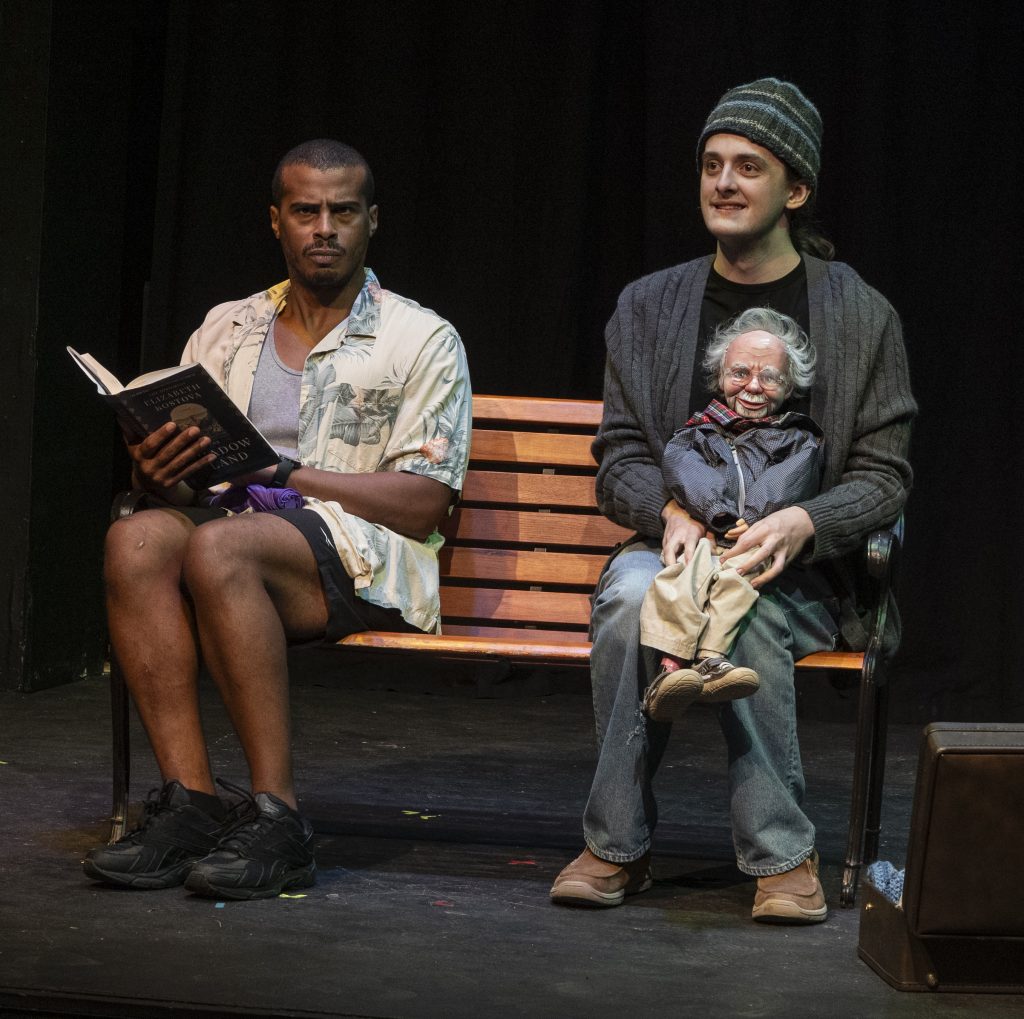
John Pierson’s novel entry, “Little Johnny Knows Things,” threw a cringy curve when Ryan, astutely played by Barrows, is interrupted while reading a book on a park bench. An odd Brett, coyly played by Huber, arrived with a suitcase, grinning.
Against his better judgment, Ryan engaged the peculiar young man, who pulled out a ventriloquist dummy. No doubt, this development was not on his bingo card for the day. Huber clearly relished this role, and deftly handled Little Johnny, who was meticulously crafted by Erin Knadler. This one is funny, a labor of laughs for both playwright and Greenwood.
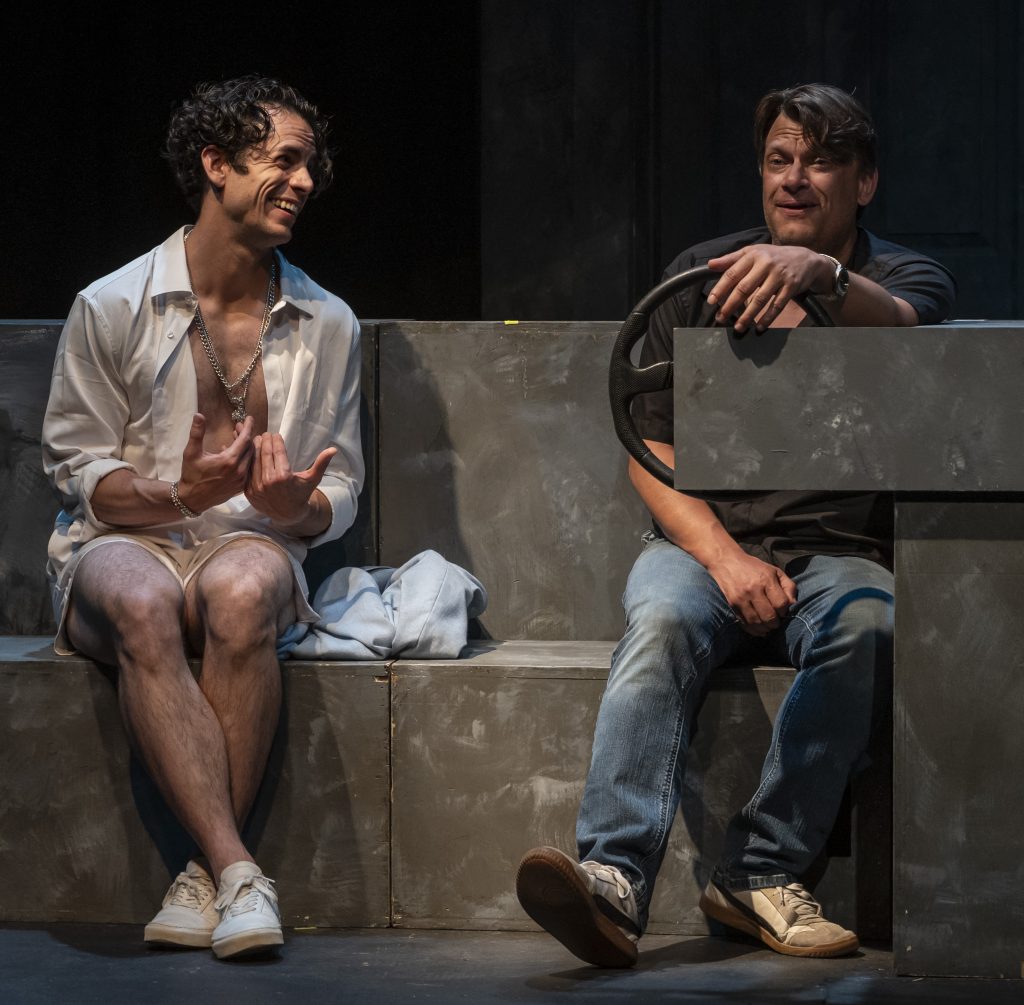
Pierson is familiar at STLAS as a performer, director and in other roles, but playwright is a new endeavor for him. He wrote this one-act while he was a theater fellow at The Bogliasco Foundation in Bogliasco, Italy, earlier this year.
In the final segment, Domenick Scudera concocted a strong sense of time, place and characterization in “The Rules.” Scudera, who works in the greater Philadelphia area, immersed us in a family dynamic between brothers who grew up in Long Island that appears typical but is not. They are together after years apart because their father has died.
In their best performances of the night, Crandall and Wininger pull off the complex relationship between these two very different siblings in a sincere and meaningful way. Crandall is Mario, openly gay, whose sexuality was not embraced by his family. Wininger, in a consistent New York accent, established the older brother Leo as a dominant alpha male. Both have chips on their shoulders.
While Mario is more candid and expressive, tough-nut Leo started, ever so slowly, to crack. There appeared to be an opening as he tentatively confided to Mario some of his confusion, hesitancy, and fears.
White poignantly delivered the authentic interaction while the actors had the crisp timing down pat. It’s the kind of rumination on human connection where you want them all to hug it out.
This year, hundreds of submissions arrived for an 8-member panel to curate, including LaBute, who doesn’t just lend his name to this fest. Supporting new work is a noble endeavor, and the crew is as dedicated as the creatives involved year in and year out.
Stage manager Amy J. Paige demonstrated her prowess in this integral role, assisted this year by Nadya Nabulsi. As is his custom, Patrick Huber smoothly handled set and lighting designs while costume designer Amanda Brasher contributed appropriate casual looks for each scene.
One of STLAS’ most enjoyable aspects in these captivating collections is their needle drops. Their sound design is always well-suited to each one-act.
A notable harmonious team effort, the LaBute Festival accomplished this summer what it does best: Probe, question, wonder, worry, stir, inspire, enlighten, amuse and entertain in a very natural way.
St. Louis Actors’ Studio presents the 12th annual LaBute New Theater Festival July 10 to 26, with performances at 8 p.m. Thursday through Saturday and at 3 p.m. on Sundays at The Gaslight Theater on North Boyle in the Central West End. General admission tickets are available via Ticketmaster or at the theater box office one hour before show time. For more information, visit www.stlas.org.

Lynn (Zipfel) Venhaus has had a continuous byline in St. Louis metro region publications since 1978. She writes features and news for Belleville News-Democrat and contributes to St. Louis magazine and other publications.
She is a Rotten Tomatoes-approved film critic, currently reviews films for Webster-Kirkwood Times and KTRS Radio, covers entertainment for PopLifeSTL.com and co-hosts podcast PopLifeSTL.com…Presents.
She is a member of Critics Choice Association, where she serves on the women’s and marketing committees; Alliance of Women Film Journalists; and on the board of the St. Louis Film Critics Association. She is a founding and board member of the St. Louis Theater Circle.
She is retired from teaching journalism/media as an adjunct college instructor.