
By Alex McPherson

Plenty of punches are thrown but few connect in Benny Safdie’s solo directorial debut “The Smashing Machine,” an awards-hungry drama that sacrifices depth for dress up.

Safdie’s film focuses on Mark Kerr, one of the original American Ultimate Fighting Championship fighters, from 1997 to 2000. When we first meet Mark, he’s the hulking yet surprisingly vulnerable undefeated champ who cannot fathom the concept of losing. He appears almost gentle in his public interactions, yet he remains a force of nature in the ring with a messy life behind the scenes.

He’s accompanied by his girlfriend, Dawn Staples (Emily Blunt), with whom he shares a decidedly unstable relationship. They struggle to navigate the effects of Mark’s celebrity status, Dawn’s attempts to support him, and Mark’s addiction to painkillers.

Mark decides to take part in PRIDE to make more money, the rival UFC league in Japan, with his wrestling BFF Mark Coleman (real-life MMA fighter Ryan Bader). But Mark’s addiction takes its toll, and he loses focus, leading to his first major loss — well, a “No Contest” ruling by the judges.

This sends Mark into a tailspin. His public image is being chipped away, and his already rocky personal life veers down new chaotic avenues. Mark finally goes into rehab and emerges 21 days later (a time jump that the film abruptly cuts to) ready to redeem himself at PRIDE. But can Mark win the championship once and for all, and potentially beat up-and-coming Coleman?

Familiar and slightly-less-familiar beats follow, leading up to, ahem, not all that much to think about. Safdie, one-half of the team that brought us high-throttle stress fests “Good Time,” “Heaven Knows What,” and “Uncut Gems,” takes an unusually surface-level look at Mark’s life in “The Smashing Machine.”

It’s an ostensibly “raw” approach that comes off as curated and sanitized. At least Johnson and Blunt give impassioned performances that are perfect for Oscars highlight reels.

As an opportunity to showcase his acting muscles alongside his actual ones, Johnson delivers. He convincingly showcases the various “sides” of Mark scene to scene as he navigates his public persona and private realities, bringing an intensity and vulnerability (with the help of some impressively detailed makeup) that pairs effectively with Maceo Bishop’s rugged cinematography.
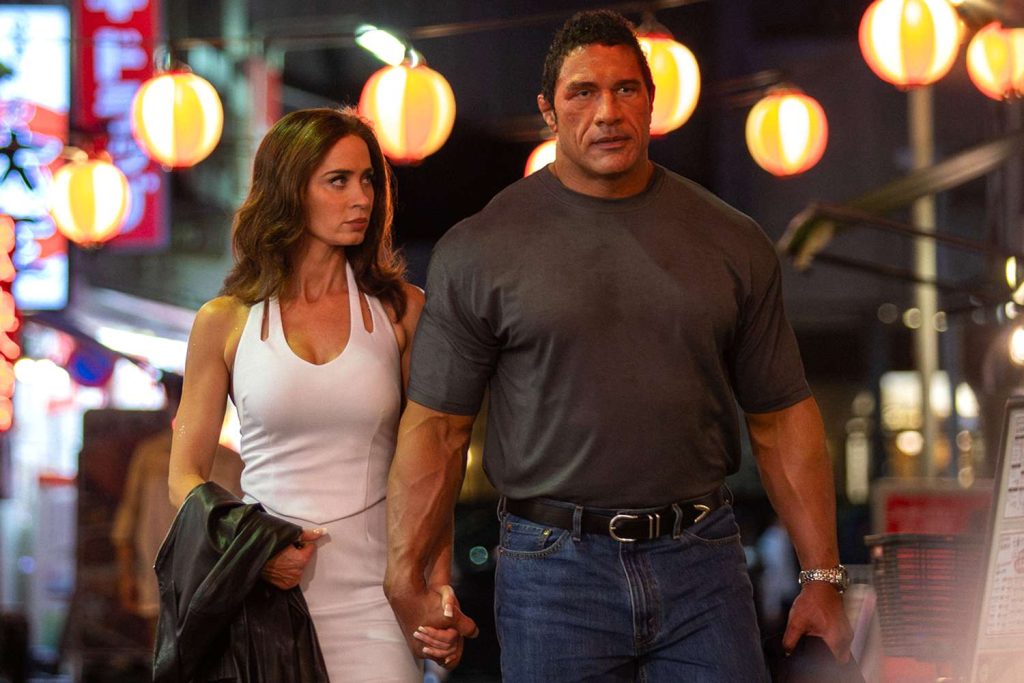
Blunt, too, is intense and volatile as Dawn. The confrontations between Mark and Dawn  are where “The Smashing Machine” succeeds most, as Safdie’s screenplay keeps who we’re “rooting for” in flux as the couple navigates the effects of Mark’s sobriety with often explosive results. 

Indeed, when “The Smashing Machine” focuses in on Mark’s vices, vanity, and loneliness after not being able to maintain the carefully-sculpted façade he’s spent years working towards (particularly during the first half), it succeeds where it counts.

Safdie’s voyeuristic approach brings an uncomfortable immediacy that’s emotionally taxing to watch (in a good way), and the film’s period-accurate stylings and music give it a grimy sense of pizazz; the fights themselves are viscerally well-choreographed, lent extra force by Nala Sinephro’s percussive, restless score.

As soon as Mark goes through the rehab center’s doors, though, Safdie winnows the narrative down to a much more digestible framework, zapped of thematic heft. Mark’s journey from addiction to sobriety largely takes place behind (literal) closed doors, and the nuances of that growth are locked within. 
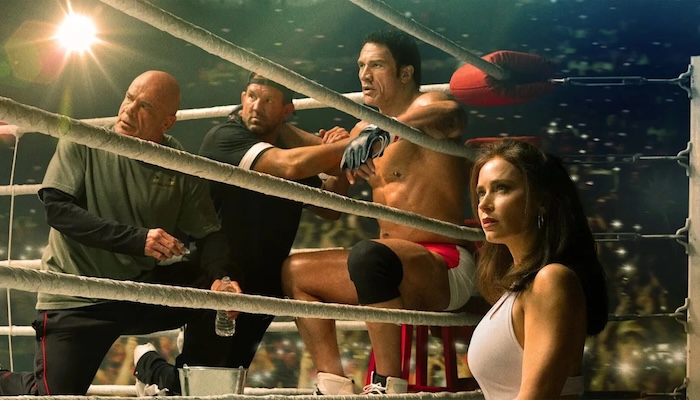
Perhaps the real-life Mark Kerr, who worked as an “informal consultant” on the film, had reservations about just how much Safdie could reveal about his story — seeing the “before” and “after” is definitely a choice, one that skips over a crucial element of Mark’s journey and the courage his recovery requires.

Mark’s eventual self-compassion and acceptance arrives, but, given the film’s lack of meaningful connective tissue, his evolution is merely seen, not felt, or fully understood.

Not every film has to be about something grandiose or particularly important. Wanting to shine light on a sport’s early pioneer is a noble enough goal. With the pedigree of a Safdie brother in the director’s chair, “The Smashing Machine” had the potential to hit hard. All this film leaves us with, though, is a sense of half-developed feeling — lots of yelling and period-accurate immersion lacking much to reflect on once the end credits roll. Oh well, maybe Johnson will get that Oscar.

“The Smashing Machine” is a 2025 sports biopic written and directed by Benny Safdie and starring Dwayne Johnson and Emily Blunt. Rated: R for language and some drug abuse. its runtime is 2 hours, 3 minutes. The film opened in theatres Oct. 3. Alex’s Grade: C.

By Lynn Venhaus

Whatever the imaginary magical Christmas feeling we crave to experience every year at this time, we seek it out in holiday traditions, seasonal foods, songs and movies – whether fantasy or funny.

Granted, most holiday movies are a license to print money. A certain greeting card company’s cable television channel churns out cheery Christmas fare for days on end starting when leaves are still on the trees.

Make no mistake, commerce-driven craftsmanship is manufacturing all the warm and fuzzy, and none of the emotions “Red One” is trying to elicit are earned. This poorly executed family fare will live on eventually streaming on Amazon Prime video. Its clash of tones is irritating, but nevertheless, there are elements that can make either the naughty or nice list.

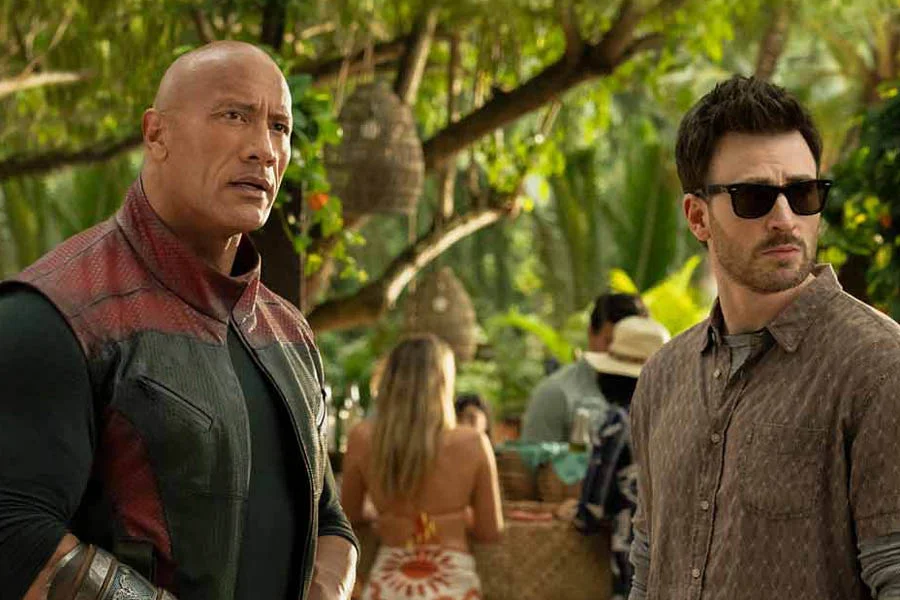
When a villain kidnaps Santa Claus (JK Simmons) from the North Pole, an E.L.F. (Extremely Large and Formidable) operative (Dwayne Johnson) joins forces with the world’s most accomplished tracker (Chris Evans) to find him and save Christmas.

With an abundance of twinkly tinsel, the slickly made fast-paced fantasy action comedy is the latest attempt to please both adults and children alike – and it is likely to be a major crowd-pleasing hit, if the preview audience’s reaction is any indication.

However, upon critical analysis, it’s an overstuffed stocking too big for hanging on the mantel because it sags with extra weight.

“Red One” is altogether too much – aggravating over-the-top computer-generated images (CGI), big beefy actors going through the motions imitating standard characters, derivative storylines from better films, and an overload of shiny distractions. The film cost $250 million to make. And it’s 2 hours and 3 minutes’ long.

The goal is to thwart gigantic gnarly shape-shifting evildoers to save Christmas. Sure, let’s scare the little kids in between the holly and jolly.

With parts both dark and light, weird and wonderful (who wouldn’t want to live and work in Santa’s extravagant futuristic village?), and an occasional sliver of charm and good humor, “Red One” tries to be all things to everyday people, like an all-you-can-eat buffet pre-global pandemic where the budget cuts of meat are over-sauced.

You might have seen the bounteous plot strands before: derelict dad learns the meaning of Christmas after bonding with the son he chose to neglect—reminiscent of “The Santa Clause” from 1994 starring Tim Allen; a Santa Claus kidnap plot in “The Christmas Chronicles” from 2018 starring Kurt Russell; a wintry North Pole wonderland looking like “The Polar Express” with touches of “Elf”; animals out of “Narnia,” and an assortment of ne’er-do-wells, cretins and bad behavior a la “Bad Santa,” “A Christmas Story” and “Jingle All the Way.”

And that’s only the tip of this iceberg. “A miniature sleigh and eight tiny reindeer”? Ha! Santa’s sleigh is souped-up, a marvel of technology that could have been crafted by NASA scientists. The “eight tiny reindeer” that Clement C. Moore wrote about in his “Twas the Night Before Christmas” poem are huge hulking beasts.

JK Simmons created a fine Father Christmas, a good ol’ sincere Nick, who doesn’t have a round belly that shakes like a bowlful of jelly because he’s fit as a fiddle. He works out so he can visit every single home around the world in one night – and sample the cookies left for him. But because he is being held hostage for most of the film, we only experience his delightful performance as bookends.

In a crazy conflict, his adopted brother is Krampus (Kristofer Hivju). This subplot is where it turns nasty and gross, for the mythology surrounding the horned figure is as a punisher of the bad kids.

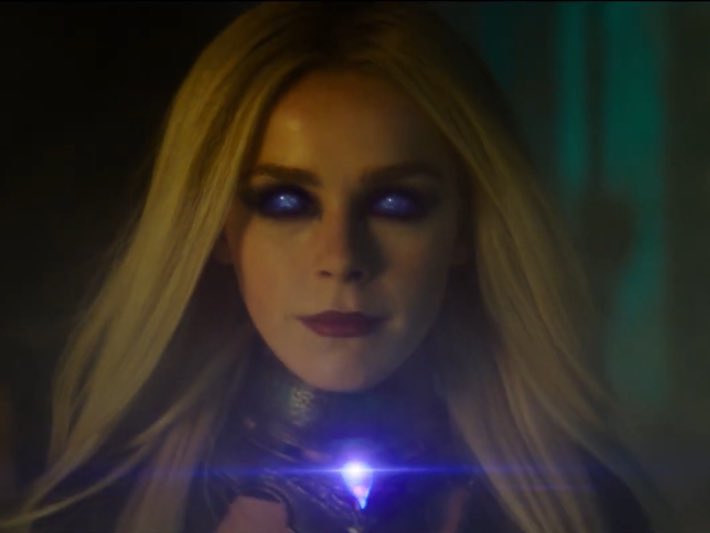
The mastermind of the nefarious plot is Gryla, a witch who’s got a bee in her bonnet about how the naughty kids don’t really receive the consequences they deserve. She is played, with a lot of CGI enhancement, by Kiernan Shipka, best known as Sally Draper on “Mad Men.” Here she wears glossy dark lipstick and has an ominous magnified voice.

It’s a ridiculous premise, written by Chris Morgan, who is responsible for three “Fast and Furious” franchise scripts that I thought were written by chimps, and Hiram Garcia, who wrote one episode of “Young Rock” and produced two “Jumanji” movies directed by Jake Kasdan, who was at the helm here.

Kasdan is known for broad satire and has missed the mark before in the raunchy “Bad Teacher” and goofy “Walk Hard: The Dewey Cox Story.” This mash-up is just bizarre, devoid of any genuine sentiment, like a chase-based videogame being played while a fake fireplace is on the television screen. Let’s go to a tropical island with babes in bikinis and attacking snowmen — and Nick Kroll as a bad guy!

Among the vacuous thinly developed characters is Jack O’Malley played by Chris Evans, in selfish cad “Knives Out” mode. A revered hacker and tracker who is supposed to be a legend in the high-tech espionage world despite being a scoundrel in real life. He does have a few earnest moments with Wesley Kimmel, who plays his son Dylan (and is a nephew of Jimmy Kimmel).

He’s enlisted to help the very serious Callum Drift, who is Santa’s head of security – of course, it’s Dwayne Johnson in a role he could do sleepwalking. Do not expect a bromance.

Totally wasted is Lucy Liu as a director who oversees the elaborate Santa compound, and the marvelous Bonnie Hunt as Mrs. Claus. Their screen time is as miniscule as a funny bit with real trolls working the cyber-security detail.

Naturally, filmmakers pepper the soundtrack with some snappy Motown-type versions of Christmas classics, distracting from the movie’s flaws with jingly bells.

Everything is wrapped up in a big red bow.  For some viewers, “Red One” is a pleasant holiday movie. For others, it’s time to let out a cranky ‘Bah, Humbug” and turn to a comforting old favorite.

“Red One” is a 2024 action-comedy-fantasy movie directed by Jake Kasdan and starring Dwayne Johnson, Chris Evans, JK Simmons, Kiernan Shipka, Kristofer Hivju, Nick Kroll, Lucy Liu, Bonnie Hunt and Wesley Kimmel. It is rated PG-13 for action, some violence, and language, and its runtime is 2 hours, 3 minutes. It opened in theaters Nov. 15. Lynn’s Grade: C-.

By Lynn Venhaus
“Jungle Cruise” is junk, as plastic as those animatronic animals and plants that are part of theme park rides.

This big-budget movie, based on Disneyland’s theme park ride where a small riverboat takes a group of travelers through a jungle filled with dangerous animals and reptiles, adding a supernatural element, has been in development and turn-around for years, so what audiences are getting is a movie patched together and written by a committee.

A hodgepodge of other – and better – movies, this Disney action-adventure really wants to be “Raiders of the Lost Ark.” Throw in nods to “Pirates of the Caribbean,” another movie based on a Disney ride, “Lost City of Z” and “The Mummy,” and the experience is derivative, not special.

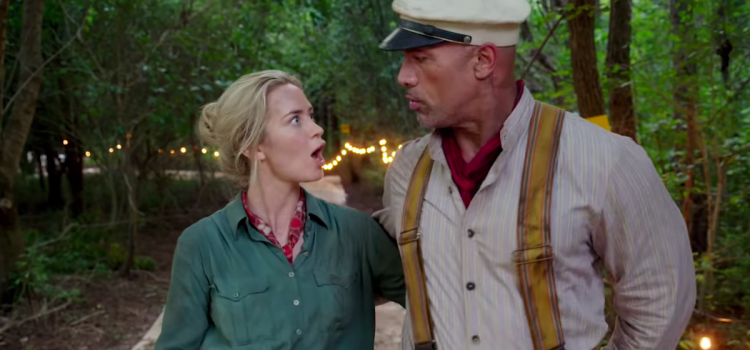
The film’s saving grace is its two leads, Dwayne Johnson, aka “The Rock,” as Frank Wolff, a con artist riverboat captain with a penchant for puns and a hardened heart, and Emily Blunt as headstrong botanist Dr. Lily Houghton, whose altruistic nature leads her on a search through the Amazon to find “Tears of the Moon,” a plant cure-all so that she can heal the sick.

The story is part of a larger mythology that involves Spanish conquistadors and a whole lot of snakes, with cartoonish melodramatic villains eager to wreak havoc as they lust for world domination.

Likeable and charming on their own, Johnson and Blunt have an easy chemistry paired together, although it appears more platonic than romantic. As ordained in this opposites-attract framework, they tussle and the snappy banter is comical – he calls her “Pants” and she calls him “Skippy.”

Their feisty-but-familiar relationship is reminiscent of Michael Douglas and Kathleen Turner in “Romancing the Stone” (1984 — really fun, check it out) and the Oscar-winning classic “The African Queen” featuring Humphrey Bogart and Katharine Hepburn (1951 – magical).

The plucky Lily has brought along her dandy brother, MacGregor, well-played by Jack Whitehall. In a stunning development, although played for laughs, this gay character comes out to the cynical Frank.

In a bit of odd casting, Jesse Plemons plays the obnoxious and lethal Prince Joachim (refer back to the Nazis in “Raiders.” Connected to Kaiser Wilhelm, for it is set at the start of World War I, the evil German progeny is maniacal and hell-bent on power.

Another head-scratcher is barely-in-it Paul Giamatti as a greedy boss, using a thick Italian stereotype accent that’s rather offensive.

The characters are broadly written. Three screenwriters, Michael Green, Glenn Ficarra and John Requa, cobbled together this throwback caper, with the stars injecting some heart and humor, along with the requisite derring-do and danger.

Other than briefly pointing out the obvious misogyny and homophobia of that early 20th century era in King George V England, the film shies away from anything deeper. It does, after all, have roots in a Disneyland tourist excursion. But at least it shows the haughtiness of the male-dominated scientific establishment at that time.

There is a supernatural element that might not be suitable for young children, hence the PG-13 rating. Dark and frightening sequences involve reptiles, ghosts, poison darts and grotesque deaths.

The movie’s focus is on action, and while it zips along once you get past the ancient set-up, 2 hours, 7 minutes seems far too long for this excursion.

Director Jaume Collet-Serra, who made the generic Liam Neeson action movies “The Commuter,” “Non-Stop” and “Run All Night,” knows how to blow things up. He favors quick cuts, which can be traced to his music video-TV commercials background.

Like most summer blockbuster escapism, the film’s main purpose is to string together explosions and other big stunt pieces on land and water.

And the caves. waterfalls and lush landscapes are gorgeously shot by cinematographer Flavio Martínez Labiano. He has imbued an old-fashioned look, not unlike early “Tarzan” movies and Saturday morning serials.

The production design carries that through as well. Designer Jean-Vincent Puzos, who did “The Lost City of Z,” knows his way around dusty museums and mysterious civilizations. Most impressive is a massive stone structure rising out of the water.

But the CGI is so obvious. I can’t get past the fake-looking bees and not-real pet leopard.

Composer James Newton Howard has ramped up the dramatic swells of music in the manner of the Indiana Jones franchise.

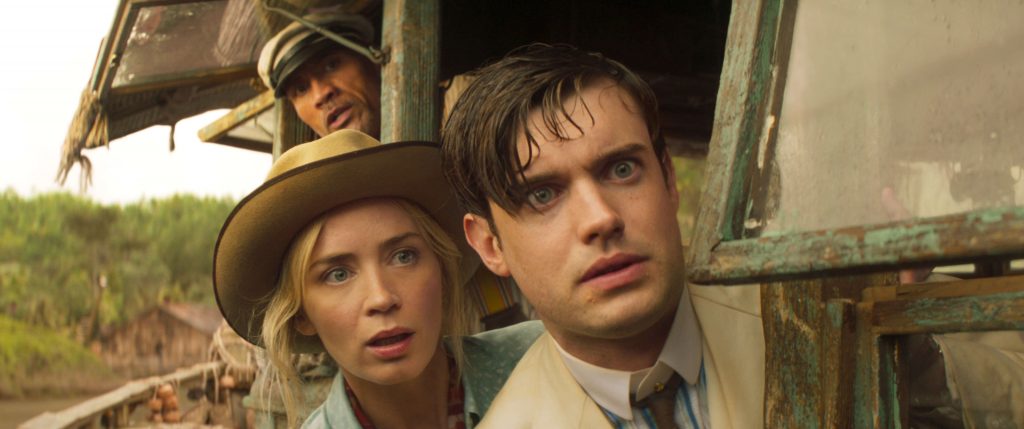
(L-R): Dwayne Johnson as Frank Wolff, Emily Blunt as Lily Houghton and Jack Whitehall as MacGregor Houghton in Disney’s JUNGLE CRUISE. Photo courtesy of Disney. © 2021 Disney Enterprises, Inc. All Rights Reserved.

Without the jolly fun of watching Blunt and Johnson wriggle out of tough situations and give some spark to their green-screen acting, the slick “Jungle Cruise” would be just another visual effects-heavy escapade that we have seen many times before.

“Jungle Cruise” is a 2021 action adventure fantasy romantic comedy directed by Jaume Collet-Serra and starring Dwayne Johnson, Emily Blunt, Édgar Ramírez, Jack Whitehall, Jesse Plemons, Paul Giamatti and Veronica Falcón. It has a 2 hour, 7 minute runtime and is rated PG-13 for sequences of adventure violence. It opened in theaters and streaming on Disney Plus (premium access) on July 30. Lynn’s Grade: C+