
By Lynn Venhaus

Messy and unflinching, “The Mercy Seat” is a complicated relationship play between two New Yorkers in the immediate aftermath of Sept. 11, 2001. At the time of a monumental national tragedy, lovers Ben Harcourt and Abby Prescott are preoccupied with their own lives, not the missing and dead as those numbers climb.

In the Neil LaBute two-hander, first staged in 2002, the thorny dynamic between these two is difficult because the characters are morally bankrupt. And the uncomfortable setting is often claustrophobic, as intended.

After the 25th anniversary commemorating the lives lost that day on Friday, anyone seeking reflection or comfort may be shocked by this unexpected selfish take, for this doesn’t reflect mourning or any insight into universal 9-11 grief, or commentary on national unity.

But those familiar with LaBute’s signature edgy plays won’t be surprised by this brutal battle of the sexes as they sort out or attempt to make sense of being together. Because of the unprecedented attack on the nearby World Trade Center the day before, right at their doorstep, the world has changed overnight.
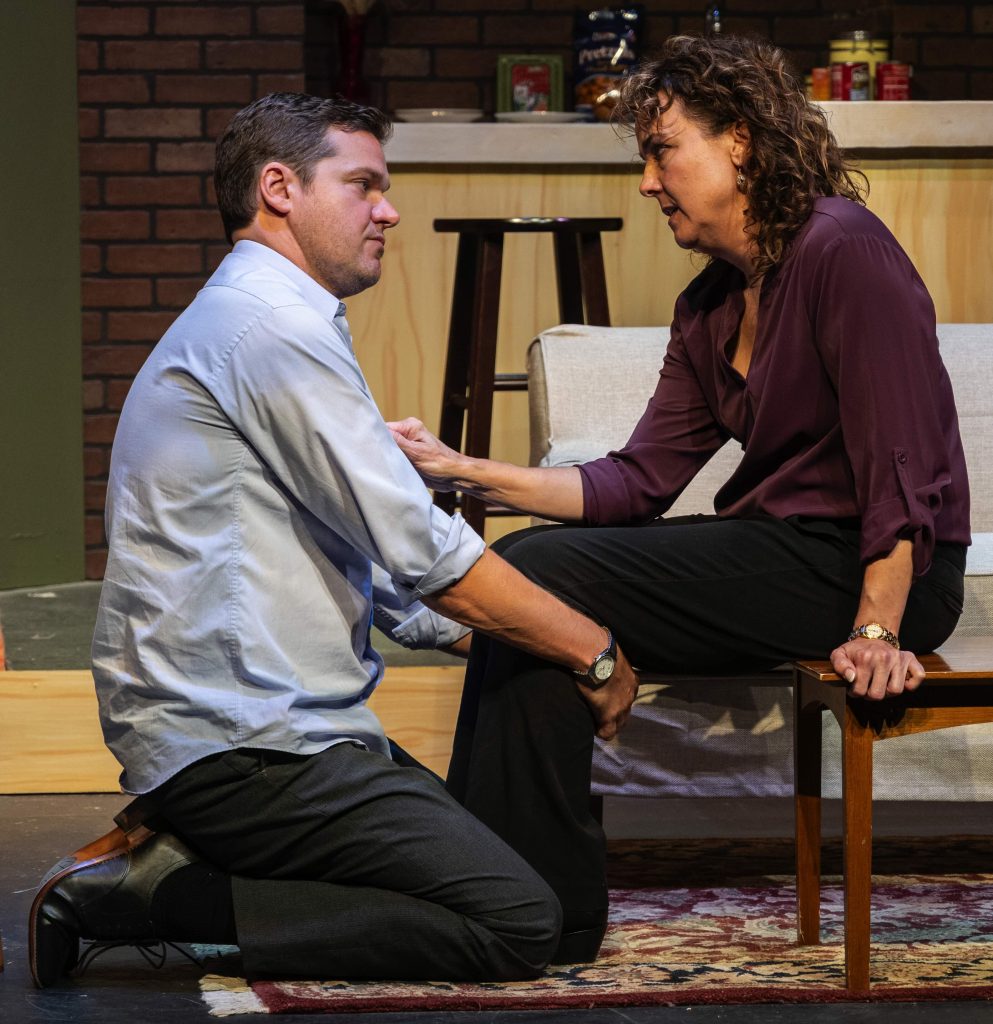
Franklin Killian as Ben and Kelly Schnider as Abby. Photo by Patrick Huber.

This pair, once in a thorny situation, may have more options available because of everyone’s disrupted lives. But how opportunistic are these thoughts and ideas? And how awful are they to even think of a convenient solution?

Franklin Killian and Kelly Schnider, making their St. Louis Actors’ Studio debut, are remarkably adept at the playwright’s rapid-fire dialogue, which creates a certain kind of rhythm that is emphasized in John Pierson’s direction.

Pierson’s nimble staging makes the most of the Gaslight Theatre’s intimate black-box space. The conversation is a power struggle that features frank sex talk and explicit language. Ben is cynical, Abby is bitter– and vice versa.

She is his superior, and older. He is married with children. In the Old Testament, “The Mercy Seat” carries the idea of the removal of sin. But they’re not getting off easy here.

The rawness of the bruised feelings, the surprise – and anguish – of what the other is thinking, and saying out loud, is apparent in the emotional interactions. Nothing is important and everything matters; such is the way LaBute creates the ebb and flow between two strong personalities flailing about on a day after the nation went numb.

Abby and Ben bicker in “The Mercy Seat,” featuring Kelly Schnider and Franklin Killian. Photo by Patrick Huber.

In momentary panic, each blurts out thoughtless remarks at each other, capitalizing on what they view as character flaws. What is it that they ever liked about each other – is it only sexual desire? And how self-absorbed is that? Are they both manipulating each other?

In the new upside-down interrupted world, is it worth maintaining their affair, breaking off or making a deeper commitment? Endgame questions that seek immediate answers. The wordplay is intense, and even in a twisty finish, prioritizes themselves.

Set and lighting designer Patrick Huber has created an efficient apartment setting without any windows on the world – but there is a door where a neighbor in need knocks. As the couple navigates between the kitchen and living room, the walls appear to close in on them.

Pierson also designed the sound, and the outside world intrudes through sounds of sirens and an occasionally ringing cellphone that Ben never picks up. Abby has ventured out to a store, which is no longer a simple task. Casual costumes provided by Teresa Doggett.

Kline and Killian fearlessly operate at a high level of verbal volleying, shifting tones throughout with this discomforting dialogue. LaBute intends to make us squirm – he maintains that clever, cavalier approach, and you’re either appalled or questioning your own impulses.
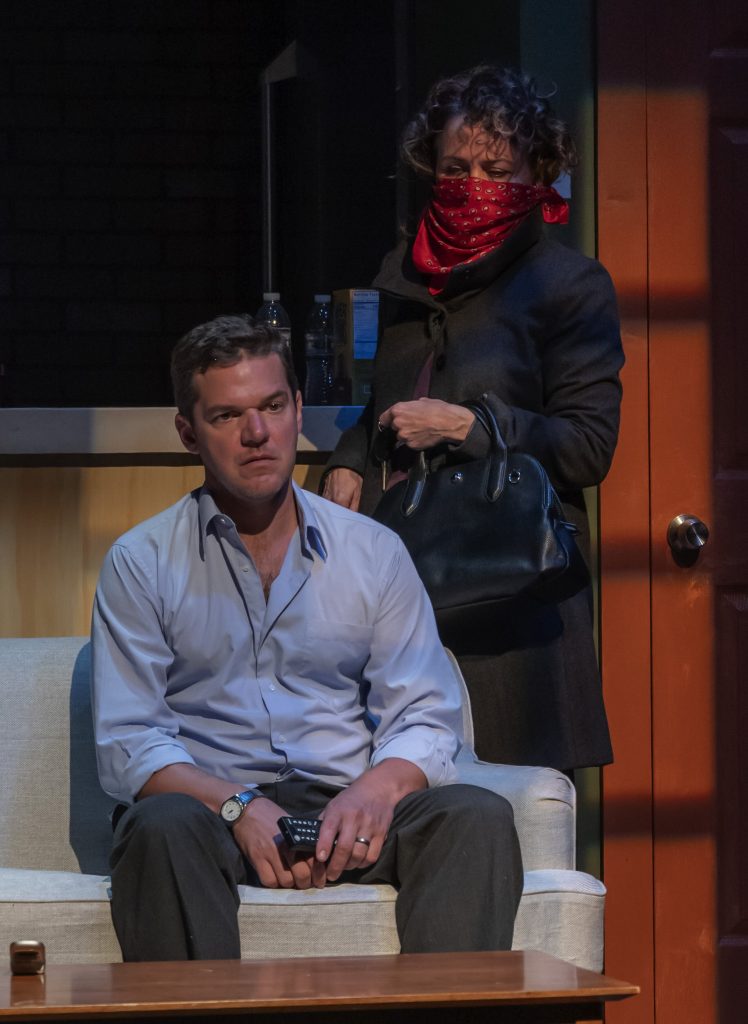
A couple at crossroads in “The Mercy Seat.” Photo by Patrick Huber.

The characters aren’t sympathetic, and those involved in the production are fully aware of the ugliness of human nature and how emotionally draining this work is. But LaBute has made a career of subverting people’s expectations (“The Shape of Things,” “Fat Pig,” “Reasons to be Pretty”).

“The Mercy Seat” premiered Off-Broadway at the Acorn Theatre in an MCC Theater production on Dec. 18, 2002, and closed on Jan. 15, 2003. Directed by LaBute, it starred Liev Schreiber and Sigourney Weaver

Because of his longstanding relationship with St. Louis Actors’ Studio since the creation of the LaBute New Theater Festival in 2013, which features curated short plays, he premieres a one-act every summer.

STLAS has also performed his full-length shows, including “Comfort” in 2022 and “The Way We Get By” in 2017, and his short plays have had lasting impact: “The Possible,” “Here We Go ‘Round the Mulberry Bush,” “Kandahar,” “Hate Crime,” “The Fourth Reich,” “Great Negro Works of Art,” “Unlikely Japan,” “Who’s on First,” and “Brunch” among them.

At 95-minutes without intermission, this unsettling confrontation in a lower Manhattan apartment is an often-fascinating narrative that at times is repetitive, and the sheer verbosity can be tedious.

One can’t shake the feeling that outside, on the ash-covered streets, traumatized New Yorkers are looking for the missing and answers. But inside, this self-centered couple bypasses universal selflessness and collective grief by thinking only of soothing their disillusioned selves.

St. Louis Actors’ Studio presents “The Mercy Seat” by Neil LaBute, Sept. 11-27 at The Gaslight Theater. Performances are on Thursday (second and third week), Friday and Saturday evenings at 8 p.m. and on Sundays at 3 p.m. For more information or to purchase general admission tickets, visit stlas.org or email [email protected].

By Lynn Venhaus
A domino chain of events have a devastating effect on a group of blue-collar steel workers in Lynn Nottage’s hard-hitting play, “Sweat,” which won the Pulitzer Prize for Drama in 2017 and retains its timeliness.

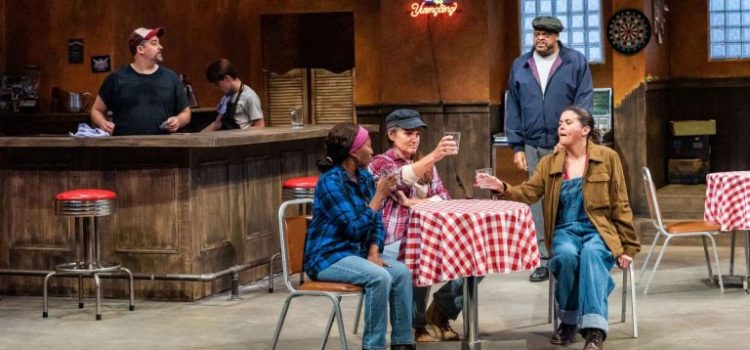
The Black Rep’s outstanding production, which kicked off its 45th season on Sept. 9 and continues through Sept. 26, features powerful performances in a lived-in atmosphere.

You know these characters, the ‘little guys’ who’ve worked the factory floor for years and thought their labor unions would protect them when the corporate owners moved operations to another country for a cheaper labor force.

Set in a local tavern where the Olstead mill workers hang out in Reading, Pennsylvania, this could have taken place in Granite City or Centralia, Ill., or near the shuttered car plants in St. Louis.

Director Ron Himes knows this and understands how today’s political and racial tensions are much the same as then, as well as immigration issues. Those are addressed in two story arcs — changing demographics and the territorial birthright felt by the longtime Caucasian residents.

Sadly, this tale is often not one of fiction in real lives — and has become familiar to anyone living anywhere in the Rust Belt, part of those Northeast and Midwestern regions where an industrial decline has been going on for decades, especially where coal and steel were economy mainstays.

The 2015 play starts and ends in 2008, but most of it takes place in flashback eight years earlier – in 2000, a pivotal time in America, after NAFTA is in place and corporations are going to Mexico. Transparency is not a word in these companies’ vocabulary, as they leave communities shattered and people broken.

The North American Free Trade Agreement was signed by Canada, Mexico, and the United States in 1994 and created a trilateral trade bloc.

The action veers from longtime friends celebrating birthdays, laughing, joking and talking about their lives to escalating tension as uncertainty about their jobs increases, along with harsh outlooks on their economic futures.

This ensemble is nimble and natural, conveying the complexities of their relationships with skill and emotional depth. The cast projects how longtime friends act and what their workplace is like with ease.

Nottage’s dialogue is shrewd and perceptive about race, class and identity. She understands the frustrations of these characters, and the lens in which they view the world.

Nottage, who is the only woman to win the Pulitzer Prize twice for Drama, first for “Ruined” in 2009, frequently writes about marginalized people.

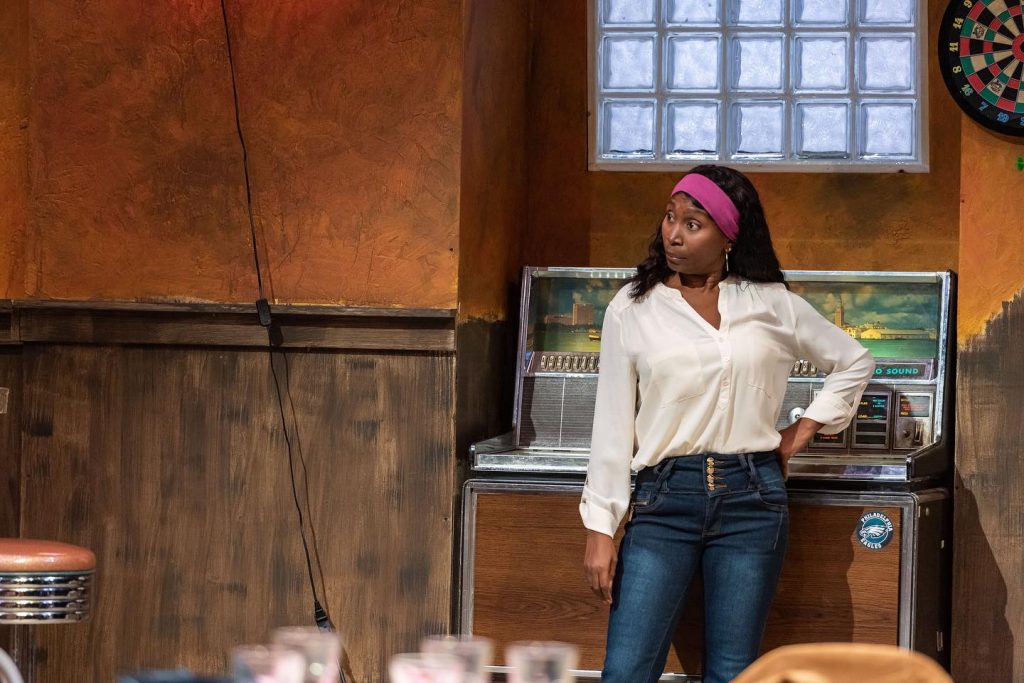
For Cynthia and Tracey, is friendship or survival stronger? The actresses Amy Loui and Velma Austin expertly convey their conflicts and mood shifts, show how friendships sour when misunderstandings and envy erupt.

Their friend Jessie drinks too much and once had dreams of traveling the world but got a job at the factory and stayed. Kelly Howe gives what could be a stereotype some nuance – and superbly displays various levels of inebriation.

The cast is anchored by Stan, the bartender who was injured on the job at the mill and reflects on multiple labor issues as he is often the voice of reason – and at least history.

He attempts to put things in perspective and tells the young bucks who are chomping at the bit that they should be outraged by the bosses, not the little guys trying to get ahead like they are.

In his Black Rep debut, Black Anthony Edwards is impressive as the guy who’s good at listening, who speaks common sense, and has made lemonade out of the lemons he was given impairing his leg and being unable to work at what he did for years.

Physically, he looks like the character Stan. Praise to the costume designer Hali Liles for her spot-on outfits depicting the wardrobes of ordinary people living in the Rust Belt.

After they strike, and Cynthia and Tracey’s sons Chris and Jason are laid off, their lives are altered forever after tensions explode in violence. The fight choreography by Paul Steger is fluid and the cast well-rehearsed to make it seem natural.

Chris wanted to make something of himself, and Brian McKinley earnestly portrays his yearning to achieve, especially after watching his dad Brucie (frequent Black Rep performer A.C. Smith) fall on hard times after being shut out at a textile plant.

The boys serve prison sentences, as reflected in the opening scene with parole officer Evan, played with authority by Don McClendon. Franklin Killian is strong as the hothead redneck Jason, now tattoed on his face and a white supremist. He perfectly embodies the once fun-loving guy now a lost soul.

The subject of the boys’ rage is represented by Oscar, a Colombian American who works as the bar’s busboy but seizes an opportunity to make more money by replacing striking workers. The regular clientele are seething about this ‘scab.’

Oscar, well-played by Gregory Almanza, pours out his heart to Stan, telling him about how ignored he is, perceived to be an immigrant when he was born in the U.S. His dad swept floors at the mill, now he wants to achieve more. He is caught in the crossfire of misplaced fury.

The scenic design by Tim Jones aptly captures this world, with detailed property work by Meg Brinkley, all expertly lit by lighting designer John D. Alexander. The jukebox works well, thanks to the terrific sound design by Kareem Deanes.

Featuring one of the year’s best ensembles, a timely tale and expert production elements, “Sweat” is not to be missed.

Velma Austin as Cynthia. Photo by Phillip Hamer.

“Sweat” will continue through Sept. 26, with Thursday show at 7 p.m., Friday and Saturday at 8 p.m., and Sunday at 3 p.m.

$15 student rush tickets are available for all shows — 30 minutes before the show with a valid student I.D.

For more information: www.theblackrep.org

Season subscriptions and single tickets for “Sweat” are available at www.theblackrep.org or by calling the Box Office at 314-534-3807. Groups of 12 or more may also reserve tickets by phone. Seating will be at 50 percent capacity; for complete information on current health protocols please visit www.theblackrep.org.

The Black Rep’s 45th Anniversary Season sponsors include the Arts and Education Council, The Black Seed Initiative, Centene Charitable Trust, Missouri Arts Council, Regional Arts Commission, Rodgers-Townsend, The Shubert Foundation, the Steward Family Foundation, and Washington University in St. Louis.

COVID-19 PROTOCOLS

Our top priority for reopening is the health and safety of our staff, artists and patrons. We have been working diligently to bring live theatre back. The Black Rep is part of the growing coalition of St Louis performing arts venues and producers that have agreed upon Covid-19 Vaccination/Testing and Mask Requirements for audiences, artists and staff through the end of 2021.

Everyone must be fully vaccinated or have received a negative covid test results no more than 72 hours prior to coming on campus. A Covid19 vaccination card or a negative test result must be presented upon entering the building.

Masks are required at all times while indoors on campus. Even if you are seated in pods and distanced, masks must remain in place.

Everyone will need to complete the visitorscreening.wustl.edu within 2 hours of your arrival to campus. You will receive a message indicating that you are cleared to come to campus and you will be asked to present the “cleared” message to ushers at the entrance of the building. For those without smart phones, there is a station in Mallinckrodt where you can complete the screener on an iPad. If you receive a message that you are “not cleared”, we ask that you not come to campus or leave campus if you are completing the screener on campus.

The St. Louis Black Repertory Company opens its 45thAnniversary Season September 10 with an in-person production of the Pulitzer Prize-winning “Sweat” by Lynn Nottage. Addressing the complexities of race, class and friendship at a pivotal moment in America,
the powerful work will be presented in person at the Edison Theatre at Washington University and directed by Founder and Producing Director Ron Himes. Previews begin on Wednesday, September 8.

A courageous and heartbreaking story explores the lives of a tight-knit group of factory workers who spend their days drinking, sharing secrets, and laughing. When layoffs and strikes create tension within the group the trust is broken. “Playwright Nottage tensely captures the root of our current political and racial tension in society today,” said Himes. “Are we only looking out for ourselves or are we
responsible for each other?”

The cast features Velma Austin (Joe Turner’s Come and Gone, The Screened in Porch), A.C. Smith (King Hedley II, The Trials of Brother Jero), Amy Loui (Canfield Drive, Three Ways Home), Don McClendon (Blues for Mr. Charlie), and Brian McKinley (Home, Spell #7). Franklin Killian, Blake Anthony Edwards, Gregory Almanza, and Kelly Howe will all be making their debut at The Black Rep

The production will feature Scenic Design by Tim Jones, Lighting Design by Jonathan Alexander, Costume Design by Hali Liles, Sound Design by Kareem Deanes, and Properties Designed by Meg Brinkley.

Fight Choreography will be done by Paul Steger who is certified by the Society of American Fight Directors and holds advanced certificates from the British Academy of Stage and Screen Combat & Fight Directors. Jim Anthony is the Stage Manager and Technical Fellow Tatiana Durant is the Assistant Stage Manager.

Season subscriptions and single tickets for “Sweat” are available at www.theblackrep.org or by calling the Box Office at 314-534-3807. Groups of 12 or more may also reserve tickets by phone. Seating will be at 50 percent capacity; for complete information on current health protocols please visit www.theblackrep.org.

The Black Rep’s 45th Anniversary Season sponsors include the Arts and Education Council, The Black Seed Initiative, Centene Charitable Trust, Missouri Arts Council, Regional Arts Commission, Rodgers-Townsend, The Shubert Foundation, the Steward Family Foundation, and Washington University in St. Louis