
By Alex McPherson

Director Jane Schoenbrun’s surrealist meta–slasher-satire-character-study “Teenage Sex and Death at Camp Miasma” is ambitious and wholly unique, even if occasionally muddled by the weight of its dense ideas.

We follow Kris Williams (Hannah Einbinder), an academic queer filmmaker hired by a big studio to direct a reboot of the “Camp Miasma” slasher-film franchise. The series has, over the years, become reduced to bargain-bin sequels and cultural irrelevance, beautifully visualized in a nostalgic, acerbic opening title sequence.

The villain, “Little Death,” wears an HVAC air vent on their head and carries a spear, skewering any poor soul who dares to stay at the titular camp.

Kris has always felt a special attachment to the series (“special attachment” is an understatement, as we later find out). She wants to make the original’s “Final Girl” Billy Presley (Gillian Anderson) the main character of this new outing. Studio reps and her agent (played by Sarah Sherman) aren’t thrilled, and are more interested in Kris sanitizing and “de-cancelling” the franchise’s transphobic core for a modern audience. 
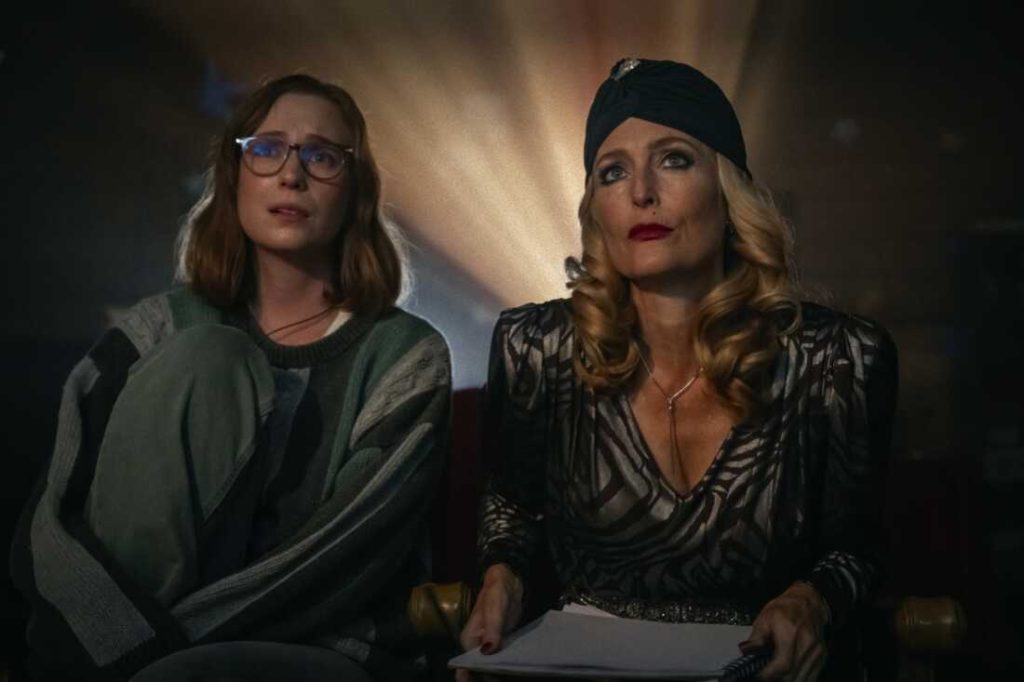
Hannah Einbinder and Gillian Anderson.

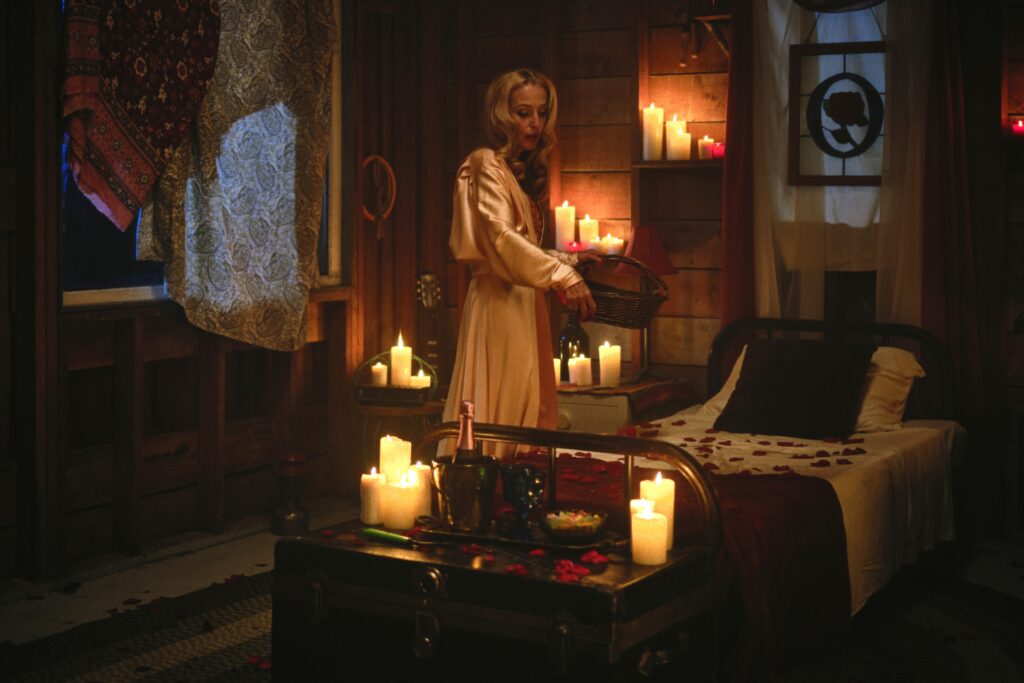
Billy retired from acting after the original film was released, but Kris sees an opportunity to capture that initial spark. It’s all the better, and weirder, that Billy now resides at a remote lakeside cabin in the Pacific Northwest at Camp Rivoli, the abandoned campground where the first “Miasma” was filmed.

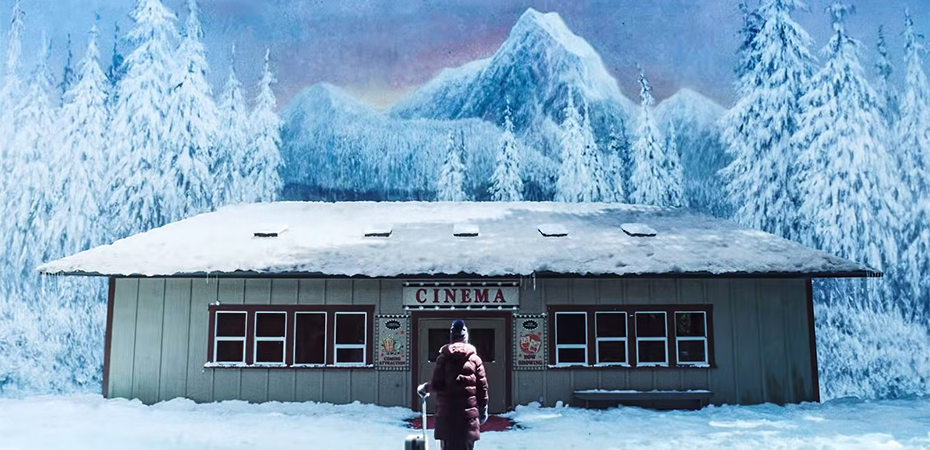
Things are strange from the get-go, with Kris barely being able to find Camp Rivoli and wandering into a local cinema. A projector flickers to life and Kris watches the scene where young Billy (Amanda Fix) loses her virginity before being stabbed by Little Death — the sequence that stuck with Kris the most, even if she can’t quite identify why it has that effect on her. 

She then meets present-day Billy, who resembles Norma Desmond from “Sunset Boulevard” with a southern twang, seductive aura, and love of weed. The two quickly bond over a basket of KFC chicken tenders and grow closer from there.

They both deconstruct their attachment to the “Miasma” franchise and find new avenues to explore — namely, further unlocking desire, pleasure, and good ‘ole cinephilia amid the blood-drenched fantasy of Little Death.
“Teenage Sex and Death at Camp Miasma” is, like Schoenbrun’s previous “I Saw the TV Glow,” not for all tastes, so obviously personal that it threatens to leave behind viewers who aren’t willing to go along with its swerving rhythms. 

Indeed, Schoenbrun’s latest project has a ton on its mind, from critiquing the slasher genre and the injustices of studio moviemaking to, most successfully, examining the powerful influence that films can have over our sense of self. There’s too much going on at any given point, but it’s a compulsively watchable mess that ultimately couldn’t be any other way.

Much of “Camp Miasma” rests on the shoulders of Einbinder and Anderson, and they’re both fully up to the task. Einbinder is the standout — able to show Kris’s evolution from high-strung, awkward, nerdy intellectual to someone gradually breaking through their shell to embrace their true desires. 

It’s a tough tightrope to walk, and it’s to Einbinder’s credit that Kris never becomes unlikable, just restrained by societal expectations and unsure of what they truly want in life; there’s also a deep connection to Billy and Little Death that defies traditional reason.
Einbinder is able to flex her comedic chops from time to time, but Schoenbrun’s screenplay treats her character arc seriously, maintaining a mostly successful throughline that continues Schoenbrun’s interest in the complex ways that media can shape us.

Einbinder and Anderson’s chemistry sizzles, and Anderson nails the balance between campiness and sincerity. Billy supports Kris from the jump, but she believes that Kris misunderstands the core of the “Miasma” series and its carnal appeals, which are more base but no less impactful.

Schoenbrun’s direction is, yet again, outstanding, making Camp Rivoli a setting out-of-time and existing in a liminal space between reality and fantasy, complete with dazzling matte paintings and an almost fairy-tale aesthetic. 

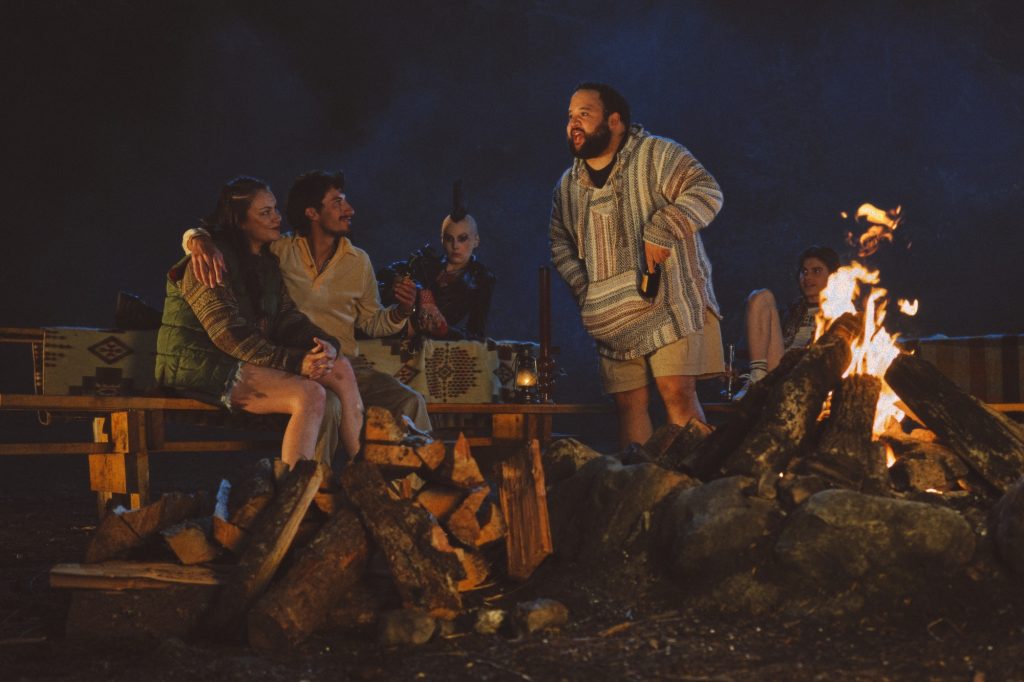
Much of the film is spent watching the film-within-the-film (with an ensemble including Eva Victor and Zach Cherry), similar to “TV Glow,” which Schoenbrun recreates with strong attention to period detail. They lean into the cheesiness inherent in its “Friday the 13th” and “Sleepaway Camp” influences while painting Little Death as exacting a sort of justified vengeance.
One ultraviolent sequence in particular, set to a melancholic country song, is cartoonishly gruesome and, perhaps counterintuitively, meditative.

There’s a certain point in Schoenbrun’s film, though, especially when the lines between fantasy and reality are blurred, that it becomes overwhelming and overstuffed. It loses some of its charm to the exhausting throes of self-indulgence. 

At these points, along with some perhaps overly broad commentary on the state of the movie industry, it seems like Schoenbrun throws everything at the wall to see what sticks (literally, in some cases). They sacrifice coherence for pure “feeling” — not inherently a problem, but alienating as new elements keep getting introduced that clumsily fit into the unruly tapestry Schoenbrun has been building.

So, while not as poignant as “TV Glow,” “Teenage Sex and Death at Camp Miasma” is still entirely like nothing else, another example of experimental filmmaking that deserves support whether or not its wild swings fully connect.

“Teenage Sex and Death at Camp Miasma” is a 2026 horror film directed by Jane Schoenbrun that stars Gillian Anderson, Hannah Einbinder, Eva Victor, Zach Cherry, Amanda Fix, and Sarah Sherman. It is rated R for bloody violence, gore, sexual content, graphic nudity, drug use and some language, and the run time is 1 hour, 52 minutes. It opened in local theatres Aug. 21. Alex’s Grade: B+

The Critics Choice Association (CCA) announced the winners of the 26th annual Critics Choice Awards LIVE on The CW during an in-person/virtual hybrid ceremony hosted for the third time by acclaimed film, television, and stage star Taye Diggs on Sunday, March 4.  The full list of winners can be found below. 

“Nomadland” led the winners in the film categories, taking home four awards including Best Picture, Best Director and Best Adapted Screenplay for Chloé Zhao, and Best Cinematography for Joshua James Richards.  Zhao is the first Chinese woman to win as either director or writer. 

“Ma Rainey’s Black Bottom” followed closely behind, winning three categories including Best Actor for the late Chadwick Boseman, Best Costume Design, and Best Hair and Makeup.  Best Actress was awarded to Carey Mulligan for “Promising Young Woman,” which also earned a Best Original Screenplay win for Emerald Fennell.  Best Supporting Actor went to Daniel Kaluuya for “Judas and the Black Messiah,” and Best Supporting Actress to Maria Bakalova for “Borat Subsequent Moviefilm.”   

In the series categories, “The Crown” took four categories, the most of the night, winning Best Drama Series, Best Actor in a Drama Series for Josh O’Connor, Best Actress in a Drama Series for Emma Corrin, and Best Supporting Actress in a Drama Series for Gillian Anderson.  In the comedy genre, “Ted Lasso” won all three categories for which it was nominated: Best Comedy Series, Best Actor in a Comedy Series for Jason Sudeikis, and Best Supporting Actress in a Comedy Series for Hannah Waddingham.  “The Queen’s Gambit” took the prize for Best Limited Series, and its leading lady Anya Taylor-Joy won Best Actress in a Limited Series or Movie Made for Television. 

The race for “Best Comedy Special,” which was dominated entirely by Netflix nominees, resulted in a tie between “Jerry Seinfeld: 23 Hours to Kill” and “Michelle Buteau: Welcome to Buteaupia.” 

As was previously announced, John David Washington presented this year’s SeeHer Award to his “Malcolm & Marie” co-star, Zendaya.  The SeeHer Award recognizes a woman who embodies the values set forth by the SeeHer movement, to push boundaries, defy stereotypes and acknowledge the importance of authentic portrayals of women across the entertainment landscape. 

After leading the nominations, Netflix also won the most awards of any studio/network with a total of 14.  Amazon Studios and Searchlight Pictures each won four. 

Critics Choice Awards are bestowed annually to honor the finest in cinematic and television achievement.  Historically, they are the most accurate predictor of Academy Award nominations. 

The 26th annual Critics Choice Awards show was produced by Bob Bain Productions and Berlin Entertainment.  The CCA is represented by Dan Black of Greenberg Traurig. 

Follow the 26th annual Critics Choice Awards on Twitter and Instagram @CriticsChoice and on Facebook/CriticsChoiceAwards.  Join the conversation using #CriticsChoice and #CriticsChoiceAwards. 

FILM CATEGORIES 

BEST PICTURE 

Nomadland (Searchlight Pictures) 

BEST ACTOR 

Chadwick Boseman – Ma Rainey’s Black Bottom (Netflix) 

BEST ACTRESS 

Carey Mulligan – Promising Young Woman (Focus Features) 

BEST SUPPORTING ACTOR 

Daniel Kaluuya – Judas and the Black Messiah (Warner Bros.) 

BEST SUPPORTING ACTRESS 

Maria Bakalova – Borat Subsequent Moviefilm (Amazon Studios) 

BEST YOUNG ACTOR/ACTRESS 

Alan Kim – Minari (A24) 

BEST ACTING ENSEMBLE 

The Trial of the Chicago 7 (Netflix) 

BEST DIRECTOR 

Chloé Zhao – Nomadland (Searchlight Pictures) 

BEST ORIGINAL SCREENPLAY 

Emerald Fennell – Promising Young Woman (Focus Features) 

BEST ADAPTED SCREENPLAY 

Chloé Zhao – Nomadland (Searchlight Pictures) 

BEST CINEMATOGRAPHY 

Joshua James Richards – Nomadland (Searchlight Pictures) 

BEST PRODUCTION DESIGN 

Donald Graham Burt, Jan Pascale – Mank (Netflix) 

BEST EDITING – TIE  

Alan Baumgarten – The Trial of the Chicago 7 (Netflix) 

Mikkel E. G. Nielsen – Sound of Metal (Amazon Studios) 

BEST COSTUME DESIGN 

Ann Roth – Ma Rainey’s Black Bottom (Netflix) 

BEST HAIR AND MAKEUP 

Ma Rainey’s Black Bottom (Netflix) 

BEST VISUAL EFFECTS 

Tenet (Warner Bros.) 

BEST COMEDY 

Palm Springs (Hulu and NEON) 

BEST FOREIGN LANGUAGE FILM 

Minari (A24) 

BEST SONG  

Speak Now – One Night in Miami (Amazon Studios) 

BEST SCORE 

Trent Reznor, Atticus Ross, and Jon Batiste – Soul (Disney) 

SERIES CATEGORIES 

BEST DRAMA SERIES 

The Crown (Netflix) 

BEST ACTOR IN A DRAMA SERIES 

Josh O’Connor – The Crown (Netflix) 

BEST ACTRESS IN A DRAMA SERIES 

Emma Corrin – The Crown (Netflix) 

BEST SUPPORTING ACTOR IN A DRAMA SERIES 

Michael K. Williams – Lovecraft Country (HBO)

BEST SUPPORTING ACTRESS IN A DRAMA SERIES 

Gillian Anderson – The Crown (Netflix) 

BEST COMEDY SERIES 

Ted Lasso (Apple TV+) 

BEST ACTOR IN A COMEDY SERIES 

Jason Sudeikis – Ted Lasso (Apple TV+) 

BEST ACTRESS IN A COMEDY SERIES 

Catherine O’Hara – Schitt’s Creek (Pop) 

BEST SUPPORTING ACTOR IN A COMEDY SERIES  

Daniel Levy – Schitt’s Creek (Pop) 

BEST SUPPORTING ACTRESS IN A COMEDY SERIES 

Hannah Waddingham – Ted Lasso (Apple TV+) 

BEST LIMITED SERIES 

The Queen’s Gambit (Netflix) 

BEST MOVIE MADE FOR TELEVISION 

Hamilton (Disney+) 

BEST ACTOR IN A LIMITED SERIES OR MOVIE MADE FOR TELEVISION 

John Boyega – Small Axe (Amazon Studios) 

BEST ACTRESS IN A LIMITED SERIES OR MOVIE MADE FOR TELEVISION 

Anya Taylor-Joy – The Queen’s Gambit (Netflix) 

BEST SUPPORTING ACTOR IN A LIMITED SERIES OR MOVIE MADE FOR TELEVISION 

Donald Sutherland – The Undoing (HBO) 

BEST SUPPORTING ACTRESS IN A LIMITED SERIES OR MOVIE MADE FOR TELEVISION   

Uzo Aduba – Mrs. America (FX) 

BEST TALK SHOW 

Late Night with Seth Meyers (NBC) 

BEST COMEDY SPECIAL – TIE  

Jerry Seinfeld: 23 Hours to Kill (Netflix) 

Michelle Buteau: Welcome to Buteaupia (Netflix) 

BEST SHORT FORM SERIES 

Better Call Saul: Ethics Training with Kim Wexler (AMC/Youtube) 

About the Critics Choice Association (CCA)  

The Critics Choice Association is the largest critics organization in the United States and Canada, representing more than 400 television, radio and online critics and entertainment reporters. It was established in 2019 with the formal merger of the Broadcast Film Critics Association and the Broadcast Television Journalists Association, recognizing the blurring of the distinctions between film, television, and streaming content. For more information, visit: www.CriticsChoice.com.