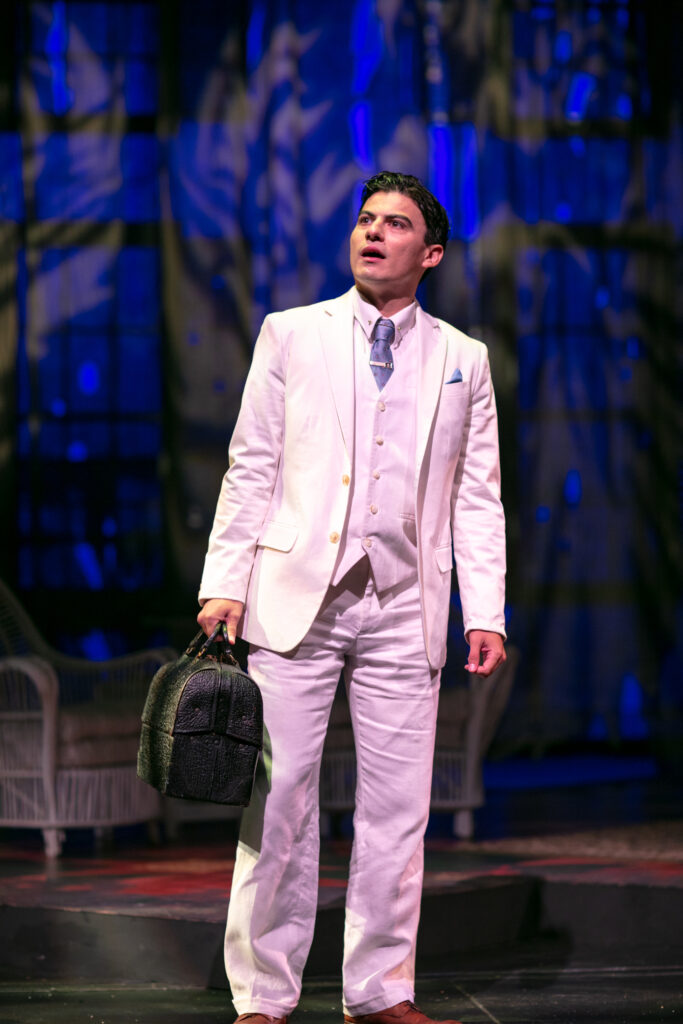
By Lynn Venhaus
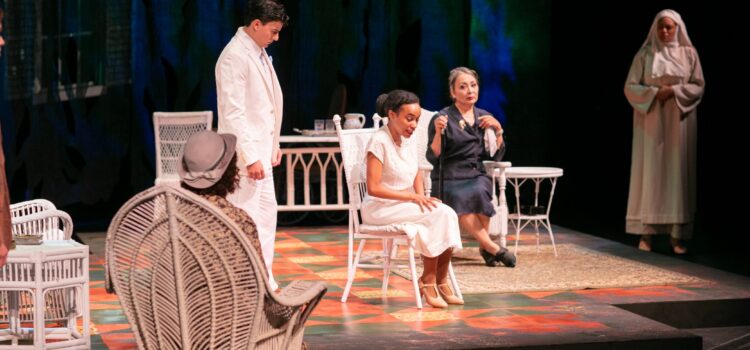
On a remote island far, far away, a mischievous mix of magic and mayhem mark “The Tempest,” which is the St. Louis Shakespeare Festival’s flagship production now anchored in Forest Park’s Shakespeare Glen.
William Shakespeare’s drama-tinged romantic comedy takes place after a violent storm has washed ashore a merry band of revelers, upending the inhabitants on this island – and nothing is as it seems. Perhaps, someone’s bad dream is another’s hopeful voyage. In any case, there is perceptible verve.
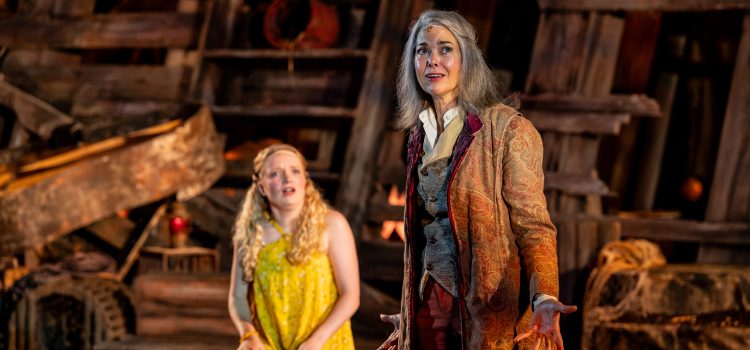
Think of this as a way-back machine “Survivor,” where everyone must outwit, outplay and outlast the people who want power. And Prospero (Nancy Bell) is manipulating a chess game.
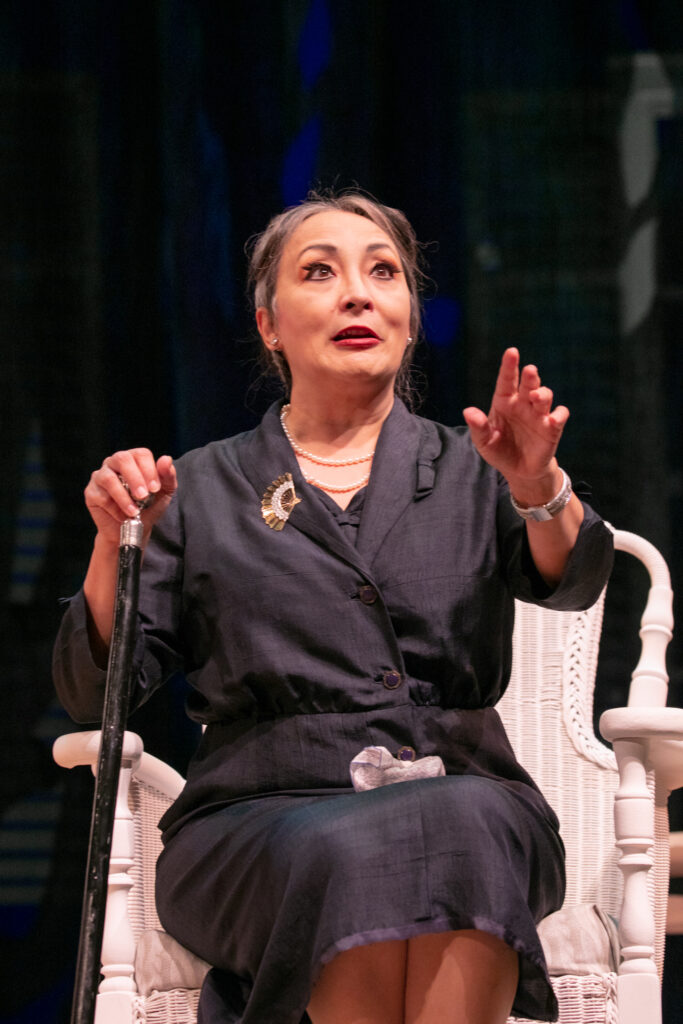
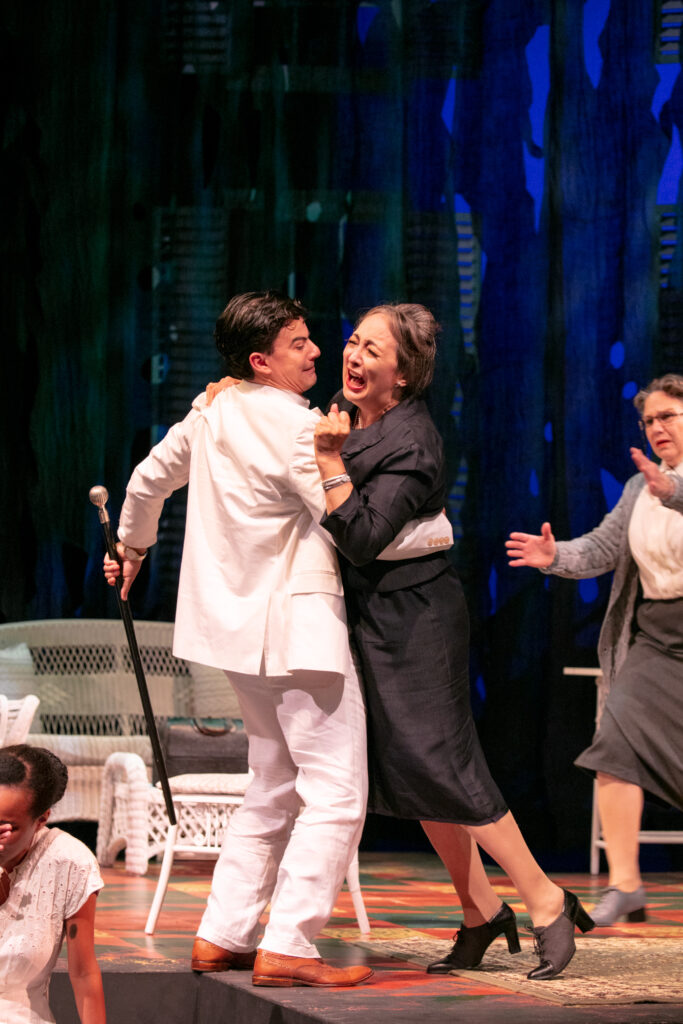
A mother and sorcerer, Prospero rules this mystical place, and tensions rise between her, her teenage daughter and now the brother who messed up her future and has reappeared. Haunted by his betrayal, she has vengeance on her mind, for she was once Duke of Milan.
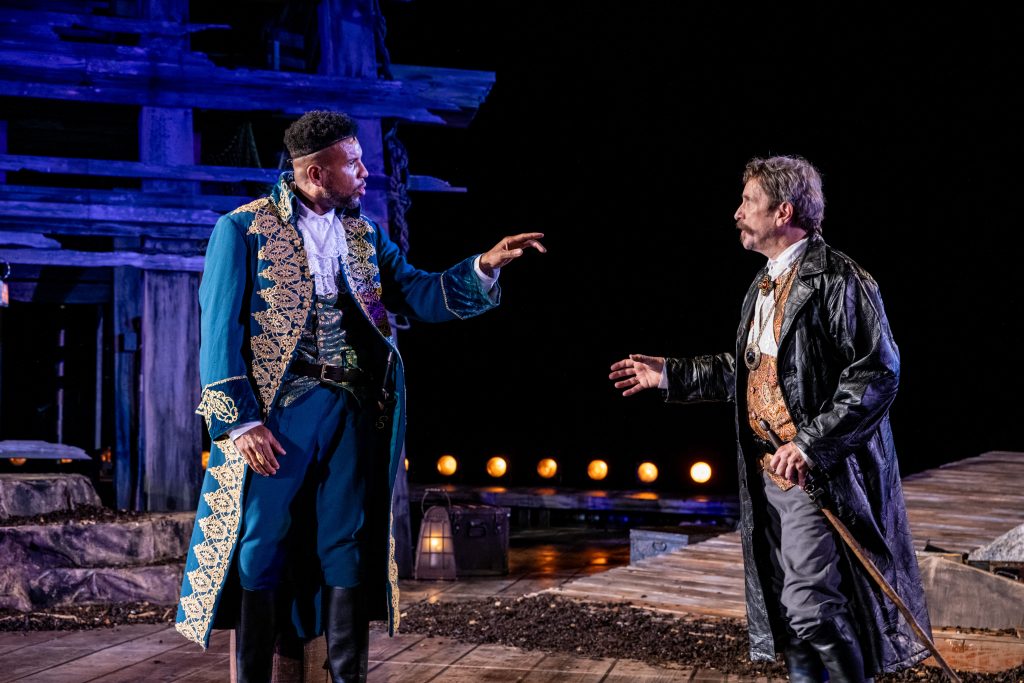
Through royal chicanery, Antonio (Jeff Cummings) usurped the title, and with the help of another brother, Alonso (Kathryn Bentley), King of Naples, she was banished 12 years earlier. But they can’t be trusted because another ambitious brother, Sebastian (Reginald Pierre), wants the king’s crown himself.
Ariel (Eliza Pagelle) is a shape-shifting spirit on the island that aids Prospero. Through her occult preoccupation, the boss finds out that her nefarious brothers are on their way from Tunis to Italy, so she conjures a squall, and they wind up where she is. Mama Bear thinks she is in control.
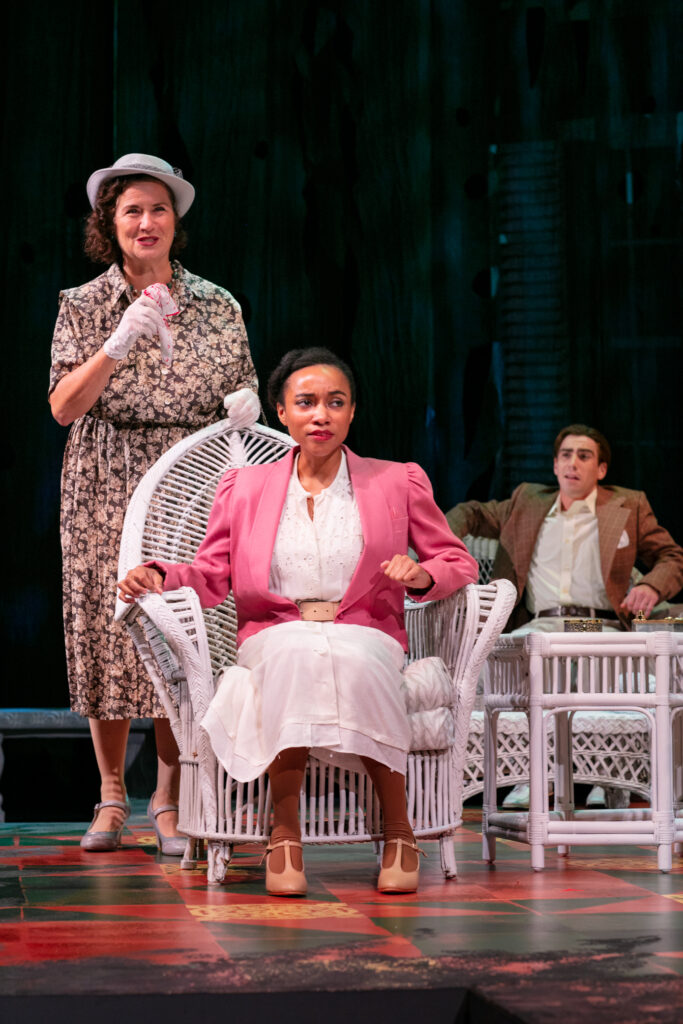
It won’t be long until old wounds resurface and new challenges arise. Oh, be careful what you wish for, as Alonso’s honorable son Ferdinand (an earnest Zay Williams) spies Miranda (Sigrid Wise) and falls in love.
Caliban (Chauncy Thomas) is the only true island inhabitant, a witch’s son, and resents being overtaken by Prospero, who imprisoned him so he doesn’t get too close to her daughter.
A fierce Thomas musters all his fury as a resentful native. Formerly of St. Louis, Thomas is always a welcome addition when he returns, now for the sixth time.
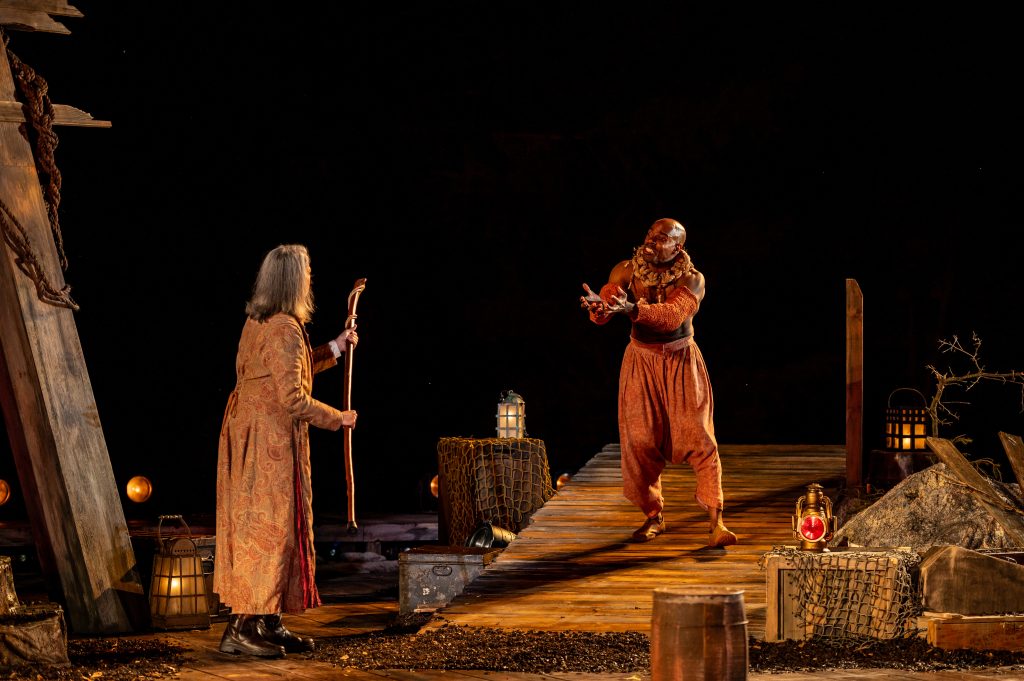
The ensemble includes kindly Gonzalo (veteran Whit Reichert), an elderly Neapolitan lord who helped Prospero survive exile (but secretly), and comic buffoons Stephano (Michael Dougherty) and Trinculo (Jose Sabillon), Alonso’s butler and court jester. That daffy duo plots with Caliban to take over.
Mother and daughter have been marooned since the girl was 2 years old, so one can imagine her naivete and innocence – and yearning to break free of the overbearing parent. Nevertheless, the protective mom wants her daughter to marry for love and position.
Wise, enchanting as the isolated Miranda, is as luminous as she was as Juliet in “Romeo and Juliet” in 2018 and was part of “The Winter’s Tale” the year before. She has tangible chemistry with Williams as a decent prince who can be trusted.
Through her instincts and technique, Bell is a formidable Prospero – and as much of an impact she has had on Shakespeare in this city, one must note that this is her first leading role outdoors in Shakespeare Glen.
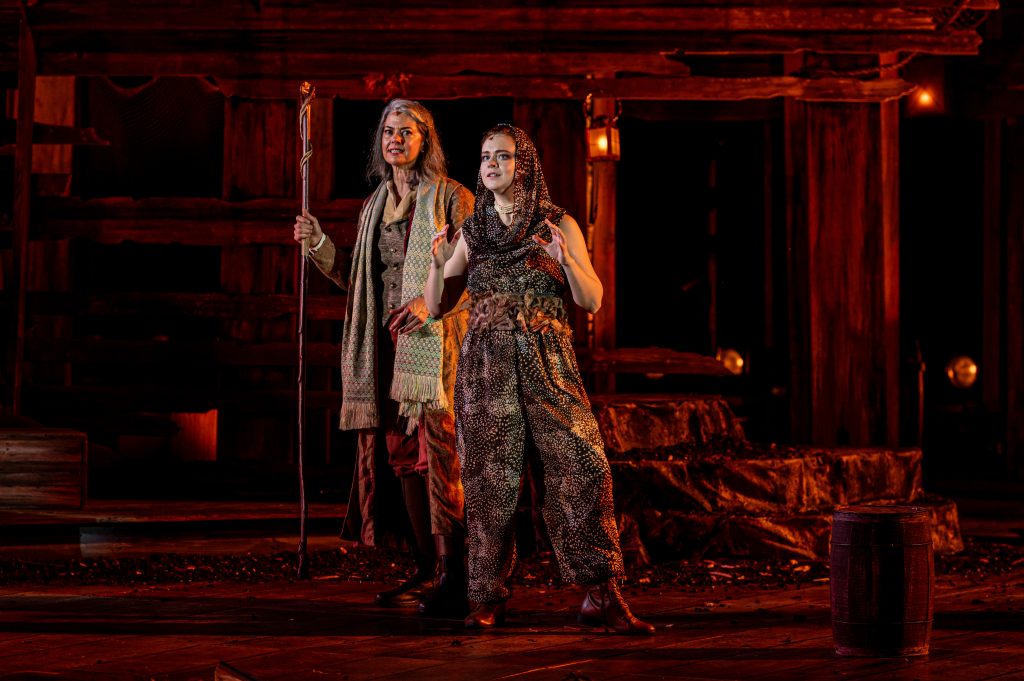
(As Playwright-in-Residence, Bell wrote several “Shakespeare in the Street” productions, earning Best New Play awards from the St. Louis Theater Circle for “The World Begun” and “Old Hearts Fresh,” and two years ago, directed the award-winning “As You Like It.” She also founded the Confluence New Play Festival.)
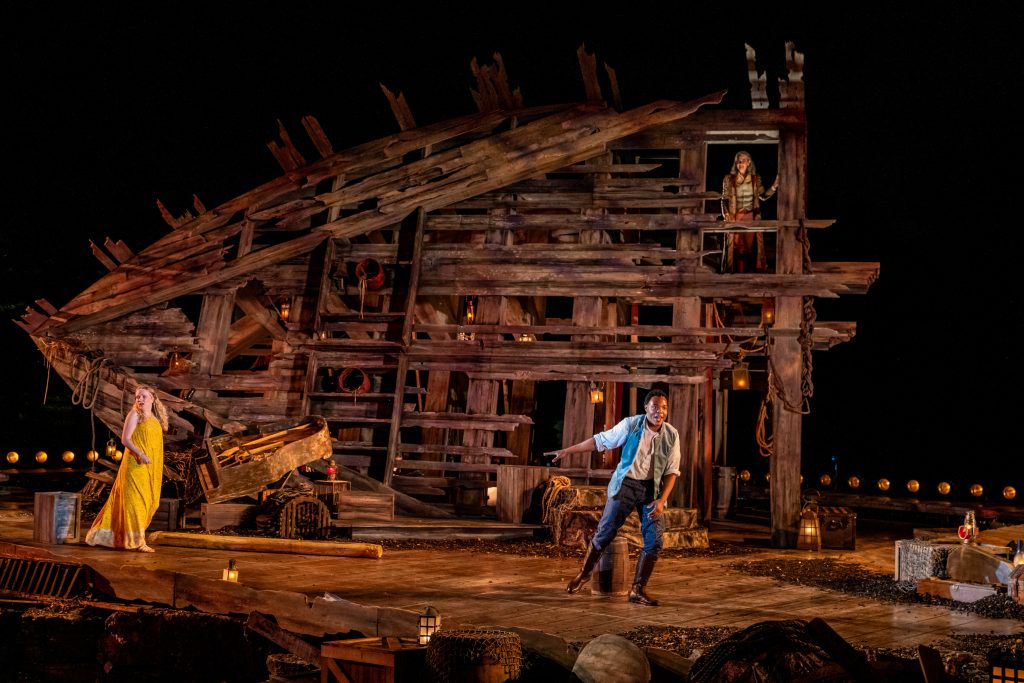
The Circle’s most awarded theater artist, for acting, writing and directing, Bell commands attention from various vantage points perched on the decaying hull of a shipwreck. Her character must find a way to forgive on this journey.
Director Rick Dildine shrewdly showcases Prospero’s dominance by staging Bell’s position at different heights – when she’s talking to others. It’s rare when she’s on the same level of this imposing set, masterfully adorned with functional nooks and crannies.
The former director of St. Louis Shakespeare Festival (2009 – 2017) emphasizes nature’s impact as well as the colonial-era themes. Dildine’s version is a breezy 90 minutes without an intermission.
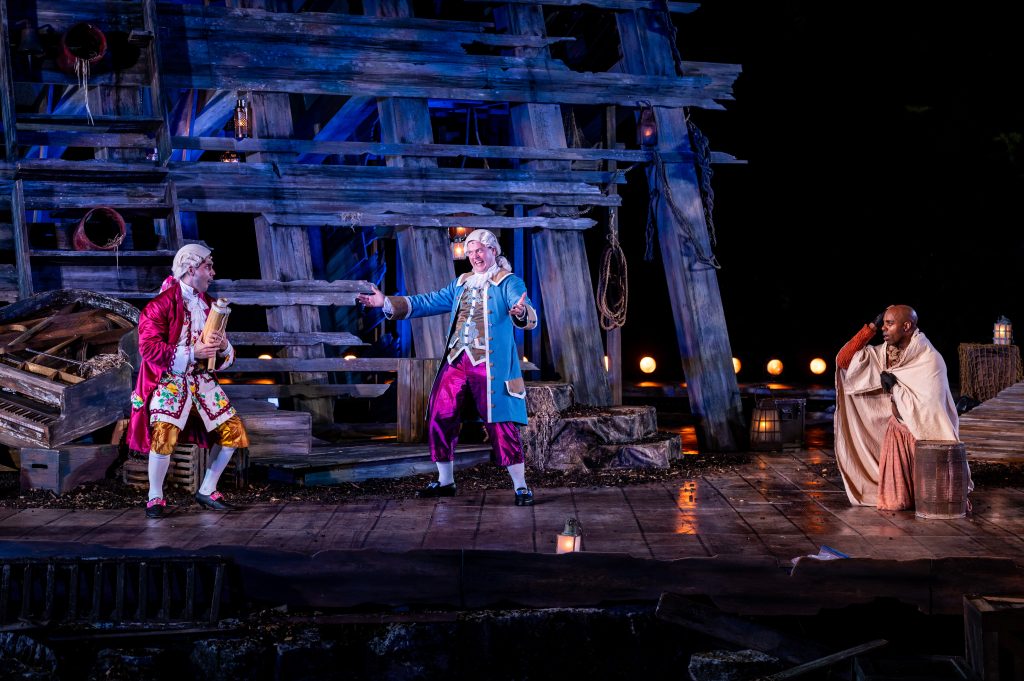
He is aided by a talented squad — assistant director Lize Lewy, producer Colin O’Brien, production company Blank Slate, stage manager Sarah Luedloff, and assistant stage manager Britteny Henry.
Dildine won a Circle award for directing a shimmering “A Midsummer Night’s Dream” in 2016 where sound, lighting and scenic design enhanced the production, especially the original music.
The storytelling here is boosted by those same elements. The artisan MVPs who blended music and storm effects to elevate the experience included music director Michael Grieve, sound designer Melanie Chen Cole, lighting designer Jeff Behm and scenic designers Justin and Christopher Swader, all making impressive debuts, as were costume designer Kathleen Geldard and props designer Katherine Stepanek.
Grieve’s captivating immersive upbeat music is a zesty blend of roots music, sea shanties and folk melodies, with lively musicians Harrison Farmer, Crayton Haney and Otto Klemp, also in supporting roles, as is Grieve.
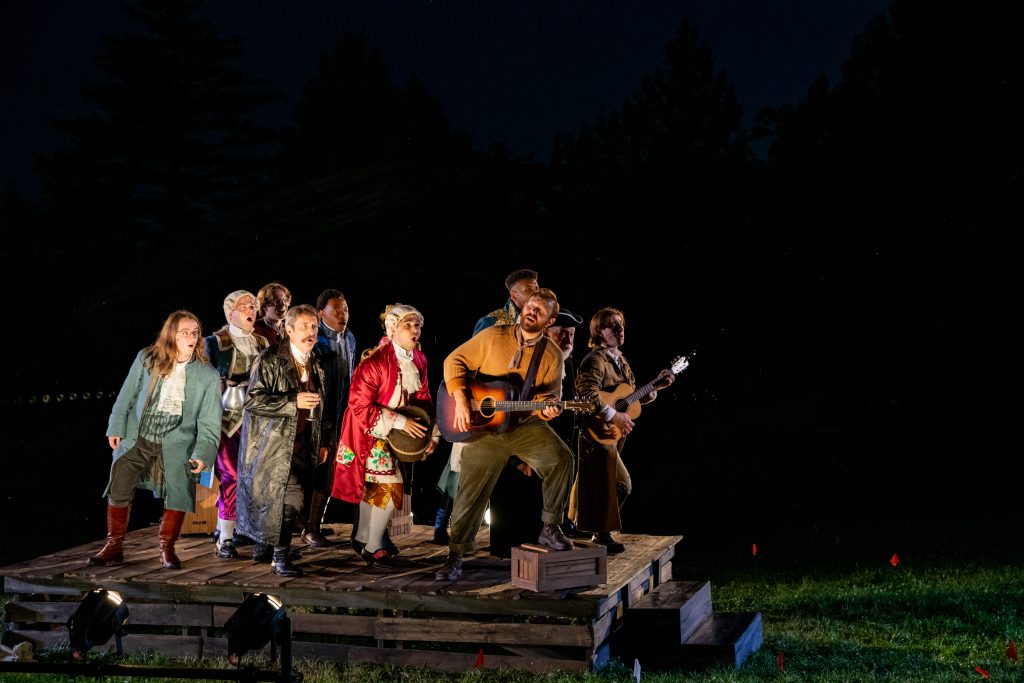
An original prologue on a satellite stage creates a festive atmosphere at Alonso’s daughter Claribel’s wedding, which kicks off the show (starting at 8 p.m.). Paul Dennhardt has provided interesting moves for the musicians and guests. All that’s swept away in the tempest.
Regarded as Shakespeare’s last play, when he was in his late 40s, this tale of forgiveness has the compassion of an experienced man looking at what’s important in life. And that is expressed well in this vibrant setting.
Dildine’s focus on nature’s capacity to heal is a key component to this 26th annual outing in the park, a year after a destructive tornado tore through Forest Park. He interprets that resiliency in the aftermath, as we all weather calm seas and violent storms in life.
A portion of the donations collected during “The Tempest” will go towards the tornado relief funds for the St. Louisans hit the hardest. And thanks to the parks department and Forest Park Forever, we are sitting today in these hallowed grounds of immense cultural importance.
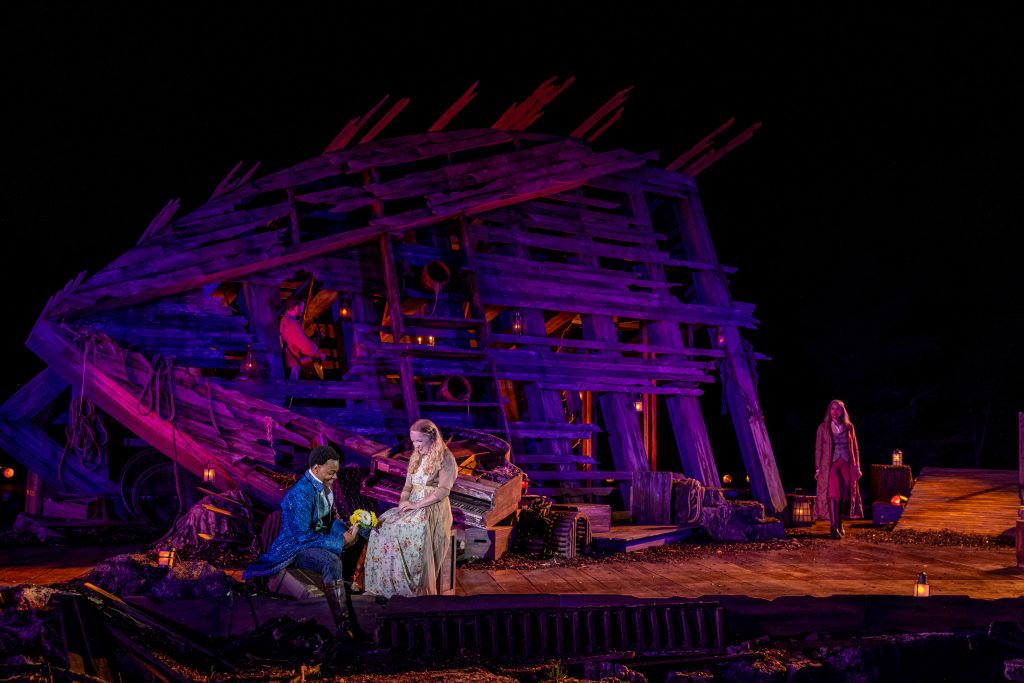
St. Louis Shakespeare Festival presents “The Tempest” May 27 – June 21 at 8:15 p.m., Tuesdays through Sundays, in Shakespeare Glen in Forest Park, 6604 Fine Arts Drive (next to the Art Museum). Admission is free and accessible to everyone. The Glen opens at 6:30 p.m. and the Teen Green Show takes place at 7:15 p.m. Thursday through Sunday. For more information, visit www.stlshakes.org

Lynn (Zipfel) Venhaus has had a continuous byline in St. Louis metro region publications since 1978. She writes features and news for Belleville News-Democrat and contributes to St. Louis magazine and other publications.
She is a Rotten Tomatoes-approved film critic, currently reviews films for Webster-Kirkwood Times and KTRS Radio, covers entertainment for PopLifeSTL.com and co-hosts podcast PopLifeSTL.com…Presents.
She is a member of Critics Choice Association, where she serves on the women’s and marketing committees; Alliance of Women Film Journalists; and on the board of the St. Louis Film Critics Association. She is a founding and board member of the St. Louis Theater Circle.
She is retired from teaching journalism/media as an adjunct college instructor.