By Lynn Venhaus

English philosopher R.G. Collingwood said, “The only clue to what man can do is what man has done.”

That is the direction this historical drama takes as it revisits the Nuremberg trials but delves more into a psychological perspective on what led the Third Reich to invade other countries and commit Holocaust atrocities, overseeing the extermination of 6 million Jews.

Based on the 2013 non-fiction book, “The Nazi and the Psychiatrist” by Jack El-Hai, writer-director James Vanderbilt looks back through a modern lens to send an urgent message about justice, intolerance, and cruelty to contemporary audiences.

The Nazi regime had their day in court during the main Nuremberg trials, held between Nov. 20, 1945, and Oct. 1, 1946. Beforehand, the Allies prepared to unveil the horrors for the world to hear as they wanted the highest-ranking officials to answer for their war crimes.

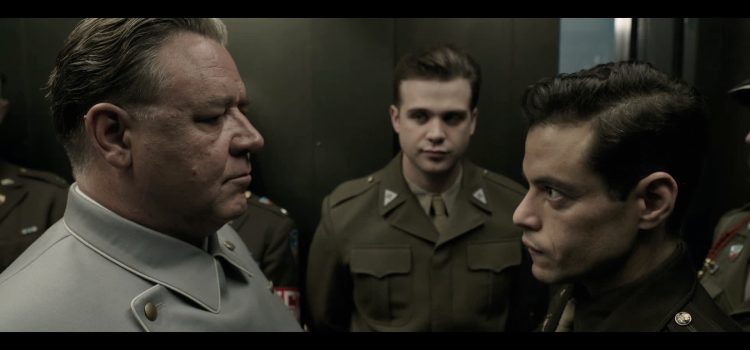
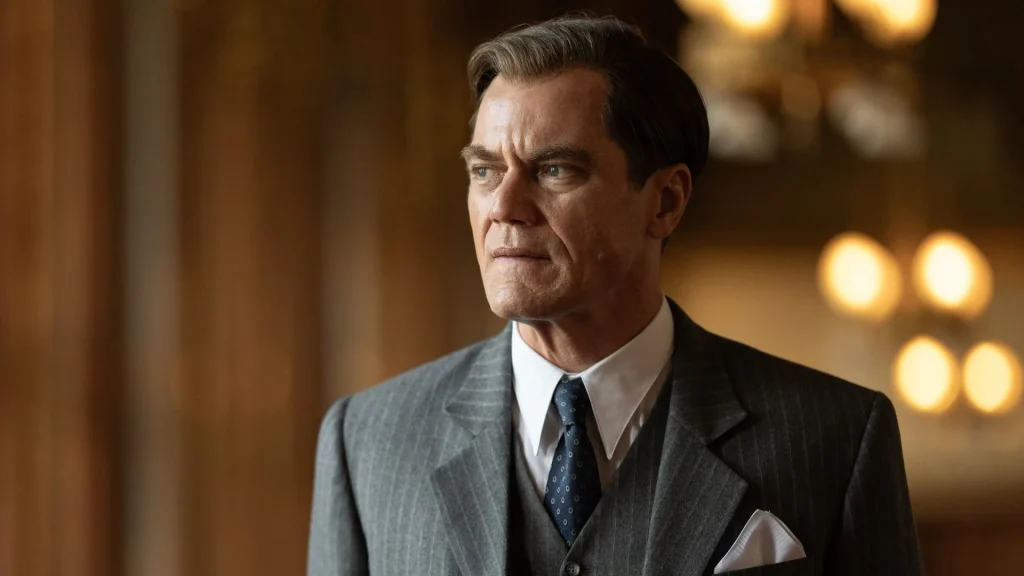
The chief prosecutor, Robert H. Jackson (Michael Shannon) wants to expose evil. Army psychiatrist Lt. Col. Douglas Kelley (Rami Malek) attempts to understand their complex psyches, and front and center is Hermann Goering (Russell Crowe), Hitler’s right-hand man.
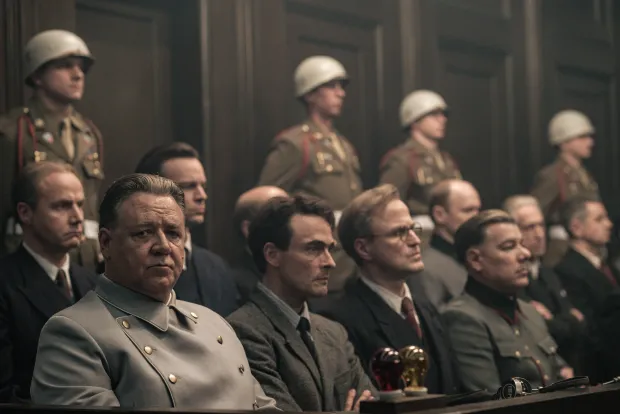
Leading the legal team, ever-reliable Shannon portrays Jackson, who worked diligently to bring 12 members of the Nazi High Command to trial for war crimes.

While others just wanted to put the war in the rear-view mirror, and favored executing those responsible for the genocide, Jackson wanted the world to see and hear what they had done. He was responsible for this international tribunal that involved the U.S., England, France and the Soviet Union, the first of its kind.

Jackson, later a Supreme Court justice, didn’t want these ‘monsters’ to become martyrs upon their deaths. His instincts were correct, but the proceedings were not smooth because this was new territory.

How do you define evil? Oscar winner Malek stars as dedicated Kelley, an Army mental health professional tasked with analyzing Hitler’s henchmen. His methods come under fire as he appears to be sympathetic to the prisoners.

He was attempting to build trust. But really, who is trying to outmaneuver whom? It becomes mainly a cat-and-mouse mind game with malevolent Goering, not unlike Jodie Foster and Anthony Hopkins in “The Silence of the Lambs.”
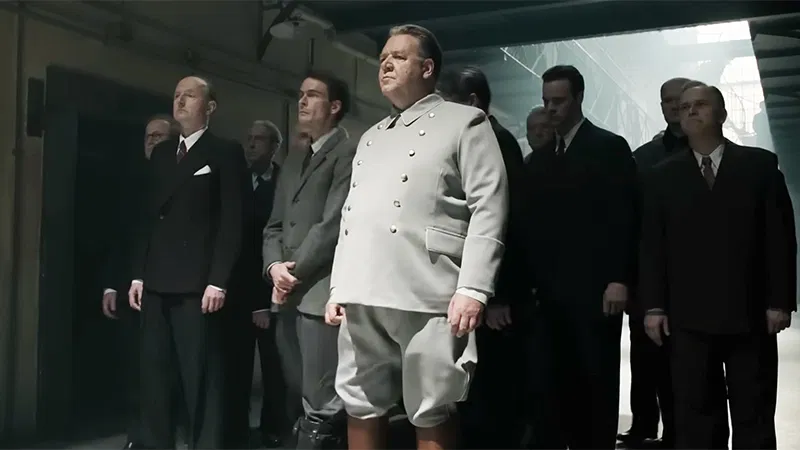
Goering was second in command to Hitler, engineering the horrors of what transpired without any remorse. At the time of this trial, he was the highest-ranking Nazi still alive. (Rudolph Hess is also a fellow prisoner).

Kelley wrote a personal account in his book, “22 Cells in Nuremberg,” but the movie indicates his fall from grace, so he’s been historically ignored, until now. His book’s final chapter is a cautionary tale about how he could see the mindset of pre-World War II Germany happening in the United States.

For those who don’t believe the Holocaust happened, this film won’t let anyone forget. The stakes, past and present, should remain in the forefront.

The chess-like match between the men, especially with Oscar winner Crowe in full command, is fascinating. However the account is fictionalized, Crowe is back to displaying the power he had in his prime, igniting the screen as the cagey, cunning and diabolical Goering.

With his keen intelligence and massive ego, narcissist Goering believed he could justify his actions on this global stage, and it’s chilling to see it unfold.

The 1961 classic Oscar-nominated film “Judgment at Nuremberg,” directed by Stanley Kramer, was mostly a courtroom drama while the current film spends more time behind the scenes on the dangers of unchecked malice.

While this 2-hour, 30-minute film gets ham-fisted in its editing and bogged down in its cumbersome narrative that makes its points repeatedly, the performances are uniformly strong.

Standouts include Leo Woodall as interpreter Sgt. Howie Triest, John Slattery as Col. Burton C. Andrus, who oversaw the prison, and Richard E. Grant as Sir David Maxwell-Fyfe, who is a British co-counselor.

The film’s other strengths include period-accurate designs – production (Eve Stewart), costume (Bartholomew Cariss) – as well as cinematographer Dariusz Wolski’s interiors in ​the secret military prison and​ German homes.

The most powerful scene is what was shown at the trial 80 years ago, the same disturbing archival footage of skeletal victims at work camps being bulldozed into their graves. The six gut-wrenching minutes are from the 1945 “Nazi Concentration and Prison Camps,” which was partially shot by director John Ford and included in George Stevens’ 52-minute film.

This footage showed the world what really happened, what these Nazi leaders were capable of, and that they must be punished for their crimes.

​N​ot just a reminder of the past, the film​s​ ​strives to be clear that the prevention and proliferation of evil is always necessary. One recalls Edmund Burke’s famous quotation: “The only thing necessary for the triumph of evil is for good men to do nothing.”

Triest, the German-born translator, says at one point: “Do you know why it happened here? Because people let it happen.”
While the film doesn’t reveal anything new, it is committed to being a clarion call. People have been quoting philosopher George Santayana a lot these days — “Those who cannot remember the past are condemned to repeat it,” from his “The Life of Reason” in 1905.

The fact that we must be nudged out of complacency and realize the consequences on a global stage is the reason that films like “Nuremberg” are made.

“Nuremberg” is a 2025 historical drama written and directed by James Vanderbilt and starring Russell Crowe, Rami Malek, Michael Shannon, John Slattery, Leo Woodall and Richard E. Grant. It is Rated PG-13 for violent content involving the Holocaust, strong disturbing images, suicide, some language, smoking and brief drug content and the runtime is 2 hours, 28 minutes. It opened in theatres Nov. 7. Lynn’s Grade: B.


By Lynn Venhaus
Alternating light humor with traumatic memories, “Treasure” never really comes together as an effective homeland revisit by a Holocaust survivor and his well-meaning daughter.

An uncomfortable odd couple road trip feels leaden and disjointed, which is disappointing given the two gifted performers and an acclaimed team behind this misfire.

Adapted from the 1999 semi-autobiographical novel, “Too Many Men” by Lily Brett, “Treasure” stars Lena Dunham as a deeply unhappy divorced New York journalist who has taken her widowed father to his homeland.

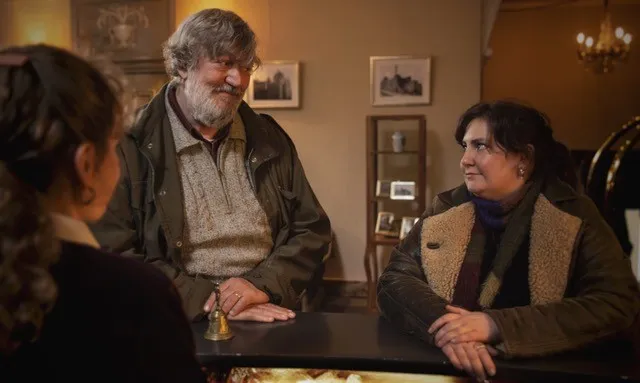
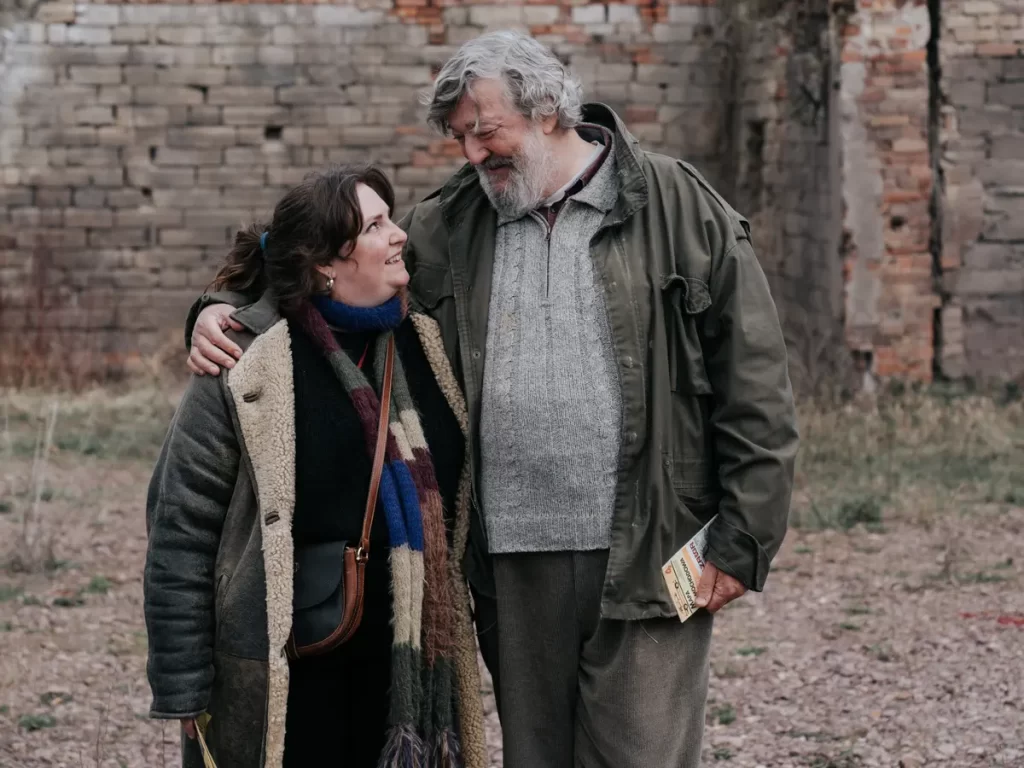
As Ruth Rothwax, Dunham thinks a look back into family history will help her connect to her father, Edek, a wonderfully genial Stephen Fry. For reasons clear to everyone but his daughter, Edek is a reluctant guide, and indifferent to seeing historical sights and places that remind him of his past family life.

There is a great pain there that is barely delved into — honestly. I mean, how does one get past that? (And there have been countless movies addressing those topics with far greater depth).

This attempt to add humorous situations feels forced. The pair clearly exasperate each other. It’s 1991 and Edek’s wife has been dead for about a year. He still considers his daughter’s ex-husband a friend and can’t understand why they are no longer married.

Not wanting to take a train, he hires a taxi driver, Stefan, to be their chauffeur. He’s played with a droll sense of humor by the terrific Polish actor Zbigniew Zamachowki, a veteran of the “Three Colors” films – Red, White and Blue.

As the pair bicker, their differences are stark – dad is an extrovert and daughter is an introvert. He loves to have a good time and engage people in conversation; she’d rather be reading.

Traveling through Poland provides a rich sense of history, most of it unpleasant. Ruins are everywhere, recalling a time of Nazi occupation and the fall of the Iron Curtain in a country that hasn’t recovered nor has reconciled with its past. The production design by Katarzyna Sobanska and Marcel Slawinski effectively portrays the complexities. They worked on the stunningly atmospheric Polish films “Ida” (Oscar winner for Best International Feature) and “Cold War.”

Director Julia von Heinz’s heart is in the right place, but the script she has co-written with her husband and frequent collaborator John Quester never really fleshes out the relationships in an engaging way.

That’s not to say there aren’t moments of devastating poignancy, especially when Edek returns to his family’s home, a childhood memory before they were rounded up and sent to Auschwitz-Birkenau.

The family currently living there is defensive and downright hostile, lying that they don’t have anything left of Edek’s family, but he discovers their possessions tucked away in places.

The most stunning – and horrific – footage is Edek’s return to the death camp, now a tourist site. Of course, it conjures up the trauma and the ghosts of what happened there. The wide shots of rows and rows of barracks remains a powerful testament to men’s inhumanity to man.

That’s tough for anyone, let alone the character revisiting the scars, and having the scabs ripped off.

The most puzzling aspect of this storytelling is to bring up tiny details about Ruth’s neuroses but only provide snippets without much context – her marriage issues, her eating disorder, self-tattooing numbers. We don’t ever get a sense of Edek’s wife and Ruth’s mother, either.

Dunham and Fry appear to genuinely connect, but something about this template doesn’t elevate the relationship beyond the tropes. Dunham, who hasn’t done much acting since ending her popular “Girls” series on HBO, and Fry, a beloved British multi-hyphenate, do what they can with the underwritten roles.

Trying to understand the Holocaust’s effect on her family and the focus on heritage is a noble gesture, but not sure that experience is enough to sustain this as a film. It sputters when it tries to be sentimental.

“Treasure” is a 2024 comedy-drama directed by Julia von Heinz and starring Lena Dunham and Stephen Fry. It is rated R for language and run time is 1 hour, 51 minutes. It opened in select theatres June 14. Lynn’s Grade: C-.

By Lynn Venhaus
A film as necessary for this time and throughout the ages, “The Zone of Interest” is a chilling look back at how Germans normalized their extermination of Jews during the Holocaust.

SS Officer Rudolph Hoess, who served the longest as the head commandant of the Auschwitz-Birkenau concentration camp in Poland (1940-43 and 1944-45), lived in a villa next door with his wife and children.

In the shadow of atrocities, his family enjoyed their dream home, and director Jonathan Glazer depicts their daily life in the most mundane ways possible. Cinematographer Lukasz Zal chiefly observes to underline the horrors taking place a few feet away, using distance instead of close-ups to speak volumes.

This makes the scenario even more unsettling as the Third Reich masterminds meet to discuss carrying out Hitler’s orders for the “Final Solution.”

Several acclaimed films have shown us the brutality of the Holocaust, in various degrees of harrowing, including Oscar winner for Best Picture “Schindler’s List” (1993) and “Son of Saul” (2015), which won the Academy Award for Best International Feature. While “The Zone of Interest” is just as haunting, the horror lies in the obvious apathy of the bystanders.

Hoess was instrumental in implementing pesticide into gas chambers that killed more than a million European Jews. (Later, at his trial, he claimed responsibility for 2.5 million deaths, the rest caused by “starvation and disease.”)

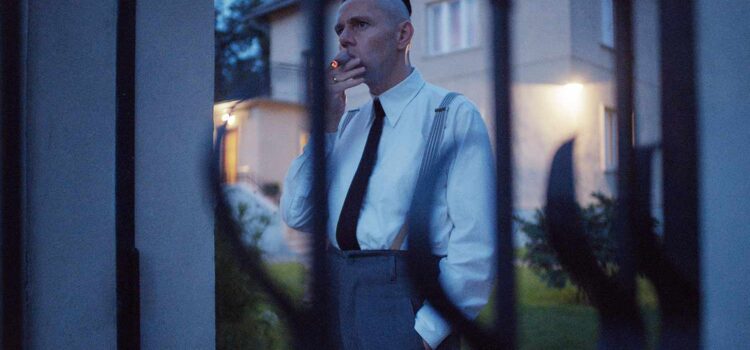
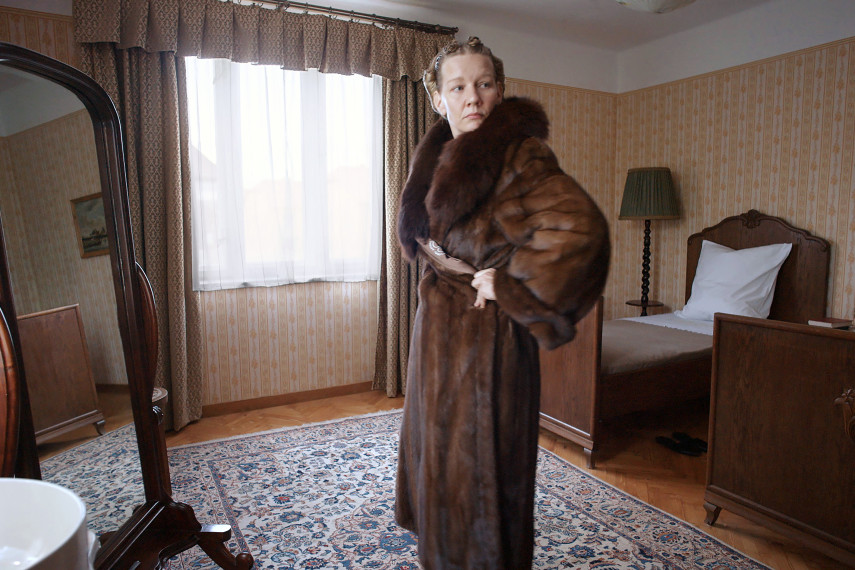
Christian Freidel plays Hoess as a dutiful Nazi, a company man who is pleased with his advancement – the undetected monster in our midst. Sandra Huller, who is having a moment with her other acclaimed performance in “Anatomy of a Fall,” Cannes Palme d’Or winner, portrays his complacent wife, Hedwig. She takes care of the children and runs the household with a desire for order.

In conversations with other wives, she is matter of fact. Her mother, Linna Hensel, played by Imogen Kogge, comes to live with them, and is impressed with their spacious digs and comfortable lifestyle, with servants at the ready and absconded goods delivered to them.

Their insensitivity and lack of empathy is revealed when interacting with others. The women guests covet what’s been pilfered from those rounded up and imprisoned or killed.

Glazer loosely adapted Martin Amis’ 2014 novel but he used real, not fictional, characters as his framework. He has constructed this historical drama to disturb because of what you don’t see and can only imagine based on details we know now.

The idyllic yard, featuring a pool and a garden, is separated by a large concrete fence, but you can hear occasional screams, gunshots, and the incinerator’s fire from a distance, and see ash floating from the crematorium.

The technical audio-visual elements, particularly the sharp editing by Paul Watts, effective sound design by Johnnie Burn and ominous music score by Mica Levi are disquieting in a slow-burn way, building on the dichotomy of the situation.

Glazer, known for “Sexy Beast” starring Ben Kingsley and “Under the Skin” starring Scarlett Johansson, has put a distinctive stamp on this cautionary tale. The end scene is one of the most powerful images in a 2023 film.

Although the film doesn’t add the real details of what happened to Hoess after Germany lost the war, it indicates that he knew their lives were doomed. Convicted of his war crimes against humanity, he was hanged at age 45 in 1947 – at Auschwitz.

“The Zone of Interest,” in subtitles, is an unforgettable work that speaks volumes by what it doesn’t say in its 1 hour, 45-minutes runtime. It is the United Kingdom’s official entry into the Academy Awards’ international feature category and was recently nominated for five Oscars. It won the Grand Prix at the Cannes Film Festival.

This one will linger because it unnerves, reminding us of how quickly freedoms can be taken away and how evil flourishes when people are systematically dehumanized.

“The Zone of Interest” is a 2023 historical drama written and directed by Jonathan Glazer. It stars Christian Friedel, Sandra Huller, Imogen Kogge and Max Beck. An international feature, it is in German and has English subtitles. Rated PG-13 for thematic material, some suggestive material and smoking, the film runs 1 hour, 45 minutes. It opens in St. Louis area theaters on Jan. 26. Lynn’s Grade: A.