By Alex McPherson

A bleak and palm-sweating look at just how profoundly screwed we all are, director Kathryn Bigelow’s “A House of Dynamite” refuses to answer its impossible questions about nuclear war, and urges reflection on the chaos and fatalism of our current fractured reality.

The film, a work of fiction that remains chillingly plausible, zeroes in on the question: What if a nuclear warhead launches from an unknown location in the Pacific for an unknown reason, and is en-route to Chicago with only 18 minutes until impact?

It’s an eventuality that many personnel in the windowless facilities of the government have been trained to deal with, but can they put theory into practice when the beginning of the end is at hand? Is anyone prepared to endure the fallout? 

Bigelow’s film repeats those 18 minutes three times from different perspectives within a series of situation rooms and command-and-control suites from Alaska to Washington, D.C., going up the chain of command until we reach the President (Idris Elba).
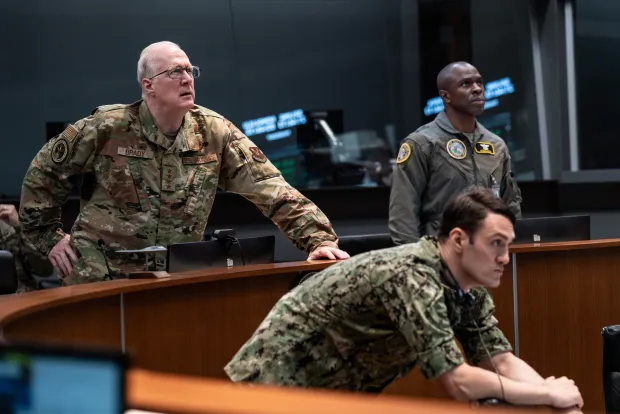
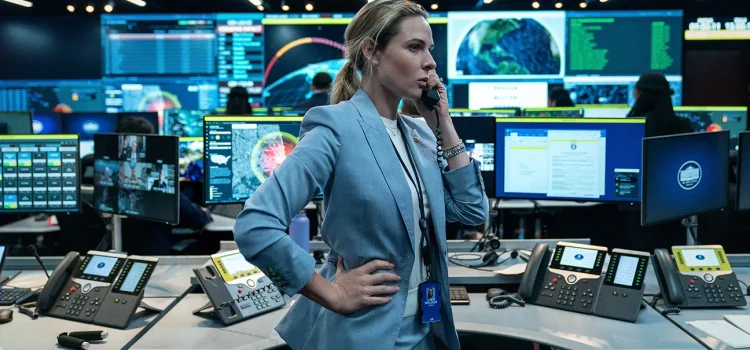
Military and civilian personnel — portrayed by an impressive ensemble including Anthony Ramos, Rebecca Ferguson, Moses Ingram, Tracy Letts, Jared Harris, Greta Lee, and Gabriel Basso, among others —  scramble to make sense of and neutralize the threat before it’s too late. The President struggles to decide what to do next should that missile actually hit Chicago. 

Time is of the essence, and these trained staff are susceptible to buckling under the weight of what’s headed their way. They are ultimately powerless no matter their rank, and an uncertain future is in the trembling hands of the Commander in Chief. As one flummoxed NSA advisor puts it, the options are either surrender or suicide.

The stakes are dreadfully high, and, despite some unnecessary flourishes, Bigelow refuses to reassure us. Indeed, “A House of Dynamite” is a warning about our (and the world’s in general) precarious situation involving nuclear weapons, as well as a high-strung look at the ways procedures and moral clarity can crumple when theory is put into practice.

Not exactly a “jovial” viewing experience, and one ripe for debate. Still, it’s compulsively entertaining— bringing the scenario to life with a vigorous attention to detail and layered structure that builds toward an integral choice. Bigelow is firmly in her wheelhouse here, supported by acting and production value wholly up to the task.

Bigelow and screenwriter Noah Oppenheim aren’t aiming to make a “satire” here à la Stanley Kubrick’s “Dr. Strangelove.” Rather, the officials depicted in “A House of Dynamite” are skilled at their jobs, many with families at home dealing with familiar, relatable challenges. 

The meaningful, albeit brief, insight into their personal lives before the ICBM is detected furthers the idea of these officials being people at the end of day — that no matter their rank, they are capable of fault just like the rest of us.

Their success in this situation, as depicted in this film, is also ultimately as much dependent on luck as their competence; the advanced technology they have at their disposal can only help them so much, too, as unknowns about the missile’s origins and what they should do if it strikes Chicago are left frustratingly opaque.

Bigelow, having consulted with several ex-Pentagon officials, brings a fly-on-the-wall verisimilitude to her direction, with cinematography by the legendary Barry Ackroyd (a frequent Paul Greengrass collaborator) that adds an effectively shaky, almost documentary-esque realism to the proceedings from start to finish.
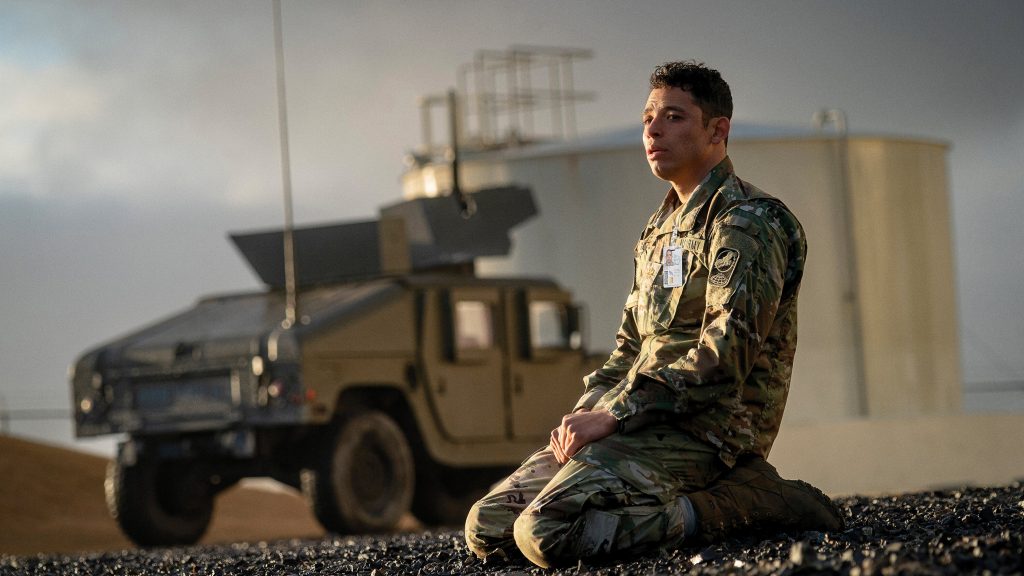
“A House of Dynamite” is primarily composed of conversations, but fraught ones, backed by a rattling, slightly overused score by Volker Bertelmann (similar to his work in “Conclave”) that lends extra tautness. 

The film’s triptych structure adds additional context to what we’ve heard and seen before. Bigelow and Oppenheim visualize the series of checks of balances at play, and the reality that those systems cannot save us.

It’s all effectively nerve-jangling, stressful, and draining through the film’s insistence on going through those 18 minutes three different times — ending on a note that encourages conversation, or, perhaps more likely, shocked silence. Less impressive are the occasional “Hollywood” lines of dialogue that break the illusion of real-life that Bigelow works hard to maintain.

But with such an outstanding cast — Ferguson, Letts, and Elba are particular standouts — it’s difficult to become too distracted by the script’s intermittent clunkiness.

“A House of Dynamite” has additional resonance when thinking about what our current governmental administration would do in the same position. Even with experts at the helm in this film, though, doom is possible if we continue down the same path, alongside procedures that are far from foolproof. Bigelow presents a dire message, and it’s extremely hard to take your eyes off the screen.

“A House of Dynamite” is a 2025 political thriller directed by Kathryn Bigelow and starring Idris Elba, Rebecca Ferguson, Jared Harris, Anthony Ramos, Jason Clarke, Tracy Letts, and Gabriel Basso. The film is rated R for language and run time is 1 hour, 52 minutes. It opened in theatres Oct. 10 and streams on Netflix Oct. 24. Alex’s Grade: B+.

By Lynn Venhaus

Visually stunning, “Three Thousand Years of Longing” is wonder on a grand scale.

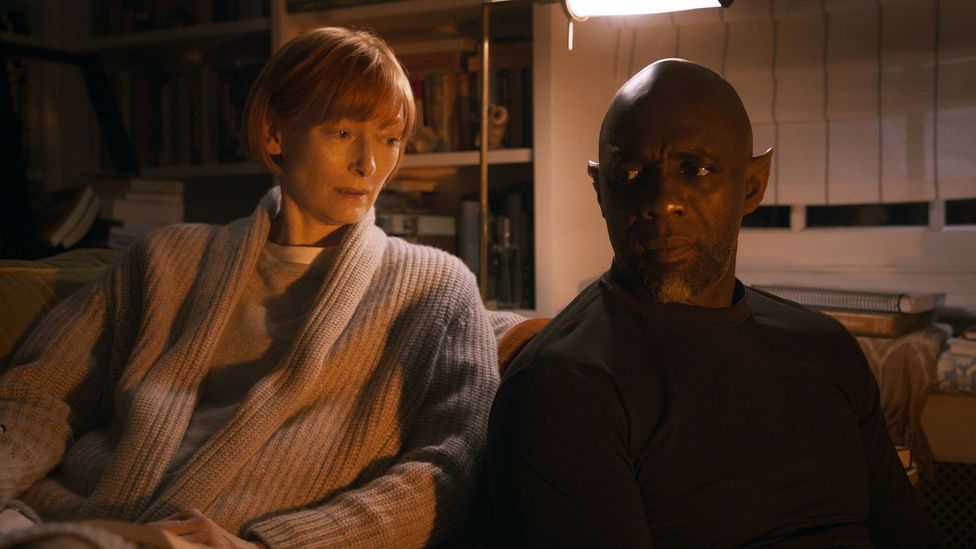
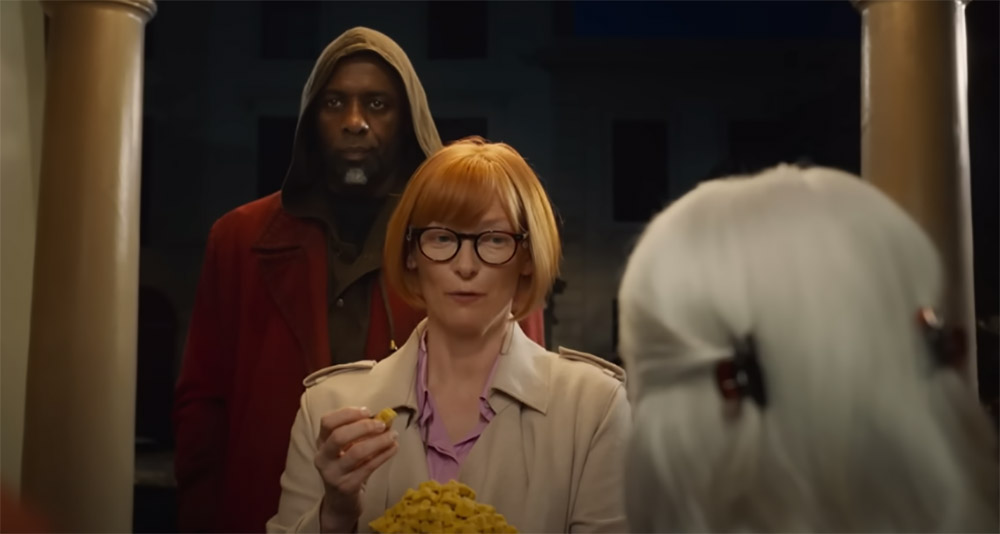
While attending a conference in Istanbul, Dr. Alithea Binnie (Tilda Swinton) happens to encounter a djinn, aka genie (Idris Elba), who offers her three wishes in exchange for his freedom. She is a scholar well-versed in mythology and storytelling, and is highly skeptical – after all, so much folklore involving genies turns into cautionary tales that end badly. He pleads his case by telling his fantastical life adventures, and she’s beguiled. What happens next surprises them both.

Far from his Fury Road, risk-taking director George Miller leads us on a less-traveled path. With his flair for the unusual, Miller charts new territory  – his “Mad Max: Fury Road” won six Academy Awards in 2016, so of course the film’s technical elements are superb.

While I am not the biggest fan of the fantasy genre, I can appreciate the technical skill and the amount of difficulty in making it look seamless.

The work of cinematographer John Seale, who came out of retirement for the second time to shoot this movie (the first being Miller’s “Mad Max: Fury Road”), is exquisite — the vibrancy of his framed shots is breathtaking.

The film unfolds like a novel. Miller collaborated on the screenplay with Augusta Gore, adapting A.S. Byatt’s short story, “The Djinn in the Nightingale’s Eye,” first published in the Paris Review in 1994. Like the British author Byatt, Miller puts familiar fairy-tale themes in a contemporary context, commenting on society along the way.

It borrows freely from “Arabian Nights,” that compendium featuring “One Thousand and One Nights,” which brought genies, or djinns, into the modern lexicon. Djinns in Islamic culture are often considered demons, but not here. There is a mystical charm to his powers.

Yet, the stories the Djinn weaves to plead his case are not as captivating as Elba and Swinton are. The pair is far more transfixing in bathrobes than the quixotic spectacles involving the Queen of Sheba and the Ottoman Empire, because those meander and such detours take us away from the film’s more interesting core relationship.

Oscar winner Swinton and Elba, who won multiple awards for his finest work in “Beasts of No Nation,” are endearing in their roles as lonely hearts whose solitary existence have led them to this crossroads. Elba could read my tax returns and I would be spellbound.

Alithea’s skepticism is relatable – it would be easy to dismiss it all as a mirage – but it’s not, and her new discovery is a joyful sojourn, particularly when she returns to her life in London. The two bigoted biddies who live next door are a hoot.

However, understand that the exotic panoply is necessary for the fanciful backstory. It’s just curiously not that engaging – a broad canvas of heroes, villains, royal protocol and expendables.

One thing about Miller, though, is that the guy always has a unique perspective – whether it’s a savage post-apocalyptic world of survival or a whimsical journey of a sweet little talking pig or dancing penquins. (After all, he won an Oscar for Best Animated Feature  for “Happy Feet” in 2006).

Swinton and Elba make us care about their characters’ outcome. Without them anchoring this film so skillfully, I would have checked out early. Still, it feels long even with its 1 hour, 48 minutes run time.

Come for the dazzling cinematic work, stay for the mesmerizing acting.

“Three Thousand Years of Longing” is a 2022 fantasy-drama-romance directed by George Miller and starring Tilda Swinton and Idris Elba. It is rated R for some sexual content, graphic nudity, and brief violence and runs 1 hour, 48 minutes. It opens in theaters Aug. 26. Lynn’s Grade: B.

By Lynn Venhaus

Even an actor as good as Idris Elba can’t save this overblown and half-baked adventure-thriller.

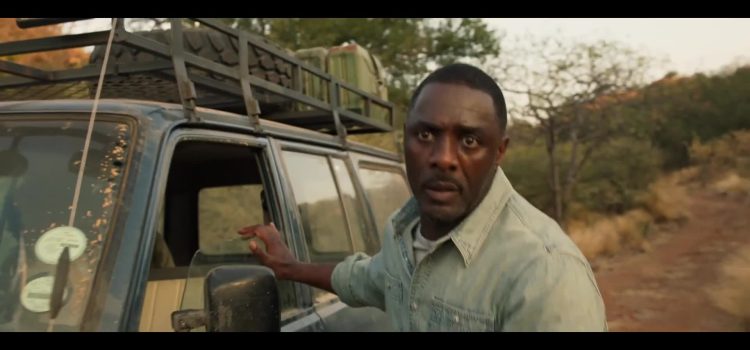
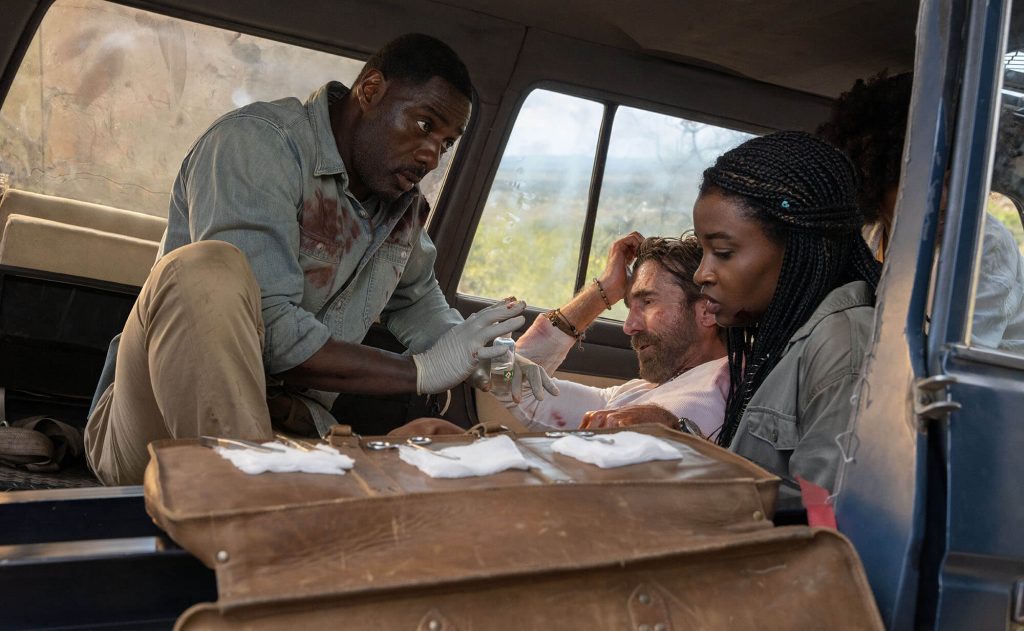
When poachers slaughter a pride of lions, ticking off a big cat who goes rogue and becomes a killing machine, this coincides with a doctor’s visit taking his two daughters to their mother’s homeland in South Africa for a getaway safari. But their dream vacation turns into a nightmare instead in yet another movie called “Beast.”

Dr. Nate Samuels (Idris Elba) was separated from his wife at the time of her death from cancer, and this has led to friction with the oldest grieving daughter, Meredith “Mere” (Iyana Halley). They are staying with the mom’s childhood friend, Martin (Sharlto Copley), who oversees an animal preserve, protecting all the creatures on the savanna.

While it starts out promisingly enough, with stunning scenic backdrops and sweeping shots of galloping giraffes, “Beast” quickly falls apart when it becomes “Cujo” and the ticked off apex predator hunts down all humans in sight – except when he/she doesn’t.

The maulings are intense and gruesome, obviously – did they not ever heed ‘it’s not nice to fool Mother Nature?’ and the cast illogically puts themselves in harm’s way.

Characters make a series of decisions that go from bad to worse, so that they seem as dense as people in slasher films. The youngest daughter, Norah (Leah Jeffries), has a penchant for wandering at the worst times. (But is it ever a good thing in unfamiliar territory?).

While I’m not skilled in the laws of the jungle, I’m pretty sure screenwriter Ryan Engle ignores most of them.

Engle takes a video game approach, just as he did in “Rampage” and run-of-the-mill Liam Neeson movies “Commuter” and “Non-Stop,” and the action doesn’t match the characters, who are poorly drawn in the broadest cliches. For a supposedly smart man, Elba’s Dr. Samuels has little common sense.

Then there are the standard tropes. We have the angry daughter lashing out at busy doctor dad who wasn’t around. Oh, that’s original. Scenes of unrealistic peril ensue, even for an animals-attack plot.

By the end, you just want everyone to be put out of their misery after what seems to be an interminable amount of pummeling. The film’s saving grace is its short runtime of 93 minutes — yet, the ending is ludicrous.

It’s not a good sign that the audience seemed to lose patience midway, and laughter grew. Would you willingly smash a walkie-talkie when that is your only lifeline?

As their friend Martin, Sharlto Copley does what he can with a role that mostly dispenses information as he gives them a tour, which goes horribly wrong. Copley, who showed so much promise in “District 9” in 2009, doesn’t have an opportunity here to stand out, and he’s better than the material..

Jeffries and Halley are natural enough as sisters. While paralyzed with fear, they still display survival skills and actually help dad when he needs it. Elba’s character owns up to his failings, so you expect the squabbles given the circumstances. But the end game is that they bond.

However, the characters are soon boxed in, and not just in the vehicle — and the conveniences become contrivances. Whatever goodwill we had for the characters evaporates and interest wanes, so that the conclusion seems anticlimactic.

Elba shows a physical side again, but this time as a flawed hero, not menacing like in “The Harder They Fall,” “Suicide Squad,” and his brief appearances in the Marvel Cinematic Universe as Heimdall. Dramatically, in film, he has yet to surpass his work in “Beasts of No Nation” in 2015, although he is best known for his television work in “Luther” and “The Wire.”

Director Baltasar Kormakur’s style is very busy, with quick cuts, and his longshots lack focus — especially as the characters’ overlapping dialogue becomes hard to understand, and it is more difficult than it should be to hear what the actors are saying.

While one can appreciate his intensity in man vs. nature conflicts, he fares better when it’s a war against the elements, unlike here, dealing with a hulking CGI beast of a lion. In “Adrift” in 2018, he gave a riveting account of Hurricane Raymond survivor Tami Oldman (Shailene Woodley) at sea, while in “Everest” he methodically delivered a procedural on the 1996 disaster on the world’s highest mountain that got bogged down with melodrama.

Still, “Beast” is a lot to unpack. Hampered by not only poor sound but also sloppy computer-generated graphic images that don’t seem realistic, the film becomes a merciless slog.

Disingenuous and dissatisfying, “Beast” is ultimately forgettable soon after exiting the theater.

Idris Elba, Sharlto Copley, Iyana Halley in “Beast”

“Beast” is an action-thriller directed by Baltasar Kormákur and stars Idris Elba, Sharlto Copley, Leah Jeffries and Iyana Halley. It’s rated R for violent content, bloody images and some language and run time is 1 hour, 33 minutes. It opens in theaters on Aug. 19. Lynn’s Grade: D.

By Lynn Venhaus
A good-looking film with a kicky soundtrack, “The Harder They Fall” comes across as a bloody western shot like a music video.

It’s no surprise, because first-time director Jeymes Samuel, a music producer and singer-songwriter known as The Bullitts, is a protégé of Jay-Z and worked with him on “The Great Gatsby” soundtrack for director Baz Luhrmann. Under his real name, Shawn Carter, Jay-Z is one of the film’s producers.

Samuel demonstrates an appealing slick style, but sadly the well-worn story lacks substance. Co-written by veteran screenwriter Boaz Yakin and Samuel as a tale of revenge and robbery, it’s merely ordinary – without much character development, squanders the talents of its extraordinary cast that includes solid-gold Idris Elba, Regina King and Delroy Lindo, with rising stars Jonathan Majors, Zazie Beetz and LaKeith Stanfield, who just gets better with every role.

The lethal shoot-outs and blood-spurting showdowns, an integral part of the western genre, are repetitive and do little to advance a gripping story. Overall, the plot is run-of-the-mill, mostly predictable, except for the third act revelation.

It’s unfortunate because you want to root for this type of new western that spotlights black cowboys. Supposedly, on the western frontier, one in four cowboys were black, and they haven’t been given proper due in America’s history on ‘go west’ and the great migration.

In the beginning, the director states that the story is fiction, but the people existed. Most of the action takes place in Redwood City, which was a primarily black community.

Faring well in this film are emerging stars Danielle Deadwyler as Cuffee, who identifies as him and would like a career in law enforcement, and Edi Gathegi as Bill Pickett, a young trigger-happy hotshot.

RJ Cyler has a solid turn as sharpshooter Jim Beckworth as does Deon Cole as Wiley Escoe, but it is Majors’ film. His outlaw Nat Love, no matter how many times he’s intimidated or dismissed, is driven and relentless.

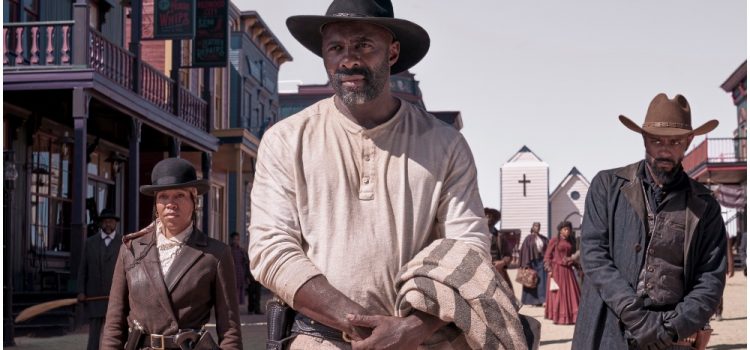
Playing a man of few words who acts quickly, Elba’s physicality is felt throughout, a foreboding presence from the opening scene where he takes down a family, to breaking out of chains in prison stripes, and then as a feared frontier gang leader.

An interesting twist is how fierce the women are – Regina King as “Treacherous Trudy” and Zazie Beetz as Stagecoach Mary. They take the bullets out of their guns and use their fists and hand-held weapons for a rip-roaring knock-down drag-out brutal fight.

With its attractive production elements, the movie benefits from cinematographer Mihai Malaimare Jr.            ‘s framing of these newly constructed towns, showcasing the period production design by Martin Whist, with editing by Tom Eagles. The violence is graphic – a blown-off arm here, an exploding head there.

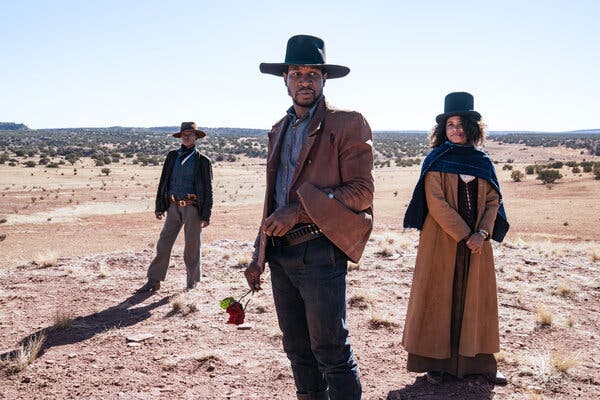
Amid the dusty outdoors and bullet-ripped clothes, Antoinette Messam’s costume design features a wide range of interesting vintage hats and lived-in frontier wear, with a few striking dusters and coats adding to the characters’ stature. You can always pick out Nat Love because of his jaunty red kerchief.

Not to be confused with a 1956 movie of the same name starring Humphrey Bogart, “The Harder They Fall” unfortunately lacks staying power because it preferred style over substance.

“The Harder They Fall” is a 2021 western directed by Jaymes Samuel and stars Idris Elba, Jonathan Majors, Regina King, Zazie Beets, LaKeith Stanfield, Delroy Lindo and Danielle Deadwyler. Rated R for strong violence and language, the run time is 2 hours and 16 minutes. In theaters Oct. 22 and streaming on Netflix on Nov. 3. Lynn’s Grade: C+