
By Lynn Venhaus
The underbelly of American nuclear families in affluent suburbia is exposed in the emotionally charged Alanis Morissette-inspired musical “Jagged Little Pill,” which can’t be wholly described in jukebox terms.
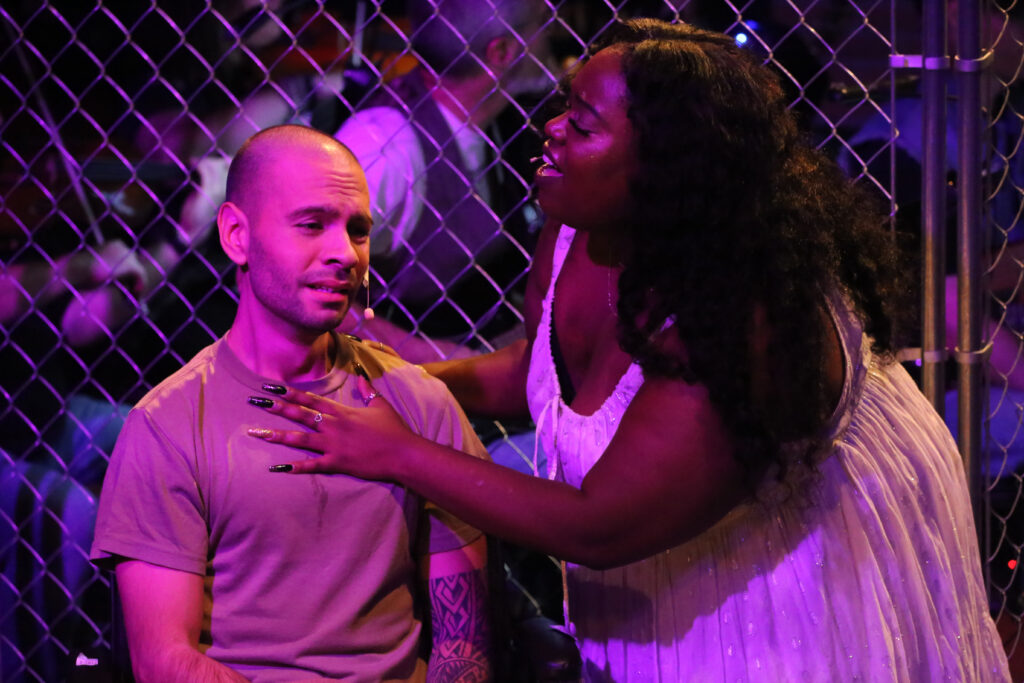
The show’s timeless message of showing up for people is emphasized, and Tesseract Theatre’s production focuses on pain, healing and empowerment. Director Brittanie Gunn features a smartly attuned cast in principal roles.
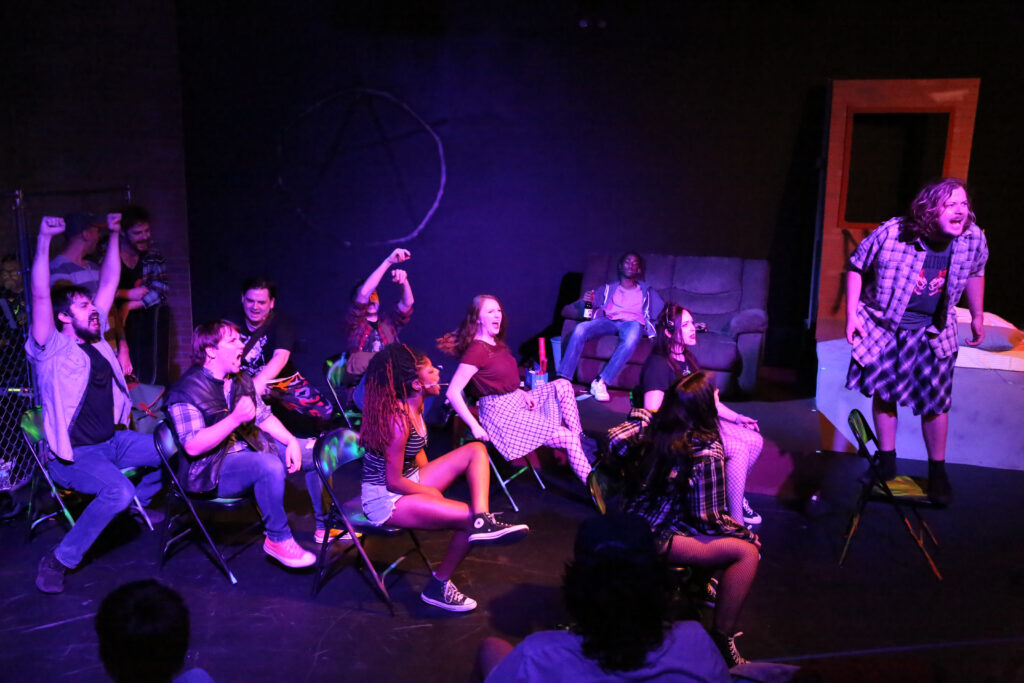
The landmark alt-rock album’s ‘90’s fueled angst is palpable as the fired-up energetic ensemble propels this professional regional theater premiere, featuring dynamic dancing, supple orchestrations and powerhouse vocals.
The recognizable musical score is well integrated into the issue-laden story, and includes other Morissette songs from later albums (“Supposed Former Infatuation Junkie,” “Under Rug Swept,” “Havoc and Bright Lights,” “Feast on Scraps,” and “City of Angels” soundtrack), and two new songs (“Smiling” and “Predator.”).
After the lead characters establish their troubled dilemmas in “All I Really Want,” pumped-up performers burst out with “Right Through You” and never let up until after the hard-fought “You Learn.” The company’s “Wake Up,” “Forgiven,” “Hands Clean,” and “Thank U” are commanding as well, especially the haunting “Uninvited.”

As the outwardly ideal mother unraveling inside, an affecting Loren Goudreau organically portrays Mary Jane “MJ” Healy – an authentic combination of fire and ice. Like most of the insulated moms nearby, MJ is a helicopter parent, aka control freak, and instead of protecting her two children, she’s smothering them.
MJ is also addicted to pain pills that she started abusing after a car accident and is pulling away from everyone who knows and loves her. Yet, she seems to realize what a fraud these shiny happy façades are, and the shallow suburbanites she’s in contact with around their snobby, judgy town.
Goudreau’s always in control in beautifully delivered vocals – “All I Really Want,” “Smiling,” and she crushes “Uninvited.” Her marital woes are aptly conveyed in “So Unsexy” and “Not the Doctor.” She shows her strength in a triumphant “You Learn.”
With a book by Diablo Cody, who won the 2021 Tony (and won an Oscar for the original screenplay “Juno”), Act I opens with MJ composing her annual Christmas letter telling everyone how perfect their family is.
Of course, it’s all big little lies. Her workaholic husband Steve (Kevin O’Brien), feeling neglected, spends time after-hours on porn sites. Their tenuous relationship appears on a downward spiral.

O’Brien, a remarkable actor, is unfortunately saddled with a standard perplexed dad role. For as superbly as the female characters are drawn, the men parts feel perfunctory. He does what he can with a poorly drawn character.
The heavy parental issues are complicated by the kids being teenagers, and moral dilemmas arise because of choices and circumstances. Hard life lessons are ahead as we go through a very stressful calendar year in Connecticut.
Son Nick was accepted into Harvard, and his future’s so bright that they all need to wear shades. Golden boy Nick, however, is feeling the pressure of being the ‘good’ son, the overachiever. So many expectations on his shoulders. He gets into a situation at a party where things go sideways, involving his classmates, and he is put to the test.
Stephen Henley, who is a young-looking 30 something, plays the high school senior, so one must suspend belief. Henley, a strong triple threat, can handle the emotional heft of the conflicted son. But like the movie cast of “Grease,” being a student is a stretch.
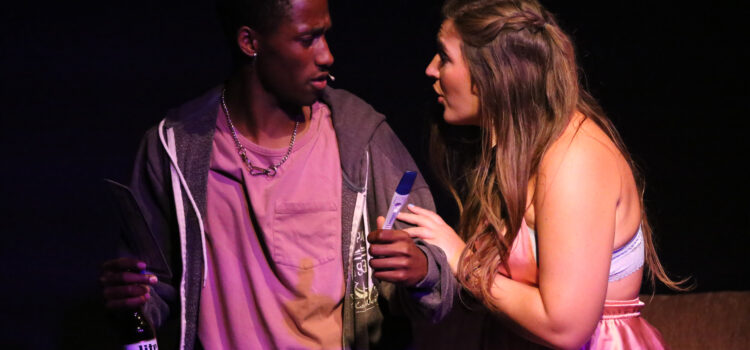
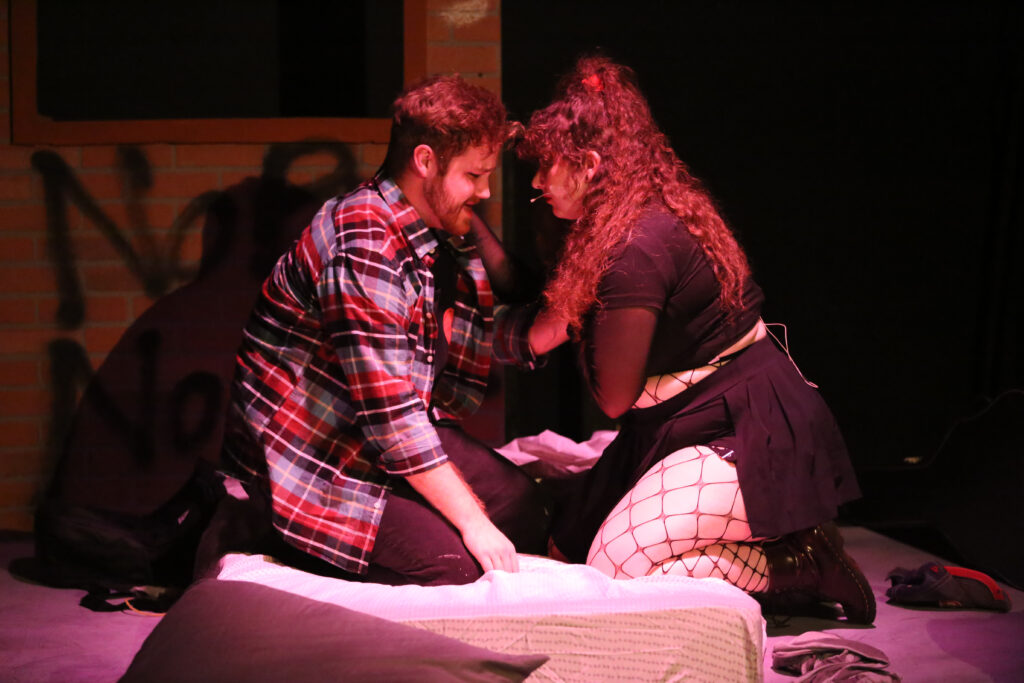
Daughter Frankie (Kinya Kairigi) is a budding social activist. She considers herself bisexual, and her best friend JoAnn “Jo” (Milo Garlich) is more than a buddy. Frankie, who is arguing more with mom, is trying to find her way – and becomes attracted to a sensitive student Phoenix (Jabari Boykin), who seems to ‘get her.’
It’s another fine showcase for Boykin, after commanding performances in Stray Dog Theatre’s “The Second Hurricane” and “Superhero.” His “That I Would Be Good” and the romantic first-love dip “Head Over Feet” show his vulnerability.
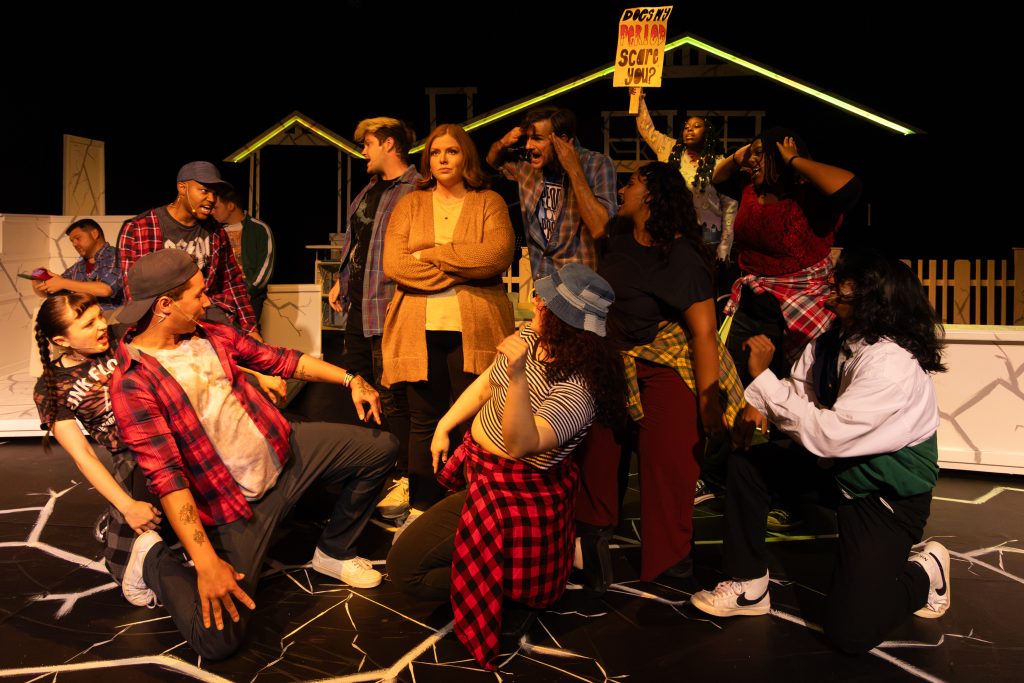
Frankie is adopted, black, and raised in a white Catholic family who didn’t think about exploring her culture but instead ignored it. ‘Better life,’ and all that. So, Frankie has some things to say about her upbringing, plus is a typical teenager ready to explode and rebel.
Kairigi, making her St. Louis debut, shows much promise, and can belt with the best of them. Her clever rendition of “Ironic,” which starts out as an essay/poem in English class and becomes a subject of debate by her sarcastic classmates, is a standout scene.
Garlich, a notable Motel in Fly North’s “Fiddler on the Roof,” has an impressive vocal range and is a passionate singer, especially on “You Oughta Know,” Morissette’s strongest anthem.
Lauren Tenenbaum’s heart-tugging portrayal of Bella Fox, the unconscious girl who is sexually assaulted at a wild holiday party, with photos circulating on social media, is another riveting aspect of the emotionally wrought show. Tenenbaum’s sincere vocals on “Predator” and “No” are noteworthy for its message.
Her tender storyline is also captured in lithe Lillian Cooper’s interpretive dance that adds a fascinating element to the presentation.
The compelling dance numbers overall, choreographed by Ella Drake and Ruben Medina, are among the show’s most memorable moments.

The ensemble – featuring Kiera Anderson-Pittman, Scott Degitz-Fries, David Hall Kaycee, David Joseph, Eesha Ved and Devynn Phoenix Yakel — is committed to getting us to feel their hurt, humiliation and outrage. Clayton Hamburg was not in the July 12 show reviewed here.
The music, by Morissette and Glen Ballard, with lyrics by Morissette, reminds us of her strengths as a groundbreaking female artist. She was only 22 when the album was released in 1995. Additional music is by Michael Farrell and Guy Sigsworth.
The album sold over 33 million copies worldwide, earned five Grammy Awards, including Album of the Year. The musical reinforces her legacy in American pop music, and the reminder is a welcome one.
Outstanding Music Director Leah Schultz is precise in conducting a very skilled band, determined to make these songs matter — not just “swallow it down.” After all, “Hand in My Pocket” promises “everything is going to be quite alright” (unless you are a cynic).
The seven-piece band sharpened the songs’ deliveries. The strings are a terrific addition, with Jill Hamill on violin and Mallory Golden second weekend, Chuck Evans on viola, and Micah Bounds on cello. Michaela Kuba is on bass, Jake Luebbert on drums, Adam Rugo on guitar, and Schultz on keyboards.
One can see how this musical garnered 15 Tony nominations, the most of any show that COVID-affected 2019-2020 season, and won two (Best Book and Best Supporting Actress). The show began previews on Broadway in November 2019 but closed due to the pandemic. It reopened on Oct. 21, 2021, and closed on Dec.17, 2021. It also won the Grammy Award for Best Musical Theater Album.
It’s easy to put this show into a time capsule, but the cast strives to make it relevant to today. The dysfunctional problems are confronted, and the solution is to start over and learn a new normal.
Lighting designer Kevin Bowman and sound designer Phillip Evans enhanced the moods while scenic designer Todd Schaefer created a fluid moving panels to anchor home, school, party, coffee shop, park and other locations. The cast helps in placing the movable pieces.
Costume designer Sarah Gene Dowling ensured the cast could move in casual looks, and rock band T-shirts helped establish the era, especially a couple classic Nirvana designs.
Other creatives included technical director Kevin Sallwasser, stage manager Abby Turner, fight choreographer Rhiannon Creighton, intimacy consultant Will Bonfiglio, and production manager Sarah Baucom.
Tesseract Theatre, as it often does, met this moment by aligning the dark topical issues to the exaggerated energetic staging. Now while the social issues are admirable, the show’s construction seems very busy.
The two-act musical is at its best when it galvanizes the intensely personal female-driven messaging and corrals the emotional landscape of adolescence in a relatable way, when it slows down to share raw, honest dialogue.
Those who respond to heartbreaking musicals like “Dear Evan Hansen” and “Next to Normal,” where personal growth and resilience occur, this is for you.
Life’s rough edges are captured in Morissette’s songs, which Cody weaves into an anxiety-ridden panoply of problems, mainly on gender and racial identities, not to mention addictions, sexuality, and suburban stereotypes. Cody’s humor is a much-needed component, too – and given the complexities of the contemporary issues, and emotional baggage, maybe not enough.
“Jagged Little Pill” can be an exhausting rollercoaster of importance, but it can also hit one in the feels. One open to this experience will discover the human condition in its moving, messy realities, set to catchy pop hooks, connecting on the Marcelle stage.
Tesseract Theatre Company presents “Jagged Little Pill” July 10 – July 26 Thursday through Sunday at The Marcelle Theatre in the Grand Center Arts District. For more information, visit www.TesseractTheatreco.org

Lynn (Zipfel) Venhaus has had a continuous byline in St. Louis metro region publications since 1978. She writes features and news for Belleville News-Democrat and contributes to St. Louis magazine and other publications.
She is a Rotten Tomatoes-approved film critic, currently reviews films for Webster-Kirkwood Times and KTRS Radio, covers entertainment for PopLifeSTL.com and co-hosts podcast PopLifeSTL.com…Presents.
She is a member of Critics Choice Association, where she serves on the women’s and marketing committees; Alliance of Women Film Journalists; and on the board of the St. Louis Film Critics Association. She is a founding and board member of the St. Louis Theater Circle.
She is retired from teaching journalism/media as an adjunct college instructor.