
By Lynn Venhaus
English philosopher R.G. Collingwood said, “The only clue to what man can do is what man has done.”
That is the direction this historical drama takes as it revisits the Nuremberg trials but delves more into a psychological perspective on what led the Third Reich to invade other countries and commit Holocaust atrocities, overseeing the extermination of 6 million Jews.
Based on the 2013 non-fiction book, “The Nazi and the Psychiatrist” by Jack El-Hai, writer-director James Vanderbilt looks back through a modern lens to send an urgent message about justice, intolerance, and cruelty to contemporary audiences.
The Nazi regime had their day in court during the main Nuremberg trials, held between Nov. 20, 1945, and Oct. 1, 1946. Beforehand, the Allies prepared to unveil the horrors for the world to hear as they wanted the highest-ranking officials to answer for their war crimes.
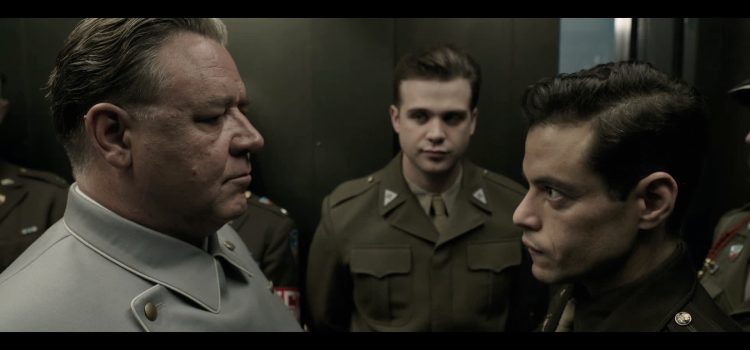
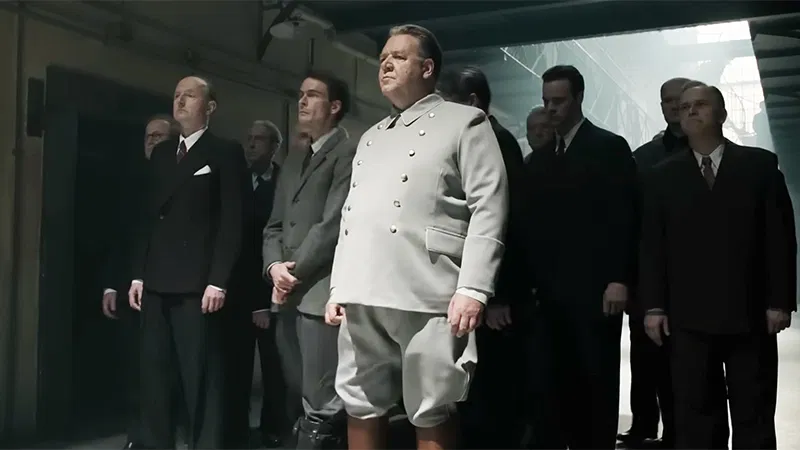
The chief prosecutor, Robert H. Jackson (Michael Shannon) wants to expose evil. Army psychiatrist Lt. Col. Douglas Kelley (Rami Malek) attempts to understand their complex psyches, and front and center is Hermann Goering (Russell Crowe), Hitler’s right-hand man.
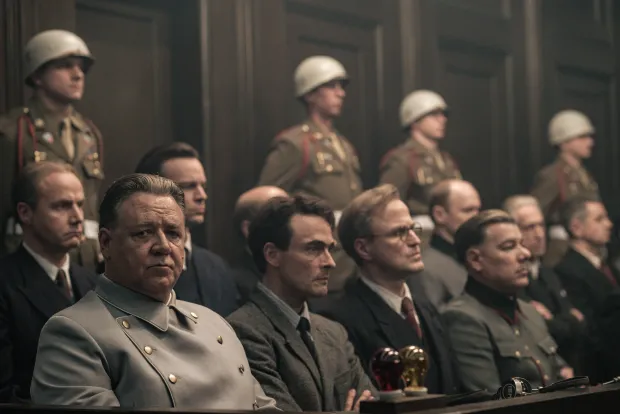
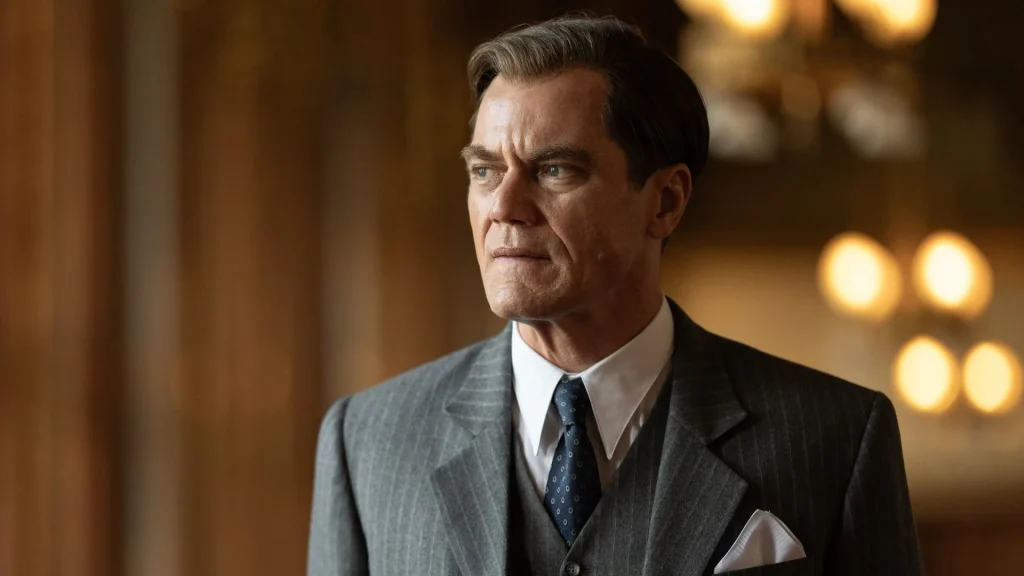
Leading the legal team, ever-reliable Shannon portrays Jackson, who worked diligently to bring 12 members of the Nazi High Command to trial for war crimes.
While others just wanted to put the war in the rear-view mirror, and favored executing those responsible for the genocide, Jackson wanted the world to see and hear what they had done. He was responsible for this international tribunal that involved the U.S., England, France and the Soviet Union, the first of its kind.
Jackson, later a Supreme Court justice, didn’t want these ‘monsters’ to become martyrs upon their deaths. His instincts were correct, but the proceedings were not smooth because this was new territory.
How do you define evil? Oscar winner Malek stars as dedicated Kelley, an Army mental health professional tasked with analyzing Hitler’s henchmen. His methods come under fire as he appears to be sympathetic to the prisoners.
He was attempting to build trust. But really, who is trying to outmaneuver whom? It becomes mainly a cat-and-mouse mind game with malevolent Goering, not unlike Jodie Foster and Anthony Hopkins in “The Silence of the Lambs.”
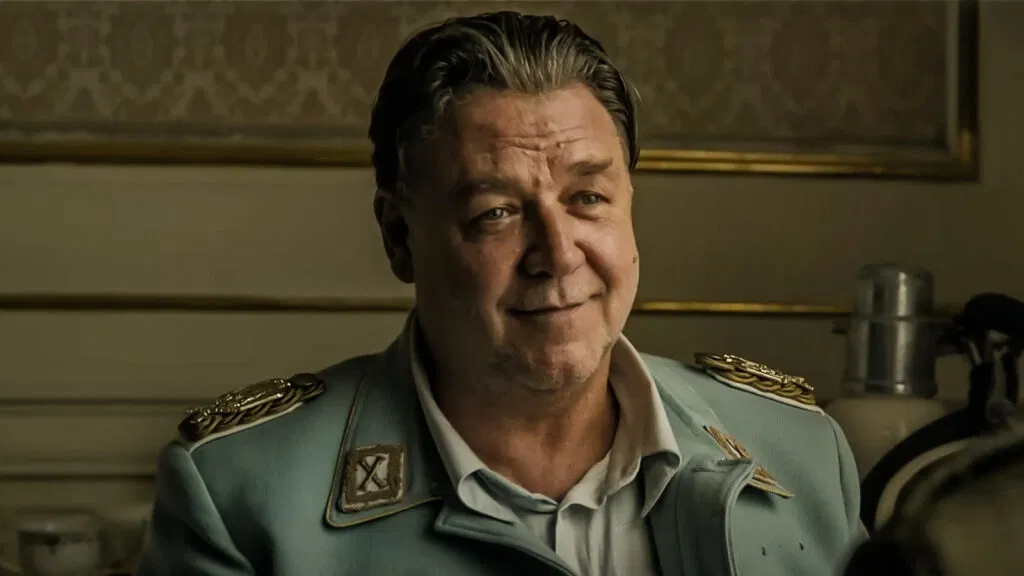
Goering was second in command to Hitler, engineering the horrors of what transpired without any remorse. At the time of this trial, he was the highest-ranking Nazi still alive. (Rudolph Hess is also a fellow prisoner).
Kelley wrote a personal account in his book, “22 Cells in Nuremberg,” but the movie indicates his fall from grace, so he’s been historically ignored, until now. His book’s final chapter is a cautionary tale about how he could see the mindset of pre-World War II Germany happening in the United States.
For those who don’t believe the Holocaust happened, this film won’t let anyone forget. The stakes, past and present, should remain in the forefront.
The chess-like match between the men, especially with Oscar winner Crowe in full command, is fascinating. However the account is fictionalized, Crowe is back to displaying the power he had in his prime, igniting the screen as the cagey, cunning and diabolical Goering.
With his keen intelligence and massive ego, narcissist Goering believed he could justify his actions on this global stage, and it’s chilling to see it unfold.
The 1961 classic Oscar-nominated film “Judgment at Nuremberg,” directed by Stanley Kramer, was mostly a courtroom drama while the current film spends more time behind the scenes on the dangers of unchecked malice.
While this 2-hour, 30-minute film gets ham-fisted in its editing and bogged down in its cumbersome narrative that makes its points repeatedly, the performances are uniformly strong.
Standouts include Leo Woodall as interpreter Sgt. Howie Triest, John Slattery as Col. Burton C. Andrus, who oversaw the prison, and Richard E. Grant as Sir David Maxwell-Fyfe, who is a British co-counselor.
The film’s other strengths include period-accurate designs – production (Eve Stewart), costume (Bartholomew Cariss) – as well as cinematographer Dariusz Wolski’s interiors in the secret military prison and German homes.

The most powerful scene is what was shown at the trial 80 years ago, the same disturbing archival footage of skeletal victims at work camps being bulldozed into their graves. The six gut-wrenching minutes are from the 1945 “Nazi Concentration and Prison Camps,” which was partially shot by director John Ford and included in George Stevens’ 52-minute film.
This footage showed the world what really happened, what these Nazi leaders were capable of, and that they must be punished for their crimes.
Not just a reminder of the past, the films strives to be clear that the prevention and proliferation of evil is always necessary. One recalls Edmund Burke’s famous quotation: “The only thing necessary for the triumph of evil is for good men to do nothing.”
Triest, the German-born translator, says at one point: “Do you know why it happened here? Because people let it happen.”
While the film doesn’t reveal anything new, it is committed to being a clarion call. People have been quoting philosopher George Santayana a lot these days — “Those who cannot remember the past are condemned to repeat it,” from his “The Life of Reason” in 1905.
The fact that we must be nudged out of complacency and realize the consequences on a global stage is the reason that films like “Nuremberg” are made.
“Nuremberg” is a 2025 historical drama written and directed by James Vanderbilt and starring Russell Crowe, Rami Malek, Michael Shannon, John Slattery, Leo Woodall and Richard E. Grant. It is Rated PG-13 for violent content involving the Holocaust, strong disturbing images, suicide, some language, smoking and brief drug content and the runtime is 2 hours, 28 minutes. It opened in theatres Nov. 7. Lynn’s Grade: B.


Lynn (Zipfel) Venhaus has had a continuous byline in St. Louis metro region publications since 1978. She writes features and news for Belleville News-Democrat and contributes to St. Louis magazine and other publications.
She is a Rotten Tomatoes-approved film critic, currently reviews films for Webster-Kirkwood Times and KTRS Radio, covers entertainment for PopLifeSTL.com and co-hosts podcast PopLifeSTL.com…Presents.
She is a member of Critics Choice Association, where she serves on the women’s and marketing committees; Alliance of Women Film Journalists; and on the board of the St. Louis Film Critics Association. She is a founding and board member of the St. Louis Theater Circle.
She is retired from teaching journalism/media as an adjunct college instructor.