By Alex McPherson

A bleak and palm-sweating look at just how profoundly screwed we all are, director Kathryn Bigelow’s “A House of Dynamite” refuses to answer its impossible questions about nuclear war, and urges reflection on the chaos and fatalism of our current fractured reality.

The film, a work of fiction that remains chillingly plausible, zeroes in on the question: What if a nuclear warhead launches from an unknown location in the Pacific for an unknown reason, and is en-route to Chicago with only 18 minutes until impact?

It’s an eventuality that many personnel in the windowless facilities of the government have been trained to deal with, but can they put theory into practice when the beginning of the end is at hand? Is anyone prepared to endure the fallout? 

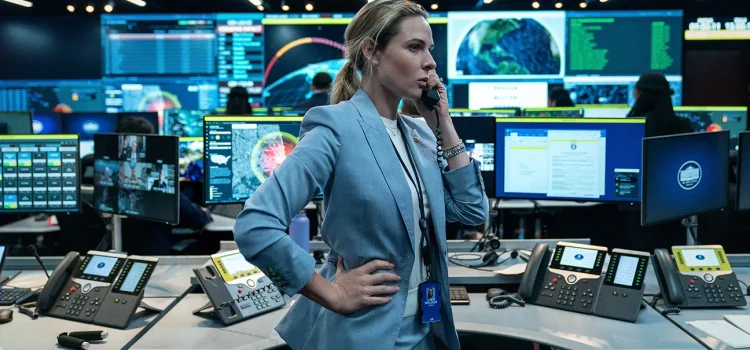
Bigelow’s film repeats those 18 minutes three times from different perspectives within a series of situation rooms and command-and-control suites from Alaska to Washington, D.C., going up the chain of command until we reach the President (Idris Elba).

Military and civilian personnel — portrayed by an impressive ensemble including Anthony Ramos, Rebecca Ferguson, Moses Ingram, Tracy Letts, Jared Harris, Greta Lee, and Gabriel Basso, among others —  scramble to make sense of and neutralize the threat before it’s too late. The President struggles to decide what to do next should that missile actually hit Chicago. 

Time is of the essence, and these trained staff are susceptible to buckling under the weight of what’s headed their way. They are ultimately powerless no matter their rank, and an uncertain future is in the trembling hands of the Commander in Chief. As one flummoxed NSA advisor puts it, the options are either surrender or suicide.

The stakes are dreadfully high, and, despite some unnecessary flourishes, Bigelow refuses to reassure us. Indeed, “A House of Dynamite” is a warning about our (and the world’s in general) precarious situation involving nuclear weapons, as well as a high-strung look at the ways procedures and moral clarity can crumple when theory is put into practice.

Not exactly a “jovial” viewing experience, and one ripe for debate. Still, it’s compulsively entertaining— bringing the scenario to life with a vigorous attention to detail and layered structure that builds toward an integral choice. Bigelow is firmly in her wheelhouse here, supported by acting and production value wholly up to the task.

Bigelow and screenwriter Noah Oppenheim aren’t aiming to make a “satire” here à la Stanley Kubrick’s “Dr. Strangelove.” Rather, the officials depicted in “A House of Dynamite” are skilled at their jobs, many with families at home dealing with familiar, relatable challenges. 

The meaningful, albeit brief, insight into their personal lives before the ICBM is detected furthers the idea of these officials being people at the end of day — that no matter their rank, they are capable of fault just like the rest of us.

Their success in this situation, as depicted in this film, is also ultimately as much dependent on luck as their competence; the advanced technology they have at their disposal can only help them so much, too, as unknowns about the missile’s origins and what they should do if it strikes Chicago are left frustratingly opaque.

Bigelow, having consulted with several ex-Pentagon officials, brings a fly-on-the-wall verisimilitude to her direction, with cinematography by the legendary Barry Ackroyd (a frequent Paul Greengrass collaborator) that adds an effectively shaky, almost documentary-esque realism to the proceedings from start to finish.

“A House of Dynamite” is primarily composed of conversations, but fraught ones, backed by a rattling, slightly overused score by Volker Bertelmann (similar to his work in “Conclave”) that lends extra tautness. 

The film’s triptych structure adds additional context to what we’ve heard and seen before. Bigelow and Oppenheim visualize the series of checks of balances at play, and the reality that those systems cannot save us.

It’s all effectively nerve-jangling, stressful, and draining through the film’s insistence on going through those 18 minutes three different times — ending on a note that encourages conversation, or, perhaps more likely, shocked silence. Less impressive are the occasional “Hollywood” lines of dialogue that break the illusion of real-life that Bigelow works hard to maintain.

But with such an outstanding cast — Ferguson, Letts, and Elba are particular standouts — it’s difficult to become too distracted by the script’s intermittent clunkiness.

“A House of Dynamite” has additional resonance when thinking about what our current governmental administration would do in the same position. Even with experts at the helm in this film, though, doom is possible if we continue down the same path, alongside procedures that are far from foolproof. Bigelow presents a dire message, and it’s extremely hard to take your eyes off the screen.

“A House of Dynamite” is a 2025 political thriller directed by Kathryn Bigelow and starring Idris Elba, Rebecca Ferguson, Jared Harris, Anthony Ramos, Jason Clarke, Tracy Letts, and Gabriel Basso. The film is rated R for language and run time is 1 hour, 52 minutes. It opened in theatres Oct. 10 and streams on Netflix Oct. 24. Alex’s Grade: B+.

By Alex McPherson

An immersive cinematic experience that isn’t quite as profound as it thinks it is, Christopher Nolan’s “Oppenheimer” is thrilling and overwhelming.

The film, based on the biography American Prometheus: The Triumph and Tragedy of J. Robert Oppenheimer by Kai Bird and Martin J. Sherwin, centers around the titular Oppenheimer (Cillian Murphy), the infamous, enigmatic, and enterprising physicist who led the secret weapons laboratory of the Manhattan Project in the creation of the atomic bombs dropped on Hiroshima and Nagasaki.

The bombs were believed to have ended World War II, but left unimaginable devastation in their wake: they released a monster that threatens to destroy humanity to this day. In typical Nolan fashion, “Oppenheimer” unfolds non-chronologically in dual timelines, spliced together non-sequentially, each playing with color schemes, aspect ratios, and perspectives. 

One, presented in color and labeled “fission,” takes place from Oppenheimer’s perspective and follows a 1954 security hearing in which Oppenheimer’s clearance is being questioned by a kangaroo court of politicians wanting to strip him of power due to his opposition to the H-Bomb program and his past leftist associations.

Flashbacks chart Oppenheimer’s career from an unruly yet “brilliant” student at Cambridge who has fiery, apocalyptic visions to his tenure as a popular professor at Berkeley; his tumultuous romantic life; his eventual recruitment as head of the weapons laboratory of the Manhattan Project, and the Trinity bomb test; and the grim aftermath of the bombs being dropped in Japan.

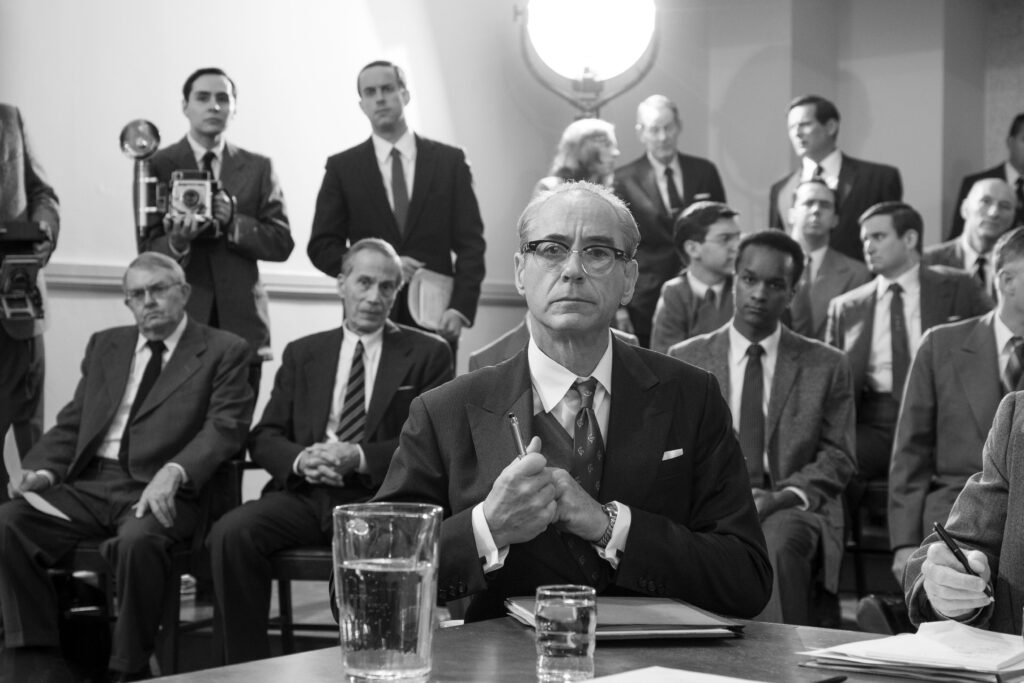
The other framing device, labeled “fusion,” is presented in black-and-white and focuses on the 1958 confirmation hearings for Commerce Secretary Lewis Strauss (Robert Downey Jr.), former head of the Atomic Energy Commission and admirer-turned-bitter rival of Oppenheimer. Strauss’s past associations with Oppenheimer are questioned, and viewers observe the systemic and personal motivations that turned Oppenheimer’s country against him.

Cillian Murphy as J. Robert Oppenheimer

Nolan’s weaving together of time periods emphasizes a cyclical, pessimistic view of humankind and covers as much thematic ground as possible — far more (for better or worse) than a traditional biopic. In its fatalistic structure forever linking cause and effect, thought and execution, ego and ruin, “Oppenheimer” is ultimately a cautionary tale about invention and heroism, the perilous nature of advancement in pursuit of exceptionalism, the sacrifice of morality for power, and the perilous nature of science (and the public’s reaction to science) when it serves or doesn’t serve them.

Meaningful themes, for sure, but ones most of us have seen played out time and time again in media and our current political hellscape.

Anchored by excellent performances and Nolan’s bombastic, unrelenting direction, “Oppenheimer” is always engaging to watch on a purely technical and sensory level, if lacking the soul that creates a lasting impression. Indeed, the film’s three-hour barrage of information, characters, and stylistic showmanship lessens its intimacy. Nolan’s storytelling is too focused on being ambitious rather than letting us sit and reflect, disappointingly distant when it should be enveloping, rendering “Oppenheimer” more satisfying on an intellectual than emotional level.

Murphy, in his first time headlining a Nolan production, is captivating and mysterious. Cinematographer Hoyte van Hoytema’s camera — capturing the halls of academia, sun-swept Los Alamos, and claustrophobic bureaucratic corridors in crisp detail, involving cinema’s first use of IMAX black-and-white analogue photography, enhanced by sterling production design and costuming — absolutely adores his peculiar facial structure, letting us observe this charismatic, arrogant, naive man become hollowed out by his own brilliance. Murphy is expressive yet measured, reflecting Oppenheimer’s contradictions.

Oppenheimer frequently seems pulled between various extremes, rarely committing himself to one point of view. He’s interested in leftist philosophies without ever fully aligning himself with them, he has difficulty navigating a turbulent love life with his alcoholic wife, Kitty (Emily Blunt, underused yet getting one crowd-pleasing moment near the end), and his troubled mistress, Jean Tatlock (Florence Pugh, also underused), while being simultaneously drawn towards and petrified by his own genius. Nolan depicts him as neither hero nor villain, but something in between, with Murphy commanding the screen with empathetic, tortured unknowability.

Robert Downey Jr. as Lewis Strauss

Downey Jr., able to stretch his actorly wings in a role separated from his usual Tony Stark persona, also excels portraying Strauss, a power-hungry politician willing to throw his peers under the bus to come out on top. While Nolan’s zinger-heavy screenplay paints Strauss rather simplistically compared to Oppenheimer — there isn’t much ambiguity left regarding Strauss’s arc by the end, it’s a persona that, though based in truth, we’ve seen before — Downey Jr. lends power and malevolent dignity nevertheless.

Matt Damon, as Leslie Groves, the Army officer who recruits Oppenheimer to lead the Los Alamos laboratory, provides most of the film’s comedic relief in his plain-spoken, nationalistic differences with Oppenheimer, and the rest of the stacked ensemble — featuring such (perhaps overly) recognizable faces as Rami Malek, Benny Safdie, Alden Ehrenreich, Jason Clarke, Casey Affleck, Kenneth Branagh, and Gary Oldman, among dozens of others, including Tom Conti as Albert Einstein — delivers the goods, some only with one or two scenes.

Nolan’s directing is typically strong, of course, with a booming score by Ludwig Göransson that keeps tension taut throughout, and bone-rattling sound design that effectively puts us in Oppenheimer’s fractured headspace. The Trinity bomb-test sequence, as previously mentioned, is almost unbearably suspenseful — the hellish plume of fire folding around itself in silence before surging with ear-shattering noise (thank god for earplugs), while Oppenheimer utters “Now I Am Become Death, the Destroyer of Worlds.”

Some expressionistic touches (like Oppenheimer being stripped naked as his interrogators discuss his romantic past) are difficult to take seriously, and dialogue veers heavily between overly expository and Aaron-Sorkin-lite, but “Oppenheimer” still bears the mark of one of cinema’s greatest directors.

It’s unfortunate that Nolan isn’t able to merge these various elements into a truly impactful whole. With so much ground to cover, the film only sometimes pauses to let us sit and reflect with the characters. Jennifer Lame’s precisely propulsive editing zips us along like we’re watching a montage. I can’t help but feel that a more traditional telling of Oppenheimer’s story, taking place entirely from his perspective without jumping timelines and points-of-view, would have a more organic evolution of his dreams and struggles.

As it stands, there’s much to think about, but little that tugs at the heart save for a few brilliantly directed sequences of Oppenheimer’s guilt visualized, the aforementioned bomb-test, and a sobering gut-punch of an ending. Perhaps a rewatch will prove otherwise, but qualms aside, “Oppenheimer” is quite a beast of a film, if one that’s not as effective or groundbreaking as it’s being heralded to be.

Emily Blunt and Cillian Murphy

“Oppenheimer” is a 2023 drama-thriller-biography written and directed by Christopher Nolan and starring Cillian Murphy, Emily Blunt, Matt Damon, Robert Downey Jr., and Florence Pugh. It is Rated R for some nudity, sexuality and language and runs 3 hours. It opens in theaters on July 21. Alex’s Grade: B+

Note: this review was written during the 2023 WGA and SAG-AFTRA strikes. Without the labor of the writers and actors currently on strike, the movie being covered here wouldn’t exist.

Matt Damon is Leslie Groves in OPPENHEIMER, written, produced, and directed by Christopher Nolan.

By Lynn Venhaus
One of the best films of the year, “Oppenheimer” is a stunning achievement in sight, sound, story, and scope.

Brilliantly directed and written by Christopher Nolan, his first biopic about the “Father of the Atomic Bomb” is his magnum opus. He not only delivers a fascinating historical drama on the genius theoretical physicist J. Robert Oppenheimer’s research and development, but he has crafted it like a big-stakes psychological thriller with many pieces of a puzzle becoming clear over its three-hour runtime.

It was exhilarating to see something this intelligent, lucid, and well-constructed.

Based on the 2005 Pulitzer Prize-winning book, “American Prometheus: The Triumph and Tragedy of J. Robert Oppenheimer” by Kai Bird and the late Martin J. Sherwin, Nolan’s adaptation focuses primarily on the scientist’s rise in the hallowed halls of revered institutions, the U.S. government’s interest in his quantum mechanics work, directing the Los Alamos Laboratory during World War II, his role in organizing the Manhattan Project, and the aftermath of building a nuclear weapon.

This erudite character study explains much in its sharp dialogue that didn’t feel heavy or highbrow, and thanks to the actors’ snappy delivery, naturalistic.  Nolan’s verbal dexterity is crucial to this becoming edge-of-your-seat good instead of an academic exercise, and through meticulous detail, infuses a compelling biography with big-picture questions.

Nolan has created some of the best films of the 21st century since “Memento” in 2000, and is known for his cerebral storytelling, nonlinear style, and visual mastery.

Oscar-nominated five times for picture and director for “Dunkirk,” picture and screenplay for “Inception” and screenplay for “Memento,” his films have won mostly technical awards. He has thrilled with his Batman trilogy, impressed with “The Prestige,” and confounded with “Tenet” and “Interstellar,” gaining a fervent fan base.

Even those not as enamored will begrudgingly admit to admiring his commitment to big, bold cinematic grandeur, rarely relying on digital effects. (For instance, no computer-generated graphics in “The Dark Knight.”)

While weaving a grand-scale intricate narrative that flashes back and forward across decades, Nolan creates tension that leads to the “Trinity” code-name bomb-testing that’s one of the most astonishing sequences ever captured on film as he manipulates sight and sound for the Big Bang.

After the bomb is used and the government takes it over from there, the film raises issues about actions causing reactions, scientific advancement, and government responsibility as Oppenheimer is swept into the maelstrom of moral, ethical, and political debates unleashed after the bomb’s use to end World War II.

The story is framed with an unsettling hearing in 1954, the U.S. Atomic Energy Commission, which stripped Oppenheimer of his security clearance, a kangaroo court depicting the post-war Red Scare paranoia. With his leftist leanings, connections to people that were avowed (past) Communists, and fretting over nuclear proliferation, he was accused of being a Soviet spy and became an unfortunate scapegoat.

Nolan uses this backroom thrashing as a look back, intertwining science with politics by effectively alternating color and black-and-white film. It’s a master storyteller at the peak of his craft.

A key element is a mega-cast that features everyone giving their all, creating authentic portraits of people that played a part in history, from Alden Ehrenreich depicting a Senate aide to British actor Tom Conti unrecognizable as Albert Einstein and Gary Oldman’s sly work as President Harry S Truman in one scene.

A longtime fan of Cillian Murphy, I’m happy to see the Irish actor finally taking center stage in a part that seems tailor-made for him, and he’s on screen nearly the entire time. It’s such a virtuoso lived-in portrait, his career best, and he superbly unfolds multiple layers – showing many facets of Oppenheimer’s personality.

Murphy’s most well-known work is as crime boss Tommy Shelby in the Netflix series “Peaky Blinders” (2013-2022), which is about a gangster family in 1900s England. In 2002, he broke through in the Danny Boyle sci-fi masterpiece “28 Days Later,” and has been featured in six Nolan films, starting with “Batman Begins” in 2005 as DC Comics’ villain Dr. Jonathan Crane/Scarecrow.

As the two complicated women in his life, Emily Blunt is bulldog-like in her support, portraying his alcoholic biologist wife Kitty, unapologetic as a stressed-out mom, and Florence Pugh is troubled longtime girlfriend, psychiatrist Jean Tatlock.

Robert Downey Jr. stands out in a shrewd performance as Lewis Strauss, a founding commissioner of the U.S. Atomic Energy Commission and ambitious political climber, and Matt Damon is strong as General Leslie Groves Jr., director of the Manhattan Project.

Josh Hartnett, who fell off mainstream movie radar, roars back as pioneering American nuclear scientist Ernest Lawrence, who worked with Oppenheimer at University of California-Berkeley, and Benny Safdie is once again surprising as theoretical physicist Edward Teller, who disagreed with Oppie on the hydrogen bomb.

A litany of recognizable actors portraying either scientists, military brass or support staff includes Casey Affleck, Kenneth Branagh, Jason Clarke, Dane DeHaan, Tony Goldwyn, David Krumholtz, Rami Malek, Matthew Modine, and Alex Wolff.

You might also be familiar with Dylan Arnold, who plays Robert’s brother Frank Oppenheimer, Michael Angarano as good friend-physicist Robert Serber, David Dastmalchian as William Borden, who filed a complaint with the FBI, Gregory Jbara as Senate Chairman Magnuson, and Macon Blair as Oppenheimer’s defense attorney Lloyd Garrison.

This film leaps to being either a frontrunner or contender in many awards categories, figuring into the year-end conversations. It will be in mine – considerations for film, director, adapted screenplay, lead actor, supporting actor (Downey), supporting actress (Blunt), cinematography, editing, music score, visual effects, production design, costumes, hair and makeup, and sound nominations.

Nolan’s go-to cinematographer Hoyte Van Hoytema, Oscar nominee for “Dunkirk” and showing his keen eye in “Nope,” reaches new heights here, groundbreaking actually. He shot the film partially in black-and-white, and in doing so, made history. In a combination of IMAX 65 mm and 65 mm large-format film photography it includes, for the first time ever, sections in IMAX black and white analogue photography.

L to R: Matt Damon is Leslie Groves and Cillian Murphy is J. Robert Oppenheimer in OPPENHEIMER, written, produced, and directed by Christopher Nolan.

So that the sections of the movie could be shot in the same quality as the rest of the film, Kodak developed the first ever black and white film stock for IMAX.

Composer Ludwig Goransson, who won an Oscar for his “Black Panther” score, distinctively guides the tone and the tempo with savvy music choices.

The artisan work is exceptional – especially Jennifer Lame’s decisive editing, and the sound editing and mixing technicians’ advanced capabilities (Richard King, Michael W. Mitchell, Kevin O’Connell, Gary A. Rizzo leading the way.)

Luisa Abel’s expert makeup and prosthetic department’s aging visages appear realistic, and costume designer Ellen Mirojnick’s looks for tweedy academia, active soldiers, swanky party guests and ‘40s housewives are spot-on, factoring in desert, Northern California, and New England climates.

Ruth De Jong’s production design spans decades and locations with accurate retro recreations, as Nolan moves from ‘20s grad school in Germany to ‘30s UC-Berkeley classrooms, to ‘40s Princeton, deserts and mountains, wartime New Mexico and McCarthy-era Washington D.C.

“Oppenheimer” harkens back to those mammoth blockbusters of old, those sweeping epics filmed by David Lean that captured our fancy. It is rare to see a movie of this magnitude be this satisfying, but it is nuanced filmmaking at its finest. Go see this big-brained movie on the biggest screen possible.

“Oppenheimer” is a 2023 drama-thriller-biography written and directed by Christopher Nolan and starring Cillian Murphy, Emily Blunt, Matt Damon, Robert Downey Jr., and Florence Pugh. It is Rated R for some nudity, sexuality and language and runs 3 hours. It opens in theaters on July 21. Lynn’s Grade: A.

Note: this review was written during the 2023 WGA and SAG-AFTRA strikes. Without the labor of the writers and actors currently on strike, the movie being covered here wouldn’t exist.