By Lynn Venhaus
“A hundred years from now, will anyone care?”
And that line, asked by a small-town council member, is a double-edged sword in Tracy Letts’ brilliant “The Minutes.” Presented by Stray Dog Theatre, this comedy-drama is a rare work of raw theatrical power as told by a razor-sharp ensemble.
In his usual unflinching way, the master playwright probes the very tenets of democracy with his customary sharp wit and acerbic style. The eight-year-old play is as timely as ever as news is suppressed, and rules of law are disregarded currently in various administrations.
The Tony-nominated play, produced by the Steppenwolf Theatre Company in Chicago in 2017, was scheduled for previews on Broadway in 2020, but had to be shut down due to COVID-19, then returned for opening in 2022.
What starts out as an amusing series of exchanges recalling the eccentric film “Waiting for Guffman” and nutty TV sitcom “Parks and Recreation,” nailing the quirkiness of small-town living and municipal government, makes a hairpin turn into a scalding look at democratic principles that should leave you shaken and stirred.
The well-chosen cast, shrewdly subverting expectations, smartly interprets Letts’ blistering look at how those in power will ignore revisionist history to distort the accuracy for political agendas. And that’s chilling to think about how history is written and recorded.
In his contemporary civics discourse, Letts focuses on a fictional town called Big Cherry. At first, we witness funny coffee-break chatter before eight elected members of the city council comprise a quorum, and along with the mayor and clerk, have a closed-door session – but wait, one guy is missing, and the reason isn’t very clear.
Oh, Letts’ cunning. The minutiae have a motive – he’s carefully chosen every topic, every chuckle. Letts has smoothly built the action to reveal how people in authority overlook principles for their own greed and ambition.
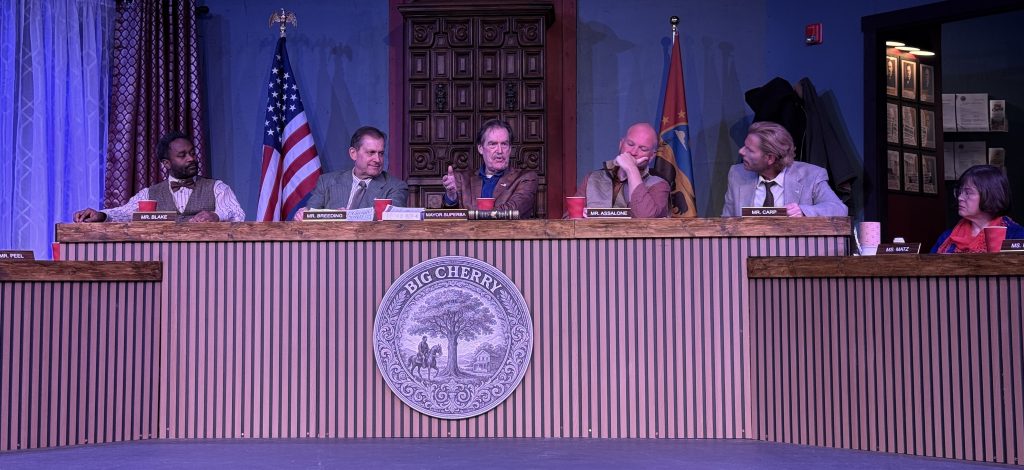
The personalities are distinct. John Reidy is sly Mr. Breeding, your typical gladhander who measures people by their golf game. Will Shaw is the eldest statesman Mr. Oldfield, a cranky sort who likes things the way they were. Patrick Canute is harder-to-read Mr. Hanratty, who appears to be thoughtful and committed.
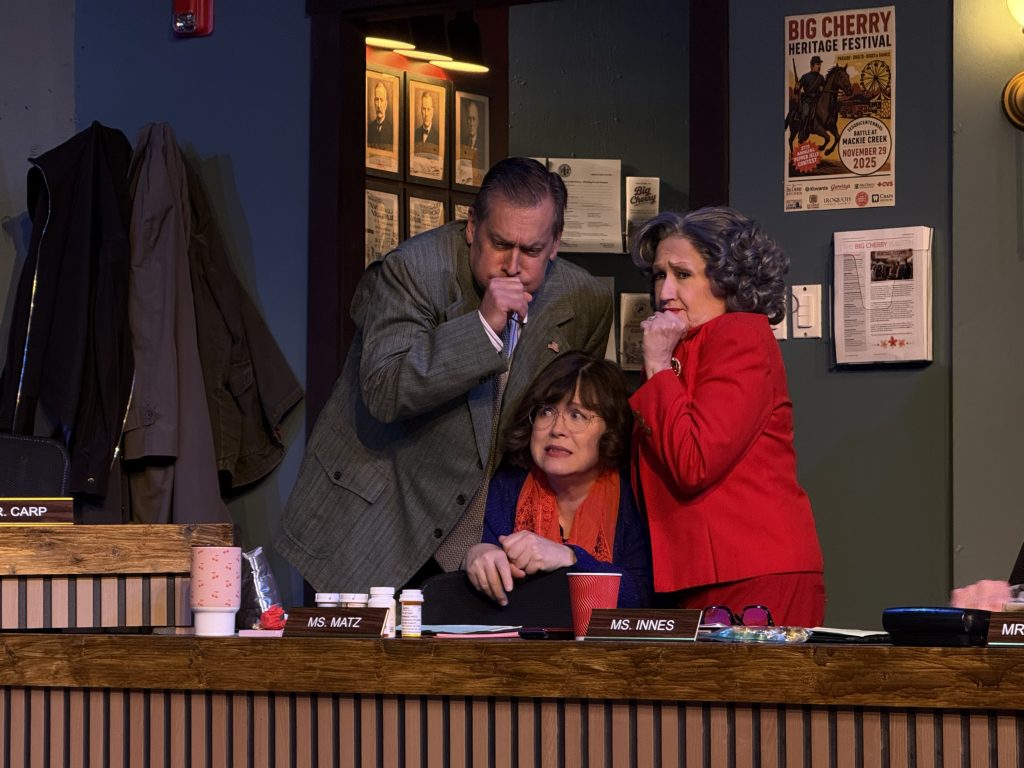
As Mr. Blake, Tawaine Noah is glib and fired up, pushing his pet project, “Lincoln Smackdown,” a cage match. Has he been drinking? Jan Niehoff is ditzy Ms. Matz, who is scattered and blurts out that she’s heavily medicated. Lavonne Byers is Ms. Innes, whose inflated sense of self-importance means she tends to make things all about her. Grandstanding is her favorite way to address her peers.
Mr. Assalone is one of Mayor Superba’s cronies who has little patience for transparency. As “that guy,” his portrayal measured, Jon Hey is smarmy and curt, attitude and aggression festering as the meeting progresses.
Gerry Love deftly plays the iron-fisted mayor as jovial enough but he’s manipulative, controlling and entitled, as his good old boy façade collapses into self-righteous excuses.
The city clerk, Ms. Johnson, savvily played by Rachel Hanks, is machine-like in efficiency, and Hanks has affected an annoying sing-songy voice to appear like an insufferable goody-two-shoes honor roll student you knew in school.
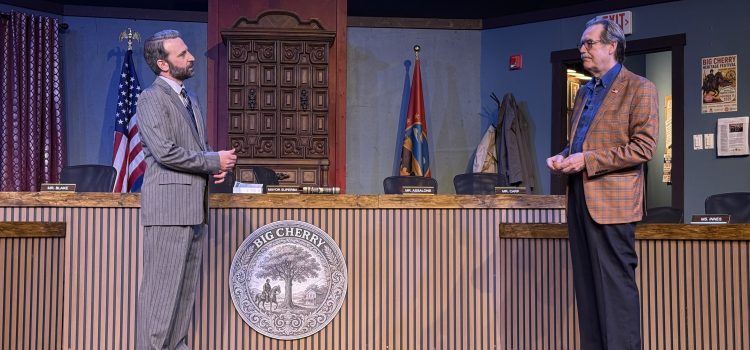
The guy who gets under all their skin is Mr. Peel, the earnest newcomer. Always impressive Nick Freed skillfully portrays the newly elected council member who wants to make a difference. He asks a lot of questions, harmless enough, but his curiosity is unwelcome.
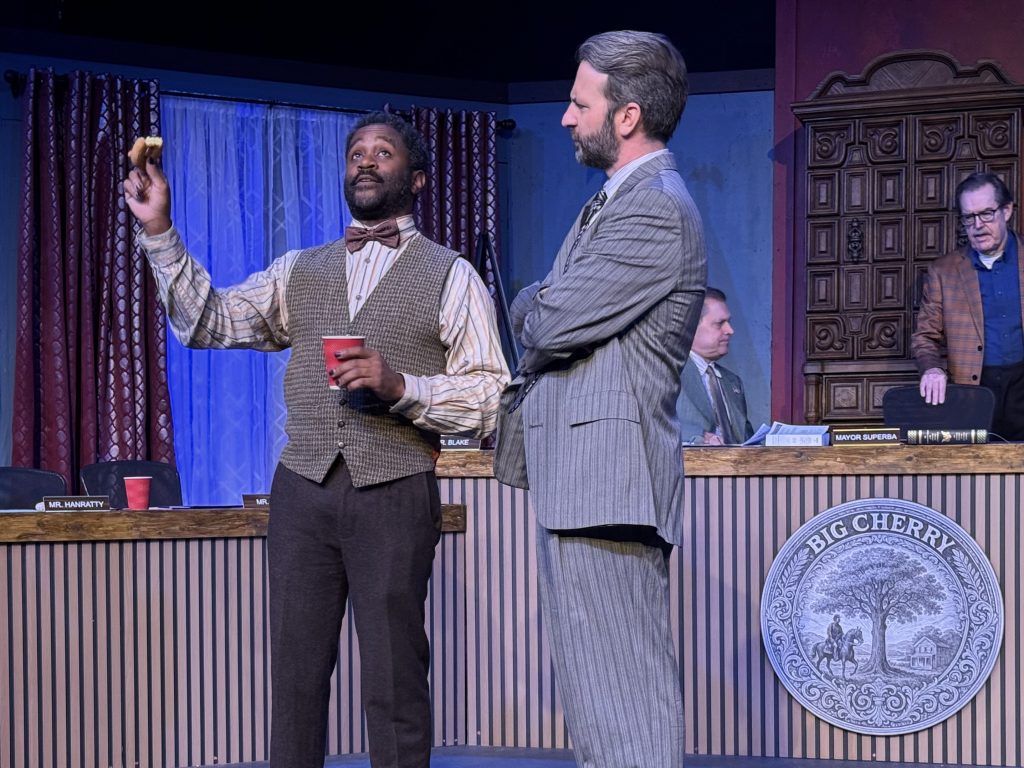
Mr. Peel missed the last meeting because his mother died. Where is Mr. Carp? This appears shrouded in secrecy. In a clever flashback, Stephen Peirick shows up as the now absent council member who dared to challenge his colleagues.
As preparations are underway for the annual Founders’ Day, a horrified Carp is compelled to share his findings. Delivered urgently and passionately, Carp has discovered something rotten they don’t want to hear.
Even the reason behind the town’s name is a lie. What is taught in classrooms and presented in pageants with great fanfare is not the reality Carp has uncovered. There’s a danger to the truth, and Peirick implores them to listen.
Peel, a dentist who is not from Big Cherry but moved there with his young family, is not familiar with the town’s founding father story. All he wants is to see the minutes from the meeting he missed. But as Peel becomes aware of why Carp retreated, a growing apprehension of being an outlier comes sharper into focus, and Freed’s work here adroitly exposes malfeasance.
Understanding the play’s complexities, director Justin Been finessed Letts’ nuances in a terrific push-pull with all the characters. As the power dynamics shifted, he carefully modulated the temperature in the room as the actors serve and volley, mostly seated, but occasionally as they move around the dais.
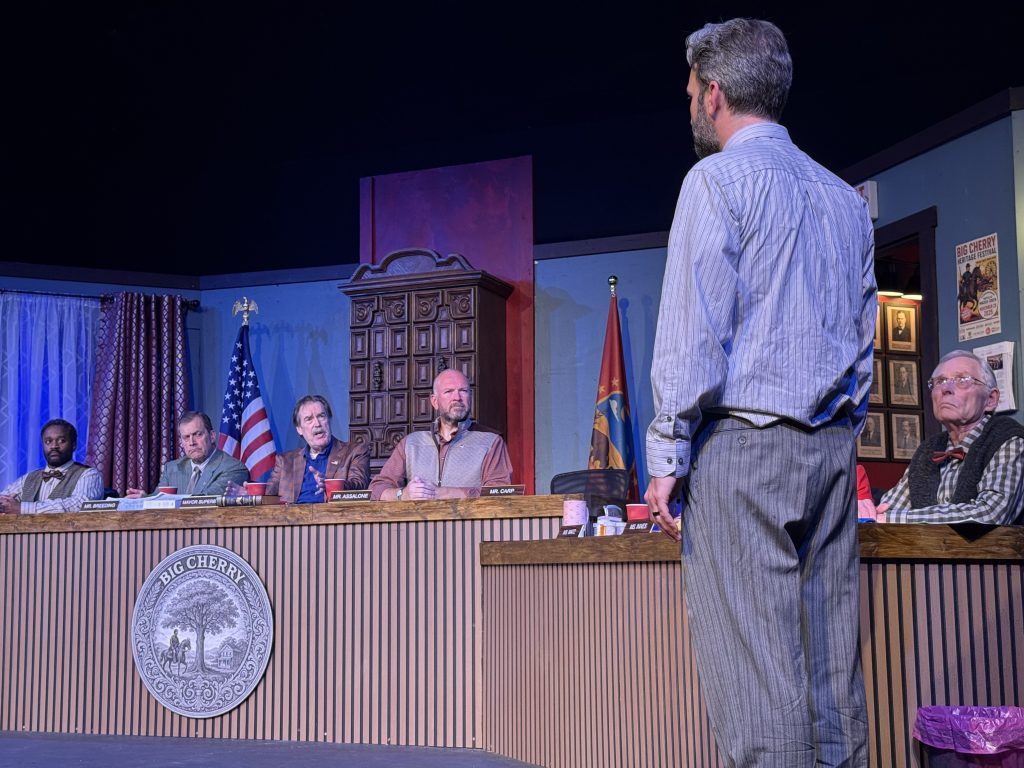
Along with Tyler Duenow’s effective lighting design, Been’s sound design signals a storm outside on this November evening. His scenic design captures a nondescript place like dozens of meeting spaces around the country, where public participation shapes laws.
Other creatives contributing to the production include Kevin Corpuz’ choreography, Colleen Michelson’s costume design and Lizi Watt as cultural consultant.
Letts, who was a finalist for the Pulitzer Prize for Drama in 2018 for this pitch-black show, exposes ugly truths and how self-preservation and complacency factors into moral dilemmas.
Letts grew up in Oklahoma and won a Pulitzer Prize and Tony Awards for his masterwork, “August: Osage County” in 2007. An insightful writer about dysfunctional human experience, he’s always thought-provoking, sometimes unsettling, with a penchant for the absurd.
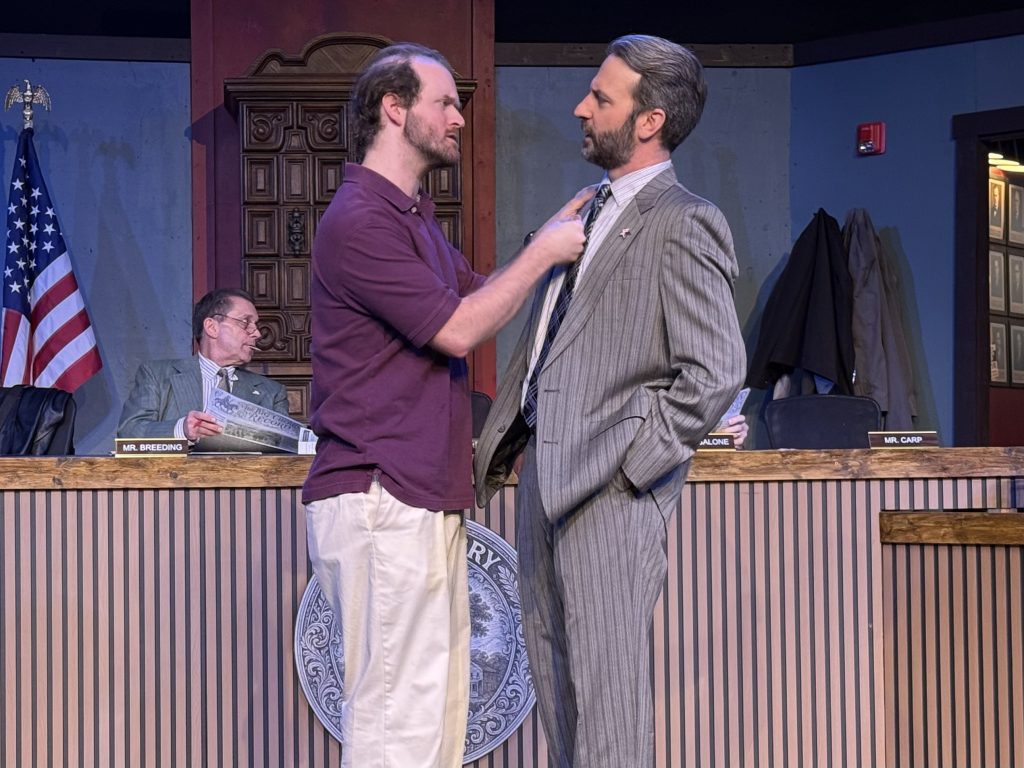
In “The Minutes,” he expertly built tension as the comfort level evaporated. At its core, the complicit council’s smugness threatened to suffocate common sense and decency in favor of expediency.
The one quibble is that while Letts engaged with a conventional narrative structure, he abandoned that for a surreal ending that seemed at odds with the tone of what’s gone on exploring imagery vs. substance, alternative facts vs. reason.
While he enjoys keeping people on edge, it appeared to be an extreme turn after already zig-zaggy storytelling. Still, an admirable work performed vividly with deliberate direction.
“The Minutes” is a potent, politically charged American allegory for the ages, relevant then and now. It may be a cliché that the smallest towns hide the biggest secrets, but exposing hypocrisy is always welcome.
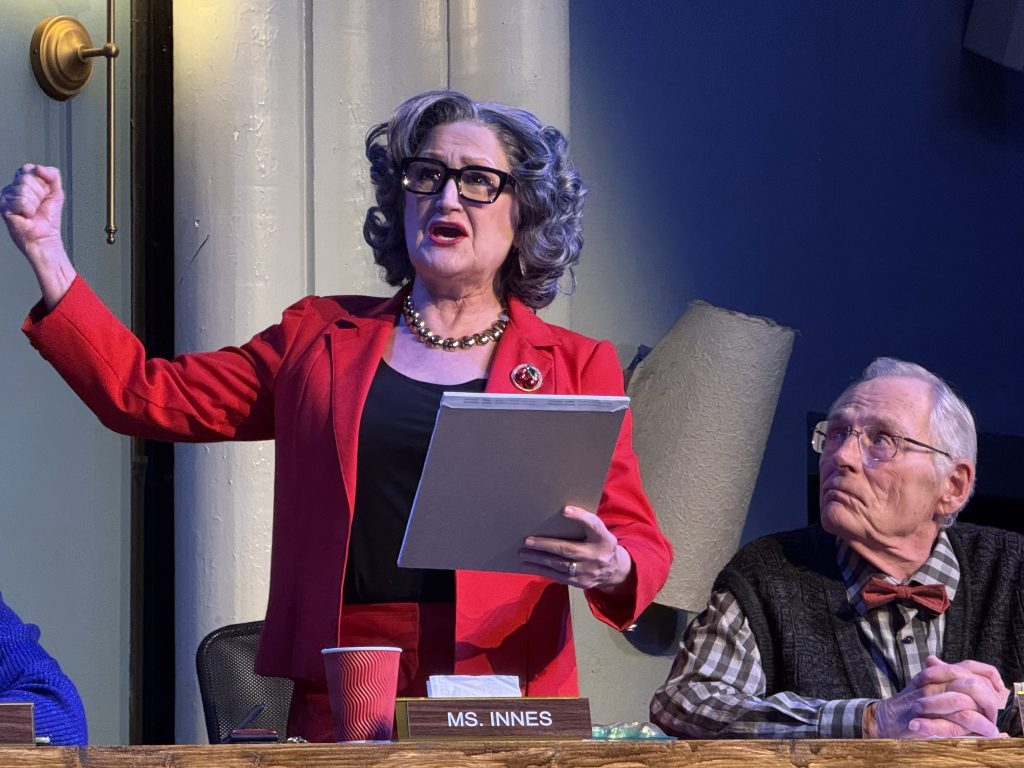
Stray Dog Theatre presents “The Minutes” Oct. 2 – 18 at the Tower Grove Abbey, 2336 Tennessee Avenue, St. Louis, Mo 63104. Performances are at 8 p.m. on Thursdays through Saturdays, with additional performances at 2 p.m. Sundays on Oct. 5 and Oct. 12. The play is 90 minutes without an intermission.
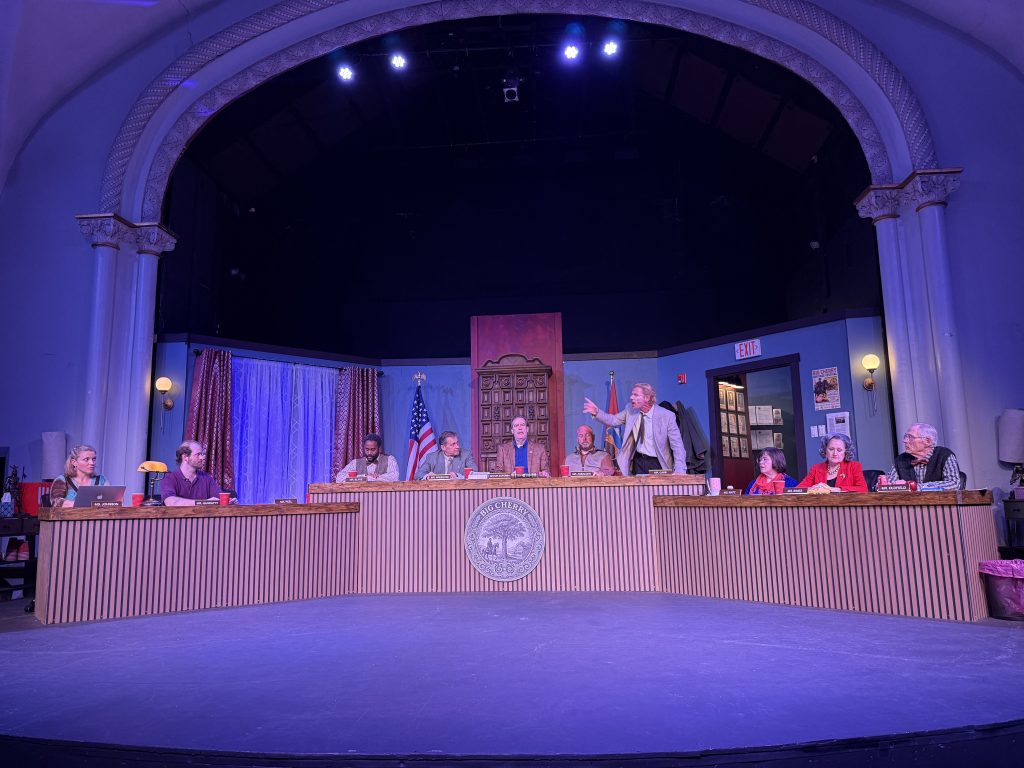
All photos by Stray Dog Theatre.

Lynn (Zipfel) Venhaus has had a continuous byline in St. Louis metro region publications since 1978. She writes features and news for Belleville News-Democrat and contributes to St. Louis magazine and other publications.
She is a Rotten Tomatoes-approved film critic, currently reviews films for Webster-Kirkwood Times and KTRS Radio, covers entertainment for PopLifeSTL.com and co-hosts podcast PopLifeSTL.com…Presents.
She is a member of Critics Choice Association, where she serves on the women’s and marketing committees; Alliance of Women Film Journalists; and on the board of the St. Louis Film Critics Association. She is a founding and board member of the St. Louis Theater Circle.
She is retired from teaching journalism/media as an adjunct college instructor.