By Lynn Venhaus

With boundless enthusiasm, a six-person ensemble enlivens “The Two Gentlemen of Verona,” an early Shakespeare comedy about boundaries in friendship and romance that remains a timeless cautionary coming-of-age story.

The intent is light-hearted, the folly of best buds falling in love with the same woman, and the betrayal and forgiveness that ensues. And saucy minions, too. (Google it).

If we’re outdoors, it must mean it’s a lovely summer evening courtesy of St. Louis Shakespeare Festival’s annual TourCo, where they travel across the bi-state area to bring live theater to local parks and plazas, this year 33 locations in all.

Six years’ strong, this far-reaching accessible and free initiative has evolved into a must-see experience. It is both the longest running play in St. Louis every season and the second largest Shakespeare tour in the country.
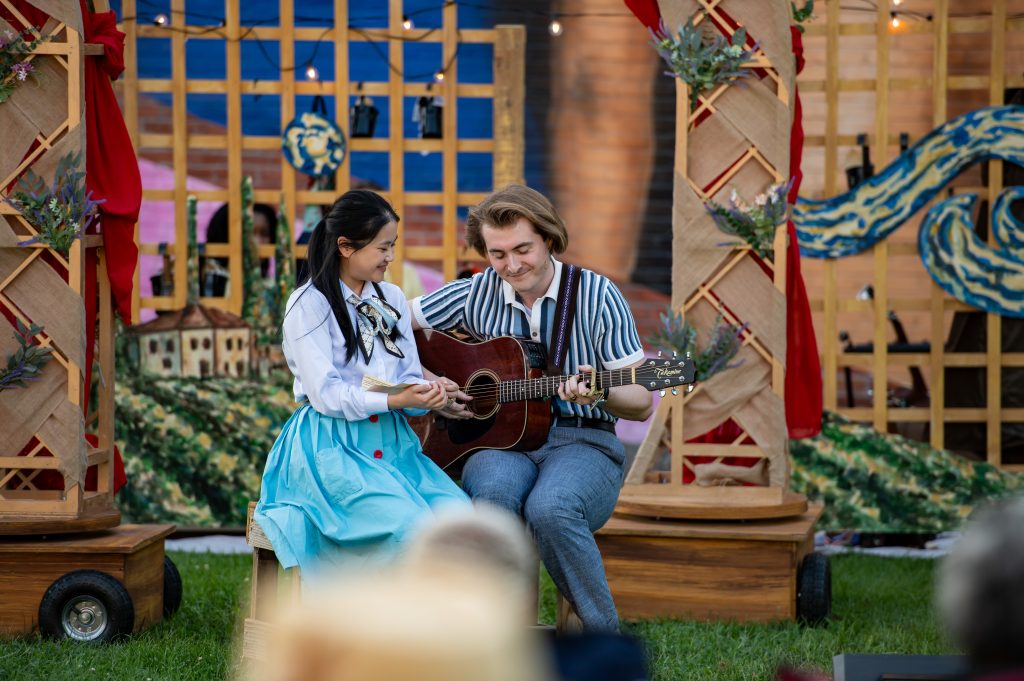
Sarah wilkinson and Tristan Wallach as young lovers Julia and Proteus. Photo by Phillip Hamer.

The picturesque open-air Cohen amphitheatre setting at the Missouri Botanical Garden was the stage Wednesday night, and it showcased all the key aspects of Shakespeare in the park that entertain: appealing performers, musicality and surprises – this time, a scene-stealing dog in the cast.

Director Rebekah Scallet, a Shakespeare veteran, has brought out the universality of the story, generally regarded less than other works, but she points out that it is a precursor to other themes and situations he explores in later plays. Capricious young men! As is typical in early Shakespeare comedies, there’s misunderstanding, disguises, and growing up to do.

What separates this version is its zip. The cast delivers a zesty introduction to set the stage for the 90-minute show in their Living Study Guide, which is a summary explaining characters and their motivations at the beginning. Because it’s a compact and concise adaptation, where the actors play multiple roles, they let us know who’s who and what’s what.

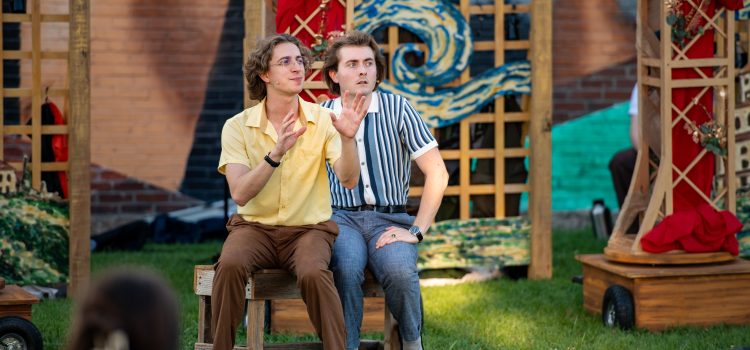
The energetic performers dash around, frequently changing an outfit or grabbing a musical instrument. All but one are making their Shakespeare debut. Newcomer Tristan Wallach is Proteus, who shifts from lovesick romantic into a traitor who betrays both his girlfriend Julia (Sarah Wilkinson) and best friend Valentine (Otto Klemp, who was in “The Tempest” earlier this summer).
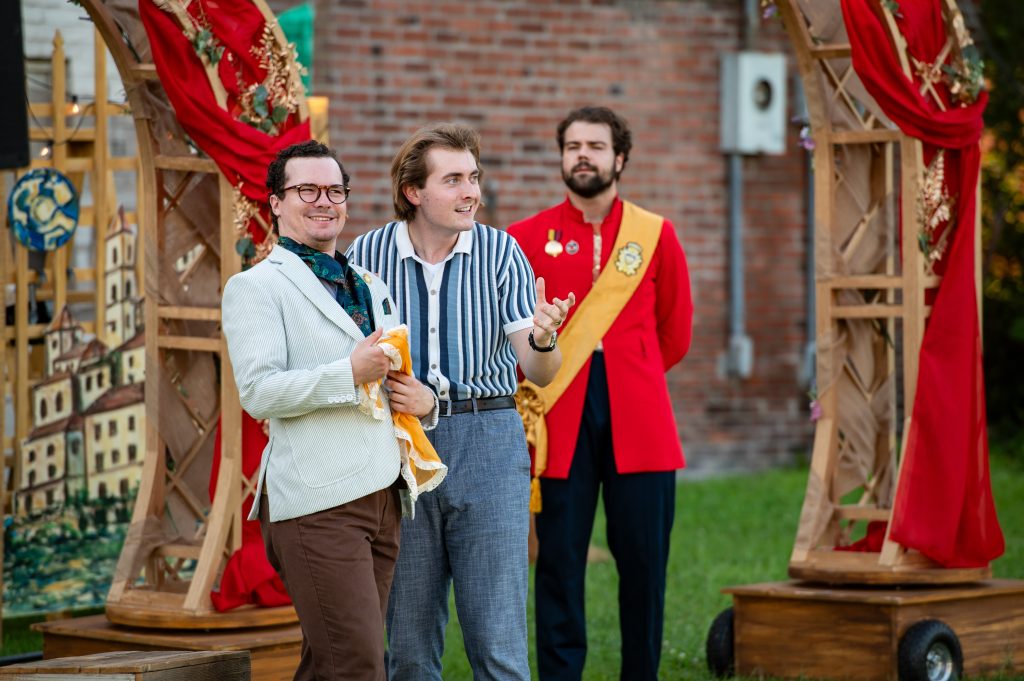
Bryce Miller, Tristan Wallach and Jayson Heil. Photo by Phillip Hamer.

In Milan, to broaden his horizons, Valentine falls in love with the strong-willed Silvia (Jade Simone Francis), daughter of the Duke (Jayson Heil). Proteus, who stayed home, fell in love with Julia. However, Proteus’ father Antonio has sent him to Milan, where he falls in love with Valentine’s girlfriend. Rut-ro. But Silvia rejects him, repeatedly (cue women in audience applauding).

But things get messy as loyalty and good judgment go out the window, and we travel between court to forest (sound familiar?). Say what you will, but in those Renaissance times, they valued the bonds of male friendship over romantic love. Hmmm…That was around 1590, and times have changed.

Charmer Bryce Miller adds oomph to his role of Speed, the quick-witted servant of Valentine. He often comments on the two besties’ foolish antics and works hard to make sure the ‘older language’ sounds fresh. He also portrays goofy Thurio, a wealthy suitor pursuing Silvia, who is favored by the Duke.

As the smart but impulsive Julia, graceful and winsome Sarah Wilkinson disguises herself as a page boy, ‘Sebastian,’ to spy on Proteus, the first evidence of Shakespeare’s cross-dressing heroines. She is assisted by her sassy waiting-woman, Lucetta, played vibrantly by Francis. She has a more practical attitude about courtships than the fickle youths do, especially her faithful boss.
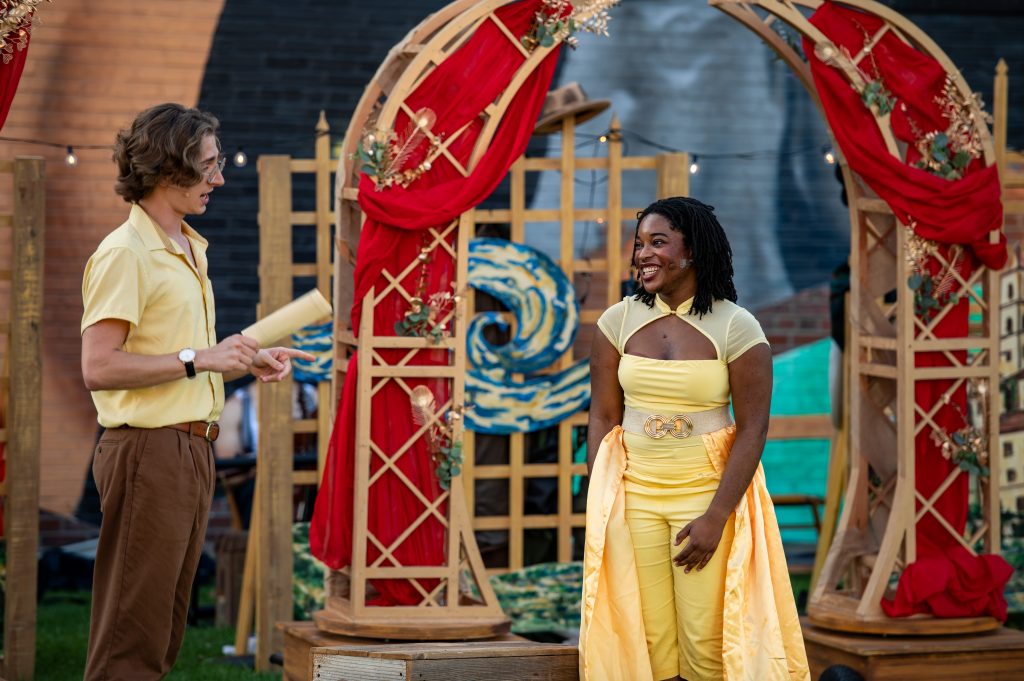
Otto Klemp and Jade Simone Francis. Photo by Phillip Hamer.

Adding even more charm is the seventh cast member, Crab, the ill-behaved pet of clownish Launce (Jayson Heil), Proteus’ servant. Five dogs are being rotated to play this scene-stealing role.

Many times, in Shakespeare comedies, the supporting characters are more interesting than the male leads, and that holds true here. Wallach and Klemp are fine in lead roles, but where they shine is in their acoustic musical accompaniment. They are both accomplished musicians.

Another distinguishing factor is original music, under the superb direction of Larry D. Pry, whose arrangements of melodic tunes fitting the period and setting stand out. The original music was written by Jordan Coughtry, who worked with Scallet when she was artistic director at the Arkansas Shakespeare Theatre.

It’s not all that unusual that “The Two Gentlemen of Verona” features music, for a groundbreaking rock musical adaptation at Joseph Papp’s NYC Shakespeare in Central Park in 1971 went on to Broadway and won the 1972 Tony Award for Best Musical (and best book), featuring Clifton Davis and Raul Julia as the leads.

Pre-pandemic, St. Louis Shakespeare Festival presented a 1980s hip-hop high school musical version of it, “Dress the Part,” in February 2020 from The Q Brothers, who played football players among over 20 parts, which won an ensemble award from the St. Louis Theater Circle in 2022.
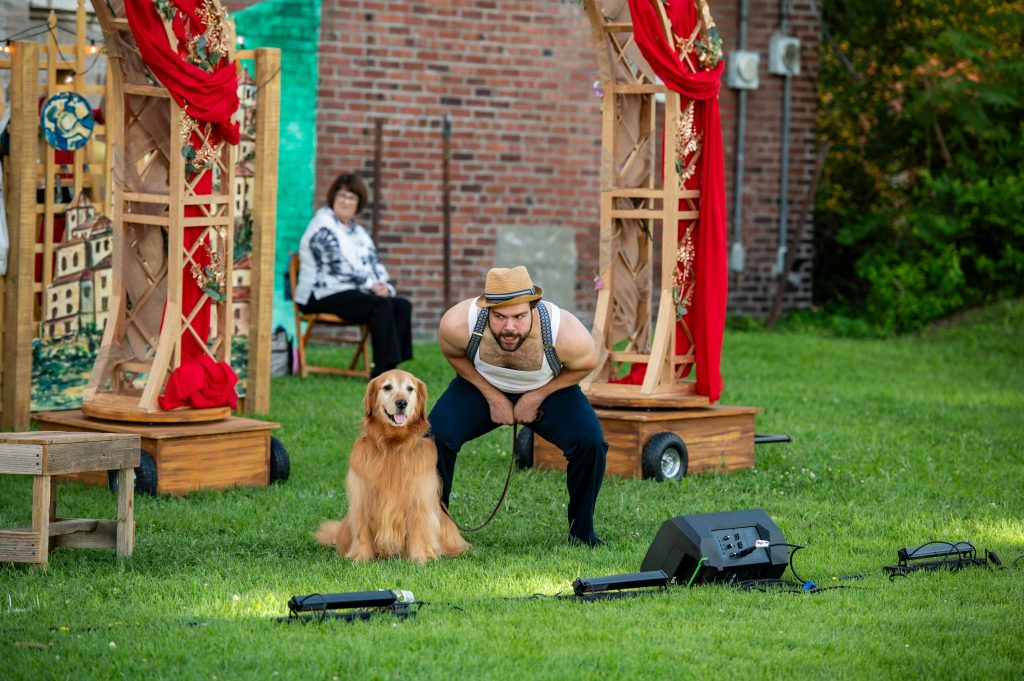
Jayson Heil with Rocky, a Golden Retriever, as Crab. Photo by Phillip Hamer.

This company features a similar fast-paced, playful spirit that Scallet strived for, imbuing a fresh attitude.

The touring company requires a portable set, and scenic designer Katherine Stepanek shows her keen eye for setting a stage to be practical and attractive, with floral-festooned arch-shaped trellises draped with a vivid red material. These move easily to suit the locales. Like she always does, costume designer Michele Friedman Siler fits the occasion with perfectly suited outfits – and ones adaptable for St. Louis summers and quick changes.

The talented technical team also includes John Wilson as both the fight and intimacy coordinator, and Colin O’Brien as the expert production manager, with Britteny Henry doing her customary efficient job as stage manager, ensuring fluid entrances and exits.

Shakespeare may have been taught in your English class, but the best way to appreciate the bard is to see his plays performed, not read. And with the touring company coming to communities and neighborhoods, the time is perfect to bring a blanket or lawn chairs, pack a picnic, and see a family-friendly 90-minute Shakespeare show. Check social media for weather updates.
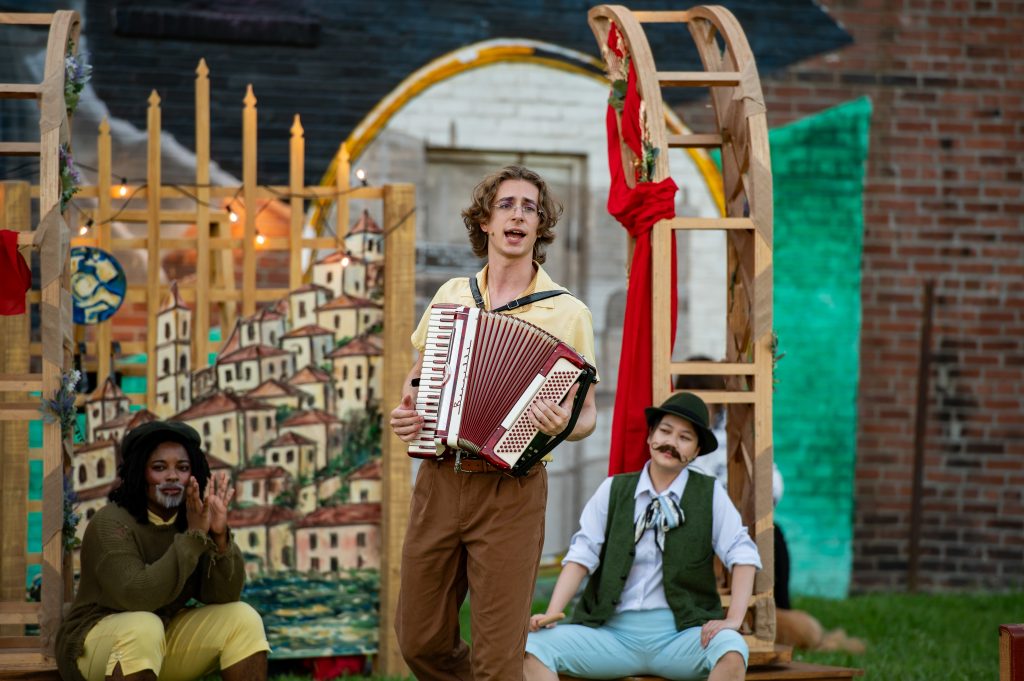
Simone, Klemp and Wilkinson. Photo by Phillip Hamer.

St. Louis Shakespeare Festival’s TourCo is presenting “The Two Gentlemen of Verona” free and open to all, no tickets required, to more than 30 parks and plazas in Missouri and Illinois from Aug. 4 to Sept. 6. Performances start at 6:30 p.m. and are 90 minutes in length. Visit https://stlshakes.org/tourco/ for a complete schedule.
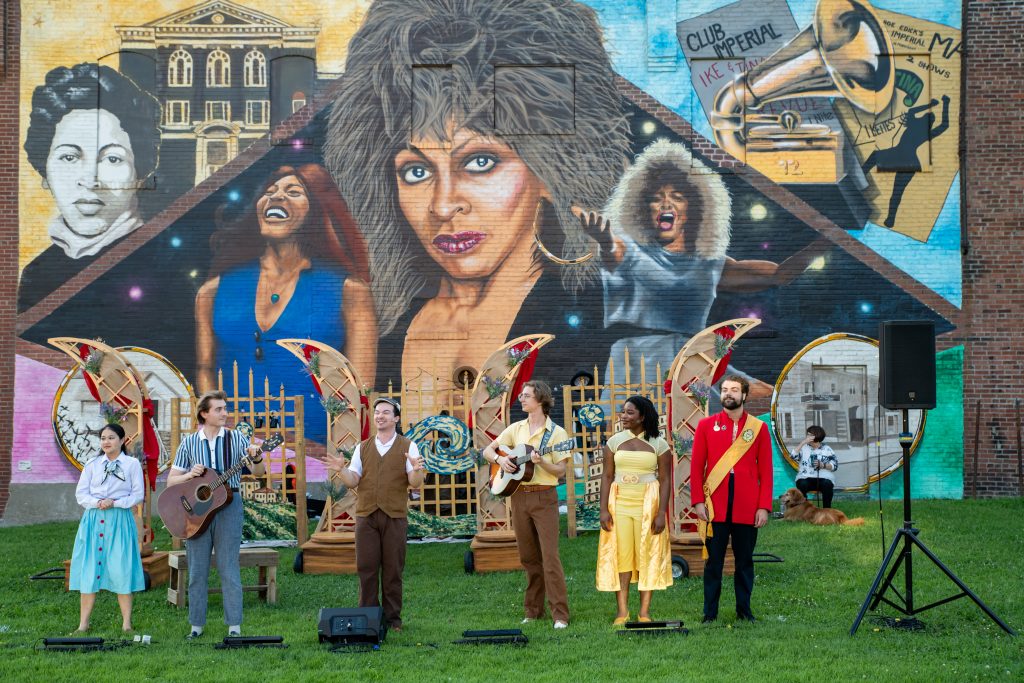

The cast of “The Two Gentlemen of Verona” – Sarah Wilkinson, Tristan Wallach, Bryce Miller, Otto Klemp, Jade Simone Francis and Jayson Heil. Photo by Phillip Hamer.

By Lynn Venhaus
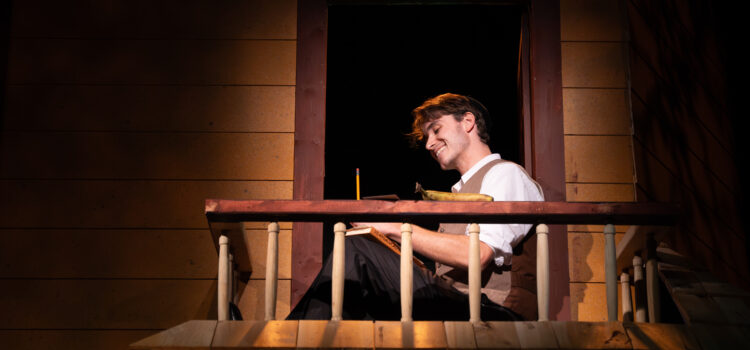
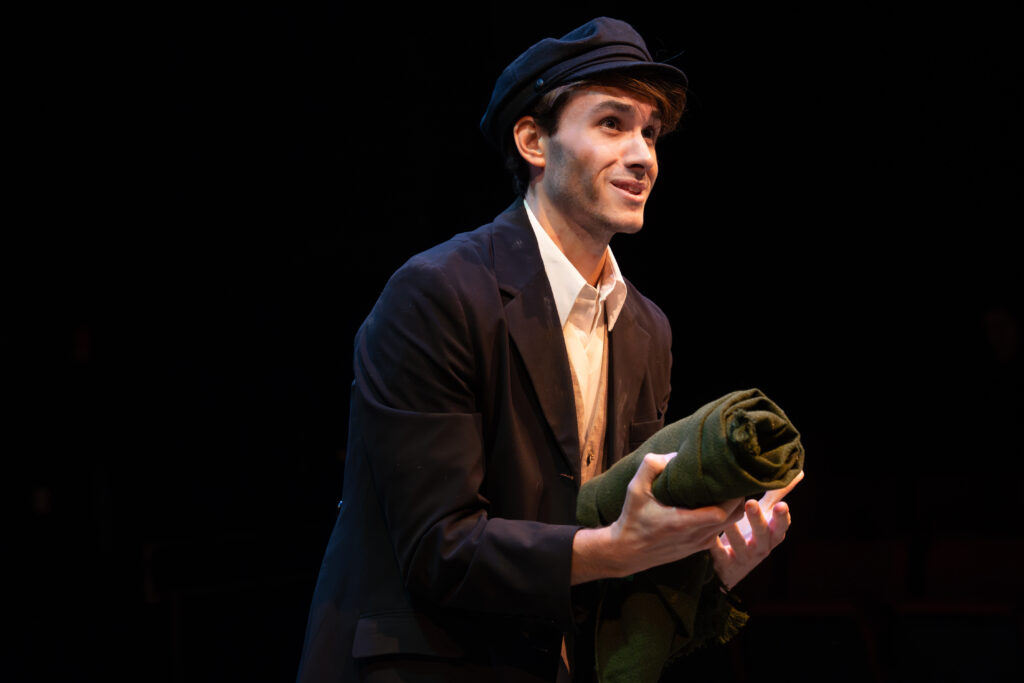
When Haskell Harelik, born Chatzkell Garehlik in Belarus, first steps off the boat in the port of Galveston, Texas, in 1909, actor Dustin Lane Petrillo beams with both joy and wonder.

That sense of liberty, breathing free on our teeming American shore, is palpable, and brings to mind how many other journeys of generations we know about, making “The Immigrant” a universal story that couldn’t be timelier.

This one is specific to Texas following the Russian Revolution. Pograms during those events spurred Haskell to emigrate as part of the Galveston Movement, as one of about 10,000 Eastern European Jews who arrived there 1907-14, arranged by a businessman to alleviate the overcrowding and poor living conditions on the lower east side of New York City.

This fresh New Jewish Theatre production, for the third time in its 25-year history, offers a warm, intimate connection that says as much about our common ground as humans as it does about hope and dreams.

Perceptively directed by Rebekah Scallet, this moving true story is awe-inspiring in its simplicity and eloquence, heart-tugging in its splendid character portrayals by an outstanding quartet, and masterly in its technical achievements.

Playwright Mark Harelik’s richly textured family drama, first produced in 1985, has an absorbing ebb and flow over eight decades, but mainly concentrates on his tempest-tossed grandfather’s early struggles to survive in a foreign land and then eventually succeed in living his American Dream.

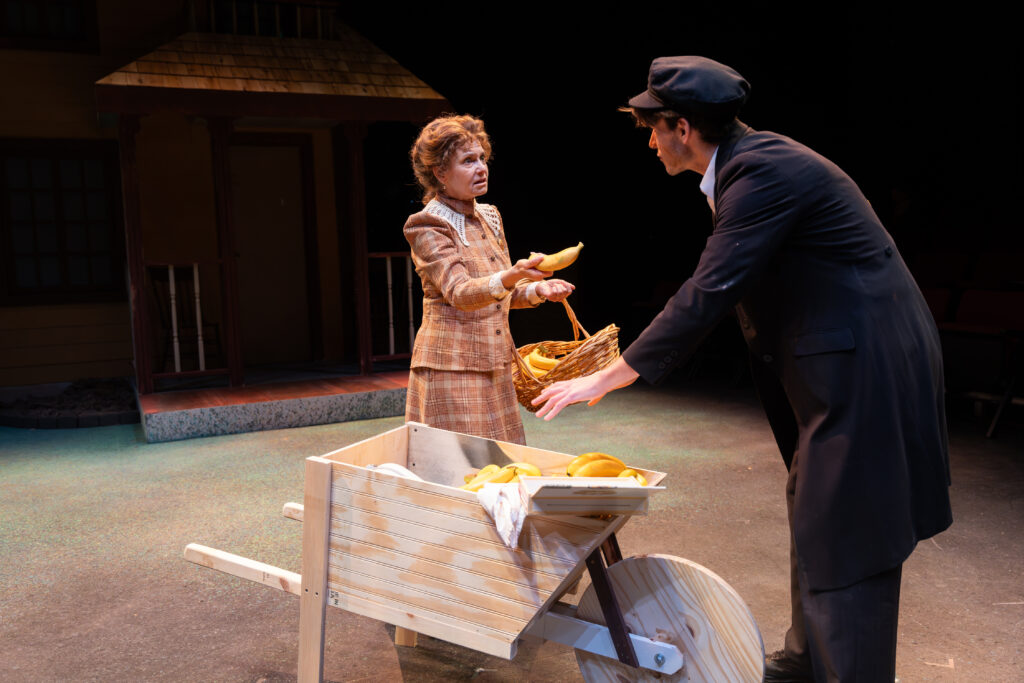
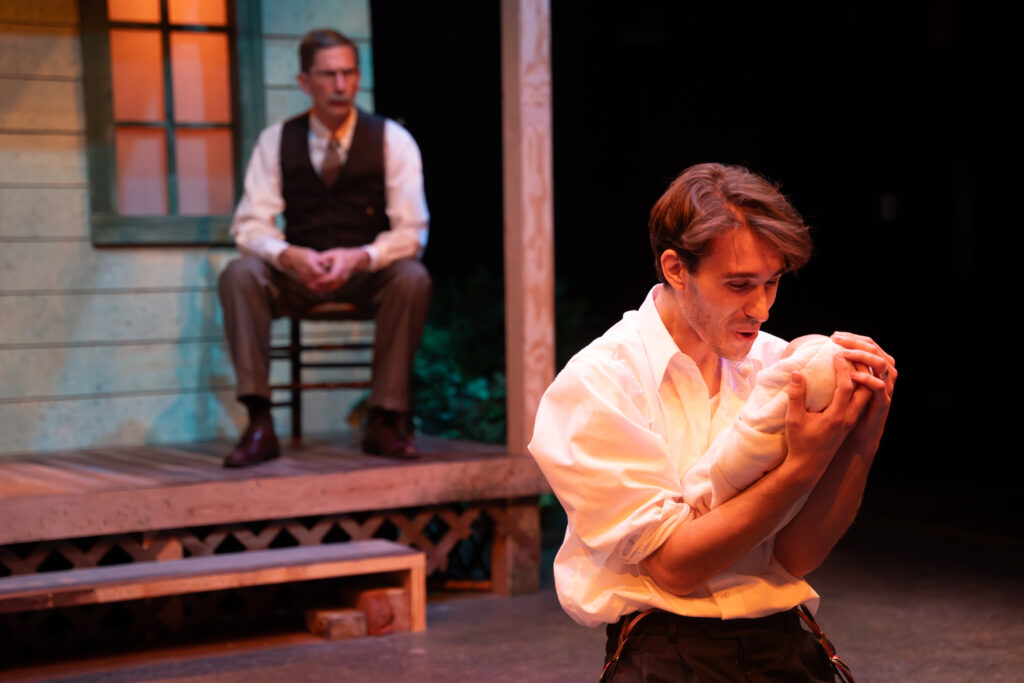
Petrillo’s exceptional range as Haskell – and exemplary command of Yiddish — is first shown as a poor, tired, and parched peddler, selling bananas for a penny apiece when he nearly collapses from the heat in front of the Perry’s home in Hamilton, Texas. Wary of the stranger, banker Milton Perry lets him get water from their well, while his tender-hearted wife Ima wants to offer more help to the lost soul in their midst, and their paths will cross again.

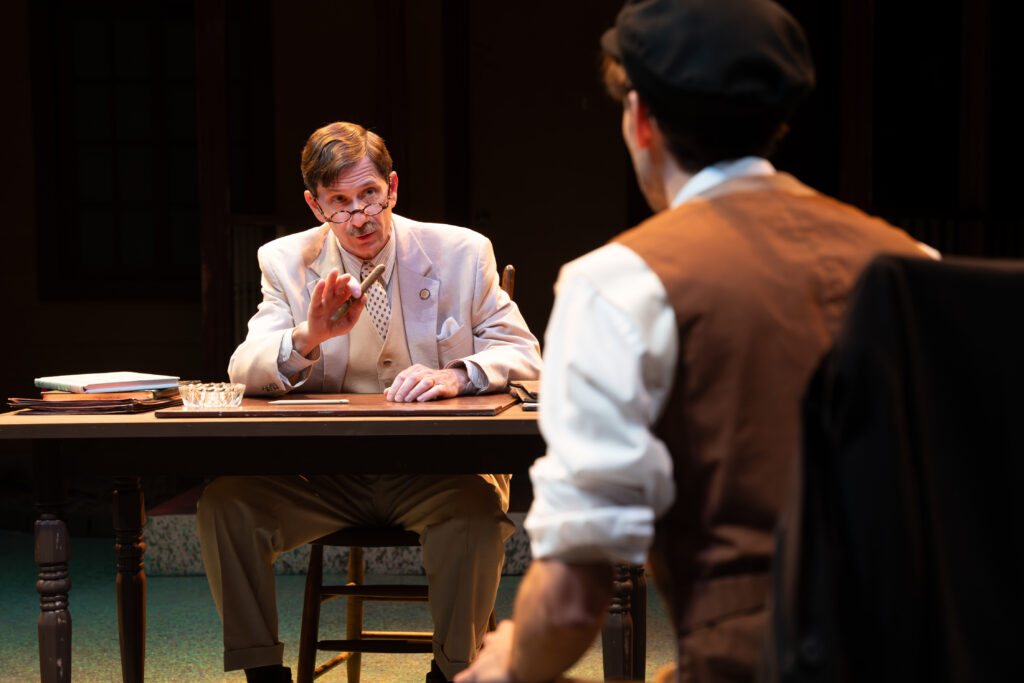
David Wassilak, Dustin Lane Petrillo. Photo by Jon Gitchoff.

As the Perrys, David Wassilak and Mindy Shaw mirror the mindsets of the day, suspicious and fearful of “the other,” but are won over by Haskell’s charm and work ethic. When Milton sees Haskell’s papers and discovers he’s a Russian Jew, his prejudice flares up, but the young man is so earnest, he wins over the locals.

Because of Milton’s position, he’s willing to help set up Haskell in a more stable enterprise – a horse-drawn fruit and vegetable cart. That leads to a store in downtown Hamilton that lasted 78 years, until it closed in 1989.

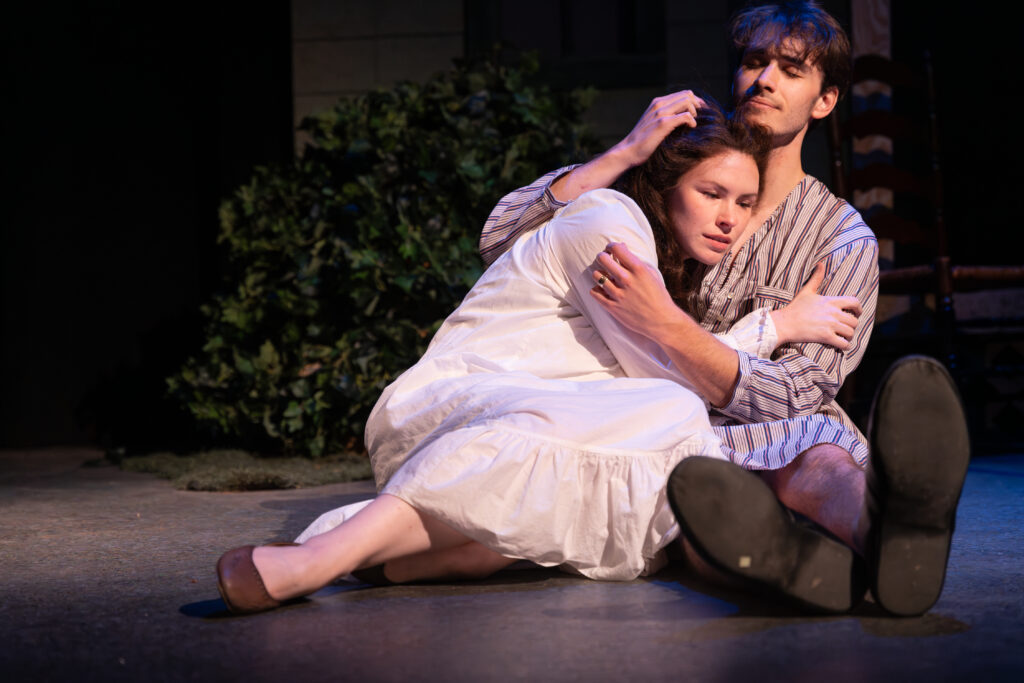
Being a practicing Jew in a primarily Christian enclave, with many Southern Baptists, takes some adjustment, especially for Haskell’s wife Leah, who reunites here with reluctance. Bryn McLaughlin conveys her challenges as she desperately misses her community, but eventually assimilates to a good life as thriving, trustworthy merchants. They raise three boys, with the Perrys being a major part of their lives.

Wassilak and Shaw deliver finely tuned performances, with subtle rural central Texas accents, and together, in sync like an old married couple through the years, for full-bodied realism. Their chemistry is matched by Petrillo and McLaughlin so that you truly feel the couple’s bonds.

Bryn McLaughlin, Dustin Lane Petrillo. Photo by Jon Gitchoff.

Differences about the growing European storm with Hitler in Germany and the reluctance of the U.S. to get involved in 1939 will cause friction between Milton and Haskell. There may be some artistic license, but it’s a wonderful story well-told. The minutia of daily living is superbly captured, all those little things that add up to making a life, no matter what era or what region. (I particularly enjoyed references to rabbit’s foot keychains, anklets and first time seeing an artichoke).

The creative team’s skills are first-rate, with stellar work from Kareem Deanes on sound –organically integrated with birds chirping, and retro background music – as well as his projections design. Each side of the theater has a screen where the audience can view information on Haskell’s journey and portraits of the Harelik family through the years that adds real sentimental moments to this deeply felt tale.

Scenic designer Rob Lippert’s meticulously detailed work on two home facades and landcaped trees and greenery creates a terrific setting to tell this story, placing the audience on each side for seamless action.

Stage Manager Nathan Wright, and Assistant Stage Manager Journee Carter keep the staging crisp and fluid.

Lighting designer Michael Sullivan’s warm illumination creates the feeling of home for both families.

Costume designer Michele Friedman Siler has astutely outfitted the women in changing skirt lengths and vintage styles while dressing the men in their appropriate professional attire, Haskell changing in stature through the years.

The play, co-conceived by Harelik, a professional actor, and Randal Myler, a writer, director, and producer, resonates beautifully with today’s audience.

New Jewish produced this play before, in 1999 and 2011, before I became part of the St. Louis Theater Circle as a founding member in 2012. This was a wise choice to mount it again.

Mindy Shaw, Dustin Lane Petrillo. Photo by Jon Gitchoff

This is Scallet’s directorial debut, and it’s impressive. She is in her second season as artistic director of New Jewish, having moved here in 2020.

The dialect coaching by John Wright deserves mention, and so does the aesthetically pleasing natural wig designs by Dennis Milam Bensie.

“The Immigrant” is a compassionate example of shining our lamps on the golden door for those yearning for better lives. Indirectly, it also is infused with an urgency to not be passive about the current state of turmoil in the world.

The fact that local groups are hosting information sessions on how to help refugees in the Israel-HAMAS War during this play’s run, creates even more meaning. For more information, visit https://jccstl.com/resources-on-the-israel-hamas-war/.

Give me your tired, your poor, your huddled masses yearning to breathe free, The wretched refuse of your teeming shore. Send these, the homeless, tempest-tossed to me, I lift my lamp beside the golden door!” – bronze plaque on The Statue of Liberty, 1883

David Wassilak, Dustin Petrillo. Photo by Jon Gitchoff.


The New Jewish Theatre presents “The Immigrant” Thursdays at 7:30 p.m., Saturdays at 4 and 8 p.m. and Sundays at 2 p.m. Oct. 12 through Oct. 29. Performances take place at the Wool Studio Theatre in the SFC Performing Arts Center, 2 Millstone Campus Drive. The two-act play runs 2 hours, 21 minutes, and has a 15-minute intermission. For more information: newjewishtheatre.org or call 314-442-3283.

The New Jewish Theatre has coordinated with multiple local organizations who help immigrants to plan outreach events at or in coordination with this production to bring awareness to current issues facing immigrants and refugees in St. Louis. They include:

  • A “needed item” drive in collaboration with The International Institute will take place throughout the showings.
  • On October 21, following the 4 pm performance, there will be a discussion panel featuring members of the Central Reform Congregation Resettlement Chavurah.
  • On October 22, following the 2 pm performance, there will be a discussion featuring members of the Shaare Emeth Congregation Resettlement Group.
  • Finally, a Welcome Neighbor dinner will take place at the J between the 4pm and 8pm performances on October 28.