
By Lynn Venhaus

With its pitch-black tale of love, murder, revenge and obsession, Stephen Sondheim’s singular “Sweeney Todd: The Demon Barber of Fleet Street” remains an ambitious, wildly popular musical that is a challenge to produce and even harder to satisfy high expectations, no matter whether the interpretation is traditional or innovative.

Such is Sondheim’s reputation as the most important figure in 20th century musical theater and the macabre masterpiece’s passionate fan base around the globe. For Sondheim enthusiasts, any opportunity to hear that majestic score is welcome – that is why it’s often adapted into a concert presentation or an opera.

For their second official foray into Sondheim’s daunting catalogue – after their award-winning and critically acclaimed “Assassins” in 2022 at the .Zack, Fly North Theatricals presents a thoughtfully staged and deeply committed 12-member cast for this demanding show.

Attention must be paid as the ensemble raises firm, emphatic voices to grab hold in the opening “The Ballad of Sweeney Todd: ‘Attend the Tale of Sweeney Todd” and stresses the dramatic stakes in the reprises, acting like a Greek chorus.

“God That’s Good!” Photo by Julie Merkle

Parker Miller, principal bass; Margaret Beekman, principal soprano; Mia Millican, principal alto; and Nathan Hakenewerth, Matt Ingram, Dereis Lambert, Crispin Shininger, Rachel Bailey, and Isobel Ramsey robustly raise their voices in unison.

They roar with energy in “God, That’s Good!” and are the mighty backbone of this grand, grim musical that is about 80% music.

Director Colin Healy has been strongly influenced by Sondheim throughout his career – and has a mural painting of Steve on the wall of the Greenfinch Theater & Dive Bar that he co-owns with technical wizard Bradley Rohlf, so his understanding of the material is never in doubt.

(Fun Fact: The bar is even named after one of Sondheim’s songs (“Green Finch and Linnet Bird”).

Healy dives into this monumental work with the intense drive of Hal Prince and the minimalistic eye of John Doyle, two legendary interpreters of Sondheim’s shows. (Prince directed the original mammoth 1979 Tony-winning Broadway show while Doyle reimagined an austere asylum-set 2005 revival).
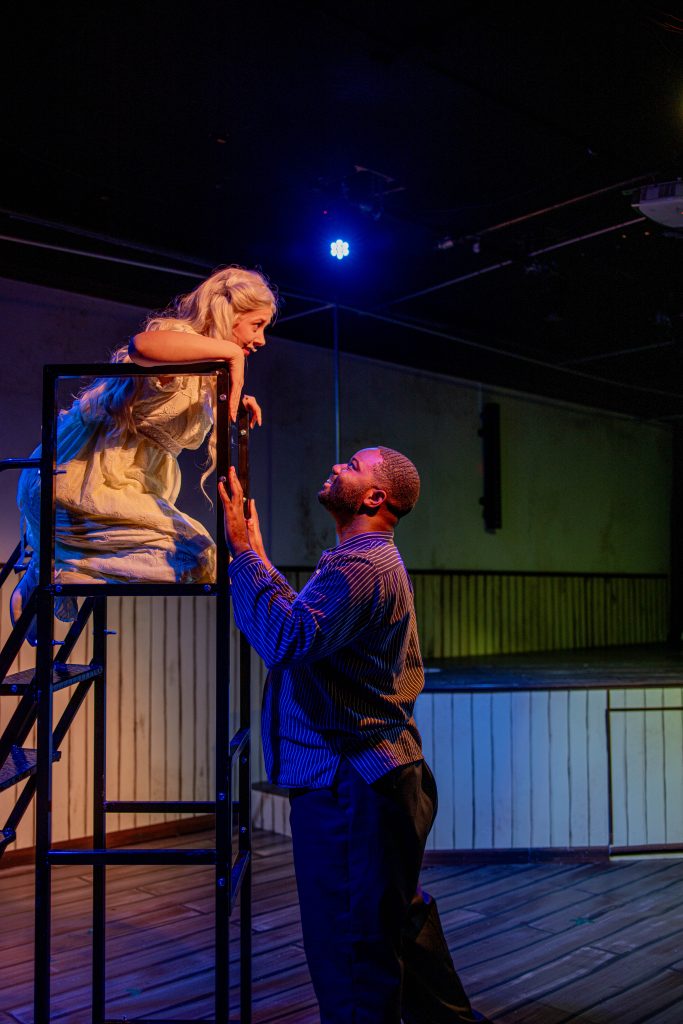
Isobel Ramsey and Dereis Lambert. Photo by Julie Merkle.

To create an intimate production in the cozy confines of the Greenfinch theater space, Healy focused on the character-driven narrative, stripping it down to a few immersive set pieces and counting on the audience’s imagination. The 19th century Victorian London setting is more of a suggestion, which is fine.

Clever lighting co-designed by Healy and Lauren Perry and nimble stagehands/cast led by stage manager Dizzy Funke help create a foreboding atmosphere. Rohlf lends his considerable skills as technical director.

Fly North’s resourcefulness with a tiny budget is laudable. And the efficient staging of the murders and body disposal benefits from everyone’s dedicated timing. Now, fresh ‘blood’ is splattered on some audience members, but those sitting at other angles don’t get that special effect, nor do they see it.

The heart-rending book by Hugh Wheeler, Tony winner for this, “A Little Night Music” and “Candide,” shocks and awes – blending terrifying psychological horror with deliciously wicked flickers of humor, some of it campy, while the music chills and thrills.

The disturbing gothic narrative was adapted from Christopher Bond’s 1970 play “Sweeney Todd,” which featured motivation for the barber’s lurid crimes. He imagined Todd as the victim of a corrupt, lecherous judge, who exiled him to a penal colony in Australia and ravaged his wife.

Bond had used a 1847 ‘penny dreadful’ (popular Victorian pulp fiction) – “The String of Pearls,” which sensationalized the demon barber of Fleet Street as a killer who baked his victims into meat pies.

Sondheim’s music made it feel larger in scope, and Prince decided the downside of the Industrial Revolution was that it turned out soulless, defeated, and hopeless people. That outlook, combined with Sondheim’s flair for emotional depth — nobody could tinge lyrics with melancholy, regret, and revulsion quite like he could.

“The Contest.” Photo by Julie Merkle.

Because Healy is such a Sondheim zealot, the ensemble’s enunciation was commendable on the razor-sharp lyrics and rhythmically complex songs. He isn’t the music director for this show, his usual role, but he and music director Stephen Schermitzler created the sound. Greenfinch’s orchestra pit is in the basement.

Chandler Spradling appears as an imposing anti-hero as Todd, a man pushed into nefarious deeds because of his life’s circumstances, thwarted by depraved men. He has a strong bass-baritone on such numbers as the battle cry “Epiphany” and chilling “My Friends.”

He and Lambert establish their relationship with the hopeful “No Place Like London,” and he shares his piteous tale “The Barber and His Wife.” Todd sets his diabolical plan in motion.

He meets a chatty Mrs. Lovett at her failing pie shop and opens a barber practice located above. Their meeting of the minds results in a thrifty use of a ghastly ingredient that makes her meat pies so tasty.
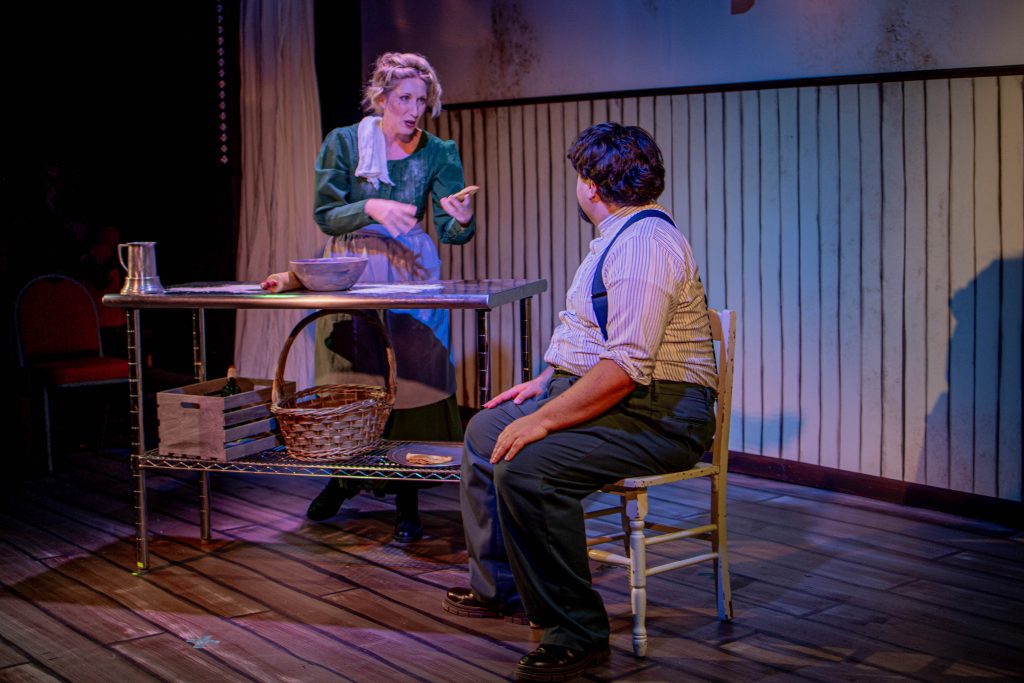
“The Worst Pies in London.” Photo by Julie Merkle.

Multi-faceted Jennelle Gilreath Owens is everything one can expect in an earthy Mrs. Lovett – she engages immediately in her “The Worst Pies in London,” showing off her finely attuned comedic skills and superb timing, not to mention an impeccable Cockney accent. She’s more ditzy than blowzy, more Lucille Ball than Ethel Merman.

Owens has always been a gem on local stages and shines in this iconic role. (At Stray Dog Theatre, she was a fierce Witch in Sondheim’s “Into the Woods”). She excelled at the patter song “A Little Priest” and was wistful in the duet “By the Sea.”

Perhaps the taxing nature of the intricate rhymes and complex musicality of the score was so arduous that some character development was lacking – because there should be more to some of these roles than broad strokes.

Spradling displayed the anguish, reinforced by a hollow gaze, but was less convincing as he descended into madness. Todd’s all-consuming grief and simmering rage must be palpable. His twisted partnership worked with Mrs. Lovett – until it tragically doesn’t. That downfall in the devastating second act felt a tad rushed – we should feel the sorrow.
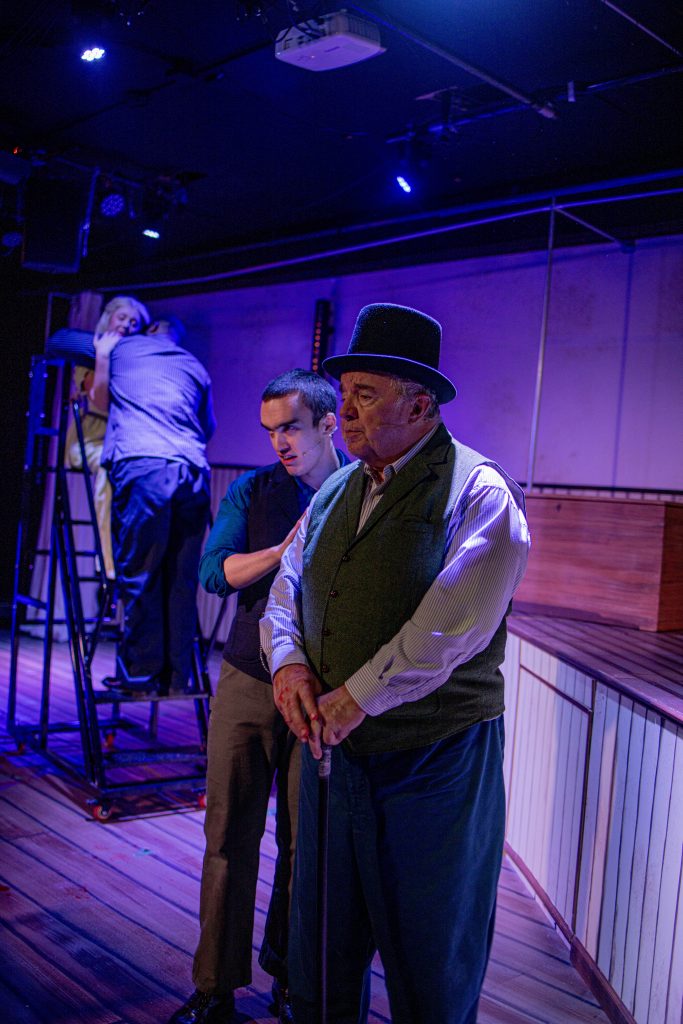
Judge Turpin. Photo by Julie Merkle.

Haller wasn’t a cruel Judge Turpin but rather a self-righteous, controlling authority figure where his possessive nature turns creepy when he lashes himself over his desires about his young ward. He could have been nastier and more intentional because he’s duplicitous.

Most disappointing was “Pretty Women.” Had the vocal prowess and the psychological depth met the moment, the beautiful song would have been haunting and unnerving.

The star-crossed lovers, Anthony Hope and Johanna Barker, seem doomed, and for the audience, they can cheer on the couple, despite Johanna being imprisoned and forced to marry the Judge (so cringy). Dereis Lambert and Isobel Ramsey are youthful in their ardor and have a lot at stake here in their songs. Lambert’s immediately smitten in “Ah, Miss” and blends romantic yearning in “Johanna.”

For the most part, Healy avoided cartoonish evil when things all start going sideways, and that meat grinder gets a workout. But pile on the menace! With the help of white curtains, shadows and light, they make the ominous asylum scene work, and the chaos grows in a wobbly “City on Fire!”

Matt Ingram as Beadle Bamford and Crispin Shininger as Tobias Ragg were compelling as these integral characters. Ingram, with a bold, strong voice and credible dialect, had to straddle the fine lines of pomposity with politeness, cruelty with complicities and his own sense of self-importance and broad humor. Ingram did so admirably, particularly in “Parlor Songs.” Nobody mourned his fate.

Matt Ingram. Photo by Julie Merkel.

However, the naïve Tobias must transition from comic relief to tragic figure, starting out as loyal assistant to the charlatan Pirelli then becoming protective of Mrs. Lovett as a maternal figure.

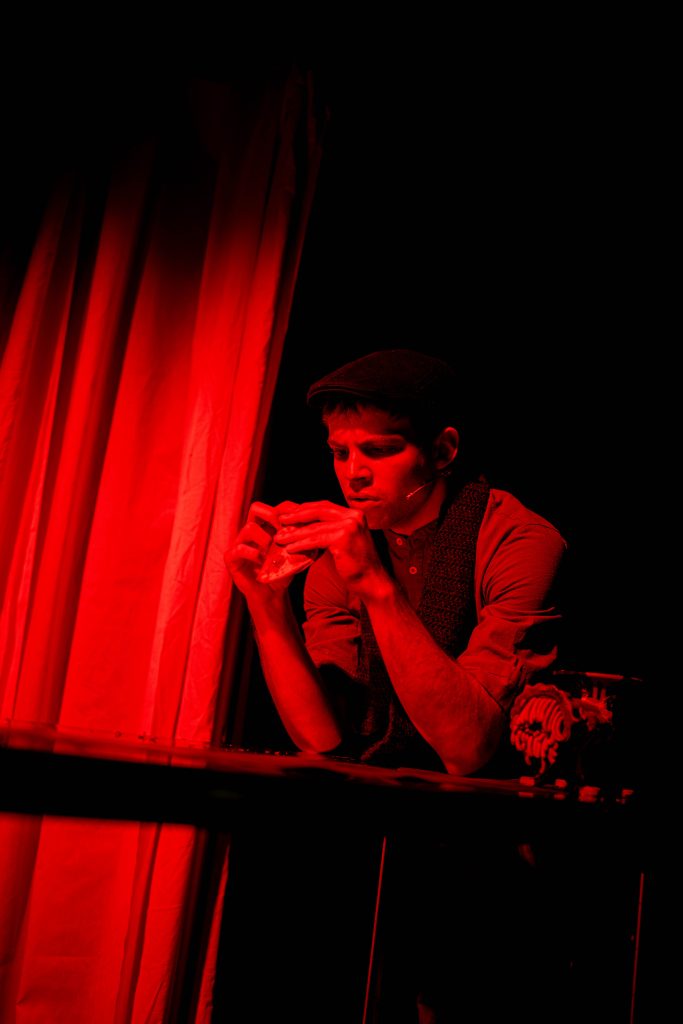
Shininger is heart-breaking in one of the show’s best songs, “Not While I’m Around,” and his inevitable mental breakdown. His trauma was believable, after he figures out Todd and Mrs. Lovett are murderers, but the blocking could have been more decisive.
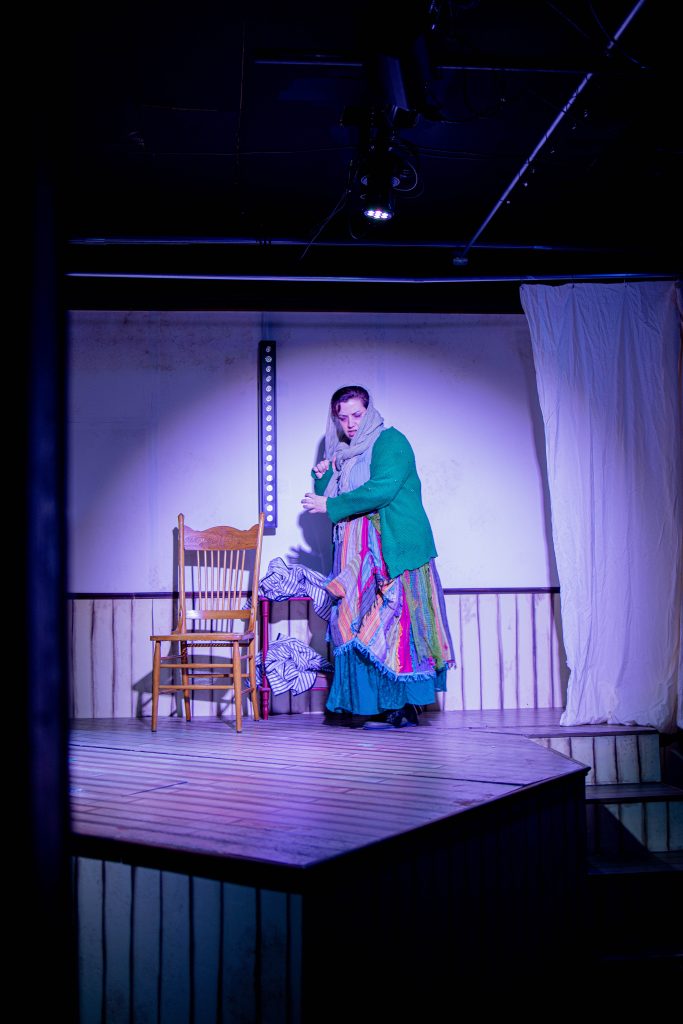
Rachel Bailey. Photo by Julie Merkle.
Crispin Shininger. Photo by Julie Merkle.

Ever reliable Rachel Bailey is persuasive as a mysterious Beggar Woman, and her “Beggar Woman’s Lullaby” regrettably seals her fate.

Hakenewerth is effective as the fraudulent Pirelli who tries to blackmail Todd, which sets off the murder spree.

And sadly, the Demon Barber of Fleet Street must come to its inevitably tumultuous gut-wrenching finale. Whether you’ve watched Tim Burton’s 2007 Oscar-nominated film or can’t get enough of the 2023 Broadway revival album, “Sweeney Todd” has many intricate layers to discover and Fly North has taken us in their own unusual distinctive way to its dark side.

Fly North Theatricals presents “Sweeney Todd: The Demon Barber of Fleet Street” from July 17 to Aug. 9 at the Greenfinch Theater and Dive Bar, 2525 S. Jefferson Avenue. The show’s runtime is 2 hours, 30 minutes, with a 15-minute intermission. Content warning: this show contains mature themes, including murder and self-harm. For more information, visit www.flynorth.org

Full disclosure: My maternal grandmother and Matt Ingram’s maternal great-grandmother were sisters, therefore we are cousins.

By Lynn Venhaus

The powerhouse cast of the musical “Caroline, or Change” features so many gifted vocalists that they raise the roof off The Marcelle Theatre every performance. To hear the soul-stirring solos and harmonies blended by this virtuosic ensemble is a scintillating experience.

It doesn’t matter if you are unfamiliar with the emotional rollercoaster of a score by composer Jeanine Tesori and lyricist Tony Kushner that creates a unique stamp of time and place in Lake Charles, Louisiana in 1963, just go and be in awe of the power and performances.

It’s easy to gush about this uncommon show, and as a longtime reviewer who tries to mix up the superlatives, so I don’t overuse them, it is hard to come up with new words that aptly describe this level of talent involved.

Yes, it’s unforgettable. Yes, I can’t believe the singers held nothing back and still had something in the tank. And yes, I want to learn more, listen again, and sing its praises. Most of all, the performers express their truth from varied perspectives. In the framework of an intense domestic drama, the characters focus on their own needs, but must see the value in others.

Three years in the making, Fly North Theatricals patiently waited out the pandemic, and some of those originally cast in 2020 have returned while others are new. Director Brian McKinley, an accomplished multi-hyphenate who wasn’t present at those early auditions, has said he has been blessed with talent. Indeed, the proficient ensemble is world-class in quality, and McKinley deftly stations them around an intimate space to spotlight highly personal interactions, which are aided by Bradley Rohlf’s artful lighting design.

De-Rance Blaylock as Caroline. Photo by Julie A. Merkel

Music Director Colin Healy, the group’s founder, has masterfully conducted an orchestra that seamlessly blends blues, gospel, spirituals, traditional Jewish klezmer melodies, Motown, folk and classical music.

The versatile top-shelf musicians include Steve Frisbee and Kate Denson on violins, Chuck Evans and Alyssa Przygoda Gove alternating on viola, Marie Brown on cello, Mary Wiley, Brandon Thompson and Dave Metzger on reeds, Blake Mickens on bass, Des Jones on percussion, and Healy on keyboards.

This is crucial because it’s an all-sung show. The first act features 24 songs in an hour, and after a 15-minute intermission, the second act has 25 songs in 70 minutes. The demanding nature requires every single person on stage and off to be in peak form, and they meet the challenge.

The story takes place mostly in the basement of a Southern home where Caroline Thibodeaux works as a maid for $30 a month. It starts on a hot day, and she laments having to do laundry “16 Feet Beneath the Sea.” Second act will transition to the December holidays, but it’s still oppressive conditions.

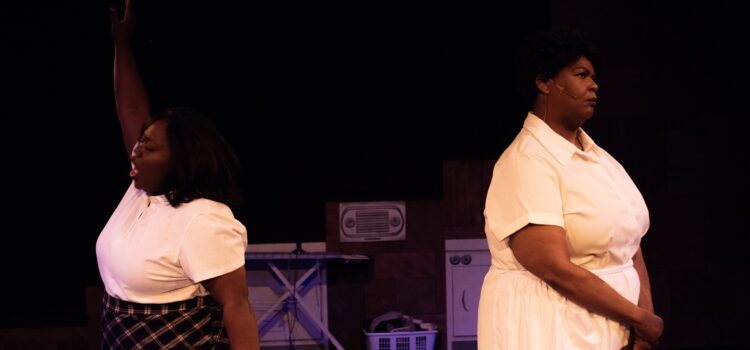
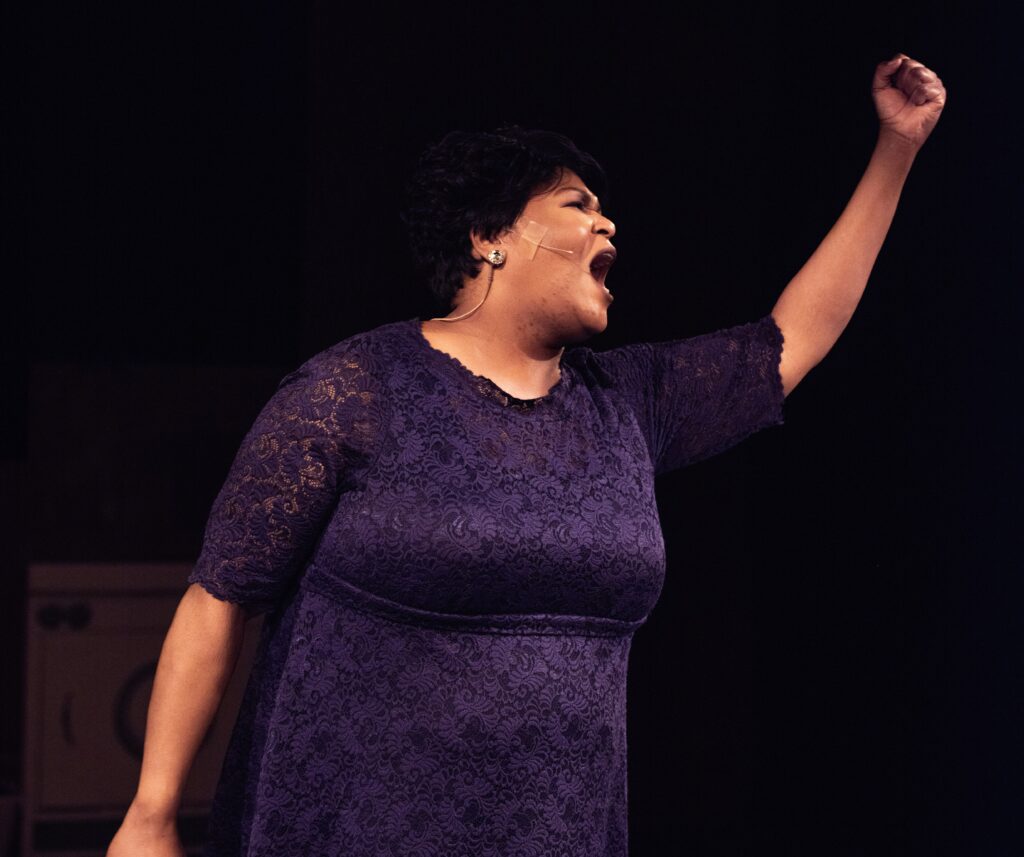
Caroline reveals her world-weary and cynical attitude, and you’ll discover an unusual protagonist because she is not a sitcom-y warm and fuzzy housekeeper. She has been beaten down by life. It’s 100 years after slavery, but segregation and inequality haven’t subsided. In a tour de force performance, De-Rance Blaylock commands the stage, making us feel her pain and anger.

She’s caught in-between being marginalized and believing she deserves more, living on the cusp of change. You root for her, hoping her life will get better, but as we soon find out, it will be up to her children to help make the world see them. Blaylock, who was in the groundbreaking “Antigone in Ferguson” at the Harlem Stage in 2018, is a consummate performer, and fiercely announces her presence.

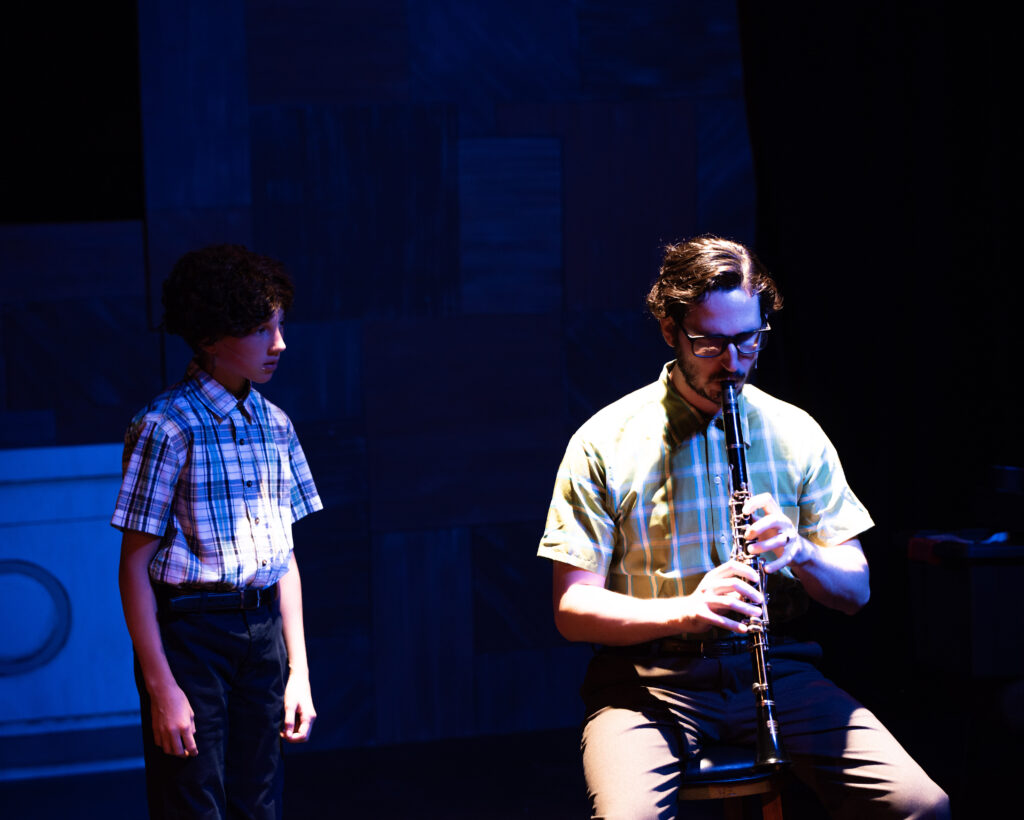
The kids. Photo by Julie A. Merkel

Resigned to her fate, Caroline has been working hard at these tasks for 22 years, without much to show for it. She is turned down for a raise, among other indignities throughout the show. She is, however, allowed to keep the loose change found in the dirty clothes. Her adoring 8-year-old charge Noah knows his pocket change is beneficial, acts absent-minded about it, but knows what he’s doing. The plot escalates when an errant $20 bill is the cause of much handwringing. She could really use it for a child’s dental work and better food for their nutrition. But it is a gift from his maternal grandfather.

Caroline is a single mother to Emmie, 16, (Kenya Nash), Jackie (Cameron Headley), 10, and Joe (Malachi Borum), 8. The needy kids dig at a traditional Christmas in “I Saw Three Ships” and they express their financial situation in the jaunty “Roosevelt Petrucius Coleslaw.”

In one of the more dynamic relationships, Caroline and rebellious Emmie butt heads about how to talk to white people, navigate changing times, and even dare to dream and hope. Nash is strong in “’Night Mamma” and “I Hate the Bus,” among other numbers.

There is an authenticity to their emotionally charged interactions, and things really get testy in “Kitchen Fight.”

Caroline has had a lifetime of disappointments, including a failed marriage. She slumps in a chair, taking a break in her white uniform, and allows Noah to light her cigarette.

Duane Foster. Photo by Julie A. Merkel

This is a secret because he lost his mother, a heavy cigarette smoker, to lung cancer, and his father has remarried. The little boy clings to his anchor, Caroline, although she never reciprocates caring. In a stunning debut, Zoe Klevorn demonstrates remarkable poise and vocal ability as Noah. (The only thing out of place is a wig too big for her delicate features).

As his widowed father Stuart, Jordan Wolk subtly conveys a distracted, conflicted parent in mourning. He has lost his faith, “There Is No God, Noah.” In his complicated relationship with his son (“Stuart and Noah”), he seems overwhelmed.

A professional musician, Stuart is now married to Rose, a typical cookie-cutter ‘60s housewife and a well-meaning stepmother. However, she really is clueless, exudes privilege, and is without compassion when dealing with Caroline and her hardships. The Gellmans aren’t racists, but lack forward-thinking, and appear to be products of their time, living in the South.

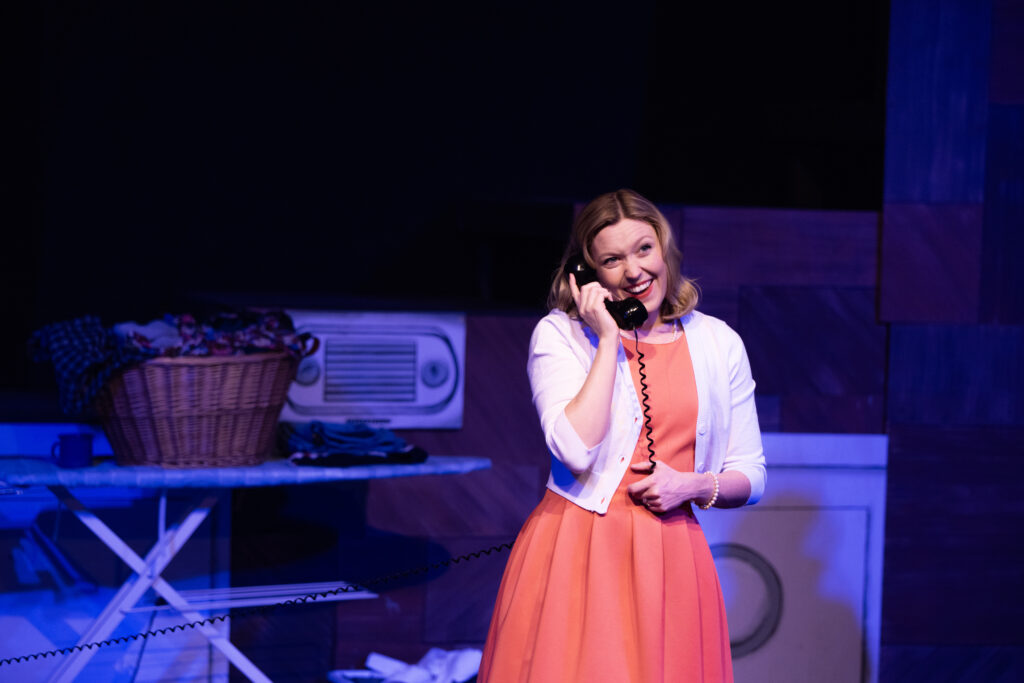
Avery Lux embodies that post-war Stepford Wife- pretty blonde (ancient advertising reference, a ‘Breck girl’) type. Noah doesn’t like her, and she confesses to her father, Mr. Stopnick (Kent Coffel) her dismay (“Long Distance”). Eventually, the relationship kinks start to soften with the boy (“Why Does Our House Have a Basement?”) But yet, the smugness (catch her mispronouncing “Caroline.”)

Lux looks chic in customary fashions of the day, but her pale-yellow frock needed ironing. With other period costumes designed by Vanessa Tabourne, some of the shoe choices aren’t accurate. For instance, if a character mentions their saddle shoes, she should have a pair on, but nope. (I saw a youth production of “Grease” last week and they had them on Rydell High Schoolers, so they can be found.)

Avery Lux as stepmom Rose. Photo by Julie A. Merkel

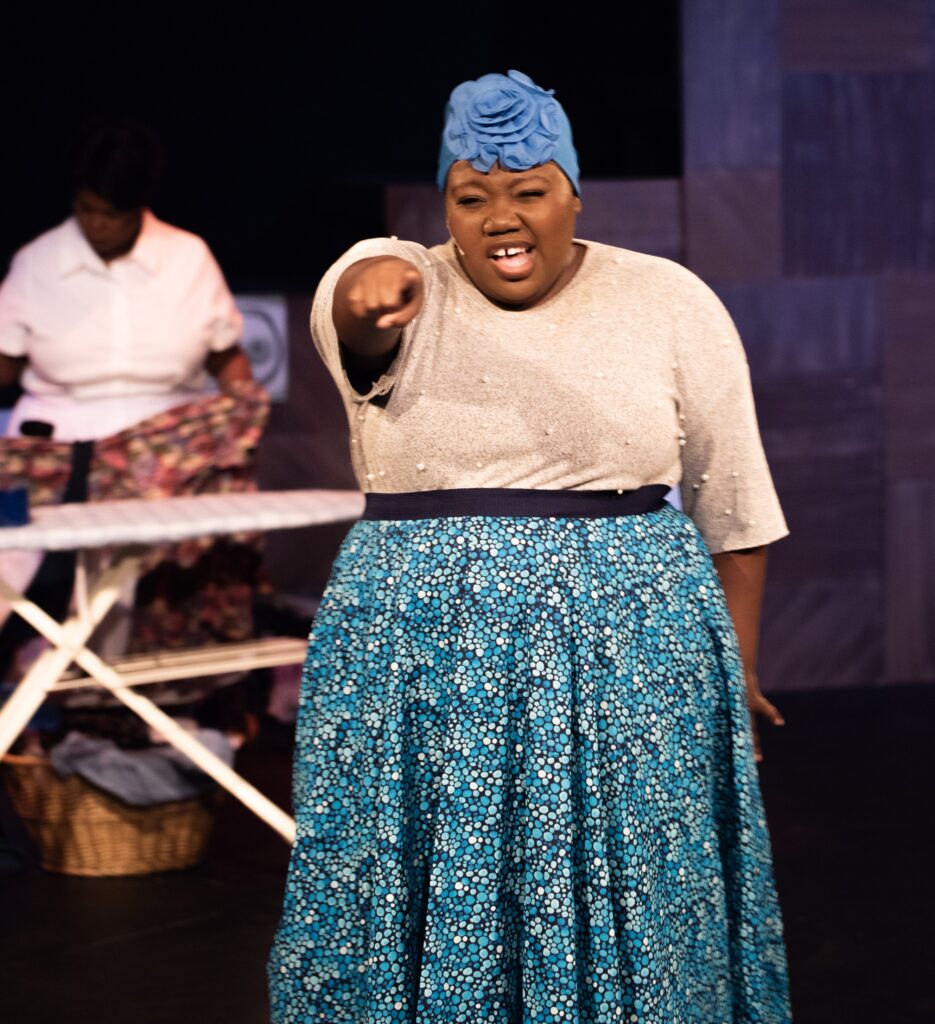
While Caroline is washing/drying clothes in the first act and ironing in the second, she imagines appliances as people – including the washing machine (a spunky Kanisha Kellum). She listens to the radio, where a robust trio of singers, not unlike the popular girl groups of the day, springs forth.

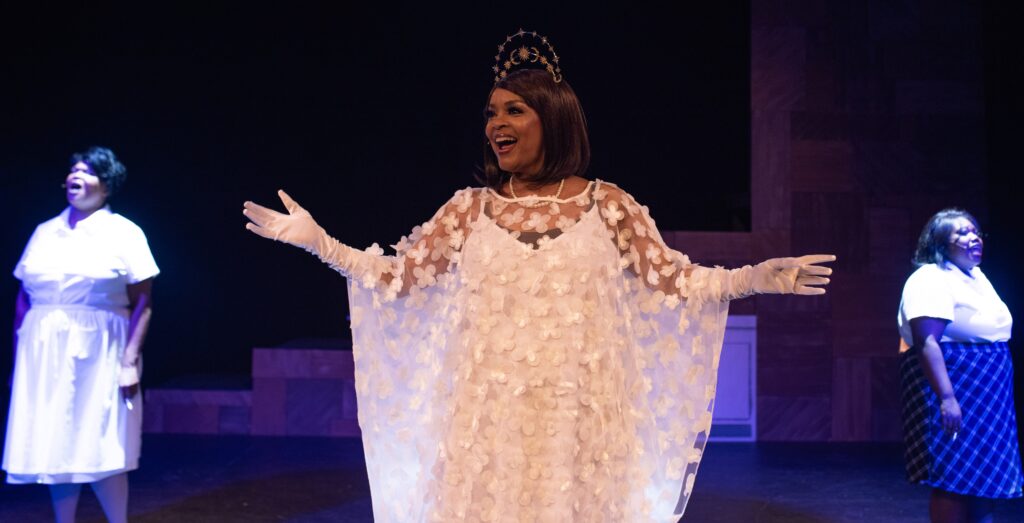
Kimmie Kidd-Booker, who is also the Moon in a gorgeous white gown, impresses as a glamorous Diana Ross look-a-like, and merry pair Ebony Easter and Adrienne Spann are the spirited singers in sync with each other, all three replicating the sounds on the airwaves, such as “Ooh Child” and “Salty Teardrops” while they wear fashionable cocktail dresses.

Caroline is so cranky that those close to her try to be helpful but nearly give up, especially Dotty (Kellum again, outstanding in a dual role).

A major occurrence is the assassination of President John F. Kennedy on Nov. 22, 1963, and this is not merely a time marker. Kushner smartly addresses that as a significant bellwether in turning tides..

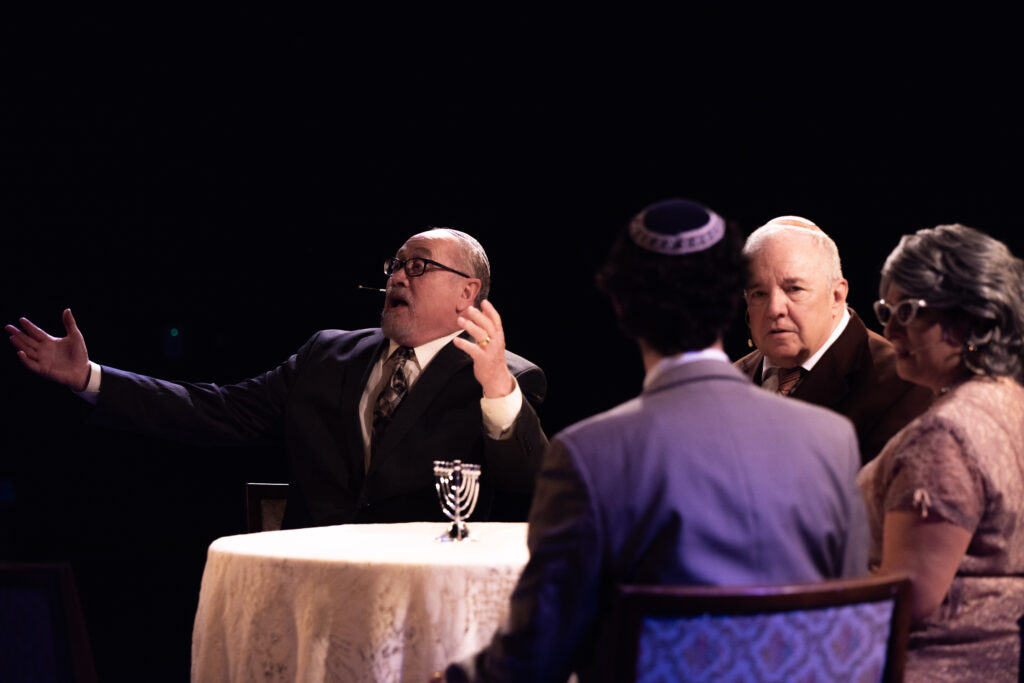
Both families express their admiration for the fallen leader in “Inside/Outside” and “JFK,” although Emmie is more mesmerized by Martin Luther King Jr.’s messages. The Gellman family includes Jewish grandparents, played by Maria Bollini and Ken Haller, who guide Noah spiritually.

The Radio. Photo by Julie A. Merkel

Act Two starts out with the Radio singing “Santa Comin’ Caroline” and “Little Reward” while the household gets ready for a Hanukkah Party. Caroline also reminisces about her ex-husband in “1943.”

With his richly textured baritone, Duane Foster sings the roles of The Dryer, The Bus, and portrays the wayward ex. He regularly appears at the Muny, was recently in the “Beauty and the Beast” ensemble. On Broadway, he was a part of the original cast of “Ragtime” in 1998 and understudied the lead Coalhouse Walker (role originated by Brian Stokes Mitchell).

Church-going Caroline comes to a reckoning about the dust-up caused by the $20, and Blaylock brings the house down with a mesmerizing “Lot’s Wife”: …”Ain’t never been no good, findin’ joy the way you should…murder my dreams so I stop wantin,…strangle the pride that make me crazy!” Gut-wrenching.

Mr. Stopnick and The Gellmans. Photo by Julie A. Merkel

This sly, simmering show is rarely done, mainly because of its difficulty level, and this is indeed a high point in a very strong theatrical season for regional professional groups. To be introduced this way to the Tesori-Kushner poetic and profound pairing is quite a treat.

First produced off-Broadway in 2003 after readings and workshops started in 1999, the show moved to Broadway in 2004, garnering six Tony nominations, including Best Musical, and a win for Anika Noni Rose for Featured Actress in a Musical as Emmie. A British National Theatre production in 2007 won an Olivier Award for Best New Musical and both a London West End revival in 2018 and Broadway revival in 2021 were heralded.

Tesori is the most honored and most prolific female theatrical composer in history, writing five Broadway musicals and receiving six Tony Award nominations. For “Caroline, or Change,” she won the 2004 Drama Desk Award for Outstanding Music.

In 2015, she made history winning Best Original Score with Lisa Kron for “Fun Home,” making them the first female writing team to win that award. And earlier this summer, she won Best Original Score for Tony Award-winning Best Musical “Kimberly Akimbo,” which she shared with David Lindsay-Abaire.

Noah and his father. Photo by Julie A. Merkel

Also known for “Thoroughly Modern Millie” and “Shrek the Musical,” you may have seen her reboot of “The Unsinkable Molly Brown” at the Muny in 2017, which went on to off-Broadway rave reviews but run cut short by global coronavirus pandemic.

Kushner is one of the few playwrights in history nominated for Emmy, Grammy, Oscar, and Tony Awards. He is most known for “Angels in America: Millennium Approaches” and “Angels in America: Perestroika,” his Broadway debut in 1993, which won a Pulitzer Prize for Drama and a Tony Award, and he won an Emmy for adapting it for the HBO miniseries. Since the 2000s, he has collaborated with Steven Spielberg on his films “Munich,” “Lincoln,” “West Side Story” and “The Fabelmans.”

This is his compelling personal semi-autobiographical story, for his father really was a clarinet player and a conductor, and his parents moved to Lake Charles, Louisiana, when he was a child.

The mindful alliance between Tesori and Kushner has produced an astounding uncompromising musical. The ‘change’ is both economical and political, at once an historical footnote and present-day conundrum. The underlying issues haven’t gone away and racial hatred for blacks and Jews has alarmingly escalated during the past 10 years.

“Caroline, or Change” gives us heartfelt snapshots that hopefully lead to more understanding. It’s a moving, meaningful musical, and this resplendent production takes flight because it resonates deeply.

The Washer. Kanisha Kellum. Photo by Julie A. Merkel

Fly North Theatricals presents “Caroline, or Change” July 28-Aug. 12, with performances at 7:30 p.m. Friday and Saturday and at 2 p.m. Sunday at The Marcelle, 3310 Samuel Shepard in Grand Center. A 2 p.m. matinee has been added for Saturday, Aug. 12. For more information, flynorthmusic.com or for tickets, go to www.metrotix.com.

Kimmie Kidd-Booker as the Moon. Photo by Julie A. Merkel