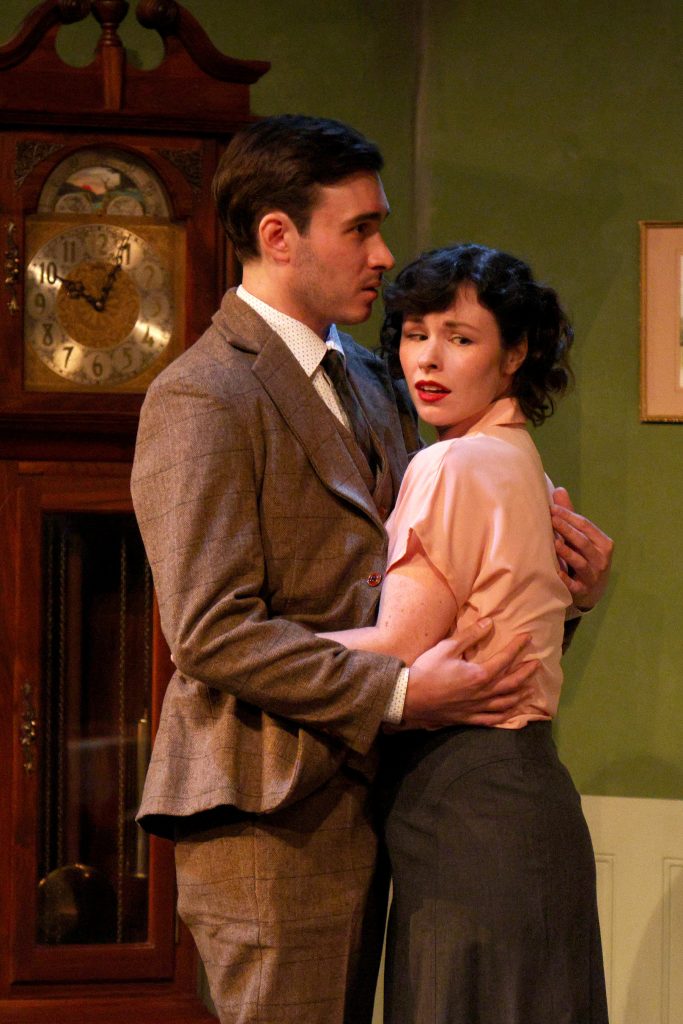

By Lynn Venhaus
Albion Theatre’s masterful interpretation of Morgan Lloyd Malcolm’s “The Wasp,” a contemporary twisty and twisted psychological thriller, leaves the gasping audience deeply unsettled and finally able to breathe after a dramatic 90-minute rollercoaster.
Because of its many layers of secrets, lies and manipulation, Robert Ashton has directed this dark two-hander by carefully building suspense and never allowing the actors to get ahead of the material. The element of surprise is always present as Heather (Ricki Franklin) and Carla (Macia Noorman) awkwardly engage in three tense-filled scenes.
Shades of high-stakes Hitchcock abound, as conversations include tea and revelations between the two former classmates, 20 years after they’ve seen each other. At first, one assumes this uneasy encounter is because there has been no contact during these ‘grown-up’ years, and the obvious class distinctions.
But it goes so much deeper than an affluent Heather approaching blue-collar Carla, pregnant with her fifth child, with a shocking request. Malcolm’s intense and intimate 2015 play becomes an exploration of female friendships and childhood trauma.
Malcolm cleverly weaves female-centric issues with occasional humor, easily establishing characters’ personalities and motivations – but maybe our perceptions aren’t as clear-cut. Hmmm… the plot thickens.
As disturbing facts are disclosed, and a proposition gets more complicated, the chemistry between the two characters is crucial. Franklin and Noorman, both making their Albion debuts, haven’t worked together before, but that isn’t apparent in their assured portrayals and compelling interactions.
They both are riveting, expertly showing vulnerability and strength, hurt and fear, rage and worry, cruelty and mercy. At times, you can see their old schoolgirl selves re-appear in their adult shadows. With a hint of where this is going, an overwhelming feeling of dread escalates — and some surprises are still ahead.
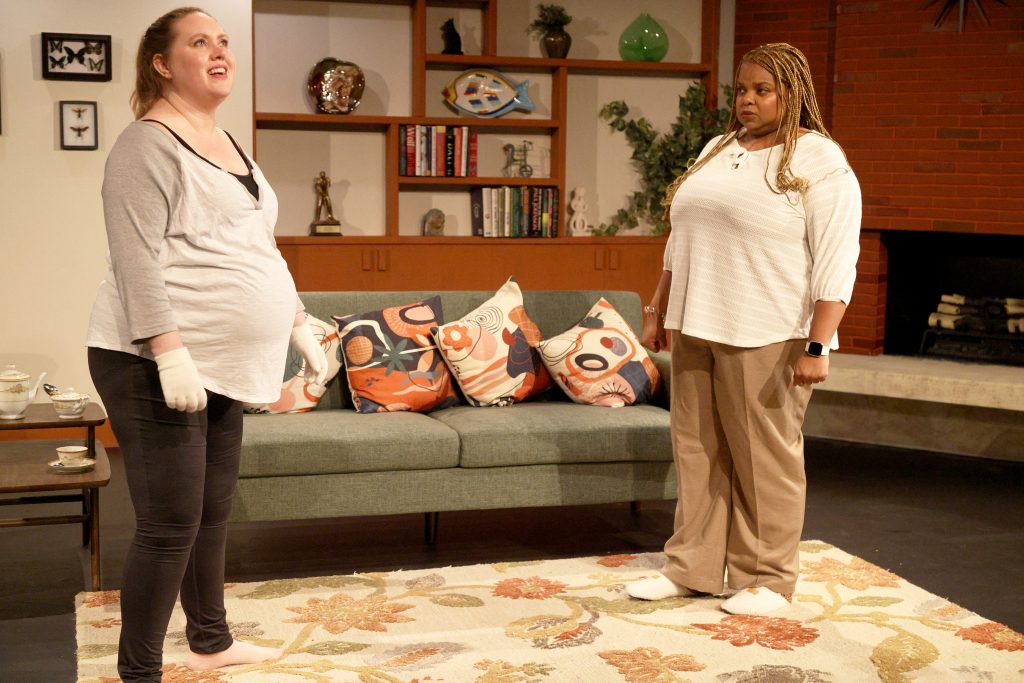
Franklin’s refined Heather seems to have the upper hand, and appearances indicate she has a thriving career and ‘married well,’ but divulges that she is miserable in the union, ticking off her husband’s alleged infidelities and despicable qualities. Franklin, two-time St. Louis Theater Circle Award winner as supporting actress in Shakespeare comedies, has an opportunity to show her dramatic chops here.
Noorman’s streetwise Carla, obviously wary but much more complex than a stereotype, has had a rougher life, struggling financially but seemingly happy as a mother, if not as a wife. Heather is childless. Noorman, a St. Louis Theater Circle Award nominee in 2019, shows an impressive range in this challenging role.
Although narrative twists have been exposed throughout the years (the play’s been around for 11 years, but this is the St. Louis premiere), I hesitate to mention too many details in case someone unfamiliar with this show would ever see it. Let’s just say your allegiance may shift as more comes to light, as we attempt to determine who you can trust or believe. Who are you feeling sorry for as grisly details emerge?
Were they once friends, enemies or frenemies? Can you ever forgive childhood slights and mean-girl behavior, and what about unreliable memories?
The play gives off the same cunning vibes as “Sleuth,” Anthony Shaffer’s brilliant 1970 cat-and-mouse mystery that featured class warfare and toxic masculinity, but Malcolm’s modern work is distinctively feminine.
Ashton astutely sets each exchange through scenic designer Rob Lippert’s well-appointed set in the intimate black box theatre. From a small coffee shop to Heather’s posh home, Lippert’s keen eye has created a vivid world, complete with a well-manicured backyard glimpsed through a glass door.
Lighting designer Kara Grimm-Denholm added to the classy atmosphere, and Tracy Newcomb’s costume designs effectively established the socio-economic status of each woman.
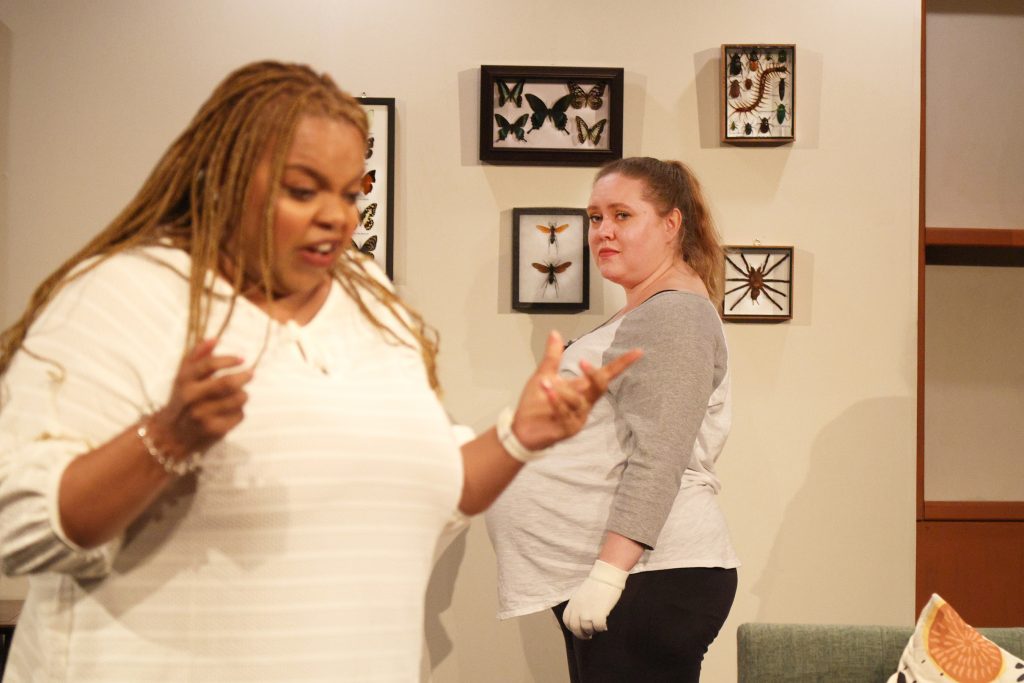
A sly reference to the titular stinger is included in Heather’s husband Simon’s framed collection of insect prints. The description is creepy, and when told, you may have an inkling of what’s ahead, but really, the script is so well-crafted and the actresses so intuitive, they keep us guessing. As both dig into a past that is far messier than first hinted at, it’s gripping and perturbing – get ready for stomach knots.
As is customary in Albion productions, the dialect is crisp and neither Franklin’s educated Brit nor Noorman’s cockney accents ever drop. Thanks to sound designer Leonard Marshell, Ashton’s tutelage and the actors’ efforts, understanding is not a problem.
Noteworthy contributions include Mo Moellering as fight choreographer, C. J. Langdon as assistant director, Rachel Klinck as board operator, Susan Wylie as stage manager and Denise Mandle as assistant stage manager, for the scene transitions are smooth and the anxious mood is never broken.
Perhaps some of the situations are contrived, but the performers are totally committed to making these characters believable and are convincing as they dredge up the distressing backstories of childhood bullying and harsh conditions.
The relationship, never solid, eventually fractures in unexpected ways. Do they go there? The performers dug deep, re-opening their characters’ wounds and showing their emotional depth in intricate, disquieting monologues.
Franklin and Noorman’s honest dynamic is key to immersing oneself in this chilling experience. Do childhood scars ever heal, and what does that say about the cyclical nature of violence? Oh, those blurred lines of life are the reason “The Wasp” has such staying power – and you’ll remember the sting.
Albion Theatre presented “The Wasp” from June 12 to 28 at the Kranzberg Black Box Theatre. This production was reviewed on June 28. The play has mature themes and adult language and runs 90 minutes without an intermission. For more information, visit www.albiontheatre.org

Lynn (Zipfel) Venhaus has had a continuous byline in St. Louis metro region publications since 1978. She writes features and news for Belleville News-Democrat and contributes to St. Louis magazine and other publications.
She is a Rotten Tomatoes-approved film critic, currently reviews films for Webster-Kirkwood Times and KTRS Radio, covers entertainment for PopLifeSTL.com and co-hosts podcast PopLifeSTL.com…Presents.
She is a member of Critics Choice Association, where she serves on the women’s and marketing committees; Alliance of Women Film Journalists; and on the board of the St. Louis Film Critics Association. She is a founding and board member of the St. Louis Theater Circle.
She is retired from teaching journalism/media as an adjunct college instructor.