By Alex McPherson

Far less lively than its premise promises, director John Patton Ford’s “How to Make a Killing” has a sturdy dramatic framework but forgets to have much fun along the way — it’s an Eat-the-Rich satire that commits the unfortunate sin of being dull.

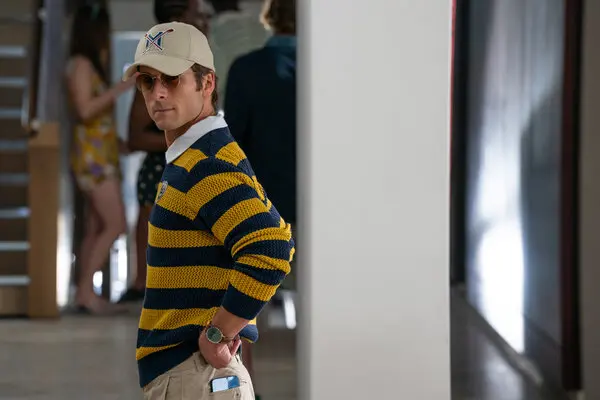
Inspired by the 1949 film “Kind Hearts and Coronets,” “How to Make a Killing” centers around Becket Redfellow (Glen Powell), a man on death row with four hours until execution who relays his life story to a priest (Sean C. Michael). The film, guided, er, dictated, by Becket’s narration, jumps back and forth in time.

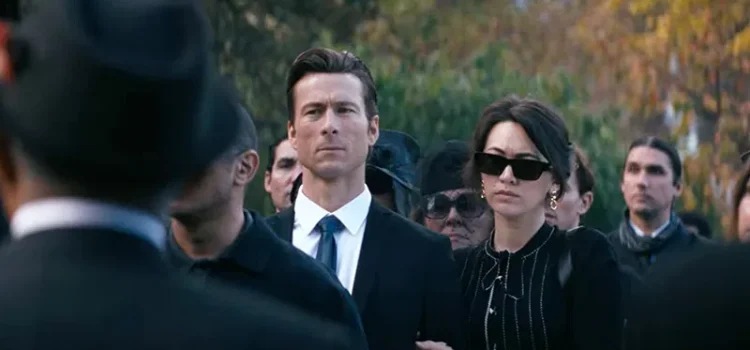
Becket, with a wry smile, insists that his story is a “tragedy,” as he reveals that his family has a 28 billion dollar fortune that he was willing to kill his seven other relatives to acquire. For Becket, it’s personal.

His mother was banished from the family by the mysterious patriarch Whitelaw (Ed Harris) after becoming pregnant with Becket as a teenager with a man of “lower class,” who quickly disappeared from the scene.

She raised Becket in a working class New Jersey neighborhood, occasionally immersing him in rich-adjacent activities like archery (featuring Chekhov’s bow and arrow), and, until her dying day, insisting that Becket has a legal claim to the Redfellow fortune and that he “deserves” it. 

It’s at one of these functions that a young Becket meets the uber-wealthy Julia Steinway (later played by Margaret Qualley). The two are drawn to each other, although they drift apart as they grow up in different social spheres.

In present-day New York City (before his arrest), Becket works at a men’s suit store and runs into Julia, who strikes up a flirtation (even though she’s engaged), and reminds him that he is a Redfellow.

After being abruptly demoted, and recognizing the sad unfairness of his current non-uber-wealthy living situation, Becket decides to take action, setting out to eliminate his relatives and do away with most of his morality. 

The group includes party boy Taylor (Raff Law), smug goofball artist Noah (Zach Woods), “philanthropist” Cassandra (Bianca Amato), Richard-Branson-esque McArthur (Alexander Hanson), rock star megachurch pastor Stephen (Topher Grace), and Becket’s surprisingly kind uncle Warren (Bill Camp) who hires Becket to work at his brokerage firm, plus the intimidatingly shady Whitelaw (Harris).

Quite a few folks to get through, but Becket’s greed and hunger for retribution motivate him, to the detriment of his personal relationships and sanity.
There’s a recipe for a crackling, twisted little thriller here, but Ford’s film is frustratingly milquetoast, possessing the skeleton of a strong narrative without putting in the work to give its story poignancy, momentum, or memorably crazy set pieces.

“How to Make a Killing” feels restrained as Becket flies further off the deep end, taking the easy way out instead of leaning into the lunacy, with derivative social commentary and subplots clunkily smashed together. It’s a shame, because the foundation is there. Powell remains an appealing leading man who brings charisma in spades.

Still, he feels underutilized, as Ford’s screenplay jumps through time erratically and often resorts to blatant exposition dumps (via Becket’s prison-set narration) that attempt to streamline the film while robbing it of textural detail.

Powell’s performance is sturdy enough on its own merits, particularly when the film slows down to briefly highlight his twisted satisfaction at his various killing schemes (which occur, puzzlingly, mostly off-screen) and to develop his relationship with the beautiful Ruth (Jessica Henwick), who is first attached to Noah.
Henwick and Powell have great chemistry, yet Ford treats their dynamic as more of a plot device than anything else — the tension between happiness/comfort and the pesky pull of greed and revenge.

It’s a conflict rendered too schematic to pack much emotional punch, worsened by dialogue that spells out Becket’s “choice” in eye-rollingly obvious fashion.

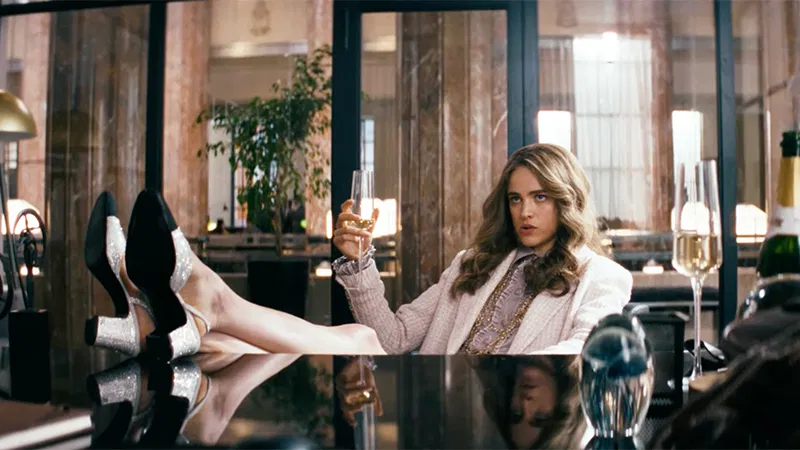
Qualley, to her credit, understands the assignment more than most of the ensemble, leaning into her character’s femme-fatale cartoonishness, periodically appearing to encourage Becket to continue his murderous mission and attempt to seduce him (for love or for the money?).

f only the rest of “How to Make a Killing” was as committed to the bit as Qualley who, regardless of whether you love or hate her performance, is definitely making choices and helping to momentarily excavate the film from generic territory.

Perhaps the biggest issues with Ford’s film revolve around its “tell, don’t show” philosophy. We don’t really feel Becket’s inner turmoil, nor do we fully buy why he feels compelled to push forward even when his life seems pretty damn good, all things considered. Nor do we get any flashy moments of R-rated violence, odd considering that the film is indeed called “How to Make a Killing.”
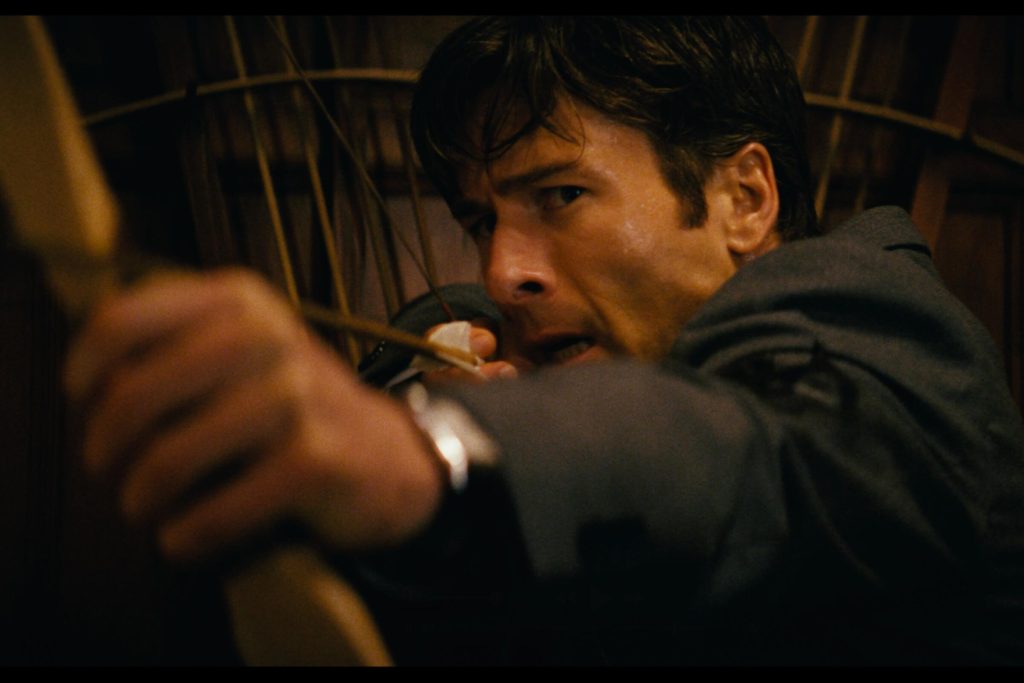
 Ford’s film does have eye-catching production design and stylistic use of light and shadow. But its conclusions are largely standard, a morality tale with a clearly telegraphed destination, and a laissez-faire approach to distinctive storytelling.

“How to Make a Killing” is a 2026 dark comedy-psychological thriller directed by John Patton Ford and starring Glen Powell, Margaret Qualley, Ed Harris, Bill Camp, Jessica Henwick, Zaff Law, Zach Woods, Bianca Amato, Topher Grace, and Alexander Hanson. It’s run time is 1 hour, 45 minutes, and it is rated R for language and some violence/bloody images. It opened in theatres on Feb. 20. Alex’s rating: C.

By Alex McPherson
A sexy, hypnotic, and intelligent drama, director Claire Denis’ “Stars at Noon” shines brightly, if viewers can get on its unusual wavelength.

Adapted from Denis Johnson’s 1986 novel of the same name, which takes place during the Nicaraguan Revolution of 1984, “Stars at Noon” unfolds in present-day and centers around Trish (Margaret Qualley), a supposed hard-news American journalist stuck in a politically unstable, Covid-stricken Managua. Lacking funds and a passport, she’s practically at the end of her rope when we first meet her, constantly drunk and turning tricks for wealthy men (including the Minister of Tourism) at the bougie Inter-Continental Hotel to scrounge up the means necessary to leave Nicaragua for good.

While on the prowl for a new client and some precious American dollars, Trish bumps into Daniel (Joe Alwyn), an enigmatic smooth-talker from London who claims to work for an oil company and casually admits he “commits adultery often.” They are immediately attracted to each other, and their transactional love-making evolves into a much deeper attachment. This mysterious white man in a white suit is being pursued by shady government operatives, and Trish’s own life is put at risk. Against their better judgment, these two spiraling souls are pulled together by desperation, romantic longing, and stupidity. They make a last-ditch effort to flee into Costa Rica, pausing frequently for sex, and causing plenty of collateral damage along the way.

Indeed, “Stars at Noon” thrives on mood and tone above all else — tedium mixed with an alluring, dreamlike haziness, offset by jolts of violence and a persistent sense of eeriness. Denis keeps plot details fairly sparse, choosing instead to let viewers bask in the sticky, humid environment, and observe the characters grasping for an escape.

The point is that they’re out-of-place in a foreign land destructively trying to remove themselves. Pacing is slow, conversations stretch on for long periods, and notwithstanding the mounting danger our central duo finds themselves in during the bloated 2-hour-and-18-minute runtime, “Stars at Noon” refuses to stomp on the gas pedal. Despite this subdued pacing, the film is mostly engaging, with a career-best Qualley doing much of the heavy-lifting.

Trish is a wonderfully flawed protagonist, equal parts cynical and helpless, prone to frantic decision-making, which often ends in trouble. Qualley brings a jumpiness that emphasizes Trish’s brash, headstrong personality, but there’s also an ever-present sadness that lingers over her conversations with Daniel and locals, self-loathing that manifests itself in impulsiveness.

While Trish isn’t an easy character to latch onto emotionally, Qualley’s performance — along with Denis’ patient approach to narrative — helps her feel like a grounded (literally) presence throughout. Her understated expressiveness brings additional layers to Trish’s interactions. Trish is trying to claw her way out of a predicament, likely of her own making, joined by a suave “gentleman” she’s both using and being used by, unsure of the kind of person she wants to become and — as Daniel’s goals become slightly clearer — what kind of impact she wants to leave behind. 

Éric Gautier’s camera follows her with a documentary-esque gaze, allowing us to observe her day-to-day efforts to leave Nicaragua, complete with strict Covid precautions. “Stars at Noon” thrives in tactile details, like the pitter-patter of rain against a windshield, and the warm glow of sunlight passing over naked bodies wrapped together in embrace. What’s sacrificed by this approach, however, is an immediacy that saps some of the intensity from pivotal sequences late in the film, as more traditionally “thrilling” elements come into play.

The soundtrack, by Tindersticks, brings a jazzy, noir-inflected touch to the proceedings, at once calming and uneasy — a dichotomy illustrated in Trish’s connection to Daniel. Sex scenes with Daniel are filmed with vivid eroticism — moments of togetherness that provide physical and emotional release while giving them both hope for a better tomorrow.

One incredible sequence on an empty dance floor, featuring a great song by Tindersticks, is irresistibly romantic, unfolding on a different plane of existence from the characters’ grim circumstances.

Qualley gets the most to work with, but Alwyn’s natural charisma and smooth line delivery helps make Daniel’s character a compelling question mark from beginning to end — mixing the profane with a cool, calm, and collected demeanor. It’s frustrating, though, that “Stars at Noon” leaves the specifics of his goals so ambiguous, rendering the film’s much more politically focused second half lacking the emotional impact it could have had.

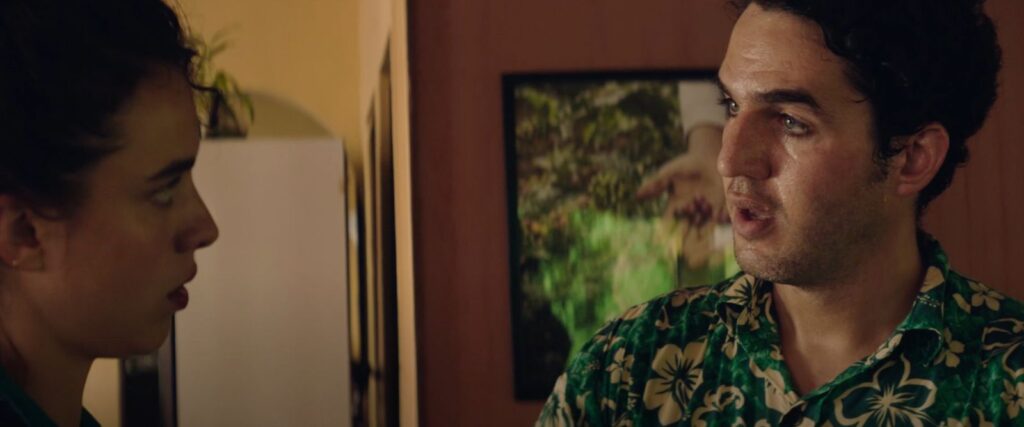
It’s clear that Denis wants to illustrate the harmful effects of Western governments forcing themselves into outside countries, but the idea seems underdeveloped here. Trish doesn’t know why people want Daniel dead, hence we don’t know for sure either, only learning tidbits of information from Daniel and a creepy CIA agent (Benny Safdie). By the time we finally figure out what’s going on, the story nears its conclusion, leaving the narrative’s political bent neutered.

On the other hand, Trish and Daniel’s dash to the border does have subversive qualities, as their “love” for one another creates chaos for those they run into. Their heroism, as a result, becomes parasitic. For all the sweltering lovemaking and “adventure,” there’s a human toll, and Denis never lets us forget the pain left in their wake.

At the end of the day, “Stars at Noon” is an imperfect, yet strangely compelling watch, put together with a level of craft that’s easy to admire. Pacing and storytelling issues aside, the film only strengthens upon further reflection, as Denis once again demonstrates her mastery of the medium.

“Stars at Noon” is a 2022 romantic thriller directed by Claire Denis and starring Margaret Qualley, Joe Alwyn and Benny Safdie. It is rated R for sexual content, nudity, language and some violence, and runtime is 2 hours, 15 minutes. It was released in select theaters Oct. 14 and began streaming on Hulu on Oct. 28. Alex’s Grade: B+