
By Alex McPherson

Less a riveting call to action against Big Tech companies than a glib, self-congratulatory dramatization of forces dragging us into an apocalypse, director Aaron Sorkin’s “The Social Reckoning” provides more eyeroll fodder than stirring revelation.

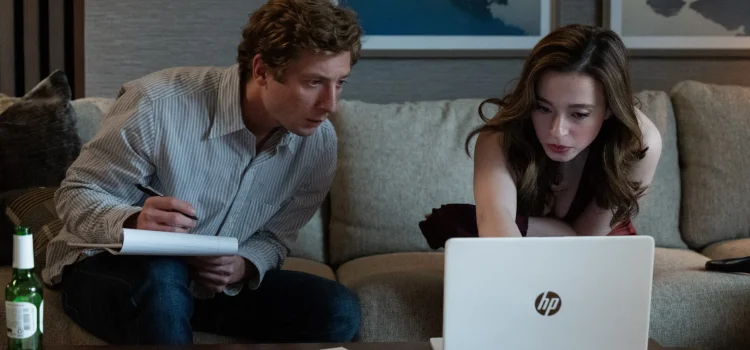
A companion piece to David Fincher’s 2010 film “The Social Network” and based on the 2021 series of Wall Street Journal articles titled “The Facebook Files,” Sorkin’s latest effort zeros in on Francis Haugen (Mikey Madison), a Facebook civics team engineer. Francis is distraught with Facebook’s disregard for user safety and the ways its algorithm funnels people into extremist groups.

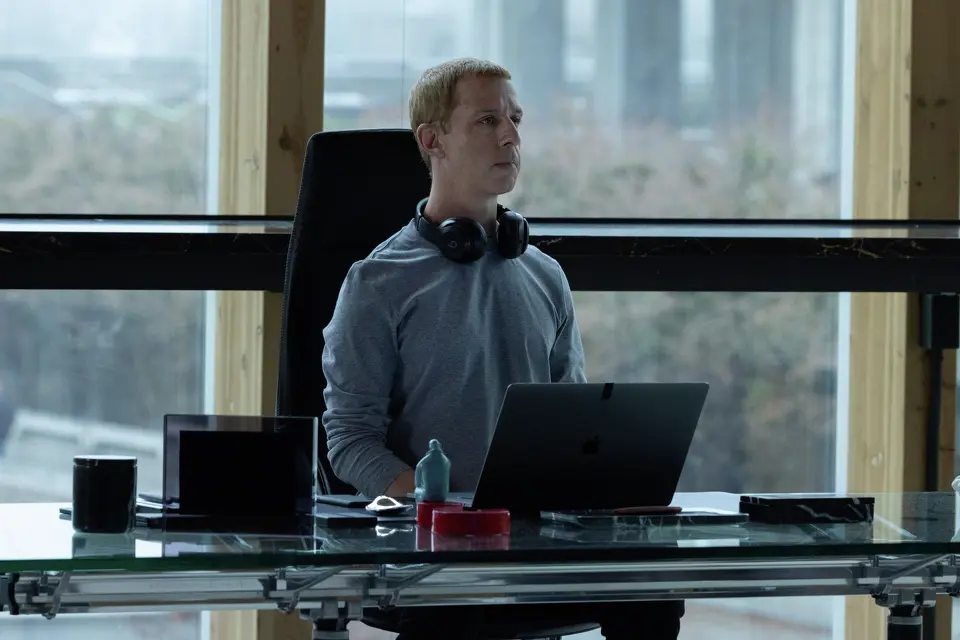
Her worries are brushed aside by arrogant (and sexist) execs, including Mark Zuckerberg (Jeremy Strong), who is painted as more of an outright monster than he was in Fincher’s predecessor. He’s an antisocial automaton unwilling to atone for the damage he’s causing humanity if it means making a profit.

Francis reaches out to luddite Wall Street Journal tech and politics journalist Jeff Horwitz (Jeremy Allen White), who’s already investigating the company. They gradually form a friendship and sound the siren on Facebook’s actions, risking their lives and livelihoods. Meanwhile, the COVID-19 pandemic looms and Donald Trump’s MAGA movement expands — two subjects particularly vulnerable to the throes of misinformation under the guise of free speech.
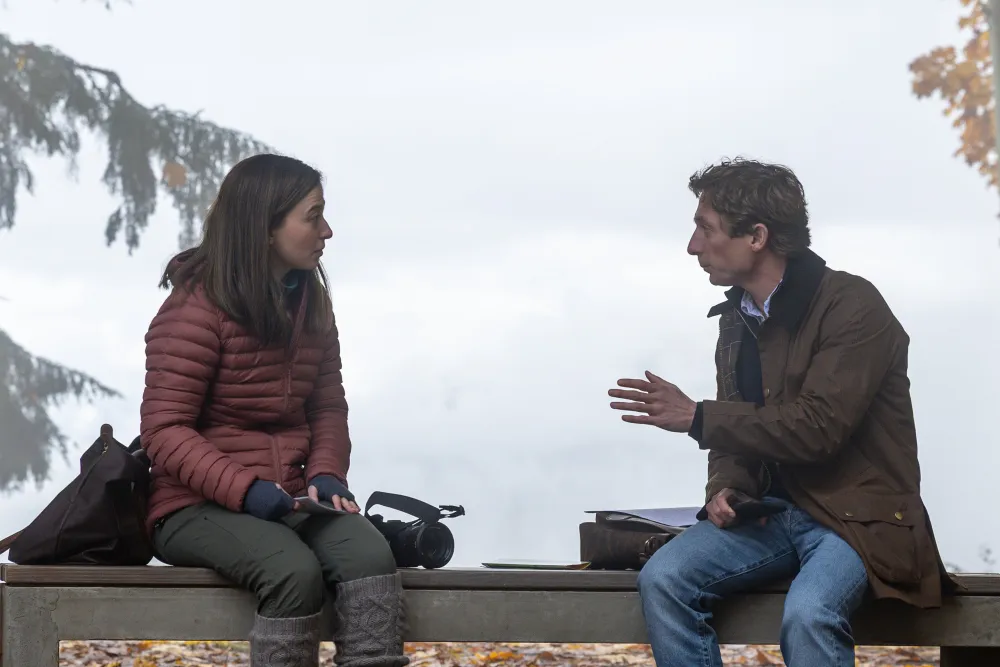
Nefarious realities are revealed, but “The Social Reckoning,” without Fincher’s involvement this time around, ultimately highlights issues that most of us (except those living under rocks) have been aware of for years. The film comes across as an attempt at being an inspirational underdog story without, well, an actual reckoning taking place at any significant scale. 

Sorkin’s heart is in the right place, but “The Social Reckoning” chugs along at a sluggish clip, seemingly afraid to acknowledge the reality of how Facebook (now Meta) has only swallowed up more of our lives since The Facebook Files released. Indeed, although it’s understandable that certain liberties need to be taken for the sake of “entertainment,” the film sands down the darkness of its story for maximum palatability. 

Sorkin’s direction replaces the sinister atmosphere of “The Social Network” with pervasive blandness. Numerous scenes are stranded in repetitive, back-and-forth exchanges, relying heavily on rat-at-tat dialogue awash in clichés and contrivances where most characters end up sounding annoyingly similar to each other.
Performances suffer as a result. Francis is a timid, socially awkward, deeply conflicted individual who struggles to reconcile her belief in Facebook’s mission with the reality that it’s destroying minds. Madison shows her range portraying the opposite end of the introversion spectrum from “Anora,” but attempts at sincerity are undercut by Sorkin’s writing.

The screenplay takes a weirdly sexualized approach to her character that highlights friction between the film’s genuine attempts at social commentary with its reliance on outdated, Hollywood tropes. White doesn’t fare much better; he’s buoyed by his natural charisma and chemistry with Madison but thrust into a standard archetype. 

Strong gives, by far, the standout performance here as Zuckerberg, yet we don’t even spend much time with him. The film jumps back and forth between the present-day investigation and Mark preparing for a United States Senate hearing years later. His performance — full of intimidating stares and off-kilter attempts at human conversation — almost resembles a Sith Lord from “Star Wars.” There’s definitely fun to be had watching him chew scenery, even if “The Social Reckoning” is far less interested in Zuckerberg’s interiority than in the obvious ways he clings to power.
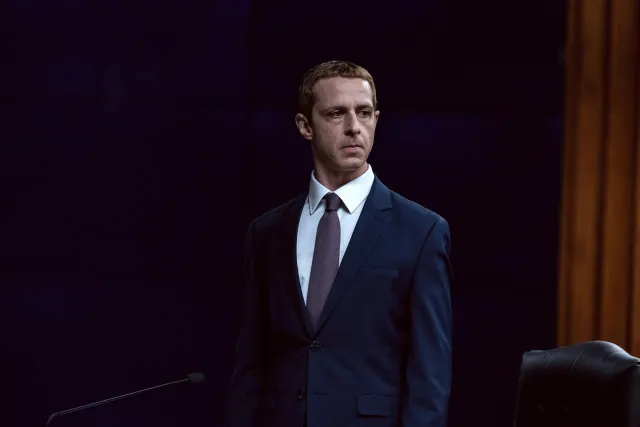
The main issue with Sorkin’s film is that it cannot balance its grim, relevant subject matter with its insistence on being “clever” and crowd-pleasing. What results is a hodgepodge of snappy, often comedic dialogue awkwardly mixed with attempts at sobering stakes. Characters and dialogue reside firmly outside of reality while the film itself tackles the too-recent history of the COVID-19 pandemic and the January 6th Insurrection.

It’s confused, muddled, and disappointingly forgettable — a worthy story desperately in need of an upgrade.

“The Social Reckoning” is a 2026 drama directed by Aaron Sorkin and starring Mikey Madison, Jeremy Allen White, Jeremy Strong, Billy Magnussen, Bill Burr, and Betty Gilpin. The runtime is 1 hour, 52 minutes, and it’s rated R for language. It opened in theaters Oct. 9. Alex’s Grade: C-

By Alex McPherson

An intense, darkly funny, and, ultimately, heartbreaking tribute to those striving to achieve the American Dream, featuring a magnificent performance from Mikey Madison, director Sean Baker’s “Anora” is a film that feels gloriously alive.

The story centers around Anora “Ani” Mikheeva (Madison), who works as a dancer and occasional escort in a high-class Manhattan strip club. She’s disarming, fierce, charismatic, and highly skilled in her lines of work. When we first meet Ani, she is gliding near-effortlessly from client to client, flashing her smile, showing off her body, and luring her clientele (often of the rich, older, White man variety) back to the club’s private rooms, for a manufactured fantasy that’s repeated night after night, under her control. 

But no matter how much fun she seems to be having in the moment, it’s just a job for Ani, and a taxing one at that, complete with co-worker rivalries, a demanding boss, and hours that leave her shuffling to a cramped house in Brighton Beach every morning for a few hours of shut-eye before doing it all over again.

Ani has a vulnerable, damaged soul behind her confident persona at work, trapped in an exhausting cycle to make ends meet doing what she knows. Should an “out” arise, she’s willing to seize it. On one fateful night, an opportunity finally presents itself.

Ivan “Vanya” Zakharov (Mark Eidelshtein), the unruly, childish son of a wealthy Russian oligarch, visits Ani’s club one night. He’s allegedly on a trip to America from Russia to “study.” Having some Russian heritage herself and being able to understand the language (if not fluently speak it), Ani is instructed by her boss to treat Vanya with a good time.

Before long, they hit it off, and Ani — drawn to Vanya’s carefree youthfulness and goofy charm — is hired as a private escort in Vanya’s father’s lavish mansion in Brooklyn. As their bond blossoms, Vanya offers Ani $15,000 to be his “super horny girlfriend” for a week, partying and partaking in various shenanigans around New York City, before flying on a private jet for more revelry in Las Vegas. 

Ani is swept off her feet by her Prince Charming, who seemingly presents her with a new life, leaving those “beneath them” to clean up their mess. When Vanya proposes to Ani, she can’t help but say yes, giving herself fully into the fantasy.

The only problem is, well, Vanya, who hopes to get a green card to stay in America. Once his parents in Russia get wind of the marriage, they rush to get it annulled. Vanya’s godfather, Toros (Karren Karagulian), and his unlucky goons Garnick (Vache Tovmasyan) and the surprisingly sensitive, observant Igor (Yura Borisov) are tasked with apprehending Vanya and Ani to move the annulment process along and bring Vanya back to Russia.

Challenges arise when Vanya runs away, leaving the group on a frantic search through New York City to find him, and sending Ani’s hopes and dreams crashing back to injustice-laden reality.

Like Sean Baker’s previous films, “Anora” is an involving experience that’s wholly empathetic to those living on the margins of society. It’s a fairy tale turned on its head — one where the allure of wealth and the illusion of consequence-free living comes crashing down, where the dehumanizing pull of money is on full display, and where genuine, non-transactional human connection is fleeting. It’s also a cinematic wonder whose highs remain long after the end credits roll.

In a star-making, effervescent turn, Madison delivers one of the year’s finest performances. Her Ani is a complex, feisty, and lovable character with depth and a history that Madison conveys with a tangible sense of lived experience. Without resorting to overacting or blatant exposition, and relying as much on delivery as on Baker’s excellent screenplay, Madison takes us on an emotional roller coaster— displaying the gradual thawing of Ani’s initial skepticism, the whirlwind of young love, the subtle-but-crushing realization of the future she’s envisioned falling apart, and her clinging to the shred of hope that remains (and is worth fighting for) amid the literal and emotional wreckage that ensues. Madison’s performance is made all the more stirring thanks to Baker’s direction, which mirrors Ani’s changing sense of self.

Baker’s characteristic attention-to-detail is in full swing from the film’s opening moments. He throws us into Ani’s world — depicting her work in nonjudgmental, matter-of-fact fashion that doesn’t linger in the male gaze. Drew Daniels’ cinematography and Baker’s editing are busy but precise, reflecting Ani in her element, before becoming free-flowing and loose during Ani and Vanya’s time together, and descending into “Uncut Gems”-level chaos in the back half, both farcical and distressing as everything spirals further and further out of control.

Baker’s screenplay — naturalistic yet wry, poignant, and always in service of developing character — rarely resorts to caricatures. The central characters contain layers beneath their initial impressions, brought to life by a consistently strong ensemble.

Everyone is mostly believable here, from the impulsive, trouble-making Vanya, to the handlers beholden to the demands of his father, to the workers they run into (and disrespect) during their scrounging for the flaky Russian Timothée Chalamet gone rogue. The situations are sometimes over-the-top, but Baker refuses to sand down his characters, never letting us forget what’s at stake.

The film’s tone, veering from darkly comedic to laugh-out-loud funny to serious to somewhere in between, threads the needle between “entertainment” and serious drama, sometimes within the same scene. Baker finds moments of humor and sensitive connection surrounding the (largely inevitable) narrative beats.

He counters moments of levity and occasional warmth with emotional gut-punches that leave a lasting sting. The outstanding, quietly shattering final moments, for example, come as a stylistic rebuke to the chaotic highs and lows that have come before. We’re left with a character that’s re-discovering herself and what matters to her, with the weight of her experiences bubbling to the surface.

Baker recognizes the power of fantasy, but also the perils of it, underlining the societal divide between who gets to indulge in it and who is relegated to being used, as well as highlighting someone persevering and trying to retain her dignity when the world is against her.

“Anora” is unique in how Baker involves us in Ani’s story, where each revelation and realization hits with force despite us knowing where it’s likely headed. Indeed, the craftsmanship makes it easy to become swept up in Ani’s feelings — establishing the kind of bond that makes the most of the film medium.

Baker’s latest is one of the year’s best films, without a shadow of doubt, only growing more powerful with further reflection. And Madison deserves all the awards.

“Anora” is a 2024 drama, comedy, romance written and directed by Sean Baker starring Mikey Madison, Mark Eidelshtein, Karren Karagulian, Vache Tovmasyan, and Yura Borisov. It is rated: R for strong sexual content throughout, graphic nudity, pervasive language, and drug use, and the runtime is 2 hours, 19 minutes. It opened in theatres Nov. 1. Alex’s Grade: A+