By Lynn Venhaus

Wackiness will ensue. Four women with very distinct personalities, under suspicion for their husbands’ mysterious deaths, throw a party to socialize with eligible bachelors of a certain age. Everyone’s looking for companionship and whatever that might lead to, so what could go wrong?

Of course, nothing goes according to how the ladies and gentlemen imagined as secrets spill and drinks flow in the amusing “The Dance on Widow’s Row,” playwright Samm-Art Williams’ clever dark comedy about death, dating and superstition.

Mystery elements are also mixed in, so it keeps us guessing. The four Southern widows all live on the same street and between them have nine dead husbands. That’s a source of many jokes, but that’s not all that elicits laughs.

Williams’ wit shines through in light-hearted fashion, and the two-act play is familiar like a television situation comedy. In the hands of a very likeable cast, who have a ball with each other, the play has enough mischief and merriment to make a dreary winter more palatable.

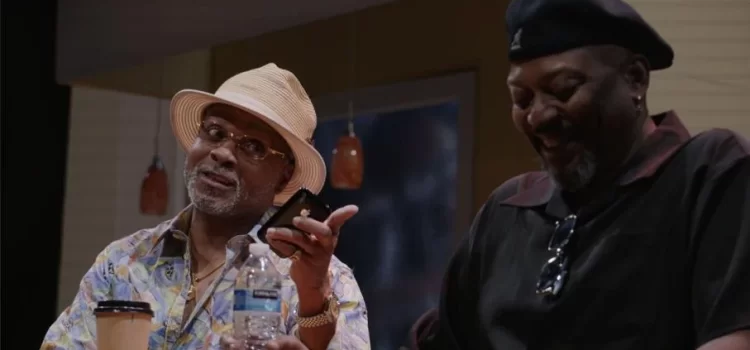
It’s such a crowd-pleaser that this is the third production the Black Rep has mounted over its 49th season. Director Ron Himes, the founder and producing director, assembled an elite ensemble of veteran actors (I think casting is his superpower).
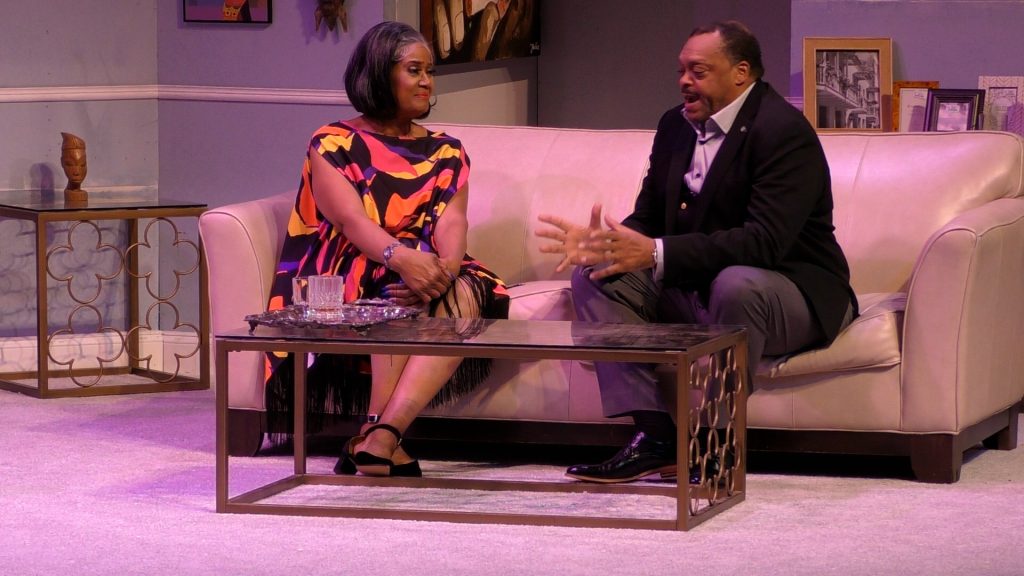
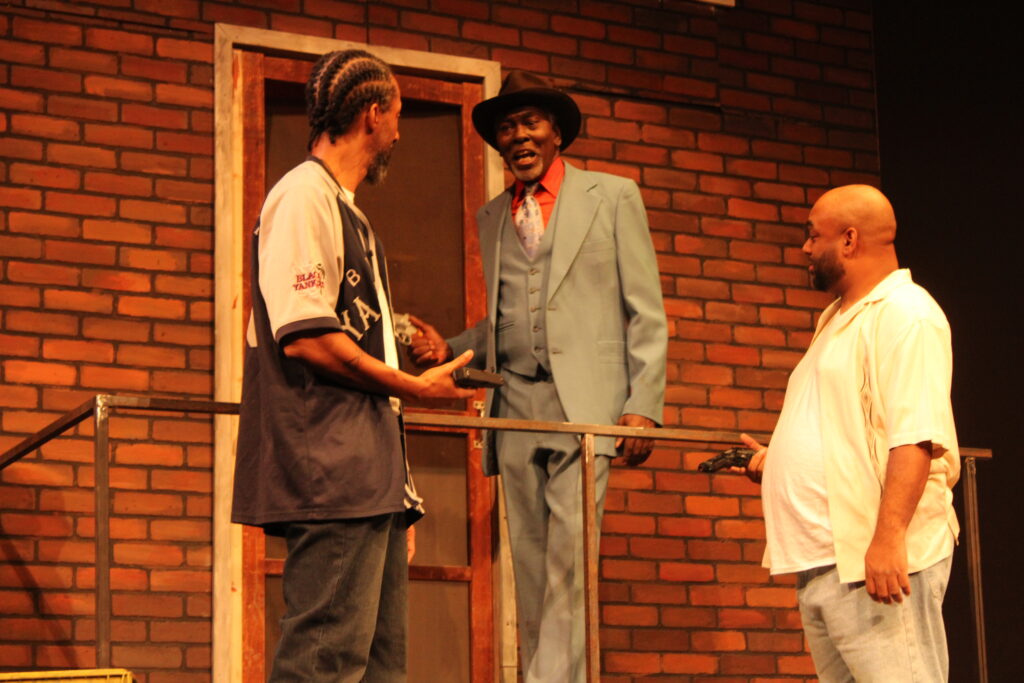
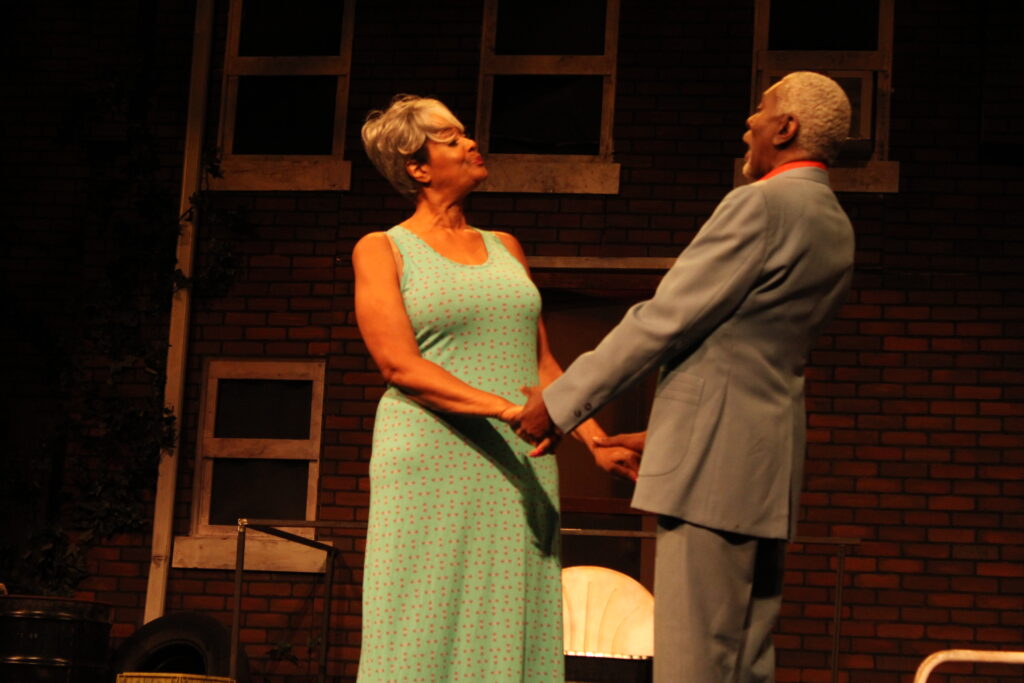
Denise Thimes, as Magnolia, and A.C. Smith, as Deacon Hudson. Photo by The Black Rep.

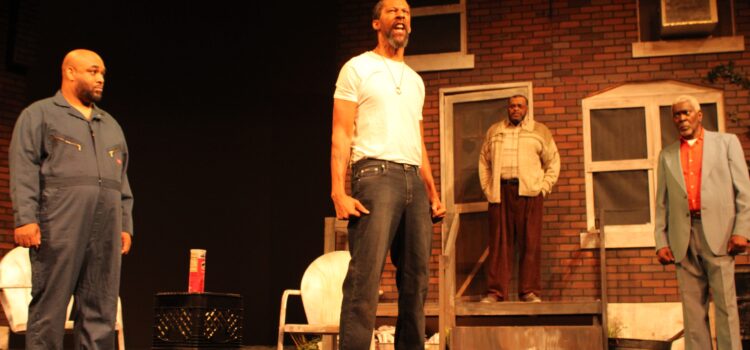
The seven performers – including Denise Thimes, A.C. Smith, Velma Austin, Margery Handy, Tiffany Tenille and Isaiah Di Lorenzo – know how to make the most of an entrance and exit. They sashay, strut and scamper easily across the well-appointed stage.

On opening night, Jan. 9, J. Samuel Davis was replaced as Newly Benson by Ron Himes, who admirably filled the role. Himes, adept at both drama and comedy, immediately connects because he’s so jittery about coming to the party.

The women are trying to revive their reputations in a fictional North Carolina coastal community, Port Town. They know they are the subject of gossip and inuendo, but that’s the chance they are willing to take.

These are full-bodied women, full of sass and spirit. Romance takes a back seat to the comedy, but it’s not for lack of trying to score Mr. Right.
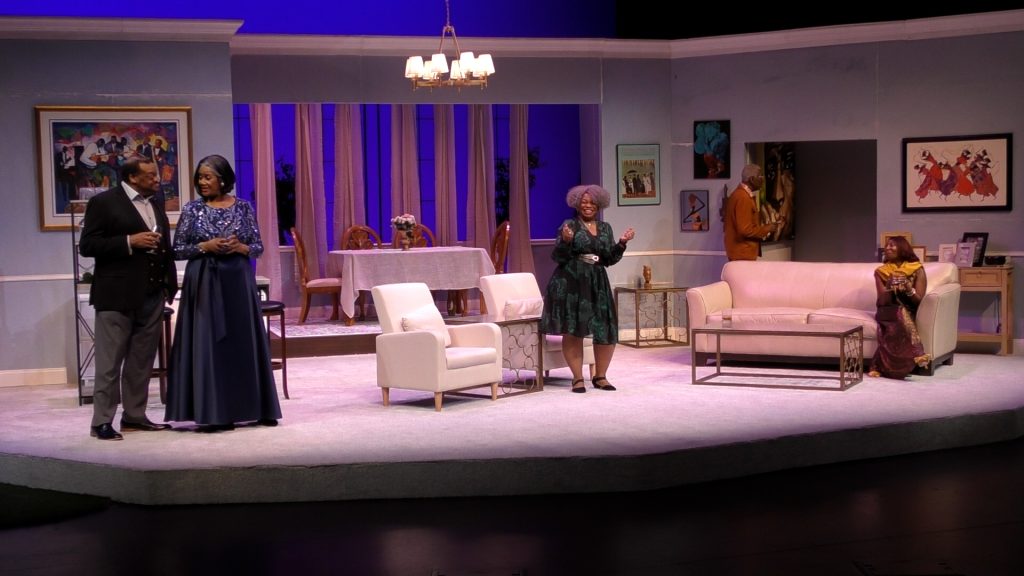
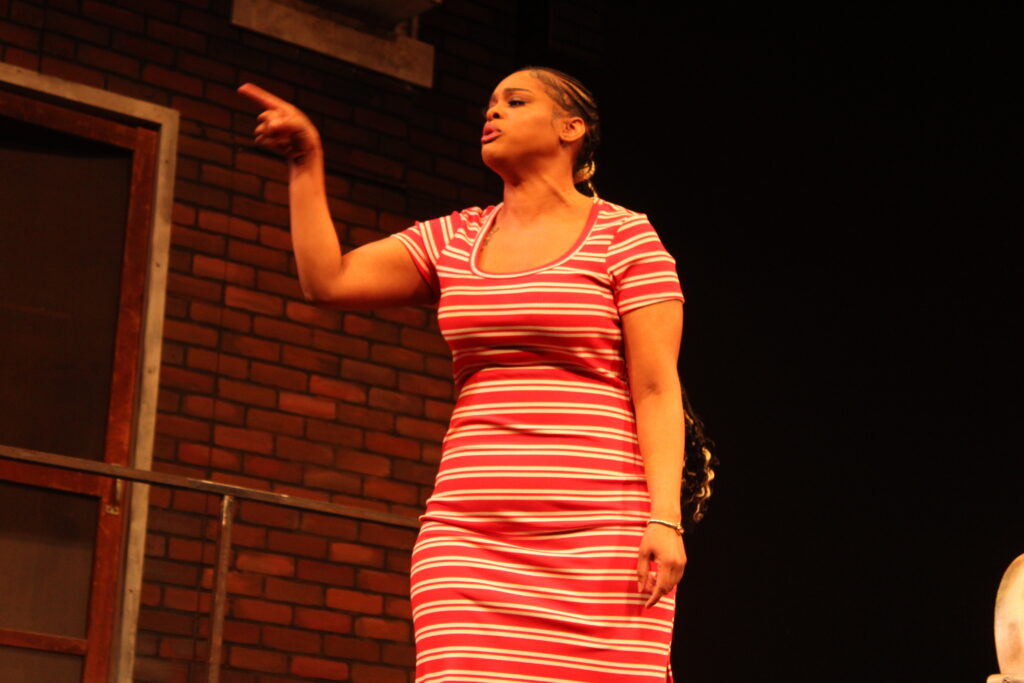
Ready for a good time. Photo by the Black Rep.

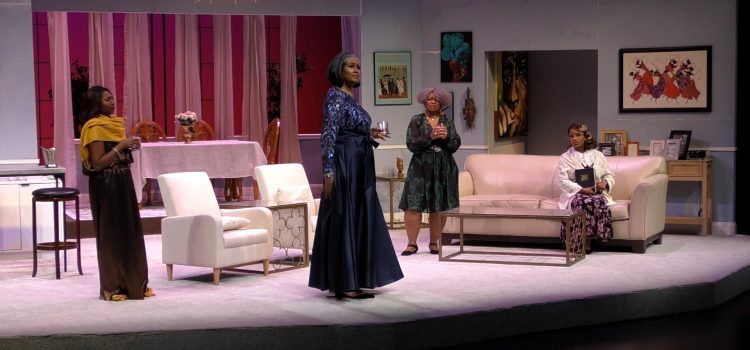
Thimes, who is a formidable leading lady, plays the sophisticated Magnolia Ellis, the hostess in her elegant home. Set designer Tim J. Jones mirrored Ellis’ style in chic décor, and prop designer Mikhail Lynn followed suit.

As she prepares for the party, she removes her late husband’s photo, saying: “I gave you a good funeral, so we’re even.”

Always excellent Velma Austin portrays the bold and audacious Simone Jackson, who has an attitude and speaks her mind, but is willing to play along for the ladies’ benefit.

Tiffany Tenille makes her Black Rep debut as the pious Annie Talbot, who doesn’t necessarily practice what she preaches. She’s outlived four husbands and professes to be lonely. As mousy as she appears, she sees an opportunity and strikes while the iron is hot, so to speak.

Margery Handy, also making her Black Rep debut, portrays the saucy Lois Miller, and she is ready to party heartily. Two of her husbands may have died from food poisoning, but that doesn’t prevent her from bringing her specialties – chicken wings and potato salad.
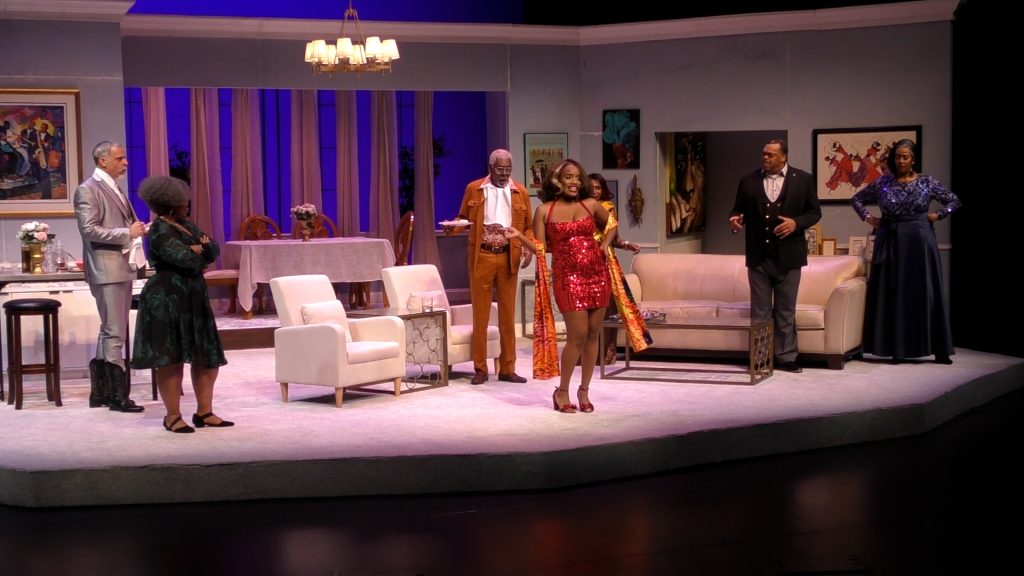
Party time. Photo by the Black Rep.

For the confident ladies, costume designer Brandin Vaughn has blended alluring upscale finery with some va-va-voom outfits emphasizing curves to make eye-catching statements. The men are sharply dressed, reflecting their personalities.

Himes knows how to mine laughs out of movement, and the cast is smooth in their shenanigans.

Because they are lonely, the men bravely take the plunge – even though Newly is very apprehensive and nervous – and show up for a night of drinks and dancing.

Isaiah Di Lorenzo is laugh-out loud hilarious as the oldest gentleman, Randall Spears, dapper and mannerly, but ready for a good time. Maybe he has too good of a time, and Di Lorenzo is a master of comic timing and body language on stage.

A.C. Smith, who was very funny as the blustery church pastor in “Chicken & Biscuits” a year ago, slips into another comedic role effortlessly, trying to be suave. Deacon Hudson is a leader of his flock – and a leader of this wolf pack.
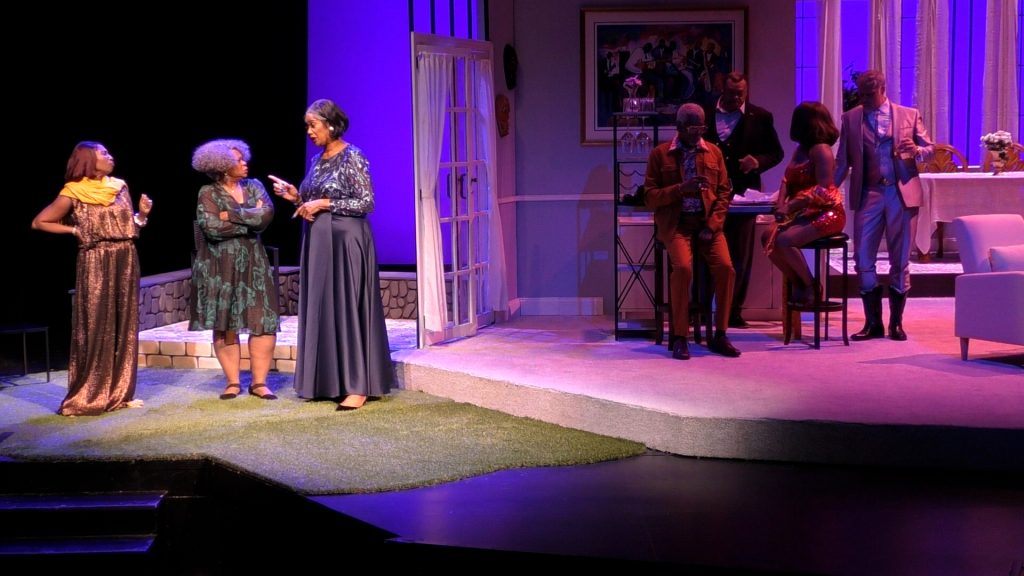
The women flit about, trying to connect and boost the ‘oomph’ as the night progresses, but the best-laid plans…not divulging too much of the plot, so people can enjoy the twists.

While trying to sparkle, the feisty females get aggravated at one’s attempt to outshine the others, and that leads to some caustic, catty remarks that are rapidly fired at the “inappropriate woman.”

Between the women going at it and the men fretting about being present possibly backfiring, the humor doesn’t slow down.

The technical crew has remarkably created a lived-in interior, and lighting designer Sean Savoie and sound designer Kareem Deanes expertly tailored sights and sounds for the occasion. The party music is quite appealing, and Smith displays some spry dance moves, and so does Thimes.                                         

With such a fearless ensemble amplifying their characters’ quirks and Williams’ snappy dialogue, “The Dance on Widow’s Row” delivers the warmth and genuine humor much welcome in January.

The Black Rep presents “The Dance on Widow’s Row” Jan. 9 through Jan. 25. at The Edison Theater on the campus of Washington University in St. Louis.  

Single tickets and subscriptions for Season 49 are available at theblackrep.org or through the Box Office at 314-534-3807. Reduced pricing is available for seniors, educators, museum staff, students and groups of 12 or more. For more information: www.theblackrep.org

.

By Lynn Venhaus

With its superlative cast, August Wilson’s powerful storytelling, and impressive milestones, “Radio Golf” is a triumph in all aspects.

Thoughtfully presented by the Black Repertory Theatre of St. Louis through June 8 in the Edison Theatre, this shrewdly observant play says so much about at what cost is doing the right thing vs. getting ahead. While it is set 1997, it speaks to issues for the ages.

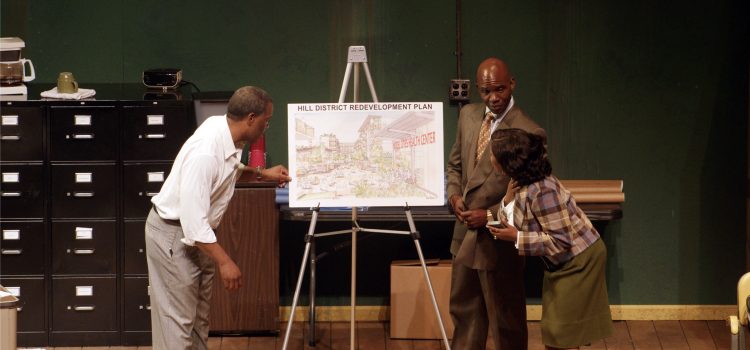
The premise of Wilson’s 10th and final play is about a real estate entrepreneur who is determined to become Pittsburgh’s first black mayor. Set in the Hill District, Harmond Wilks and his business partner Roosevelt Hicks are golf enthusiasts with big plans for the neighborhood, and their future. But at what risk?

Their office, Bedford Hills Redevelopment Inc., is a storefront on Centre Avenue. The two partners talk of their hopes and dreams as they work on a modern housing and shopping development that will include Whole Foods and Starbucks.

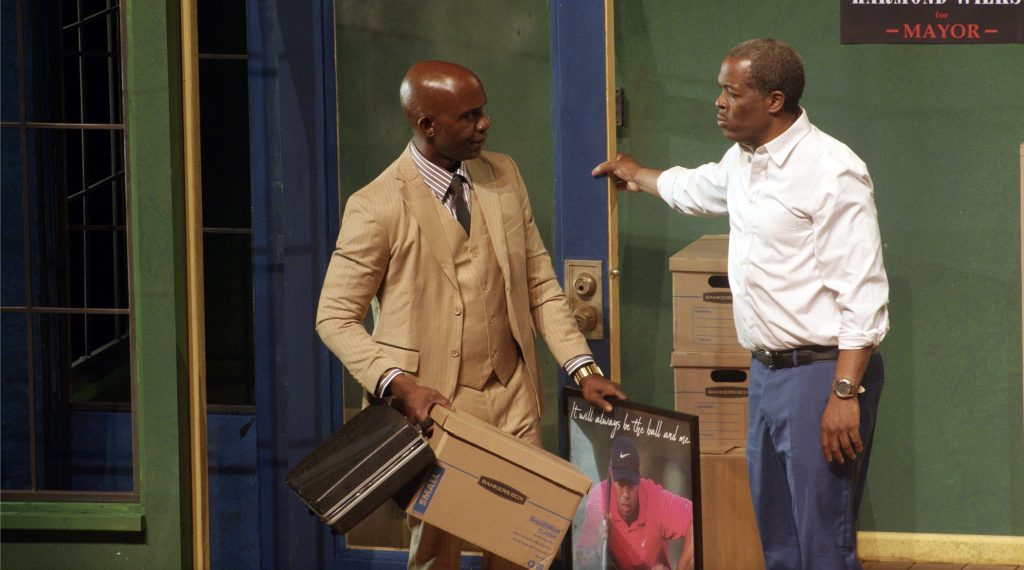
Ronald L. Conner, a St. Louis native now living in Chicago, is a fiery, slick, upwardly mobile Roosevelt who is a bank vice-president and plays golf games to get ahead. Being accepted by the Country Club movers-and-shakers is a goal that he feels is within reach.

Ronald L. Conner and Reginald L. Wilson as business partners Roosevelt and Harmond. Photo by Keshon Campbell

Reginald L. Wilson, in a slow-burn riveting performance, views the development as a way to lift people up. But a block of the Hill District must be torn down. It’s his Black Rep debut but he has immersed himself in Wilson’s works, and previously starred in “Ma Rainey’s Black Bottom” and “Fences.”

Where Harmond and Roosevelt see blight, others see the heritage that marks the tight-knit families who grew up there. He isn’t looking at the other side – and both a cranky yet wise Old Joe Barlow and no-nonsense handyman-contractor Sterling Johnson remind him of people’s worth, no matter their economic means or position.

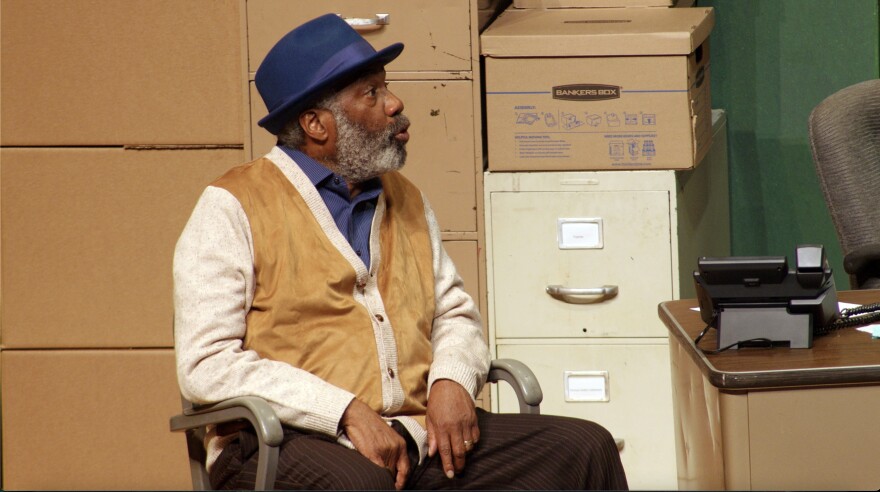
Himes is unabashedly brilliant and the audience’s favorite character as Joe, a neighborhood elder who knows its history. He also remembers Harmond’s father who was in the real estate business. Blunt and smart like a fox, Joe tells it like it is.

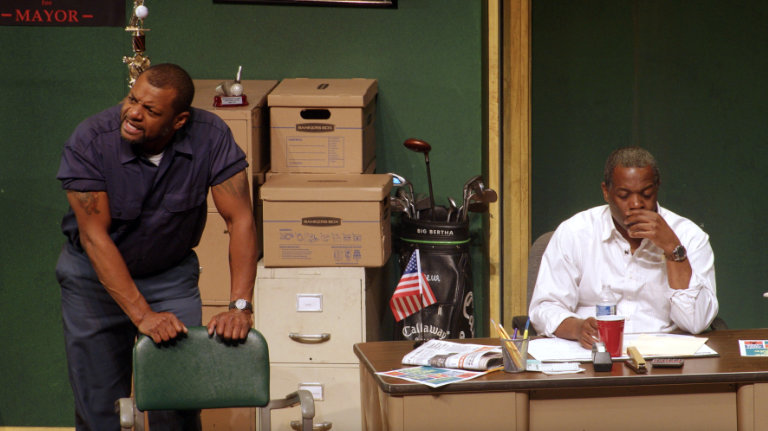
As street-smart Sterling, Kelvin Roston Jr. is the play’s conscience. A good judge of people and their motives, he warns Harmond about neglecting the reasons why people value their history and turning his back on his neighbors. An ex-con who has lived a colorful life, and his dialogue just sings with authenticity, thanks to Roston.

Savvy Velma Austin is the lone female in the cast, portraying Mame, Harmond’s ambitious wife and public relations professional. She is looking ahead and extremely conscious of image. She doesn’t want him to jeopardize the path they envision for their future.

The conflicts occur organically because the ensemble is skilled in delivering Wilson’s rhythmic prose, making their characters’ struggles well-grounded.

Ron Himes as Old Joe Barlow. Photo by Keshon Campbell.

Director Jon Royal’s layered approach allows Wilson’s realistic dialogue to breathe and to build with tense clashes.

Jim Burwinkel’s scenic design aptly encapsulates Wilks’ needs and his hopes – an MLK poster is near his desk and a Tiger Woods poster is near Roosevelt’s. Lighting designer Jayson Lawshee captures times of day through the windows and Justin Schmitz’ astute sound design includes a terrific soundtrack.

Also setting the moods were costume designer Shevare Perry, who fits the period well, and Mikhail Lynn, who nailed the props, such as stolen golf clubs.

In “Radio Golf,” like he has touched on so eloquently before, Wilson examines the lifelong practices of white-run institutions, and whether minorities getting a place at the table was lip service, or another way for control, or an opportunity. And what would you do to ensure that opportunity?

All good, thoughtful points. As Martin Luther King once said, “The time is always right to do the right thing.”

Wilson published the play before his death in 2005, long before social media could have exploited the efforts of people involved to do the right thing vs. the corporate and political spins of the day. However, at that time, the outrage that is the norm when righteous dudes stand up for rights and beliefs now is sadly absent.

Reginald L Wilson and Velma Austin as Harmond and Mame. Photo by Keshon Campbell.

Wilson’s monumental American Century Cycle covers 100 years of the Black experience in America, chronicling social and historical changes in his remarkable style. He won Pulitzer Prizes for two of the plays – “Fences” and “The Piano Lesson.”

“Radio Golf” is the Black Rep’s second completion of the cycle, which took them 18 years to achieve. The Black Rep first completed it – only the third company in the U.S. to do so – from 1988 to 2003.

Starting in 2007, they have presented Wilson’s collection in chronological order. Thanks to the Black Rep, since 2012, I have seen seven of Wilson’s works, and each one has been a gem to treasure.

“Radio Golf” is also a record for actors Himes, founder and producing artistic director of the Black Rep, and Conner, who complete their own personal cycle this go-round.

They have earned St. Louis Theater Circle awards for outstanding production of a drama with Wilson’s “Two Trains Running” in 2022 and “Jitney” in 2023, and Ron Himes won best actor for “Fences.”

All 10 powerful in their own ways, these finely acted and impeccably produced shows illuminate black heritage and specific challenges as only Wilson can, and it’s always the right time to be reminded of his humanity.

With vibrant performances, The Black Rep’s “Radio Golf” is a masterful production that elevates its timeless message for today.

Kelvin Roston Jr as Sterling talks to Harmond.

The St. Louis Black Repertory Company presents “Radio Golf” through June 8. The opening weekend of May 16 – 18 was cancelled because of tornado damage, and performances have been added from Thursday, June 5 to Sunday, June 8. A portion of those ticket sales will support tornado relief. Performances take place in the Edison Theatre on the campus of Washington University with support from The Whitaker Foundation. For more information: www.theblackrep.org Box Office at 314-534-3807. Reduced pricing is available for seniors, educators, museum staff, students, and groups of 12 or more.

By Lynn Venhaus
Four retired guys sitting around talking and drinking coffee at a Chicago McDonald’s is intriguing food for thought –a delectable slice-of-life scenario that immediately draws us in to the play “Coconut Cake.”

Playwright Melda Beaty’s flair for dialogue, humor and seamlessly integrating social commentary in her dramedy is irresistible in a compelling and thoughtful presentation in The Black Rep’s intimate A.E. Hotchner Studio Theatre at Washington University.

Because of the caliber of its five-male cast, this character-driven work makes a swift and memorable connection. Their nimble delivery and interactions under the skilled direction of Geovonday Jones enhances their personal relationships as their struggles are revealed over the course of the two-act 2-hour show.

As they explore issues of manhood, racism, mental health and offer advice over games of chess, they show genuine affection — and aggravation — with each other but offer convincing immersive characterizations and realistic camaraderie. It’s set in the summer of 2010.

A fifth character, an unhoused man they call Gotdamnit, interrupts their mornings asking for money and offering his philosophical and spiritual words of wisdom. He’s considered a pest, but there is a surprising backstory and as suspected, more to the guy than his appearance indicates. Lawrence Evans is riveting as a marginalized man.

While the women in their lives are discussed, not seen, vivid portraits of the female characters emerge as they factor into the men’s disparate demeanors. Two characters in particular – a classy, attractive woman that has caught their eye, whom they watch as she walks to work from the Mickey D’s window, and property owner Joe’s mysterious new tenant, Ms. Brulee, who is a baker that makes a divine coconut cake, which happens to be Eddie’s nostalgic childhood favorite.

Richard E. Waits and Joe Hanrahan listen to Duane Foster. Photo by Keshon Campbell

Eddie Lee, a handyman, is the most agitated guy – upset about his wife’s escalating threatening behavior and discloses personal details about his troubled marriage. Everyone knows he has not been faithful, and that complicates matters. Duane Foster is strong as a guy whose life is falling apart but he’s not taking responsibility for the reasons why.

Marty is often the voice of reason, and his faith has kept him grounded. He’s a deacon in his church and devoted to his family, friends and congregation. As Marty, Richard E. Waits is firm, but measured, in the advice he gives, and it’s not always welcome.

The characters show different sides of them as husbands, fathers, sons and friends. Their individual stories mesh well, and the play offers unexpected twists and turns that add poignancy.

Each man has a significant emotional journey, and their textured portrayals give us richer story arcs as they bring up cherished memories and confide secrets.

Marty has brought along his brother-in-law Hank, a white guy who was married to his sister, who died a year ago. As played warmly by Joe Hanrahan, the widowed Hank is lonely and comes along for companionship and something to do. He’s learning chess, and he beams talking about his family, as his daughters and granddaughters try to keep him busy.

The outspoken Joe likes to needle Hank, calling him “Republican,” and increases his pot shots and cruel jabs. Richard Harris is a feisty live wire as the loud, swaggering Joe, a flashy blowhard who brags about his money and conquests. He’s never married but has a couple baby mamas.

Richard Harris is the outspoken Joe. Photo by Keshon Campbell.

As the very opinionated Joe, Harris can change his mood quickly. His accusations get heated and personal, especially if the other guys give him some lip about his boasts. His colorful wardrobe, often referred to as ‘fly’ in urban slang, is an indicator of his perceived status (kudos to costume designer Brandin Vaughn for the stylin’ attire).

Because Joe’s disposition can turn on a dime, his pointed barbs take on a hostile, accusatory tone in the second act, after he endures some setbacks.

All accomplished actors, the five bring nuance and shades of gray to our assumptions and give us deeper insight into these complicated men. They eventually must grapple with the consequences of their choices during their lifetimes.

Scenic designer Tammy Honesty has presented elements of a typical nook at a 2010-era McDonald’s, well-lit by designer Tony Anselmo, that allows Jones to move the action to wherever the guys are sitting.

When Joe struts in, he commands attention by seemingly holding court. Eddie is too restless to sit down most of the time, and Marty and Hank are often hunched over their chess board.

Lawrence Evans as Gotdamnit and Joe Hanrahan as Hank. Photo by Keshon Campbell.

Sound designer Alan Phillips incorporated people chattering at times and assembled an appealing soundtrack of catchy pop hits. Christian Kitchens was an assured technical director, and Mikhail Lynn provided the minimal props.

This isn’t the first time The Black Rep has presented the play, because during the pandemic in September 2020, they made a virtual Zoom reading available from The Ensemble Theatre in Houston, which featured founder Ron Himes as a major character, Eddie Lee.

In 2022, Beaty received the second annual Sylvia Sprinkle-Hamlin Rolling Premiere Award by the International Black Theatre Festival. Because of that, this play is being produced by five theaters, including the Black Rep. It is a welcome return.

With its engaging cast, a captivating funny-sad bittersweet narrative, and noteworthy technical know-how, “Coconut Cake” is a satisfying production to savor.

(At intermission, a coconut cream cheese pound cake is available for purchase too, along with other snacks. Just sayin’, if you get a hankering for a sweet treat.)

Richard Waits and Joe Hanrahan are brothers-in-law playing chess. Photo by Keshon Campbell.

The Black Rep presents “Coconut Cake” Feb. 5 – March 2 in the AE Hotchner Studio Theatre at Washington University. For tickets and more information, visit www.theblackrep.org

By Lynn Venhaus

Sins of the past collide with a volatile present in the intense gut-punch that is August Wilson’s “King Hedley II,” part of his American Century Cycle now in return rotation at The Black Rep.

One of the foremost interpreters of Wilson’s work, director Ron Himes superbly creates a powder keg of family secrets, desires for fresh starts, and hopes punctured by despair.

Shaping vivid portrayals, an outstanding ensemble conveys an abundance of passion in a heartbreaking and tragic tale.

The ninth of Wilson’s 10 plays set in the 20th Century, “King Hedley II,” written in 1999, takes place in Reagan’s America 1985, when class struggles were escalating.

This was a fraught time for black men and women trapped by circumstances – few opportunities and an alarming rise in gun violence, teen pregnancies and unemployment. Wilson hammers all those points home in poetic dialogue that spills out in blistering, breathtaking monologues that offer perspective.

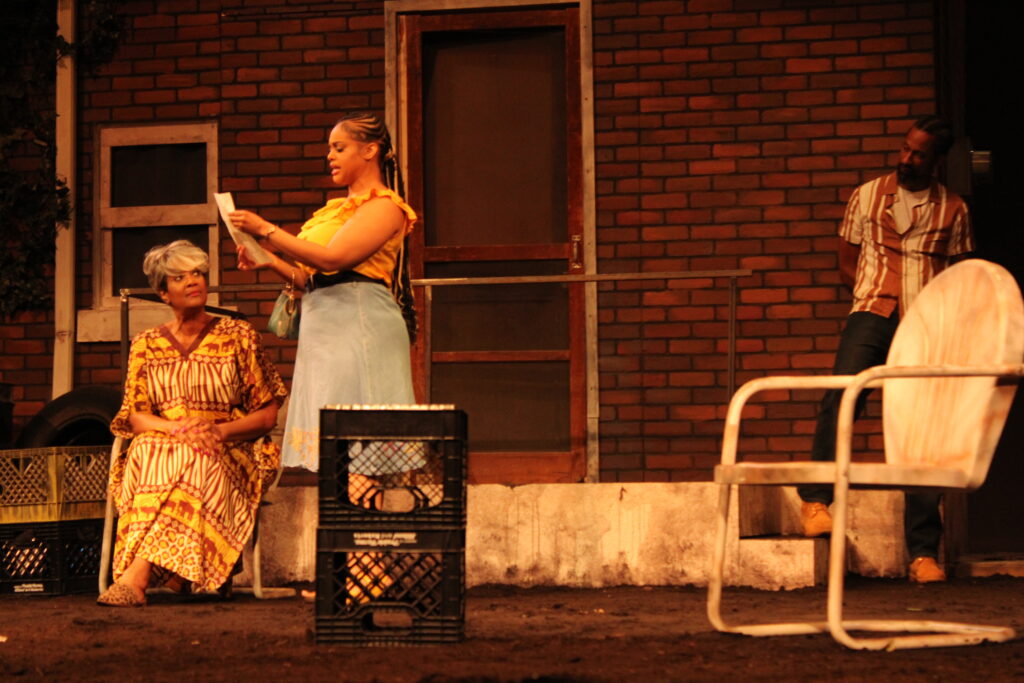
Ka’ramuu Kush, J. Samuel Davis and Geovonday Jones. Photo by Keshon Campbell.

Himes understands the rhythms of these individual characters so that their story arcs are distinctive – and the six intertwining connections are convincing. It is masterful, moving work from Ka’ramuu Kush as rage-filled King and Alex Jay as his conflicted wife Tonya, local legends Denise Thimes as matriarch Ruby and J. Samuel Davis as ramblin’, gamblin’ Elmore, with strong support from A.C. Smith as evangelical neighbor Stool Pigeon and Geovonday Jones as King’s pal Mister.

With daily indignities chipping away at his self-respect, King is attempting to overcome a world of hurt to rebuild his life. He just spent seven years in prison for killing a man who disfigured his face. Now, he wants to provide for his family as he hustles stolen refrigerators and dreams of opening a video store with his best friend Mister.

Trouble seems to lurk everywhere, to pull him back, and his life could blow up at any moment because of all these small fires and volatile situations fanning the flames.

Such is the action in a backyard of Pittsburgh’s Hill District, fertile ground for Wilson’s dark, complex story about the widening gulf between the haves and have-nots. Some of the characters we met in his “Seven Guitars” reappear a generation later.

Alex Jay as Tonya. Photo by Keshon Campbell.

“Seven Guitars,” presented in 1995, confronted obstacles faced by a blues musician, Floyd “Schoolboy” Barton, who lived in a boarding house in 1948.  In that one, Ruby, visiting from Alabama, is pregnant with the son she names King Hedley II. Hedley is a prominent character, although the father’s paternity is not explained. Stool Pigeon appears as musician Canewell, one of Floyd’s best buds who is now collecting newspapers and trying to maintain historical records in “King Hedley II.” His friend, Red Carter, is Mister’s father.

Wilson’s 10 plays, each exploring the African American experience by decade over the course of 100 years, have been performed by the Black Rep before. During this second go-round for the anthology, I have seen them all since “The Piano Lesson” in 2013, with “Jitney” in 2022 and “Two Trains Running” in 2020 earning outstanding production awards from the St. Louis Theater Circle.

Next season, they will complete this recent cycle with “Radio Golf,” which takes place in the 1990s and was Wilson’s final work, presented in 2005.

All powerful in their own ways, these finely acted and impeccably produced shows illuminate black heritage and specific challenges.

Denise Thimes and J. Samuel Davis. Photo by Keshon Campbell.

This production’s gritty look immerses us into the neighboring row houses’ struggles through scenic designer Timothy Jones’s shabby stoop of Stool Pigeon’s and the grimy back porch of Miss Ruby’s delapidating family home while Travis Richardson’s lighting design, Alan Phillips’ sound design and Mikhail Lynn’s props create an authentic daily atmosphere.

Kush’s King gains our sympathies as he expresses his self-doubts and displays his vulnerabilities, detailing the reasons behind his noticeable facial scar, prison sentence, and his impoverished life to date.

He’s trying to grow flowers in a neighborhood of few success stories, an apt metaphor, but an unwavering sense of community is present, even as they lament the disrespectful thug environment encroaching on their turf they try so hard to protect.

The cast excels in fleshing out their characters’ colorful personalities and backstories so that you understand their motivations and philosophies on life. Stool Pigeon and Mister present some welcome humor, which both Smith and Jones are skilled at providing.

Stool Pigeon’s frequent quoting of the Bible often gives the play a spiritual angle that reveals more as it unfolds. “God got a plan. That medicine can’t go against God. God do what he want to do. He don’t have to ask nobody nothing,” Smith matter-of-factly states.

Denise Thimes, Alex Jay, Ka’ramuu Kush. Photo by Keshon Campbell.

Wilson’s views on disadvantaged lives hit hard as their truths tumble out – exemplified by a fiery outburst from Tonya on why she doesn’t want another child, and we feel all of Jay’s anguish.

Davis, a two-time St. Louis Theater Circle acting award winner, is silky-smooth as the charming Elmore, a rascal and former suitor that reconnects with Ruby. He’s trying to soothe his soul on some of the messes of his life.

Davis’s stellar track record with Wilson’s plays continues in one of his finest portrayals, deftly maneuvering the rapid-fire exchanges of a flashy con artist always trying to score.

Thimes, known as one of the best jazz singers in town, fully embodies Ruby, trying to find peace in her golden years, and looking back at regretful missteps.

Costume designer Kristie Chiyere Osi has outfitted the working-class characters specifically, with Elmore’s slick suits and snazzy hats an interesting contrast to everyone else’s casual attire.

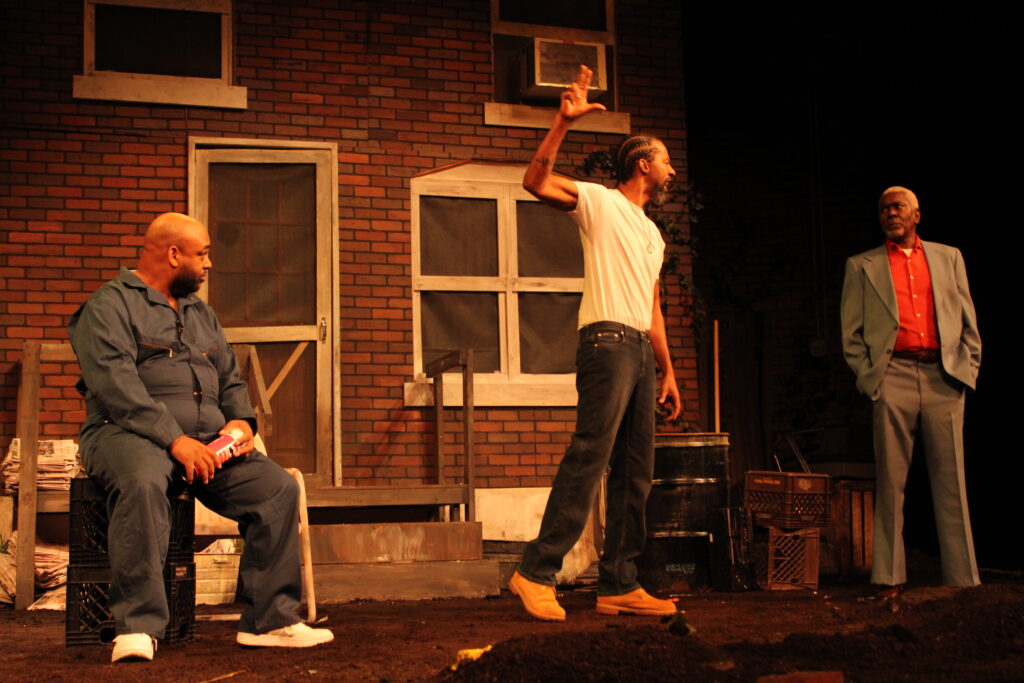
Geovonday Jones, Ka’ramuu Kush, J. Samuel Davis. Photo by Keshon Campbell.

The cast is riveting as the action heats up, leading to an explosive climax that left me shaken. The tension is telegraphed all through Wilson’s exceptional prose, as past violence is recounted, but it still stuns.

Nominated for both the Pulitzer Prize and the 2001 Tony Award for Best Play, “King Hedley II” is impactful in its goal, to better understand behavior when people are robbed of dignity and humanity. That message resonates with The Black Rep’s insightful staging.

The Black Rep presents “King Hedley II” from June 19 to July 14 at the Edison Theatre on the Washington University campus. An intergenerational matinee is June 26. It is 2 hours, 45 minutes, with an intermission, and contains mature language. For more information, www.theblackrep.org.

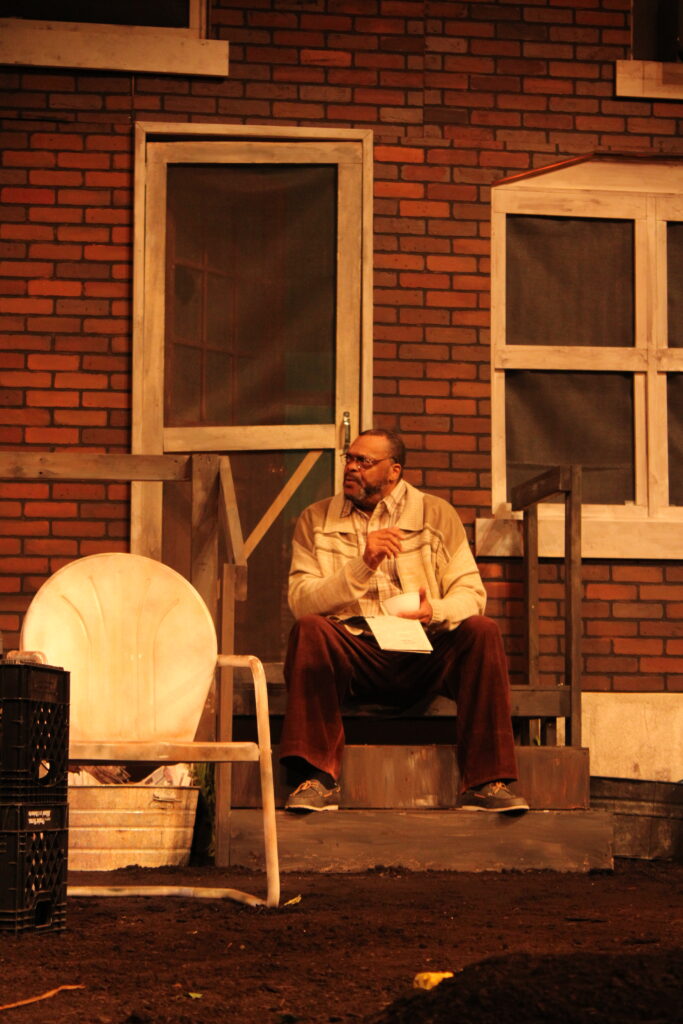
AC Smith as Stool Pigeon. Photo by Keshon Campbell.