By Lynn Venhaus

In contemporary biopics, well-known artists are usually presented in a typical template – rags to riches, bumpy roads and triumphs during a specific period, not spanning womb to tomb, and “Michael” doesn’t stray from that formula.

How this narrative distinguishes itself, in this Jackson family-produced portrait of their singular superstar, is the undeniable impact of his music and the memorable pop culture moments that Michael Jackson was a part of during his brief life. (He died at age 50 on June 25, 2009).

The story of the “King of Pop” begins in the mid-60s in Gary, Indiana, through the Jackson 5 success and their relocation to a family compound, Hayvenhurst, in Encino, Calif., to his breakout solo career, stopping at his “Bad” World Tour in 1988.

As an artistic innovator who redefined music, dance and music videos, he was known as a perfectionist who had a relentless work ethic. That is also shown in “MJ The Musical,” which opened on Broadway in 2022 and continues to tour the country, concentrating on rehearsals for Jackson’s 1992 Dangerous World Tour, and his career pressures.
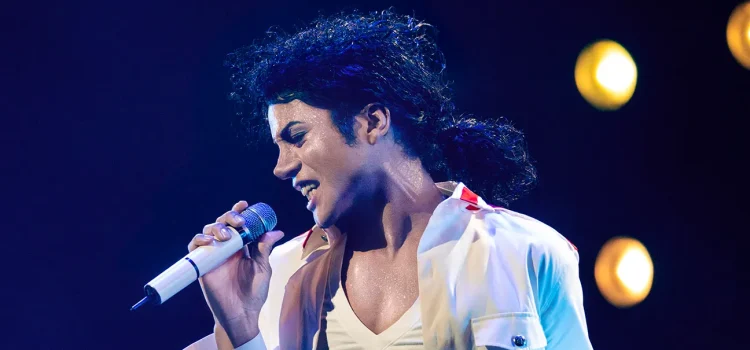
Michael’s real-life nephew Jaafar Jackson portrays his uncle.

His creative genius and masterful songwriting skills are the major focus of this dramatization, while displaying his painfully shy and sensitive personality. There are glimmers of his compassion (visiting children in hospitals) and humanitarianism (although it doesn’t touch on “We Are the World” or his Heal the World Foundation).

Key moments include meeting Berry Gordy (Larenz Tate) at Motown, and his collaborations with Quincy Jones (Kendrick Sampson) on his first solo album “Off the Wall” in 1979 and then “Thriller” in 1982, which remains the best-selling album of all-time.

But the film really comes alive during the iconic pop essentials – filming of the landmark “Thriller” video, a choreography rehearsal for “Beat It,” the stunning introduction of his famous “moonwalk” on the Motown 25th anniversary special in 1983, besides his solo and group performances with his brothers Jermaine (Jamal R Henderson), Jackie (Joseph David-Jones), Tito (Rhyan Hill), and Marlon (Tre Horton).

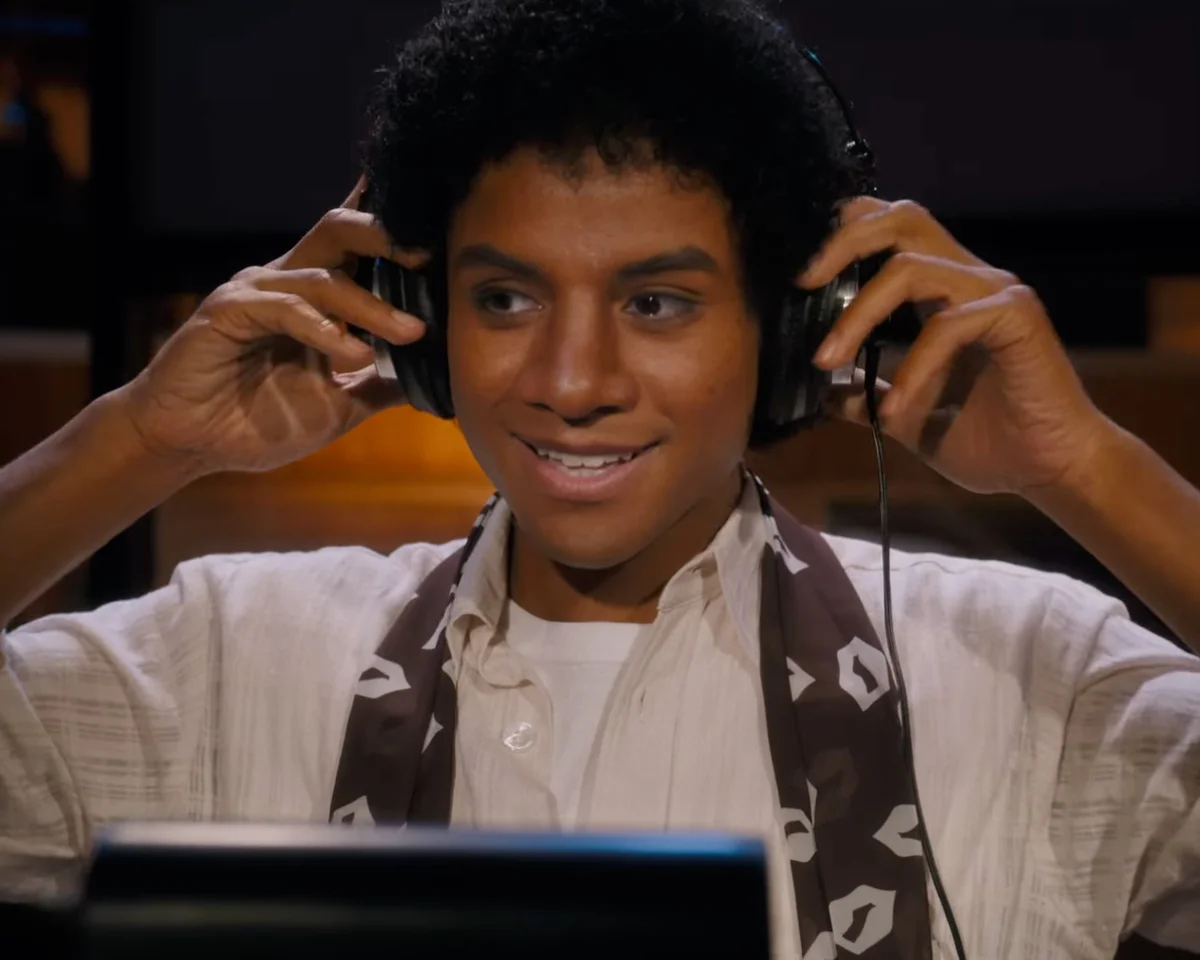
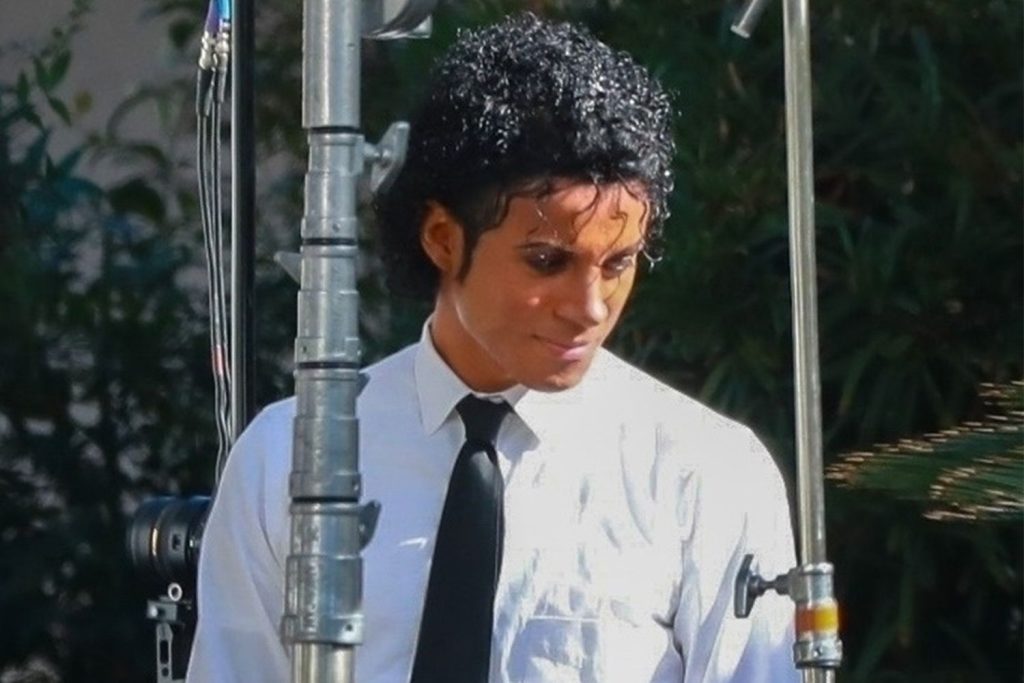
Those scenes bristle with electricity and give the film its heartbeat. Jaafar Jackson, who is Jermaine Jackson’s son and Michael’s nephew, is remarkable in his uncanny portrayal of Michael from his teen years on, while Juliano Krue Valdi portrays him at age 10.
Jaafar has the moves, the speech pattern and the megawatt smile down pat, and Valdi is incandescent as the ebullient child singer fronting the Jackson Five. Suffice it to say he thrived in the spotlight. It’s the real-life stuff he had difficulties with (although it’s only hinted at briefly).

The struggles with his controlling and abusive father Joseph (Colman Domingo) and sweet but passive caretaker mother Katherine (Nia Long) are shown, but the family’s input on this heavily redacted narrative is obvious. After all, the list of producers includes everyone but his sister Janet and his daughter Paris. who did not sign off on this version.

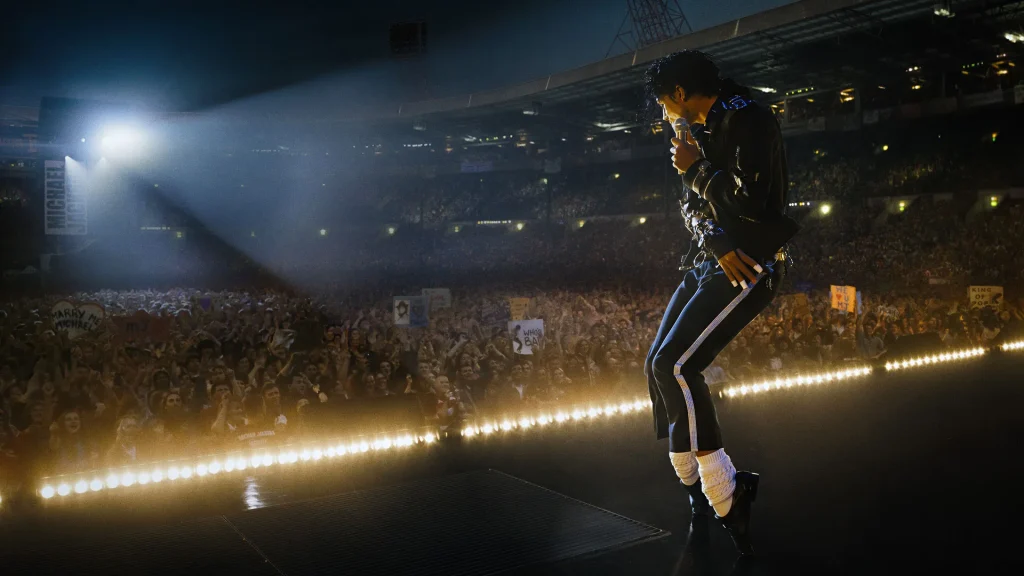
So, you know you are getting a sanitized version of his life. This is the story the family wants to tell, and this is the movie that resulted – 2 hours and 15 minutes, from modest beginnings in Gary, Ind., to stopping at his Bad World Tour at Wembley Stadium the summer of 1988. Supposedly, a second part is in development. (To be continued, a screen says at the end).

If you want juicier details, look elsewhere. But if you want an entertaining slice of life that takes you back to the days when you first heard Michael Jackson and saw his evolution in the music business, those scenes pop with energy and excitement.
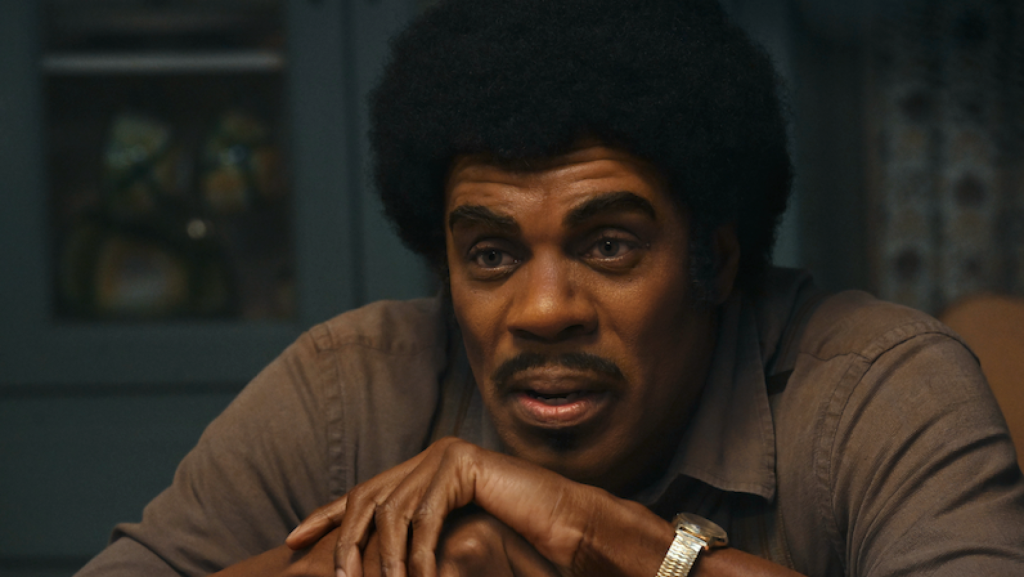
Colman Domingo as domineering Jackson patriarch Joseph.

Antoine Fuqua, who has directed action movies like “Training Day” and “The Equalizer,” helmed this, and his early career as a music video director is evident. His concert footage is beautifully shot by cinematographer Dion Beebe, who captures the electricity of live performances.

They also recreate the 1984 filming of the Pepsi commercial accident where Michael’s hair caught on fire from pyrotechnics and he suffered second and third degree burns on his scalp. That alludes to taking painkillers, which later caused issues for the star.

Screenwriter John Logan, who has been nominated for three Oscars for writing “Gladiator,” “The Aviator” and “Hugo,” and won the Tony Award for Best Play with “Red” in 2010, knows how to weave a compelling tale about larger-than-life personalities.

Logan also highlights Jackson as a savvy businessman, knowing exactly what he wanted, in meeting scenes with record company executives and managers.
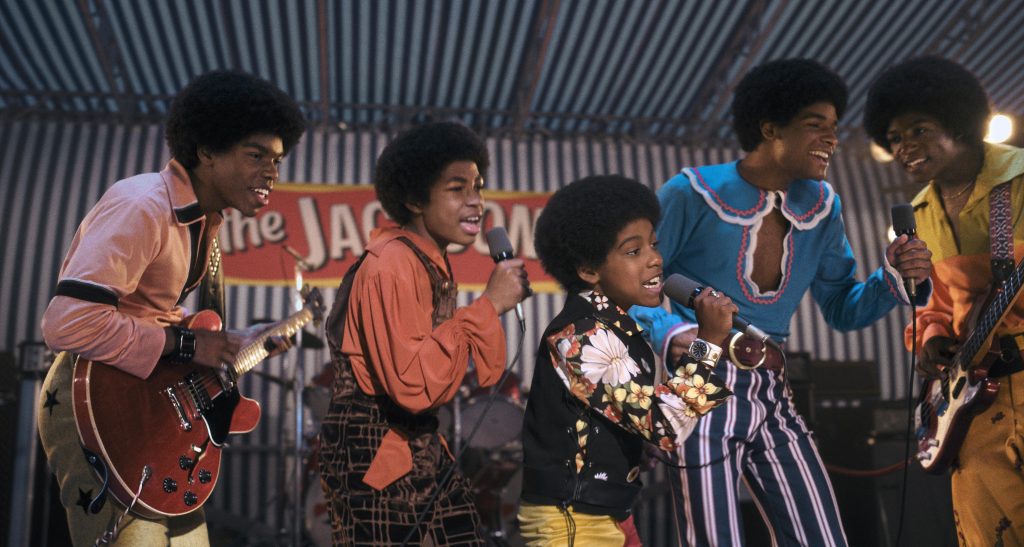
the early beginnings of the Jackson 5 band.

This film was made for his legions of fans, and from the preview audience reaction, this will be a massive crowd-pleaser for those who separate the art from the artist, and is not for the cancel culture.

In quieter life moments, the film touches on Michael’s loneliness as a boy, his retreat into a fantasy life involving Peter Pan, old Hollywood movies, and his big dreams to be the best at what he did as an entertainer. It’s meant to tug at the heartstrings, the perennial man-child dilemma..

Yet, the film shows a loving relationship between Michael and his brothers — even when they’ve grown up and he hasn’t. In their younger days, those roles are played with great zest by Jayden Harville as Jermaine, Jaylen Lyndon Hunter as Marlon, Judah Edwards as Tito, and Nathaniel Logan McIntyre as Jackie, with Amaya Mendoza as a young LaToya.

His eccentricities include housing exotic animals that were a major part of his menagerie, including Bubbles the Chimp (a horrible CGI visual)..

The cast includes Laura Harrier as sharp Motown talent scout and later executive Suzanne de Passe, Jessica Sula as La Toya, KeiLyn Durrel Jones as Michael’s bodyguard/confident Bill Bray, and Miles Teller as lawyer and manager John Branca, who is also credited as a producer. Branca is co-executor of the Michael Jackson Estate.
Mike Myers, who also had a cameo in “Bohemian Rhapsody,” shows up here as CBS Records president Walter Yetnikoff, who puts the squeeze on MTV to play Michael Jackson’s “Billie Jean” in heavy rotation, threatening to pull his artists like Bruce Springsteen, Journey, Billy Joel, and other big names on the label if they didn’t.

While “Michael” is not a documentary or a complete picture, this fictional account encapsulates how Jackson’s talent endures and reminds the audience why they admired his unique four-decade contributions. This is definitely geared to a specific audience who is willing to get lost in the music.
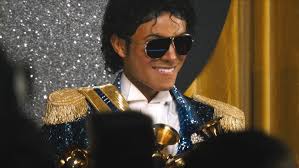
“Michael” is a 2026 music drama biography about the late Michael Jackson, produced by his family and estates. It is directed by Antoine Fuqua and stars Jaafar Jackson, Colman Domingo, Nia Long, Juliano Krue Valdi, Larenz Tate, Kendrick Sampson, KeiLyn Durrel Jones, Ryan Hill, Miles Teller, Mike Myers, Jamal R. Henderson, Joseph David-Jones, Tre Horton, Jessica Sula and Laura Harrier. The film runs 2 hours, 15 minutes and is Rated PG-13 for some thematic material, language, and smoking. It opens in theatres April 24. Lynn’s Grade: B

By Lynn Venhaus

With its genre mash-up of science fiction, horror, action-adventure and romance, the most surprising of all is that the romance is the most satisfying aspect of “The Gorge.” And that’s because of the sparks flying between charismatic co-stars Anya Taylor-Joy and Miles Teller.

While this mysterious thriller has intriguing menacing elements, it does take a while to get going, but once the creature danger plotline is revealed, it doesn’t take a biochemist to explain it all to us (although that does help) – so then what follows is entirely predictable and borders on the ridiculous at times.

But the pair’s coupling is worth sticking out the extra-long runtime of 2 hours, 7 minutes, because these lost souls are clearly meant to be together. As two lone wolves, they discover not only do they have their line of work in common, but so much more. Tenderly, though, they bond through poetry and music, which is a sweet, thoughtful touch.

Both are hired guns – she’s a Lithuanian assassin whose dad was a KGB agent, and he’s a former U.S. Marine who takes on sniper assignments, used to a solitary existence. They’ve accepted a vague year-long assignment to be guards at an undisclosed location.

They are told they are protecting the world from the present evil in this misty gorge, with eerie noises and a foreboding terrain. The enemy is unseen, but it’s only a matter of time until the threat is disclosed.

Teller’s Levi Kane is in the West Tower while Taylor-Joy’s Drasa is in the East Tower, super-secret representatives of a government pact made during the Cold War, during the tail end of World War II.

Levi, a reader, discovers a wall inscribed with sayings from all the previous guards, hidden behind a bookcase. He’s given a training lesson from his British counterpart who’s about to return to civilization after 365 days. As JD, Sope Dirisu alludes to the “Hollow Men,” a reference to the T.S. Eliot poem that Levi is familiar with, so that’s a tipoff.

Levi is told not to have contact with ‘the other side,’ although it’s unclear why not. The watchtower is self-sufficient with a garden, rainwater system, solar power, and he must perform a radio check every 30 days. Lots o’ firepower for protection as well.

Drasa may not have gotten the same memo, so she fires the first shot – they begin writing messages to each other, visible in their panoramic windows. It doesn’t take long before they’re playing long-distance chess and feeling a strong connection. What develops is fun and joyful, because it all makes sense in a swashbuckling scenario.

The screenplay by Zach Dean, while clever, has limitations because once we figure out who the real threat is, we’re faced with an onslaught of increasingly icky gross ‘things’ that crawl, some form of zombified human-plant-insect hybrids. They are relentless in trying to climb the steep walls of their ‘hell.”

Among other higher profile projects, Dean wrote one of my favorite guilty pleasures, “Deadfall,” so I admire his intentions. Yet, he did write “Fast X,” not chimps, which is what I suspected.

After repeated gnarly attacks, it doesn’t take a nuclear physicist to figure out that some sort of chemical warfare experiments have gone wrong (but of course, there is more to that discovery).

Our heroes now must team up for their survival, and the gauntlet is a disgusting maze of natural and man-made disasters. Director Scott Derrickson, who has crafted some well-received horror movies, including “The Black Phone,” and the mega-blockbuster “Doctor Strange,” has laid out a booby-trapped road map that benefits from cinematographer Dan Laustsen, who is known primarily for his work with Guillermo del Toro and “John Wick” chapters 2-4.

Lausten makes the environment a terrifying living, breathing world for this resourceful and smart couple to navigate, with plenty of tension and threats of bodily harm. Their final attempt to escape is quite an inventive piece of derring-do.

The score is a dandy spooky synth-driven composition by Trent Reznor and Atticus Ross that adds to the creepy atmosphere, and Drasa’s musical taste unearths some alt-rock favorites like the Yeah Yeah Yeah’s “Spitting Off the Edge of the World.”

This is best to enjoy with as few expectations as possible. Come for the romance and stay for the thrills.

“The Gorge” is an action-adventure sci-fi horror thriller romance directed by Scott Derrickson and starring Miles Teller and Anya Taylor-Joy. Rated PG-13 for intense sequences of violence and action, brief strong language, some suggestive material and thematic elements, its run time is 2 hours, 7 minutes. It began streaming on Apple TV+ on Feb. 14. Lynn’s Grade: B.

By Alex McPherson

Director Joseph Kosinski’s “Top Gun: Maverick” surpasses the 1986 original to soar among 2022’s most satisfying efforts thus far.

Taking place over three decades later, viewers are reunited with Navy aviator Pete “Maverick” Mitchell, who has since avoided promotion to keep flying as a test pilot. Continuing to mourn and feel guilt over the death of his best friend, Goose (Anthony Edwards), there’s an air of melancholy surrounding Maverick, but his penchant for rebelliousness continues in full force.

Rear Admiral Chester “Hammer” Cain (a scenery-chewing Ed Harris) informs Maverick that drones will soon replace flesh-and-blood pilots. Maverick, trying to once again prove himself and save his program, pushes a prototype jet beyond Mach-10, becoming the fastest man alive before plummeting back to the land of mere mortals in a violent fireball. Somehow he emerges to live, and fly, another day.

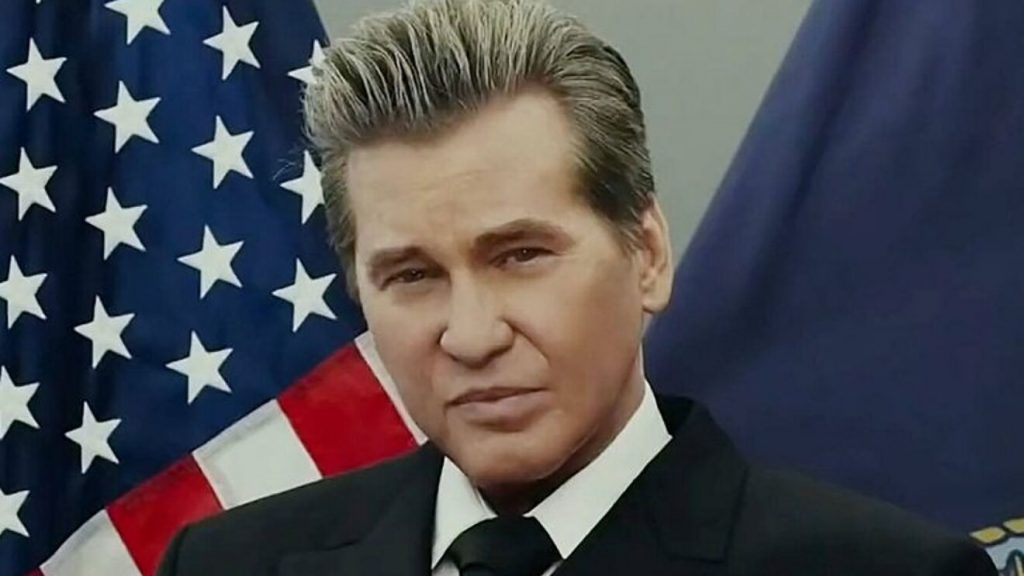
Admiral Tom “Iceman” Kazansky (Val Kilmer, truly impactful in his short screen-time) saves Maverick from being permanently grounded and requests his return to the Top Gun school in San Diego to train a new batch of aviators for a “New Hope”-esque bombing run against an unnamed foreign enemy.

The group, mostly simple characterizations, includes a badass woman pilot “Phoenix” (Monica Barbaro), a soft-spoken lad with the call sign “Bob” (Lewis Pullman), and a macho show-off named “Hangman” (Glen Powell), echoing a young “Iceman,” among others. Maverick is constantly watched over by Admiral Beau “Cyclone” Simpson (Jon Hamm), who’s none too pleased with Maverick’s unconventional methods. 

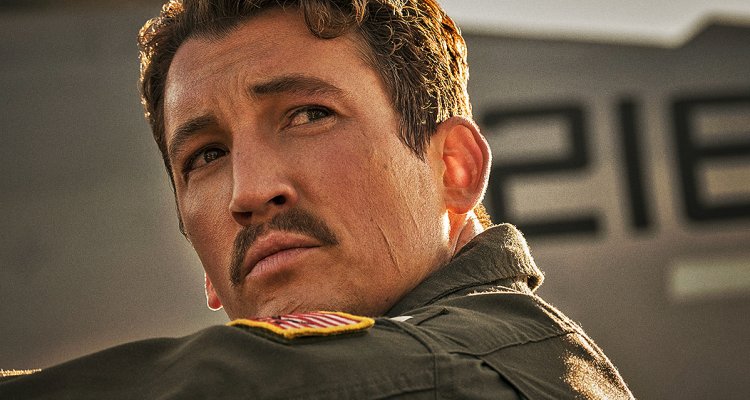
Miles Teller

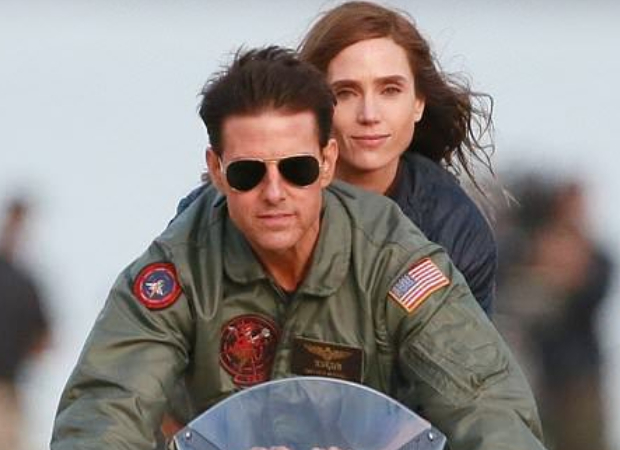
Crucially, however, Goose’s son, “Rooster” (Miles Teller, with a mustache channeling Goose’s), joins the team, carrying palpable resentment towards Maverick, whom he deems responsible for his father’s untimely demise. Maverick reunites with a long-ago lover, the beautiful Penny (Jennifer Connelly) — with nary a mention of Kelly McGillis’s Charlie — and gradually begins to recognize the appeal of leading a more “normal” existence. Tensions are high, the stakes are real, and Maverick must confront the ghosts of his past to make it out alive and reach some semblance of inner peace before he signs off for good.

Quite unexpectedly, there’s far more thematic meat to chew in “Top Gun: Maverick” than viewers might expect. But those looking for a pure shot of cinematic adrenaline won’t be disappointed either. Kosinski achieves a near-perfect balance between tongue-in-cheek popcorn thrills, nostalgic callbacks, and deeper nuance — extending beyond Maverick to comment on Cruise’s own acting career, as well the state of big-budget filmmaking today.

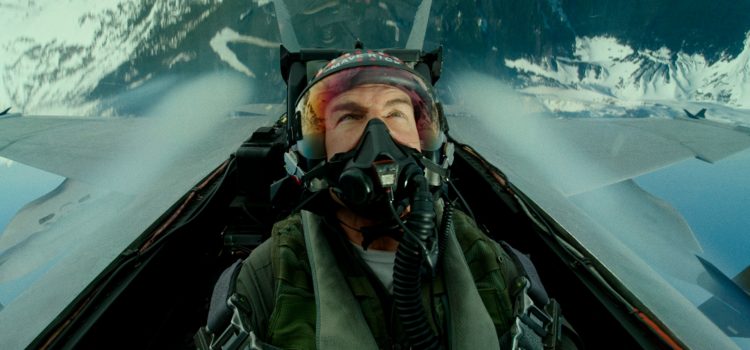
“Top Gun: Maverick” features one of Cruise’s all-time best performances, capturing both the character’s courageousness and newfound fearfulness at his position in the world and with the treacherous mission he’s preparing to guide. The way he carries himself throughout his old hunting grounds lacks the upbeat bounce it used to — replaced by an awareness of his own age and mortality, the sense that this once-invincible daredevil can’t be around forever. Indeed, neither can Cruise as an actor: one of the last movie stars who literally risks his life for our enjoyment.

His conversations with Penny and Iceman, especially the latter, reveal a vulnerable soul unable to forgive himself and fully accept the passage of time — an unexpected narrative choice for a character originally drenched in macho masculinity. He’s still charming and capable of copious one-liners, but the added depth is much welcomed.

Val Kilmer as Admiral Thomas “Iceman” Kazansky

Maverick’s conflict with Rooster also hangs over the film, as Maverick deeply fears losing him to the same fate as his father. Teller’s performance conveys Rooster’s stubbornness, contempt, and own self-doubt. His arc, while predictable, hits home with force in the film’s absolutely electrifying final act.

Speaking of which, “Top Gun: Maverick” features some of the most mind-blowing set-pieces I’ve ever witnessed. Reportedly filmed in real planes with minimal VFX, cinematographer Claudio Miranda puts viewers right in the cockpit with the pilots, immersing us into all the high-flying maneuvers to staggering effect.

At one point, as Cruise flies straight upwards, we practically feel the G-forces along with him, our ears bombarded by thunderous engines. I cannot overstate just how incredible these sequences are, and how impressive it is that they’re filmed coherently. Whether or not stunt work like this can ever be recreated again — if we ever get away from CGI-infested superhero flicks — the craziness on display makes “Top Gun: Maverick” a spectacle that must be viewed on the big screen, preferably in IMAX. Similarly, the score by Lorne Balfe, Harold Faltermeyer, Hans Zimmer, and Lady Gaga deserves to be blared as loudly as possible.

Yes, Kosinski’s film certainly has its cheesy, soap-opera-esque flourishes — it is a sequel to “Top Gun” after all — and the film’s militarism remains blatant, albeit neutered this time around. Where things wrap up isn’t exactly surprising, and the sweaty, crimson-hued world seems (intentionally) separated from gritty reality.

Regardless, this is a pure, balls-to-the-wall action film that contains thought-provoking undercurrents beneath its crowd-pleasing sheen. It’s an experience that I’ll be revisiting frequently and one that reminds me of the power of the summer blockbuster.

“Top Gun: Maverick” is a 2022 action-adventure directed by Joseph Kosinski and starring Tom Cruise, Miles Teller, Jennifer Connelly, Jon Hamm, Ed Harris, Glen Powell, Lewis Pullman, Monica Barbero and Val Kilmer. It is rated PG-13 for sequences of intense action, and some strong language, and runs 2 hours, 10 minutes. The movie was released in theaters and IMAX on May 27. Alex’s Grade: A-.