By Lynn Venhaus
With its pitch-black tale of love, murder, revenge and obsession, Stephen Sondheim’s singular “Sweeney Todd: The Demon Barber of Fleet Street” remains an ambitious, wildly popular musical that is a challenge to produce and even harder to satisfy high expectations, no matter whether the interpretation is traditional or innovative.
Such is Sondheim’s reputation as the most important figure in 20th century musical theater and the macabre masterpiece’s passionate fan base around the globe. For Sondheim enthusiasts, any opportunity to hear that majestic score is welcome – that is why it’s often adapted into a concert presentation or an opera.
For their second official foray into Sondheim’s daunting catalogue – after their award-winning and critically acclaimed “Assassins” in 2022 at the .Zack, Fly North Theatricals presents a thoughtfully staged and deeply committed 12-member cast for this demanding show.
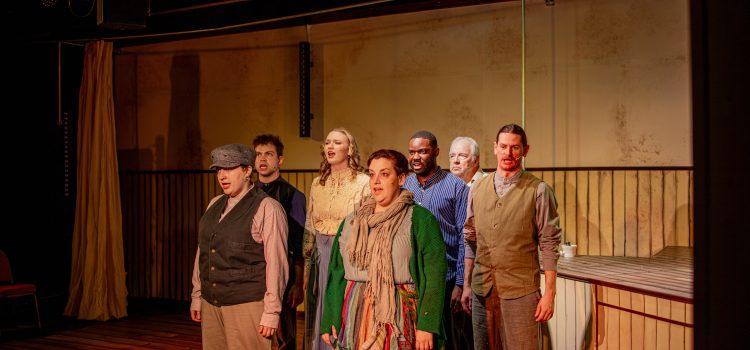
Attention must be paid as the ensemble raises firm, emphatic voices to grab hold in the opening “The Ballad of Sweeney Todd: ‘Attend the Tale of Sweeney Todd” and stresses the dramatic stakes in the reprises, acting like a Greek chorus.
Parker Miller, principal bass; Margaret Beekman, principal soprano; Mia Millican, principal alto; and Nathan Hakenewerth, Matt Ingram, Dereis Lambert, Crispin Shininger, Rachel Bailey, and Isobel Ramsey robustly raise their voices in unison.
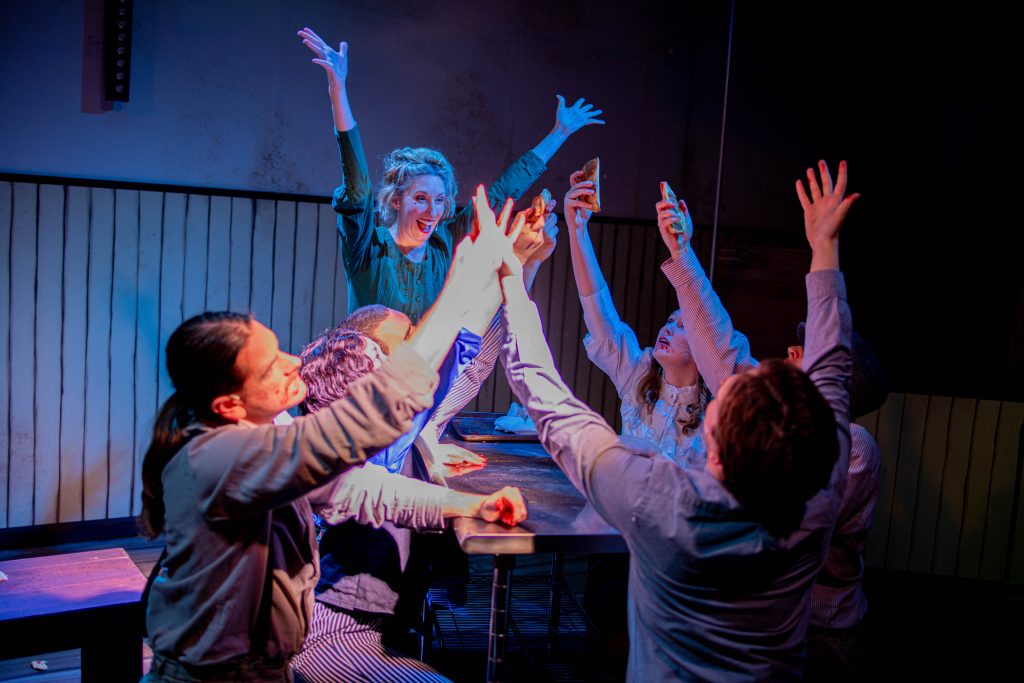
They roar with energy in “God, That’s Good!” and are the mighty backbone of this grand, grim musical that is about 80% music.
Director Colin Healy has been strongly influenced by Sondheim throughout his career – and has a mural painting of Steve on the wall of the Greenfinch Theater & Dive Bar that he co-owns with technical wizard Bradley Rohlf, so his understanding of the material is never in doubt.
(Fun Fact: The bar is even named after one of Sondheim’s songs (“Green Finch and Linnet Bird”).
Healy dives into this monumental work with the intense drive of Hal Prince and the minimalistic eye of John Doyle, two legendary interpreters of Sondheim’s shows. (Prince directed the original mammoth 1979 Tony-winning Broadway show while Doyle reimagined an austere asylum-set 2005 revival).
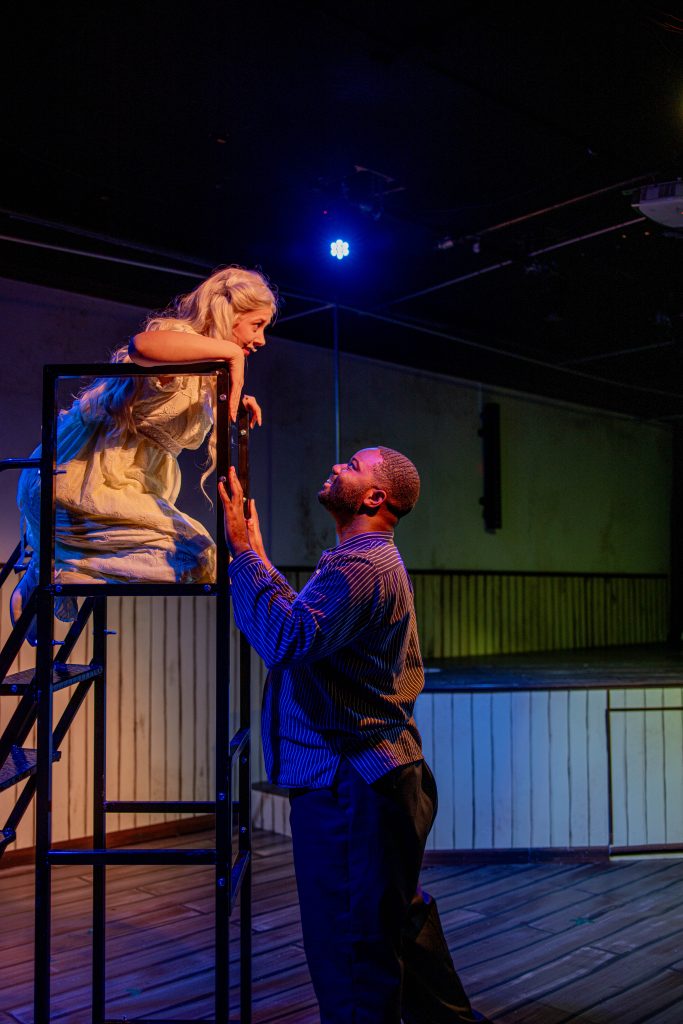
To create an intimate production in the cozy confines of the Greenfinch theater space, Healy focused on the character-driven narrative, stripping it down to a few immersive set pieces and counting on the audience’s imagination. The 19th century Victorian London setting is more of a suggestion, which is fine.
Clever lighting co-designed by Healy and Lauren Perry and nimble stagehands/cast led by stage manager Dizzy Funke help create a foreboding atmosphere. Rohlf lends his considerable skills as technical director.
Fly North’s resourcefulness with a tiny budget is laudable. And the efficient staging of the murders and body disposal benefits from everyone’s dedicated timing. Now, fresh ‘blood’ is splattered on some audience members, but those sitting at other angles don’t get that special effect, nor do they see it.
The heart-rending book by Hugh Wheeler, Tony winner for this, “A Little Night Music” and “Candide,” shocks and awes – blending terrifying psychological horror with deliciously wicked flickers of humor, some of it campy, while the music chills and thrills.
The disturbing gothic narrative was adapted from Christopher Bond’s 1970 play “Sweeney Todd,” which featured motivation for the barber’s lurid crimes. He imagined Todd as the victim of a corrupt, lecherous judge, who exiled him to a penal colony in Australia and ravaged his wife.
Bond had used a 1847 ‘penny dreadful’ (popular Victorian pulp fiction) – “The String of Pearls,” which sensationalized the demon barber of Fleet Street as a killer who baked his victims into meat pies.
Sondheim’s music made it feel larger in scope, and Prince decided the downside of the Industrial Revolution was that it turned out soulless, defeated, and hopeless people. That outlook, combined with Sondheim’s flair for emotional depth — nobody could tinge lyrics with melancholy, regret, and revulsion quite like he could.
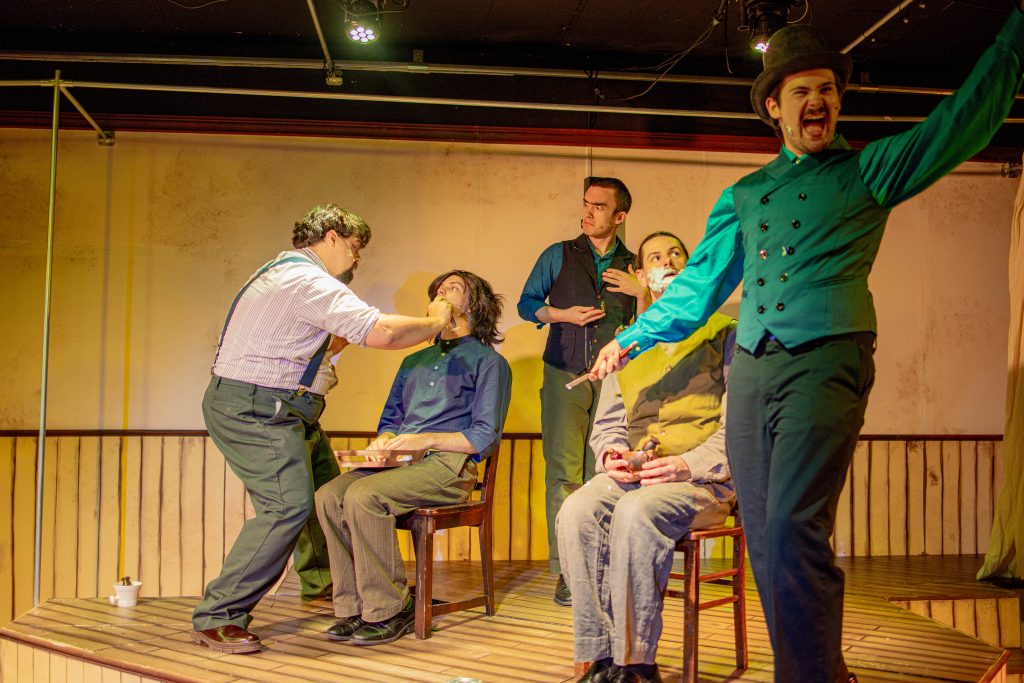
Because Healy is such a Sondheim zealot, the ensemble’s enunciation was commendable on the razor-sharp lyrics and rhythmically complex songs. He isn’t the music director for this show, his usual role, but he and music director Stephen Schermitzler created the sound. Greenfinch’s orchestra pit is in the basement.
Chandler Spradling appears as an imposing anti-hero as Todd, a man pushed into nefarious deeds because of his life’s circumstances, thwarted by depraved men. He has a strong bass-baritone on such numbers as the battle cry “Epiphany” and chilling “My Friends.”
He and Lambert establish their relationship with the hopeful “No Place Like London,” and he shares his piteous tale “The Barber and His Wife.” Todd sets his diabolical plan in motion.
He meets a chatty Mrs. Lovett at her failing pie shop and opens a barber practice located above. Their meeting of the minds results in a thrifty use of a ghastly ingredient that makes her meat pies so tasty.
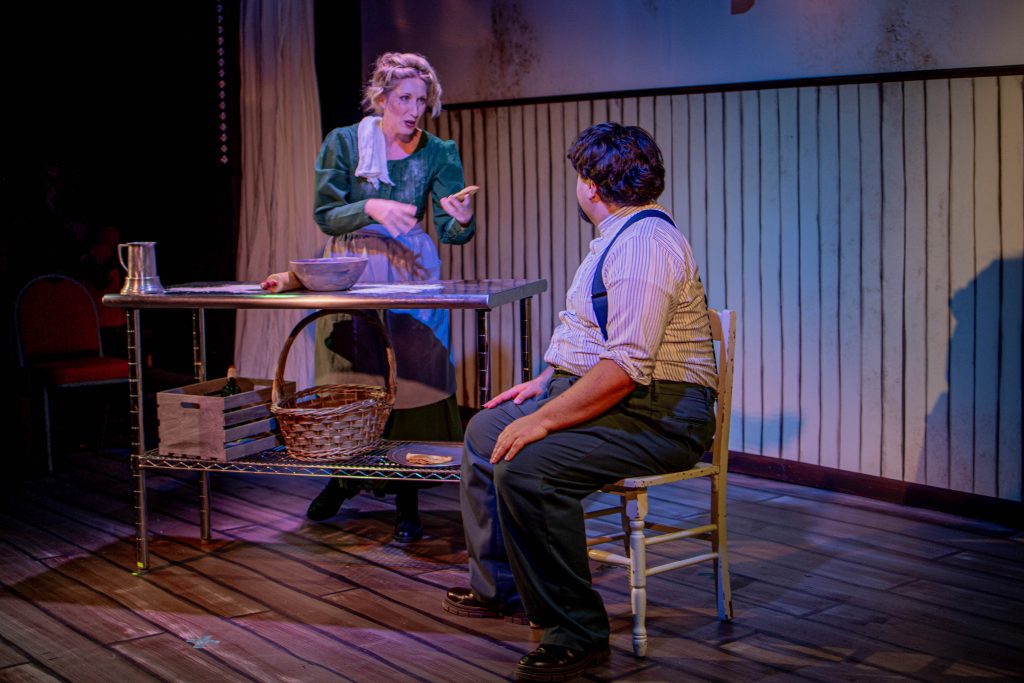
Multi-faceted Jennelle Gilreath Owens is everything one can expect in an earthy Mrs. Lovett – she engages immediately in her “The Worst Pies in London,” showing off her finely attuned comedic skills and superb timing, not to mention an impeccable Cockney accent. She’s more ditzy than blowzy, more Lucille Ball than Ethel Merman.
Owens has always been a gem on local stages and shines in this iconic role. (At Stray Dog Theatre, she was a fierce Witch in Sondheim’s “Into the Woods”). She excelled at the patter song “A Little Priest” and was wistful in the duet “By the Sea.”
Perhaps the taxing nature of the intricate rhymes and complex musicality of the score was so arduous that some character development was lacking – because there should be more to some of these roles than broad strokes.
Spradling displayed the anguish, reinforced by a hollow gaze, but was less convincing as he descended into madness. Todd’s all-consuming grief and simmering rage must be palpable. His twisted partnership worked with Mrs. Lovett – until it tragically doesn’t. That downfall in the devastating second act felt a tad rushed – we should feel the sorrow.
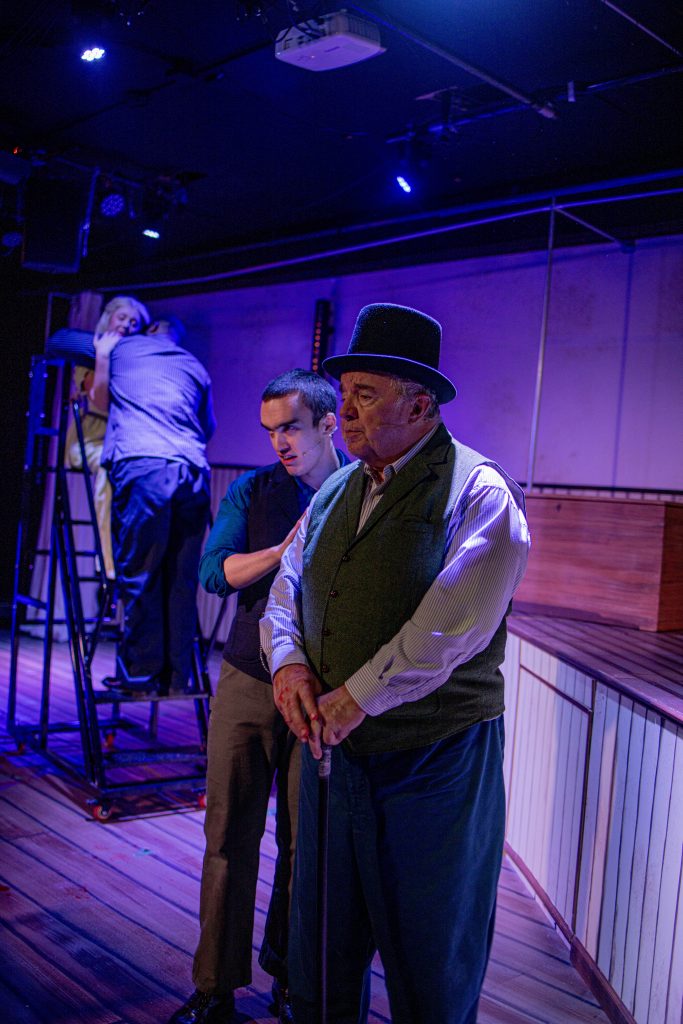
Haller wasn’t a cruel Judge Turpin but rather a self-righteous, controlling authority figure where his possessive nature turns creepy when he lashes himself over his desires about his young ward. He could have been nastier and more intentional because he’s duplicitous.
Most disappointing was “Pretty Women.” Had the vocal prowess and the psychological depth met the moment, the beautiful song would have been haunting and unnerving.
The star-crossed lovers, Anthony Hope and Johanna Barker, seem doomed, and for the audience, they can cheer on the couple, despite Johanna being imprisoned and forced to marry the Judge (so cringy). Dereis Lambert and Isobel Ramsey are youthful in their ardor and have a lot at stake here in their songs. Lambert’s immediately smitten in “Ah, Miss” and blends romantic yearning in “Johanna.”
For the most part, Healy avoided cartoonish evil when things all start going sideways, and that meat grinder gets a workout. But pile on the menace! With the help of white curtains, shadows and light, they make the ominous asylum scene work, and the chaos grows in a wobbly “City on Fire!”
Matt Ingram as Beadle Bamford and Crispin Shininger as Tobias Ragg were compelling as these integral characters. Ingram, with a bold, strong voice and credible dialect, had to straddle the fine lines of pomposity with politeness, cruelty with complicities and his own sense of self-importance and broad humor. Ingram did so admirably, particularly in “Parlor Songs.” Nobody mourned his fate.
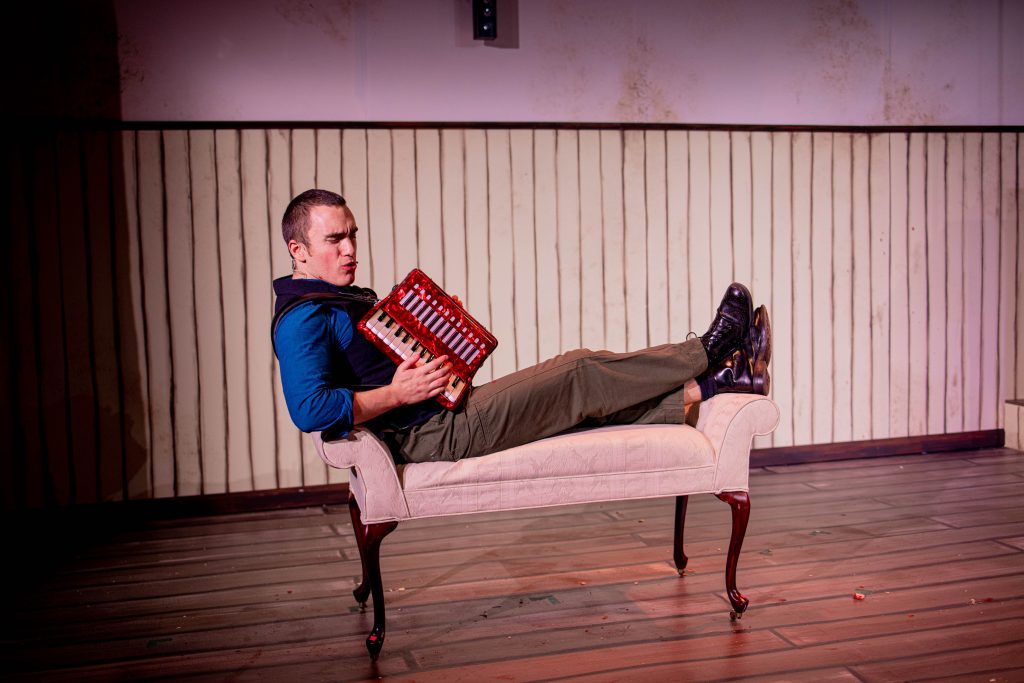
However, the naïve Tobias must transition from comic relief to tragic figure, starting out as loyal assistant to the charlatan Pirelli then becoming protective of Mrs. Lovett as a maternal figure.
Shininger is heart-breaking in one of the show’s best songs, “Not While I’m Around,” and his inevitable mental breakdown. His trauma was believable, after he figures out Todd and Mrs. Lovett are murderers, but the blocking could have been more decisive.
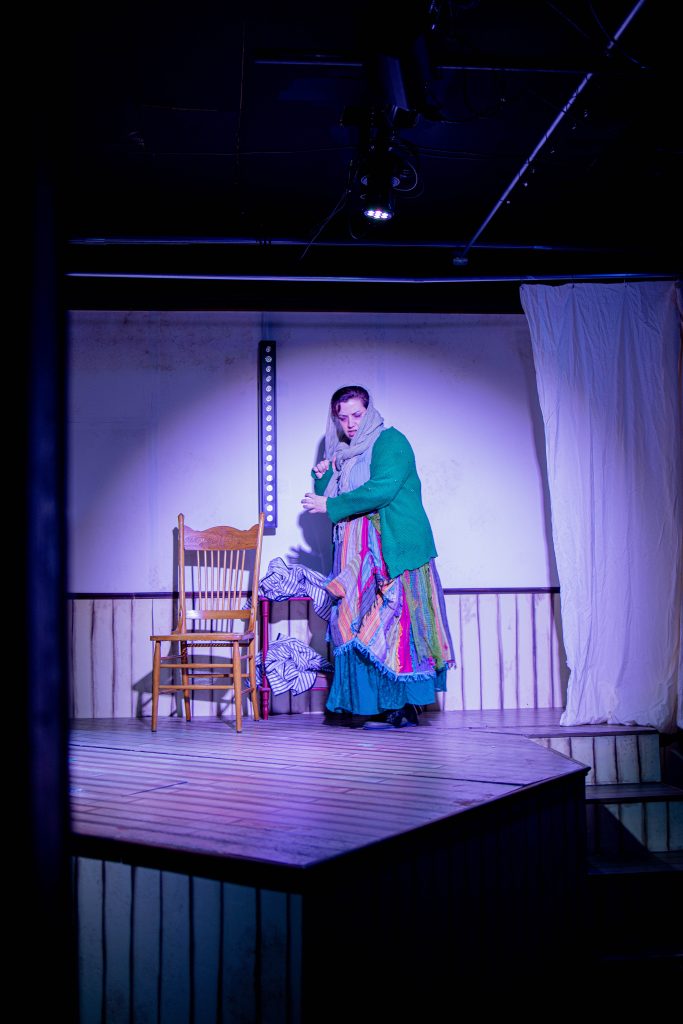
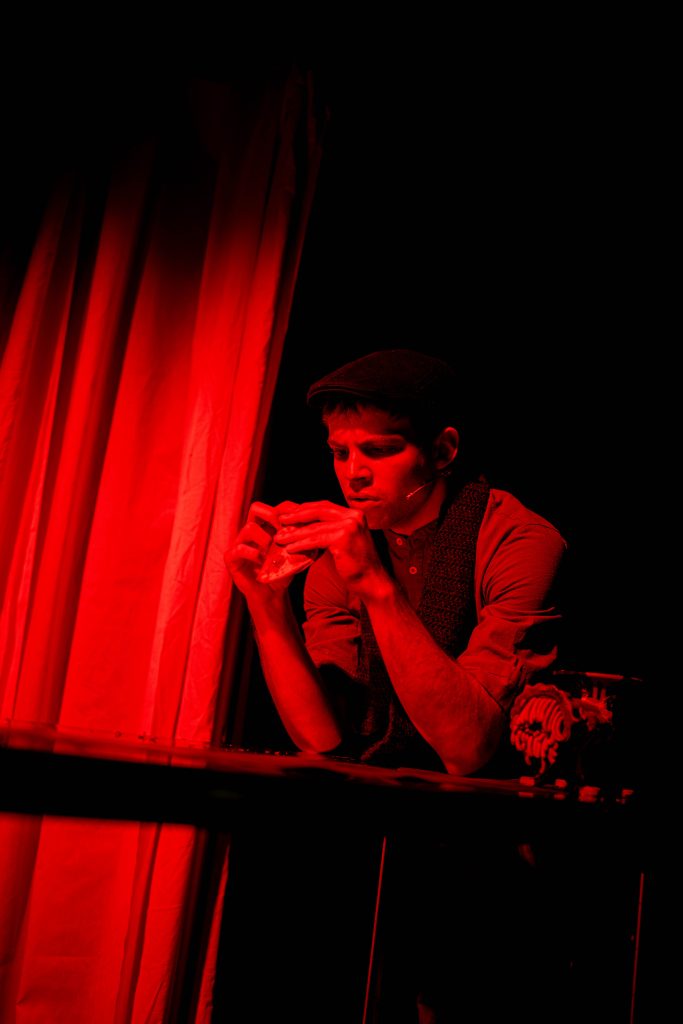
Ever reliable Rachel Bailey is persuasive as a mysterious Beggar Woman, and her “Beggar Woman’s Lullaby” regrettably seals her fate.
Hakenewerth is effective as the fraudulent Pirelli who tries to blackmail Todd, which sets off the murder spree.
And sadly, the Demon Barber of Fleet Street must come to its inevitably tumultuous gut-wrenching finale. Whether you’ve watched Tim Burton’s 2007 Oscar-nominated film or can’t get enough of the 2023 Broadway revival album, “Sweeney Todd” has many intricate layers to discover and Fly North has taken us in their own unusual distinctive way to its dark side.
Fly North Theatricals presents “Sweeney Todd: The Demon Barber of Fleet Street” from July 17 to Aug. 9 at the Greenfinch Theater and Dive Bar, 2525 S. Jefferson Avenue. The show’s runtime is 2 hours, 30 minutes, with a 15-minute intermission. Content warning: this show contains mature themes, including murder and self-harm. For more information, visit www.flynorth.org
Full disclosure: My maternal grandmother and Matt Ingram’s maternal great-grandmother were sisters, therefore we are cousins.

Lynn (Zipfel) Venhaus has had a continuous byline in St. Louis metro region publications since 1978. She writes features and news for Belleville News-Democrat and contributes to St. Louis magazine and other publications.
She is a Rotten Tomatoes-approved film critic, currently reviews films for Webster-Kirkwood Times and KTRS Radio, covers entertainment for PopLifeSTL.com and co-hosts podcast PopLifeSTL.com…Presents.
She is a member of Critics Choice Association, where she serves on the women’s and marketing committees; Alliance of Women Film Journalists; and on the board of the St. Louis Film Critics Association. She is a founding and board member of the St. Louis Theater Circle.
She is retired from teaching journalism/media as an adjunct college instructor.