By Lynn Venhaus

A story of uncommon courage and grace while facing deeply rooted cruelty and oppression, “The Color Purple” is a momentous achievement for the Black Rep.

Through Celie’s harrowing emotional journey, a stunning Angela Wildflower leads a passionate ensemble who gives it all through the musical’s sorrows, love, pain and ultimately, triumph.

In a tour de force performance, Wildflower is the heart and soul of this deeply felt production, directed with considerable flair and impact by Daniel Bryant.

In the St. Louis Black Repertory Theatre’s premier that opened its landmark 50th season, the affection for the storytelling was palpable between the audience and the artists. The spirited cast’s voices soared, starting with powerhouse Anita Jackson and the other two ebullient Church Ladies Amber Rose and Olivia Neal with the opening.

The vibrant, roots-infused score includes gospel, jazz, ragtime, blues, and African beats, with songs by Brenda Russell, Allee Willis, and Stephen Bray that bring out the purpose and yearnings.
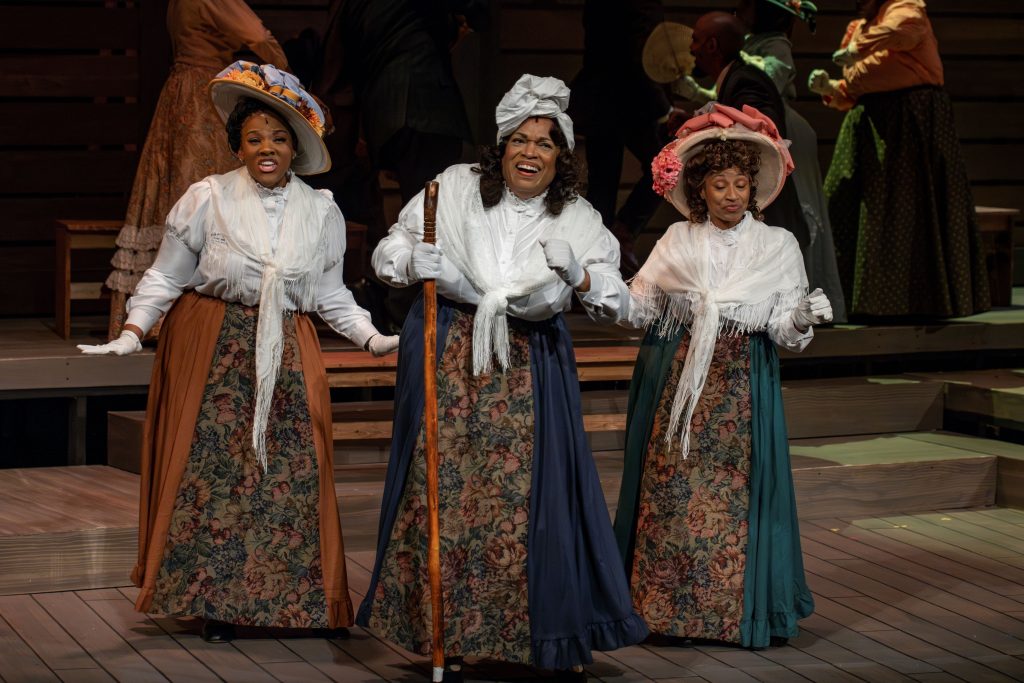
The Church Ladies Amber Rose, Anita Jackson, Olivia Neale. Photo by Arieona Phillips

In 1909, Celie, 14, is a humble, hard-working poor black girl living in rural Georgia, who has delivered two babies whose father is her father, and Pa (J. Samuel Davis) has taken them away.

Several years later, he makes a deal to give Celie to Albert “Mister” Johnson (sturdy Kelvin Roston Jr.), an emotionally and physically abusive widower and farmer, to care for his unruly children and serve him.

By her sacrifice, she spared her sister, Nettie (a tender Morgan Taylor), so that she could follow her dream of being a teacher. Unbeknownst to Celie, for many years, the compassionate Nettie winds up with a missionary family in Africa. When Morgan and Angela sing together, it’s magical, especially “Our Prayer.”

Celie has gone from one house of horror to another. But her faith sees her through, as do the people who raise her up. That community will return her kindness.
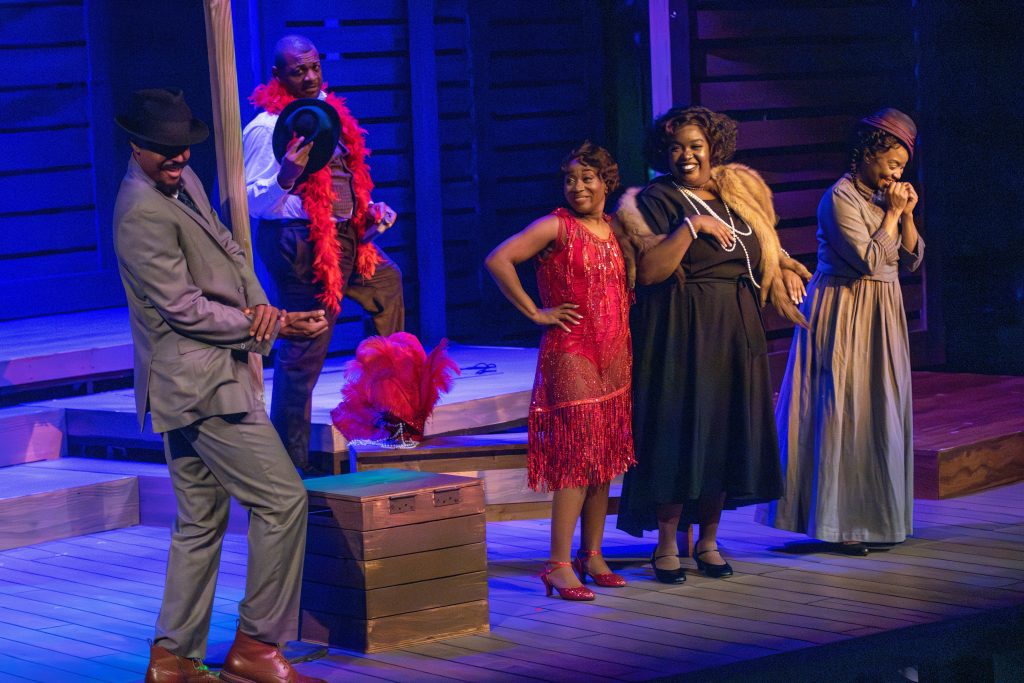
Push Da Button. Photo by Arieona Phillips

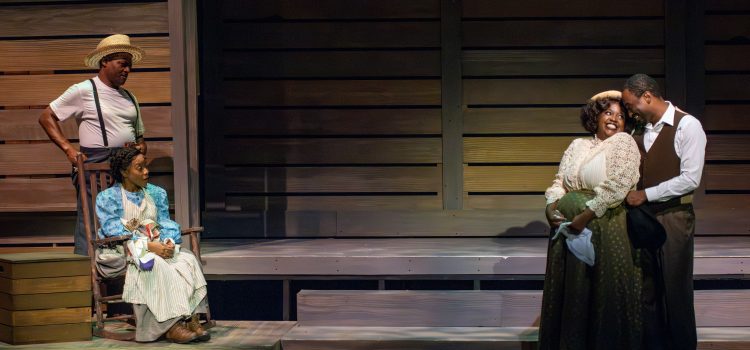
While taking care of Mister’s home, the nurturing Celie meets the glamorous and worldly nightclub chanteuse Shug Avery (dynamic Alexis J. Roston). They share romance and a deep bond.

Wearing a snazzy red outfit, Roston sashays with confidence in “Push Da Button” and she shines in “Too Beautiful for Words” and “What About Love?”

One of Mister’s grown children, Harpo (versatile Brian McKinley), marries Sofia (powerhouse Adrienne Spann). Spann, impressive in her Black Rep debut, is strong as the feisty free spirit, known for her independence and speaking her mind. She stands out with her phrase (and song) “Hell, no!”

Tyler White is comical as the irrepressible Squeak and Olajuwon Davis, Dajuan Davis and Samantha Madison are well-rounded, adaptable ensemble members.

Marsha Norman wrote this musical adaptation of Alice Walker’s Pulitzer Prize-winning touchstone novel, a National Book Award winner in 1982. It debuted on Broadway in 2005 and then was revived in 2015.
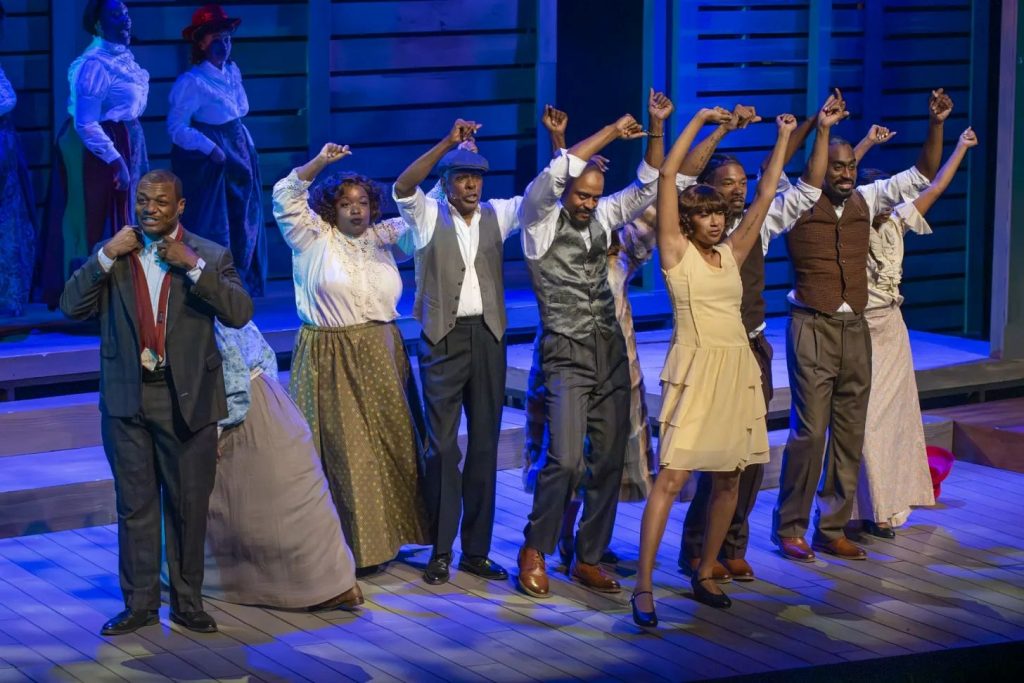
Photo by Arieona Phillips

In the two film adaptations, first in 1985 by Steven Spielberg, which garnered 11 Academy Award nominations, and then a 2023 musical version, they brought out the dignity and virtues of a trauma survivor.

Wildflower brought down the house with “I’m Here” – which was interrupted three times by applause, a goosebump moment.

With this stellar cast, the finale, reprising “The Color Purple,” is heartfelt and affecting, reminding us of the mighty power of love, healing and resilience.

The staging is simple and Heather Beal’s choreography is supple, well-suited for this nimble ensemble. They have fun with the juke joint dance – and ‘Uh Oh.” Special mention to fight choreographer Paul Steger. The energetic African dance number is an ideal way to open the second act.
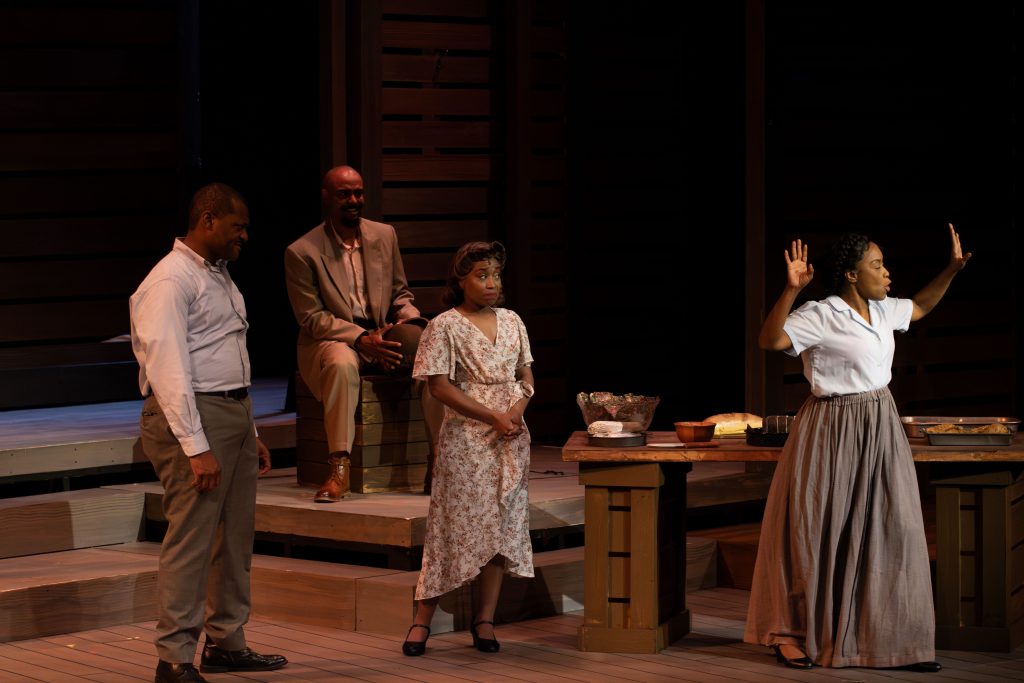
Photo by Arieona Phillips

Using cultural soundscapes beautifully, Music Director Jermaine Manor fluidly leads an eight-piece orchestra, with Zach Neumann on keyboards, Stan Coleman and Alex Macke on reeds, Dennis Brock on guitar, Willem von Hombracht on bass, Des Jones on drums, Gerald “Babtunde” Williams on percussion, and Manor on keyboards, too.

Resourceful scenic designer Tim Jones’ flexible scenic design uses an ancestral tree as a backdrop focal point, with nods to 20 Century South and Africa, and lighting designer Michael Sullivan created atmospheric notes, as did Justin Schmitz’ sound design. Mikhail Lynn did his customary excellent work on props.

With a story spanning 40 years, costume designer Jarrod Barnes’s stylish vintage wear reflects the periods and the economic level of the characters, with Sunday best church clothes and fancier juke joint attire. Nettie’s gorgeous white Victorian dress rivals Shug’s dazzling pieces, and all the trousers are fun for “In Miss Celie’s Pants.”

African Dance. Photo by Arieona Phillips

Of note, purple symbolizes strength, transformation, power, wisdom, bravery — and all meanings can be applied here.

What is most personal is also the most universal, and it shows in The Black Rep’s expertly produced, very moving musical.

The Black Rep presents “The Color Purple” Sept. 9 – 27 at The Edison Theatre at Washington University in St. Louis. For tickets, visit The Black Rep’s website, www.theblackrep.org.
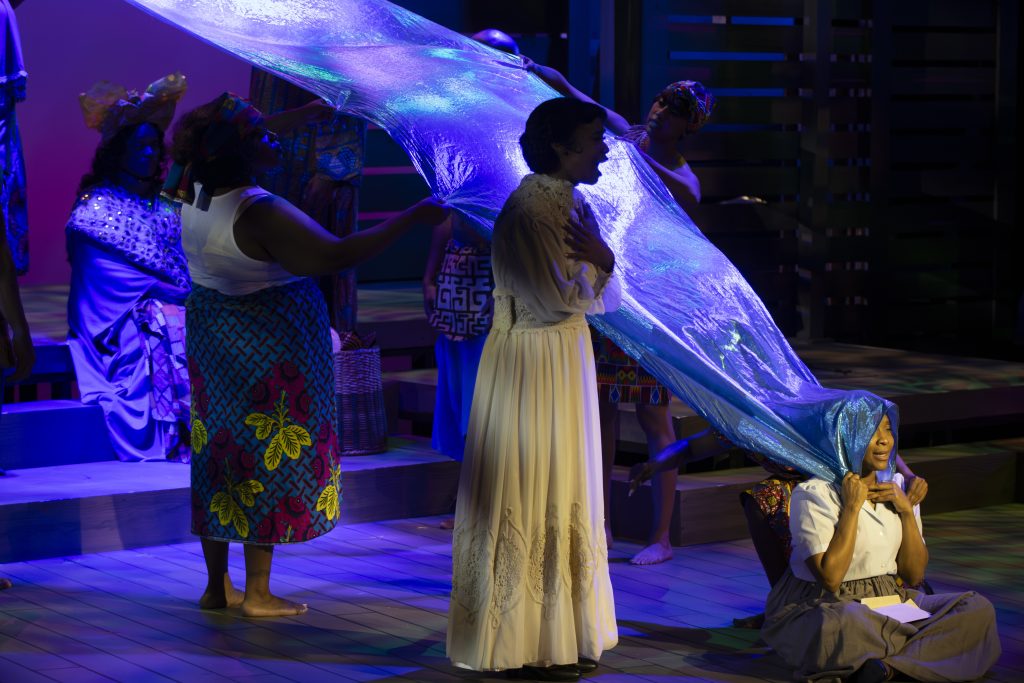

Photo by Arieona Phillips

By Lynn Venhaus

In the warm glow of the cozy March parlor, a singular author wins us over with her exuberant family portrait while a modern playwright interprets the timeless work “Little Women” by sharing these relatable lives less ordinary.

Together, this exceptional ensemble of women depicts how love makes the poorest soul thrive, how dreams fuel ambitions, how comforting sisterhood is, and that gumption matters at any age and era.

Louisa May Alcott coaxed generations of women to dream. No doubt playwright Lauren Gunderson was one of them. How their worlds intertwine has created a fascinating dynamic that feels both modern and sentimental, lively and lovely.

Alcott’s most famous work, published in two volumes in 1868 and 1869, was eventually combined in 1880, and ever since, “Little Women” has never been out of print.

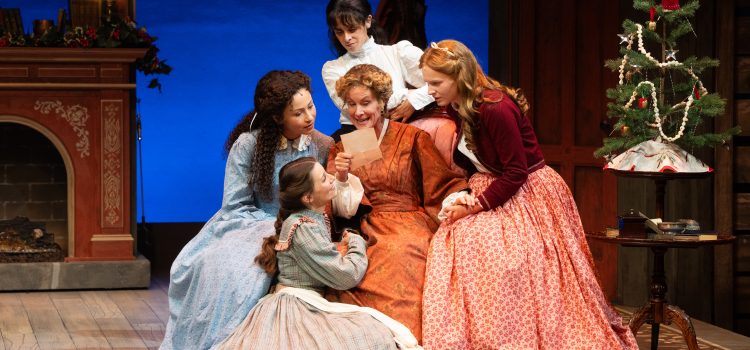
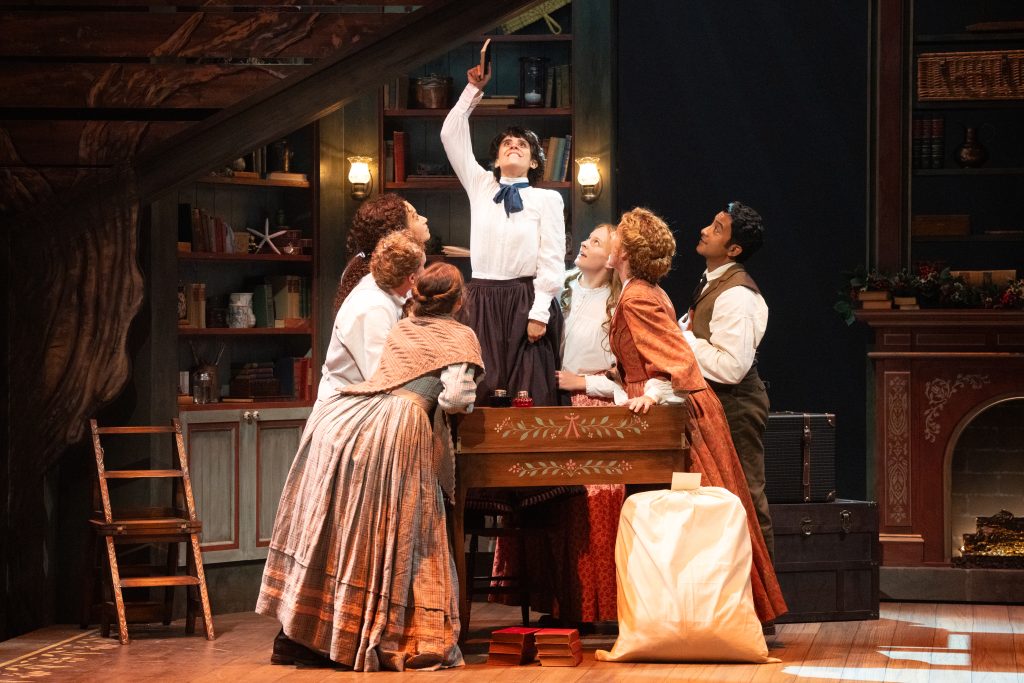
Addison Foote, Andrea San Miguel, Kristen Lindvedt, Marcia Pizzo and Amira Danan as the March women. Photo by Jon Gitchoff.

Gunderson, one of the world’s most produced playwrights, shares the same gift for honest writing that resonates. Through her fresh framing and frequent use of contemporary dialogue, the twin story unfolds, with dual roles of Lou and Jo played by the same actress. She also incorporated direct narration from Alcott’s writing, which adds authenticity.

In Civil War era Massachusetts, the fictional March family tends to the business of living while their father is away fighting for the Union Army. They endure traditional 19th century society struggles, especially financial – and love stories they refreshingly shape in their own way.

In 2024, director Delaney Piggins saw Gunderson’s adaptation during its rolling world premiere at the Northlight Theatre in Chicago, participating with three other theater companies. As associate artistic director, she lobbied for its inclusion in The Rep’s 60th season and is now making her triumphant directorial debut.

Her astute understanding of the characters and clever, inventive staging propels this charmer. Through her clear vision, she has gathered top-tier women creatives as designers — scenic designer Ann Beyersdorfer, costume designer Kotryna Hilko, lighting designer Paige Seber, and sound designer Amanda Werre. Choreographer Sam Gaitsch, intimacy director Frankie Ferrari, and dialect coach Lauren Roth all made noteworthy contributions, as did Paul Steger as fight director and Will Vicari as wig designer.

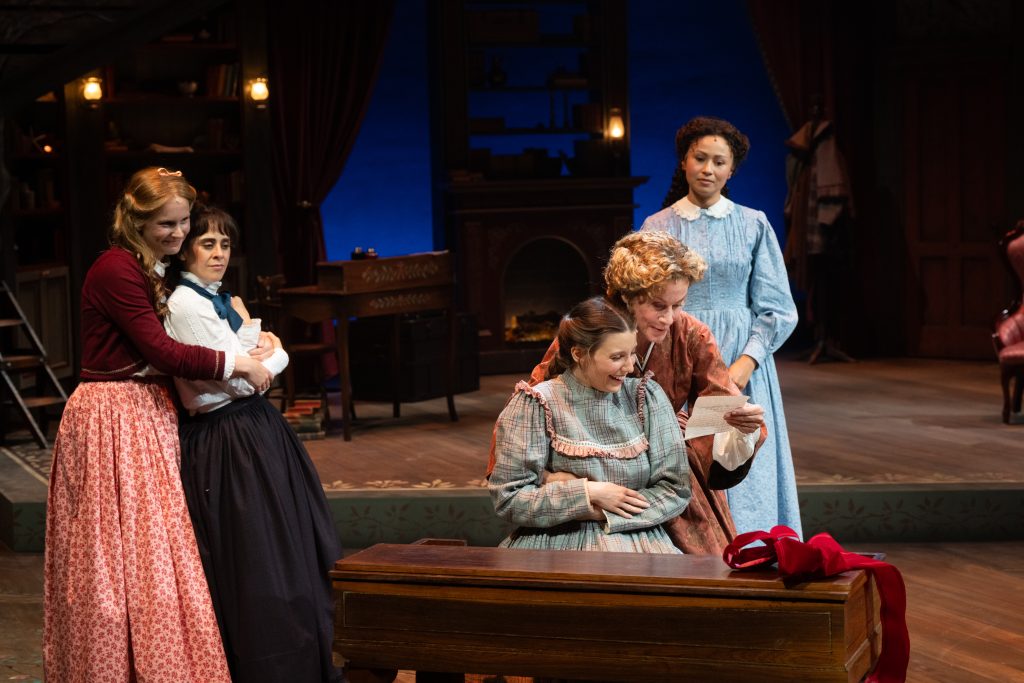
Photo by Jon Gitchoff.

Piggins has assembled a strong quartet of lovable multi-faceted March sisters – Amira Danan as dutiful and devoted Meg, the oldest; Andrea San Miguel as fiercely independent Josephine “Jo”; Kristen Lindvedt as kind and gentle Elizabeth “Beth”; and Addison Foote as melodramatic and spoiled Amy, the youngest.

For those of us who grew up with a strong mother, Marmee rings true – and so does the passionate affection of the sisters and the memories they evoke.

Marcia Pizzo is a calm moral compass as the matriarch, guiding her girls about what’s important — especially self-respect and inner character. Warm and wise, she tells them she’d rather see them happy and poor instead of marrying only for money or social status.

She notices that Meg and Amy are more concerned with social status and luxury and tries to lower those expectations. She confides in Jo that she’s learned to control her temper instead of it controlling her.  

As the young women go after what they want, the big female energy on stage and in the audience was palpable – and glorious. The production’s rebel spirit reflected Jo’s empowering and enduring aspirations.

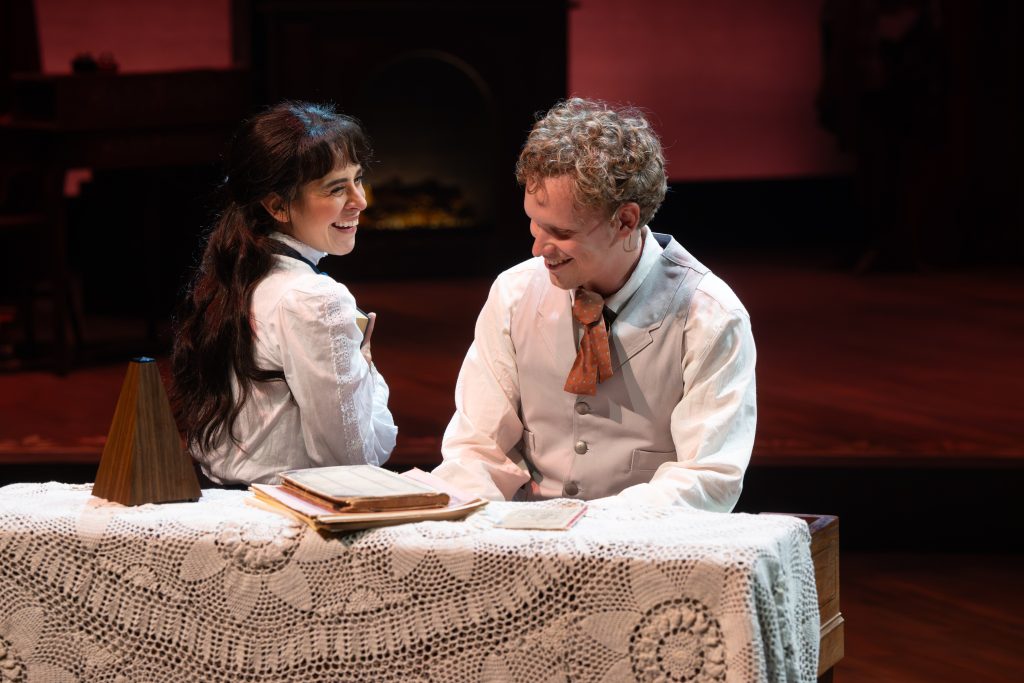
Andrea San Miguel and Jack Lancaster as Jo and Laurie. Photo by Jon Gitchoff.

Andrea San Miguel is a major force as feisty Jo, leaning into her tomboy side, sometimes with an over-emphasis on humor. She strongly interprets a confident Jo and stubborn Louisa. San Miguel, who won the St. Louis Theater Circle for Best Performance in a Comedy, Female or Non-Binary Role, for her masterful madcap mischief in “The Cottage” last year, displays the same ease with the robust performers here.

Amira Danan is a strong loyal and nurturing Meg, who ultimately marries for love over money. Kristen Lindvedt excellently embodies the shy peacemaker Beth, who provides such joy playing music for her family. Lindvedt, also the music supervisor, plays the stage piano.

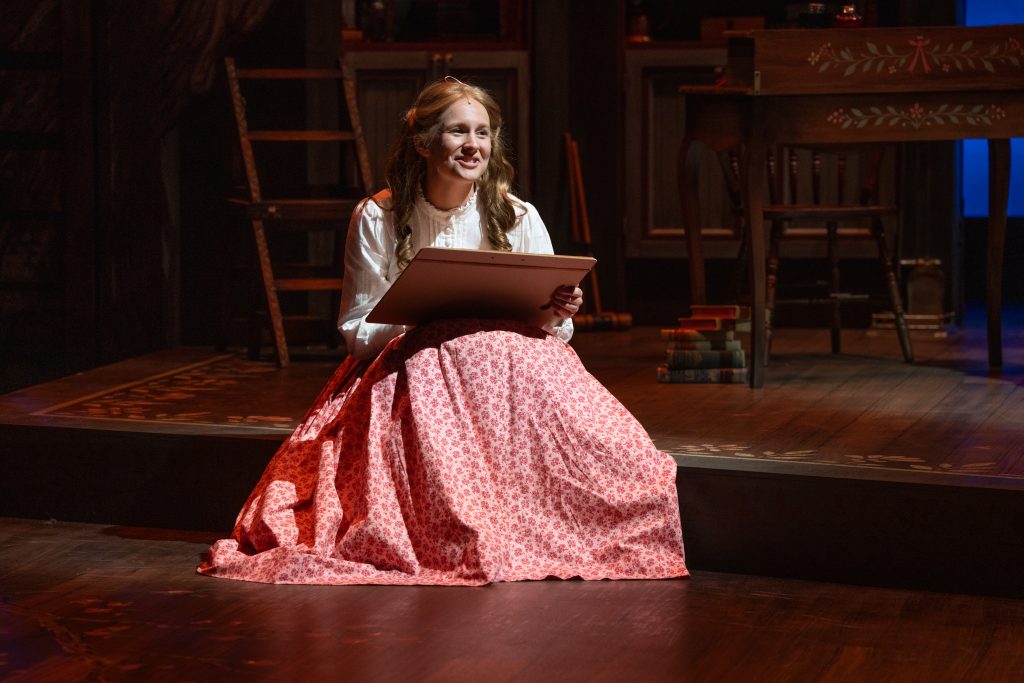
Addison Foote must grow the most as her character Amy, at first selfish and dramatic, but eventually becomes a worldly sophisticate who marries Laurie (Jack Lancaster), aka Theodore “Teddy” Laurence, their playful childhood pal now sensible adult.

The energetic Lancaster is ideally suited as Laurie, starting off as a lonely, sheltered rich boy next door who becomes a regular fun-loving fixture in the March sisters’ lives. As a confidante and best friends with Jo, he and San Miguel have an effortless chemistry together.

Addison Foote as Amy in “Little Women.” Photo by Jon Gitchoff.

They are such kindred spirits that when Laurie mistakes platonic compatibility for romantic feelings, Jo firmly rejects him, causing a rift. He flees to Europe, where he runs into Amy, who is studying art and painting while traveling with wealthy but cantankerous Aunt March (Marcia Pizzo in a dual role).

Eager for new horizons to fuel her literary ambitions, Jo travels to New York City, where she works as a governess and sells stories to publications. At her boarding house, she meets the kind and highly educated Professor Bhaer, who shares her passion for literature. He’s mature, respectful and hard-working. The spark is there; he and Jo will eventually share a wonderful life together, letting love in (“Little Men,” “Jo’s Boys”).

Adam Poss capably plays both Meg and Jo’s future good-guy husbands – earnest John Brooke and honorable Friedrich Bhaer. He’s first seen as Laurie’s tutor Mr. Brooke, who falls in love with Meg, then he enters late in the second act as the older German professor. He seamlessly transitions to each part and has a comfortable, steady presence on stage. He also briefly appears as the March patriarch.

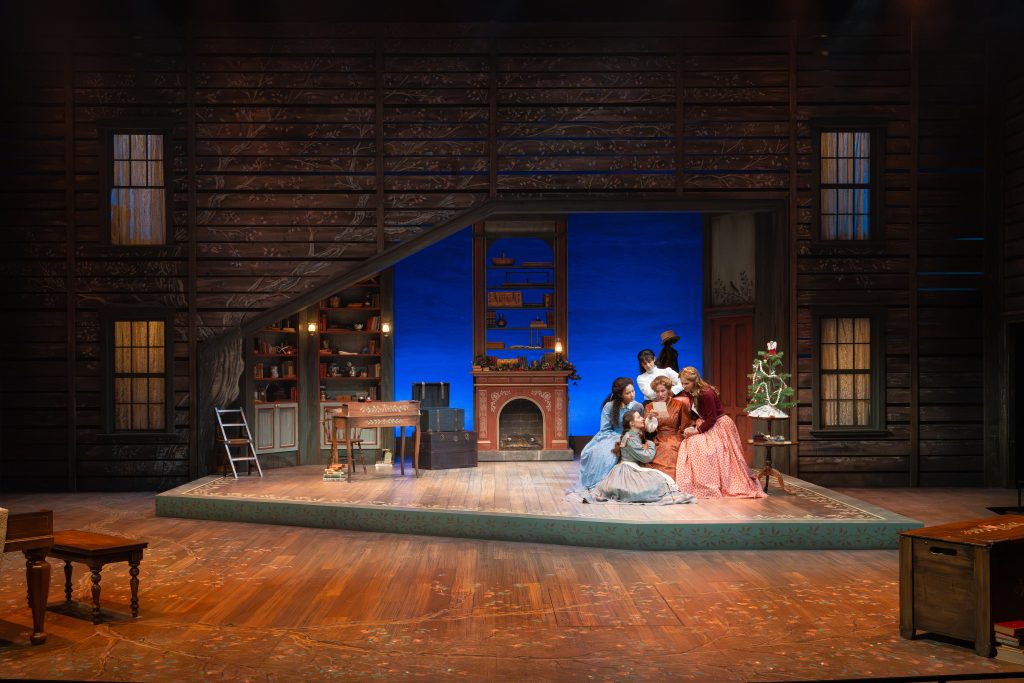
Piggins’ fluid direction easily moves characters through the home, which scenic designer Ann Beyersdorfer has filled with books, mementoes, functional furniture and a small piano for Beth. The modest, lived-in New England aesthetic includes an outdoor area – for playing on the ice, dancing, and conversations. A second-floor window indicates the Laurence home. Lighting designer Paige Seber has shifted moods and seasons with her lighting choices that complement the set.

“Little Women.” Photo by Jon Gitchoff.

The costumes that Kotryna Hilko designed not only fit the period and economic status of the characters, but don’t bog down the performers in their active scenes, flowing well in movement, even with shawls and coats. With a few changes in jackets, Poss becomes three different characters.

To be in a theater alive with an effusive audience who believes in the deep value of female independence and creativity was meaningful Friday, a feeling I have carried – well, re-ignited, since that night. Those female voices, once found, carry.

Infused with Gunderson’s vitality and showcasing appealing performers, the Rep’s “Little Women” demonstrated that Louisa May Alcott’s populist work is timeless, sisterhood is a necessary emotional component in our lives, and women seizing their own journey with gusto is reason enough to stand up and cheer loudly.

The Repertory Theatre of St. Louis presents “Little Women” from Sept. 9 to Sept. 27 on the mainstage Browning Theatre in the Loretto-Hilton Center on the Webster University campus. For more information on tickets, call the box office at 314-968-3925 or visit www.repstl.org. For ticket deals, be sure to check out: www.repstl.org/ways-to-save

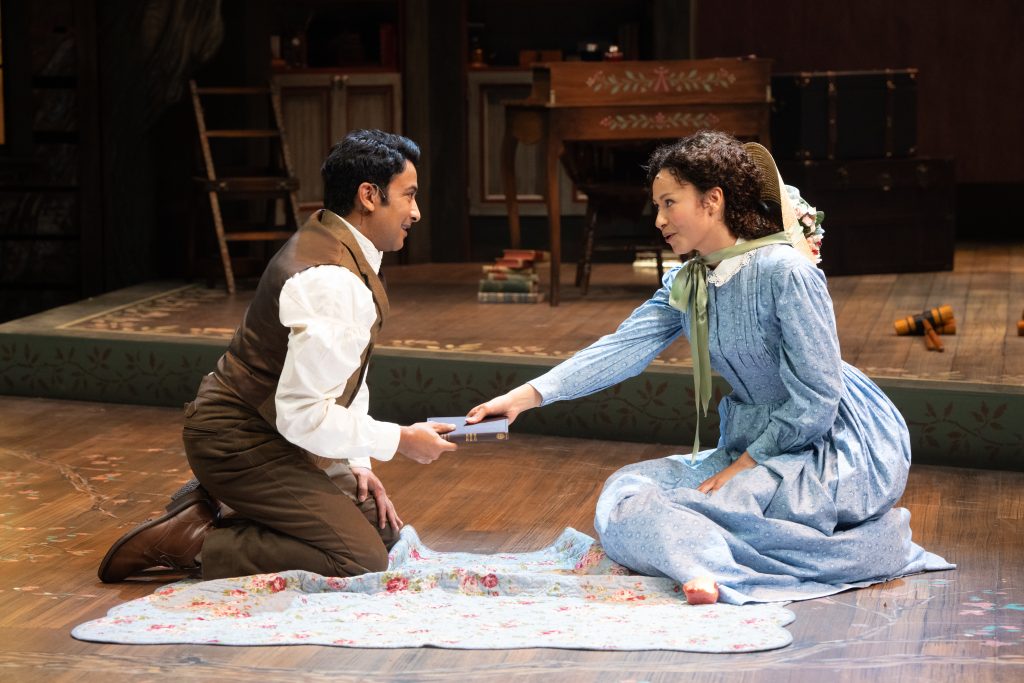
Adam Poss and Amira Danan as John and Meg. Photo by Jon Gitchoff.

By Lynn Venhaus

Sidesplitting hijinks ensue as a marital merry-go-round farce, “The Cottage,” spills the tea and twists a Noel Coward-esque comedy of manners for a female-forward finish.

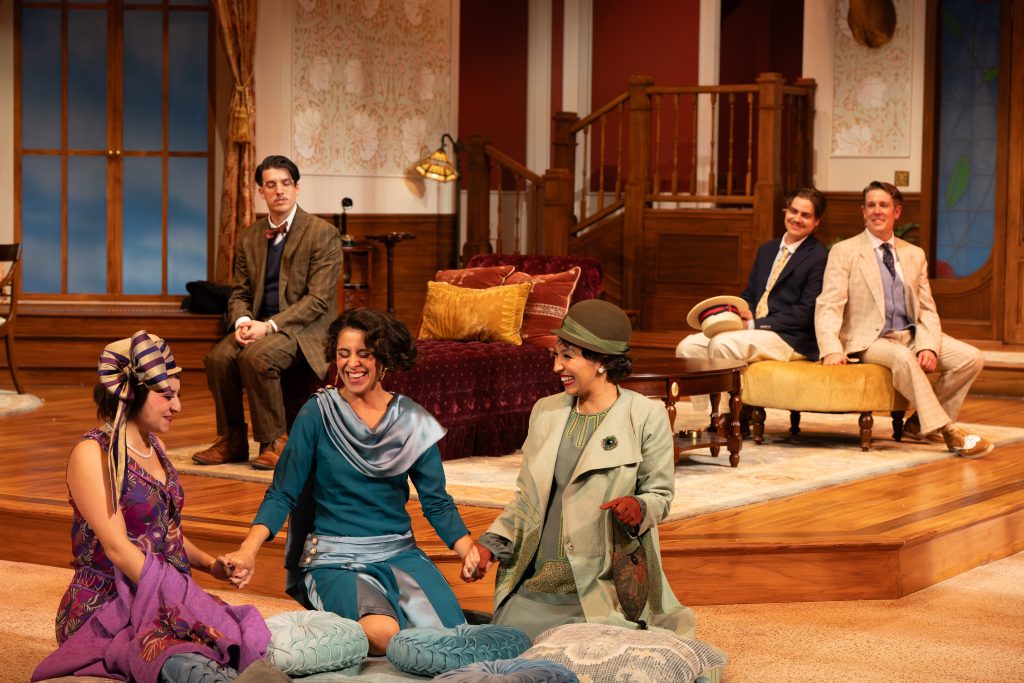
Now playing through Sept. 28 on the Repertory Theatre of St. Louis’ mainstage, a splendid sextet puts the roar in this Roaring Twenties romp as they gamely carry on in a sophisticated upper-crust British setting.

They deftly deliver standard King’s English dialect – all those ‘darlings,’ ‘indeeds’ and ‘rathers’ – in crisp witty, and a tad cynical, manner (special shout-out to dialect coach Lauren Roth).

Sandy Rustin’s jaunty play effectively depicts complicated relationships among polite society, and the cast’s Swiss-watch timing and nimble silliness combine for a sparkling collaboration that shows off their verbal and physical dexterity. Their flair for slapstick is impressive, as is their limber body language.

The company of “The Cottage.” Photo by Jon Gitchoff.

It all begins one sunny Monday morning in June 1923 at the Van Kipness matriarch’s tony countryside cottage, about 90 minutes outside of London. For seven years, Sylvia and Beau have enjoyed an annual tryst there.

Sylvia happens to be married to Beau’s stuffed-shirt brother Clarke. A hopeless romantic, she has impulsively told Clarke and Beau’s wife Marjorie of their affair so she can get her happily ever after.

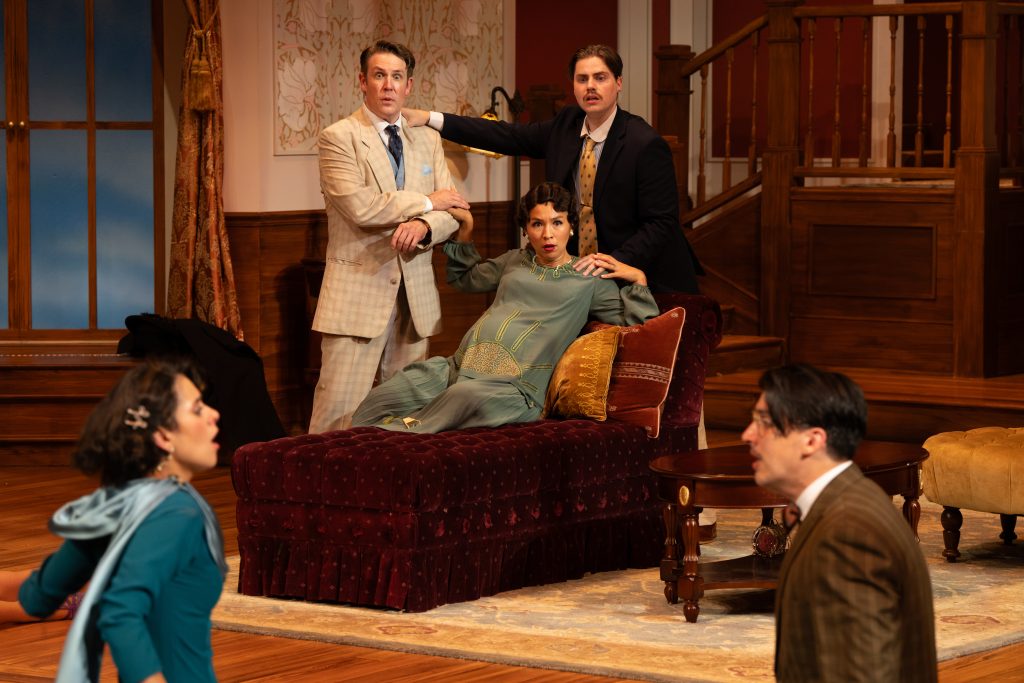
That sets off a chain reaction where shocking truths are revealed, more characters are introduced, and doors lead to unexpected entrances and exits. These denizens of the smart set find their private lives upended, along with their carefully cultivated identities.

With this fashionable group, let’s just say love and marriage don’t go together like a horse and carriage, and things are not what they seem. As Coward famously said: “It’s discouraging to think how many people are shocked by honesty and how few by deceit.”

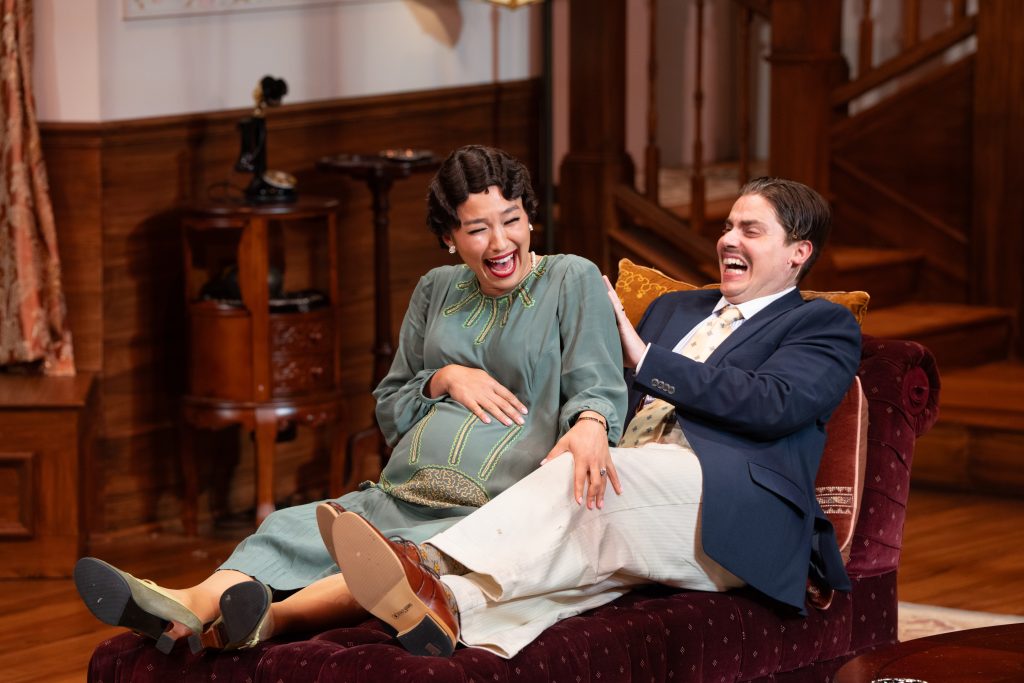
Jihan Haddad and Jack Dryden get frisky as Marjorie and Clarke. Photo by Jon Gitchoff.

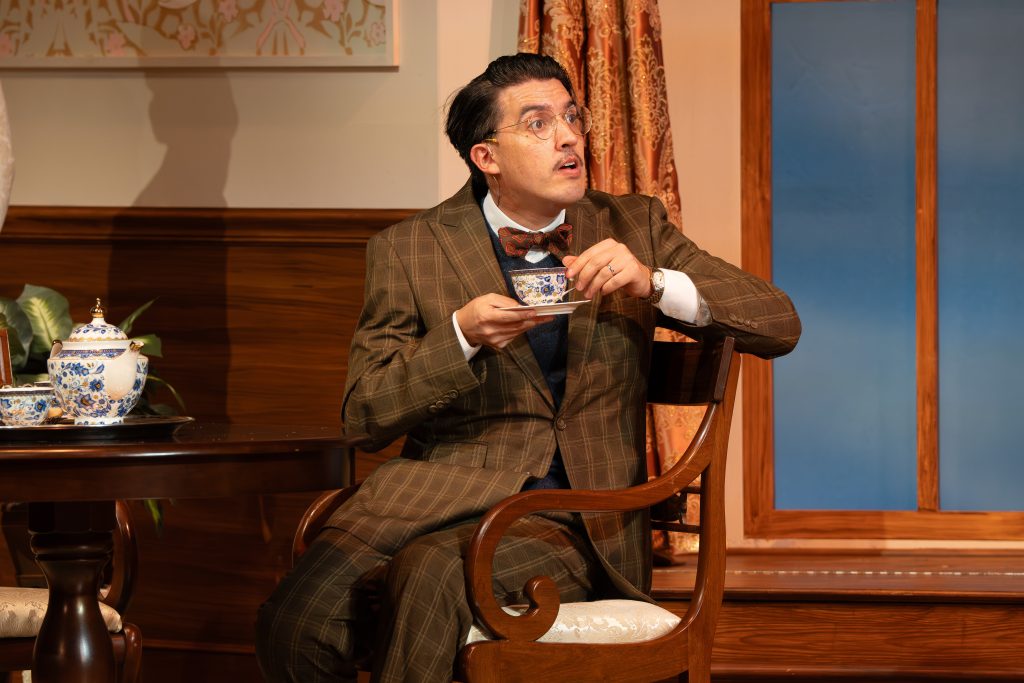
The remarkable ease with which this cast achieves synergy is a credit to the talents of Andrea San Miguel as the spirited and stylish Sylvia; Jordan Coughtry as the handsome but caddish Beau; Jihan Haddad as the ladylike Marjorie; St. Louis native Jack Dryden as buffoonish Clarke; Isa Venere as ditzy Dierdre; and Andres Enriquez as Richard, best described as a loose cannon.

Rustin, who wrote the hilarious play adaptation of the murder-mystery-comedy “Clue” based on the 1985 movie, is faithful to the British style of drawing-room comedies that skewered the manners and morals of high society – but only up to a point.

In a refreshing move, she has flipped the script on women only being in service to men in these throwback shows. You see the women emerge, speaking about their wants and desires, ultimately taking charge of their own lives.

It has more of a modern sense and sensibility – and most importantly, they get the last laugh. A charming live wire, San Miguel is the perfect embodiment for an awakening, a transformative journey for Sylvia, an intelligent woman stuck in stereotypes of the time.

However, besides her own stamp on Coward’s celebrated writing, Rustin injected the story with more than a month’s worth of soap opera confessions – and those juicy tidbits keep on coming. Must not forget Sam Matthews’ brief appearance as the gardener.

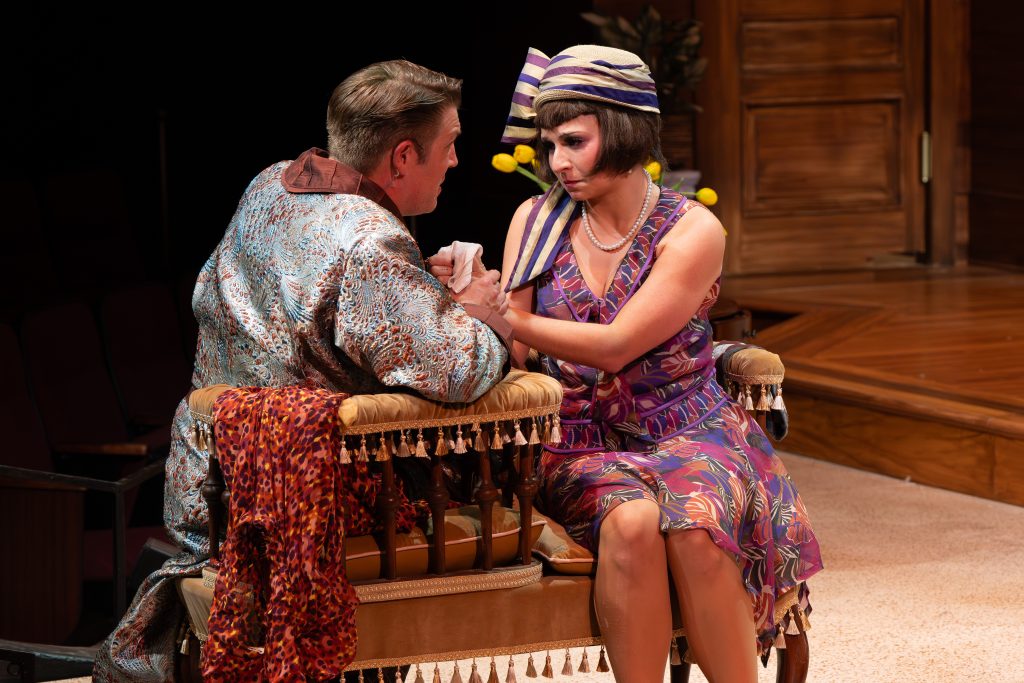
San Miguel and Coughtry as a passionate couple. Photo by Jon Gitchoff.

It’s best not to spoil more of the twisty turns the plot took as it unraveled, all at a swift pace. As details unfolded, anxiety ramped up, and rarely was anyone calm, cool and collected – all the better for zaniness.

Director Risa Brainin fluidly directed the chaos, making sure the action had a rhythm, and the well-cast ensemble maintained a pleasing tempo throughout. (Notable nod to casting director Delaney Piggins for assembling this finely tuned machine).

To emphasize their eccentric personalities, Brainin breezily blended them into the well-appointed set and ensured they each stood out when they were the focus.

One inspired segment involved Venere’s exaggerated acrobatic moves as an unconscious Dierdre is awkwardly handled by the others, reminiscent of classic Carol Burnett and Molly Shannon’s zesty physicality.

And this piggybacks on good-sport Haddad handling classy 8-months-pregnant Marjorie’s untimely gas-passing for more goofiness, which she managed with terrific finesse. (And loud guffaws and shrieks from the audience.)

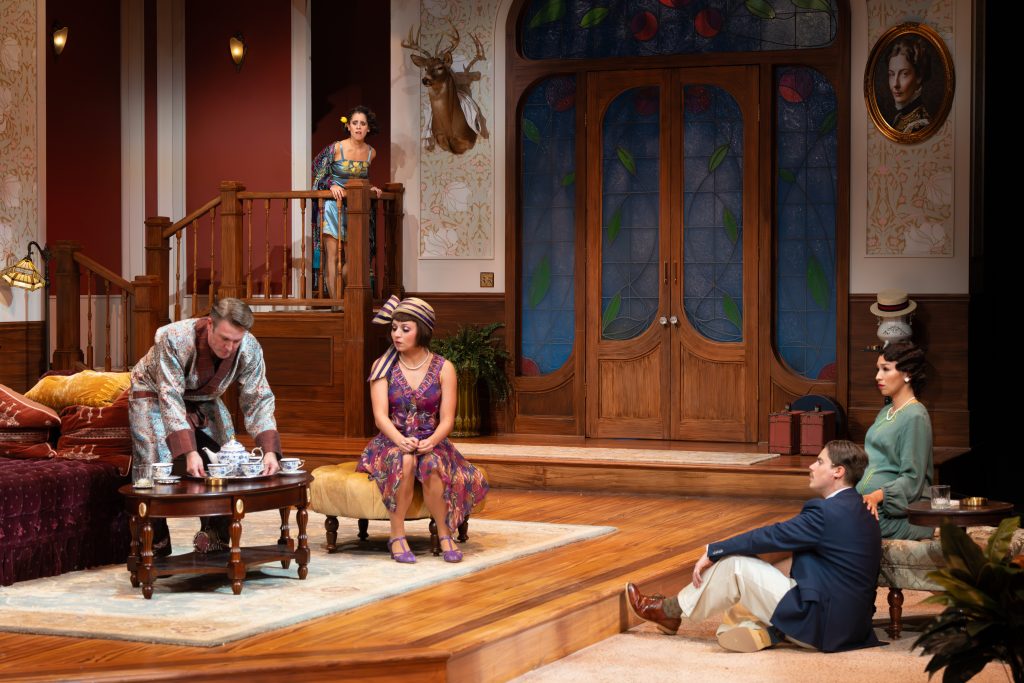
Coughtry, San Miguel, Verare, Dryden and Haddad. Photo by Jon Gitchoff.

Brainin and scenic designer Robert Mark Morgan, ever mindful of architectural harmony, worked out a floor plan for maximum effect, as characters moved back and forth from the kitchen, the stairs leading to the bedrooms, and the guest room that was offstage, for the main action is in the elegant drawing room.

A focal point is a grand-scale front door with faux stained glass to complement the luxurious setting. Morgan’s exquisitely detailed set is the bee’s knees with its bespoke touches. Michael Klaers’ lighting design illuminates the bright space, with special attention to spotlighting Mama Van Kipness’ stern portrait hung in a prominent place.

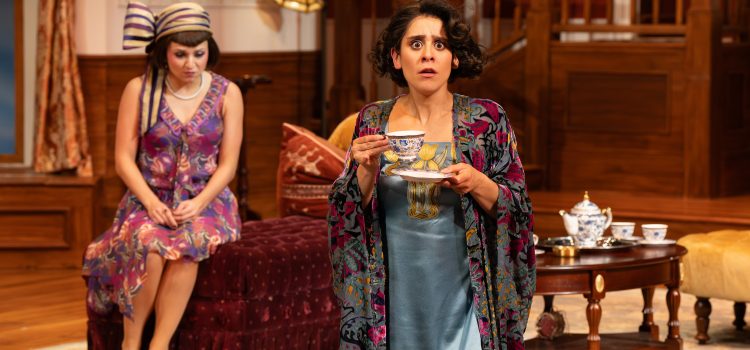
Renee Garcia’s posh period costume designs are the cat’s pajamas, with sumptuous fabrics, fancy bathrobes, chic graceful designs, flattering colors, and tasteful tailored menswear and overcoats.  

The wig and makeup design by Dennis Milam Bensie is attractive in vogue styles, well-suited to the characters.

Coughtry, Verare. Photo by Jon Gitchoff.

Amanda Werre’s exemplary sound design is a necessary mix of victrola music, shower sounds, a weapon discharge – and loud flatulence.

Noteworthy nods to fight director Paul Steger and intimacy director Jamie McKittrick, and to production stage manager Evangeline Rose Whitlock for their astute contributions

As delightful as the performers are and the production’s flawless execution, the running time could be shaved, at least 10 minutes in each act, so that Rustin’s points don’t seem as repetitive. It would help maintain the bubbly mood as the urbane story gets increasingly absurd.

The play is 2 hours, 15 minutes, including a 15-minute intermission.

Andres Enriquez as Richard. Photo by Jon Gitchoff.

First produced in 2013 before regional productions, the play had a 2023 debut on Broadway directed by Jason Alexander that starred Eric McCormack, Laura Bell Bundy, Alex Moffat, Lilli Cooper, Dana Steingold and Nehal Joshi in a limited engagement for 111 performances.

The current cast appeared to be having a blast, so it’s easy to imagine how difficult it was to not crack up and keep their composure on stage and during rehearsal, let alone acquire the fleet moves and effortlessly deliver acerbic dialogue in a highly theatrical manner that reflected that era.

If madcap mischief and light-hearted entertainment are your cup of tea, you should plan a getaway to the Loretto-Hilton Center. Scandals are usually never this fun.

The Repertory Theatre of St. Louis presents “The Cottage” Sept. 3-Sept. 28 at the Loretto-Hilton Center on the campus of Webster University, 130 Edgar Road. For tickets or more information, visit www.repstl.org. The box office is available by calling 314-968-4925 and opens two hours prior to curtain time.

Post-show discussions follow the Sunday matinee at 2 p.m. Sept. 14 and the Wednesday matinee Sept. 18.

San Miguel, Coughtry, Haddad, Dryden and Enriquez. Photo by Jon Gitchoff.

By Lynn Venhaus

For a small show, “Athena” packs a mighty punch. Set in the specific world of competitive fencing, the 75-minute two-hander is a remarkable achievement for a fierce pair of young actresses whose skill and timing are paramount to the show’s success.

Led with a deft hand and an acute ear by director Nancy Bell, “Athena” tells a slice-of-life story between two 17-year-old athletes as they train for national competition, with the goal of qualifying for the Junior Olympics.

A third character, Jamie (Carmen Cecelia Retzer), is seen briefly near the end.

The worldlier Athena (Isa Venere) appears to have the upper hand in this rivals dynamic, while studious Mary Wallace (Jaelyn Genyse) for all her bravado, is more insecure and sheltered.

Both ambitious and driven, they have teamed up to practice together after school – Athena lives in the city while Mary Wallace commutes from Teaneck, N.J. They have spent so much of their lives competing that they don’t make friends easily, but a bond, no matter how bumpy, forms based on mutual respect and admiration. They push each other and accept nothing but their best. Much is riding on their success and their future.

Jaelyn Genyse and Isa Venere/ Photo by Jon Gitchoff.

Athena, aka Darby Schlossberg, has named herself after the Greek mythological goddess of wisdom and warfare, known for heroic endeavors. She projects confidence, and a  command of the sport, but her life skills aren’t as developed yet. They both crave experiences but have devoted themselves to the goal of making it as far as they can in the sport.

Playwright Gracie Gardner’s nimble dialogue is matched by the actresses’ physical agility as they realistically banter and spar. It’s as if we are eavesdropping on two teenagers and their Gen Z viewpoints, frustrations and assessments of their daily routines.

Laced with humor, hormonal angst and that age group’s never-ending melodramas, “Athena” pops with personality and pizzazz.

The tremendous amount of work involved in mounting this show can’t be overstated – what a monumental task for all involved. With its warrior attitude, this intimate 2018 play is a good fit for the Steve Woolf Studio Series

Isa Venere as Athena. Photo by Jon Gitchoff.

Venere and Genyse are flawless in their natural portrayals, conveying appealing vitality as their characters and handling physicality with grace and aplomb. They appear to be well-trained in this ancient sport, and much credit goes to Fight Director Paul Steger and Fencing Consultant Annamaria Lu.

Seth Howard’s set design of a rectangular “piste” is functional and formatted for an in-the-round experience, while Jayson M Lawshee’s lighting design suits the competition and training demands.

Sound designer Jimmy Bernatowicz keeps the fast-paced action at a lively clip, interspersing contemporary dance hits to pump up the energy. Costume designer Renee Garcia outfits the pair in their practice and competitive uniforms, one recognizable through her neon orange shoes and the other by her colorful socks.

With bravura lead performances, this coming-of-age journey of self-discovery is a compelling look at girls trying to grab the brass ring, and ways female friendships are put to the test.                                                                                                                                                                                                                                                                                                                                                                                                                                                                                                                                                                                                                                                                                                                                                                                                                                                                                                                                                                                                                                                                                                                                                                             

Jaelyn Genyse as Mary Wallace. Photo by Jon Gitchoff

The Repertory Theatre of St. Louis presents “Athena” by Grace Gardner Jan. 15 through Feb. 9 “Performances take place in the Emerson Studio Theatre of the Loretto-Hilton Center on the Webster University campus. This production lasts 75 minutes without intermission. It contains strobe lights, strong language, and is recommended for ages 16 and up. For more information: www.repstl.org.

Mary Wallace and Athena (Jaelyn Genyse and Isa Venere. Photo by Jon Gitchoff.

The St. Louis Black Repertory Company opens its 45thAnniversary Season September 10 with an in-person production of the Pulitzer Prize-winning “Sweat” by Lynn Nottage. Addressing the complexities of race, class and friendship at a pivotal moment in America,
the powerful work will be presented in person at the Edison Theatre at Washington University and directed by Founder and Producing Director Ron Himes. Previews begin on Wednesday, September 8.

A courageous and heartbreaking story explores the lives of a tight-knit group of factory workers who spend their days drinking, sharing secrets, and laughing. When layoffs and strikes create tension within the group the trust is broken. “Playwright Nottage tensely captures the root of our current political and racial tension in society today,” said Himes. “Are we only looking out for ourselves or are we
responsible for each other?”

The cast features Velma Austin (Joe Turner’s Come and Gone, The Screened in Porch), A.C. Smith (King Hedley II, The Trials of Brother Jero), Amy Loui (Canfield Drive, Three Ways Home), Don McClendon (Blues for Mr. Charlie), and Brian McKinley (Home, Spell #7). Franklin Killian, Blake Anthony Edwards, Gregory Almanza, and Kelly Howe will all be making their debut at The Black Rep

The production will feature Scenic Design by Tim Jones, Lighting Design by Jonathan Alexander, Costume Design by Hali Liles, Sound Design by Kareem Deanes, and Properties Designed by Meg Brinkley.

Fight Choreography will be done by Paul Steger who is certified by the Society of American Fight Directors and holds advanced certificates from the British Academy of Stage and Screen Combat & Fight Directors. Jim Anthony is the Stage Manager and Technical Fellow Tatiana Durant is the Assistant Stage Manager.

Season subscriptions and single tickets for “Sweat” are available at www.theblackrep.org or by calling the Box Office at 314-534-3807. Groups of 12 or more may also reserve tickets by phone. Seating will be at 50 percent capacity; for complete information on current health protocols please visit www.theblackrep.org.

The Black Rep’s 45th Anniversary Season sponsors include the Arts and Education Council, The Black Seed Initiative, Centene Charitable Trust, Missouri Arts Council, Regional Arts Commission, Rodgers-Townsend, The Shubert Foundation, the Steward Family Foundation, and Washington University in St. Louis

The St. Louis Black Repertory Company announces additions to its Board of Directors. Joining the Board is Feleccia Moore-Davis, Wanda Starr-Ferguson, and Paul Steger. “The new members further diversify the board towards the goal of bringing the magic of live theatre to everyone by entertaining diverse audiences, educating promising youth, and enriching our community,” says Ron Himes, Founder and Producing Director.

Feleccia Moore-Davis is Campus President at St. Louis Community College: Meramec. Feleccia is a first generation college graduate that recognizes the importance of education. She has more than 20 years of higher education experience teaching and in cross-functional administrative roles within Community Colleges. Prior to coming to STLCC Feleccia served as Provost and Vice President for Academic Affairs at Tallahassee Community College in Florida and Vice President for Instruction at Lone Star College-CyFair. Feleccia brings leadership, grant writing, fundraising, and program management to the board and plans to expand partnerships support and further expose students to the arts.

Wanda Starr-Ferguson is the Inclusion & Diversity Specialist for Edward Jones. Throughout her 20-year tenure at Edward Jones, Wanda served in multiple capacities the Compliance and Operations division including Asset Surveillance Officer, leading to a promotion to Field Supervision Director. Wanda has a passion for developing relationships with the community and giving back.  In 2017, Wanda was awarded “Volunteer of the Year”, by the Boys and Girls Clubs of Greater St. Louis. Wanda brings leadership, program management skills, and a strong passion for inclusion and diversity to the board. She looks to increase awareness of the Black Rep offerings to the St. Louis Community.

Paul Steger, Dean of the Leigh Gerdine College of Fine Arts at Webster University. Paul is a director, producer, actor, and action designer with credits on Broadway and in numerous regional theatres. He is a Certified Teacher with the Society of American Fight Directors and holds certificates from the British Academy of Stage and Screen Combat, the Nordic Stagefight Society, and Fight Directors Canada. Paul is a member of Actors’ Equity Association, the Screen Actors Guild, and the National Theatre Conference among others. He plans to serve as a liaison to higher education institutions across St. Louis and nationwide.    

About the Black Repertory Company

The St. Louis Black Repertory Company was founded in 1976 by Producing Director Ron Himes. The Black Rep is one of the largest, professional African-American theatre companies in the nation and the largest African-American performing arts organization in Missouri. Quality professional dramas, comedies and musicals by primarily African-American and third world playwrights are produced. Mainstage productions and education programs combine to reach more than 80,000 people annually.