By Lynn Venhaus
A personality-powered gem, “The 25th Annual Putnam County Spelling Bee” is a rambunctious musical comedy that celebrates American meritocracy, eccentric nerds and freak flag waving.
Produced with extra oomph by Stages St. Louis, a sagaciously cast sextet has nimbly mastered wordplay and improvisations in this offbeat musical that’s as accessible to logophiles as it is to class clowns.
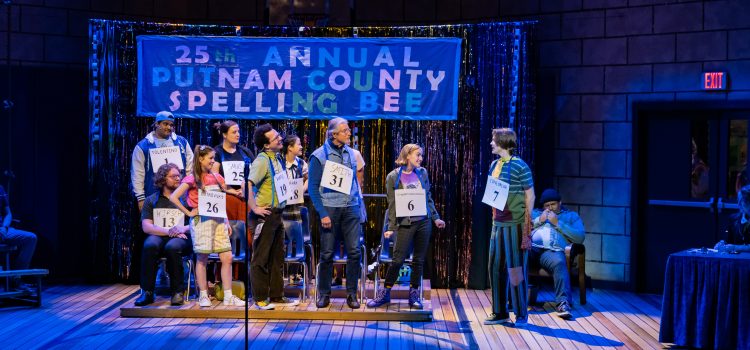
Inside a typical middle school gymnasium, dweeby sixth graders compete for a $200 savings bond, a shot at the national bee, and a towering trophy.
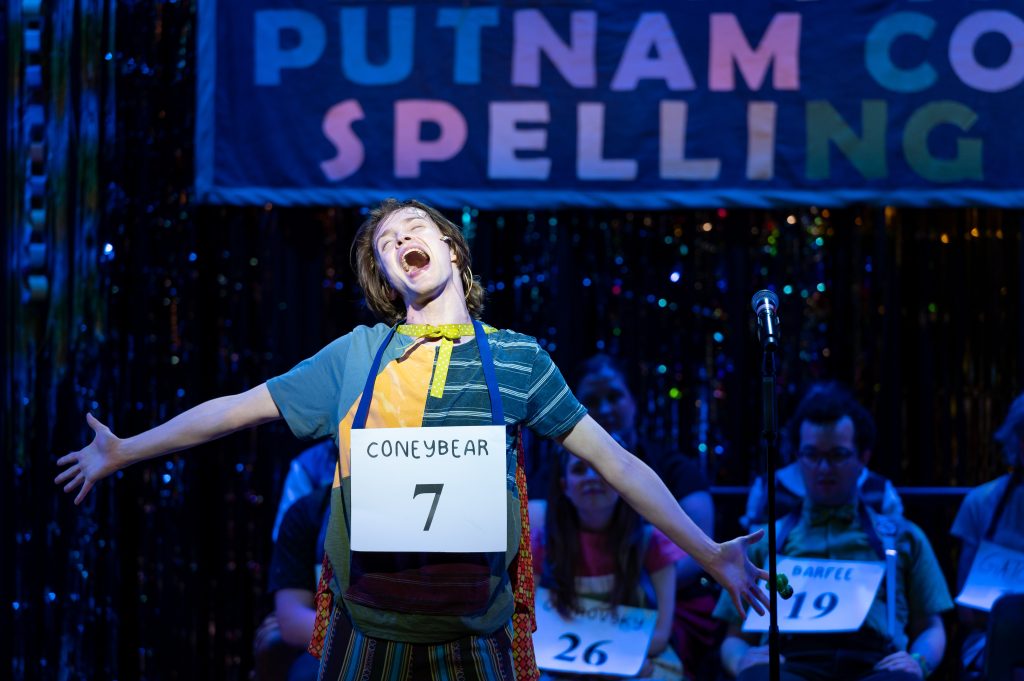
All triple threats, this enthusiastic cast has got game – showing heart, humor and humanity. The boys are Michael Schimmele as returning champ Charlito “Chip” Tolentino, who is struggling with puberty; Matthew Cox as Leaf Coneybear, the wide-eyed home-schooled son of hippies; and Bryce A. Miller as showboating misfit William Morris Barfee.
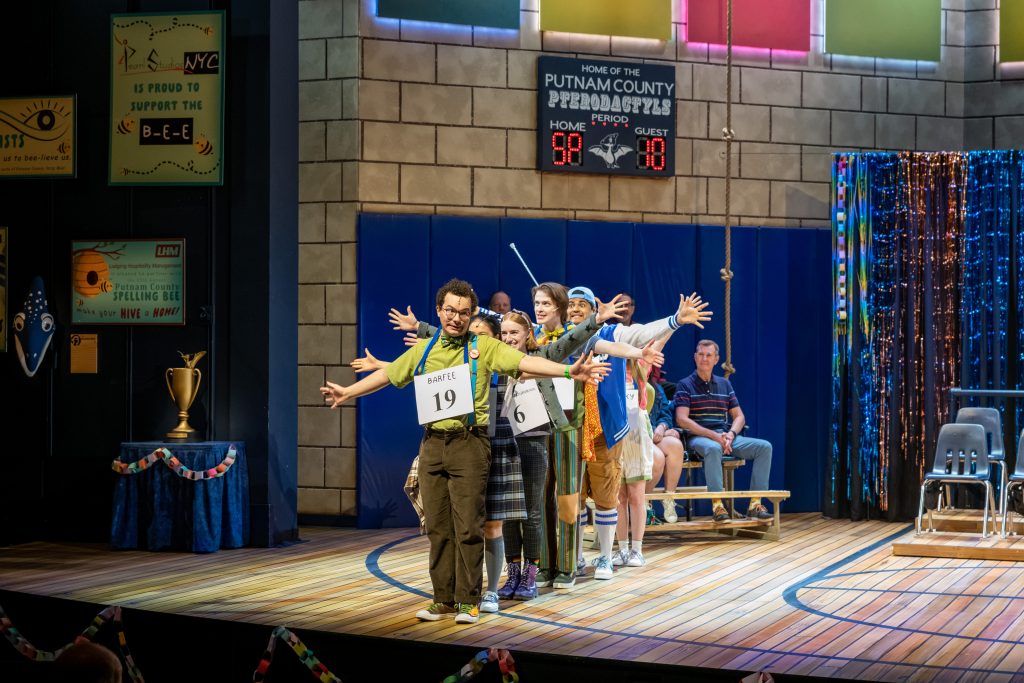
A running gag is the constant mispronunciation of Bar-Fay, because of an accent aigu, and not Bar-Fee.
The girls are Abigail Isom as high-strung Logainne SchwartzandGrubenierre, a positive political activist pushed by her two dads to be best; Alexis Kinney as exuberant wordsmith Olive Ostrosky, whose mom is in India and dad is always working; and Sarah Wilkinson as pedantic Marcy Park, an over-achieving transfer student.
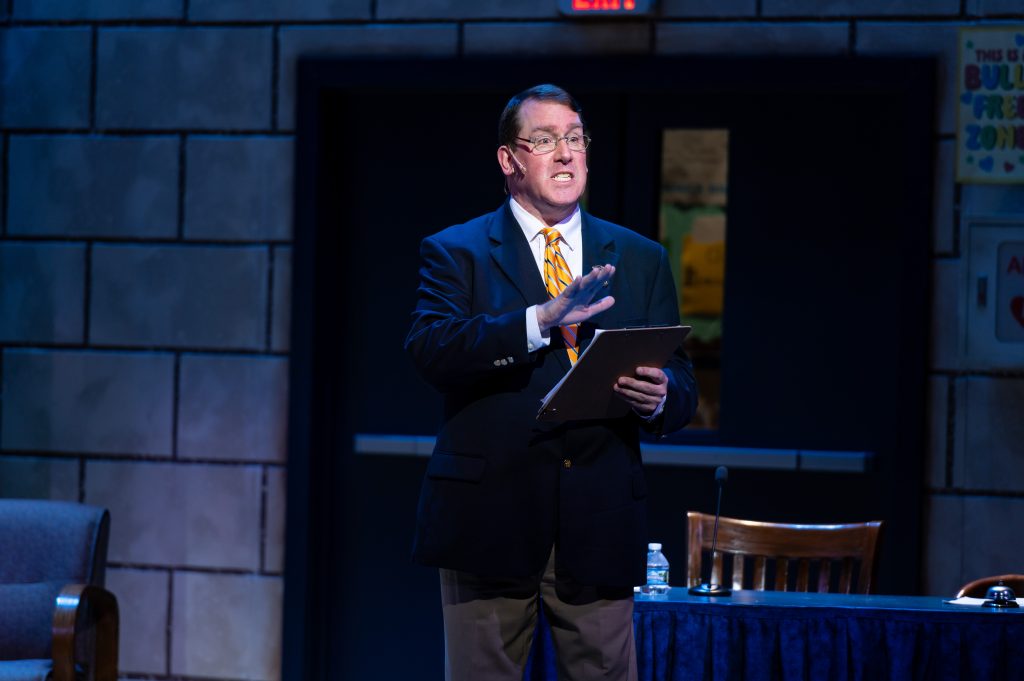
The annual event is a big deal in the town, with three adults in charge – ‘comfort counselor’ Mitch Mahoney (Omega Jones), an ex-con who gives the eliminated contestants a juice box and a hug; former champ and returning moderator Rona Lisa Peretti (Jennifer Theby-Quinn), a successful realtor who enjoys reliving her glory days; and Vice Principal Douglas Panch (Christopher Hickey), who has returned as a judge after personal time off to work out some ‘things.’
Their innuendos and double entendres elicit laughs – and the show’s mature content is aimed for a PG-13 audience.
The catchy music and lyrics by William Finn, of “Falsettos” and “A New Brain,” give each character their moment to shine and explain their character’s drive or idiosyncrasies.
Their signature songs are Leaf: “I’m Not That Smart.” Olive: “My Friend, The Dictionary.” Marcy: “I Speak Six Languages.” Logainne: “Woe Is Me” and Chip: “Chip’s Lament.”
The coming-of-age stories about their home lives are poignantly delivered, and they perform the funny parts with gusto. The spellers have crafted realistic kids – not to mock but to enjoy their characteristics and identify with their emotions, and you root for them to stay golden.
Barfee, unfortunately hampered by one working nostril, has a peculiar way of spelling out the words – with his “Magic Foot.” (Fun fact: Dan Fogler, of “Fantastic Beasts,” won a Tony Award for originating the role).
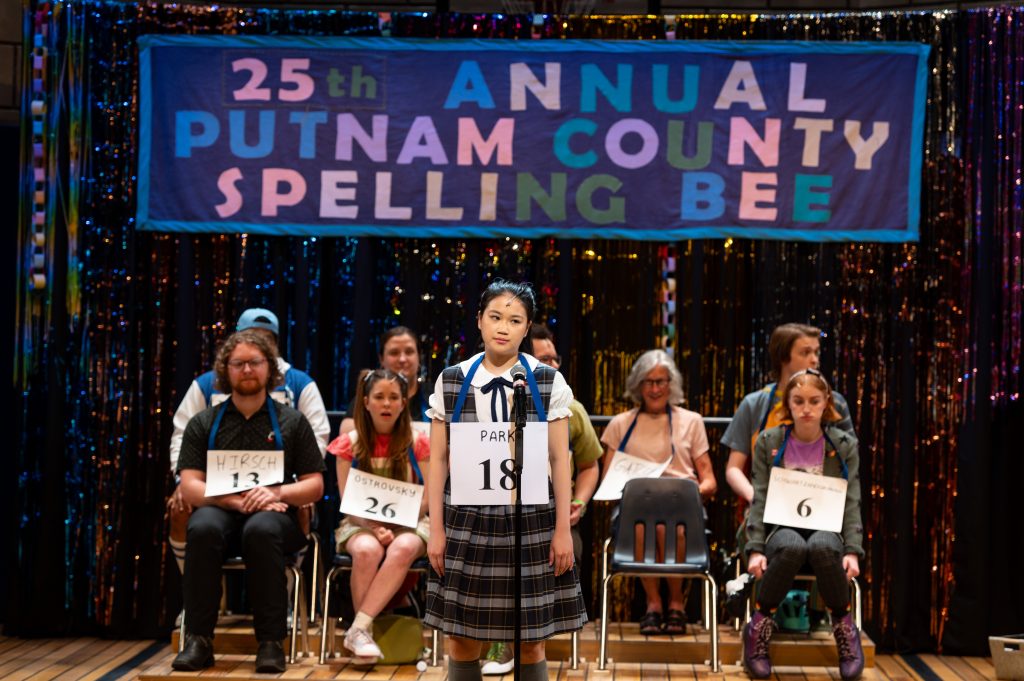
The convivial show, workshopped into an off-Broadway hit, transferred to Broadway in 2005 – and was nominated for six Tony Awards, winning two (book by Rachel Sheinkin, featured actor). It was originally conceived by Rebecca Feldman and based upon “C-R-E-P-U-S-C-U-L-E,” a play by her improv collective, The Farm. Additional material was supplied by Jay Reiss.
The fluid script allows producing companies to insert topical and local references. It also includes audience participation, and patrons can fill out a slip in the lobby before the show.
Four names are drawn backstage, so no one is tipped off in advance, and they join the spellers to take their turn at the microphone. All good sports, this is a key element to the fun, producing good-natured laughter from the audience. No special treatment – they might get to spell “Cow” or a consonant heavy four-syllable word.
The crowd’s perspicacity was evident on opening night June 3 and embraced the experience. The ingenious construction keeps it fresh, and that spontaneity is appealing.
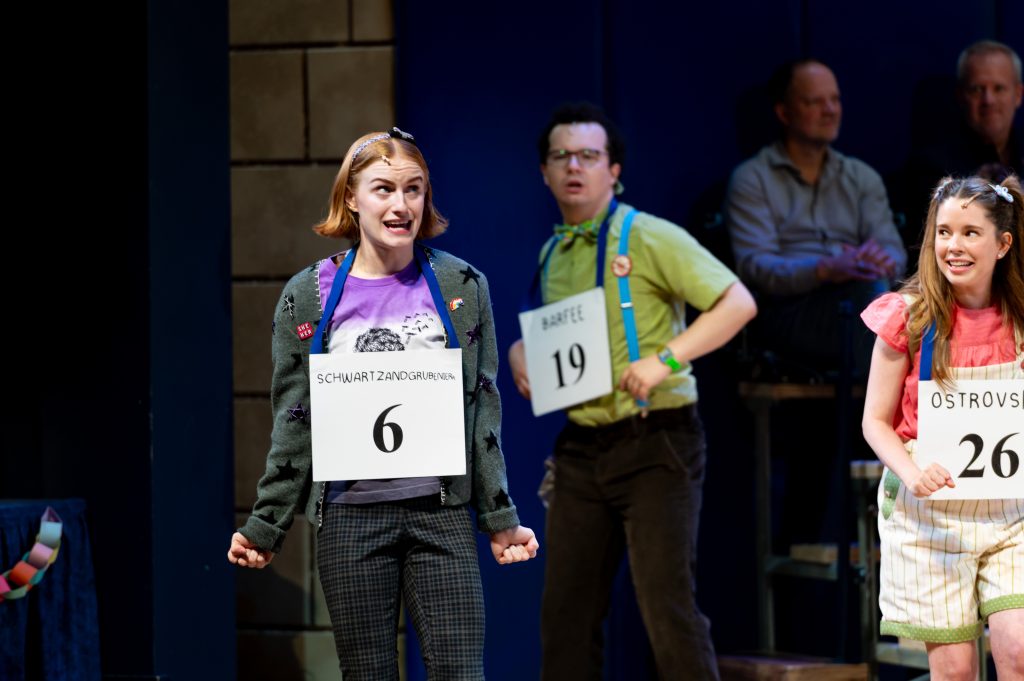
Detail-oriented co-directors Ron Gibbs and Gayle Seay also co-choreographed the show, achieving a terrific level of energy. The upbeat title song introduces the characters, and “The Spelling Rules” brings out their quirks and “Pandemonium” is just that.
In stand-out moments, dynamic Wilkinson showcases her gymnastic skills in her peppy number “I Speak Six Languages” and her prayer for change, “Jesus,” while gifted comic actors Miller and Kinney display charming chemistry leading up to and including their duet “Second.”
Another highlight is the tender ballad “The I Love You Song” that heart-tugging Kinney sings with her parents – as the absentee mom, Jennifer Theby-Quinn’s strong mezzo-soprano is in lovely harmony with workaholic dad Omega Jones’s warm vocals.
As Rona, Theby-Quinn confidently commands the stage in “My Favorite Moment of the Bee,” and in two reprises. As Mitch, Jones demonstrates expressive vocals in “The Prayer of the Comfort Counselor” and in “Woe Is Me” reprise with the vivacious Isom.
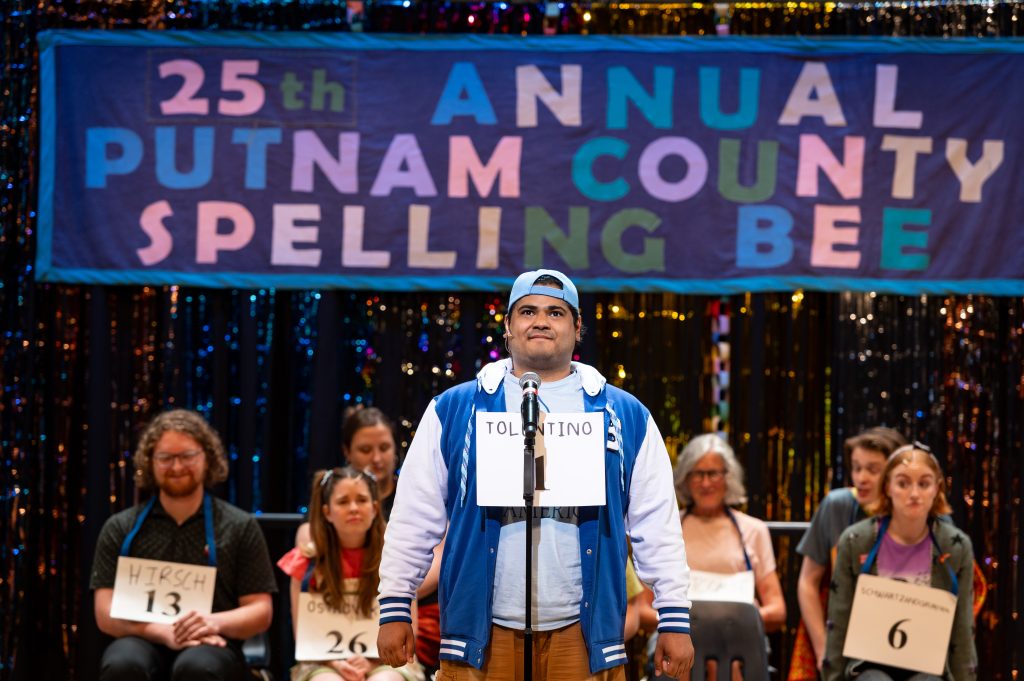
And Schimmele is a trouper with his sudden onset of a puberty issue, and feigning discomfort in his public humiliation. If you know, you know. (Refer to mature rating).
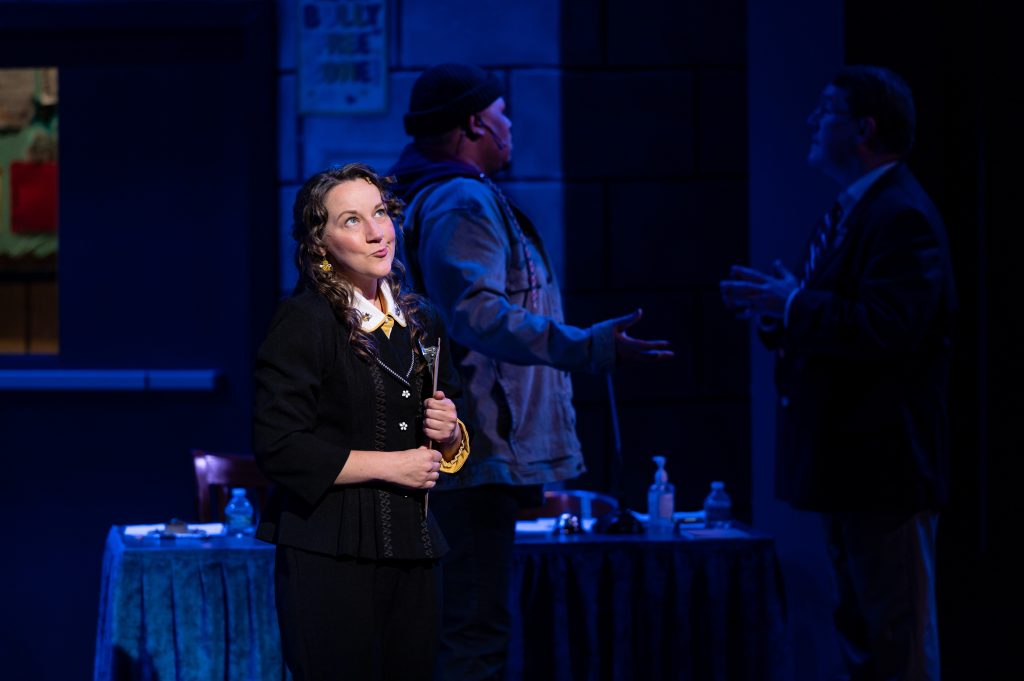
The junior high vibes are boosted by scenic designer Rachel Seabaugh’s school gymnasium set that is a nifty flashback to every community event ever, with sly nods to the civic organizations and school sports teams that are delightful to notice.
Lighting Designer Sean M. Savoie’s expertise is apparent in the harsh gym glare, which shifts to the warm intimate interaction moments. Sound designer Hankyu Lee’s work is remarkably crisp, without any dead spots in the KPAC’s Ross Family Theatre.
Costume Designer Cat Lovejoy has jauntily defined every character through their distinct outfits, and the addition of a makeshift cape and roller-sneakers for Leaf Coneybear is inspired. Cox gives his movements extra flair with those accessories.
Music Director Michael Kaish smoothly kept the tempo on track, and is on one keyboard, joined by Randon Lane on a second keyboard, Lea Gerdes on reeds, Marcia Erwin on cello and Jonathan M. Taylor on percussion.
The Bee is a buzzy, playful communal experience, one that celebrates smart kids without any stigma – a proud revenge of the nerds, and the relatable rituals of youth. To be a part of the glee expressed by cast and crowd alike will lift spirits of any age.
Note: Understudies include Julie Hanson, Lillie Self-Miller, Bradford Rolen and Connor Kelly-Wright.
Stages St. Louis presents the musical “The 25th Annual Putnam County Spelling Bee” through June 28. Performances take place at the Kirkwood Performing Arts Center, 210 E. Monroe Ave. For more information: stagesstlouis.org.

Lynn (Zipfel) Venhaus has had a continuous byline in St. Louis metro region publications since 1978. She writes features and news for Belleville News-Democrat and contributes to St. Louis magazine and other publications.
She is a Rotten Tomatoes-approved film critic, currently reviews films for Webster-Kirkwood Times and KTRS Radio, covers entertainment for PopLifeSTL.com and co-hosts podcast PopLifeSTL.com…Presents.
She is a member of Critics Choice Association, where she serves on the women’s and marketing committees; Alliance of Women Film Journalists; and on the board of the St. Louis Film Critics Association. She is a founding and board member of the St. Louis Theater Circle.
She is retired from teaching journalism/media as an adjunct college instructor.