By Lynn Venhaus
The rich legacy of Tennessee Williams has become a major point of pride in St. Louis, where he spent his formative years. For 10 years, we’ve embraced the Tennessee Williams Festival St. Louis, and rediscovered a new appreciation for the great American playwright.
Therefore, an original work about the dramatic and sometimes humorous events leading up to the Broadway premiere of his autobiographical “The Glass Menagerie,” a game changer in many ways, is worth diving back into the Williams lore.
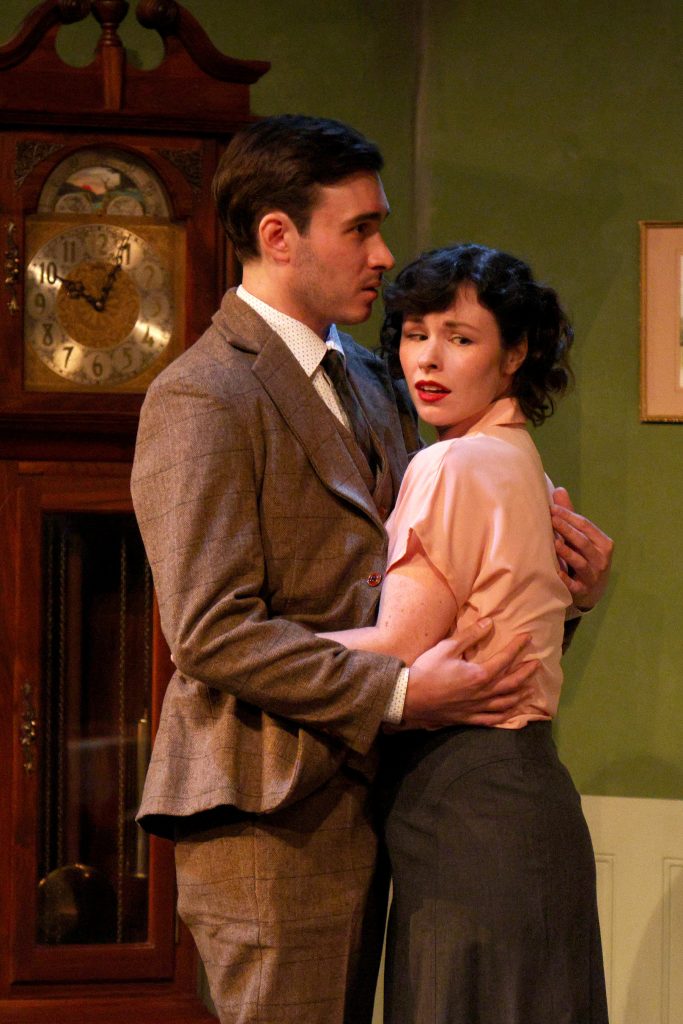
An earnest “Tenn” by Aaron Scully takes us back to the ‘before’ – nervous investors, stressed-out playwright, unreliable leading lady, and major jitters by others involved.
But all those can and will be overcome, and who really matters are two people who fiercely believed in the play and playwright – namely talent agent Audrey Wood and director/producer Eddie Dowling.
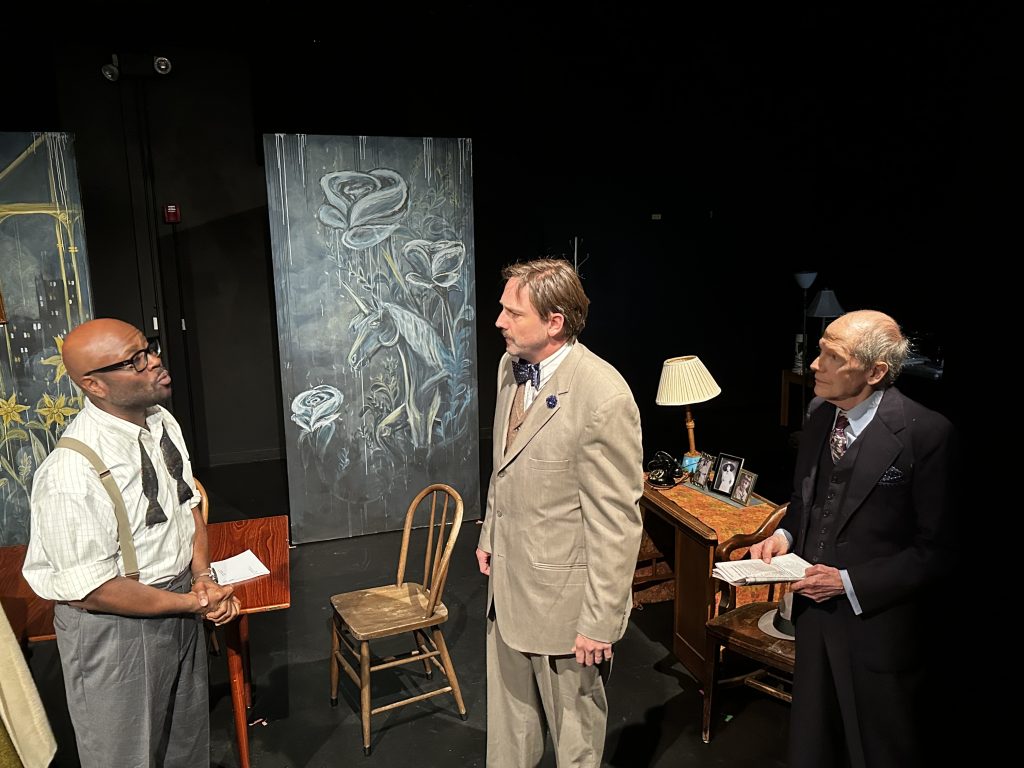
They were life-changing contacts for Williams, and as played by Kelli Rao and Kevin Bailey, convey the necessary passion and support he needed to succeed. Without them, he would never have catapulted from obscurity to fame.
In addition, Dowling steps onto the stage as dreamer Tom Wingfield, the character based on the author himself. Tom yearns for a different life, writing for a living and away from his family and mundane job in a shoe warehouse.
The events, presented as vignettes, start in 1939 and lead up to opening night on Dec. 26, 1944, in Chicago, then on Broadway on March 31, 1945. Scully frames it as Tennessee’s memories about his memory play, a clever premise. For his take, he has pared it down to a six-person ensemble.
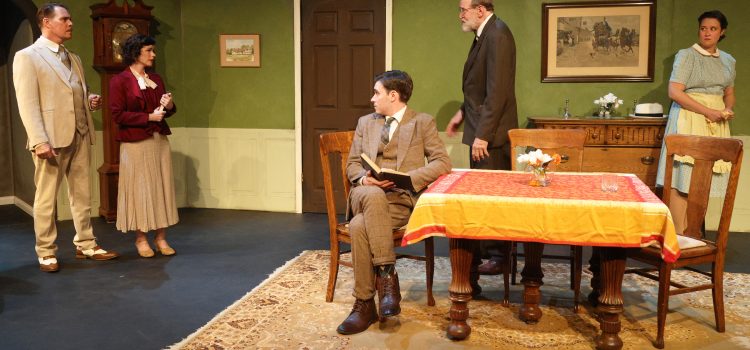
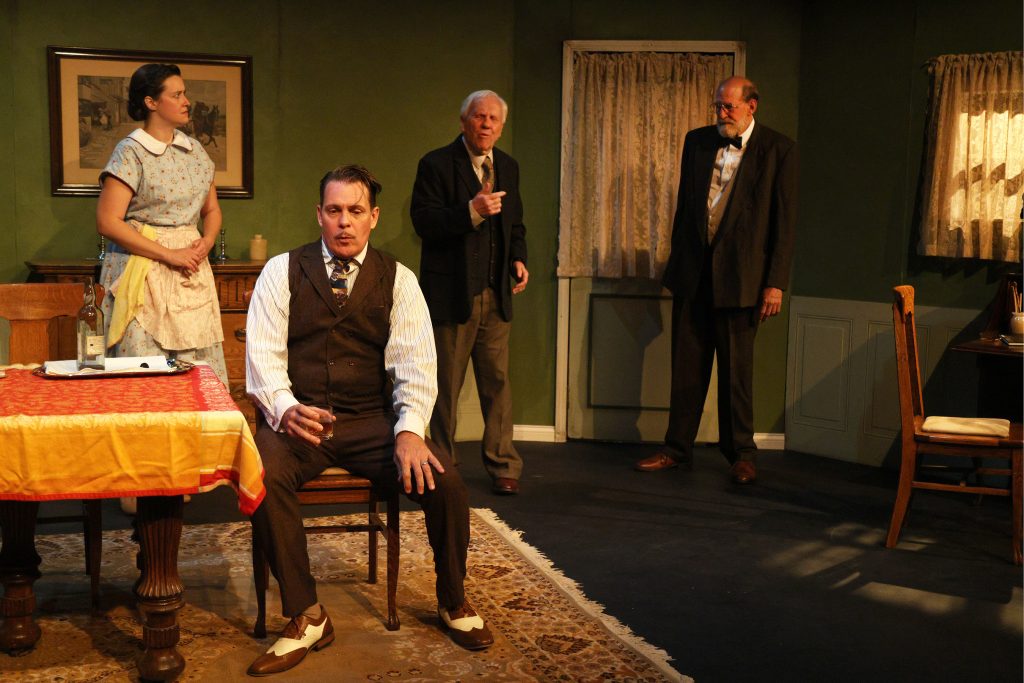
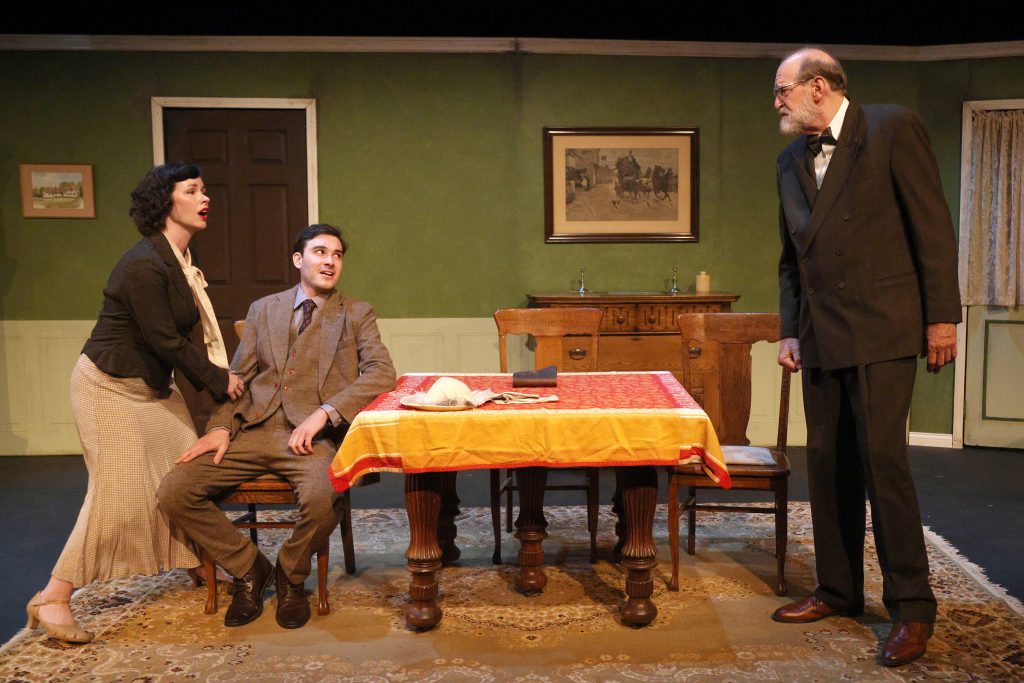
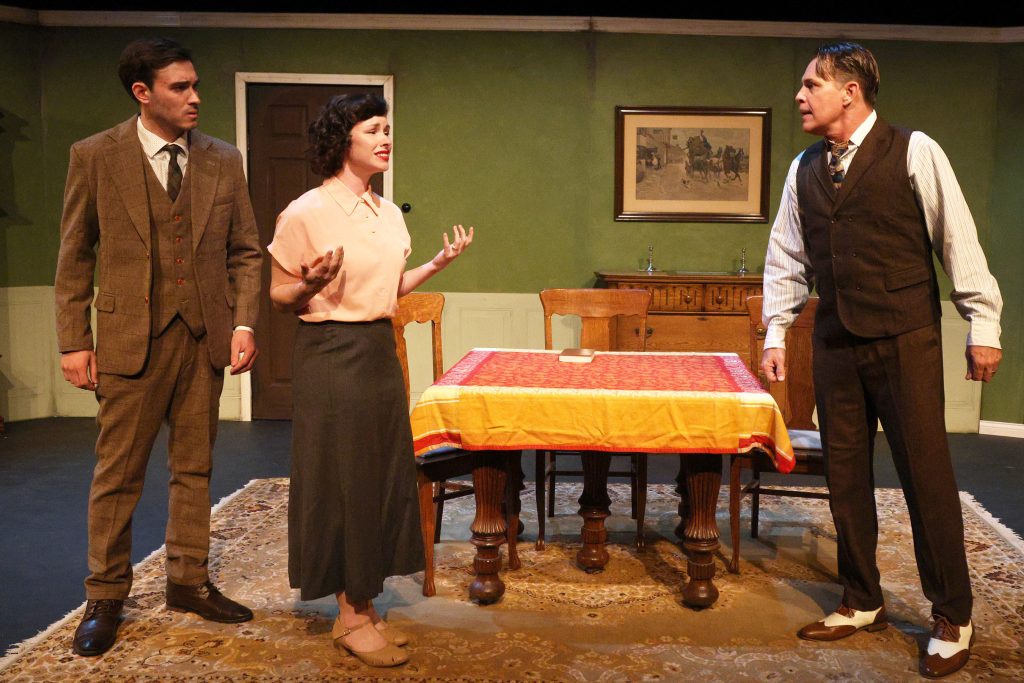
After an earlier staged reading, First Run Theatre has produced this full-length play, meticulously mounted in the Kranzberg Arts Center, with cozy and concise period details in costumes, set, mannerisms and props (the vintage typewriter is a beat-up beaut). Granted, the production is low budget, but that also gives it an intimate feel.
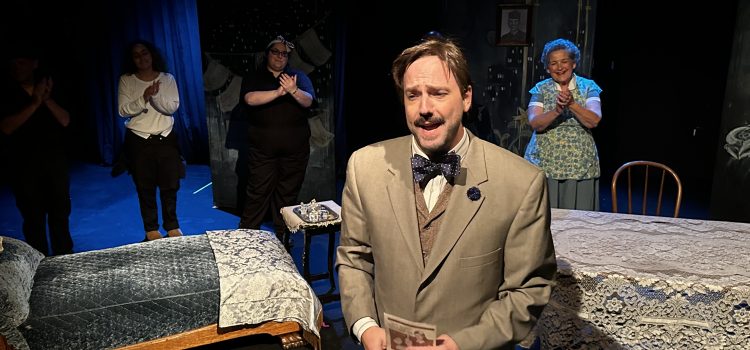
Matt Newlin anchors the backstage drama as Tennessee, fiercely protective of his work, but fretful that the play based on his life would have the same fate as his earlier flop, “Battle of Angels.”
His Tenn is a genteel Southern gentleman, soaking up experiences and commenting on what’s happening, showcasing the playwright’s trademark wit and insecurities. Scully captures those aspects of the character well, and Newlin depicts him as a sympathetic creative that you root for to succeed.
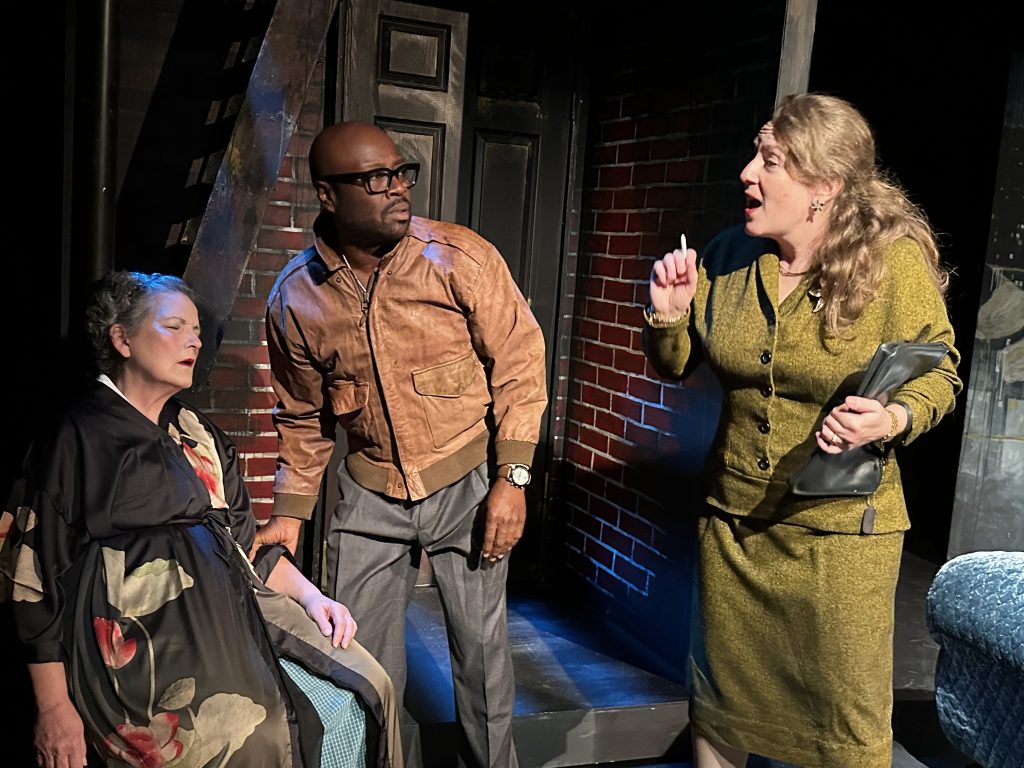
Dorothy LaBounty deftly portrays the alcoholic actress Laurette Taylor, who drew rave reviews immortalizing Williams’ histrionic mother Edwina as the character Amanda Wingfield, a faded Southern belle who is ill-equipped to deal with harsh financial conditions in a small St. Louis apartment in the late 1930s.
Giving this story a sense of gravitas are Kyle Reeves as Donald Windham, Williams’ partner, and Charles Huevelman as the financier Louis Singer, who balks at putting more funds into the show.
A notable absence is an actress playing Laura, who is modeled after Tenn’s fragile sister Rose. In the opening, Newlin explains that there are 12 scenes, not in chronological order, and not everyone that was involved is part of the process.
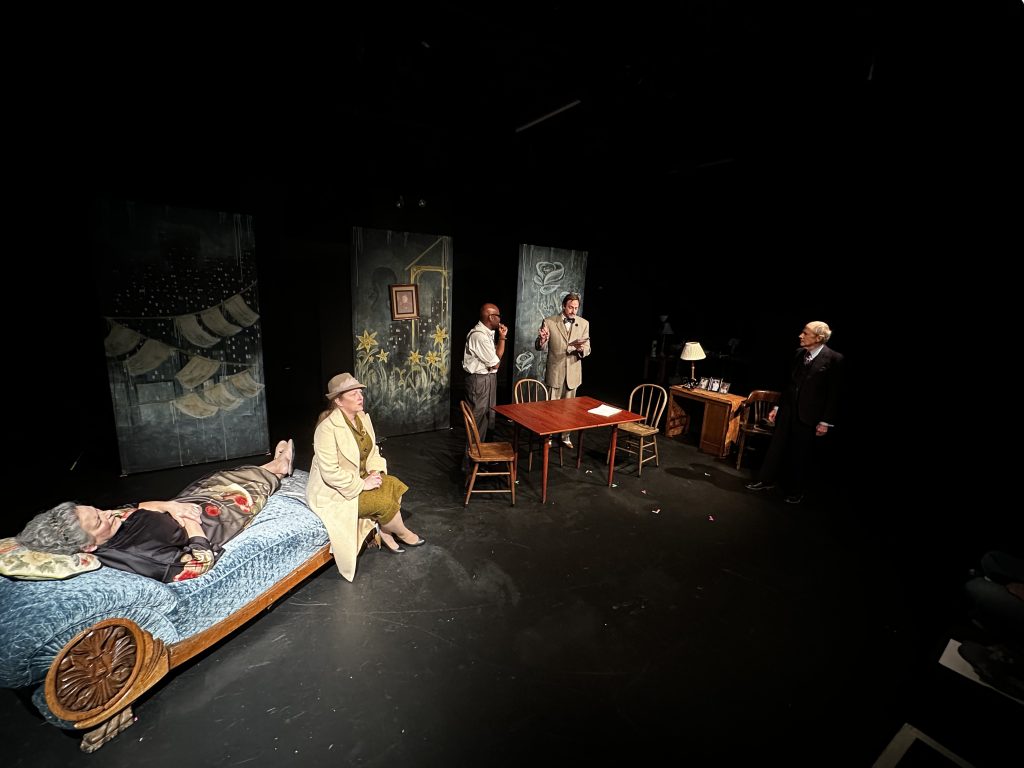
For a modest production, set designs are an essential part of this storytelling, and set designer Brad Slavik, the producer and board president, has crafted an ambitious scenic tableau, with a fire escape, restaurant, hotel room, stage and other settings.
Three hard-working stagehands Mike True, Phoebe Carlson and Lilly Holland are busy changing settings, which can be cumbersome to the play’s flow.
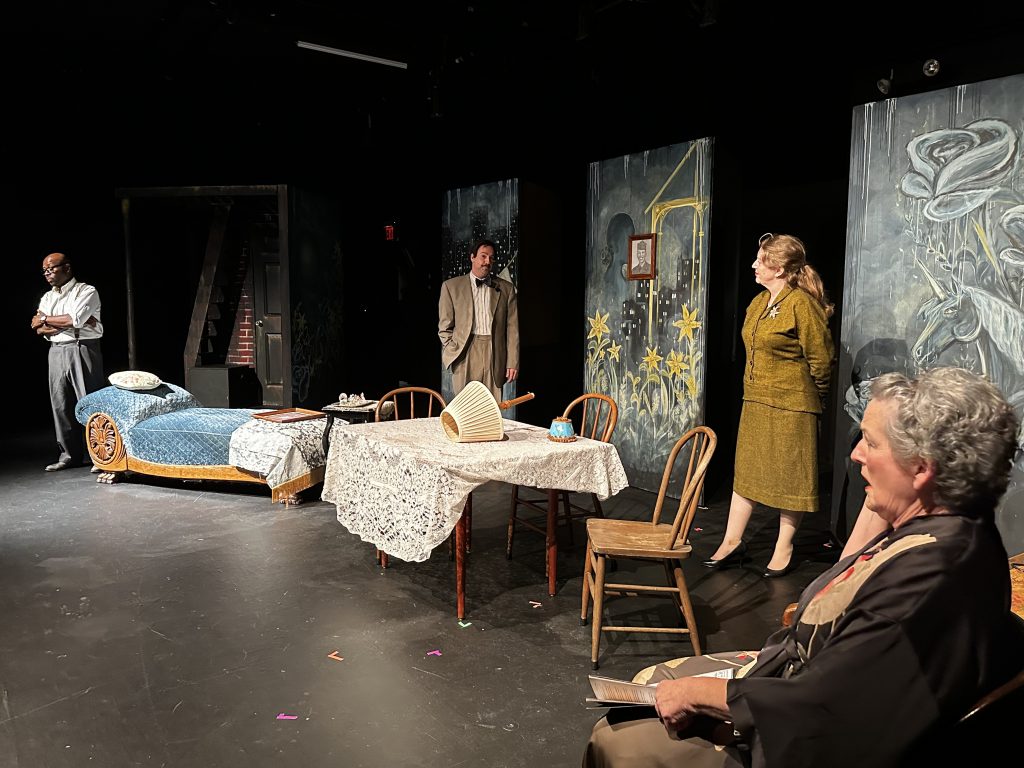
With costume designer Lauren Smith Beardon’s retro outfits, lighting designer Mike Gasparich’s illumination, and props manager A. Merkt adding old-timey lamps, they set the scenes well. Rachel St. Pierre was a scenic painter and Jenn Ciavarella the technical director, with Addie McGrath and Lilly Holland sound designers.
Before the Tony Awards were created in 1947, the New York Drama Critics’ Circle awarded “The Glass Menagerie” the Best American Play in 1945. For Tenn, the rest, as they say, is history. He went on to win two Pulitzer Prizes for Drama with “A Streetcar Named Desire” 1948 and “Cat on a Hot Tin Roof” in 1955.
Inspired by the world around him, Tenn made his mark with his poetic realism. His understanding of the human condition, his ability to highlight outsiders, misfits and eccentrics, and his focus about love, understanding, compassion and kindness, made him singular.
All his works are about loss – the summer, beauty, youth, love – and yes, glass animals. None of these things last very long.
Born Thomas Lanier Williams III in 1911 in Mississippi, he moved to St. Louis when he was 8 because his father, a traveling shoe salesman, was promoted at the International Shoe Company. St. Louis was a very polluted bustling industrial town in the 1920s and 1930s.
He was the second of three children born to a hot-tempered, hard-drinking Cornelius Coffin Williams and his neurotic wife, Edwina Dakin, who was frustrated in a bad marriage.
His sister Rose (1909-1996) was schizophrenic and institutionalized for the remainder of her life after a botched lobotomy in 1943. His brother Dakin (1919-2008) was an attorney who lived in Collinsville for years.
His family life was miserable, but he was ambitious and yearned for adventure. His restlessness took him away, but his roots here are significant. The family moved several times, and Williams attended both Soldan and University City high schools.
College included stints at University of Missouri-Columbia from 1929 to 1931 and Washington University in 1936, before earning a degree at the University of Iowa, then heading to New York City.
He also lived in Provincetown, Mass.; New Orleans; and Key West, Fla. Williams died Feb 25, 1983, in New York City, at age 71, and is buried in a family plot in Calvary Cemetery in St. Louis.
Scully is stingy with historical details, relying on the audience to know about the play and Williams’ backstory. Sure, the play is classic and iconic, but what about those unfamiliar?
What is missing here is the ‘how’ and ‘why’ the play was heralded. Perhaps characters rehearsing some of the scenes, to demonstrate Williams’ verbal dexterity, his emotional honesty, and his psychological profiles? Audiences connected to his memorable characters, and we should get a sense of that.
(I’ve since learned, after a Q&A with the author, that he originally wanted to use lines from “The Glass Menagerie,” but because of copyright issues, could not.)
From Newlin, we do get a sense of his idealistic passion, and Bailey’s fervent portrayal of Dowling as the guiding light, is a standout. Director Julie George-Carlson has thoughtfully staged this glimpse into the past.
Elia Kazan, who directed several of Williams’ iconic stage and film productions, described him as thus: “Everything in his life is in his plays, and everything in his plays is in his life.”
The story here feels incomplete, and I left wanting more, for Williams is as fascinating of a character as the fictional ones he created. “Tenn” focuses solely on the backstage drama that results in a triumphant theatrical achievement.
As a work in progress, “Tenn” illuminates a key aspect of Williams’ luster.
“Make voyages. Attempt them. There is nothing else,” Williams wrote in his 1953 play “Camino Real.”
First Run Theatre is presenting “Tenn” from July 31 through Aug. 9, Friday and Saturday at 8 p.m., and Sunday at 2 p.m., at the Kranzberg Arts Center, 501 N. Grand, St. Louis MO. The two-act play has one 15-minute intermission. For tickets and information, please visit www.firstruntheatre.org.

Lynn (Zipfel) Venhaus has had a continuous byline in St. Louis metro region publications since 1978. She writes features and news for Belleville News-Democrat and contributes to St. Louis magazine and other publications.
She is a Rotten Tomatoes-approved film critic, currently reviews films for Webster-Kirkwood Times and KTRS Radio, covers entertainment for PopLifeSTL.com and co-hosts podcast PopLifeSTL.com…Presents.
She is a member of Critics Choice Association, where she serves on the women’s and marketing committees; Alliance of Women Film Journalists; and on the board of the St. Louis Film Critics Association. She is a founding and board member of the St. Louis Theater Circle.
She is retired from teaching journalism/media as an adjunct college instructor.