By Alex McPherson

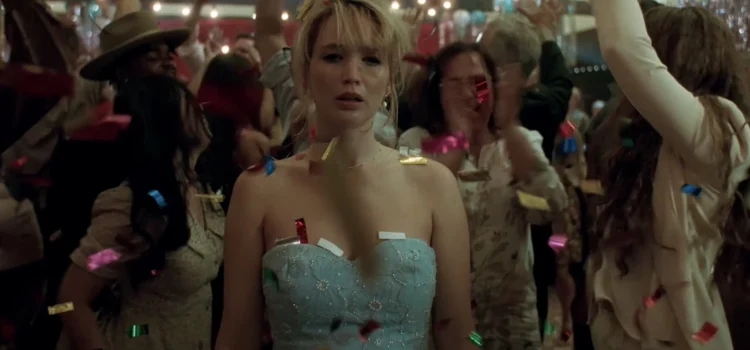
An intensely gripping acting showcase for Jennifer Lawrence, director Lynne Ramsay’s “Die My Love” paints an existentially nightmarish picture of motherhood, conformity, and relationships in fateful disarray.

Based on the novel Matate, Amor by Ariana Harwicz, the film follows Grace (Lawrence), a free-spirited and frustrated writer who moves into an old house in rural Montana with her ruggedly handsome but insecure boyfriend, Jackson (Robert Pattinson). The house, nestled within tall grasses and fairy-tale woods, was left to Jackson by his uncle who committed suicide.

It’s seemingly a prime location for Grace and Jackson’s antics; they drink nonstop and have wild sex, fully embracing their physical passions. Before long, Grace is pregnant and gives birth to a baby boy (whom they choose not to name), forever altering the paradigms they exist within.

Grace and Jackson’s relationship begins to crumble. Jackson is away at work for suspiciously long periods, and Grace suspects him of infidelity. Loneliness, emotional detachment, and sexual frustration grow exponentially day by day, with Grace feeling abandoned even when Jackson is at home.

She crawls on all fours like a prowling dog and masterbates in the nearby woods, at one point walking through the plain’s wispy grass, knife in hand, while their son sits unattended on the porch. 

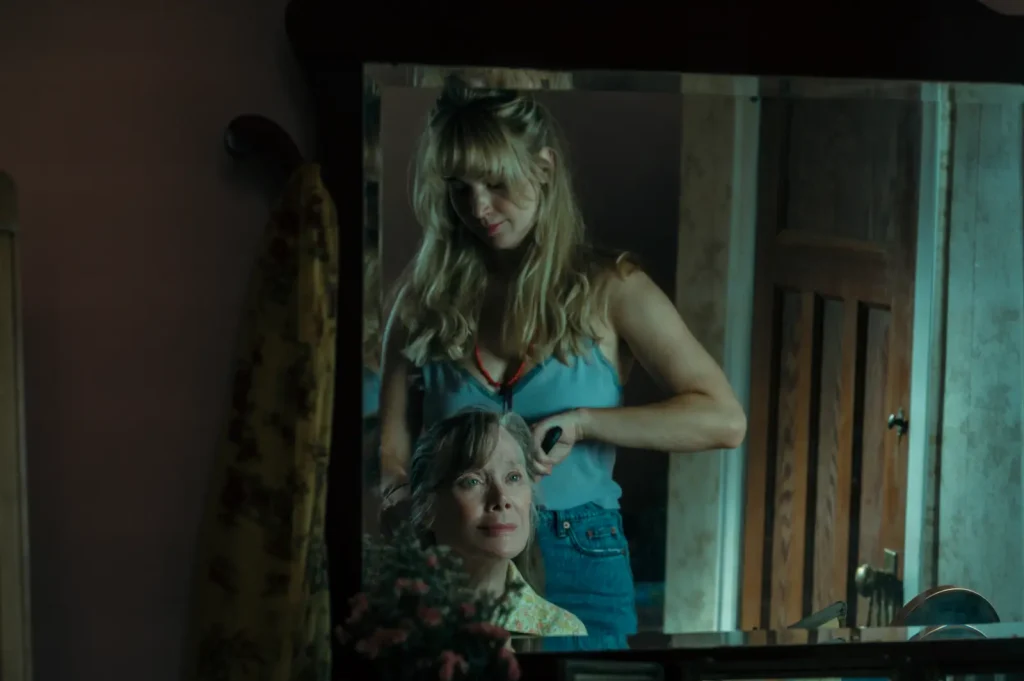
Grace’s new responsibilities and social expectations untether her present self from her former self, with troublingly extreme results. Jackson’s unstable mother, Pam (Sissy Spacek), lives nearby and is grieving her recently-deceased husband (Nick Nolte). She offers Grace some support, but Grace stubbornly refuses to accept help during her postpartum spiral. 

Jackson is also largely clueless and unwilling to change his ways. He and Grace are still drawn to each other, but they’re unable to let go of a toxic cycle of fighting and reconciliation. A mysterious biker (LaKeith Stanfield) living in the area offers the possibility for Grace to indulge her needs.

Melding sheer brutality with sequences of dreamy, sensual beauty, “Die My Love” thrives on its ethereal atmosphere and a show-stopping performance from Lawrence. She inhabits Grace with a wild-eyed intensity and crushing pathos, a woman fallen out of touch with both herself and with “civilized” society writ large. 
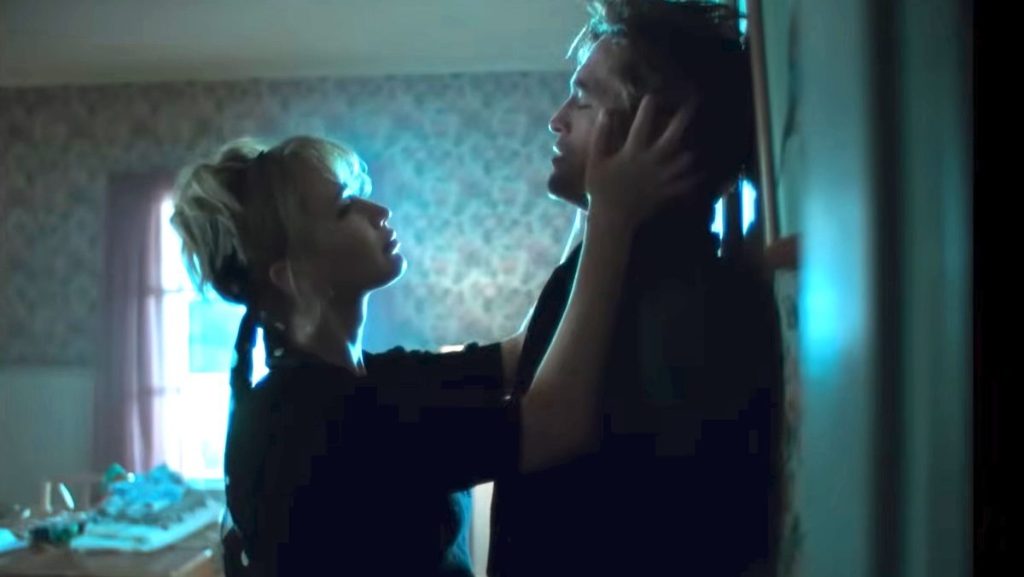
Ramsay, known for disquieting character studies, is a prime fit for this portrait of mental decline. “Die My Love” prizes tone over traditional narrative —we’re watching a hypnotizing trainwreck as Grace destroys both herself and her relationships.

Neither Grace nor the people in her orbit have the power to shift her trajectory; she’s as much a byproduct of postpartum depression as she is from the ways that Jackson and the world treat her in her new role as a mother. 

Seamus McGarvey’s cinematography frames the expansive yet confining landscape as foreign and disorienting. The environment often distorts as characters move through space, as if each step renders Grace further divorced from desires she feels forbidden from embracing, with other characters also struggling to find their own paths forward.

There’s a haunting, symbolic quality to the 4:3 aspect ratio and the wide-open surroundings the characters reside within: expansive and limiting, even isolating.
“Die My Love,” not completely unlike Mary Bronstein’s “If I Had Legs I’d Kick You,” does a fantastic job at submerging us into its protagonist’s mind. Ramsay’s filmmaking is at times dreamlike and other times startling in its blunt depiction of Grace’s self-destructive behaviors (animal lovers beware).

Music plays a critical role here, featuring one of the year’s best soundtracks, expressing dread as well as mournful reflection on the idealized life Grace once envisioned she’d have.

Lawrence gives a highly physical performance, from manifesting Grace’s desires through animalistic, “interpretive dance” sequences (that the film plays completely straight), to the peace she feels within the nearby woods away from civilization, and the violent self-hatred that flares unexpectedly.

There’s some bone dry humor in Lawrence’s matter-of-fact delivery. This is especially apparent during a scene where she has a “conversation” with a friendly gas station cashier, although Grace’s wit always reflects her deep-seated malaise.
The screenplay by Ramsay, Alice Birch, and Enda Walsh doesn’t provide much backstory, which puts more emphasis on the intricacies of Lawrence’s performance. Luckily, she is fully up to the task of conveying Grace’s emotional limbo.

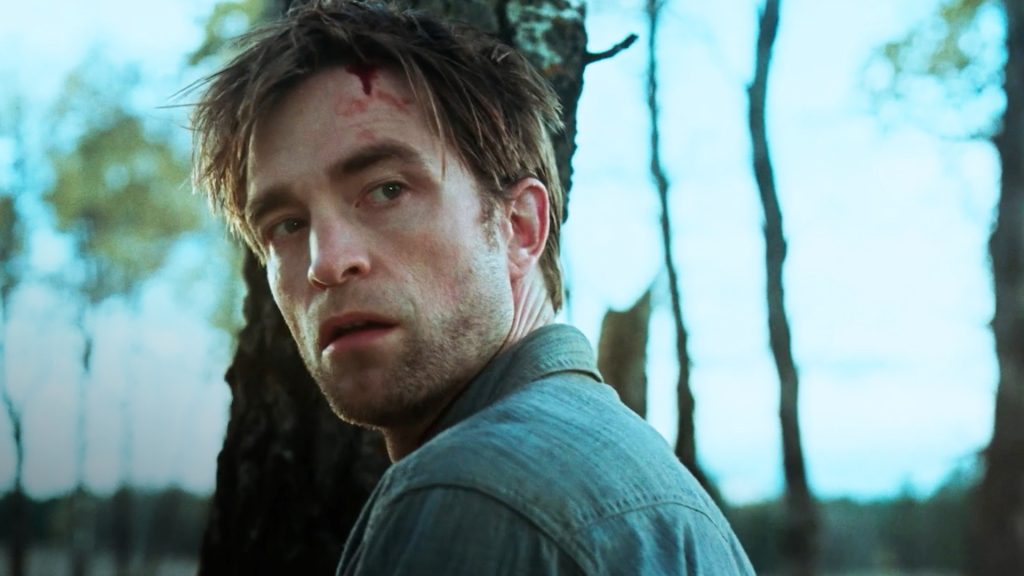
Pattinson, not given as much to do as Lawrence, brings a shaggy insecurity that underlines Jackson’s volatility and half-hearted attempts at making amends. Like most other characters in “Die My Love,” Jackson remains unable to truly listen to Grace and understand where she’s coming from, every conversation seemingly creating more distance.

Spacek, too, does a lot with limited screen time; on some level, Pam identifies with Grace’s decline, and supports her efforts for independence even as they threaten Grace’s life.

The problem is that “Die My Love” eventually starts to wear out its welcome in Grace’s perpetual perils. Grace’s “journey” is a downhill slide that won’t stop until it’s all burned down. Ramsay’s film is disconcertingly harsh, alienating viewers through a story about alienation. And, well, isn’t that part of the point? It’s a dark, twisted vision of Hell still worth experiencing.

“Die My Love” is a 2025 psychological thriller directed by Lynne Ramsay and starring Jennifer Lawrence, Robert Pattinson, Sissy Spacek and LaKeith Stanfield. It is rated R for sexual content, graphic nudity, language, and some violent content, and the run time is 1 hour, 59 minutes. It opened in theatres Nov. 7. Alex’s Grade: B+.

By Lynn Venhaus
The grittiest, gloomiest, and most pitch-black of the entire Caped Crusader canon, “The Batman” expands the compelling mythology with a neo-noir approach and very gothic Gotham look.

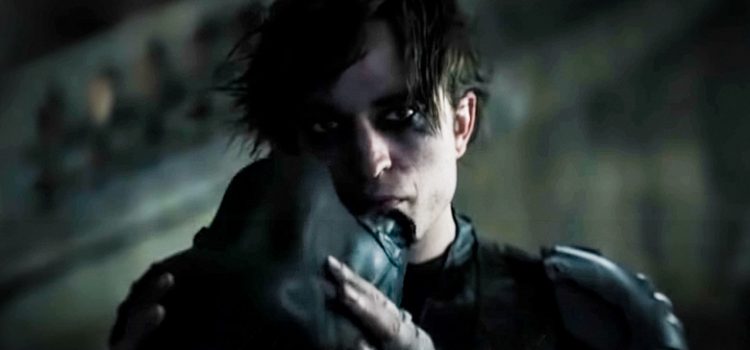
Now in his second year as masked crime-fighter Batman, reclusive billionaire Bruce Wayne (Robert Pattinson) wades deeper into Gotham City’s underworld after The Riddler (Paul Dano) leaves a trail of cryptic clues, cyber messages and greeting cards addressed to The Batman. Wayne uncovers rampant corruption and abuse of power that has long plagued the metropolis while he seeks to apprehend a deranged killer.

Director Matt Reeves has set the iconic DC comic book character into year two of his “Batman Project,” where the scion of Wayne Enterprises, Bruce Wayne, calls himself “Vengeance” and roams at night, throwing punches with the “drophead” drug addicts and hoodlums overtaking his town.

His nocturnal alter-ego somberly narrates the film from his journals. “They think I’m hiding in the shadows, but I am the shadows,” he says in an intense, hushed tone.

This Batman works as a vigilante, delving into the detective work with Police Commissioner Gordon, played with his customary gravitas by Jeffrey Wright. After all, DC stands for Detective Comics, which Batman has been a part of since 1943.

Reeves, who helmed the found-footage thriller “Cloverfield” and two of the three “Apes” prequels “Dawn of the Planet of the Apes” in 2014 and “War for the Planet of the Apes” in 2017, taps into modern-day fears here, much like a horror film. It’s not science that’s created an aberration, but human nature at its bleakest, because evil has seeped into the everyday fabric of big-city life.

Reeves and co-screenwriter Peter Craig, who specializes in gutsy action (Oscar nominee for “The Town,” the upcoming “Top Gun: Maverick”) take a page from Todd Phillips’ 2019 bold and menacing “Joker,” which depicted Gotham City’s slide into lawlessness as greed and sadistic forces rose.

No one out-broods actor Robert Pattinson, and he inhabits the Batsuit with an imposing physique – although a human one, battle-scars on his back. This superhero’s physical prowess is on full display in fierce fight sequences.  

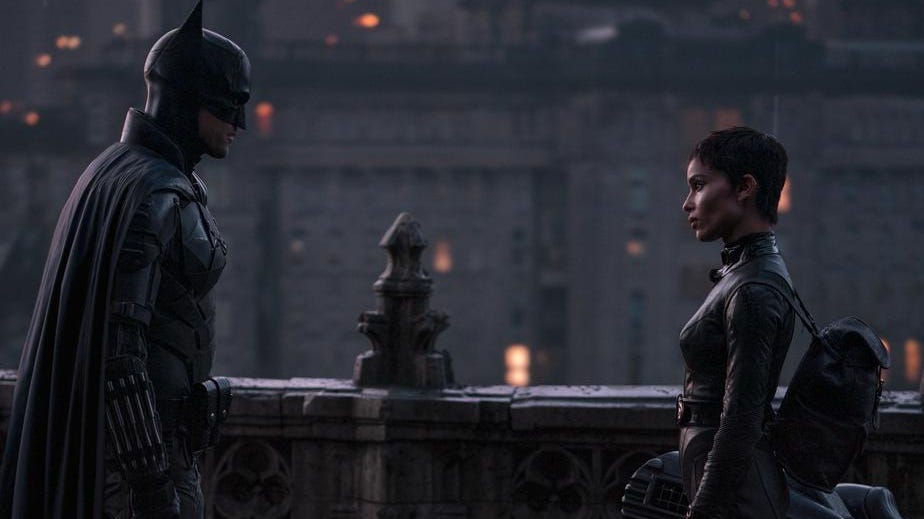
The Bat and The Cat

He has the Bat “toys” at his disposal – a very cool Batmobile makes a splashy entrance and he uses a turbo-charged Batcycle in hot pursuit of justice.

Pattinson, who broke out as sensitive heartthrob and tortured vampire Edward Cullen in the “Twilight” Saga (2008-2012), took a few years to find his way in post-blockbuster projects but has been memorable in interesting but odd indies – “The Lost City of Z,” “High Life,” “The Devil All the Time,” and his acclaimed “Good Time” and “The Lighthouse” (Independent Spirit Awards nominations).  He projects vulnerability and an inner strength along with the physicality.

His re-imagined Bruce is even more emotionally bruised and psychologically battered than any previous characterization, although Christian Bale came the closest in the masterful Christopher Nolan trilogy (“Batman Begins,” “The Dark Knight” and “The Dark Knight Rises”).

For 80 years, the dynamic hero has grown a passionate fanbase and many spin-offs – including TV shows, animated series, and video games. Since Tim Burton’s “Batman” in 1989, there have been many incarnations of the Caped Crusader, each with their own take.

Bale perfectly embodied both the conflicted hero and suave bachelor, while glib charmers Michael Keaton and Ben Affleck played to their strengths as seasoned veterans. The OG, Endearing Adam West, of the landmark TV series and first movie in 1966, had fun with the kitschy camp and the bombastic cartoonish Joel Schumacher ones in the 1990s, with Val Kilmer and George Clooney, though charismatic, took a wrong turn.

With less to say and more to emote, Pattison is convincing as driven to restore order while wrestling with his demons. The poor little orphaned rich boy, traumatized by watching his parents murdered at age 10, has found a solitary life of purpose. He remains a lone wolf who doesn’t let people in easily – even his loyal butler Alfred.

After Michael Caine’s emotional turn in Nolan’s three, as a surrogate father and protector, to see a gruff Bruce keep Alfred at a distance is jarring. Andy Serkis, who was Caesar in Reeves’ “Ape” movies, is every bit the archetypal British gentleman and dutiful servant.

Nolan’s work remains the gold standard, but Reeves’ deeper dive into the crevices is interesting – and unrelentingly grim. The skies are either a gloomy gray or a foreboding hard downpour, reminiscent of “Blade Runner.”

Cinematographer Greig Fraser, Oscar-nominated for “Dune,” sets a moody atmosphere to emphasize the scummy cesspool, and uses very little daylight. Blood red punctuates the darkness.

Reeves has cast the ensemble well, with Zoe Kravitz intriguing as both Catwoman and Selina Kyle, who develops a complicated alliance with Batman.

While nothing will ever approach Heath Ledger’s fearsome Joker in “The Dark Knight,” the familiar villains here are fresh takes — Paul Dano plays The Riddler as a dangerous mastermind, revealing hard truths about the powerful and elite of Gotham, and exposing himself as an unhinged psychopath. He may not have the maniacal laugh of Frank Gorshin and Jim Carrey, but he will send shivers down your spine, nonetheless. You want more of his Edward Nashton.

The Riddler’s killing spree, brutally murdering political figures and lawmen as he baits Batman, ramps up the tension.

John Turturro excels as mob boss Carmine Falcone, a smooth operator who is as lethal with his words as his deeds.

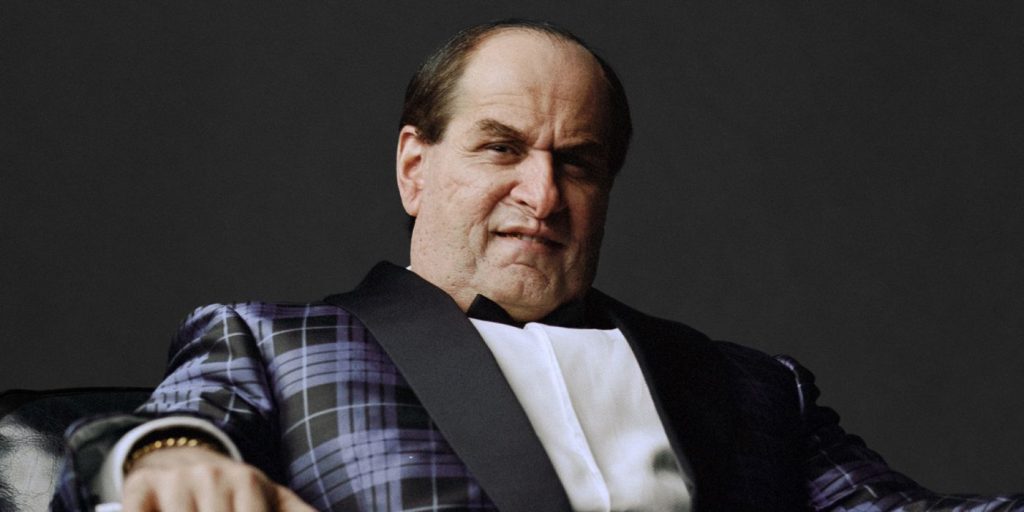
Colin Farrell as The Penguin

Less successful is Colin Farrell, unrecognizable as the thuggish Penguin (Oswald Cobblepot). His sleazy character is not as developed as the other bad guys.

The tech work is solid, and production designer James Chinlund went farther with a crumbling Wayne Manor, a once-grand mansion that serves as a forlorn reminder of what all has been lost.

Reeves tapped his frequent collaborator Michael Giacchino to compose the score. Giacchino, who won an Oscar for “Up,” an Emmy for “Lost” and Grammy Awards for “Up” and “Ratatouille,” has created haunting character themes.

“The Batman” is one of the more complex reinventions in the DC-verse and signals a promising new story thread, but at 176 minutes, the pace is a detriment, for it seems unnecessarily slow. But it is rare that you get this much depth in a tentpole genre film.

“The Batman” is a 2022 action-adventure crime drama directed by Matt Reeves and stars Robert Pattinson, Zoe Kravitz, Paul Dano, John Turturro, Colin Farrell, Jeffrey Wright, Andy Serkis and Peter Sarsgaard. It is rated PG-13 for strong violent and disturbing content,
drug content, strong language, and some suggestive material and runs 2 hours, 56 minutes. It is only in theaters starting March 4. Lynn’s Grade: B.

By Lynn Venhaus
For all his technical brilliance, Christopher Nolan’s ambition and vision sometimes impede his screenplays from making sense. And despite its dazzling action scenes, “Tenet” can’t overcome an unwieldy time-travel plot to make us care – about the future, present or past on screen.

The dangerous time-bending mission is to prevent the start of World War III.

Basically, this jumbo-sized James Bond-type thriller, complete with fabulous gadgets and zippy globe-trotting, is complicated, trying to employ algorithms and explain inversion in its race to thwart doomsday. The layers are murky, the dialogue isn’t always convincing and the complexities lead to overthinking. By midway, it’s a lot to keep straight.

As a director, Nolan’s bombast and daring are unmatched today. And for every letdown like “Interstellar,” there is a masterpiece like “The Dark Knight.” That’s why I look forward to his films, and this one drew me into a theater for the first time since mid-March.

Its stunning set pieces – especially an airport scene and a highway car chase that features speeding cars going backwards, are quite something, and make it a blockbuster worthy of the big screen (and IMAX if you want the upgrade).

As a writer, Nolan’s obsession with puzzles, obviously one of his signatures, and his ability to frame a shot with the fanaticism of a Kubrick, is admirable, but he is often too cold and clinical. With little backstory, we aren’t sympathetic to the principal characters or drawn into their world, with the exception of Elizabeth Debicki, a strikingly beautiful and tall actress playing the Hitchcock blonde, art dealer Kat. She married a vicious oligarch and arms dealer Andrei Sator (Kenneth Branagh), who is keeping her estranged from her young son. And he has plutonium. And tons of money.

Branagh chews the scenery in a cartoonish role, and his thick Russian accent doesn’t help in deciphering his threats, as he attempts to be menacing with a steady monotone.

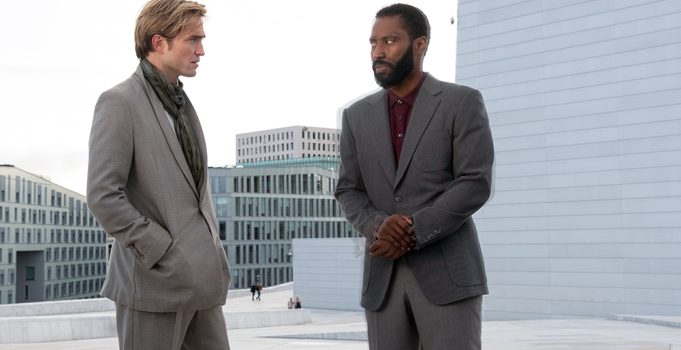
The Protagonist, John David Washington, seems miscast. As good as he was in “BlacKkKlansman,” he appears ill-at-ease here, and it’s not just in the fancy suits to convince others he has wealth. On the other hand, Robert Pattinson is fine as his handler, the mysterious Neil. We don’t know much about him by design, but he and Washington make a good pair.

Clues are dispensed in a frustrating fashion. Oh, there are many big ideas, paradoxes, secrets — and plenty of head-scratching, but by the third act, interest fades. At 150 minutes, it is not exactly taut, although the action is fluid. When military guys in shields show up in droves, and the visors make them unrecognizable, that is a problem.

Nolan is very serious here – maybe too serious. He is good at harrowing — it just always seems we are kept at a distance. Think of this as “Inception” times 10.

“People saw the world for what might have been,” one character says at the end. This did not help me in understanding.

I don’t go to movies to do math. And you shouldn’t have to see a movie again to figure it out, although I’m not sure a second viewing would help anyway, because the story is too convoluted, not to mention flat dialogue and sound-mixing issues.

The movie is very loud – but Ludwig Goransson’s musical score effectively ratchets up danger and suspense with its ominous tone. Goransson won an Oscar for the “Black Panther” score.

The Nolan production team is stellar – magnificent cinematography from Hoyte van Hoytema and smart, crisp editing from Jennifer Lame are among its virtues.

For all its pomp, “Tenet” was a victim of circumstance with its release delayed by the coronavirus global pandemic. It has pulled us back in to theaters, but its lack of connection makes the flaws stand out more than the spectacle.

“Tenet” is an action, suspense film written and directed by Christopher Nolan. It stars John David Washington, Robert Pattinson, Elizabeth Debecki, Kenneth Branagh, Michael Caine and Hamish Patel. Rated PG-13 for intense sequences of violence and action, some suggestive references and brief strong language. Run-time is 150 minutes. Released on Sept. 3 in movie theaters and IMAX.
Lynn’s Grade: C+
A version of this review was published in the Webster-Kirkwood Times.