By Lynn Venhaus

In the warm glow of the cozy March parlor, a singular author wins us over with her exuberant family portrait while a modern playwright interprets the timeless work “Little Women” by sharing these relatable lives less ordinary.

Together, this exceptional ensemble of women depicts how love makes the poorest soul thrive, how dreams fuel ambitions, how comforting sisterhood is, and that gumption matters at any age and era.

Louisa May Alcott coaxed generations of women to dream. No doubt playwright Lauren Gunderson was one of them. How their worlds intertwine has created a fascinating dynamic that feels both modern and sentimental, lively and lovely.

Alcott’s most famous work, published in two volumes in 1868 and 1869, was eventually combined in 1880, and ever since, “Little Women” has never been out of print.
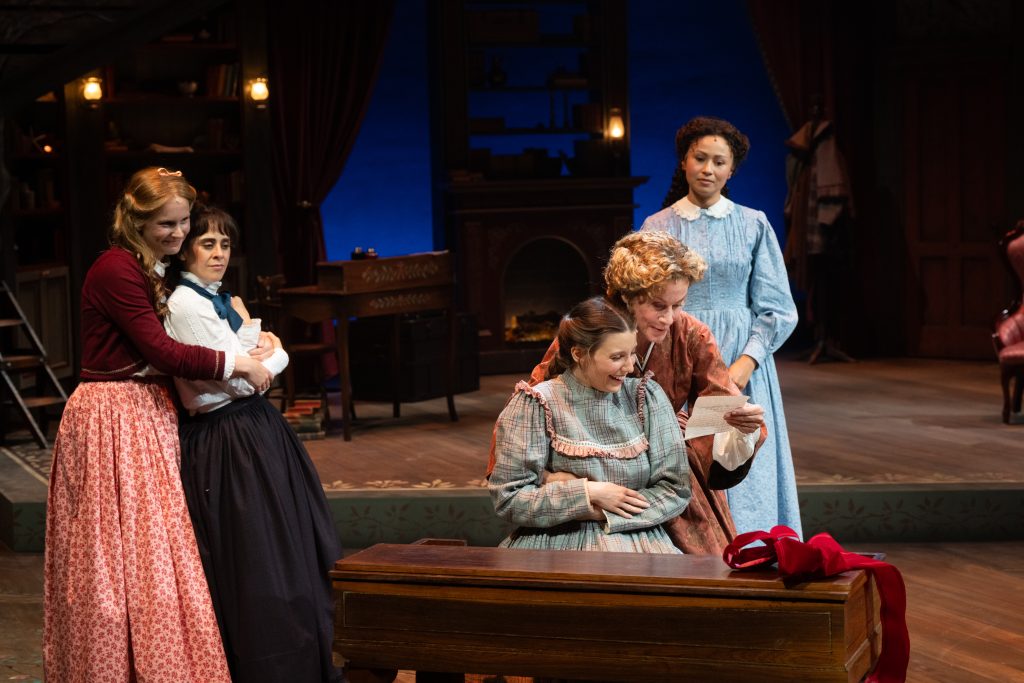
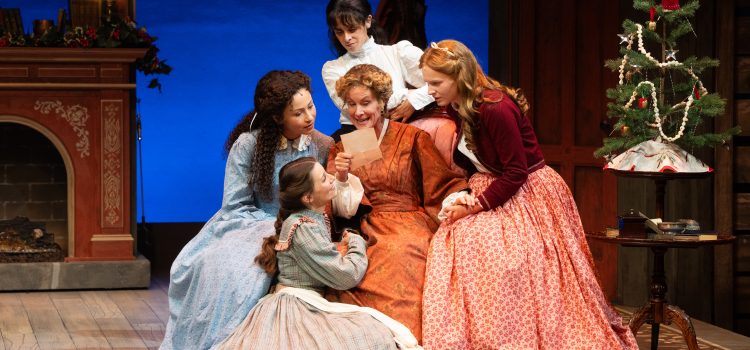
Addison Foote, Andrea San Miguel, Kristen Lindvedt, Marcia Pizzo and Amira Danan as the March women. Photo by Jon Gitchoff.

Gunderson, one of the world’s most produced playwrights, shares the same gift for honest writing that resonates. Through her fresh framing and frequent use of contemporary dialogue, the twin story unfolds, with dual roles of Lou and Jo played by the same actress. She also incorporated direct narration from Alcott’s writing, which adds authenticity.

In Civil War era Massachusetts, the fictional March family tends to the business of living while their father is away fighting for the Union Army. They endure traditional 19th century society struggles, especially financial – and love stories they refreshingly shape in their own way.

In 2024, director Delaney Piggins saw Gunderson’s adaptation during its rolling world premiere at the Northlight Theatre in Chicago, participating with three other theater companies. As associate artistic director, she lobbied for its inclusion in The Rep’s 60th season and is now making her triumphant directorial debut.

Her astute understanding of the characters and clever, inventive staging propels this charmer. Through her clear vision, she has gathered top-tier women creatives as designers — scenic designer Ann Beyersdorfer, costume designer Kotryna Hilko, lighting designer Paige Seber, and sound designer Amanda Werre. Choreographer Sam Gaitsch, intimacy director Frankie Ferrari, and dialect coach Lauren Roth all made noteworthy contributions, as did Paul Steger as fight director and Will Vicari as wig designer.
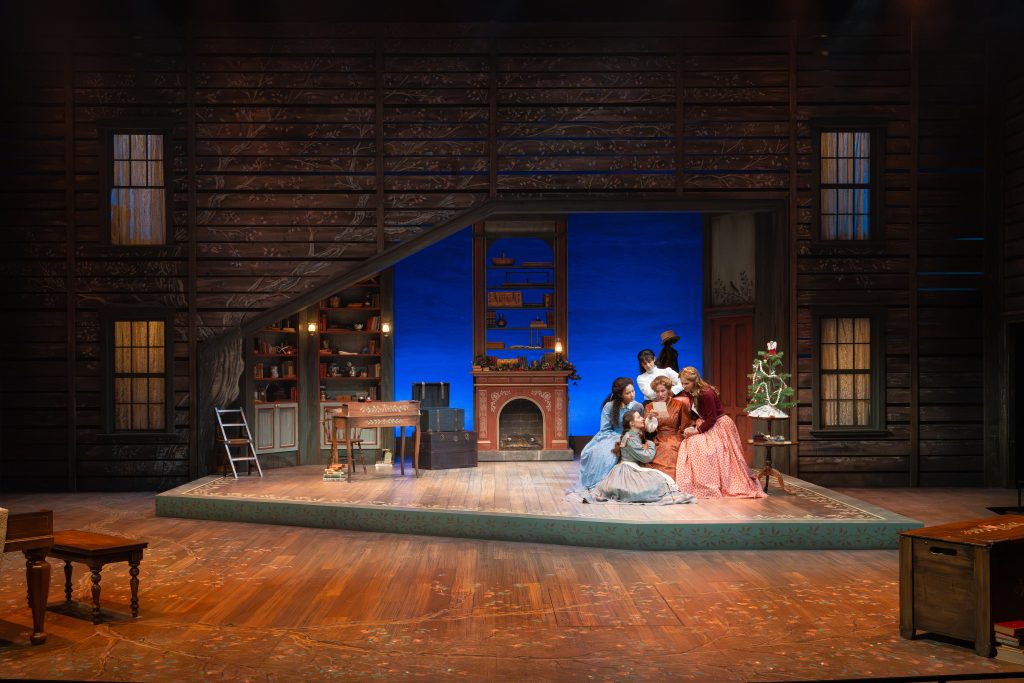
Photo by Jon Gitchoff.

Piggins has assembled a strong quartet of lovable multi-faceted March sisters – Amira Danan as dutiful and devoted Meg, the oldest; Andrea San Miguel as fiercely independent Josephine “Jo”; Kristen Lindvedt as kind and gentle Elizabeth “Beth”; and Addison Foote as melodramatic and spoiled Amy, the youngest.

For those of us who grew up with a strong mother, Marmee rings true – and so does the passionate affection of the sisters and the memories they evoke.

Marcia Pizzo is a calm moral compass as the matriarch, guiding her girls about what’s important — especially self-respect and inner character. Warm and wise, she tells them she’d rather see them happy and poor instead of marrying only for money or social status.

She notices that Meg and Amy are more concerned with social status and luxury and tries to lower those expectations. She confides in Jo that she’s learned to control her temper instead of it controlling her.  

As the young women go after what they want, the big female energy on stage and in the audience was palpable – and glorious. The production’s rebel spirit reflected Jo’s empowering and enduring aspirations.
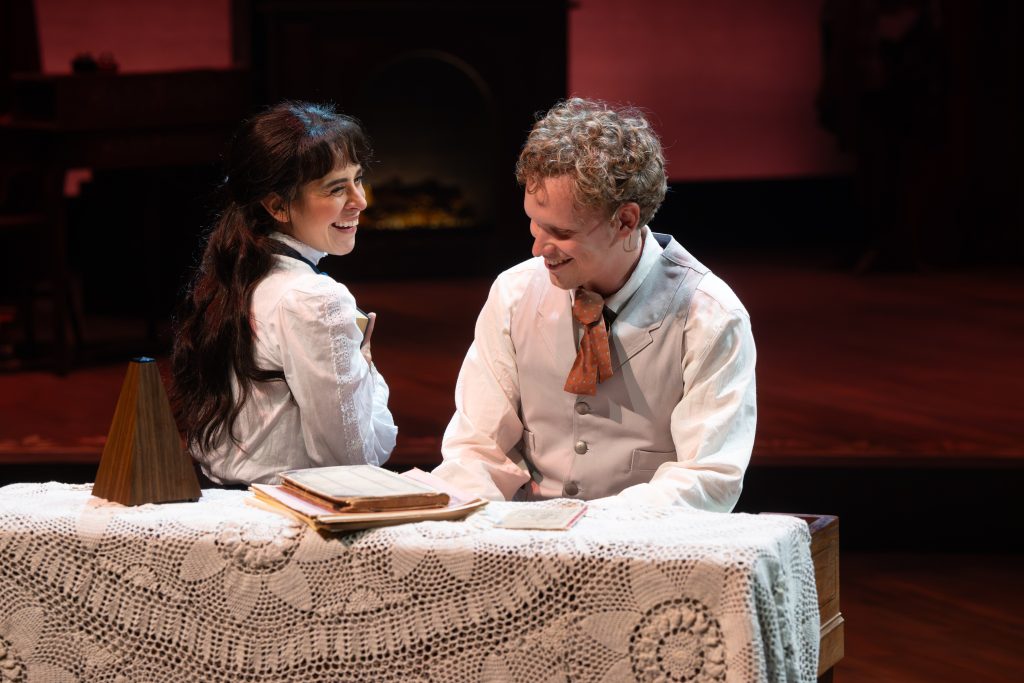
Andrea San Miguel and Jack Lancaster as Jo and Laurie. Photo by Jon Gitchoff.

Andrea San Miguel is a major force as feisty Jo, leaning into her tomboy side, sometimes with an over-emphasis on humor. She strongly interprets a confident Jo and stubborn Louisa. San Miguel, who won the St. Louis Theater Circle for Best Performance in a Comedy, Female or Non-Binary Role, for her masterful madcap mischief in “The Cottage” last year, displays the same ease with the robust performers here.

Amira Danan is a strong loyal and nurturing Meg, who ultimately marries for love over money. Kristen Lindvedt excellently embodies the shy peacemaker Beth, who provides such joy playing music for her family. Lindvedt, also the music supervisor, plays the stage piano.

Addison Foote must grow the most as her character Amy, at first selfish and dramatic, but eventually becomes a worldly sophisticate who marries Laurie (Jack Lancaster), aka Theodore “Teddy” Laurence, their playful childhood pal now sensible adult.

The energetic Lancaster is ideally suited as Laurie, starting off as a lonely, sheltered rich boy next door who becomes a regular fun-loving fixture in the March sisters’ lives. As a confidante and best friends with Jo, he and San Miguel have an effortless chemistry together.
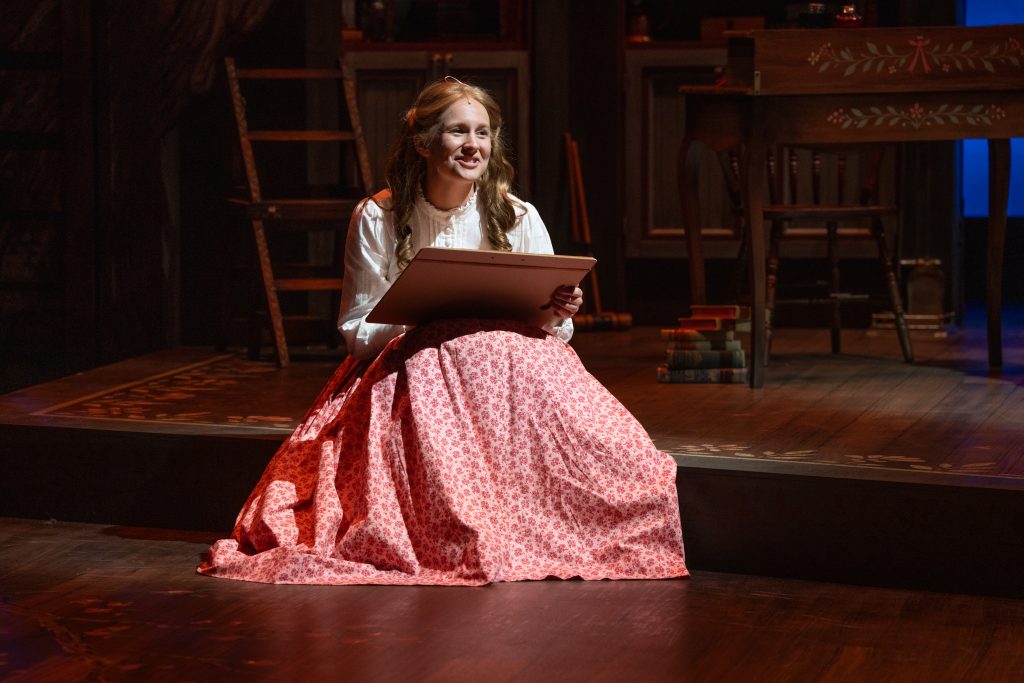
Addison Foote as Amy in “Little Women.” Photo by Jon Gitchoff.

They are such kindred spirits that when Laurie mistakes platonic compatibility for romantic feelings, Jo firmly rejects him, causing a rift. He flees to Europe, where he runs into Amy, who is studying art and painting while traveling with wealthy but cantankerous Aunt March (Marcia Pizzo in a dual role).

Eager for new horizons to fuel her literary ambitions, Jo travels to New York City, where she works as a governess and sells stories to publications. At her boarding house, she meets the kind and highly educated Professor Bhaer, who shares her passion for literature. He’s mature, respectful and hard-working. The spark is there; he and Jo will eventually share a wonderful life together, letting love in (“Little Men,” “Jo’s Boys”).

Adam Poss capably plays both Meg and Jo’s future good-guy husbands – earnest John Brooke and honorable Friedrich Bhaer. He’s first seen as Laurie’s tutor Mr. Brooke, who falls in love with Meg, then he enters late in the second act as the older German professor. He seamlessly transitions to each part and has a comfortable, steady presence on stage. He also briefly appears as the March patriarch.

Piggins’ fluid direction easily moves characters through the home, which scenic designer Ann Beyersdorfer has filled with books, mementoes, functional furniture and a small piano for Beth. The modest, lived-in New England aesthetic includes an outdoor area – for playing on the ice, dancing, and conversations. A second-floor window indicates the Laurence home. Lighting designer Paige Seber has shifted moods and seasons with her lighting choices that complement the set.
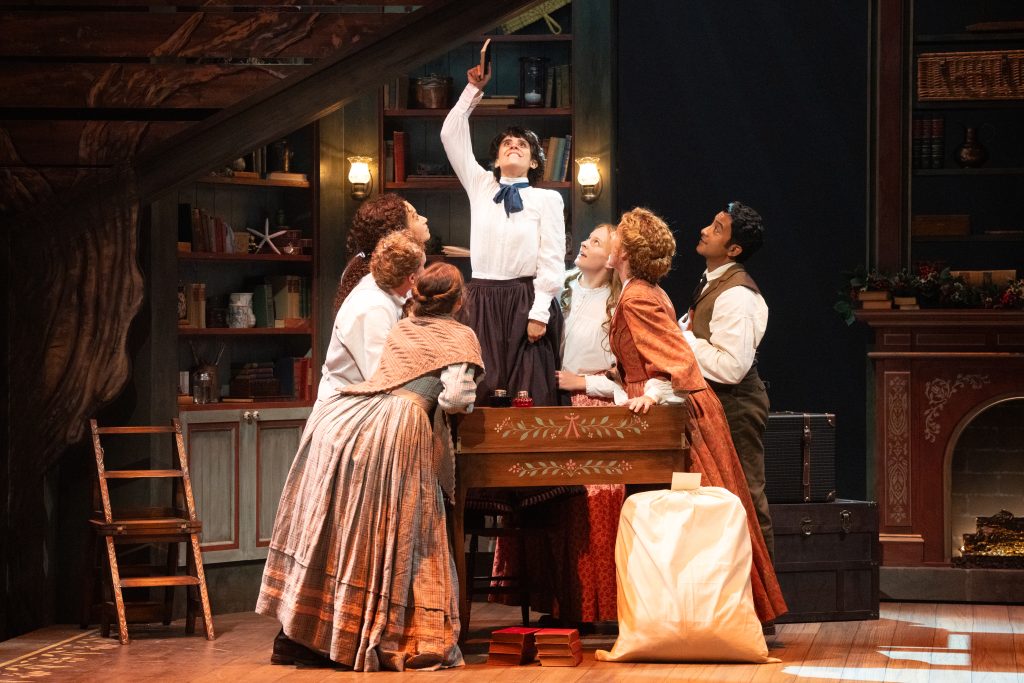
“Little Women.” Photo by Jon Gitchoff.

The costumes that Kotryna Hilko designed not only fit the period and economic status of the characters, but don’t bog down the performers in their active scenes, flowing well in movement, even with shawls and coats. With a few changes in jackets, Poss becomes three different characters.

To be in a theater alive with an effusive audience who believes in the deep value of female independence and creativity was meaningful Friday, a feeling I have carried – well, re-ignited, since that night. Those female voices, once found, carry.

Infused with Gunderson’s vitality and showcasing appealing performers, the Rep’s “Little Women” demonstrated that Louisa May Alcott’s populist work is timeless, sisterhood is a necessary emotional component in our lives, and women seizing their own journey with gusto is reason enough to stand up and cheer loudly.

The Repertory Theatre of St. Louis presents “Little Women” from Sept. 9 to Sept. 27 on the mainstage Browning Theatre in the Loretto-Hilton Center on the Webster University campus. For more information on tickets, call the box office at 314-968-3925 or visit www.repstl.org. For ticket deals, be sure to check out: www.repstl.org/ways-to-save
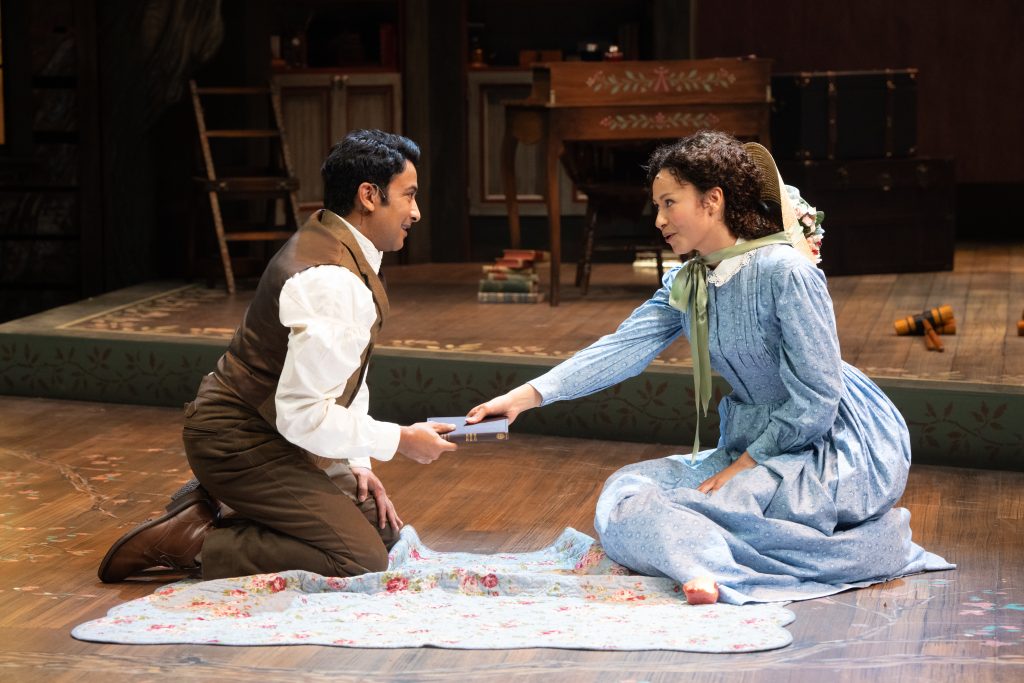

Adam Poss and Amira Danan as John and Meg. Photo by Jon Gitchoff.

By Lynn Venhaus

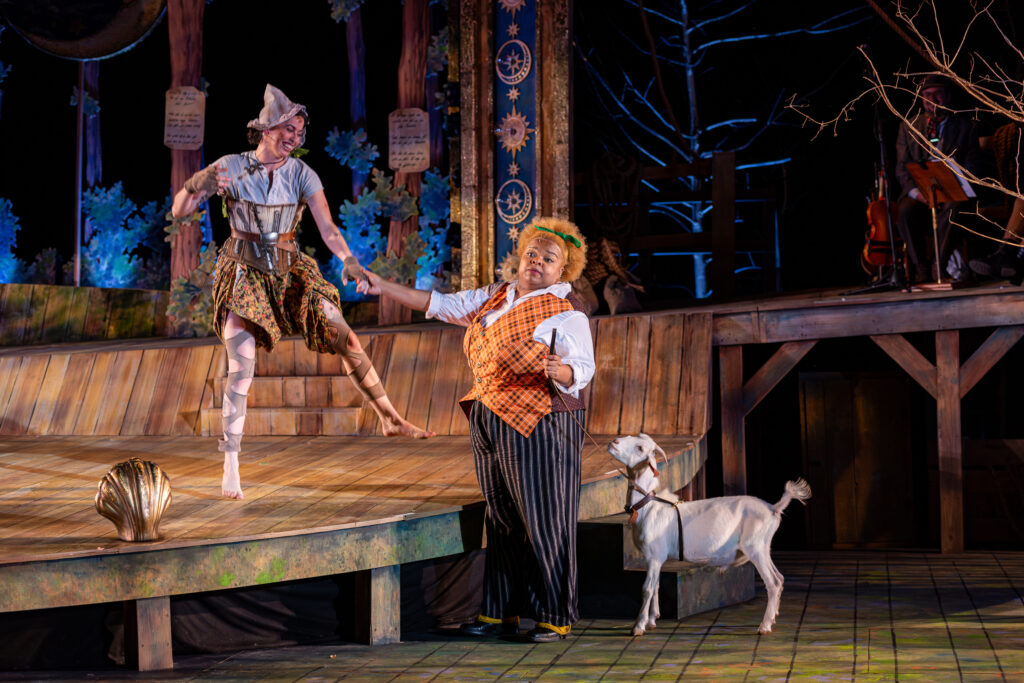
A grizzly bear, crocodile, prairie dog, red panda, and tiger dance into a party in Zoorona, and we get a bouncy beat, a perky vibe, and a bright-eyed and bushy-tailed family-friendly adaptation of Shakespeare’s classic love story, revived as “Romeo and Zooliet.”

After all, what’s in a name? “That which we call a rose by any other name would smell as sweet.” What if the animal kingdom put on their own show in the friendly confines of a public zoo?

This inspired first-ever collaboration between St. Louis Shakespeare Festival and the Saint Louis Zoo is staged in a grassy, wooded valley area known as “Historic Hill,” between the sea lions and Cat Country on the zoo’s south side.

It is an enchanted setting on a midsummer night, and even a rain delay and sound glitch on Friday, July 11, couldn’t dampen the enthusiasm and enjoyment, particularly of the young and the young at heart.

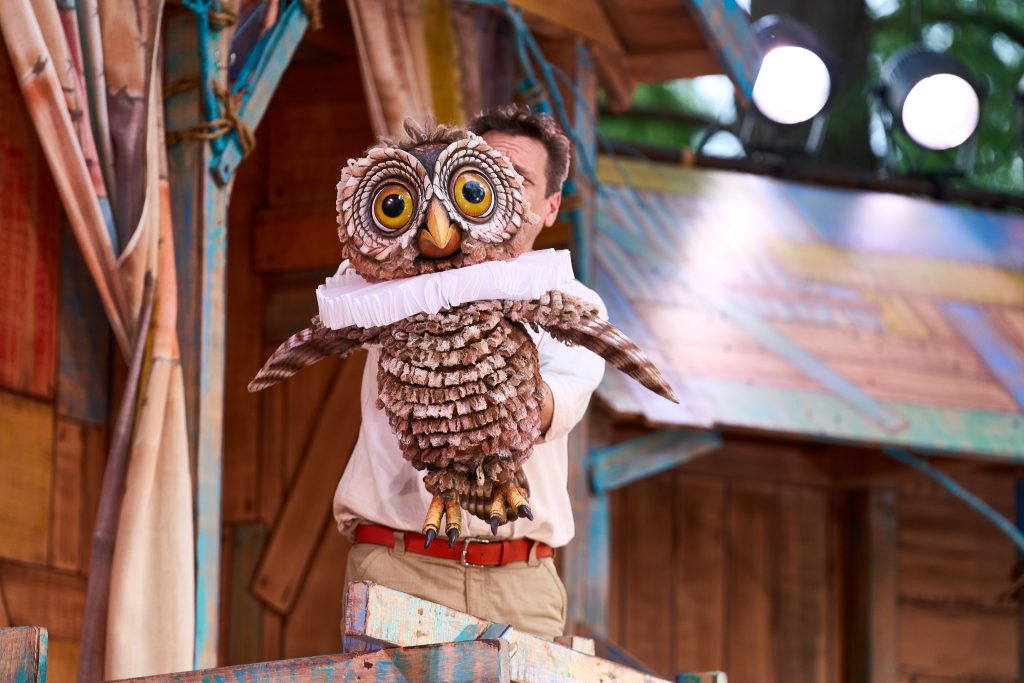
Ingeniously camped in a performance space named “The Glowb,” clever large custom-made animal puppets cavort in their make-believe habitats, courtesy of Shakespeare-trained actors nimbly operating their characters while they provide the voices and the movements.

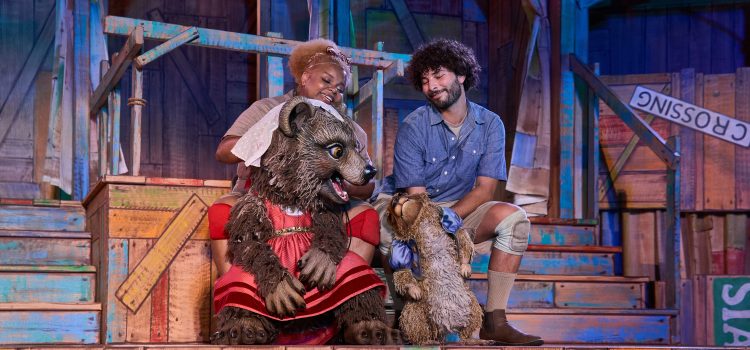
Ryan Omar Stack and Nisi Sturgis. Photo by Theo R Welling.

The synergy between playful puppeteers is uplifting, especially when you have a tale aimed at young audiences that is an ode to friendship. (In crossing the biological divide, no animals were harmed in this charming presentation).

The tragic-free conflict, created with wildlife behaviors in mind, is that cuddly bear cub Juliet, an omnivore who leans towards being a vegetarian, becomes best friends with adorable prairie dog Romeo, an herbivore who eats plants.

They don’t mind their differences and want to spend time together without their friends and families interfering. Those colorful characters are not feuding; they’re just from different clans.

Playwright Jennifer Joan Thompson’s imaginative script, based on a 2015 graphic novel, “The Stratford Zoo Midnight Revue Presents Romeo and Juliet,” which was written by Ian Lendler and illustrated by Zack Giallongo, takes flight in this delightful zoo setting.

An exuberant Ricki Franklin, a master interpreter of Shakespearean iambic pentameter, is the sweet Juliet seeking a best buddy. Franklin is a two-time winner of the St. Louis Theater Circle Award for performer in a supporting role for “Twelfth Night” and “As You Like It,” two recent outdoor productions in Shakespeare Glen, and her vibrant stage presence is welcoming.

Jacob Schmidt and Jordan Moore. Photo by Theo R. Welling.

Agile Jordan Moore plays nice Romeo, smitten with Juliet in a way where it’s the platonic version of “Did my heart love till now? forswear it, sight! For I ne’er saw true beauty till this night,” and wants to hang out after they dance.

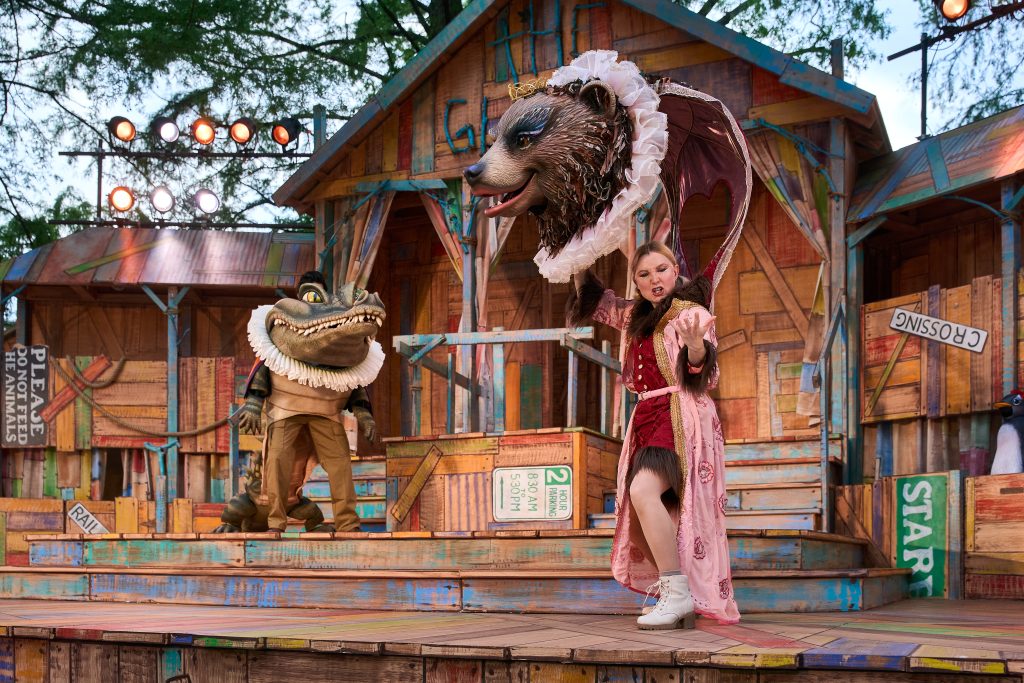
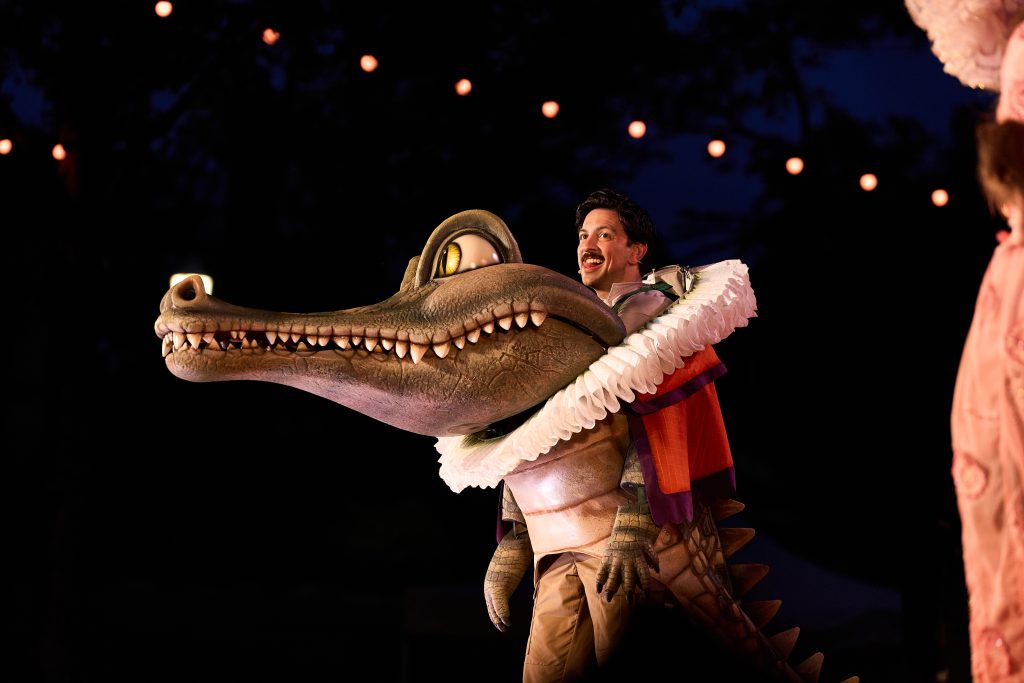
Juliet’s controlling mom, Lady Capulet, has other ideas — to have a play date with Paris, a smarmy crocodile with ulterior motives, for he sees a meal ticket. Nisi Sturgis’s suppleness in moving with an enormous bear apparatus above her head is impressive.

Adroit Ryan Omar Stack cunningly delivers his double entendre lines, trying to cover up his hearty appetite. He also portrays the prince, who is a sage sea lion (and easily distracted by balls!)

Zookeepers have gone home for the evening, and assorted critters come alive for fun and adventure. The remarkable puppets were designed and fabricated by Michael Curry Design. They collaborated with Julie Taymor for incredible “The Lion King” puppets, so no wonder these are striking in detail.

All the characters are animals that can be found in the Saint Louis Zoo – and on your way in and out, you can watch the prairie dogs’ antics as they go about their evening.

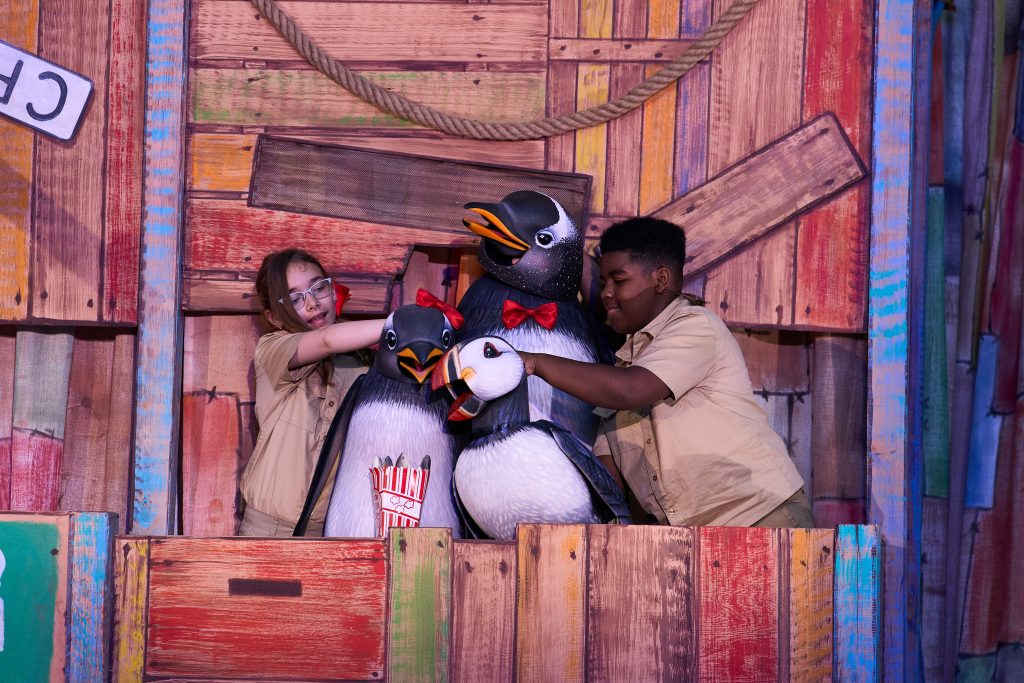
Narrators are a penguin, their offspring, and a puffin. Bryce Cleveland is Puff, Genevieve Mazzoni is Penny. Rian Page and Sophie Stogsdill are also listed in the program.

An animated Jacob Schmidt is a gleeful Mercutio, ready to dance, but he clashes with Juliet’s cousin, Tybalt (the always vivacious Rae Davis). He’s more laid back, she’s friskier – but they both are protective of their pals.

Schmidt also makes a comical entrance as an ambling tortoise, Friar John, ready to dispense his wisdom. He’s quite a crowd-pleaser.

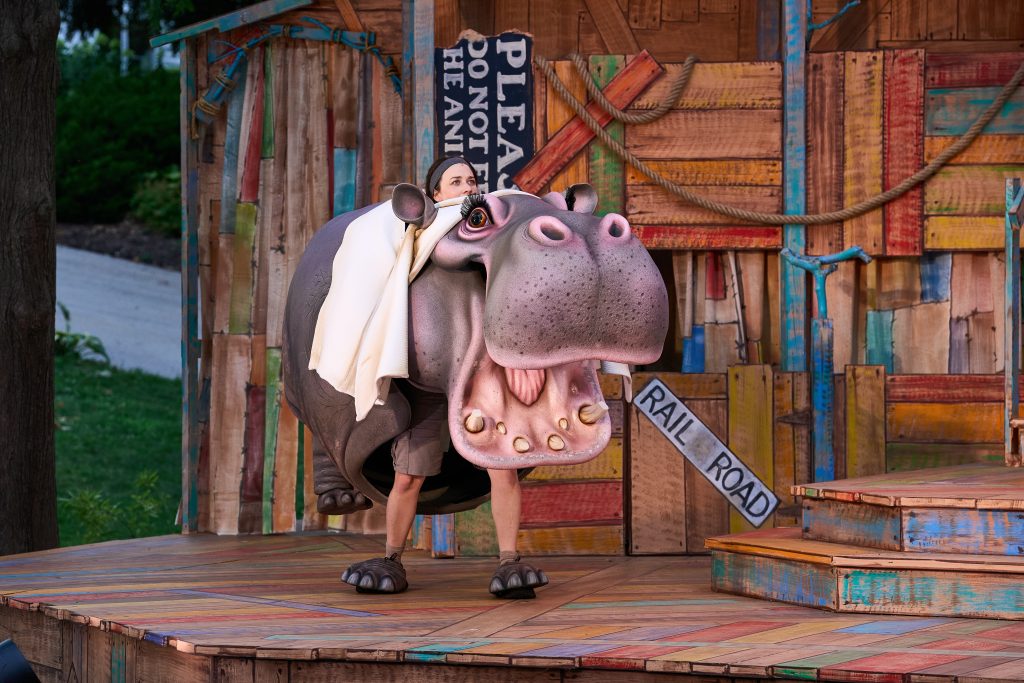
The mellifluous Jeff Cummings is Friar Lawrence, a wise owl, while Olivia Scicolone is a marvel of motion as a hippo, who is quite limber as Juliet’s fussy nurse.

Rising stars Charlie Mathis and Daisy Held are the capable swings throughout the run.

Scenic designer extraordinaire Scott C. Neale has fashioned a rustic performance space that’s part clubhouse, treehouse, campground and stage – with interesting nooks and crannies for the animals to pop in and take off from.

Jesse Klug’s lighting design incorporates fairy lights, and their illumination elicited ‘aws’ from the crowd.

Costume designer Rachel Adorno, in tandem with Caitlin McLeod, associate costume designer and additional puppet fabrication, give the animals distinct personalities – including sparkly masks for the party scene, to convey the whimsy. Eric Barnes managed the props.

With his keen eye for detail and his zest for high-spirited, fun-filled action, producing artistic director Tom Ridgely has helmed this show laser-focused on cheerful entertainment for all ages, especially wide-eyed youngsters.

Ridgely, as he always does, has included exceptional creatives on this show’s roster. His team included producer Colin O’Brien, associate producer Ryan Jeffery, stage manager Sarah Luedloff and assistant stage manager Britteny Henry.

Olivia Scicolone

The 80-minute show includes catchy pop tunes, with a sensational signature song “Just Like Romeo and Zooliet,” the show’s own interpretation of a song first recorded in 1964 by The Reflections.

It has been re-arranged by music supervisor Jeffrey “JQ” Oaiyum, and sung by JQ and Kiley B. Moore, with background vocals by Sophie Dimitroff and trumpet playing by Marques Carroll.

JQ is part of The Q Brothers, which have been involved in several shows presented here by the St. Louis Shakespeare Festival. A Chicago composer, he also works on the Emmy-winning Hulu series “The Bear.”

The peppy music numbers are choreographed by Sam Gaitsch, and Steve Ptacek did a terrific job with sound design. Zev Steinrock choreographed the fights.

Jeff Cummings.

While it’s briskly performed and pleasantly presented, “Romeo and Zooliet” is a massive undertaking, so no small feat for all involved to create such a magical, purposeful experience.

With an entire village of artisans, Ridgely good-naturedly directed this groundbreaking attempt to unite two different worlds, and we’re the better for it.

If you’re like me, you’ll leave grinning ear to ear, hearing little tots giggling being the best sounds of all on a summer’s eve. (And it’s not every day you hear barking sea lions ready to go to bed).

St. Louis Shakespeare Festival presents “Romeo and Zooliet” Tuesdays through Sundays at 7:30 pm from July 8 through Aug. 17. Performances take place at the Historic Hill in the St. Louis Zoo. For more information: stlzoo.org.

Rehearsal photos by Theo R Welling

Ryan Omar Stack as Paris.

By Lynn Venhaus

An invigorating energy, combined with an intriguing neo-noir atmosphere, mark an unforgettable milestone production of William Shakespeare’s most famous work, “Hamlet” as this year’s 25th St. Louis Shakespeare Festival in Forest Park offering.

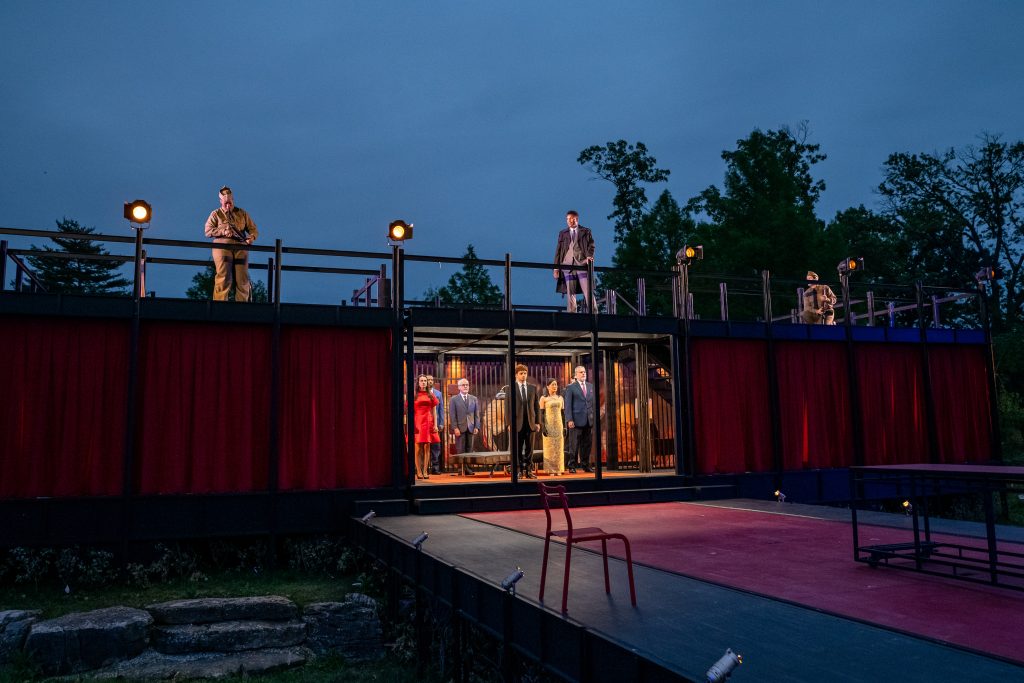
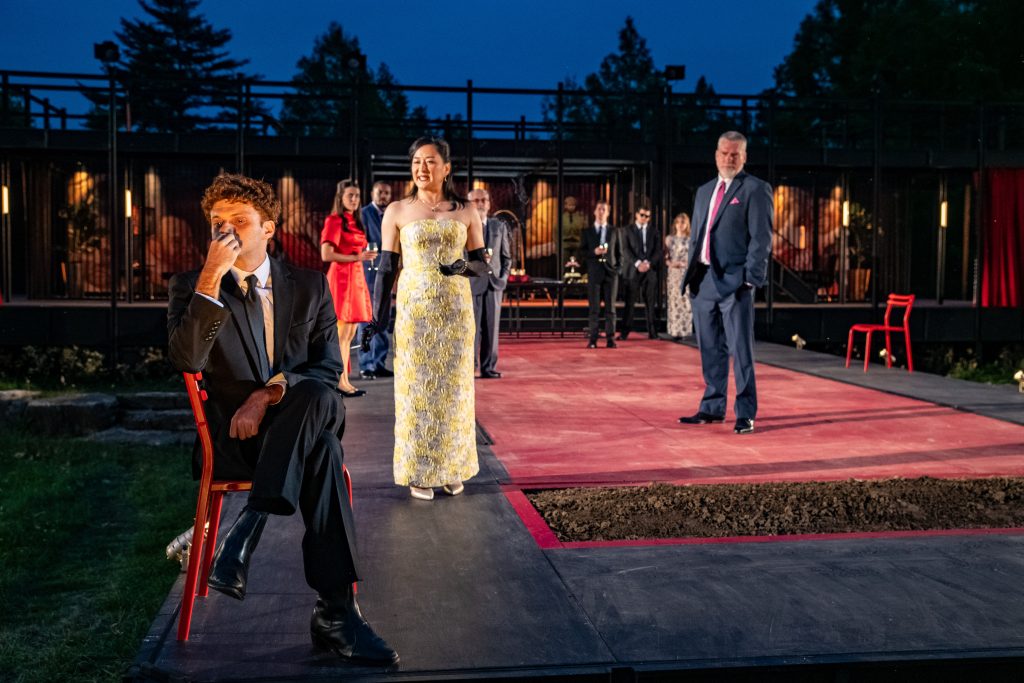
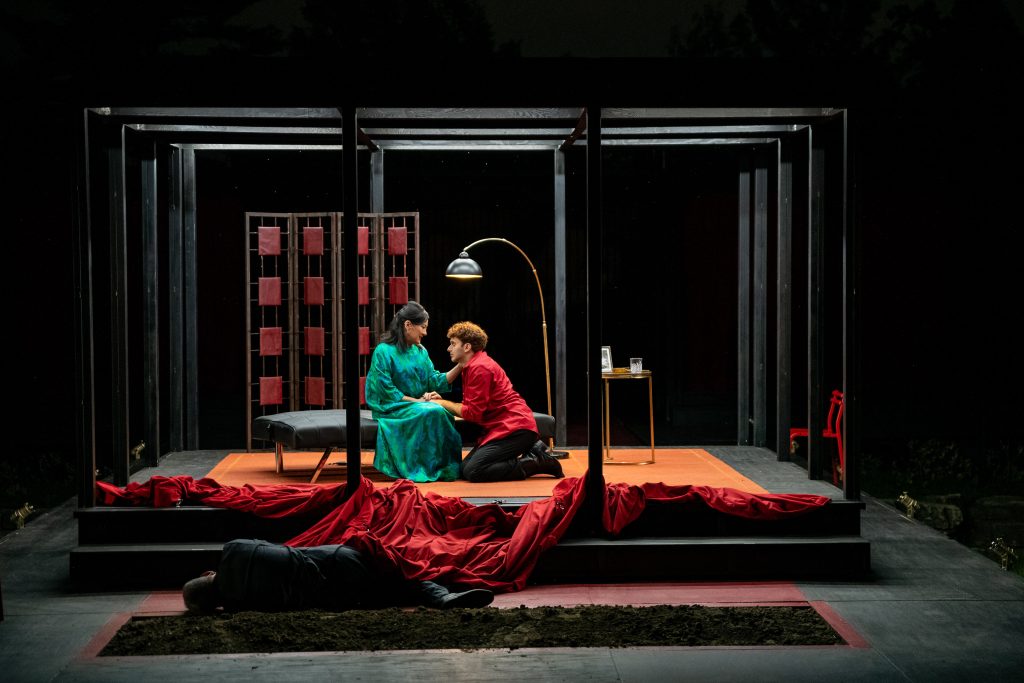
Director Michael Sexton’s novel interpretation is moody and minimalist, with scenic designer Scott C. Neale’s striking mid-century modern setting. Sexton follows through his stylistic vision with a noteworthy flair.

From the bold first appearance of King Hamlet’s ghost (Larry Paulsen), the prince’s father, one can sense we’re in for electric, thrilling storytelling, and these inspired choices bring out the best in the impressive ensemble.

Think the angsty howl of James Dean in “Rebel Without a Cause” combined with Robert Pattinson’s emo rendering of tormented Bruce Wayne in “The Batman” for this new-age Hamlet. After all, no one out-broods this iconic prince of Denmark.

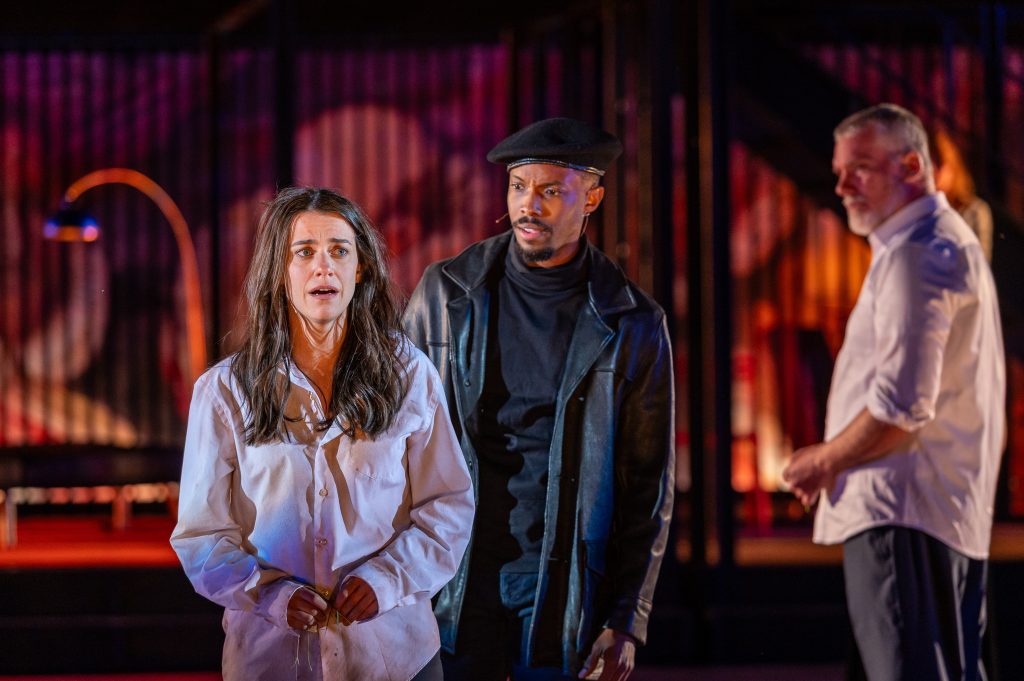
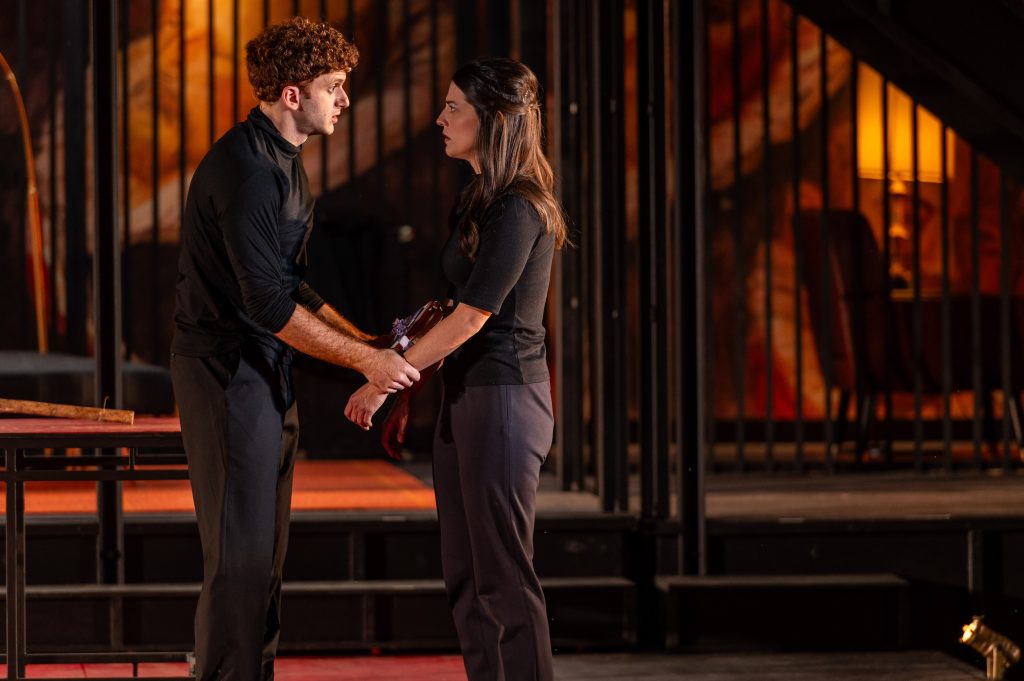
Raw, confrontational and reeling in emotional distress, Michael Khalid Karadsheh is mesmerizing as the boy – to the manner born — who comes home from college in Germany to learn of a “murder most foul.”

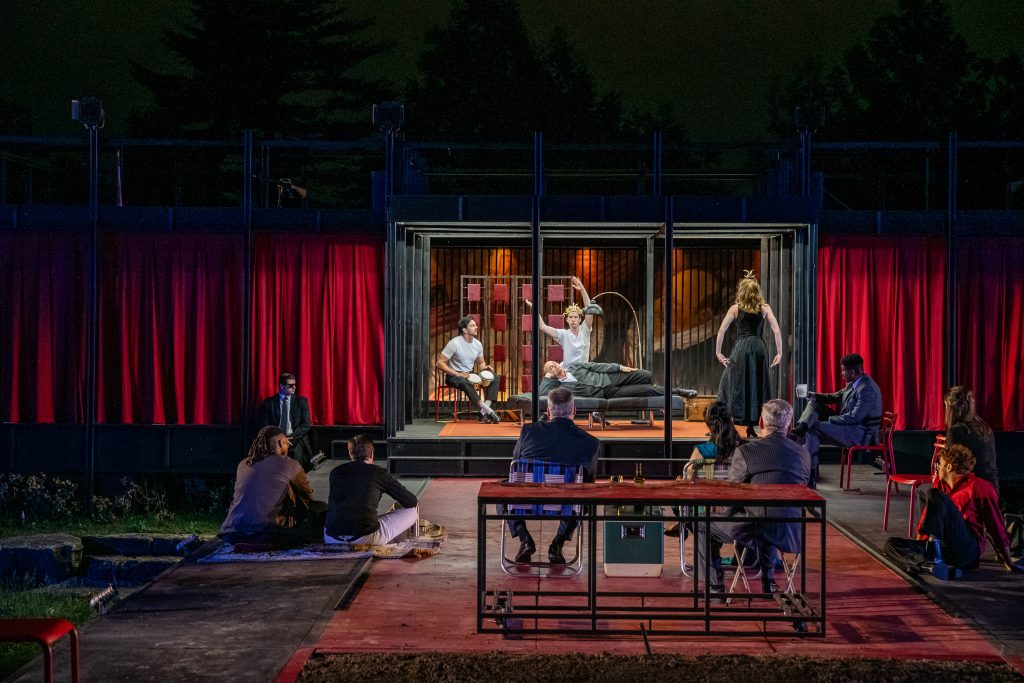
The play within a play. Photo by Phillip Hamer.

His father has been killed, and his mother Gertrude (Jennifer Ikeda) has married his uncle Claudius (Glenn Fitzgerald), who has seized the throne. He is the leading suspect in his stepson’s eyes and ever the manipulator, is trying to cast doubt on Hamlet’s stability.

“Something is rotten in the state of Denmark,” military sentry Marcellus (CB Brown) fears. Meanwhile, a war is brewing. Hamlet is a powder keg of emotion as he plunges into a downward spiral, suspecting corruption and abuse of power. A sense of foreboding is palpable.

Written around 1600, Shakespeare’s tragedy endures because of rich characters, complicated relationships and sharp observations about human nature. In the pastoral setting of Shakespeare Glen, the festival team blows the cobwebs off your English lit textbook with a fresh look at these Danish royals.

That includes a dynamic black, white, and red palette with shades of gray for unconventional statement designs – in Oana Botez’ functional, comfortable costumes (reminiscent of The Beat Generation and “Mad Men” wardrobes), Denisse Chavez’ atmospheric lighting emphasizing dramatic shadows, and Neale’s layered set. You won’t miss a palatial setting for Elsinore Castle.

Scott C. Neale’s striking set. Photo by Phillip Hamer.

The innovative dramatizing includes a versatile thrust stage (just like Shakespeare’s Old Globe) – 50 feet that juts from the standard proscenium stage. This allows for a more intimate connection with the actors.

And if you are waiting to be wowed by Hamlet’s soliloquies, Karadsheh’s emotional pleas are in optimum positions, and his commanding delivery of one of the most famous literary passages is a joy to behold. Drink every word in of the beautiful iambic pentameter.:

“To be, or not to be, that is the question
Whether ’tis nobler in the mind to suffer
The slings and arrows of outrageous fortune,
Or to take arms against a sea of troubles
And by opposing end them. To die—to sleep,
No more; and by a sleep to say we end
The heart-ache and the thousand natural shocks
That flesh is heir to: ’tis a consummation
Devoutly to be wish’d. To die, to sleep;
To sleep, perchance to dream—ay, there’s the rub:
For in that sleep of death what dreams may come,
When we have shuffled off this mortal coil,
Must give us pause—there’s the respect
That makes calamity of so long life.
“

Sarah Chalfie as Ophelia. Photo by Phillip Hamer.

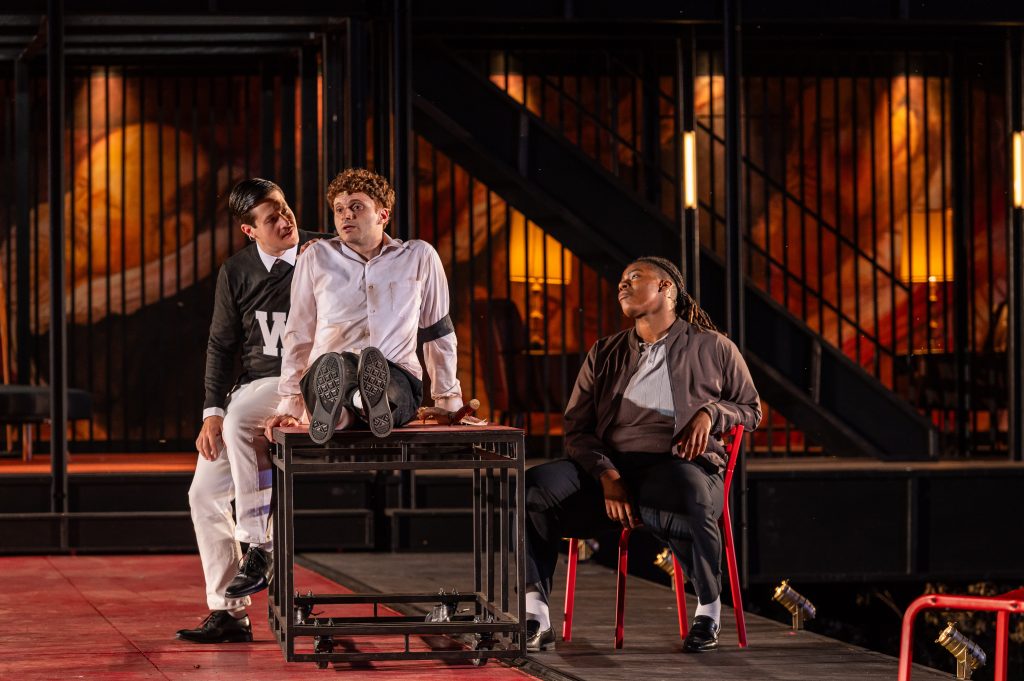
Consumed with guilt, rage and confusion, Hamlet is acting out, and not in a good way, alarming those closest to him. His mother sends for his Wittenberg University chums Rosencrantz (Mitch Henry-Eagles) and Guildenstern (CB Brown), hoping they can shed light on the situation.

His gal pal Ophelia (Sarah Chalfie) is scared, her brother Laertes (Grayson DeJesus) startled, their caring father Polonius – Claudius’ counselor – upset, and his best friend Horatio (Reginald Pierre) worried. It doesn’t help that he keeps seeing disturbing visions of his dad’s ghost.

Meanwhile, cunning Claudius is forcing power plays and mistrust to protect his secrets and lies. “That one may smile and smile and be a villain,” and Fitzgerald suits him well. Thus, Hamlet’s rebellion will bring more sadness, madness and losses.

Hamlet, Gertrude and Claudius. Photo by Phillip Hamer.

Most of all, the regal Gertrude, dressed in elegant ballgowns and cocktail attire, symbolizes wealth and aristocracy. Ikeda, who appeared as Juliet here in the fest’s inaugural production, contrasts with the young characters representing the need to explore and discover, find their purpose while they question moral decay.  

Hamlet’s disgust at his mom’s choices couldn’t be clearer — “The lady protests too much, methinks.” He can’t get past what he perceives as her betrayal.

You know exactly where Hamlet is coming from when he tells Horatio: “There are more things in heaven and earth, Horatio, than are dreamt of in our philosophy.” As Hamlet’s best friend, Reginald Pierre is a harmonious Horatio, his eloquence shines through, as he does in every Shakespeare role.

Pierre is masterful in delivering a heart-tugging “Goodnight, sweet prince, and flights of angels sing thee to thy rest!”

Gertrude, Hamlet. Photo by Phillip Hamer.

Mark Nelson excels as busybody Polonius, who is doomed by his meddling. When he advises his son and daughter “To thine own self be true,” the audience erupted in applause.  He also delivers the often misquoted “Though this be madness, yet there is method in’t.”

No matter how much he tries, he can’t save his emotionally bruised daughter, who can’t cope with losing her parent. Sarah Chalfie is outstanding in her robust portrayal of Ophelia, one of the best I’ve seen.

She’s no fragile flower, not the usual whiny or showing too ethereal qualities, and instead gives a fully formed rendering of a psychologically battered young woman raised to be sweet and pretty, but there’s an independence and intelligence that she brings out too.

In real life, Chalfie is responsible for helping to save the day when original cast member Vaughn Pole was injured and unfortunately needed to be replaced as Laertes. Chalfie knew actor Grayson DeJesus had played the part twice before, and he came to the rescue. Considering that he had only four hours’ rehearsal before opening night May 30 and was so vibrant on stage was a remarkable feat. His dexterity and fervor were exceptional.

Hamlet, Ophelia. Photo by Phillip Hamer.

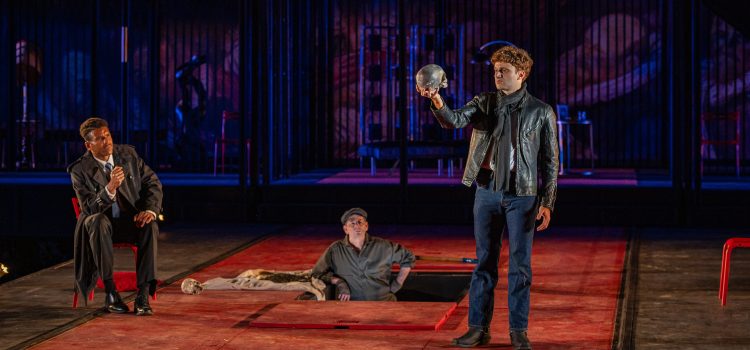
The supporting roles are fluidly handled by Max Fiorello, Daisy Held, Charlie Mathis and Ryan Omar Stack. Henry-Eagles and Brown also capably play another role other than their sharp preppies Rosencrantz and Guildenstern, and Larry Paulsen is also effective as the gravedigger, in addition to the fatherly spirit.

The presentation’s nifty flourishes in no way overshadow the passionate performances, for this tight ensemble rises to the occasion – it’s lucid, riveting and rhythmic in a way that the audience leans into the gripping action and the heartfelt agony.

Another outstanding addition to this year’s set is an eye-popping moving, motorized room that rolls up and down the stage on tracks, especially in the pivotal Polonius eavesdropping scene.

Perhaps music personifies this tale more than any other staged in recent years – although fine local musicians have added such gorgeous sounds in the previous comedies ‘As You Like It,” “Twelfth Night,” “Much Ado About Nothing” and “A Midsummer Night’s Dream.”

Music director/Composer Brandon Wolcott’s jazzy score played by East St. Louis trumpeter Brady Lewis is an integral part of the storytelling,. and recorded music sets the cinematic tone and heightens the ominous tension that builds in intensity.

Rosencrantz and Guildenstern, talk to Hamlet, center. Photo by Phillip Hamer.

Special mentions to choreographer Sam Gaitsch for her 50s ultra-cool dance moves, Zev Steinrock for his taut fight choreography, Laura Skroska as the key props master, stage manager Sarah Luedloff and assistant stage manager Britteny Henry for their brisk work, producer Colin O’Brien and assistant director Heather Anderson for assuring that all the elements come together in fine fashion.

This nontraditional dark adaptation is refreshing because its artistic accomplishments feel organic, and its collaborative creatives and cast dazzle without artifice for a truly enthralling evening. The play’s the thing! A haunting and hypnotic “Hamlet” starts the summer off with an exclamation point, and more is in store from St Louis Shakespeare Festival — with “Romeo and Zooliet,” the touring company’s “A Midsummer Night’s Dream” in 34 parks and an original St. Louis Shake in the Streets in East St. Louis.

St. Louis Shakespeare Festival presents “Hamlet” May 28 through June 22, nightly at 8 p.m. except Mondays in Forest Park’s Shakespeare Glen (near Art Museum). Admission is free but special seating is available for a fee. For more information, visit www.stlshakes.org

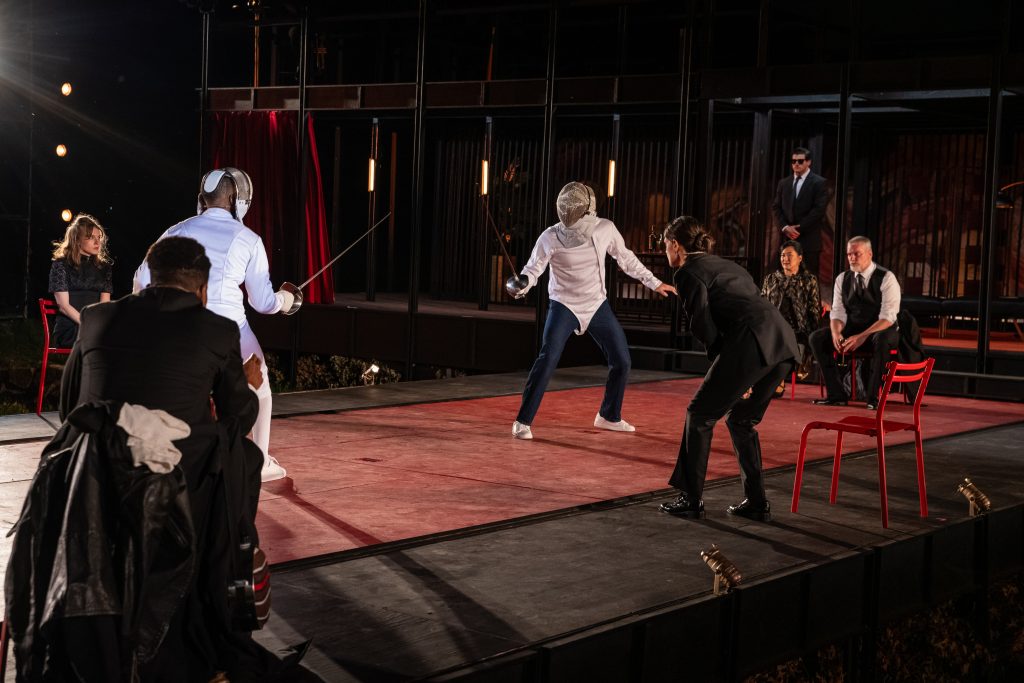
Laertes and Hamlet fence. Photo by Phillip Hamer.

By Lynn Venhaus

Need a vacation? Escape to Forest Park’s Shakespeare Glen for an idyllic summer treat, for “As You Like It” is a robust, refreshing tonic that celebrates the restorative powers of art, love, and nature.

An absolutely perfect vehicle for the St. Louis Shakespeare Festival’s annual offering, this 1623 romantic comedy is fun and frisky.

It’s been 20 years since it was last performed on the mainstage, and one of the playwright’s most accessible.

Sprinkling her magic fairy dust, director Nancy Bell demonstrates why she is a master interpreter of the Bard. A creative genius, she stamps every project with esprit and has a firm grasp of iambic pentameter.

In much the same way she has engaged audiences by transforming classics into easy-to-understand mashups in past local Shakespeare in the Streets projects, she maintains a breezy and playful atmosphere.

The festival’s former playwright-in-residence, she wrote the vigorous “Remember Me” performed outdoors in Maplewood, “Blow Winds!” downtown, “Good in Everything” in Clayton, “The New World” in Benton Park West, and the St. Louis Theater Circle Award winners for Best New Play “The World Begun” in Old North St. Louis and “Old Hearts Fresh” in The Grove.

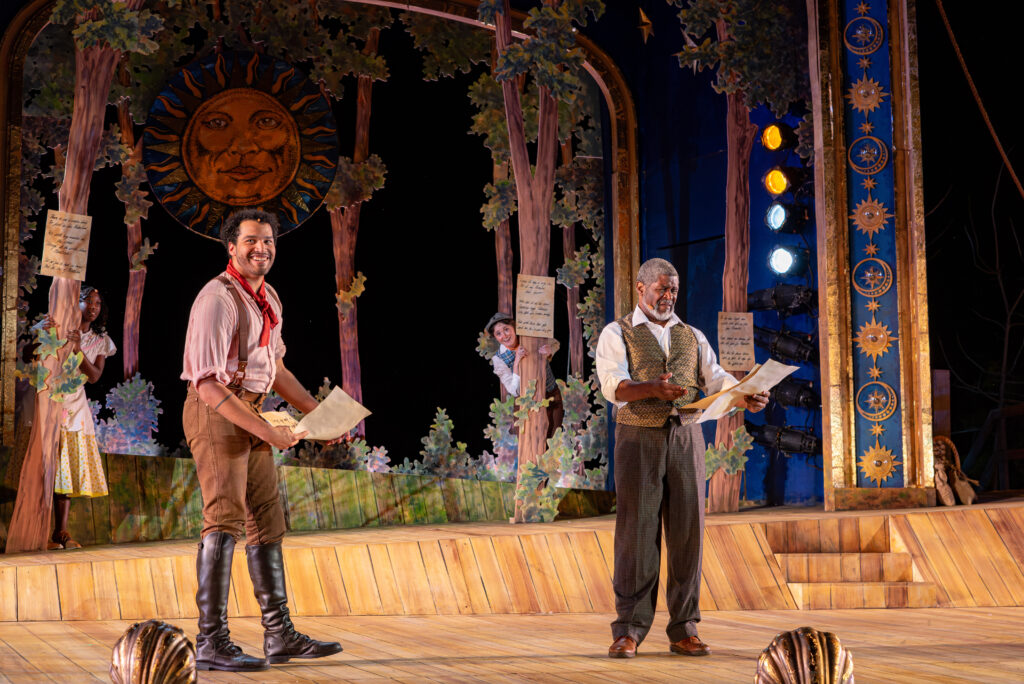
Christian Thompson, Wali Jamal.. Photo by Phillip Hamer.

To further illustrate a point about embracing change in “As You Like It,” Bell’s adaptation is a liberating antidote to a stuffy and strait-laced patriarchal Gilded Age.

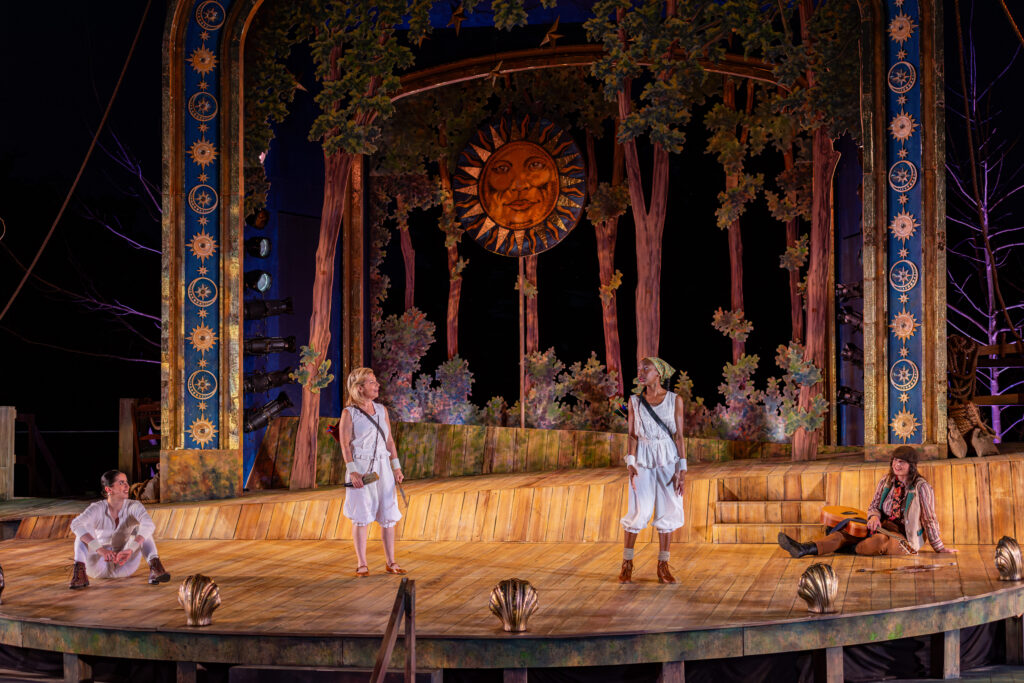
A scintillating ensemble conveys a more laid-back, accepting merry band of brethren – well, emphasis on a sisterhood – once action shifts to the Forest of Arden.

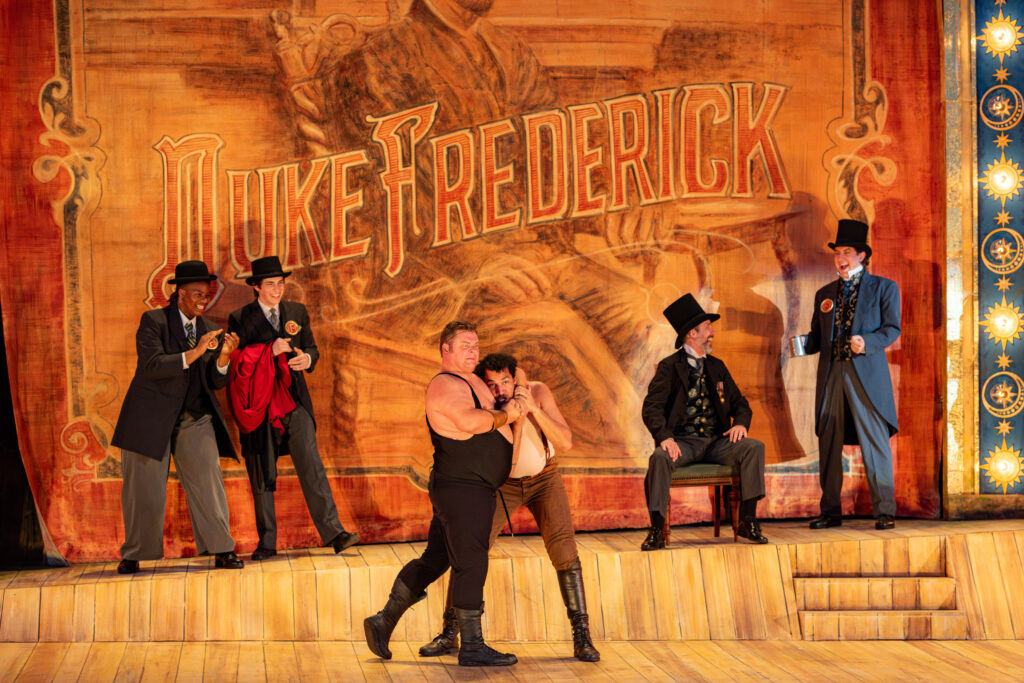
The contrasts couldn’t be sharper when imperious Duke Frederick – ever-reliable Joel Moses in high-handed wickedness, banishes his sister Duchess Senior, a feisty Michelle Hand, from the royal court. Oh pshaw!

Defiantly, the Duchess flees to the Forest of Arden, where she discovers exile can be rejuvenating. It’s another memorable performance from the inspired Hand.

Also thriving in this pastoral setting is the Duchess’ daughter Rosalind, a clever girl who disguises herself as a man, Ganymede. After all, this is Shakespeare, so of course the plot includes mistaken identities.

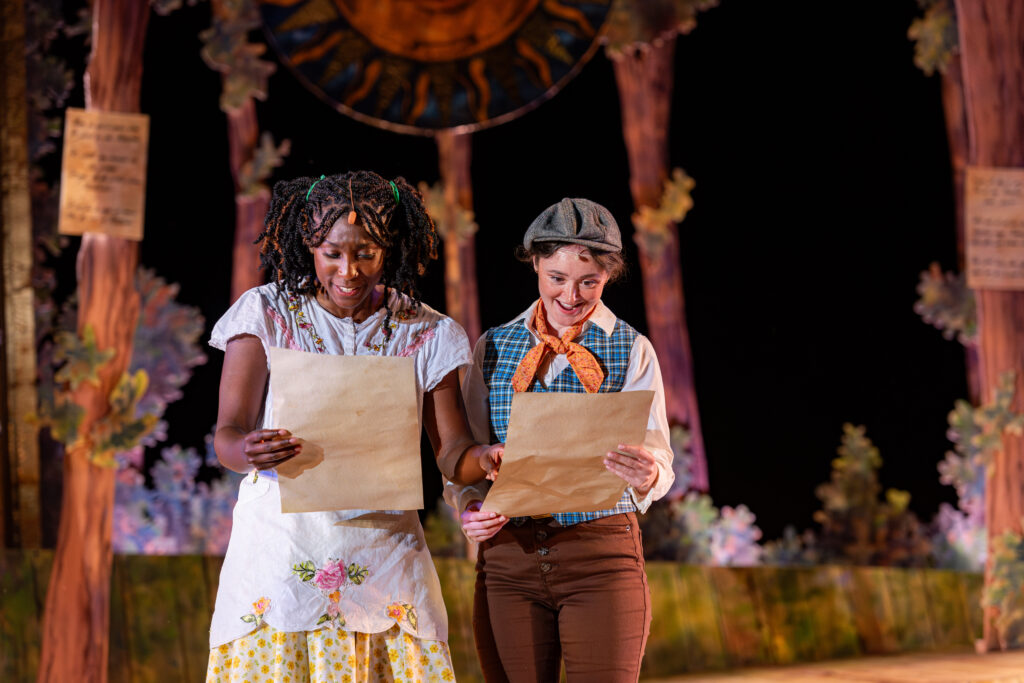
Caroline Amos is poetry in motion as Rosalind, sprinting across the stage with boundless energy. She is matched by the delightful Jasmine Cheri Rush as her loyal cousin-best friend Celia, the Duke’s daughter. Rush has returned for a second year, after playing Olivia in last summer’s “Twelfth Night.”

Bianca Sanborn, Michelle Hand, Riley Carter Adams, Beth Bombara. Photo by Phillip Hamer.

Rosalind falls in love with affable landowner Orlando, also displaced, and Christian Thompson is a charmer as her heroic object of affection, if a bit dim because he doesn’t suspect anything unusual.

In fairness, he’s pre-occupied trying to stay one step ahead of his scheming brother Oliver (Greg Cuellar), who is not very nice – as in trying to get his sibling killed.

Their lives become topsy-turvy, with thankfully Orlando having a change of heart, and the sweet Celia zeroes in on him.

Further wackiness ensues with the introduction of effervescent Ricki Franklin as bawdy Touchstone, a clownish character. Franklin’s a bright addition for the second year in a row, a scene-stealer last summer as Dame Toby Belch in “Twelfth Night,” a gender-bending turn that earned her a St. Louis Theater Circle Award,

Delivering one of Shakespeare’s most famous soliloquys, “All the world’s a stage…,” the mellifluous Wali Jamal earned applause immediately after reciting the passage so eloquently. He plays Jaques, a solitary and gloomy man who leans towards the melodramatic.

The multi-generational cast includes familiar and fresh faces, notably local treasure Joneal Joplin, who was in the festival’s first Forest Park show, “Romeo and Juliet,’ in 2001. He returns for his seventh one as Adam, a devoted servant of Sir Rowland de Boys, who is Oliver and Orlando’s father.

Jasmine Cheri Rush, Caroline Amos. Photo by Phillip Hamer.

Making her festival ensemble debut is winsome young teen Riley Carter Adams, a seasoned performer on local stages with television credits. She is listed as “young lady.”

Romance is on the mind of several characters. Kathryn A. Bentley is a likable shepherd Corin, a sage advisor to Silvius, who is not listening. CB Brown is endearing as the lad in need of guidance, for he’s in pursuit of Phoebe, who only has eyes for Rosalind (Ganymede).

Molly Wennstrom is spirited as the unpleasant but lovestruck shepherdess, whose course is altered by Touchstone’s interesting moves. Phoebe’s due for a rude awakening.

Two of the goofiest characters are Isaiah Henry as William, a simple, unsophisticated country boy crushing on goatherder Audrey, humorously played by Bianca Sanborn.

In a crowd-pleasing turn, St. Louis professional wrestler Lenny Mephisto, aka Maniacal Mephisto, is pitted against Orlando as Charles, a wrestler in the duke’s court.

The wrestling match is well-staged, thanks to savvy fight and intimacy choreographer Rachel Flesher, and Cuellar, who also is fight captain.

Lenny Mephisto, Christian Thompson wrestle. Photo by Phillip Hamer.

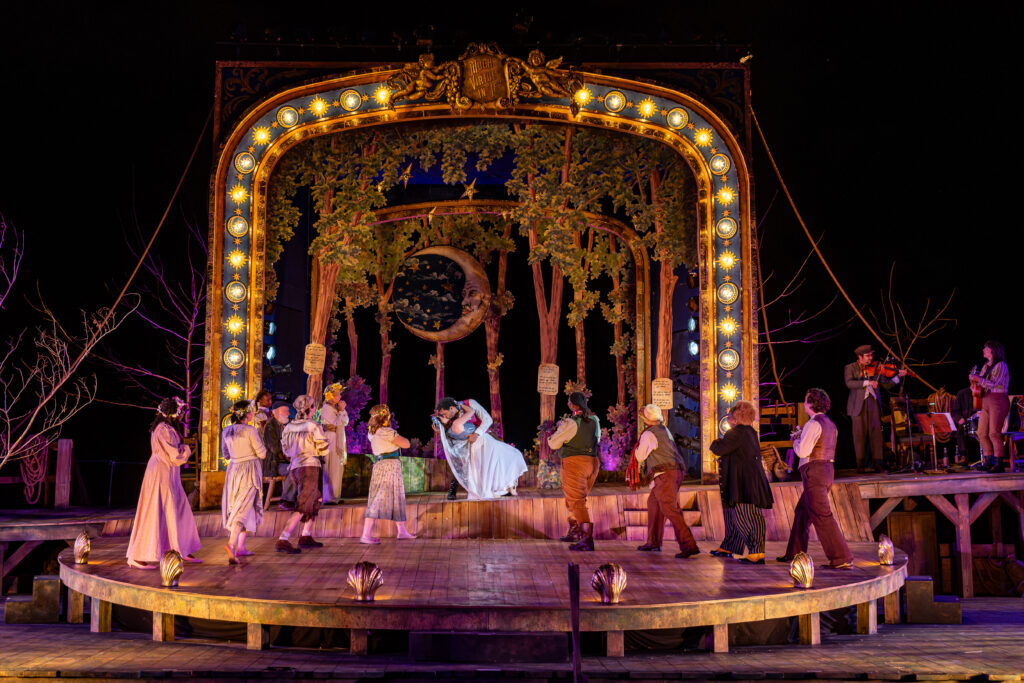
Captivating music is an integral part of this vibrant tableau, with an original score performed live on stage by local musician Beth Bombara in the role of faithful friend Amiens. Joining her are Sam Golden on viola and mandolin and percussionist Jeremy Reidy.

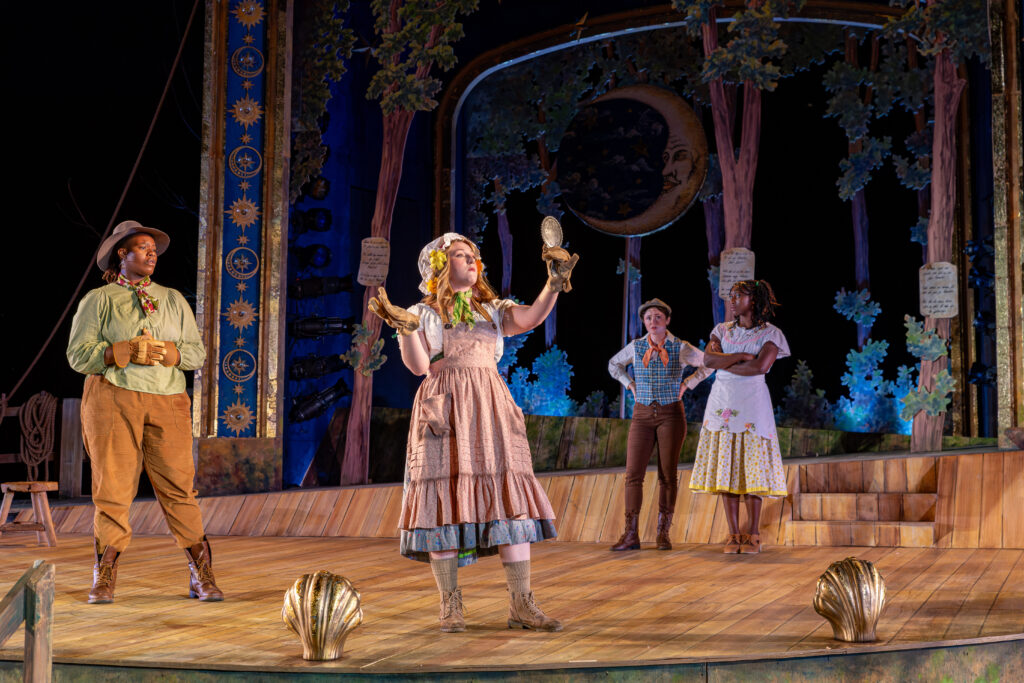
Scenic Designer Scott C. Neale, whose work has always astonished on the outdoor stage in Shakespeare Glen, has created a striking bucolic setting that is reminiscent of an old-timey illustrated picture book. Its reveal earned a hearty round of applause.

Among his six previous designs, you may recall his stunning set for “Antony and Cleopatra” in 2015 and “Henry IV and V” the year before.

As is customary, the technical work is superb, with distinct work by lighting designer Denisse Chavez and costume designer Dottie Marshall Englis. Sam Gaitsch choreographed buoyant moves, and props manager Taylor Laine Abs kept the accessories simple.

The unpredictability of working with live farm animals is evident with a goat and a sheep from D Bar S Ranch, which amused the crowd May 31. Apparently, from new accounts, they are adjusting to life in the spotlight.

Bianca Sanborn, Ricki Franklin. Photo by Phillip Hamer.

With its exuberant and energetic cast having a swell time on stage, that translates into one of the most enjoyable Shakespeare Festival’s mainstage efforts to date.

Due to their high standards, the festival has grown into the largest free outdoor Shakespeare play between the coasts. It’s a well-deserved achievement, and this supremely entertaining effort is not to be missed.

The festival is one of the best things about living in the St. Louis metropolitan region, and we are so very fortunate to be able to smile on a summer night under the stars in Forest Park.

St. Louis Shakespeare Festival presents “As You Like It” from May 29 to June 23, Tuesday through Sunday, at 8 p.m., free in Forest Park (Shakespeare Glen). https://stlshakes.org/production/as-you-like-it/

Shakespeare in the Park is free to attend, no reservations or tickets required for any of the performances. But every night a small number of reserved chairs and blanket spots are available for purchase – directly supporting the Festival’s mission and year round programming. Find your favorite spot: in the blanket-only section, box seats for up to six guests or general single-chair reservations.

CB Brown, Molly Wennstrom, Caroline Amos, Jasmine Cheri Rush. Photo by Phillip Hamer.
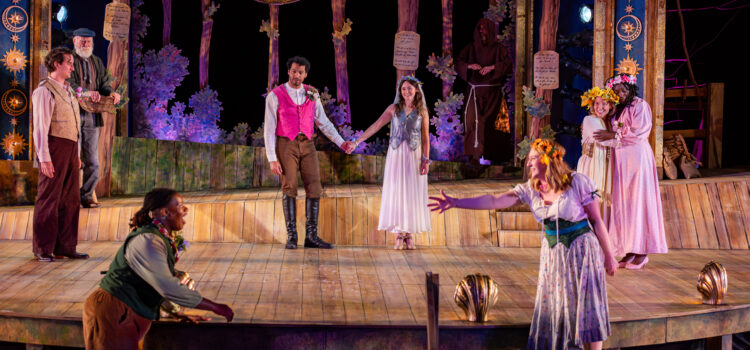
The company. Photo by Phillip Hamer.