By Lynn Venhaus

Wow, just wow!

The latest heart-warming production of “Meet Me in St. Louis,” which is self-referential – us sitting in Forest Park watching a musical about the 1904 World’s Fair set in Forest Park, is so remarkable that with the Muny’s utmost care and dedication, all our collective memories came alive.

We felt it, the nearly 8,000 of us gathered on Friday. That connection, that thread linking each one of us, elicited never-ending smiles on a summer night. Just as our ancestors did, we reveled in the Muny magic under the stars

This beloved musical’s ninth time on that renowned stage is thrilling, sentimental and even tear-jerking. After all, it’s unmistakably “right here in St. Louis,” which is a vibrant valentine to the community.

Director Maggie Burrows and her creative team established a homey feel, leaning into the happy golden days of yore.
Beth Leavel (left) and the company of the 2026 Muny production of “Meet Me In St. Louis.” Photo by Phillip Hamer

That sense of wonder, of awe, and a swelling of civic pride came together organically to celebrate our treasured traditions and what makes our region so special through the devoted designers/ technical team. They feel the same way, and it shows.

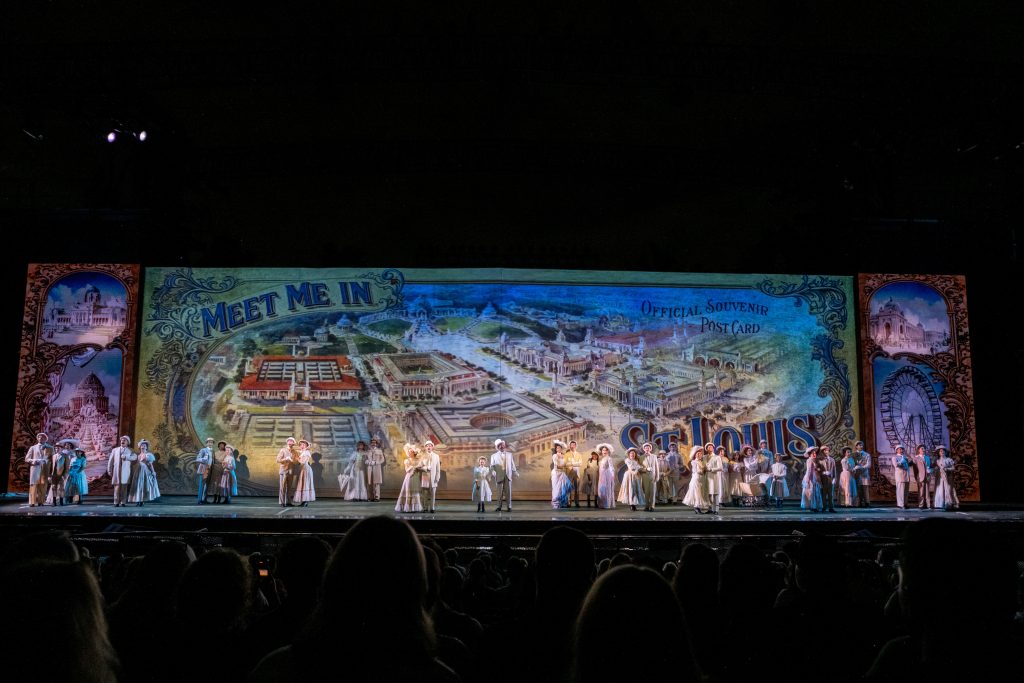
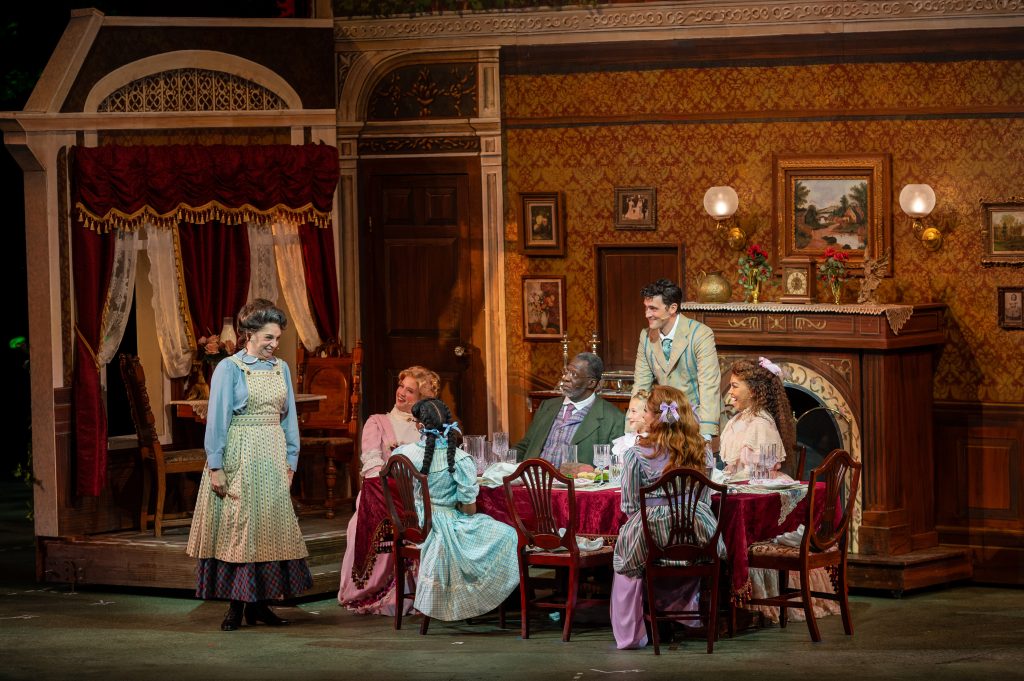
In fact, the visual storytelling splendors they’ve designed are unprecedented – we’ve never seen these paired in such a spectacular way. Set designer Ann Beyersdorfer’s re-imagining of the Smith’s Victorian home at 5135 Kensington Place is a revolving work of art, a picturesque red-brick exterior and richly period-detailed interior on the Muny’s massive turntable (master technicians, we salute you).

Add the changing seasons – once again, falling snow, like “Frozen” did last year for winter, and the natural beauty of trees framing the stage. The whole feel of the panoramic landscapes of our fair city, 1903-1904, as we keep rolling along on the shores of the Mississippi River.

New York-based Beyersdorfer, a Belleville native who has designed seven sets for the Muny, three for Stages St. Louis (current “Guys and Dolls”), and the upcoming “Little Women” for The Repertory Theatre of St. Louis, has created lasting memories here.
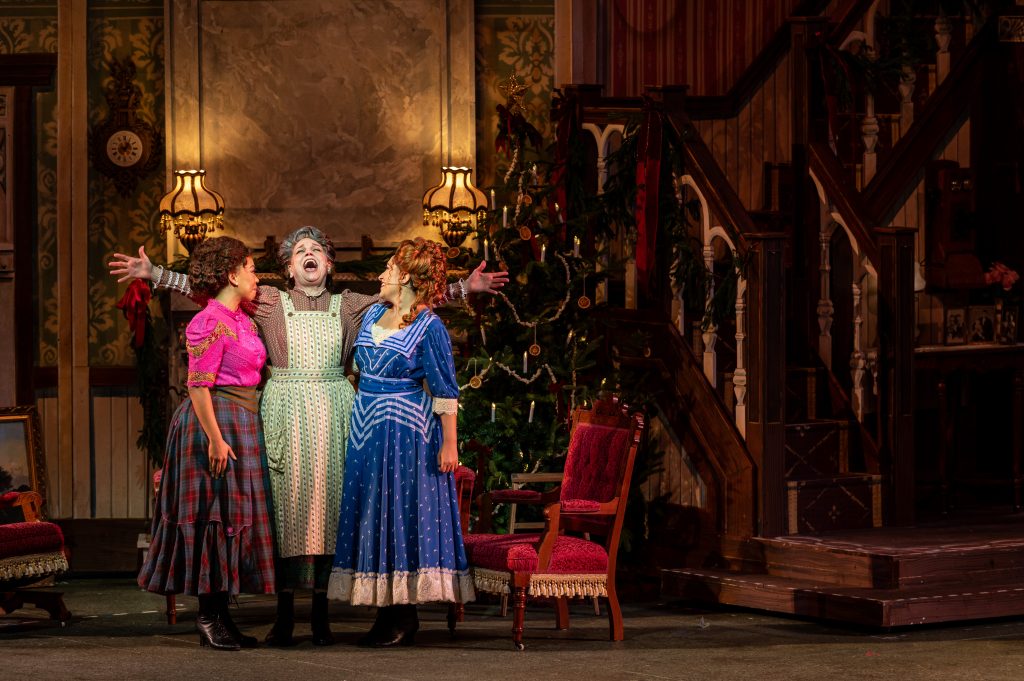
From left: Kyla Stone, Beth Leavel and Katerina McCrimmon in the 2026 Muny production of “Meet Me In St. Louis.” Photo by Phillip Hamer

The scenic design, paired with the ravishing video designs by Greg Emetaz and Kylee Loera, was a next-level display of what the Muny artisans are capable of, and the breathtaking sights prompted the audience to cheer and applaud loudly multiple times. The recreation of vintage lithograph postcards was exquisite.

The stage musical, first commissioned by and for the Muny in 1960, has always offered comforting nostalgia about the simple joys of childhood and affectionate family dynamics.

Let’s face it, the storyline is a deluxe Hallmark movie. Warm and winsome that it is, the Smith family drama occurs when a planned move to New York City throws plans awry, including romance for the two eldest daughters and being here when St. Louis hosts the World’s Fair.

Officially the Louisiana Purchase Exposition, which honored Lewis and Clark’s westward expansion and celebrated technology, culture and industry, the fair took place from April 30 to Dec. 1, 1904, on 1,200 acres in Forest Park.
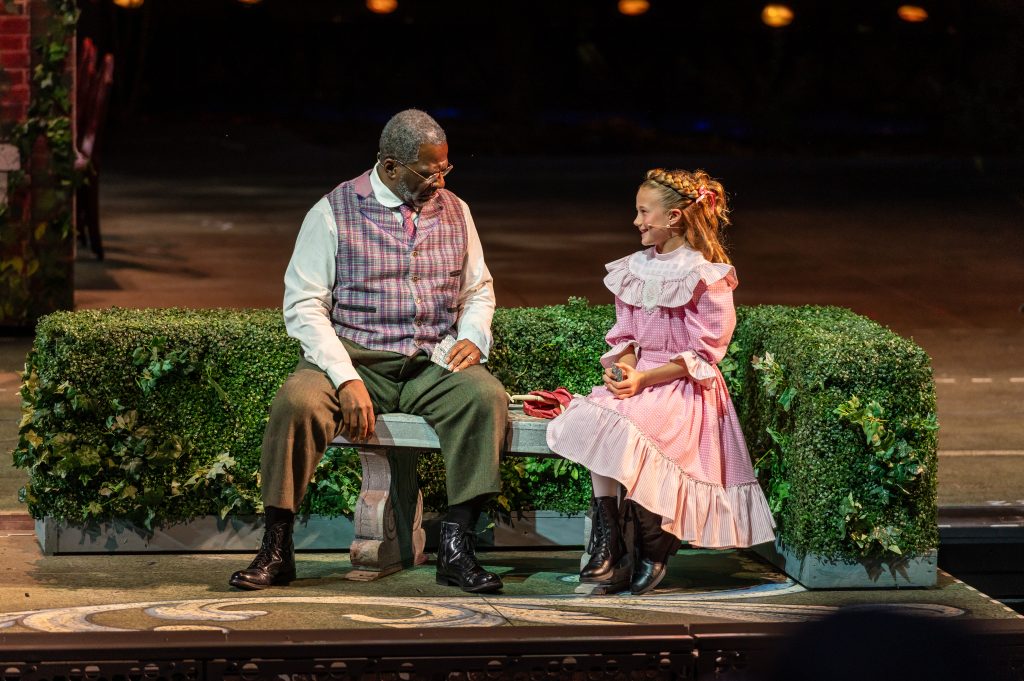
Stan Brown, Lilah Levinson. Photo by Phillip Hamer

It was the first time the Olympic games were held in the U.S., and introduced such foods as hot dogs, ice cream cones, cotton candy and iced tea. More than 60 countries and 43 states took part, and it attracted 20 million visitors.

Because the show matters so much here, the cast’s bond to the story was strong, honoring it with sincerity and joy. St. Louisan Colin Donnell, a Broadway veteran, is the genial patriarch, Alonzo Smith, who wants the best for his family.

He and his real-life wife, Patti Murin, are captivating anchors, projecting an emotional closeness. She’s appeared at the Muny seven times, last seen as Anna in “Frozen” last summer, and this time as sensible Anna Smith.

Triple-threat dynamo Katerina McCrimmon, fearlessly tackling such iconic roles as Fanny Brice on the national tour of “Funny Girl” in 2023 (brought down the house at the Fox!), and Eva Peron in last summer’s “Evita” here, assuredly slips into Judy Garland’s shoes as strong-willed, kind-hearted Esther Smith.
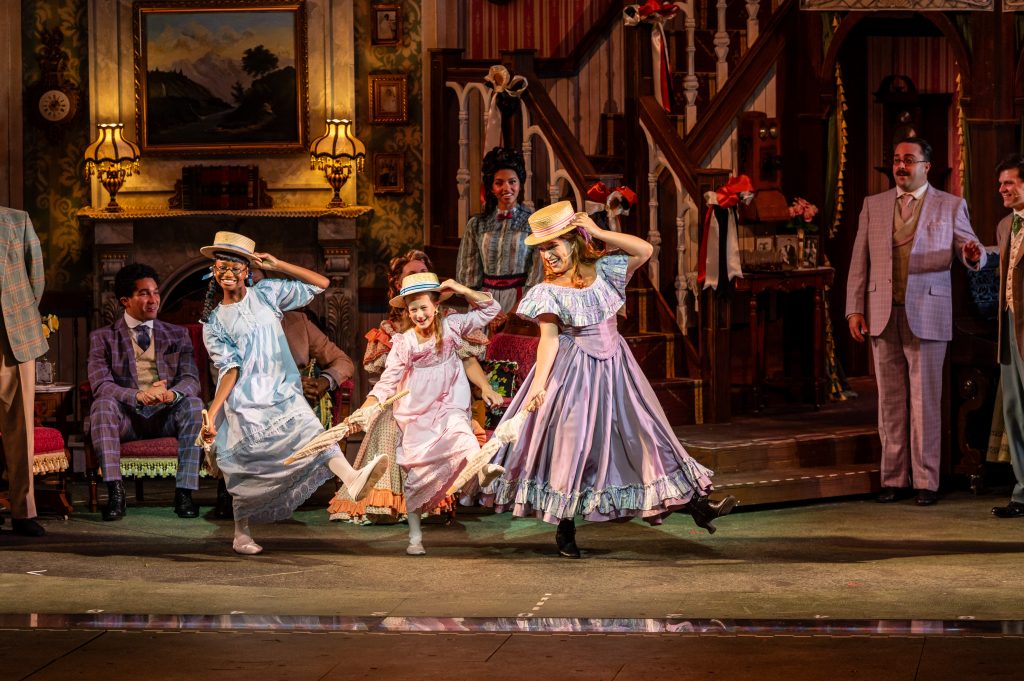
From left: Joylin Bass, Lilah Levinson and Katerina McCrimmon in the 2026 Muny production of “Meet Me In St. Louis.” Photo by Phillip Hamer

With her powerhouse vocal range, she balanced belting with vulnerability. She emulated Garland’s rich velvet timbre, combined with her emotional honesty and passionate vibrato, and they both shared the gift of tender, wistful delivery.

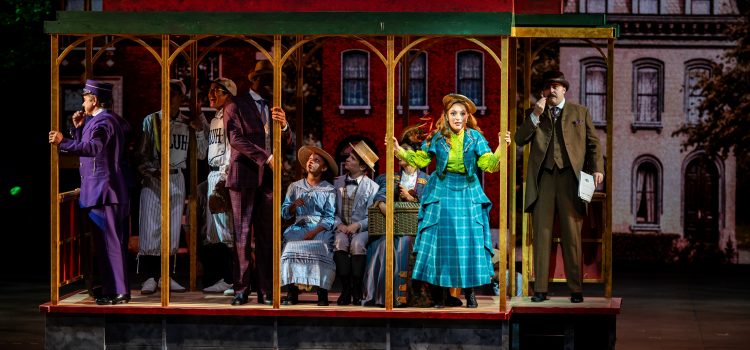
In the eye-popping and jaw-dropping “The Trolley Song,” we followed a moving trolley’s path through turn-of-the-century St. Louis as video projections of neighborhood vistas went by.

Gordon Greenberg’s snappy re-do of the book by Hugh Wheeler, which improved characters, pacing and boosted local references, debuted for the Muny’s 100th anniversary in 2018, and now, just in time for Forest Park’s 150th anniversary, it enveloped us with heart and humor.

Author Sally Benson grew up at that Academy neighborhood address, in the home her father purchased in 1891. Fun fact: her maiden name was Smith and her nickname Tootie. (Spoiler alert: They did move to New York. Sadly, the home was demolished in 1994.)
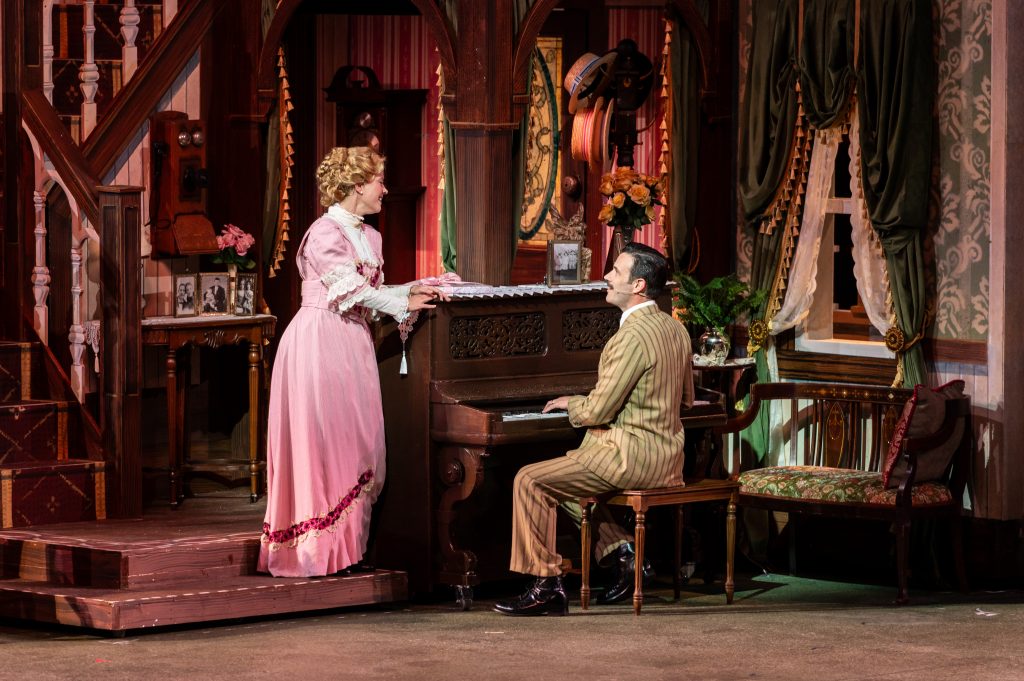
Patti Murin and Colin Donnell in the 2026 Muny production of “Meet Me In St. Louis.” Photo by Phillip Hamer

Her fond recollections were published in short story installments, “The Kensington Stories,” in The New Yorker in 1941, and proved so popular, she turned it into a book in 1942, the basis for the beloved MGM film starring Judy Garland and directed by Vincente Minnelli.

The movie was released in 1944 wartime America, resonating about home and togetherness, and included Garland favorites “The Boy Next Door” and the holiday classic “Have Yourself a Merry Little Christmas,” which McCrimmon makes her own. The movie is no. 10 on the American Film Institute’s 100 best movie musicals.

The show’s music and lyrics are by Ralph Blane and Hugh Martin, and additional material by George W. Meyer, Edgar Leslie and E. Ray Goetz, Kerry Mills and Andrew B. Sterling.

This refreshed production, with additional orchestrations by John McDaniel, includes the cut song by Rodgers and Hammerstein “Boys and Girls Like You and Me,” originally intended for the film, and the stage debut of “You and I,” a duet sung by Donnelly and Murin.
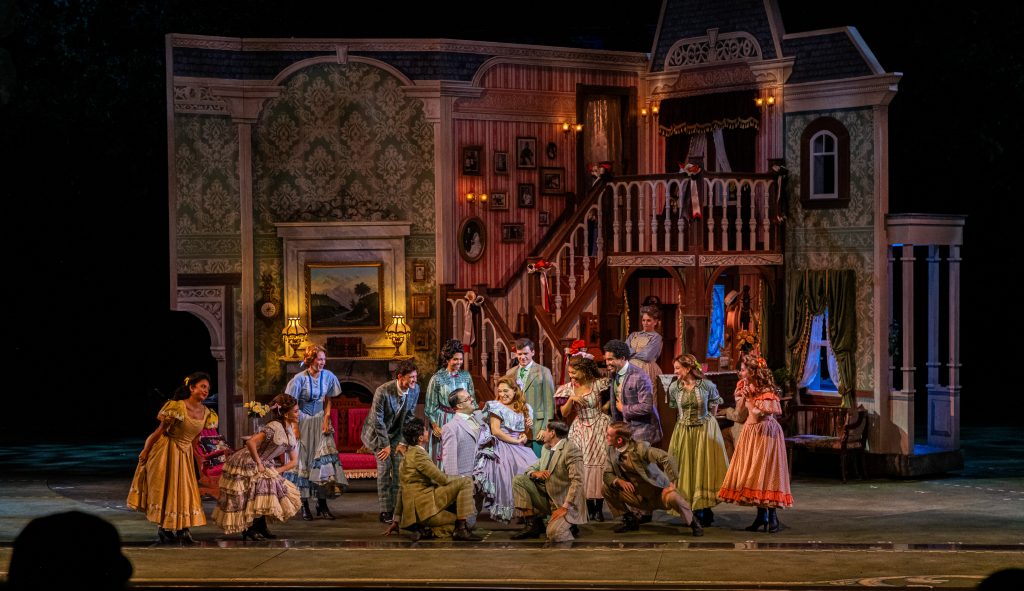
The company of the 2026 Muny production of “Meet Me In St. Louis.” Photo by Phillip Hamer

This year, a new number premiered, “That’s Enough of That,” sung by Tony Award winner Beth Leavel. The Muny fan favorite, whose 13 memorable performances include Mama Rose in “Gypsy” (St. Louis Theater Circle Award), Dolly Levi in “Hello, Dolly!” and Aunt Eller in “Oklahoma,” portrays the lovable housekeeper, Katie Connelly. During the song, she dispenses wry, wise advice to the two oldest Smith daughters, Rose and Esther.

The song is written by Mark Sonnenblick, with orchestrations by Greg Anthony Rassen. Sonnenblick is having a banner year, after winning an Oscar, Grammy and Golden Globe for collaborating on the smash hit “Golden” from “K Pop Demon Hunters” (a joyful mental loop).

A musical theater composer and lyricist, he’s written additional lyrics for the musical “The Devil Wears Prada” and the films “Spirited,” “Theater Camp” and “Lyle, Lyle Crocodile.” He also wrote the opening song Pink performed at this year’s Tony Awards.

It’s nice to know that Mike Isaacson, executive producer and artistic director, is open to fresh ideas and making updates to outdated shows.
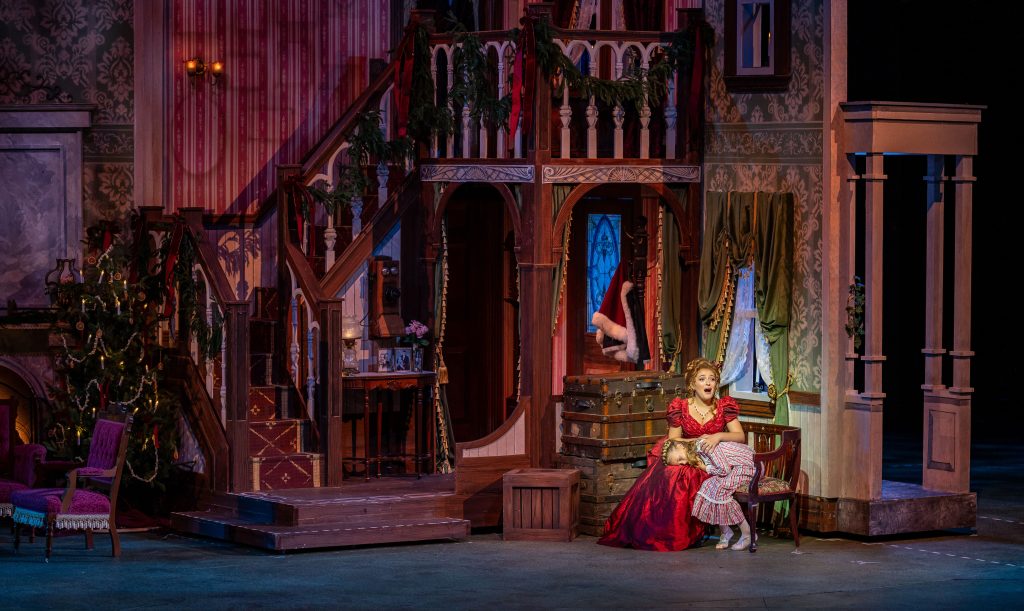
Katerina McCrimmon (left) and Lilah Levinson in the 2026 Muny production of “Meet Me In St. Louis.” Photo by Phillip Hamer

The enthusiastic principals demonstrated a tight-knit communal feel, with noteworthy turns by Stan Brown as retired doctor Grandpa Prophater, Kyla Stone as oldest sister Rose, Andrew Poston as boy next door John Truitt, Ilan Eskenazi as brother Lon Smith, Joylin Bass as younger sister Agnes, Gregory Lee Rodriguez as Rose’s beau Warren Sheffield, Emma Crow as Lon’s sophisticated outsider girlfriend Lucille Ballard.

Spunky Lilah Levinson as mischievous youngest sister Tootie stole all her scenes, comically landing every line.

A spirited ensemble, under the fine music direction of Paul Byssainthe Jr. and choreographer Sarah Meahl, helped the realistic feel — Chloe Chamberlin, Jason Goldston, Beau Harmon (a funny Pee-wee Drummond!), Ava Noble, Ben Nordstrom, Sandra Valeska Orozco, Jasmine Overbaugh, Ronan Ryan, Leann Schuering, Gordon Semeatu, Drew Tanabe, Bronwyn Tarboton, Allie Villhard and Justus Wheatley (who is spotlighted singing a popular beer garden song “Under the Anheuser Bush” as the Christmas Ball band singer.

Kailey Bender and Michael Santomassimo are the swings, with Michael associate choreographer and dance captain, too.

The company of the 2026 Muny production of “Meet Me In St. Louis.” Photo by Phillip Hamer

The cast was fabulously costumed by Leon Dobkowski, with gorgeous all-white finery for the fair, elegant jewel-toned gowns for the Christmas ball and everyday vintage apparel, with Kelley Jordan’s cascading curls and braids natural-looking wig designs.

The razzle-dazzle in a grand finale seemed to have multiple moving parts that will be talked about for years, starting with a magnificent reveal of lighting designer Paige Seber’s festive World’s Fair, followed by fireworks. Kudos to Director of Production Tracy Utzmyers and Technical Director Theo Prifti, and their teams.

During a lively curtain call we joined the cast singing the title song, but the production people weren’t done yet with the wow factor. It’s as if they pushed farther to see what new heights they could achieve to celebrate our twin crown jewels, the Muny and Forest Park.

Putting a cherry on top, we watched our St. Louis skyline/history unfold, including the Arch being built and other nods to our heritage. This happy ending on an extraordinary night was akin to everyone wearing their hearts on their sleeves, feeling the ties that bind us, and roars and repeated ovations erupted.
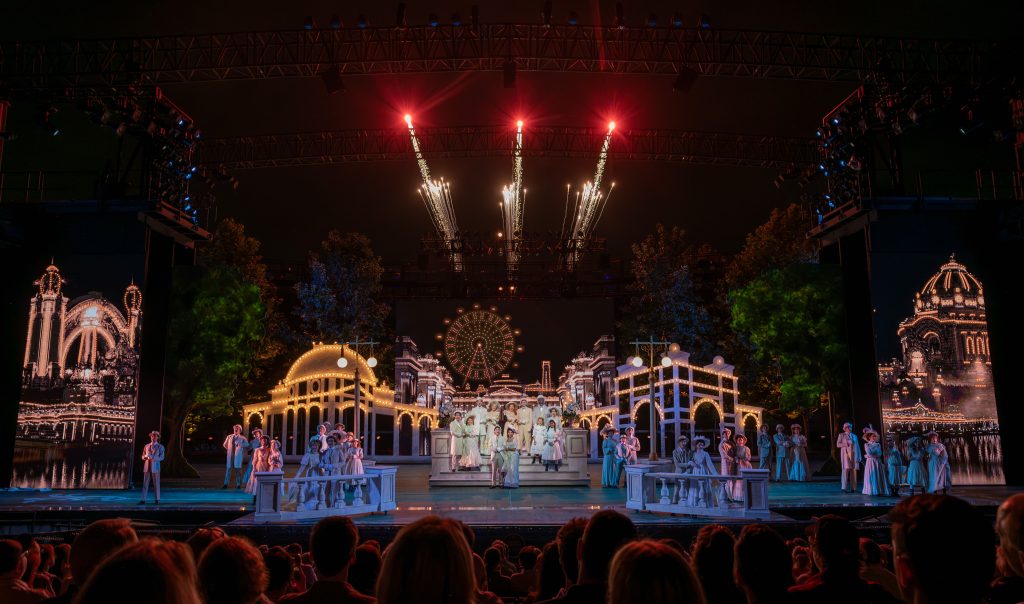
The company of the 2026 Muny production of “Meet Me In St. Louis.” Photo by Phillip Hamer

The Muny presents “Meet Me in St. Louis” Aug. 6 – 13 at 8:15 p.m. Performances take place on the Muny’s outdoor stage in Forest Park. For more information, visit muny.org.
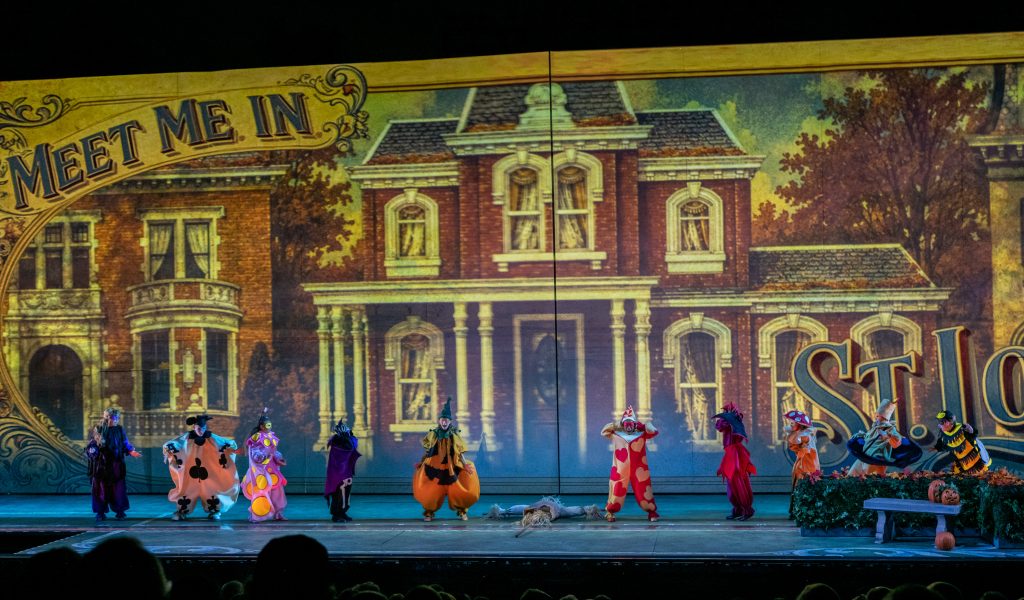

The company of the 2026 Muny production of “Meet Me In St. Louis.” Photo by Phillip Hamer

By Lynn Venhaus
Inspired by an adored golden-age movie musical 67 years ago, the stage version of “Seven Brides for Seven Brothers” has been updated to rework some of the more problematic portions of the plot for contemporary audiences.

While the Muny’s latest production tries mightily to breathe new life into one of the more neanderthal mid-century musicals, selling the macho characters is a pesky issue to overcome – even with a cast deep with exceptionally skilled dancers and singers.

Head of an all-male household in the mountains, Adam’s caveman way of thinking has influenced his uncultured backwoods brothers. However, they have their ‘teachable’ moments in the revamped book.

The focus on the uncouth siblings becoming more civilized around women – as they have zero experience with the opposite sex – is part of the show’s enduring charm.

They are tutored by their new sister-in-law, the dissatisfied yet determined townswoman Milly (Kendra Kassebaum). Though strong-willed, she is coerced into marrying Adam (Edward Watts) in a weak moment when he comes to town on a woman-hunt.

We can look it this as a ‘glass half full’ or a ‘glass half-empty’ experience.

After all, that is the period. The time is 1850, during the great migration to the Pacific Northwest on The Oregon Trail, when men still acted like women were property, and society felt marriage was in part a financial transaction.

In so many words, people didn’t discuss gender politics. Times, as they tend to do, have changed. But we are still evolving as a society, and theater must address the modern sensibilities to stay relevant. Musical theater, by virtue of its history, is forced to mirror those changes, and this discussion will be ongoing.

As we are painfully aware, during this 21st century, particularly in the last five years, with the #MeToo and #Time’s Up movements, the old-fashioned sexist attitudes on display in the old chestnuts are hard to get beyond. (Think of the abused women in “Carousel” and “Oliver!”). In the upcoming “Chicago,” we hear another side from fed-up females in “Cell Block Tango.”

Thankfully, among the improvements to “Seven Brides for Seven Brothers,” they have removed Adam’s song, “A Woman Ought to Know Her Place,” and Milly’s “One Man.”

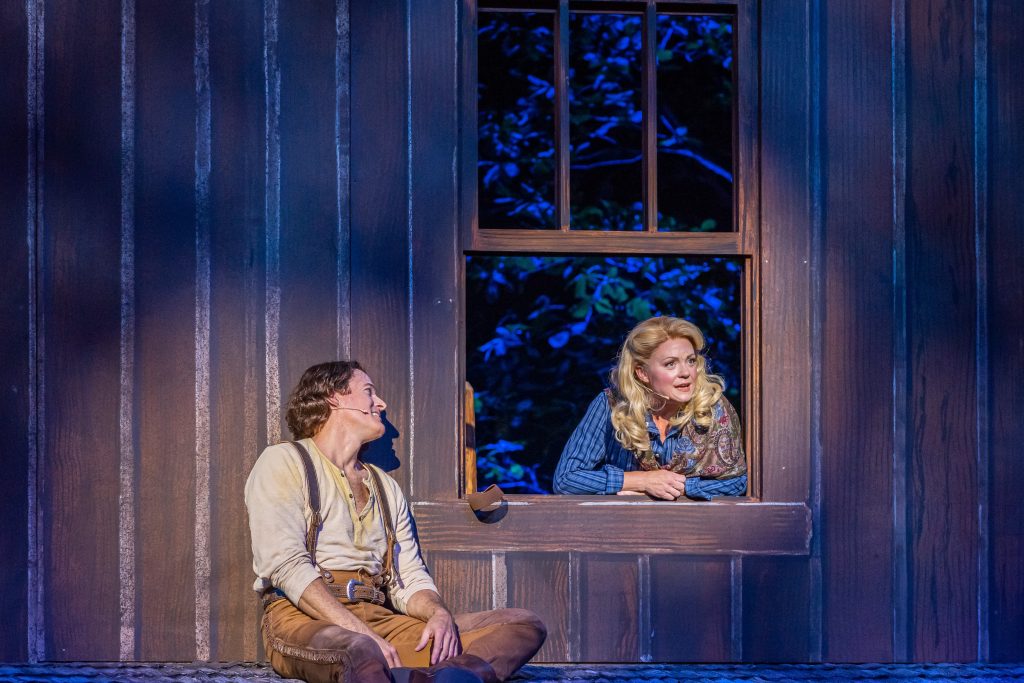
Edward Watts and Kendra Kassebaum as Adam and Milly. Photo by Phillip Hamer.

They have added a feisty “I Married Seven Brothers” for a peeved Milly – a highlight for Kassebaum — and “Where Were You?” as a vehicle for Adam to vent his anger from his perspective.

Nevertheless, a musical that is based on a Stephen Vincent Benet short story, “The Sobbin’ Women,” which was shaped by an ancient Roman legend called “The Rape of the Sabine Women,” that’s just hard to spin – and swallow — these days. And the plot hinges on the other six brothers encouraged to kidnap women they took a shine to in town, so that is a controversial hurdle.

And despite a Herculean effort from the Muny’s creative team to focus on a battle of the sexes and bring out the personality and humor, the aggressive song “Sobbin’ Women” and some of the remaining dialogue are wince-inducing, even like nails on a chalkboard.

I know, I know – people generally go to musical theater to be entertained, to escape the realities of daily life and usually aren’t seeking enlightenment while enjoying song and dance. They are just fine taking a respite, blissfully unaware of the real world. They enjoy a bouncy, tuneful musical and take it all in stride.

That’s not me. So, this review is from my perspective. As a friend said, “Every musical is someone’s favorite.” I had to keep reminding myself: “Context.”

It’s like my inexplicable fondness for “Mamma Mia!” Everything screams silly, but I love it, and have seen it at least six times — reminds me of “Gidget” movies when I was growing up, comfort food for the soul.

Under a magnifying glass, many musicals can’t hold up to current scrutiny, but that debate will keep on keeping on.

Peruse a list of musicals from the 1940s through 1970s, and so many female characters are underwritten – typically waiting for a man to rescue her or change her life, which should be annoying to current generations.

Modern musical theater has hopefully moved beyond that. Maybe someday our princes will come, but none of that royal superiority, he’ll be on equal footing, and in the meantime, we’re following paths trailblazed by women who clamored to be heard.

Next week’s “On Your Feet!” will show a true partnership between a husband and a wife, Gloria and Emilio Estefan.

“Seven Brides for Seven Brothers” isn’t the first musical to deal with deception – for starters, the list includes “Light in the Piazza,” “The Most Happy Fella,” “Dirty Rotten Scoundrels,” “A Funny Thing Happened on the Way to the Forum” (and ‘go!’), among others.

And bull-headed Adam and assertive Milly work on trust issues to advance the plot.

People really do have affection for the 1954 movie. It was nominated for Best Picture, losing the Oscar to “On the Waterfront,” but won Best Scoring of a Musical Picture. In 2006, the American Film Institute named it one of the best American musicals ever made, and in 2004, the Library of Congress’ U.S. National Film Registry selected it for preservation because of it being “culturally, historically or aesthetically significant.”

Many fans enjoy the nostalgia, the appealing leads – brawny Howard Keel as Adam and sweet girl-next-door Jane Powell as Milly, plus the gymnastic Russ Tamblyn as youngest brother Gideon, and foremost, those rousing dance numbers.

The Muny drew 6,907 patrons on opening night. This is the sixth time the Muny has produced the show. Taking a cue from a reworked version by the Goodspeed Opera House in 2005, brought in David Landay, an original co-writer of the stage play, to do some rewrites and editing. A female contribution may have been helpful too.

The script feels like whiplash. One minute, the women are acting empowered, and the next minute the guys seem in “Me, Tarzan, you Jane” mode. It’s like when people attempt to update Shakespeare by a couple hundred years, but don’t commit to a wholly new vision.

Oh well. Baby steps. Growth is good.

In recent years, the Muny has resurrected some of the creakier shows and presented versions with freshened books – most notably “The Unsinkable Molly Brown” and “Paint Your Wagon,” both of which I enjoyed.

I was hoping this would be similar. Several members of the “Paint Your Wagon” production team have returned for this reboot, including director-choreographer Josh Rhodes and associate director-choreographer Lee Wilkins, along with music supervisor Sinai Tabak.

The music direction by Valerie Gebert is crisp. Additional arrangements and orchestrations are by Larry Blank and Mark Cumberland. That’s quite a collaboration.

The Muny was one of the first theaters in America to present the stage adaptation of the movie, back in 1978 during a pre-Broadway tryout. The new stage show didn’t make it to Broadway until 1982; its last year at the Muny was 2011.

The music retained from the movie, written by Saul Chaplin and Gene de Paul, with lyrics by Johnny Mercer, includes “Bless Your Beautiful Hide,” “Wonderful Wonderful Day,” “Lonesome Polecat” and “Goin’ Courtin’.”

Al Kasha and Joel Hirschhorn wrote “Love Never Goes Away,” “We Gotta Make It Through the Winter,” and “Glad That You Were Born” for the stage show.

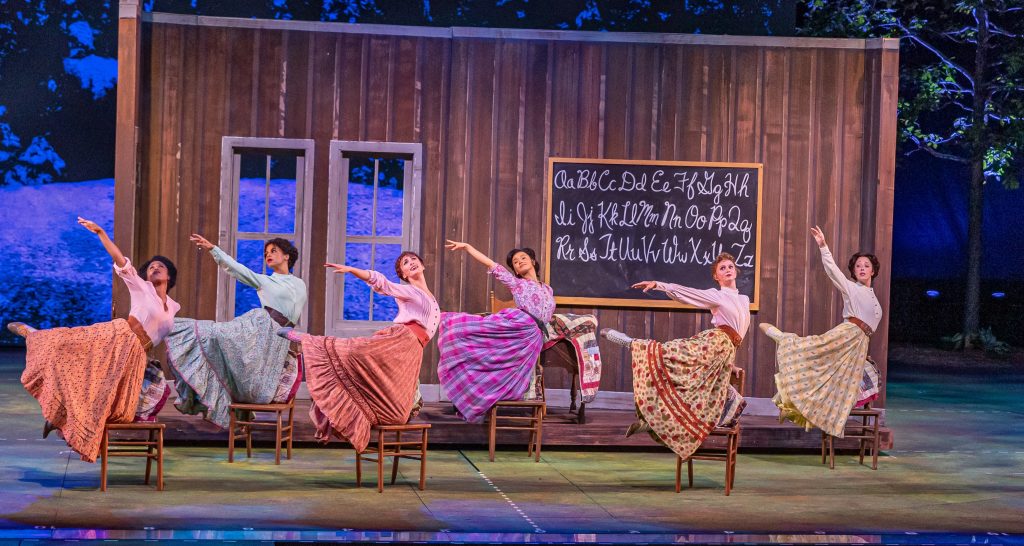
The maidens in The Quilt Dance. Photo by Phillip Hamer.

The show has always been considered a major dance vehicle, and five-time Tony Award winning choreographer Michael Kidd cemented his reputation through his robust barn-raising dance and his movements based on reality.

Kidd’s unpretentious style earned him Tony Awards in “Guys and Dolls,” “Can-Can,” “Lil Abner,” “Finian’s Rainbow” and “Destry Rides Again,” and lasting Hollywood admiration (check out Danny Kaye in “Knock on Wood.”)

His uncommon approach transformed frontier chores into rollicking dance numbers. He once said if he had made slobs in the woods break out in ballet, people would have ridiculed it.

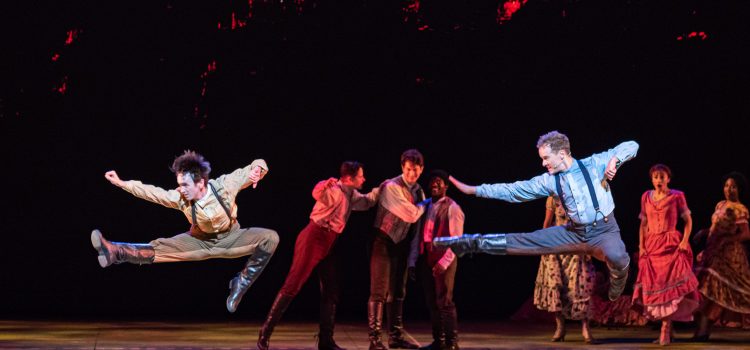
And the Muny has assembled an outstanding dozen triple threats to portray the men and women going courting – the Pontipee brothers show off their muscular moves in “The Challenge Dance” at the church social while the maids-in-waiting demonstrate a graceful, sophisticated elegance in “The Quilting Dance.” The finale, “The Wedding Dance,” wraps everything up on an enthusiastic, happy note as a long winter has turned into spring.

Rhodes has emphasized the ensemble’s energy and spotlighted the athletic and acrobatic dances. He helmed an exhilarating “Newsies” in 2017 and has finessed these pieces with vigor.

Kassebaum, who grew up in St. Louis, was impressive as lovable and comical showgirl Adelaide in the 2019 “Guys and Dolls” (and won a St. Louis Theater Circle Award for that performance). She is an emphatic Milly, strong in voice and spirit.

Edward Watts, saddled with a distracting shaggy hairstyle, struggled with the push-pull of that stubborn barbaric character, but is assured in his commanding vocal numbers and a sturdy physical presence as the dominant hero.

The brothers, nowhere near as educated as the snotty East Coast-bred smart-alecks running the town, show plenty of spirit and ‘street smarts’ when they are struck by love and try to impress the town maidens.

Raised to think marriage is the end-all for their young lives learning how to cook, sew and clean, the women must play the stereotype common to the era. But here, they have a tad more gumption, individually attracted to the guys, no matter what their dads say.

Harris Milgrim is a standout as second-oldest brother Benjamin, and lithe Carly Blake Sebouhian’s beautiful movements and ballet-training are noticeable as Martha.

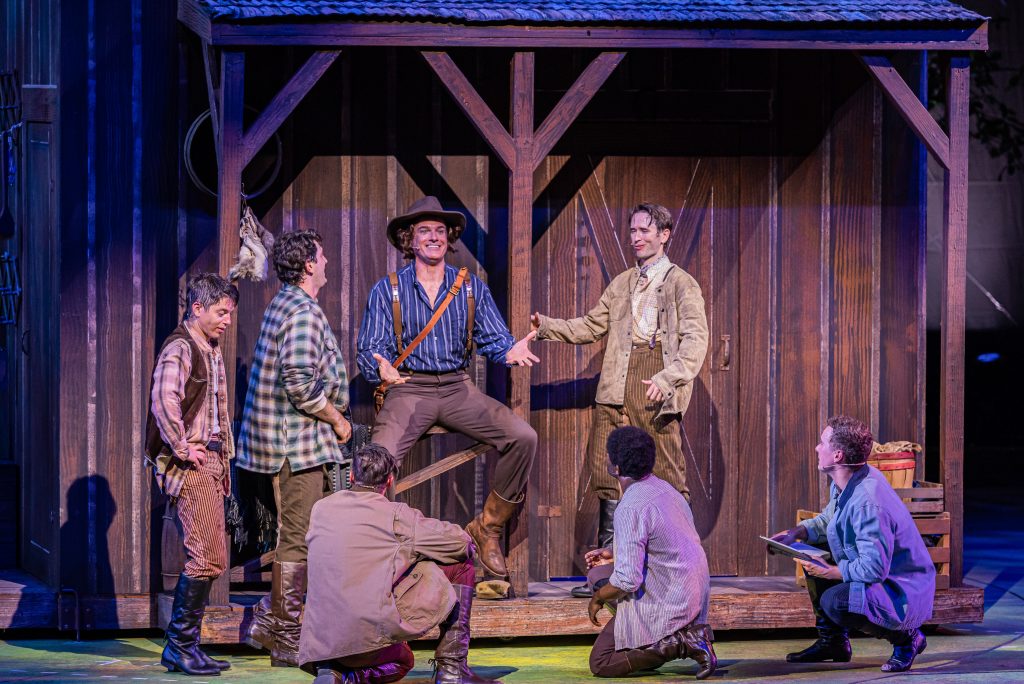
The seven brothers. Photo by Phillip Hamer.

The limber Pontipee lads include Waldemar Quinones-Villanueva as Caleb, Ryan Steele as Daniel, Garett Hawe as Ephraim, 4-time Muny vet Kyle Coffman as the tempestuous Frank, and Brandon L. Whitmore as Gideon.

The supple refined city girls are Leslie Donna Flesner as Dorcas, Shonica Gooden as Sarah, Sarah Meahl as Ruth, Mikayla Renfrow as Alice and Kristin Yancy as Liza.  

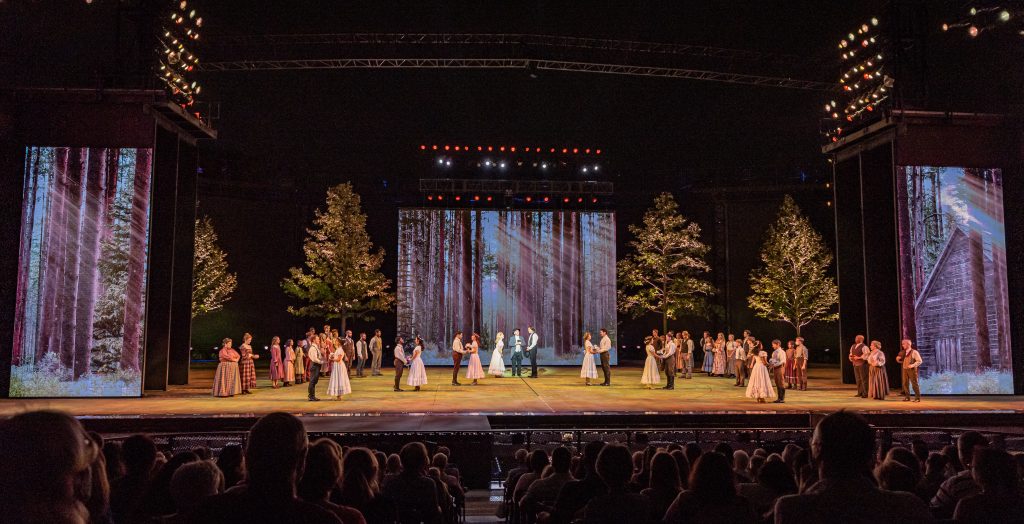
Michael Schweikardt has provided majestic mountains to convey the grand open spaces and dense forests for the topography while video designer Caite Hevner’s striking work on the changing seasons and the Echo Pass avalanche are spectacular. Schweikardt’s multi-floor log farmhouse is masterful in levels and details.

While some shows like the culturally inappropriate “Flower Drum Song” have unofficially been ‘retired,’ the jury is obviously still out on this show. The passionate performers carry this one here over the threshold

A look back can be a step forward in some instances. The Muny has put a tremendous amount of effort in making this production palatable for its multi-generational audience. Yet, the outdated debate will continue.

As Thursday’s opening night rainout indicated, patience is a virtue. Not to be a Debbie Downer, this isn’t a step backwards, but some of us are ready to move on.

The company of “Seven Brides for Seven Brothers.” Photo by Phillip Hamer.

“Seven Brides for Seven Brothers” is at 8:15 p.m. through Wednesday, Aug. 18, at the Muny outdoor stage in Forest Park.

The shows remaining are Seven Brides for Seven Brothers (Aug. 12 – 18), On Your Feet! (Aug. 21 – 27) and Chicago (Aug. 30 – Sept. 5). For more information, visit muny.org. 

Tickets can be purchased in person at the box office, online at muny.org or by phone by calling (314) 534-1111.

To stay connected virtually and to receive the latest updates, please follow The Muny on their social media channels, including Facebook, Instagram and Twitter.


Muny Photos by Phillip Hamer.