
By Lynn Venhaus

The underbelly of American nuclear families in affluent suburbia is exposed in the emotionally charged Alanis Morissette-inspired musical “Jagged Little Pill,” which can’t be wholly described in jukebox terms.

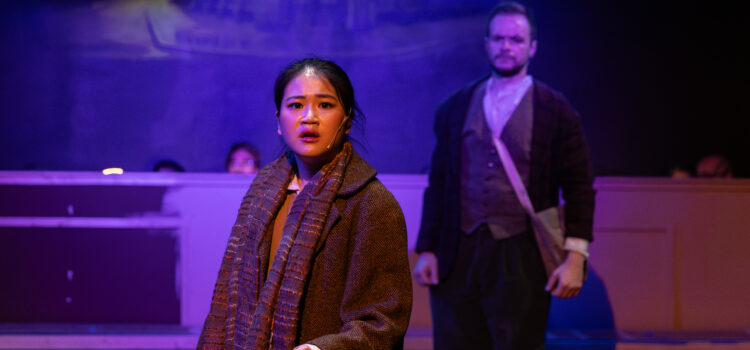
The show’s timeless message of showing up for people is emphasized, and Tesseract Theatre’s production focuses on pain, healing and empowerment. Director Brittanie Gunn features a smartly attuned cast in principal roles.

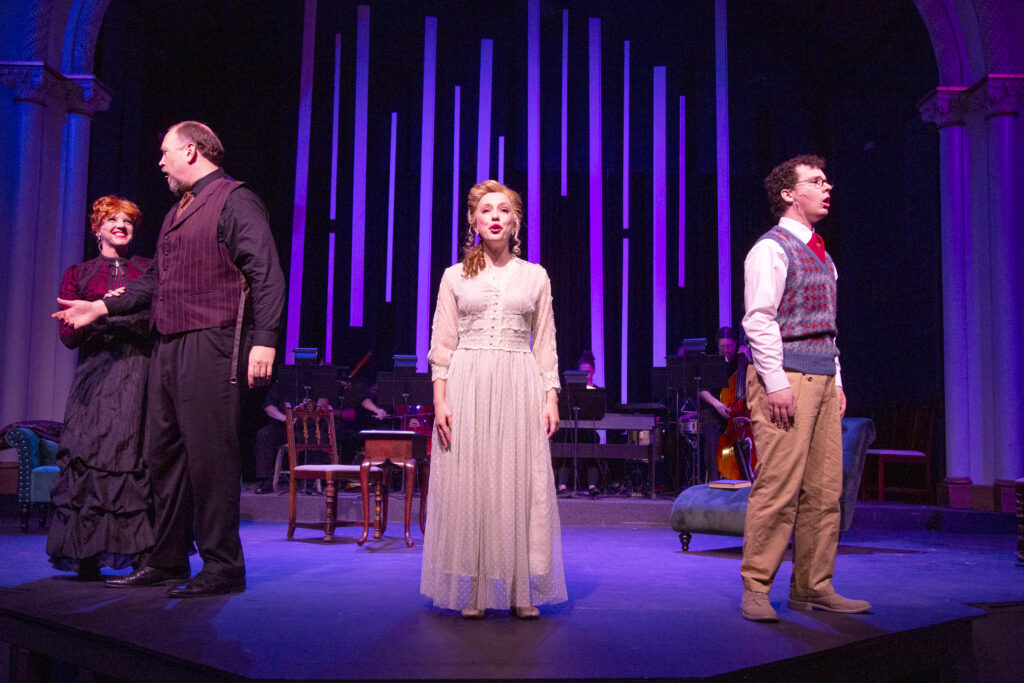
The landmark alt-rock album’s ‘90’s fueled angst is palpable as the fired-up energetic ensemble propels this professional regional theater premiere, featuring dynamic dancing, supple orchestrations and powerhouse vocals.

The recognizable musical score is well integrated into the issue-laden story, and includes other Morissette songs from later albums (“Supposed Former Infatuation Junkie,” “Under Rug Swept,” “Havoc and Bright Lights,” “Feast on Scraps,” and “City of Angels” soundtrack), and two new songs (“Smiling” and “Predator.”).

After the lead characters establish their troubled dilemmas in “All I Really Want,” pumped-up performers burst out with “Right Through You” and never let up until after the hard-fought “You Learn.” The company’s “Wake Up,” “Forgiven,” “Hands Clean,” and “Thank U” are commanding as well, especially the haunting “Uninvited.”
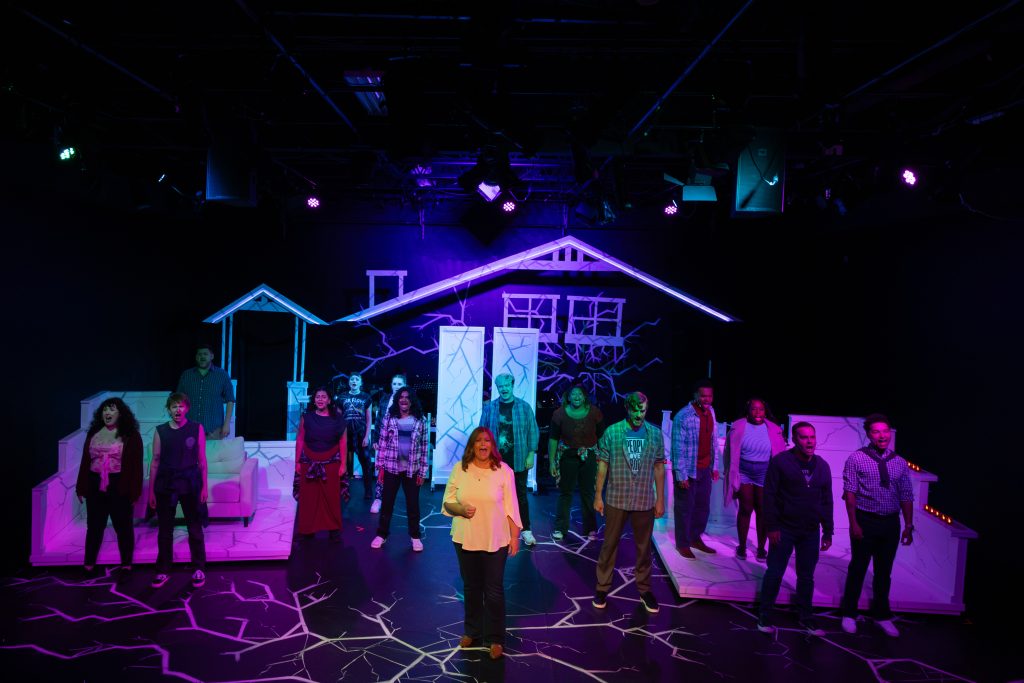
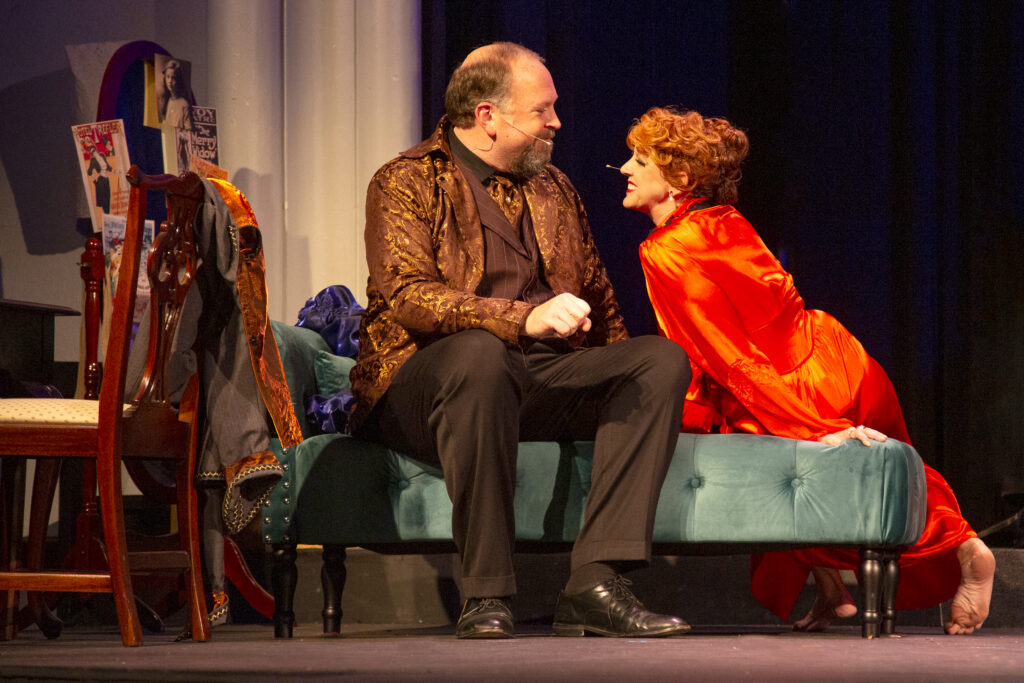
As the outwardly ideal mother unraveling inside, an affecting Loren Goudreau organically portrays Mary Jane “MJ” Healy – an authentic combination of fire and ice. Like most of the insulated moms nearby, MJ is a helicopter parent, aka control freak, and instead of protecting her two children, she’s smothering them.

MJ is also addicted to pain pills that she started abusing after a car accident and is pulling away from everyone who knows and loves her. Yet, she seems to realize what a fraud these shiny happy façades are, and the shallow suburbanites she’s in contact with around their snobby, judgy town.

Goudreau’s always in control in beautifully delivered vocals – “All I Really Want,” “Smiling,” and she crushes “Uninvited.” Her marital woes are aptly conveyed in “So Unsexy” and “Not the Doctor.” She shows her strength in a triumphant “You Learn.”

With a book by Diablo Cody, who won the 2021 Tony (and won an Oscar for the original screenplay “Juno”), Act I opens with MJ composing her annual Christmas letter telling everyone how perfect their family is.

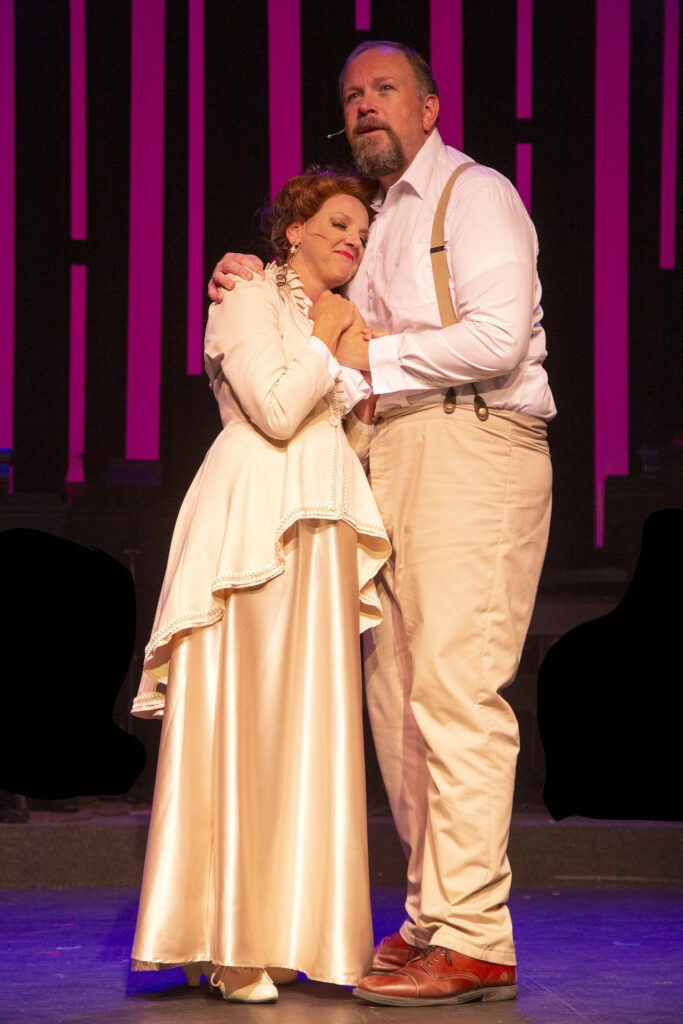
Of course, it’s all big little lies. Her workaholic husband Steve (Kevin O’Brien), feeling neglected, spends time after-hours on porn sites. Their tenuous relationship appears on a downward spiral.

O’Brien, a remarkable actor, is unfortunately saddled with a standard perplexed dad role. For as superbly as the female characters are drawn, the men parts feel perfunctory. He does what he can with a poorly drawn character.

The heavy parental issues are complicated by the kids being teenagers, and moral dilemmas arise because of choices and circumstances. Hard life lessons are ahead as we go through a very stressful calendar year in Connecticut.

Son Nick was accepted into Harvard, and his future’s so bright that they all need to wear shades. Golden boy Nick, however, is feeling the pressure of being the ‘good’ son, the overachiever. So many expectations on his shoulders. He gets into a situation at a party where things go sideways, involving his classmates, and he is put to the test.

Stephen Henley, who is a young-looking 30 something, plays the high school senior, so one must suspend belief. Henley, a strong triple threat, can handle the emotional heft of the conflicted son. But like the movie cast of “Grease,” being a student is a stretch.

Daughter Frankie (Kinya Kairigi) is a budding social activist. She considers herself bisexual, and her best friend JoAnn “Jo” (Milo Garlich) is more than a buddy. Frankie, who is arguing more with mom, is trying to find her way – and becomes attracted to a sensitive student Phoenix (Jabari Boykin), who seems to ‘get her.’

It’s another fine showcase for Boykin, after commanding performances in Stray Dog Theatre’s “The Second Hurricane” and “Superhero.” His “That I Would Be Good” and the romantic first-love dip “Head Over Feet” show his vulnerability.
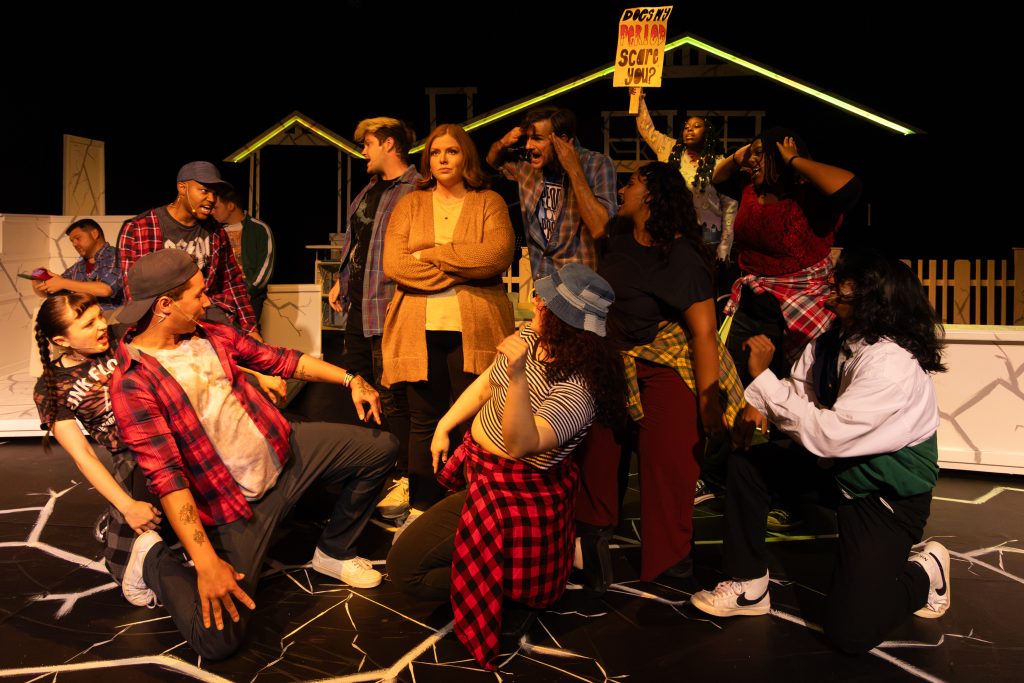
Frankie is adopted, black, and raised in a white Catholic family who didn’t think about exploring her culture but instead ignored it. ‘Better life,’ and all that. So, Frankie has some things to say about her upbringing, plus is a typical teenager ready to explode and rebel.

Kairigi, making her St. Louis debut, shows much promise, and can belt with the best of them. Her clever rendition of “Ironic,” which starts out as an essay/poem in English class and becomes a subject of debate by her sarcastic classmates, is a standout scene.

Garlich, a notable Motel in Fly North’s “Fiddler on the Roof,” has an impressive vocal range and is a passionate singer, especially on “You Oughta Know,” Morissette’s strongest anthem.

Lauren Tenenbaum’s heart-tugging portrayal of Bella Fox, the unconscious girl who is sexually assaulted at a wild holiday party, with photos circulating on social media, is another riveting aspect of the emotionally wrought show. Tenenbaum’s sincere vocals on “Predator” and “No” are noteworthy for its message.

Her tender storyline is also captured in lithe Lillian Cooper’s interpretive dance that adds a fascinating element to the presentation.

The compelling dance numbers overall, choreographed by Ella Drake and Ruben Medina, are among the show’s most memorable moments.

The ensemble – featuring Kiera Anderson-Pittman, Scott Degitz-Fries, David Hall Kaycee, David Joseph, Eesha Ved and Devynn Phoenix Yakel — is committed to getting us to feel their hurt, humiliation and outrage. Clayton Hamburg was not in the July 12 show reviewed here.

The music, by Morissette and Glen Ballard, with lyrics by Morissette, reminds us of her strengths as a groundbreaking female artist. She was only 22 when the album was released in 1995. Additional music is by Michael Farrell and Guy Sigsworth.

The album sold over 33 million copies worldwide, earned five Grammy Awards, including Album of the Year. The musical reinforces her legacy in American pop music, and the reminder is a welcome one.

Outstanding Music Director Leah Schultz is precise in conducting a very skilled band, determined to make these songs matter — not just “swallow it down.” After all, “Hand in My Pocket” promises “everything is going to be quite alright” (unless you are a cynic).

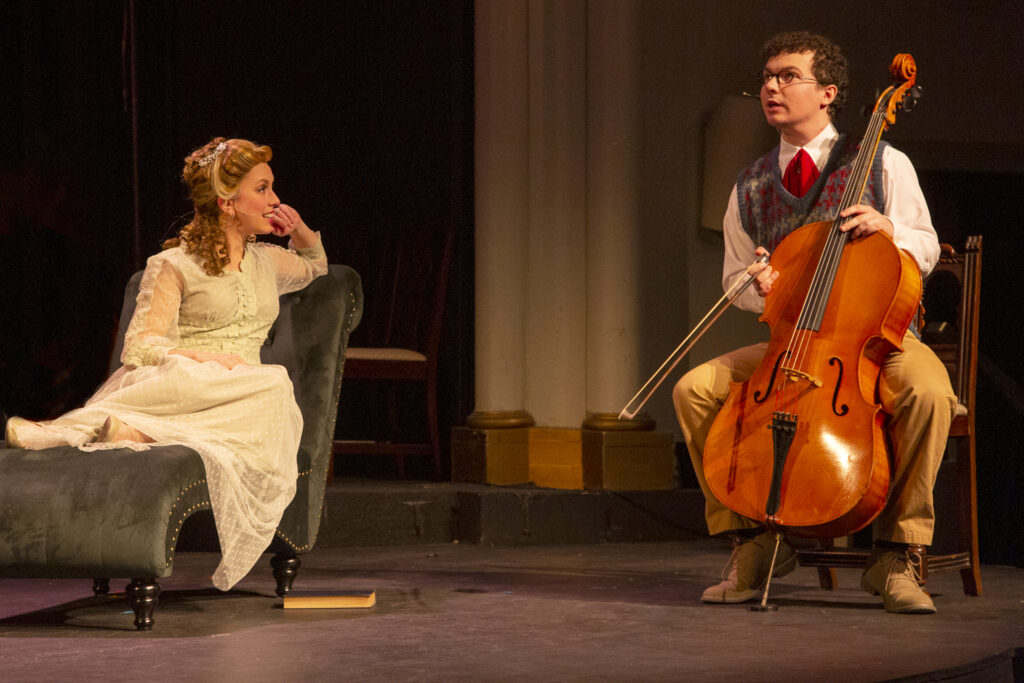
The seven-piece band sharpened the songs’ deliveries. The strings are a terrific addition, with Jill Hamill on violin and Mallory Golden second weekend, Chuck Evans on viola, and Micah Bounds on cello. Michaela Kuba is on bass, Jake Luebbert on drums, Adam Rugo on guitar, and Schultz on keyboards.

One can see how this musical garnered 15 Tony nominations, the most of any show that COVID-affected 2019-2020 season, and won two (Best Book and Best Supporting Actress). The show began previews on Broadway in November 2019 but closed due to the pandemic. It reopened on Oct. 21, 2021, and closed on Dec.17, 2021. It also won the Grammy Award for Best Musical Theater Album.

It’s easy to put this show into a time capsule, but the cast strives to make it relevant to today. The dysfunctional problems are confronted, and the solution is to start over and learn a new normal.

Lighting designer Kevin Bowman and sound designer Phillip Evans enhanced the moods while scenic designer Todd Schaefer created a fluid moving panels to anchor home, school, party, coffee shop, park and other locations. The cast helps in placing the movable pieces.

Costume designer Sarah Gene Dowling ensured the cast could move in casual looks, and rock band T-shirts helped establish the era, especially a couple classic Nirvana designs.

Other creatives included technical director Kevin Sallwasser, stage manager Abby Turner, fight choreographer Rhiannon Creighton, intimacy consultant Will Bonfiglio, and production manager Sarah Baucom.

Tesseract Theatre, as it often does, met this moment by aligning the dark topical issues to the exaggerated energetic staging. Now while the social issues are admirable, the show’s construction seems very busy.

The two-act musical is at its best when it galvanizes the intensely personal female-driven messaging and corrals the emotional landscape of adolescence in a relatable way, when it slows down to share raw, honest dialogue.

Those who respond to heartbreaking musicals like “Dear Evan Hansen” and “Next to Normal,” where personal growth and resilience occur, this is for you.

Life’s rough edges are captured in Morissette’s songs, which Cody weaves into an anxiety-ridden panoply of problems, mainly on gender and racial identities, not to mention addictions, sexuality, and suburban stereotypes. Cody’s humor is a much-needed component, too – and given the complexities of the contemporary issues, and emotional baggage, maybe not enough.

“Jagged Little Pill” can be an exhausting rollercoaster of importance, but it can also hit one in the feels. One open to this experience will discover the human condition in its moving, messy realities, set to catchy pop hooks, connecting on the Marcelle stage.

Tesseract Theatre Company presents “Jagged Little Pill” July 10 – July 26 Thursday through Sunday at The Marcelle Theatre in the Grand Center Arts District. For more information, visit www.TesseractTheatreco.org

By Lynn Venhaus

A zestful and exuberant “Anastasia: The Musical” is a crowning achievement for the Tesseract Theatre Company, which has crafted a big, bold production where every element is in harmony together.

Elegantly produced and seamlessly performed, this intriguing story centering on the legend of a Russian grand duchess is executed with remarkable skill by innovative creatives and a first-rate cast.

Impeccably staged as a swirling mix of constant motion, this adventurous blend of history, mystery and romance engaged from the jump. While this 2017 musical is not a flawlessly constructed show, the company’s determination and their lively interpretation propels it forward.

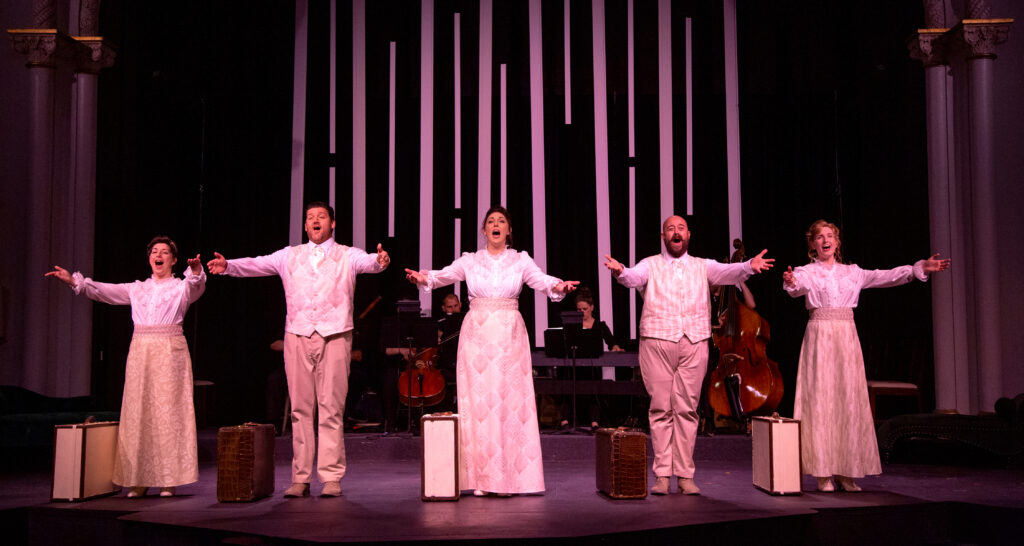
Using an abstract, intimate stage design at The Marcelle, director Brittanie Gunn, a Tesseract co-founder and creative director along with Kevin Corpuz, has focused sharply on the storytelling. The charming and well-cast 17-person ensemble’s hard work is obvious throughout this emotional journey that leads to a bittersweet finale.

The Press Conference. Photo by FF.

This ultimately is a tale of self-discovery. Gunn wanted Anya to be seen as a strong woman, and Sarah Wilkinson is believable as she works on herself – who is she and who will she become? But other characters find their purpose and their way, too.

Tesseract has been dipping its toe into musical productions for the past two years, with small-scale shows “Ordinary Days” in November 2022, “The Last Five Years” in February 2023, and “The Mad Ones” in November 2023, with its first large-cast splashy musical “Kinky Boots” in August 2023. This year, an original musical “Cascade’s Fire,” and another small-scale effort “My Heart Says Go” were previously performed.

With the ambitious “Anastasia,” they are taking a huge leap forward, and each component is impressive — Gunn’s thoughtful depiction, Zach Neumann’s vigorous music direction, choreographer Michelle Sauer’s graceful ballet and vibrant period dance numbers, and the superb technical team’s designs.

This all-ages show, which has been performed by schools, youth and community theaters in recent years but not yet by regional professional companies, features lyrics by Lynn Ahrens and music by Stephen Flaherty, whose best-known works are “Ragtime” and “Seussical.”

This grand-scale musical is adapted from the well-liked 1997 animated movie, which in turn was inspired by the 1956 “what if” dramatic film “Anastasia” that starred Ingrid Bergman in her second of three Oscar-winning roles.

The Czar’s Family Pre-Revolution. Photo by FF.

Fun fact: The animated musical’s music, composed by Ahrens and Flaherty, also featured music by David Newman, whose father, Alfred, was Oscar-nominated for the original 1956 film. This team earned two Oscar nominations for the film – musical score, and “Journey to the Past” for best song.

That power ballad is reprised in this stage musical, with a dynamic rendition by Sarah Wilkinson ending Act 1. There are five other songs from the movie, including the poignant “Once Upon a December,” and 16 new songs.

Playwright Terence McNally wrote the book, from the play by Marcelle Maurette, as adapted by Guy Bolton. While the late McNally is among the greatest, winning five Tony Awards, this result isn’t among his best. However, he shaped what could have been a too-sprawling complex narrative into several subplots that mesh well.

He has omitted the villain Rasputin and dropped the magic realism that were a major part of the animated tale, replacing the shady wizard with a formidable Bolshevik general Gleb, who seems as obsessed as Javert in “Les Miserables.” In fact, this show may remind you somewhat of “Les Miz,” only not as epic in scope.

Photo by FF.

The character Anastasia has always been enigmatic because she may or may not be who she thinks she is. The story arc begins at the twilight of the Russian Empire and moves to Paris in the 1920s, as this young woman tries to fit the puzzle together of her life.

The real story is that the royal family Czar Nicholas II, his wife, Alexandra; son, Alexis; and four daughters, Olga, Tatiana, Maria, and Anastasia, were taken captive after he abdicated the throne on March 15, 1917. They were executed by a firing squad of Communist Bolsheviks on July 17, 1918, along with four of their servants, but no bodies were immediately found. Reports were so unclear that the dowager empress, then in Crimea, doubted the news of her family’s death.

The musical begins nine years after the Russian Revolution in 1918. Legend has it that Anastasia escaped her family’s murder, but hit her head while running away, causing her to lose all her memories.

Can she reclaim the magic of her childhood? In an interesting contrast, the show flashes back to Anya as a child, and 12-year-old Devynn Phoenix is luminous in her dance sequences as both the young Anastasia and Alexia. Ella Drake demonstrates superb dancing skills in ballet sequences, also.

Ella Drake. Photo by FF.

As the grown-up Anya, she meets two conmen, Dmitry and Vlad, who are looking for a girl to pretend she is the lost princess. Wilkinson easily slips into Anya’s skin, while new-to-professional theatre Aaron Fischer is revelatory as Dmitry, and Kent Coffel, an MVP when it comes to playing comedic sidekicks, works well with both.

The men hatch their imposter plan in “A Rumor in St. Petersburg.” They tutor her, a la “My Fair Lady,” in “Learn to Do It,” then take her to Paris and plan to meet with her grandmother, because they think the Dowager Empress will give them a substantial reward for recovering this long-lost member of the royal family.

Through this process, she slowly starts to regain her memory and believes she is indeed the real Anastasia. Wilkinson’s transformation is palpable, and you see her become more radiant.

Wilkinson, who has been memorable on local stages in “Nine” and “Into the Woods,” is an accomplished singer and dancer. With an opportunity to anchor this production, she grabs it with gusto.

She shines on her solo numbers. “Once Upon a December” is wistfully delivered, as is “A Secret She Kept,” and “In My Dreams” is a touching tribute to starting over. She also possesses considerable poise and carries herself regally on stage.

Danielle Feinstein, Kimmie Kidd-Booker and Lindsey Grojean. Photo by FF.

Act 2 opens with an ebullient “Paris Holds the Key (to Your Heart)” and the chorus also has fun with “Land of Yesterday” led by the intrepid Kimmie Kidd-Booker as the lady-in-waiting Countess Lily.

Anya and Dimitry are in a budding romance that’s straight out of a Hallmark movie template, but Wilkinson and Fischer have a genuine connection. He soars in his strong vocals, especially “Everything to Win” and with Anya in “My Petersburg” and “In a Crowd of Thousands.”

Vlad reminisces about hobnobbing with the aristocracy, and his wit comes through – as does his physical comedy.

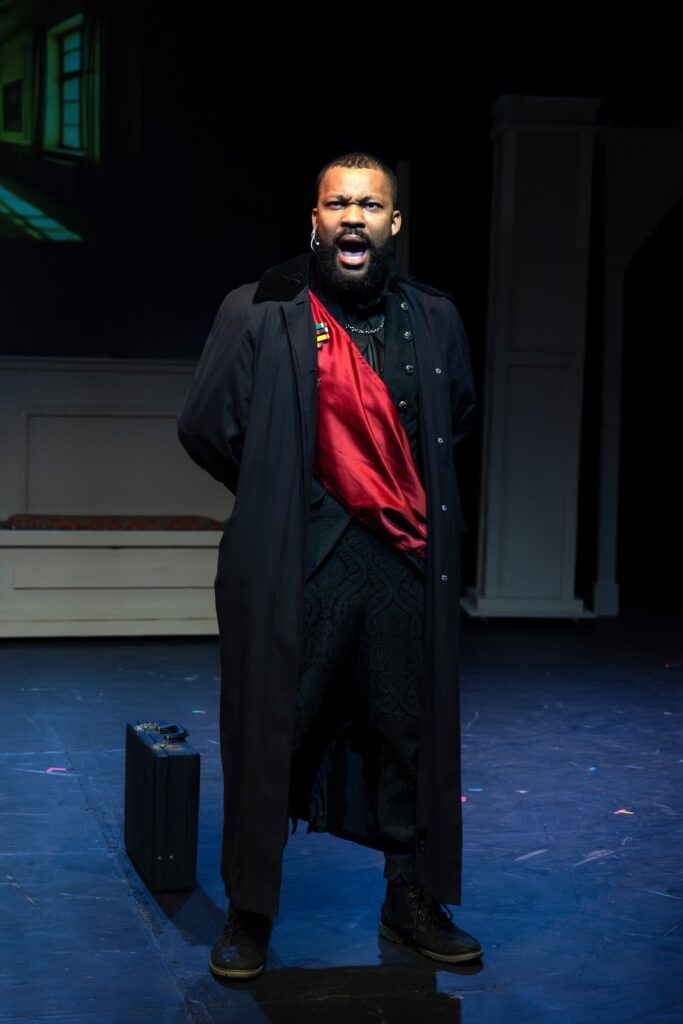
In his role as Gleb, Donald Kidd stuns with his sturdy vocals and layered characterization. “The Neva Flows,” along with Anya, showcases his vocal command, and when he realizes he has feelings for Anya, “Still.”

As the Dowager Empress, dauntless Margery A. Handy is imposing, and has a terrific song, “Close the Door.” She is as stately as Lily is goofy. Kidd-Booker is hilarious hamming it up as Vlad’s former mistress, and she and Coffel know how to create an effective chemistry in “The Countess and the Common Man,” ramping up the physical comedy.

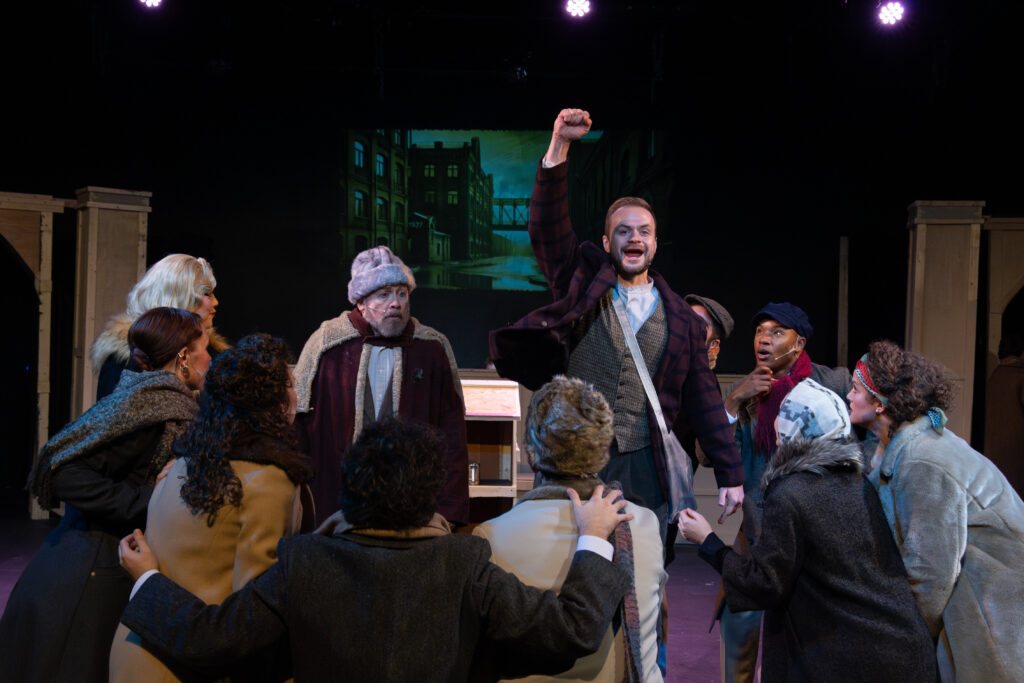
Aaron Fischer, as Dmitry, revs up the crowd. Photo by FF.

The ensemble is quite strong, with distinctive characterizations developed by each supporting player. Tielere Cheatem, Scott Degitz-Fries, Ella Drake, Danielle Feinstein, Julia Gilbert Gaglio, Lindsey Grojean, Jaelyn Hawkins, Stephanie Merritt, Jacob Schmidt and Kelvin Urday all blend well, but also stand out as different characters.

They harmonize beautifully, and the orchestra’s vitality is noticeable. Besides conducting, Neumann is on keyboards, joining Chuck Evans on violin, John Gerdes on brass, Lea Gerdes and Joseph Hendricks on reeds, Brad Martin on percussion, and Paul Rueschhoff on cello.

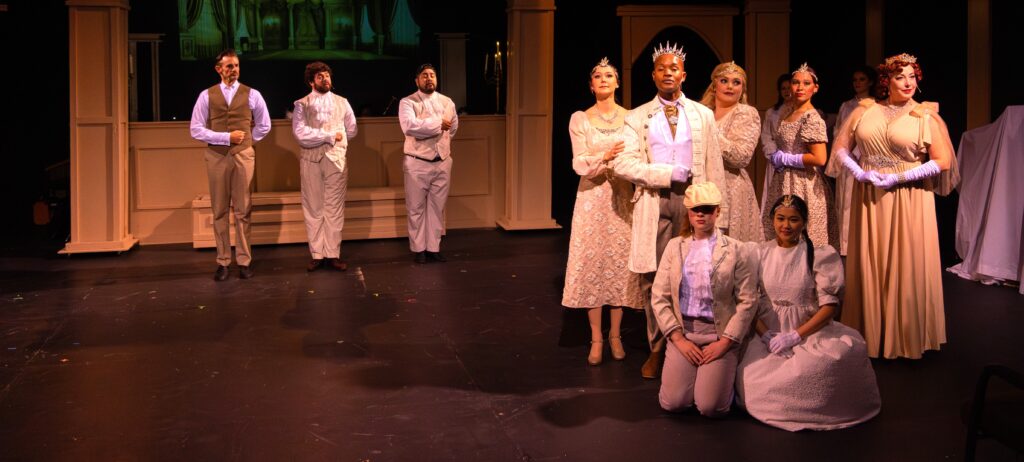
The musical’s costumes are an opulent showcase, with costume designer Sarah Gene Dowling assembling a bevy of beautiful gowns, flashy vintage party dresses, textured ethereal whites, working-class garments and heavy wintry outerwear. She collected over 100 looks for this show alone.

The craftsmen meet the moment, with noteworthy sound design by Phillip Evans, lighting design by Kevin Bowman, properties design by Rachel Puleo, and scenic design by Todd Schaefer.

Kevin “Kevlar” Sallwasser was the technical director, Sarah Baucom production manager, and Marisa Daddazio the stage manager, with Bella Lucero assistant stage manager and Hannah Lohmeyer the intimacy coordinator.

Donald Kidd as Gleb. Photo by FF.

The show’s lush qualities combine with the venue’s cozy ambience to create an enchanting experience. “Anastasia: The Musical” will linger for a while. Tesseract’s mission accomplished, and it was refreshing to see how well it all came together.


Tesseract Theatre presents the musical Anastasia Thursdays through Saturdays at 8 p.m. and Sundays at 4 p.m., Nov. 14 – 24. Performances take place at the Marcelle Theatre in Grand Center. For more information: www.tesseracttheatre.com.

By Lynn Venhaus

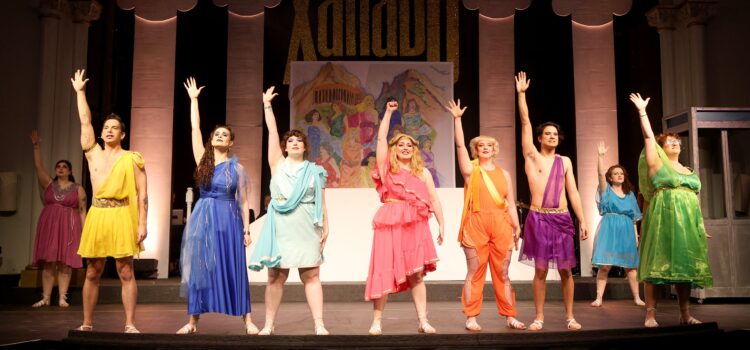
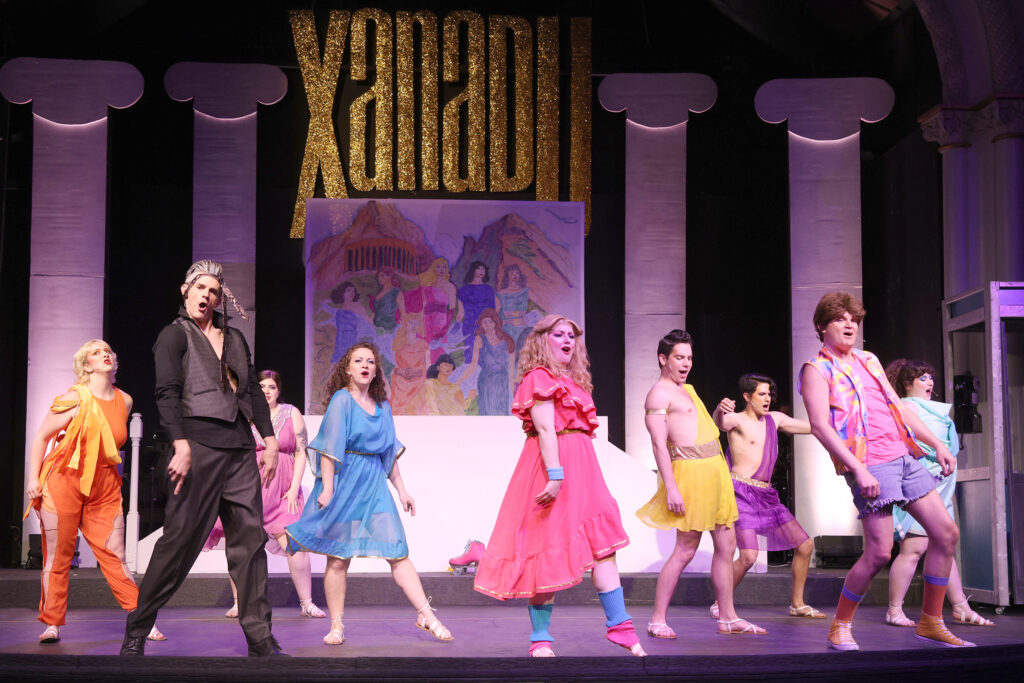
“Xanadu” is a silly bunch of nonsense – and that is its intention. A spoof of the ridiculous 1980 romantic musical fantasy movie must be playful, and Stray Dog Theatre leans into the stage musical comedy sendup with full-bodied camp.

The theater company’s affinity for broad comedy romps is well-known, and they’ve presented these types of crowd-pleasers for years, from “Evil Dead: The Musical” and “Triassic Parq” to Charles Busch’s oeuvre “Red Scare at Sunset,” “Vampire Lesbians of Sodom” and “Psycho Beach Party,” among them.

And they gleefully double-down on this show’s cheesiness. Director Justin Been takes great delight in skewering the movie’s premise as a turgid soap opera that’s part “Saturday Night Live” sketch (think of the deliberate exaggerated acting in “The Californians”) and part old-timey Hollywood studio system dream factory, sprinkled with fairy dust.

To fully understand the surprising transformation from movie to Broadway, here’s a little backstory. Somehow, after the film was totally trashed upon its release, it developed a cult audience, and then in 2007, a stage adaptation was Tony-nominated for Best Musical. Stranger things.

The comical book was written by Douglas Carter Beane, who won a Drama Desk Award for it and is known for his musical adaptations of “Cinderella” and “Sister Act.” He wrote the 1995 movie “To Wong Foo, Thanks for Everything! Julie Newmar.” Stray Dog Theatre produced his Tony-nominated play, “The Little Dog Laughed,” in 2014.

Being familiar with the movie “Xanadu” is not a prerequisite to enjoy this farcical show, but it helps if you have some knowledge of ancient Greek mythology, for Beane incorporates the shlocky epic “Clash of the Titans” into his themes, including the Immortals.

Photo by John Lamb

The wackadoodle screenplay by Richard Danus and Marc Rubel was already inspired by the 1947 Rita Hayworth movie “Down to Earth,” which features muses showing up to teach Earthlings a lesson. Fun fact: Xanadu is the exotic name of Mongolian emperor Kublai Khan’s summer palace.

This far-fetched plot doesn’t take itself seriously – or shouldn’t. Set in Los Angeles, the 44-year-old movie focused on a beautiful muse (pop star Olivia Newton-John riding the ‘Grease’ wave) who inspires a young hunky artist (Michael Beck, fresh from “The Warriors”) and his older friend (Gene Kelly! Yes, the ‘Singin’ in the Rain’ icon) to convert a dilapidated auditorium into a hip roller-skating club, all set to the beat of Yacht Rock songs.

She is forbidden to fall in love with a mortal, but two mean-spirited sisters (Calliope and Melpomene) concoct a curse, and chaos ensues. Is it surprising that it was nominated for six Razzie Awards?

At the first Golden Raspberry Awards in 1981, the movie lost the worst picture award to another truly awful musical, “Can’t Stop the Music,” which was a pseudo-autobiography of the Village People and starred then-Bruce Jenner (now Kaitlyn), Oscar nominee Valerie Perrine and Steve Guttenberg (Gotta love the ‘80s!). But the “Xanadu” director Robert Greenwald did take a Razzie home.

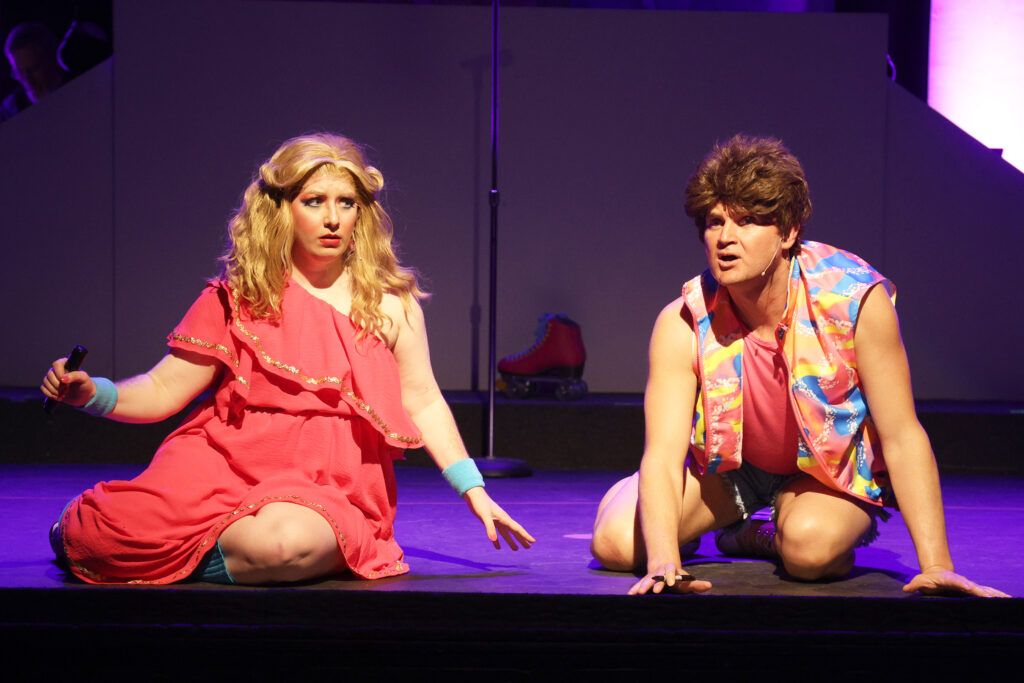
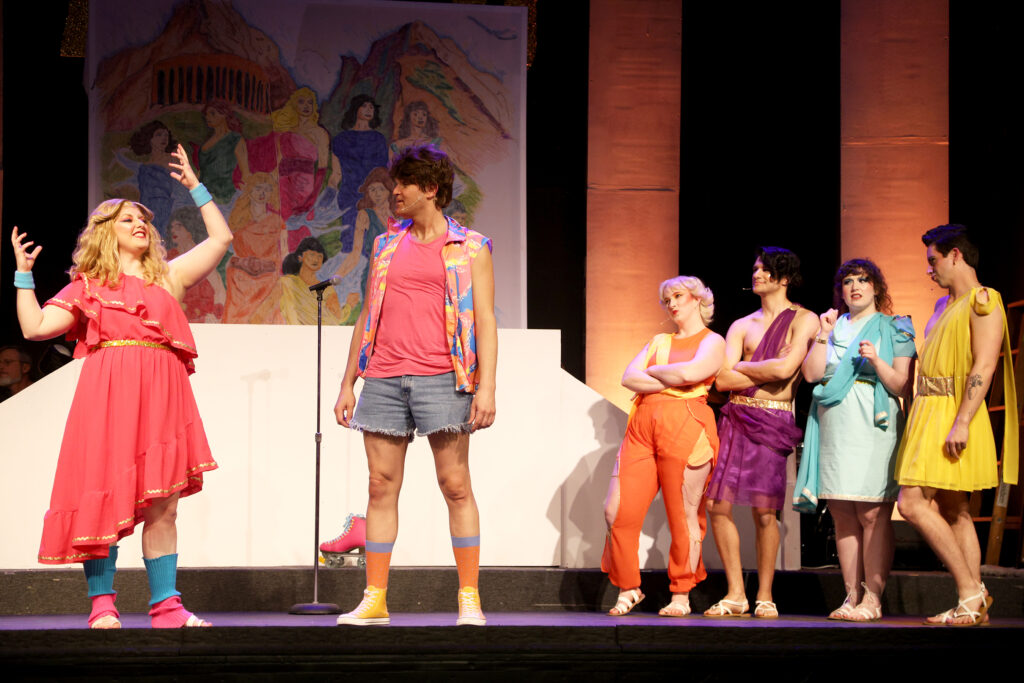
See if this makes any kind of sense: Artist Sonny Malone – Phil Leveling having a blast doing ‘beach’ dressed like Malibu Ken and talking like a righteous dude – has completed a mural at Venice Beach that he’s not satisfied with, so he wants to end it all.

He has a chance encounter with Clio, a muse masquerading as a fetching Aussie named Kira who roller skates and wears leg warmers. She sprang eternally from the Mount Olympus artwork, and her effect has made him change his mind. She is played with a wink and a smile by Shannon Lampkin Campbell.

They pair well on their duets “Suddenly” and “Suspended in Time.”

Shannon Lampkin Campbell and Phil Leveling. Photo by John Lamb

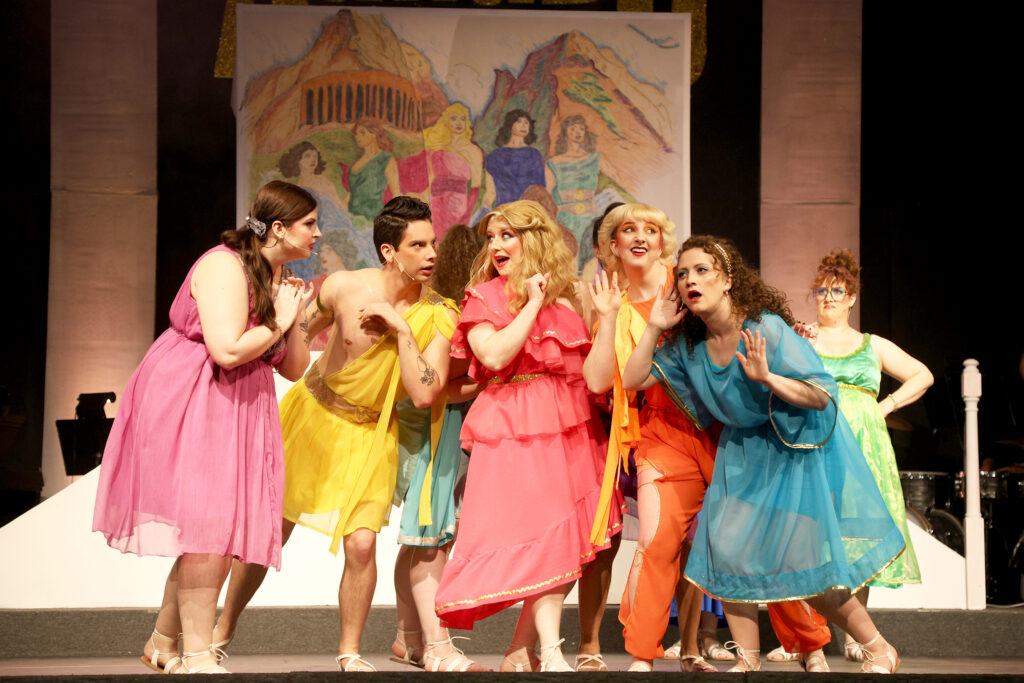
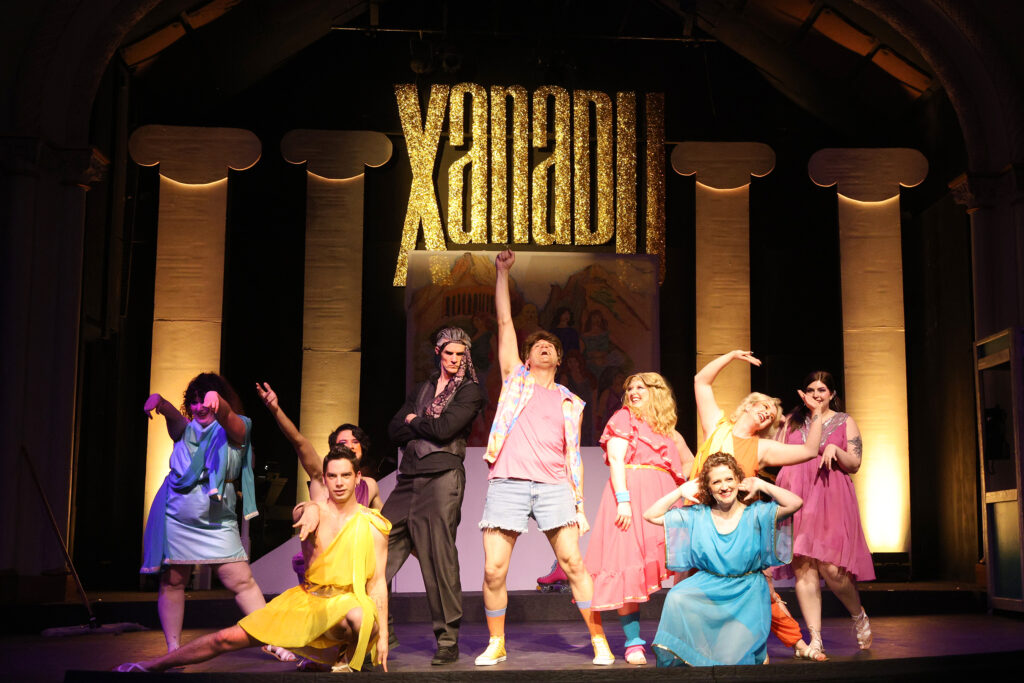
However, she didn’t arrive alone. Because Sonny envisioned the Immortals, her six sisters (Zeus’ daughters) magically appear, cavorting in their goddess cosplay – two are guys in drag.

Eight are part of the ensemble in multiple roles: Mateo Bluemel, Sarah Gene Dowling, Lindsey Grojean, Chelsie Johnston, Madison Mesiti, Drew Mizell, Katie Orr, and Lauren Tenenbaum.

Dowling, as Calliope, and Johnston, as Melpomene, inject much humor in “Evil Woman” and “Strange Magic,” two of Electric Light Orchestra’s power-pop songs added to the stage musical.

Sonny’s new dream is to turn an old theater into a roller disco. He tries to convince a wealthy real estate magnet Danny McGuire, a former Big Band musician, to give him the property, and eventually they become partners. But the road to success is rocky.

Kira’s presence re-awakens part of Danny’s past where he had a memorable fling with a look-alike named Kitty. This is all played for laughs, as well it should. That leads to a snazzy ‘40s-style song-and-dance because Gene Kelly played the film role, so of course (“When You’re Away from Me”).

Scott Degitz-Fries, a lithe dancer whose smooth moves on local stages are always admirable, is effortless in these dancing sequences. He has mad roller-skating skills and is a former competitive figure skater (made it to the national finals in high school), so he also served as roller-skating consultant.

Everyone else is trying very hard, and skills vary, but you can’t knock people doing their best given such a demanding challenge.

Photo by John Lamb.

Choreographer Mike Hodges worked the moves out with Degitz-Fries, and he created the bouncy musical group numbers so that it accurately resembles late ‘70s, early ‘80s dance-floor action: “I’m Alive,” “Magic,” and “All Over the World,” with a grand “Xanadu” are bright spots.

A mash-up scene that attempts to duplicate the movie’s “Battle of the Bands” between The Tubes, which was a rock band then (you may recall their 1983 “She’s a Beauty”), and an Andrews Sisters type girl-group circa World War II. Called “Dancin’,” it is a tad messy, and the ill-fitting costumes hamper the girl duo in their movements because of the clingy fabric. Cute little hats, nevertheless.

Costume designer Colleen Michelson’s dresses are mostly distracting and unflattering. Overall, the muses’ cheap-looking chiffon outfits don’t seem suitable, with tacky designs and shoddy material – unless it’s done on purpose? Are they meant to be versions of flimsy Johnny Brock Halloween costumes for quirky ‘80s looks? Costumers must adhere to budgets, but to me, the styles are a disconnect for the female characters. Now the Mount Olympus white gowns are fine, and the guys’ attire is, too.

Music director Leah Schultz and her zesty band keep the beat peppy – Adam Rugo on guitar, Randon Lane on second keyboard, and Joe Winters on percussion. They have added some amusing riffs, too.

Leveling is strong leading the power ballad “Don’t Walk Away” that ends Act I on a good note, while the finale “Xanadu” gets the crowd on their feet.

Campbell set the right tone for Newton-John’s signature 1975 hit “Have You Never Been Mellow” that was added to the stage musical and winds up a memorable ensemble piece.

Photo by John Lamb.

ELO’s Jeff Lynne is credited with music numbers, as is John Farrar, Newton-John’s longtime producer. Their work propelled the soundtrack to skyrocketing sales that ended that year with twice-platinum numbers.

Director Been also simply constructed the set so that movement could flow on the small stage, and it was illuminated well by lighting designer Tyler Duenow.

Because of its lightweight goofy premise that can only be stretched so far, one’s relieved when the wrap-up comes around 2 hours (with an intermission). Pacing is uneven at times, and the show can get a little shaggy. The meaning of this falderal? “Xanadu” is “true love and the ability to create and share art.”

The film came out at a time when everyone had been trying to duplicate the magic of “Saturday Night Fever” and disco, so hot for a brief time, was waning. And the stage musical came out at a time that jukebox musicals were emerging as a trend, such as “Mamma Mia!” and the retro “Hairspray.” Ah, that elusive “Next Big Thing.”

This production of “Xanadu” is well-meaning fluff, with entertaining tongue-in-cheek performances, so don’t expect more – just go with the good vibes coming from kitschy pop culture.

“Xanadu” is going to hit people differently, depending on when and how this tale came into their lives – whether they were young listening to the soundtrack on their Walkman, or today, enjoying a sentimental walk down memory lane.

Photo by John Lamb.

Stray Dog Theatre presents “Xanadu” from April 4 to April 27, Thursdays through Saturdays at 8 p.m., with Sunday matinees at 2 p.m. April 14 and April 21 at the Tower Grove Abbey, 2348 Tennessee Ave, St. Louis, MO 63104/ For tickets or more information, visit www.straydogtheatre.org

By Lynn Venhaus

Infused with humor and a breezy charm, Stray Dog Theatre’s enchanting interpretation of Stephen Sondheim’s “A Little Night Music” brings out starlit summer imagery, the glory and glimmer of love, and the best in a resplendent cast.

On opening night, nature supplied a full moon on a crisp autumn evening outside the Tower Grove Abbey, a serendipitous touch. Imagine the golden glow of a warm, fragrant moonlit midsummer night – and you’ll easily slip into the mood for this sophisticated romp.

Set in Sweden at the turn of the 20th century, “A Little Night Music” concerns several pairs in various stages of romance or uncoupling – and what entanglements transpire during a summer sojourn in the country.

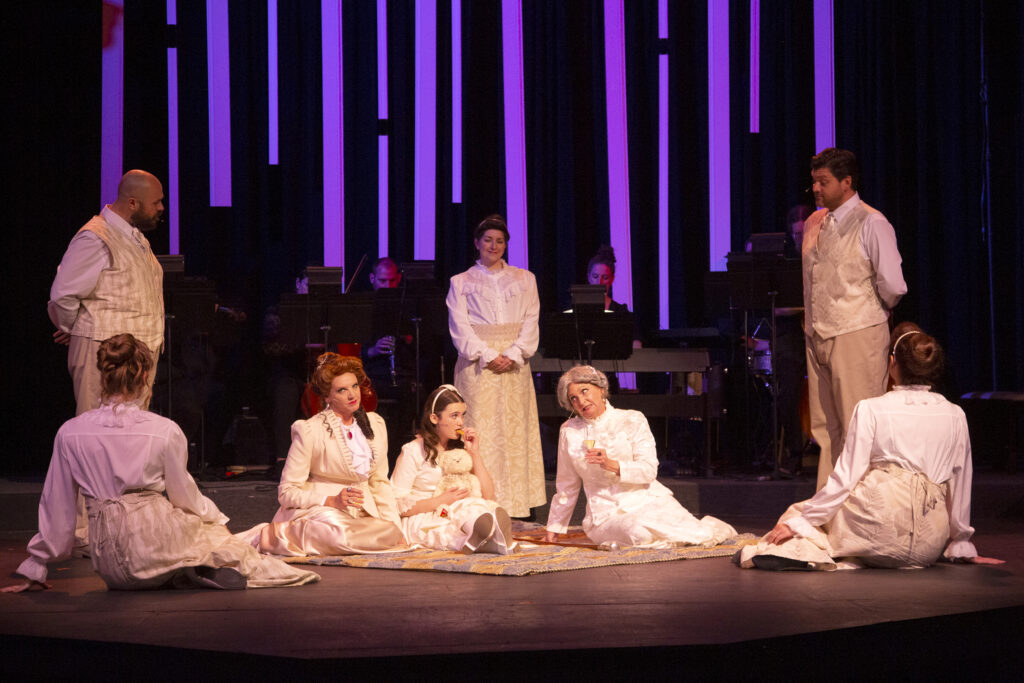
Liz Mischel is amusingly sarcastic as the unfiltered Madame Leonora Armfeldt, a wealthy matriarch who had colorful liaisons as a courtesan. She is schooling her innocent granddaughter Fredrika (a sweet and assured Adeline Perry) on the ways of the world – and men. She tells her the summer night ‘smiles’ three times: first on the young, second on fools, and third on the old.

The Armfeldts and servants picnicking. Photo by John Lamb

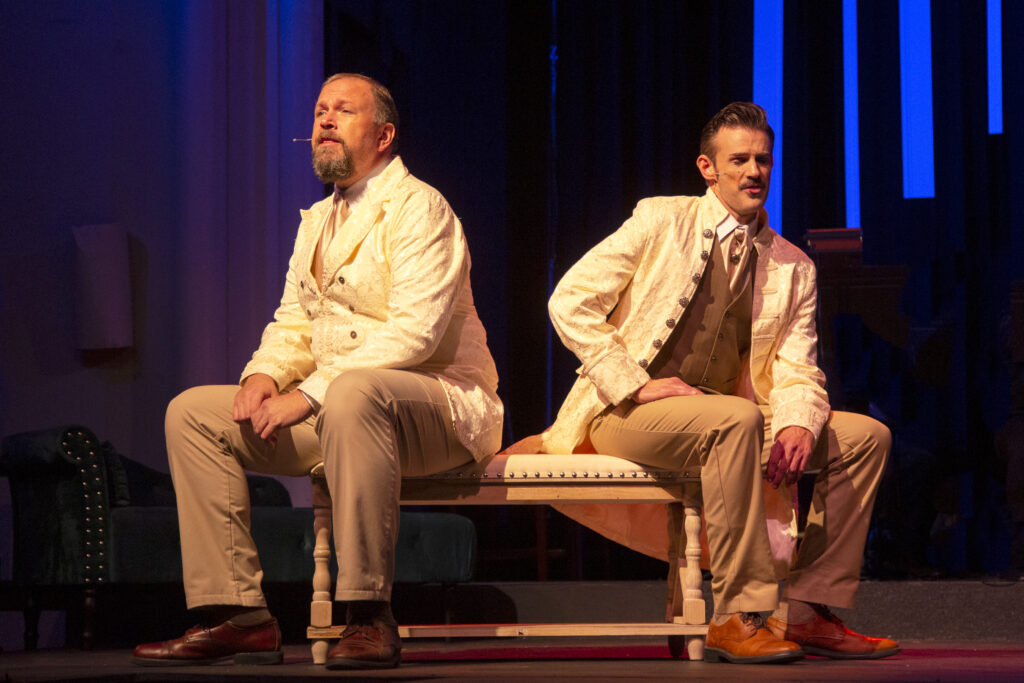
Madame’s daughter, the alluring, touring stage actress Desiree Armfeldt (Paula Stoff Dean) is a force of nature known for not playing by the rules. Her old lover, attorney Fredrik Egerman (Jon Hey), married a naïve young woman Anne (Eileen Engel) about 30 years his junior 11 months ago, and their union has not been consummated (her issues).

The coquettish but inexperienced wife teases her serious husband’s awkward son, Henrik (Bryce A. Miller), by his late first wife, who is studying for the ministry but has feelings for her, his stepmother. Although clumsy, he is not impervious to desire and has a dalliance with her maid, an older and wiser Petra (a brassy Sarah Gene Dowling making her character’s worldliness obvious).

Miller has to demonstrate the widest emotional range as the confused and ready-to-explode Henrik, and he effectively finesses the fine line between the melodramatic and the comedic to distinguish himself in a cast of veterans.

Desiree is currently the mistress of self-absorbed Count Carl-Magnus Malcolm (Scott Degitz-Fries), a buffoon whose jealous wife, Countess Charlotte (Madeline Black), is in on the charade. Degitz-Fries plays the military royal as an obnoxious, arrogant chauvinist who is not used to ‘no.’ Black channels her rage into a scheme – you know the adage about women scorned – but keeps her character’s refinement intact.

They all circle around and back to each other. Fredrik has taken Anne to see Desiree’s latest play, which eventually leads to an invitation for a country excursion. The complications culminate in the anticipation, flirting, fighting, and fleeing that takes place in the second act. Does love win in the end?

Hey, Dean. Photo by John Lamb.

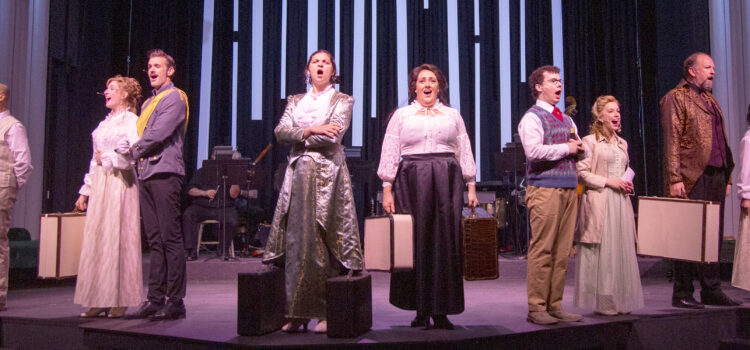
One look at the waltzing quintet in their summer whites that starts this elegant show, and you’re transported back to a different era. Splendidly delivering “Night Waltz,” Cory Anthony, Shannon Lampkin Campbell, Jess McCawley, Kevin O’ Brien and Dawn Schmid glide across the stage as the Liebeslieder Singers, astutely controlling the tempo.

They act like a Greek chorus, and their lush harmonies soar in “The Glamorous Life,” “Remember?” and “The Sun Won’t Set.”

The entire cast’s strong vocal prowess is noteworthy throughout, but a masterfully arranged “Weekend in the Country” is a triumph.

Dean has decided to belt the signature song, “Send in the Clowns,” instead of reciting nearly all of it, as others have done, and it’s a fine rendition. Another highpoint is Dowling’s “The Miller’s Son,” emphatically sung as a mix of longing and reflection.

Whether they are singing solo or in duets, or at the same time with different songs (“Now” by Fredrik, “Later” by Henrik and “Soon” by Anne), you’ll marvel at how seamless the numbers are performed.

Black and Engel lament together on infidelity, smoothly combining in “Every Day a Little Death,” and Degitz-Fries has his moment with “In Praise of Women.”

Photo by John Lamb

Employing the beautiful orchestrations of Jonathan Tunick, Music Director Leah Schultz uses three string players that elevate the sumptuous sound. The orchestra is prominently placed on stage, and their work is exquisite.

Schultz, also playing piano, expertly conducts the seven-piece orchestra that includes a cello (Michaela Kuba), a violin (Steve Frisbee) and a bass (M. Joshua Ryan), along with Ian Hayden and David Metzger on reeds and Joe Winters on percussion.

The way director Justin Been has shaken off the stodginess and stuffiness of a high society period piece is impressive. He’s embraced the farcical aspect of revolving romantic hook-ups, sleekly moving the characters through a country estate, the grounds, and an adjacent forest

Looking at the book by Hugh Wheeler with a fresh set of eyes gave it needed oomph, and the ensemble, nimble in comedy, conveys a playfulness that endears. Been has brilliantly adapted the very theatrical and somewhat operetta-ish work for the small stage.

The original 1973 Broadway production won six Tony Awards, including Best Musical, book, and score, and has had revivals in London’s West End and Broadway, adapted into a 1977 film starring Elizabeth Taylor, and has been performed by opera companies around the world – including this summer’s traditional format at Union Avenue Opera in St. Louis.

Anne and Henrik. Photo by John Lamb

With a minimum of set pieces, Been has depicted the states of different affairs well. He designed modern Scandinavian impressionistic slats that hang above the orchestra, perhaps as a nod to magic realism. Jacob Baxley’s sound design and Tyler Duenow’s lighting design add to the imagery.

The creators claim the musical was suggested by Ingmar Bergman’s romantic comedy, “Smiles of a Summer Night,” which premiered in 1955, and is a staple at film retrospectives.

You might not think of Bergman as a merry sort of guy, particularly if you’ve seen his critically acclaimed classics “The Seventh Seal,” “Persona,” “Cries and Whispers,” and “Through a Glass Darkly.” But he mixed sugar and spice to come up with a confection that’s been ‘borrowed’ more than a few times. (Woody Allen’s 1982 “A Midsummer Night’s Sex Comedy,” to name one, which also references Shakespeare’s “A Midsummer Night’s Dream.”).

But this Bergman-inspired fantasia is much lighter, and Been has brought out the laughter, easy on the melancholy – yet has middle-agers expressing regrets.

Dean, Hey. Photo by John Lamb

Hey, as Fredrik, and Dean, as Desiree, portray a rueful pair, looking back wistfully and rediscovering their spark. The accomplished actors display a natural rhythm with each other, especially in “You Must Meet My Wife.”

Like the music, the dance numbers are polished, choreographed by Michael Hodges with an emphasis on regal posture — although, at first, notice how awkward the pairings are – it’s on purpose, ahem).

Engel, who is delightful as the conflicted Anne, designed the costumes – and they are a mix of ethereal and chic, conveying the social status of each character. The hair and wig design by Dowling suitably complimented the looks.

Hey and Engel were part of Stray Dog’s “Sweeney Todd” in spring 2017, he in the title role and she as daughter Johanna, and know the challenges Sondheim presents, and their experience serves them well.

Sondheim’s work is getting a lot of posthumous attention – but that’s a good thing, never enough Sondheim done well. Like the recently revived “Into the Woods,” some of his musicals take on richer, more contemplative meaning as one ages and revisits them again.

Stray Dog’s superb “A Little Night Music” is worth the immersion, featuring a triple-threat cast in fine form and an inspired creative team.

The Liebeslieder Singers. Photo by John Lamb.

Stray Dog Theatre presents the Stephen Sondheim’s “A Little Night Music” at 8 p.m. Thursdays through Saturdays through Oct. 22, with additional performances at 2 pm Sunday, Oct. 16 and 8 pm Wednesday Oct.19. Performances take place at Tower Grove Abbey, 2336 Tennessee in Tower Grove East. Tickets are only offered in physically distanced groups of two or four. For more information: www.straydogtheatre.org

Hey and Degitz “It Would Have Been Wonderful.” Photo by John Lamb