By Alex McPherson
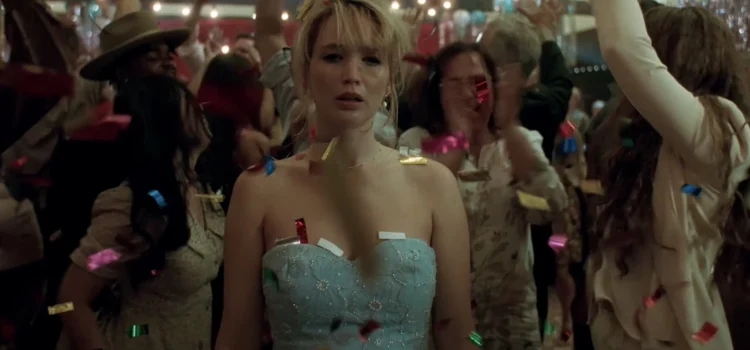
An intensely gripping acting showcase for Jennifer Lawrence, director Lynne Ramsay’s “Die My Love” paints an existentially nightmarish picture of motherhood, conformity, and relationships in fateful disarray.
Based on the novel Matate, Amor by Ariana Harwicz, the film follows Grace (Lawrence), a free-spirited and frustrated writer who moves into an old house in rural Montana with her ruggedly handsome but insecure boyfriend, Jackson (Robert Pattinson). The house, nestled within tall grasses and fairy-tale woods, was left to Jackson by his uncle who committed suicide.
It’s seemingly a prime location for Grace and Jackson’s antics; they drink nonstop and have wild sex, fully embracing their physical passions. Before long, Grace is pregnant and gives birth to a baby boy (whom they choose not to name), forever altering the paradigms they exist within.
Grace and Jackson’s relationship begins to crumble. Jackson is away at work for suspiciously long periods, and Grace suspects him of infidelity. Loneliness, emotional detachment, and sexual frustration grow exponentially day by day, with Grace feeling abandoned even when Jackson is at home.

She crawls on all fours like a prowling dog and masterbates in the nearby woods, at one point walking through the plain’s wispy grass, knife in hand, while their son sits unattended on the porch.
Grace’s new responsibilities and social expectations untether her present self from her former self, with troublingly extreme results. Jackson’s unstable mother, Pam (Sissy Spacek), lives nearby and is grieving her recently-deceased husband (Nick Nolte). She offers Grace some support, but Grace stubbornly refuses to accept help during her postpartum spiral.
Jackson is also largely clueless and unwilling to change his ways. He and Grace are still drawn to each other, but they’re unable to let go of a toxic cycle of fighting and reconciliation. A mysterious biker (LaKeith Stanfield) living in the area offers the possibility for Grace to indulge her needs.
Melding sheer brutality with sequences of dreamy, sensual beauty, “Die My Love” thrives on its ethereal atmosphere and a show-stopping performance from Lawrence. She inhabits Grace with a wild-eyed intensity and crushing pathos, a woman fallen out of touch with both herself and with “civilized” society writ large.
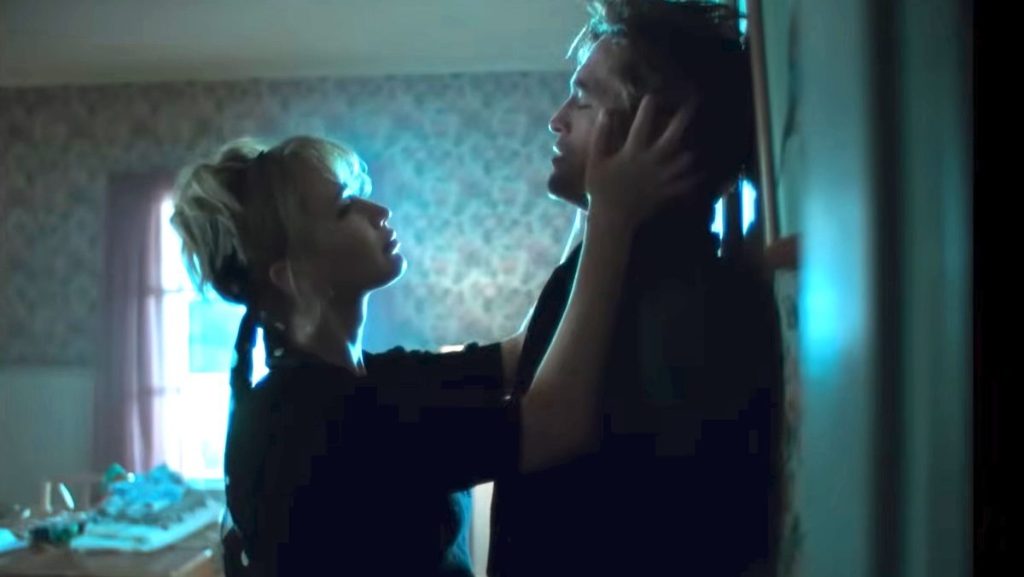
Ramsay, known for disquieting character studies, is a prime fit for this portrait of mental decline. “Die My Love” prizes tone over traditional narrative —we’re watching a hypnotizing trainwreck as Grace destroys both herself and her relationships.
Neither Grace nor the people in her orbit have the power to shift her trajectory; she’s as much a byproduct of postpartum depression as she is from the ways that Jackson and the world treat her in her new role as a mother.
Seamus McGarvey’s cinematography frames the expansive yet confining landscape as foreign and disorienting. The environment often distorts as characters move through space, as if each step renders Grace further divorced from desires she feels forbidden from embracing, with other characters also struggling to find their own paths forward.
There’s a haunting, symbolic quality to the 4:3 aspect ratio and the wide-open surroundings the characters reside within: expansive and limiting, even isolating.
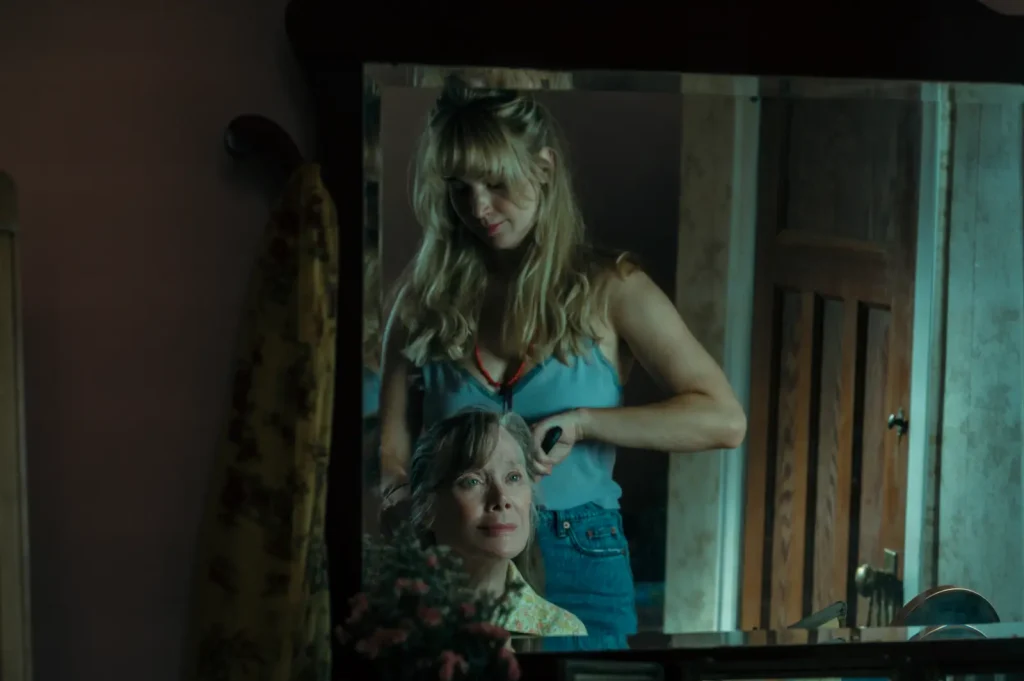
“Die My Love,” not completely unlike Mary Bronstein’s “If I Had Legs I’d Kick You,” does a fantastic job at submerging us into its protagonist’s mind. Ramsay’s filmmaking is at times dreamlike and other times startling in its blunt depiction of Grace’s self-destructive behaviors (animal lovers beware).
Music plays a critical role here, featuring one of the year’s best soundtracks, expressing dread as well as mournful reflection on the idealized life Grace once envisioned she’d have.
Lawrence gives a highly physical performance, from manifesting Grace’s desires through animalistic, “interpretive dance” sequences (that the film plays completely straight), to the peace she feels within the nearby woods away from civilization, and the violent self-hatred that flares unexpectedly.
There’s some bone dry humor in Lawrence’s matter-of-fact delivery. This is especially apparent during a scene where she has a “conversation” with a friendly gas station cashier, although Grace’s wit always reflects her deep-seated malaise.

The screenplay by Ramsay, Alice Birch, and Enda Walsh doesn’t provide much backstory, which puts more emphasis on the intricacies of Lawrence’s performance. Luckily, she is fully up to the task of conveying Grace’s emotional limbo.
Pattinson, not given as much to do as Lawrence, brings a shaggy insecurity that underlines Jackson’s volatility and half-hearted attempts at making amends. Like most other characters in “Die My Love,” Jackson remains unable to truly listen to Grace and understand where she’s coming from, every conversation seemingly creating more distance.
Spacek, too, does a lot with limited screen time; on some level, Pam identifies with Grace’s decline, and supports her efforts for independence even as they threaten Grace’s life.
The problem is that “Die My Love” eventually starts to wear out its welcome in Grace’s perpetual perils. Grace’s “journey” is a downhill slide that won’t stop until it’s all burned down. Ramsay’s film is disconcertingly harsh, alienating viewers through a story about alienation. And, well, isn’t that part of the point? It’s a dark, twisted vision of Hell still worth experiencing.

“Die My Love” is a 2025 psychological thriller directed by Lynne Ramsay and starring Jennifer Lawrence, Robert Pattinson, Sissy Spacek and LaKeith Stanfield. It is rated R for sexual content, graphic nudity, language, and some violent content, and the run time is 1 hour, 59 minutes. It opened in theatres Nov. 7. Alex’s Grade: B+.

Alex McPherson is an unabashed pop culture nerd and a member of the St. Louis Film Critics Association.