By Lynn Venhaus

A story of uncommon courage and grace while facing deeply rooted cruelty and oppression, “The Color Purple” is a momentous achievement for the Black Rep.

Through Celie’s harrowing emotional journey, a stunning Angela Wildflower leads a passionate ensemble who gives it all through the musical’s sorrows, love, pain and ultimately, triumph.

In a tour de force performance, Wildflower is the heart and soul of this deeply felt production, directed with considerable flair and impact by Daniel Bryant.

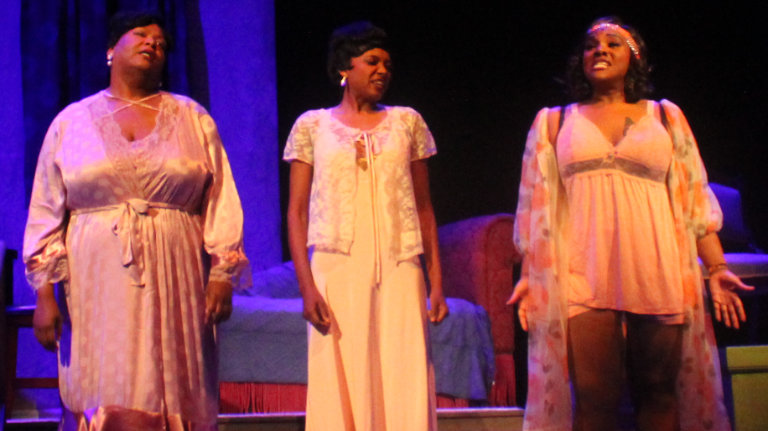
In the St. Louis Black Repertory Theatre’s premier that opened its landmark 50th season, the affection for the storytelling was palpable between the audience and the artists. The spirited cast’s voices soared, starting with powerhouse Anita Jackson and the other two ebullient Church Ladies Amber Rose and Olivia Neal with the opening.

The vibrant, roots-infused score includes gospel, jazz, ragtime, blues, and African beats, with songs by Brenda Russell, Allee Willis, and Stephen Bray that bring out the purpose and yearnings.
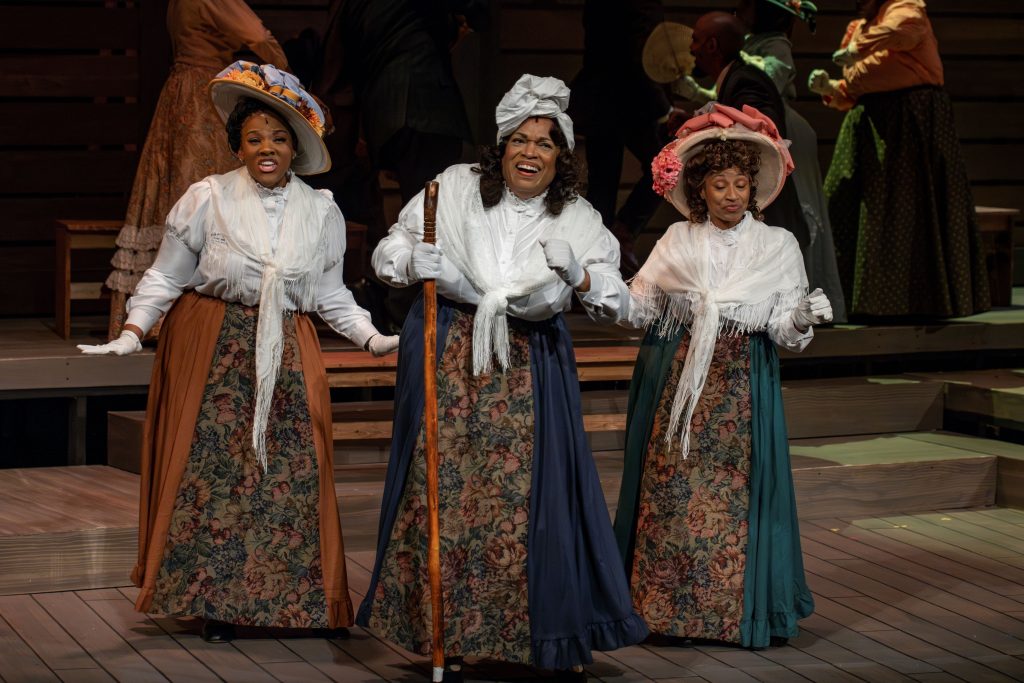
The Church Ladies Amber Rose, Anita Jackson, Olivia Neale. Photo by Arieona Phillips

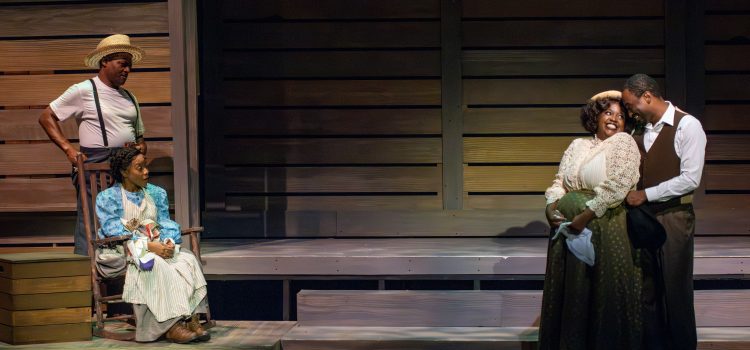
In 1909, Celie, 14, is a humble, hard-working poor black girl living in rural Georgia, who has delivered two babies whose father is her father, and Pa (J. Samuel Davis) has taken them away.

Several years later, he makes a deal to give Celie to Albert “Mister” Johnson (sturdy Kelvin Roston Jr.), an emotionally and physically abusive widower and farmer, to care for his unruly children and serve him.

By her sacrifice, she spared her sister, Nettie (a tender Morgan Taylor), so that she could follow her dream of being a teacher. Unbeknownst to Celie, for many years, the compassionate Nettie winds up with a missionary family in Africa. When Morgan and Angela sing together, it’s magical, especially “Our Prayer.”

Celie has gone from one house of horror to another. But her faith sees her through, as do the people who raise her up. That community will return her kindness.
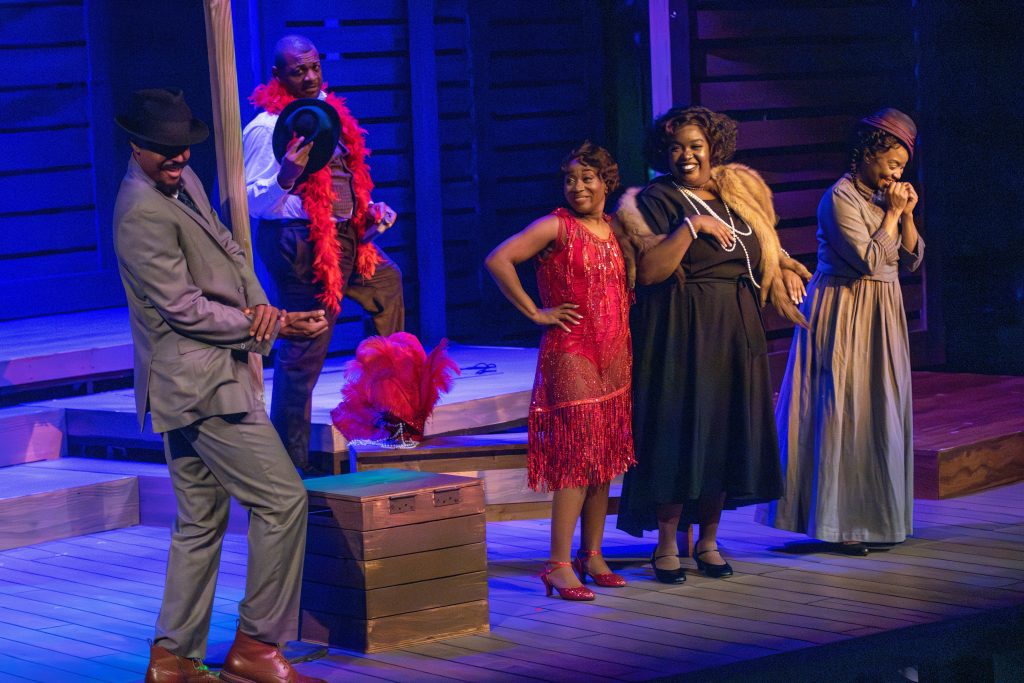
Push Da Button. Photo by Arieona Phillips

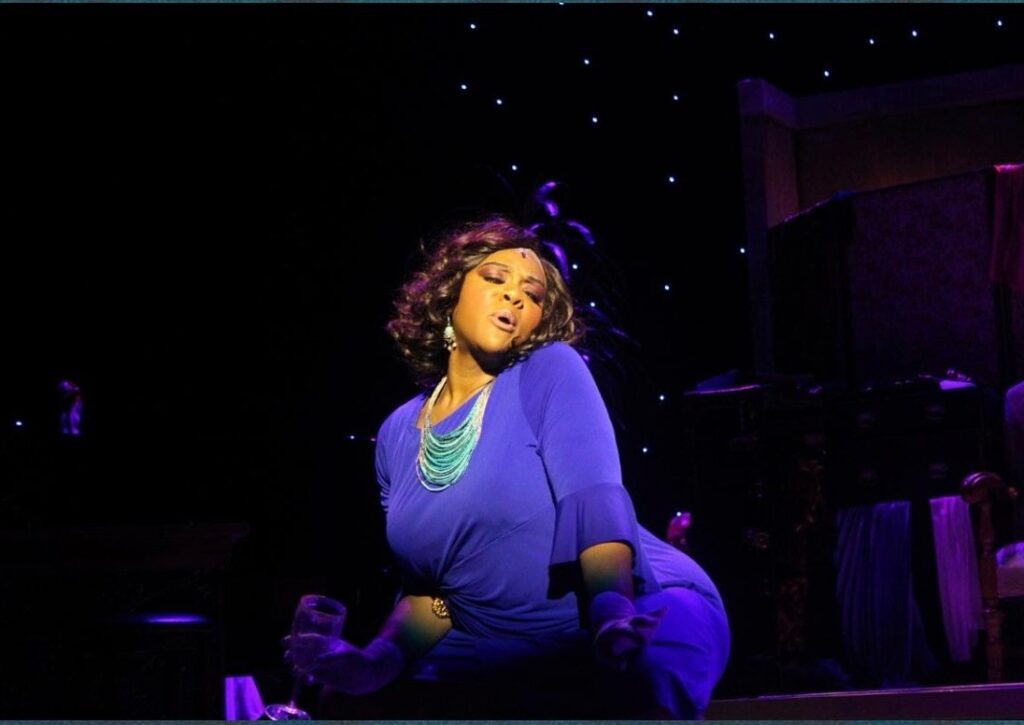
While taking care of Mister’s home, the nurturing Celie meets the glamorous and worldly nightclub chanteuse Shug Avery (dynamic Alexis J. Roston). They share romance and a deep bond.

Wearing a snazzy red outfit, Roston sashays with confidence in “Push Da Button” and she shines in “Too Beautiful for Words” and “What About Love?”

One of Mister’s grown children, Harpo (versatile Brian McKinley), marries Sofia (powerhouse Adrienne Spann). Spann, impressive in her Black Rep debut, is strong as the feisty free spirit, known for her independence and speaking her mind. She stands out with her phrase (and song) “Hell, no!”

Tyler White is comical as the irrepressible Squeak and Olajuwon Davis, Dajuan Davis and Samantha Madison are well-rounded, adaptable ensemble members.

Marsha Norman wrote this musical adaptation of Alice Walker’s Pulitzer Prize-winning touchstone novel, a National Book Award winner in 1982. It debuted on Broadway in 2005 and then was revived in 2015.
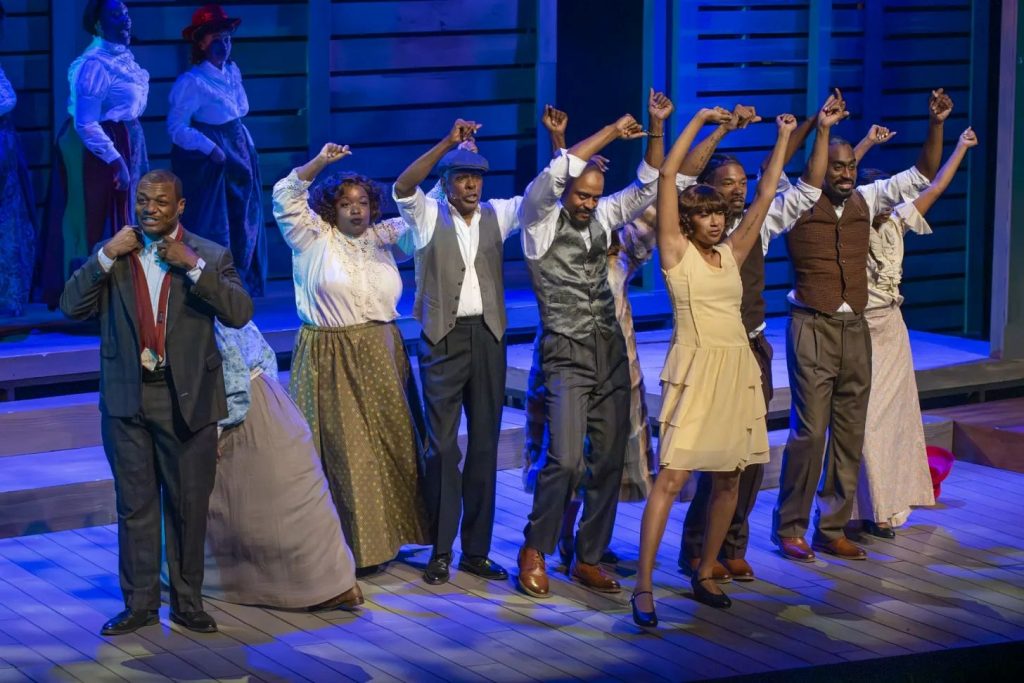
Photo by Arieona Phillips

In the two film adaptations, first in 1985 by Steven Spielberg, which garnered 11 Academy Award nominations, and then a 2023 musical version, they brought out the dignity and virtues of a trauma survivor.

Wildflower brought down the house with “I’m Here” – which was interrupted three times by applause, a goosebump moment.

With this stellar cast, the finale, reprising “The Color Purple,” is heartfelt and affecting, reminding us of the mighty power of love, healing and resilience.

The staging is simple and Heather Beal’s choreography is supple, well-suited for this nimble ensemble. They have fun with the juke joint dance – and ‘Uh Oh.” Special mention to fight choreographer Paul Steger. The energetic African dance number is an ideal way to open the second act.
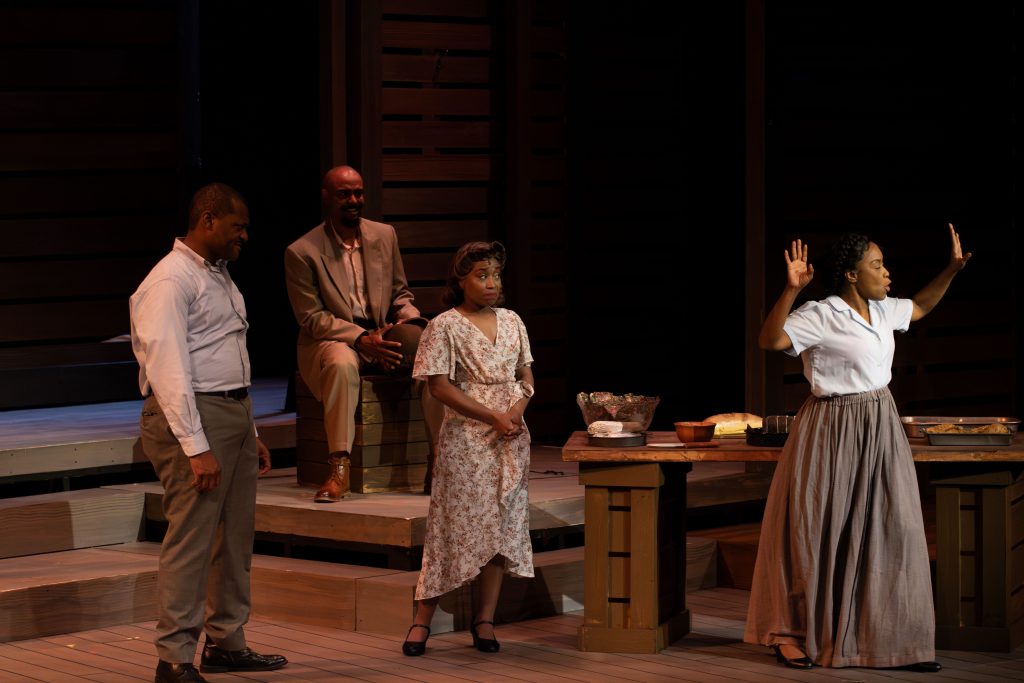
Photo by Arieona Phillips

Using cultural soundscapes beautifully, Music Director Jermaine Manor fluidly leads an eight-piece orchestra, with Zach Neumann on keyboards, Stan Coleman and Alex Macke on reeds, Dennis Brock on guitar, Willem von Hombracht on bass, Des Jones on drums, Gerald “Babtunde” Williams on percussion, and Manor on keyboards, too.

Resourceful scenic designer Tim Jones’ flexible scenic design uses an ancestral tree as a backdrop focal point, with nods to 20 Century South and Africa, and lighting designer Michael Sullivan created atmospheric notes, as did Justin Schmitz’ sound design. Mikhail Lynn did his customary excellent work on props.

With a story spanning 40 years, costume designer Jarrod Barnes’s stylish vintage wear reflects the periods and the economic level of the characters, with Sunday best church clothes and fancier juke joint attire. Nettie’s gorgeous white Victorian dress rivals Shug’s dazzling pieces, and all the trousers are fun for “In Miss Celie’s Pants.”
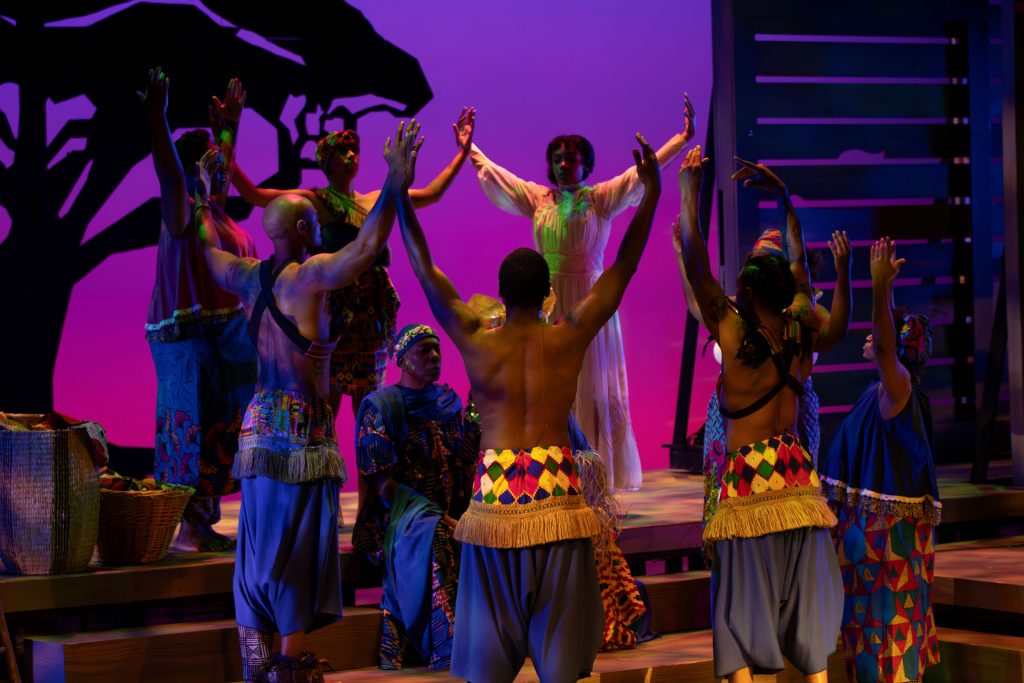
African Dance. Photo by Arieona Phillips

Of note, purple symbolizes strength, transformation, power, wisdom, bravery — and all meanings can be applied here.

What is most personal is also the most universal, and it shows in The Black Rep’s expertly produced, very moving musical.

The Black Rep presents “The Color Purple” Sept. 9 – 27 at The Edison Theatre at Washington University in St. Louis. For tickets, visit The Black Rep’s website, www.theblackrep.org.
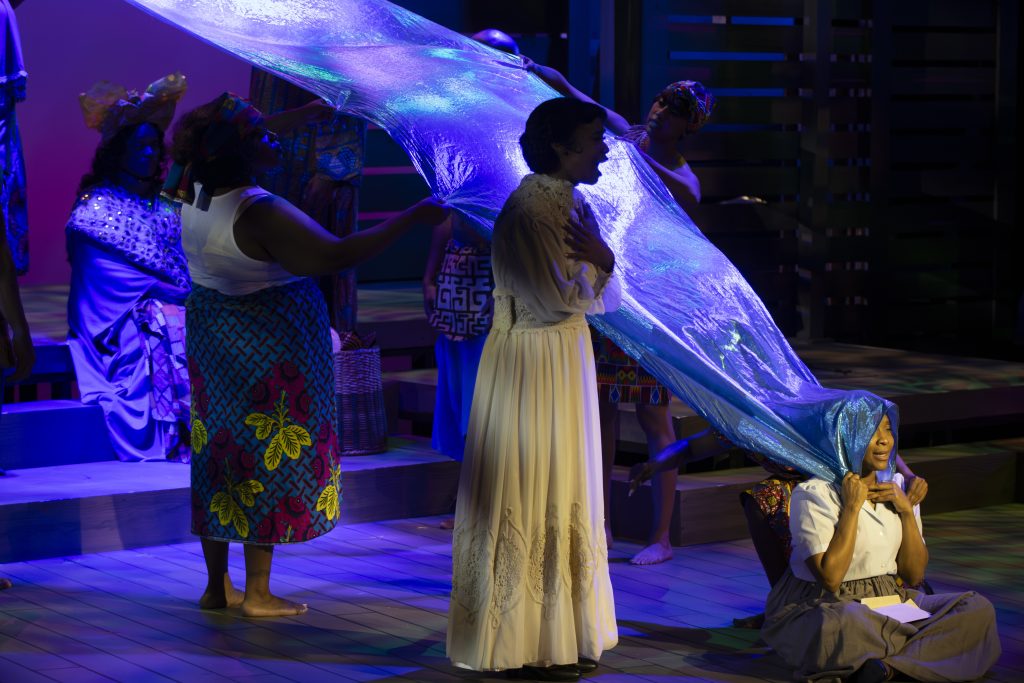

Photo by Arieona Phillips

By Lynn Venhaus

A saucy, sultry and soulful trio of supremely talented women take us on their rocky road of hard-fought life lessons in a stylishly framed musical “Blues in the Night.” They sure have earned the right to sing the blues, and the Black Rep’s polished gem of a show is evocative of divine romance and the light that breaks through after darkness.

The enchanting Adrianna Jones as “The Woman,” Amber Alexandria Rose as “The Girl,’ and De-Rance Blaylock as “The Lady” conjure up past lives of sorrows, heartbreak and triumphs as they take us through an appealing catalogue of 27 classic blues and jazz songs.

In their skilled delivery, while projecting attitude and emotion, they bring those experiences to life with a vitality that’s mesmerizing. These songs may have been written in days gone by, but there is a freshness because the numbers are presented with a vibrancy and good nature.

The time is the 1930s and the place is Chicago. And we are swept away to an era immortalized in music and movies. I can see/hear images of Duke Ellington, Bessie Smith, Louie Armstrong and Ella Fitzgerald.

The women get to shine in solos – think of their voices as the luxurious textures of silk, satin and velvet.

De-Rance Blaylock as “The Lady.” Photo by Keshon Campbell.

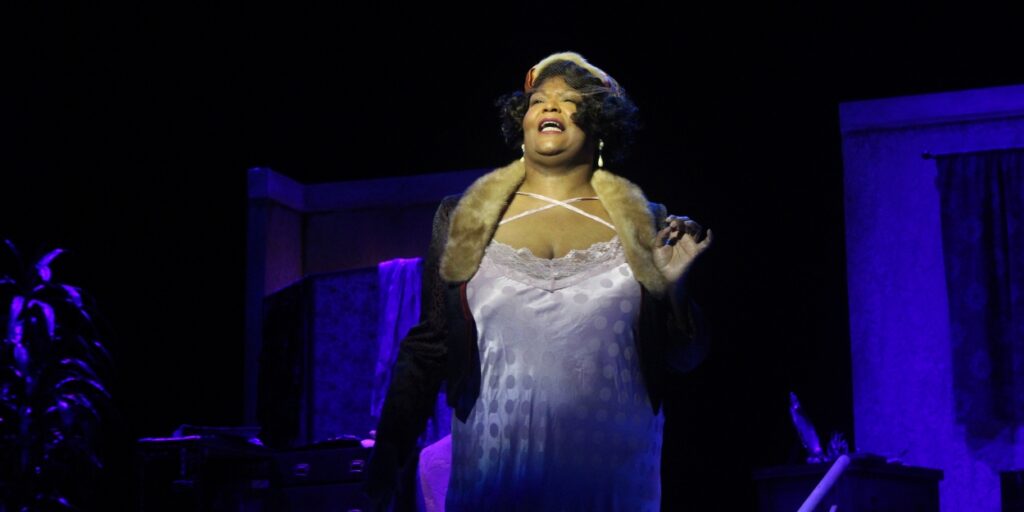
As the eldest woman “The Lady,” Blaylock, who won the St. Louis Theater Circle Award for Best Performance in a Musical, Female or Non-Binary Role, last year for “Caroline, or Change,” imbues Bessie Smith’s dramatic standards “New Orleans Hop Scop Blues,” “Dirty No-Gooder’s Blues” and “Wasted Life Blues” with grit, then is playful in “Take Me for a Buggy Ride” and “Kitchen Man.” She’s sorrowful in Billie Holiday’s “Lover Man.”

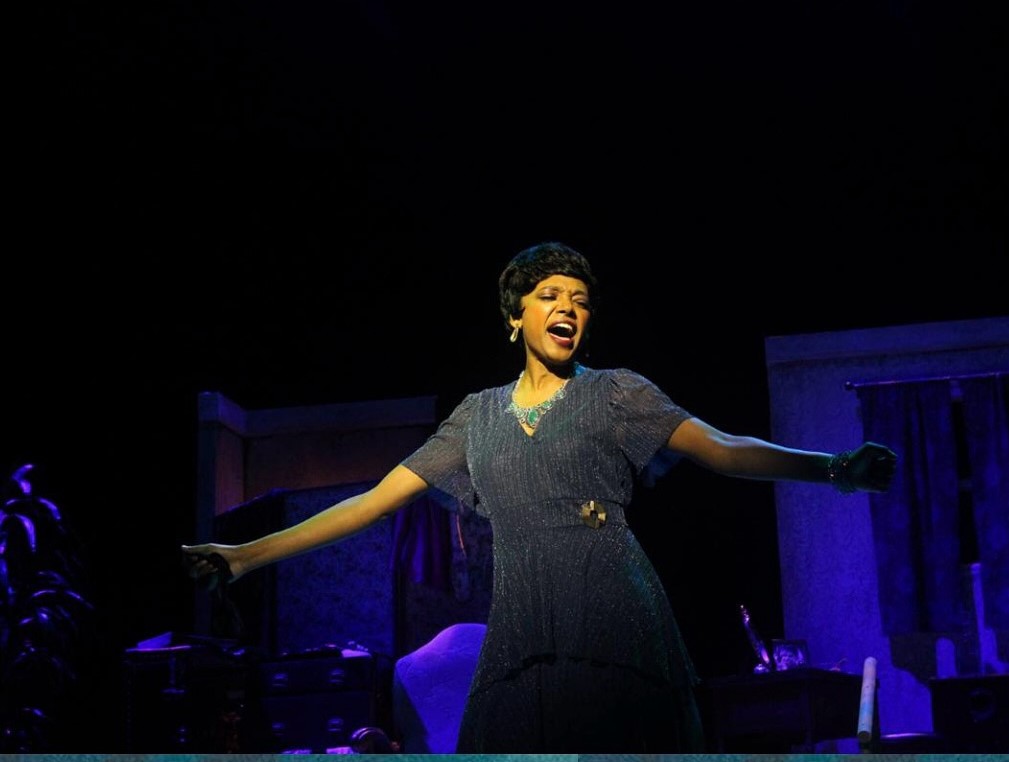
As “The Woman” in her prime, Jones makes a memorable Black Rep debut, swinging in the famous Benny Goodman song named after the famous Harlem nightspot, “Stompin’ at the Savoy,” and Billy Strayhorn’s jazz standard “Lush Life.” She’s longing – and assertive –in “Rough and Ready Man.”

As the youngest “The Girl,” Amber Alexandria Rose is already a veteran of multiple musicals produced at The Black Rep and was part of the noteworthy Fisk Jubilee Singers at the Tennessee university. She’s dynamic in the Big Band favorite “Taking a Chance on Love,” “Willow Weep for Me” and “Reckless Blues.” Jones and Rose duet in the great torch song “When Your Lover Is Gone.”

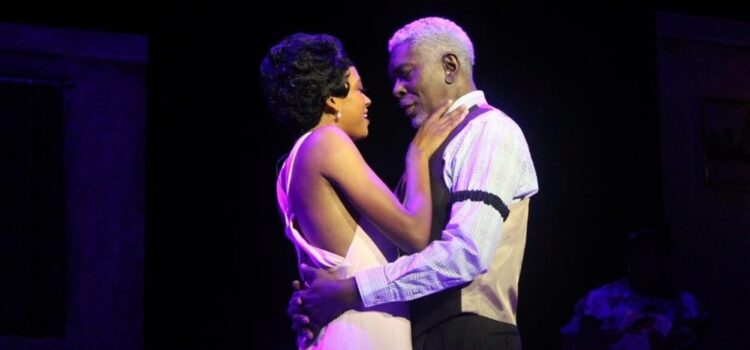
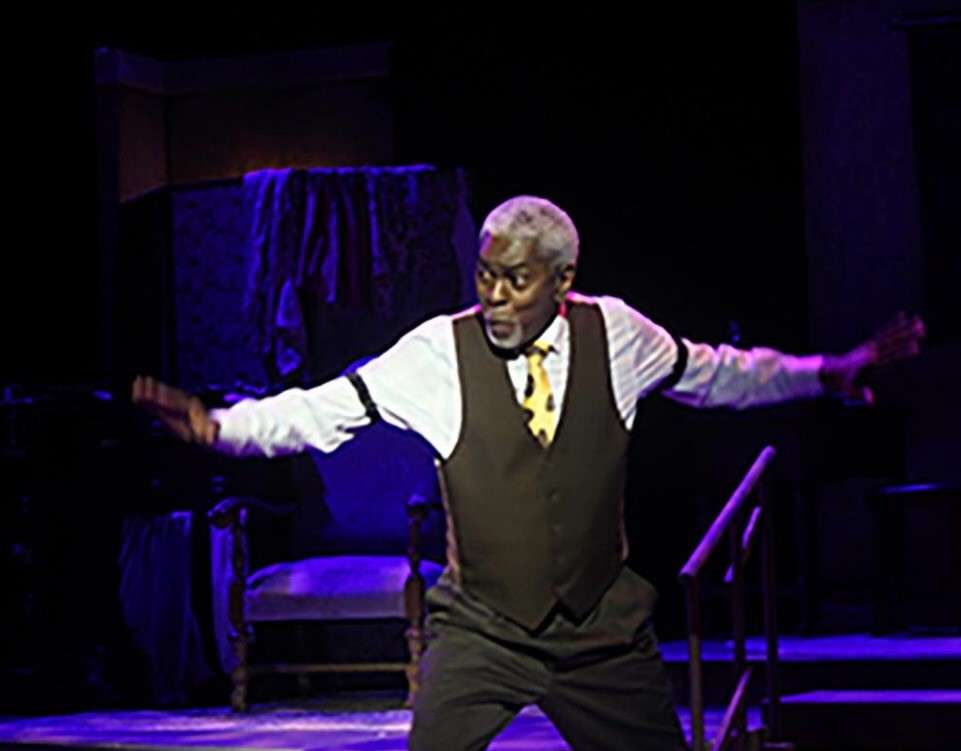
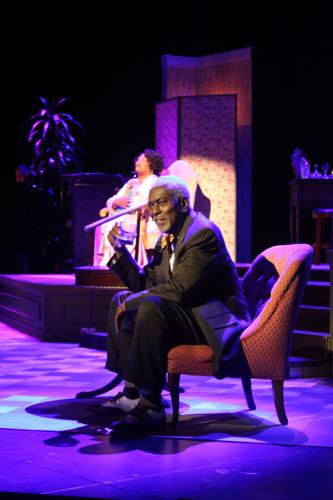
However, the women aren’t the only ones adding sass and class to the show. As “The Man,” J Samuel Davis displays a remarkable gift for singing – who knew? (I mean he’s one of our finest dramatic actors, but an accomplished vocalist? Heck, yeah! More, please).

J Samuel Davis as “The Man.” Photo by Keshon Campbell.

Well, he gets to play the cad, the guy who done them wrong, but also a fellow with considerable charm. He opens with a rousing “T-Bone Walker’s “The Blues Is a Woman” and has fun with Louie Armstrong’s “I’m Just a Lucky So-and-So” and “Wild Women Don’t Have No Blues.” Davis is a two-time St. Louis Theater Circle Award winner, for performances in “Bashir Lazhar” at Upstream Theater and “District Merchants” at New Jewish Theatre. He’s recently been seen in “Cat on a Hot Tin Roof” at the Tennessee Williams Festival St. Louis and in The Black Rep’s “King Hedley II.”

A tight quintet of superb musicians makes the magic happen, with music director Khalid McGee giving the piano a mighty fine workout, along with Willem von Hombracht on bass, Brady Lewis on trumpet, Stan Coleman on reeds and Bernard Long Jr. on drums smoothly jiving, wailing and scorching the compositions.

The original vocal arrangements were by Chapman Roberts, with orchestrations and additional vocal arrangements by Sy Johnson. It’s a satiny-smooth trip through the best representations of the genre.

Their second act opening jam session to “Wild Women Don’t Get the Blues” gets the joint a jumping, while their Exit Music at the show’s end is enough to keep you in your seats. What a delight they are to listen to all evening. And special shout-out to sound designer Justin Schmitz on his outstanding work.

The way the set is structured, with Davis often presiding over a bar, you feel like the musicians are masters of their destination nightclub, and you feel part of a very ‘inside’ cool experience.

Adrianna Jones as “The Girl.” Photo by Keshon Campbell

The women are placed in individual rooms that appear to be the same floor of a hotel — each of various ages and different reasons to be home alone.

Scenic designer Jamie Bullins’ attention to detail is admirable and sets a terrific nostalgic tone, which is carried through by prop designer Mikhail Lynn.

Travis Richardson’s lighting design enhances those spaces and adds so much to the shifting moods.  It feels elegant despite hearing tales of woe (but often resilience and strength, too).

Director Ron Himes has enlivened this show – part jukebox musical, part revue and totally entertaining with a breezy staging that also offers comfort, joy and inspiration.

Sheldon Epps, well-known for his work as artistic director at the Pasadena Playhouse, earned Tony nominations and much acclaim for his musical on Duke Ellington called “Play On!” He then conceived and put together “Blues in the Night,” which opened off-Broadway in 1980 before it moved to Broadway in 1982. It was nominated for a Tony as best musical but mostly (inexplicably) has had short runs.

 It deserves to be noticed, for its depth of material and sharp execution are worth seeing because of the band’s rhythms and the cast’s vocal power and emotional intensity. It results in a charming evening of good tunes, sumptuous vocals and a fun atmosphere.

Amber Alexandria Rose as “The Girl.” Photo by Keshon Campbell.

The company’s group numbers showcase their abilities to harmonize beautifully, with “It Makes My Love Come Down” and a feisty “Take It All Back” wrapping up the first act.

Decked out in shades of blue, the women coming out swinging in the second act with “Blues in the Night,” followed by stellar renditions of “When A Woman Loves a Man” and “Am I Blue?” and a wistful “Nobody Knows You When You’re Down and Out” with the entire company.

After baring their souls and singing their hearts out, the women present a moving “I Gotta Right to Sing the Blues,” the well-known Harold Arlen standard, before the “Four Walls Blues” encore/finale.

Heather Beal’s light touch on choreography is well-suited to this show, and the characters. For the most movements, the women sashay, the man struts, and any dance is attuned to the times.

Gregory J. Horton’s gorgeous selection of vintage formal attire, cocktail dresses, and loungewear provides a sumptuous assortment of fabrics and styles ideally representing time periods and happenings.

The Women. Photo by Keshon Campbell.

Tracy Holliway-Wiggins is the stage manager with Daija Jones as assistant stage manager.

The blues provide a universal language into the soul, and the Black Rep has splendidly guided us through a pleasurable excursion into the urban blues of Chicago and a post-Great Depression America.

Photo by Keshon Campbell.

The Black Rep presents the musical “Blues in the Night” Sept. 4 through Sept. 29 at the Edison Theatre on the Washington University campus. Performances are at 7 p.m. Wednesday and Thursday, 8 p.m. Friday and Saturday, and 3 p.m. Sunday. The show is recommended for mature audiences ages 14 and up. Tickets are available at theblackrep.org or through the Box Office at 314-534-3807. Reduced pricing is available for seniors, educators, museum staff, students, and groups of 12 or more. For more information: www.theblackrep.org.