By Lynn Venhaus

An extraordinary work of vision, power and poetry, “The Brothers Size” is one of The Repertory Theatre of St. Louis’s finest achievements to date.

Because of a cohesive collaboration between some of the most talented artists in St. Louis, this spiritual exploration of brotherhood and the black male experience has a dramatic impact that may leave you emotionally spun and moved to tears.

Directed with grace and deep understanding by multi-hyphenate Jacqueline Thompson, Metro Theater Company’s artistic director and winner of multiple St. Louis Theater Circle Awards for acting and directing, this gritty tale is staged in a lean, deliberate manner.

This immersive triumph is enhanced by the muscular choreography of Kirven Douthit-Boyd, artistic director of Saint Louis Dance Theatre; the memorable music composition and sound design of Tre’von Griffin and David A. N. Jackson; and the atmospheric lighting of Jayson Lawshee.
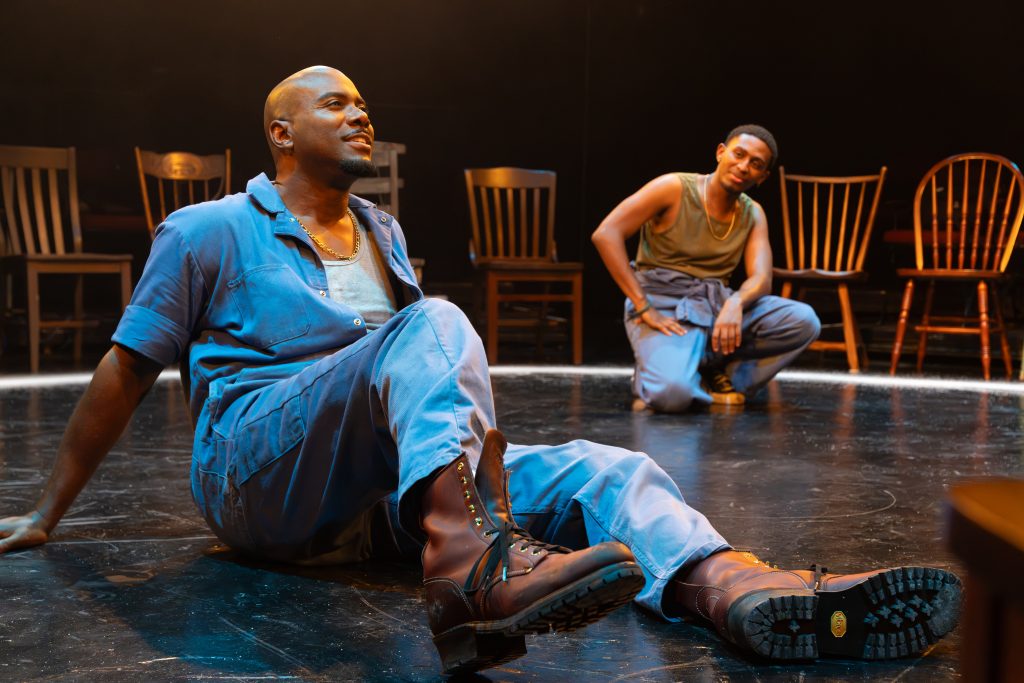
Nic Few as Ogun and Christian Kitchens as Oshoosi. Photo by Jon Gitchoff.

Their artistic vision, along with other artisans behind-the-scenes and the dynamic performances of Nic Few, Christian Kitchens and Donald Jones Jr., make this an unforgettable presentation.

They strived to make this resonate emotionally and do so in waves, for it grows in intensity and richness. Artistic consultant LaWanda Jackson and dramaturg Taijha Silas helped make that happen.

In his signature lyrical style, playwright Tarell Alvin McCraney, who won an Oscar for the screenplay of “Moonlight,” unfolds a common man story, with heart and humor, in the Louisiana bayou, which he wrote 20 years ago.

He examines the complex bonds of family, how love and loyalty affect relationships, the ripple effects of crime and punishment, systemic racism, and the hard road to healing.
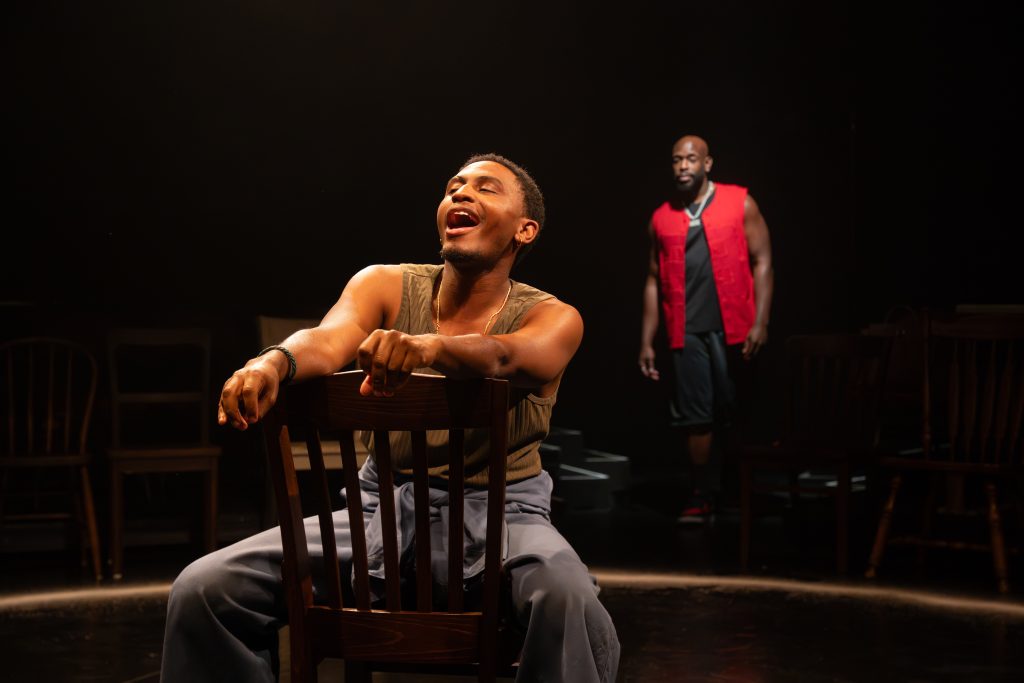
Christian Kitchens and Donald Jones Jr. Photo by Jon Gitchoff.

Nic Few is big brother Ogun, a responsible, hard-working auto mechanic whose younger brother Oshoosi (Christian Kitchens), has been released from prison. He’s restless, impulsive, trying to carve out a new life.

Can they reconnect or will the youngest return to his old habits when his ex-con friend Elegba (Donald Jones Jr.), his former cellmate, comes by for visits.

Ogun is tough on Oshoosi, annoyed by his swagger and aimlessness, and that chafes his little brother. It’s complicated when the oldest wants stability and the youngest is content to be carefree, tempted by a friend who’s a bad influence.

The brothers are eager to succeed, but they tussle often, like many siblings. Their temperaments are different – Few embodies fierce physicality and weighted down by the world and Kitchen imbues his part with musicality and a lightness of being.
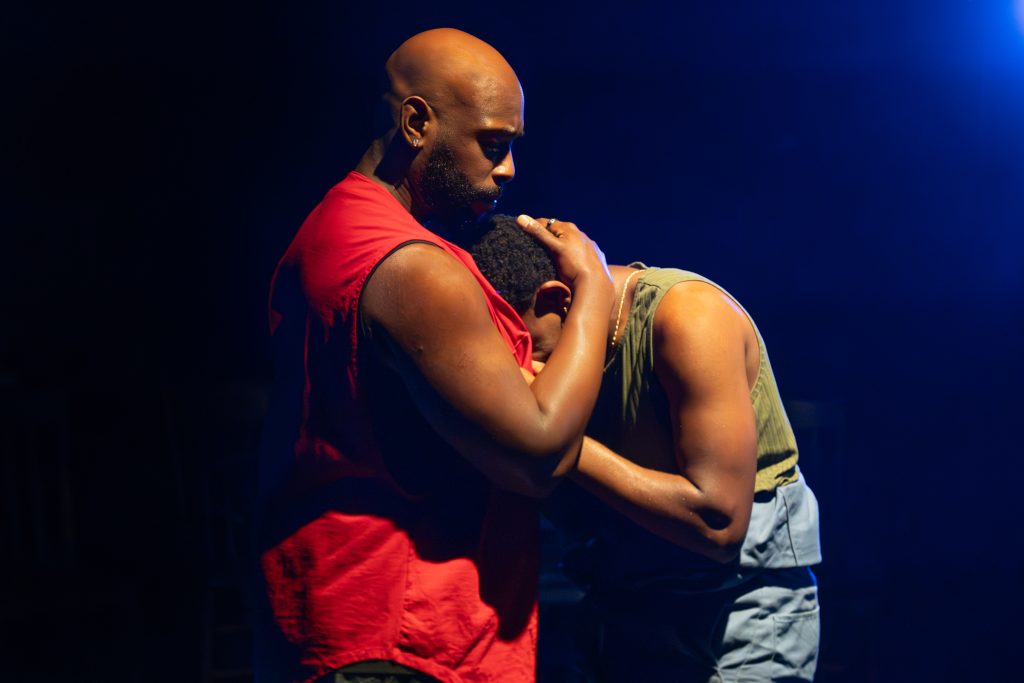
Photo by Jon Gitchoff.

The charming Elegba seems to want the same things but actually is a detriment to Oshoosi and Ogun’s goals. Ogun is suspicious but Oshoosi is faithful. Are we our brother’s keeper?

The effects of incarceration and the never-ending fight to be free, to make something better for their futures, shape this raw portrait. When danger lurks, they wrestle with decisions (Shades of “Nickel Boys.”)

Few, Kitchens and Jones corral an electrical charge to deliver honest characterizations that are physically and emotionally demanding. Their chemistry personifies their close ties. They are natural in their interactions – arguing, goofing off, trash talking, soul-singing, dancing and expressing their feelings.

Thompson was determined to find entry points for everyone watching, illuminating what could be considered abstract elements. The trust between everyone is obvious, their artistry elevated through her guidance.
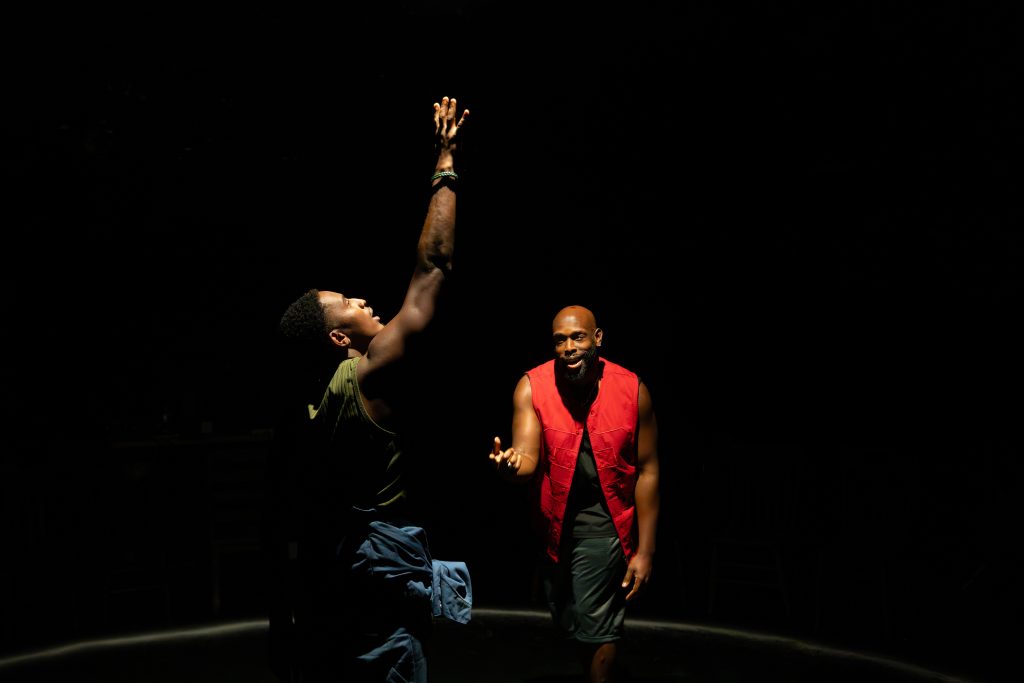
Photo by Jon Gitchoff.

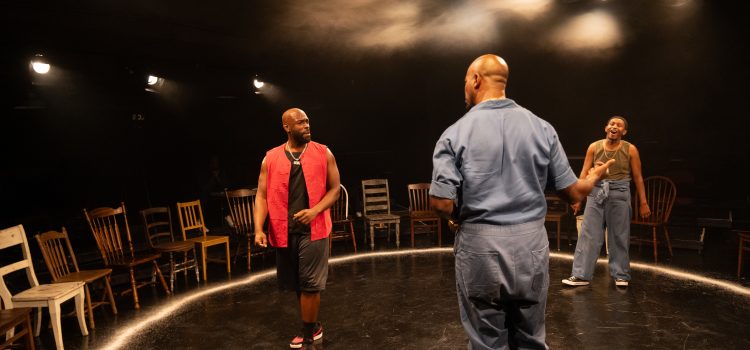
The minimalist staging, with action taking place within a circle, is reflected in Kristie C. Osi’s costume design, Jayson Lawshee’s scenic design and Eric William Barnes’ props design.

A regional premiere, “The Brothers Size” is the first time one of McCraney’s plays are staged in St. Louis. Considered a modern-day fable, “the script includes stage directions in the dialogue to heighten the encounter between the actor and the audience.

McCraney was inspired by the Yoruba people of West Africa – their rituals and religion, so he incorporated symbolism. His stylistic choices are rhythmically distinctive, seamlessly blending verse and conversation. In his original way, he aims for a mythical quality, making it about something larger than our daily lives. That adds a potency and an urgency.

The first show this season in the Steve Woolf Studio Series, it’s a play that was made for the intimate space and the series, praised for its risk-taking. The former artistic director, who retired in 2019 after 33 years at The Rep and died during the pandemic in 2021, encouraged theatregoers to be adventurous with newer works and unknown playwrights. What a fine legacy.
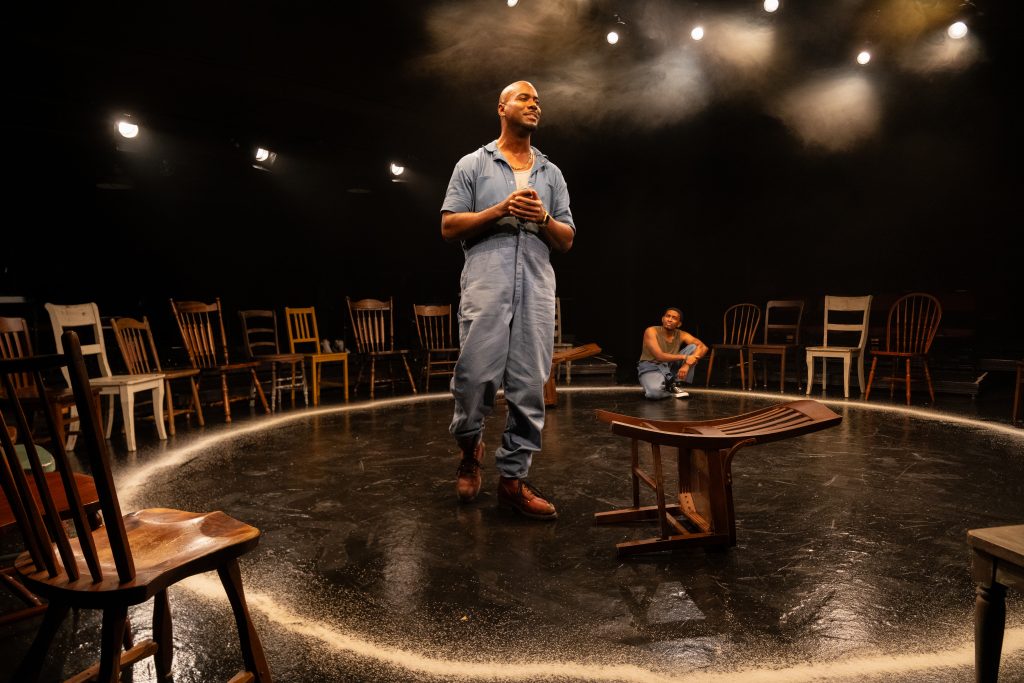
Photo by Jon Gitchoff.

Opening night bristled with electricity, the kind of buzz that marks a big deal event. After this profound, gut-wrenching experience, the audience leapt to their feet as soon as it ended, with an outpouring of love and thunderous applause. It was indeed a moment (well, several).

“The Brothers Size” boldly represents The Rep’s vision and demonstrates their commitment to produce works of daring imagination and transformative symmetry with exceptional casts and crews.

The Repertory Theatre of St. Louis presents “The Brothers Size” from Oct. 22 to Nov. 16 as part of the Steve Woolf Studio Series in the Emerson Studio of the Loretto-Hilton Center, 130 Edgar Road, St. Louis.

The play is 90 minutes without intermission. A post-show discussion follows the performance on Sunday, Nov. 2, at 2 p.m.

To purchase tickets, visit www.repstl.org or call the box office Monday through Friday noon to 5 p.m. at 314-968-4925.
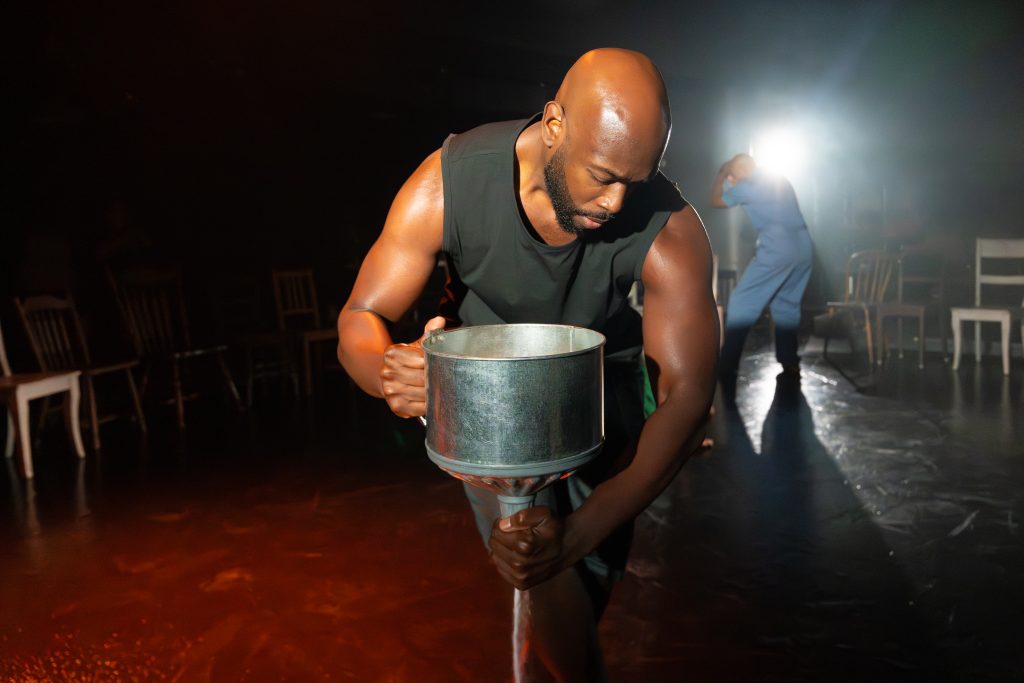

Photo by Jon Gitchoff.

By Lynn Venhaus

Whether you have a family that always puts the ‘fun’ in dysfunctional or is going through a temporary rough patch, you will find something relatable in Lila Rose Kaplan’s crowd-pleasing comedy-drama “We All Fall Down.”

Nowhere is an extended family’s quirkiness more apparent that at a holiday gathering, and this setting is a Passover seder with the Jewish but non-practicing Steins coming together.
 
The territory navigated is both familiar and foreign. When the playwright’s wit, director Rebekah Scallet’s finesse, and the cast’s crisp comic timing percolate on all cylinders, it’s splendid.

Yet, there is a busyness that comes across as somewhat annoying. The seven characters are all pre-occupied, with the parents and two grown adult children overstuffed with personality peculiarities, and the three guests underdeveloped. Perhaps some trimming would have made it feel less congested.

While the resolution is heartfelt, it doesn’t feel as genuine or as earned as it could be, for the relationships are complicated, and the revelations feel rushed.

As we all know, often when people try too hard to make a celebration joyful, it fails to meet expectations because of uncooperative moving parts.

Add befuddlement as to why this festival is happening now when it’s never been a big deal, which adds a layer – and everyone is in various degrees of a tizzy.

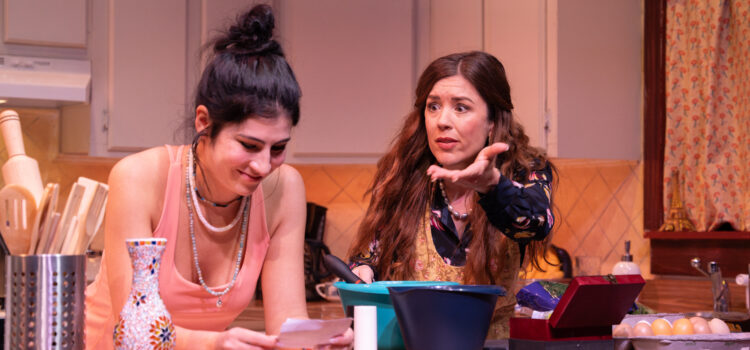
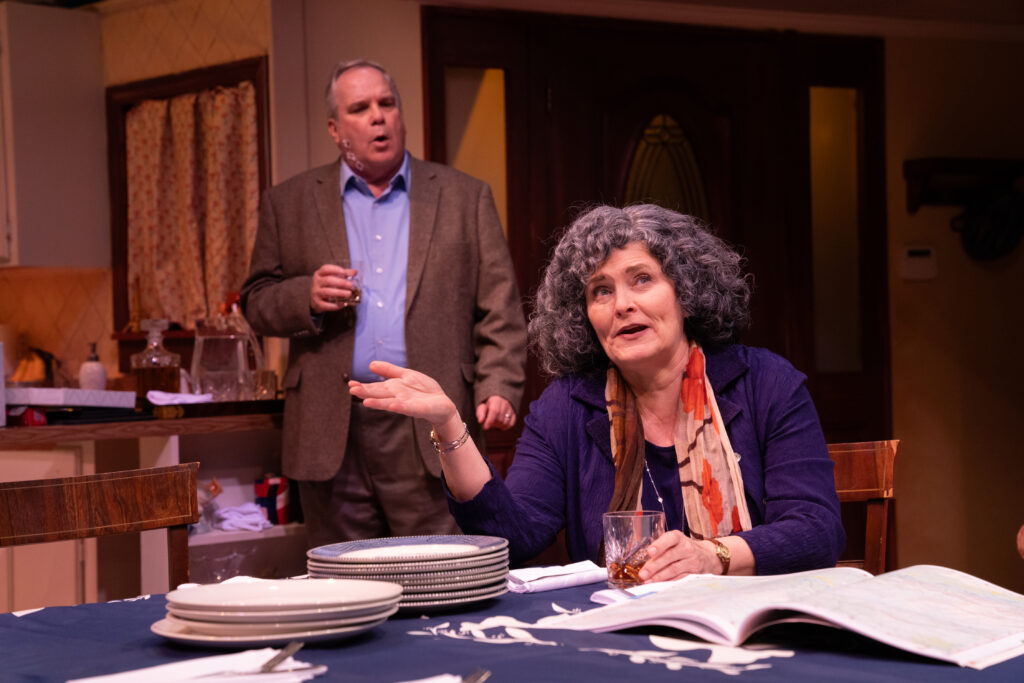
While psychologist and family therapist mom Linda (Mindy Shaw), history professor dad (Alan Knoll), yoga instructor daughter Ariel (Hailey Medrano), feminist activist-educator daughter Sammi (Bridgette Bassa), sarcastic aunt Nan (Jenni Ryan), a sweet but sensitive friend Bev (Bethany Barr) and an efficient assistant Ester (Taijha Silas) are preparing for this specific meal with their own ‘to-do’ lists, wackiness ensues, and universal truths give way.

Mindy Shaw, Hailey Medrano. Photo by Jon GItchoff.

In Judaism, Passover commemorates the Hebrews’ liberation from slavery in Egypt, sparing the first-born of the Israelites on the eve of the Exodus. There are specific rituals handed down through generations, and Kaplan deftly explains traditions to those of us not in the know.

Those of other faiths can identify with their own heritage’s touchstones while the evergreen themes of people growing older, and children growing up strike chords.

The ensemble meshes well, conveying all the stress, resentments and aggravations that a holiday represents, but also their unique family dynamic and relationships. As in real life, a delicate balance between mothers, fathers, daughters and sisters is always shifting.

Sunrise, sunset
Swiftly fly the years
One season following another
Laden with happiness and tears

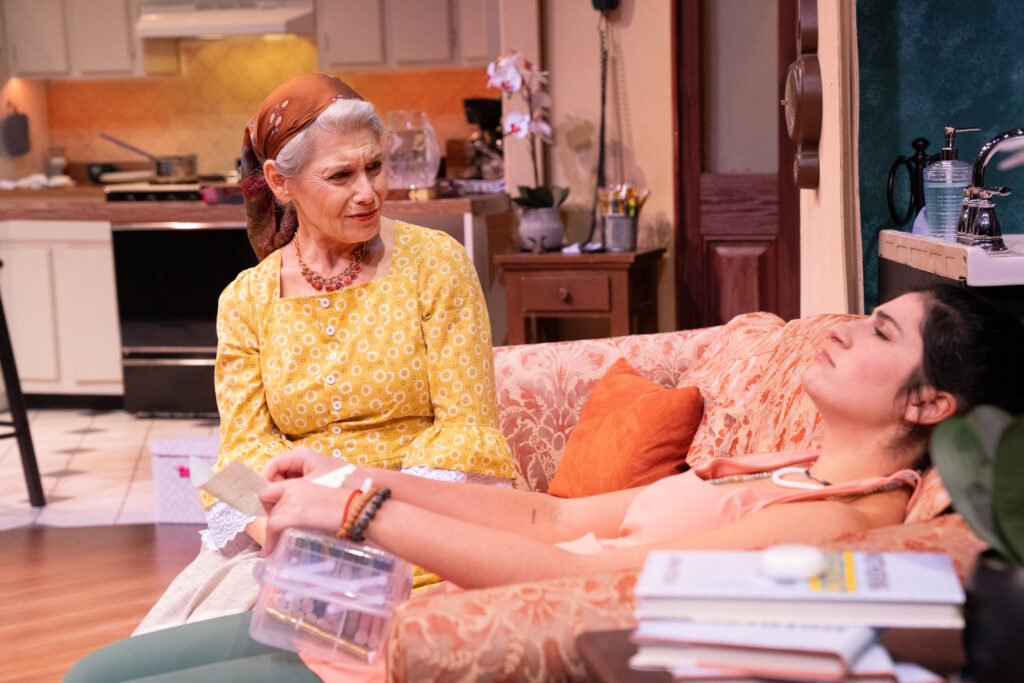
Knoll, whose performances are always lived in and first-rate, has shaded Saul with convincing layers, coming across at first as good-natured but concealing a troubled soul.

His memory is fading, and he’s confused, disconnected, and not understanding what’s happening, although he’s trying to cling tight to his routines.

His patterns are being interrupted by all the hubbub, and glimpses of what’s happening begin to be noticed by the others when they start paying attention. Most everyone is in their own little bubble and must eventually find the compassion they need at this moment. Frustrated, he won’t admit or can’t come to terms with his cognitive decline.

Alan Knoll, Bridgette Bassa, with Jenni Ryan in background. Photo by Jon Gitchoff.

Those who’ve witnessed a loved one lose parts of themselves through Alzheimer’s disease or other forms of dementia can recognize the symptoms that Kaplan astutely presents.

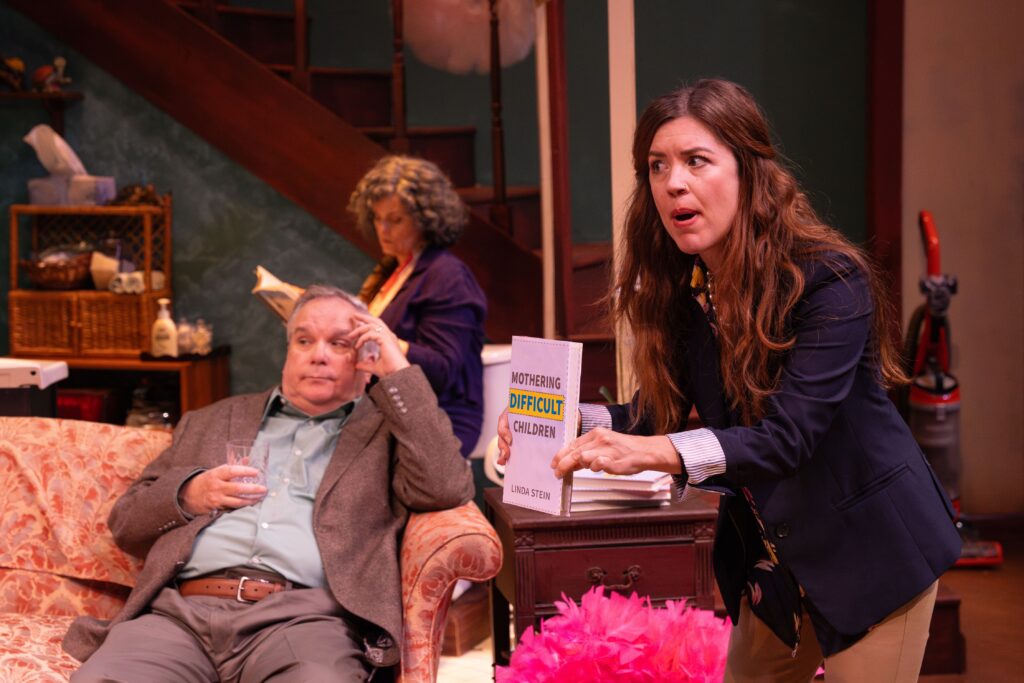
A flustered, frantic melodramatic wife and mother, Linda is played as a demanding perfectionist with nervous energy by the lissome and facile Mindy Shaw.  

This bossy control freak and bestselling author has a hidden agenda that keeps everyone guessing as to why she’s going to all this trouble. She’s a little kooky dressing up in costumes and flitting about.

Her two daughters, with secrets of their own, are focused on their problems and not why their dad may have retired early, why he’s drinking so much, or why mom’s making the signature dishes for what an old neighbor describes as “Jewish Easter.”

As adult daughters, Bassa and Medrano affect a realistic sibling rivalry and dissatisfaction with their current paths. Intelligent and limber performers, Bassa and Medrano bounce off each other like women with a history, and their rhythm is naturalistic.

There is an undercurrent of tension that may be connected to their mother’s book “Mothering Difficult Children”,” which is a hoot.” (What a great title!).

Ryan plays Saul’s outspoken sister, Aunt Nan, a part that seems straight out of sitcom land, as does Barr’s Bev, an empty nester who once lived across the street.

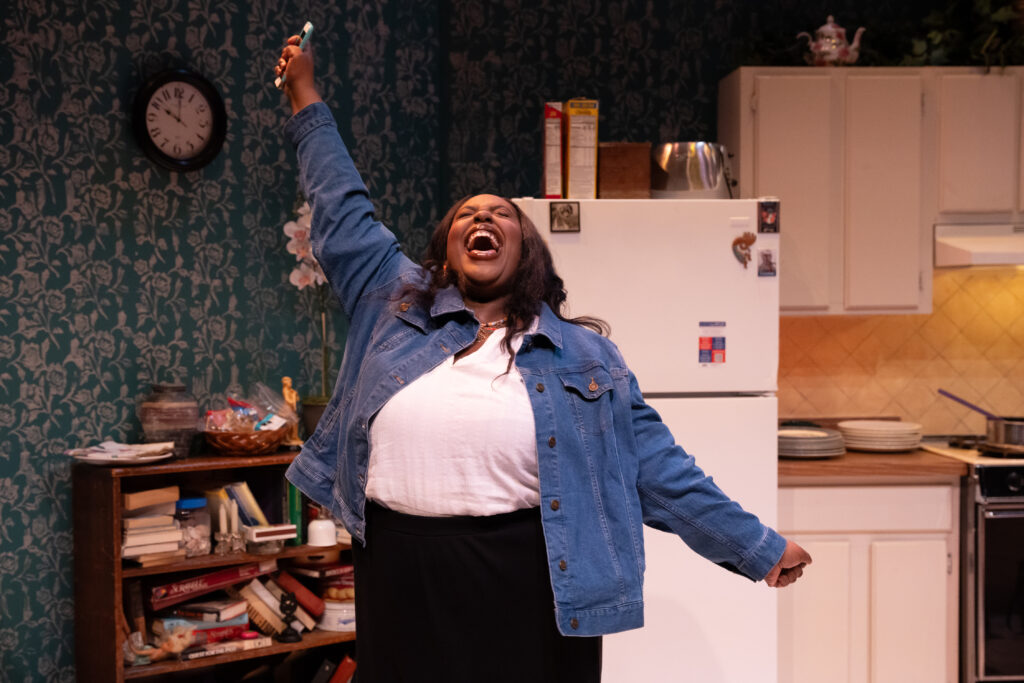
Silas has a nice turn as Linda’s graduate assistant who is tasked with singing “The Four Questions,” and does so beautifully.

Taijha Silas as Ester. Photo by Jon Gitchoff.

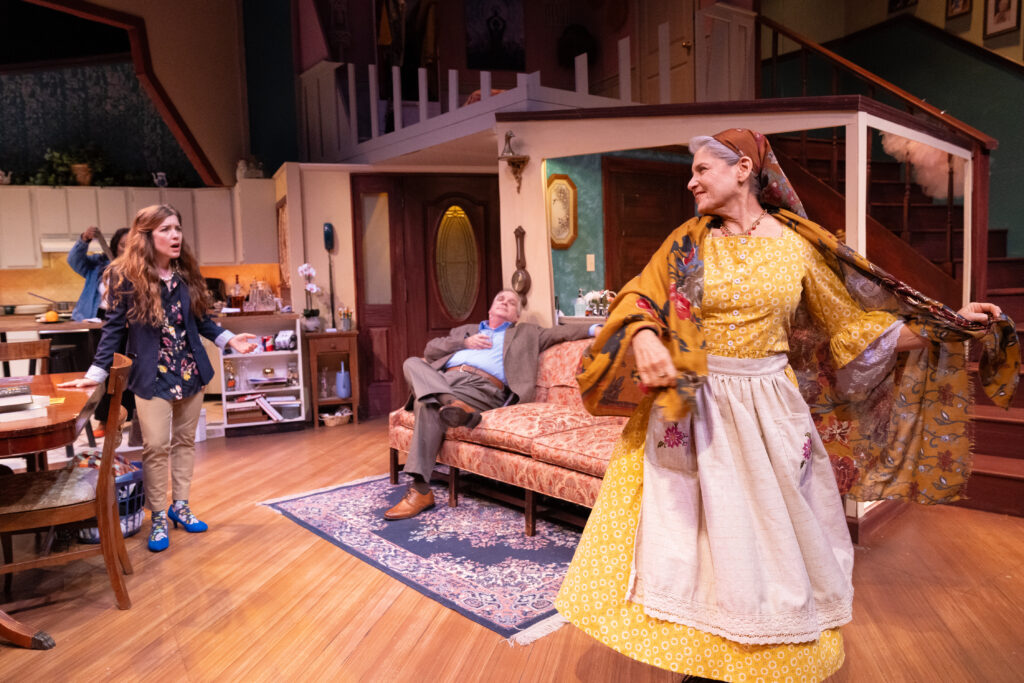
The two-story suburban home setting designed by Andrea Ball is a marvel of functionality and comfort. The kitchen is stocked with all the necessary ingredients and tools to make Kugel and matzo balls, and the girls’ childhood bedroom becomes an oasis (as does a bathroom).

The technical design work is as admirable as ever, with Michael Sullivan’s lighting design and Michelle Friedman Siler’s costume design both stellar components. Cecille “Cece” Entz’ prop work is noteworthy — an appealing mix of years of clutter.

Ellie Schwetye’s sound design is always significant, and this time her mix tape choices are interesting — especially the specific “War of 1812 Overture” that’s in the script.

Kaplan crafted this play with heart. Originally produced in 2020 in Boston, this presentation is the regional premiere in St. Louis. She has a flair for tackling issues from a woman’s point of view, which is refreshing. However, the tone shifts several times, which happens when the material is both a comedy and a drama.

Scallet, also the artistic director, has helmed this show in a light-hearted way, even though the theme is heavy – parents must be taken care of even when you can’t take care of yourself

She and the playwright met years ago when Scallet was directing Kaplan’s play “Catching Flight,” which was part of a new play development program, and became friends.

The main takeaway is that traditions should be appreciated and familial love is the foundation of life. Whatever our families are going through, we can lean on each other for comfort and strength. All families deal with loss, lose their way, and re-emerge with new customs, yet never forgetting those who have passed.

Memories are made, and passed on through generations — simple yet profound.

Alan Knoll, Jenni Ryan. Photo by Jon Gitchoff.

The New Jewish Theatre presents “We All Fall Down” from May 30 to June 16 at the JCCA’s Wool Studio Theatre, 2 Millstone Campus Drive, St. Louis. The play is 95 minutes without an intermission. Performances are Thursdays at 7:30 p.m., Saturdays at 4 and 8.p.m., and Sundays at 2 p.m. Individual tickets are $27- $58. Tickets are available by phone at 314.442.3283 or online at newjewishtheatre.org.

Special Note: Scallet will host two additional talkbacks with show audiences on Saturday, June 14 following the 4 p.m. performance, and on Thursday, June 6, following the 7:30 p.m. performance.

Photo by Jon Gitchoff.