
By Alex McPherson
Far less lively than its premise promises, director John Patton Ford’s “How to Make a Killing” has a sturdy dramatic framework but forgets to have much fun along the way — it’s an Eat-the-Rich satire that commits the unfortunate sin of being dull.
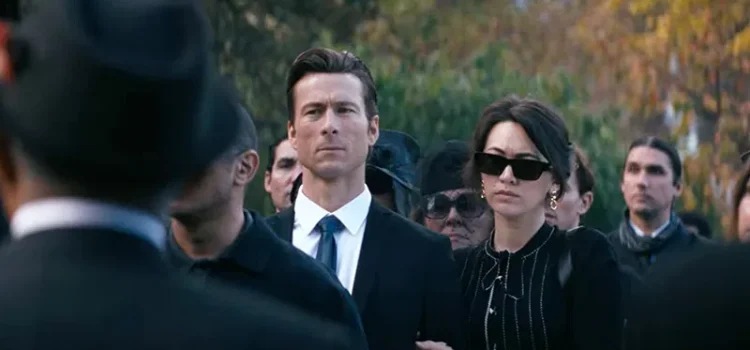
Inspired by the 1949 film “Kind Hearts and Coronets,” “How to Make a Killing” centers around Becket Redfellow (Glen Powell), a man on death row with four hours until execution who relays his life story to a priest (Sean C. Michael). The film, guided, er, dictated, by Becket’s narration, jumps back and forth in time.
Becket, with a wry smile, insists that his story is a “tragedy,” as he reveals that his family has a 28 billion dollar fortune that he was willing to kill his seven other relatives to acquire. For Becket, it’s personal.
His mother was banished from the family by the mysterious patriarch Whitelaw (Ed Harris) after becoming pregnant with Becket as a teenager with a man of “lower class,” who quickly disappeared from the scene.
She raised Becket in a working class New Jersey neighborhood, occasionally immersing him in rich-adjacent activities like archery (featuring Chekhov’s bow and arrow), and, until her dying day, insisting that Becket has a legal claim to the Redfellow fortune and that he “deserves” it.

It’s at one of these functions that a young Becket meets the uber-wealthy Julia Steinway (later played by Margaret Qualley). The two are drawn to each other, although they drift apart as they grow up in different social spheres.
In present-day New York City (before his arrest), Becket works at a men’s suit store and runs into Julia, who strikes up a flirtation (even though she’s engaged), and reminds him that he is a Redfellow.
After being abruptly demoted, and recognizing the sad unfairness of his current non-uber-wealthy living situation, Becket decides to take action, setting out to eliminate his relatives and do away with most of his morality.
The group includes party boy Taylor (Raff Law), smug goofball artist Noah (Zach Woods), “philanthropist” Cassandra (Bianca Amato), Richard-Branson-esque McArthur (Alexander Hanson), rock star megachurch pastor Stephen (Topher Grace), and Becket’s surprisingly kind uncle Warren (Bill Camp) who hires Becket to work at his brokerage firm, plus the intimidatingly shady Whitelaw (Harris).
Quite a few folks to get through, but Becket’s greed and hunger for retribution motivate him, to the detriment of his personal relationships and sanity.

There’s a recipe for a crackling, twisted little thriller here, but Ford’s film is frustratingly milquetoast, possessing the skeleton of a strong narrative without putting in the work to give its story poignancy, momentum, or memorably crazy set pieces.
“How to Make a Killing” feels restrained as Becket flies further off the deep end, taking the easy way out instead of leaning into the lunacy, with derivative social commentary and subplots clunkily smashed together. It’s a shame, because the foundation is there. Powell remains an appealing leading man who brings charisma in spades.
Still, he feels underutilized, as Ford’s screenplay jumps through time erratically and often resorts to blatant exposition dumps (via Becket’s prison-set narration) that attempt to streamline the film while robbing it of textural detail.
Powell’s performance is sturdy enough on its own merits, particularly when the film slows down to briefly highlight his twisted satisfaction at his various killing schemes (which occur, puzzlingly, mostly off-screen) and to develop his relationship with the beautiful Ruth (Jessica Henwick), who is first attached to Noah.

Henwick and Powell have great chemistry, yet Ford treats their dynamic as more of a plot device than anything else — the tension between happiness/comfort and the pesky pull of greed and revenge.
It’s a conflict rendered too schematic to pack much emotional punch, worsened by dialogue that spells out Becket’s “choice” in eye-rollingly obvious fashion.
Qualley, to her credit, understands the assignment more than most of the ensemble, leaning into her character’s femme-fatale cartoonishness, periodically appearing to encourage Becket to continue his murderous mission and attempt to seduce him (for love or for the money?).
f only the rest of “How to Make a Killing” was as committed to the bit as Qualley who, regardless of whether you love or hate her performance, is definitely making choices and helping to momentarily excavate the film from generic territory.
Perhaps the biggest issues with Ford’s film revolve around its “tell, don’t show” philosophy. We don’t really feel Becket’s inner turmoil, nor do we fully buy why he feels compelled to push forward even when his life seems pretty damn good, all things considered. Nor do we get any flashy moments of R-rated violence, odd considering that the film is indeed called “How to Make a Killing.”
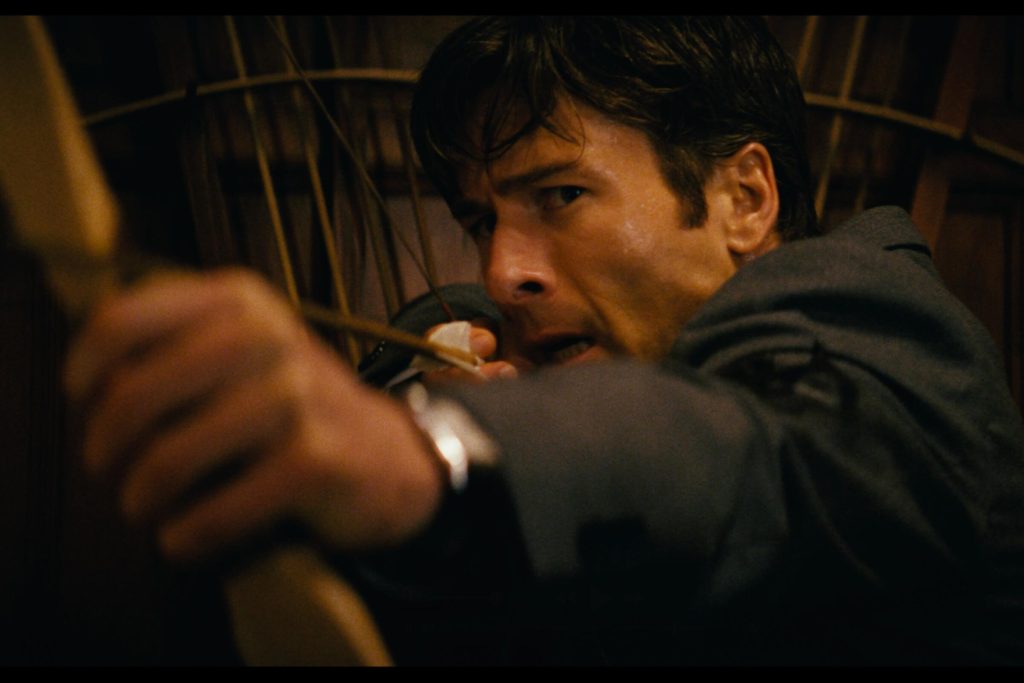
Ford’s film does have eye-catching production design and stylistic use of light and shadow. But its conclusions are largely standard, a morality tale with a clearly telegraphed destination, and a laissez-faire approach to distinctive storytelling.
“How to Make a Killing” is a 2026 dark comedy-psychological thriller directed by John Patton Ford and starring Glen Powell, Margaret Qualley, Ed Harris, Bill Camp, Jessica Henwick, Zaff Law, Zach Woods, Bianca Amato, Topher Grace, and Alexander Hanson. It’s run time is 1 hour, 45 minutes, and it is rated R for language and some violence/bloody images. It opened in theatres on Feb. 20. Alex’s rating: C.

Alex McPherson is an unabashed pop culture nerd and a member of the St. Louis Film Critics Association.