
By Lynn Venhaus

Laying the foundation for the palace intrigue in Shakespeare’s tragic “Hamlet,” the original play “Elsinore” is an interesting interpretation of those familiar characters in an affecting prequel.

Known for its bold choices, local theater company Chorus of Fools has mounted artistic director Eric Satterfield’s 2021 play updated by co-playwrights David Nonemaker and Satterfield, who also directed.

How did Denmark become so rotten? Satterfield wants answers and his strong cast will tell a more nuanced story.

Through compelling performances, this ensemble delves into the unraveling of the royal family and how the political scheming escalates, which eventually leads to the kingdom’s instability and headed to war with Norway.

Most remarkable is how much the language sounds like the Bard in tone and tempo. Smartly written with style, wit and theatricality, “Elsinore” plausibly imagines the backstories.
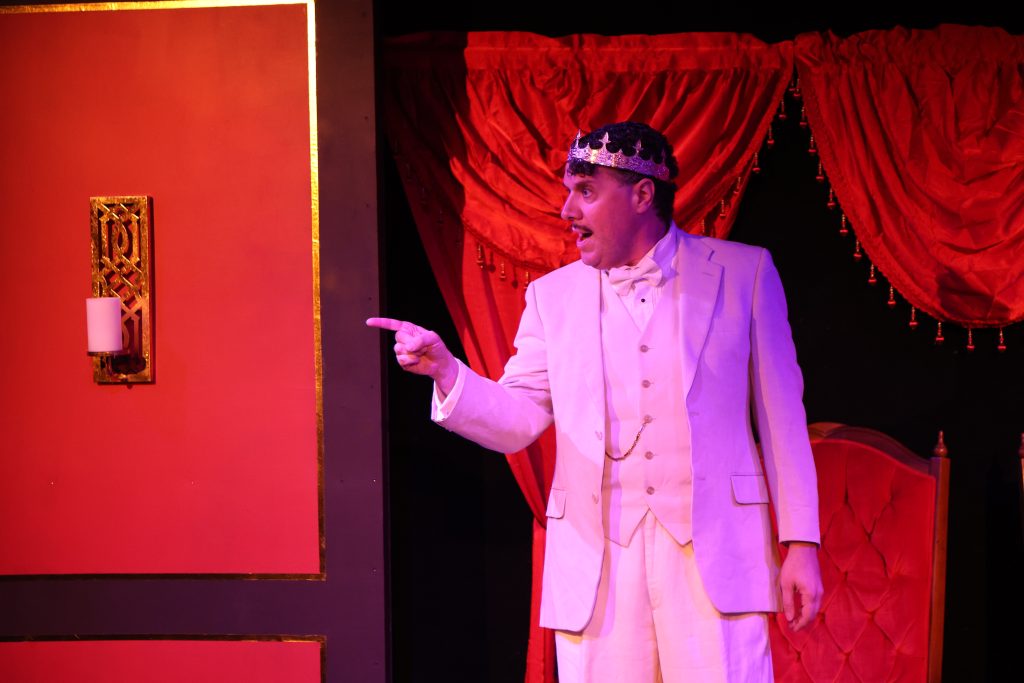
John Wolbers is the domineering King Hamlet. Photo by David Nonemaker.

The playwrights obviously have read and studied Shakespeare, presenting a new angle on one of literature’s most influential works. After all, “Hamlet” has been adapted in many ways (“The Lion King,” anyone?)

A rewarding aspect is its exploration of many of the same universal themes, such as making one’s mark, duty, honor, loyalty, destiny and revenge. However, in these earlier incarnations, character transformations and motivations give the actors a juicy challenge.

We may think we know these characters, but by the time Shakespeare crafted them, they had been developed by circumstances, revealing their true nature.  In the prequel, they are forging their paths.

While the prince of Denmark has always been fascinating, in the before times he is secondary to Claudius, who has the most complex character arc. Joseph Garner, one of the region’s most versatile performers, has been a formidable stage presence in supporting roles. As the king’s brother and emissary, he delivers a dynamic characterization rich in detail.

Initially, a dedicated selfless royal, Claudius undergoes personal tragedies and moral dilemmas that lead to his stunning power-grab as he ascends to the throne while breaking up his brother’s family.
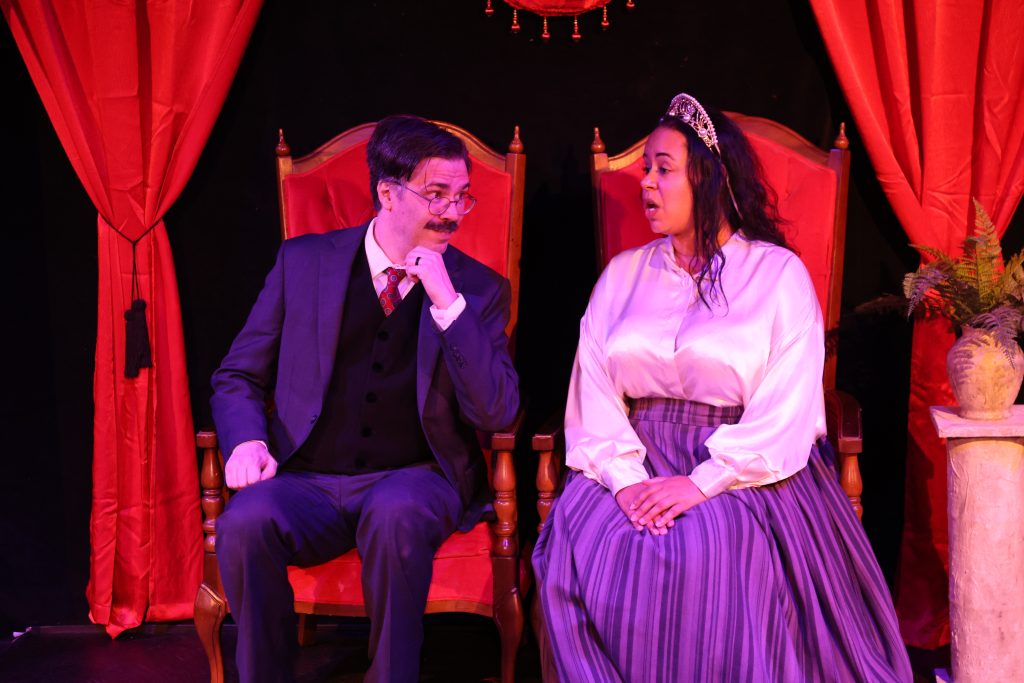
Joseph Garner and Jocelyn Padilla as Claudius and Gertrude. Photo by David Nonemaker.

King Hamlet is not a benevolent ruler. John Wolbers portrays him as imperious and devious, and with his son Hamlet, he is demanding and impatient. The young heir is finding his way, clashing with his father and being more comfortable around his uncle.

He starts brooding, and Andre Eslamian gives the intense, rebellious lad an emotional depth while conveying quicksilver moods. He’s confused and angry in interactions with his father, merry with his goofy friends Rosencrantz and Guildenstern, playful with his cousin Claudius, and tender with Ophelia.

His father is not fond of his childhood pals, and Xander Huber, as Rosencrantz, and Zach Pierson, as Guildenstern, display why. As the bumbling buddies, they demonstrate sharp comic timing and play off each other well, adept at slapstick.

Chuck Brinkley, equally good at comedy and drama, adds moments of daffiness to the garrulous Polonius, who is Claudius’ trusted advisor. But he’s capable of conniving. (And what a trouper — he really did break his ankle, hence the assistance.)

Madness has not yet affected major players. Ophelia becomes a handmaiden for Queen Gertrude. She is an intelligent, curious girl, devoted to her father Polonius and gives her heart to Hamlet. Hannah Geisz plays her as a spirited, virtuous member of the court – but one who won’t be an afterthought.
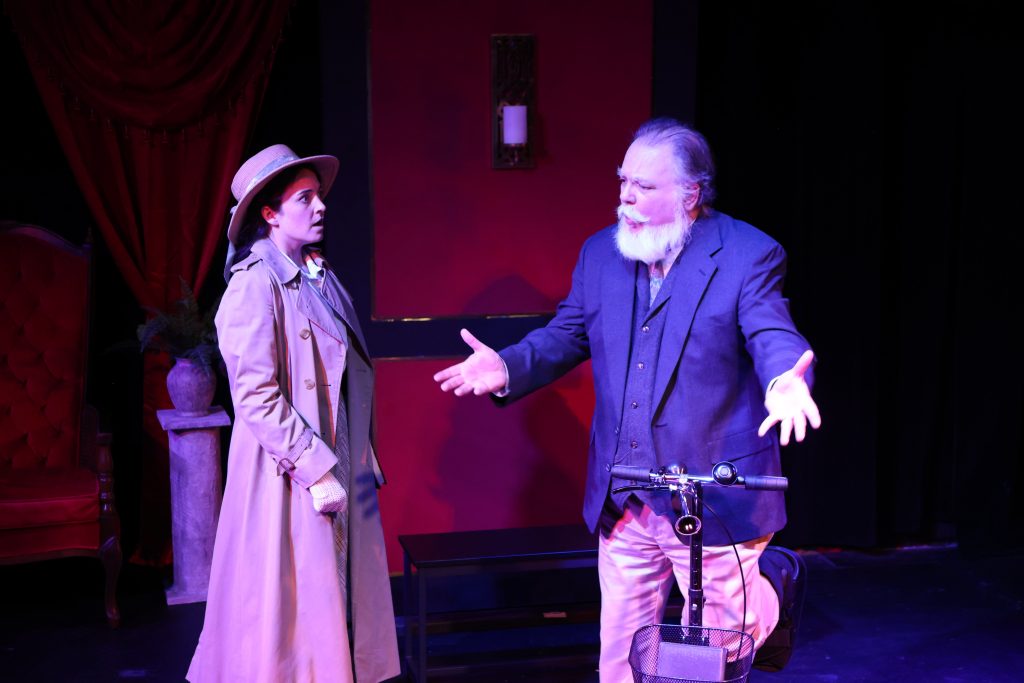
Hannah Geisz and Chuck Brinkley as Ophelia and Polonius. Photo by David Nonemaker.

As Gertrude, Jocelyn Padilla is an obedient wife and dutiful mother. She is hurt by the king’s gruff treatment of her, and after his untimely death, brightens under the gaze of Claudius.

Huber and Pierson each fill another role – Huber is Lord Waldemar and Pierson as young Claudius. Joe Kercher handles three brief roles – Lord Olaf, Laertes and a hooded figure. Rose Reiker is Osric, a courtier and messenger.

Claudius, who becomes a widower after his loving wife Colette (Lexie Johnson) and their beloved son Claudius (Zach Pierson), died in a shipwreck, has somewhat of a reset.

He has lost faith after those devastating losses, becoming bitter and angry. He disagrees with his brother’s decisions and ruthlessly sets a course to takeover.

“Hamlet” was Shakespeare’s longest play, and this version is in three acts, with two intermissions. The second act resumes 14 years later, and the third is one year after that.
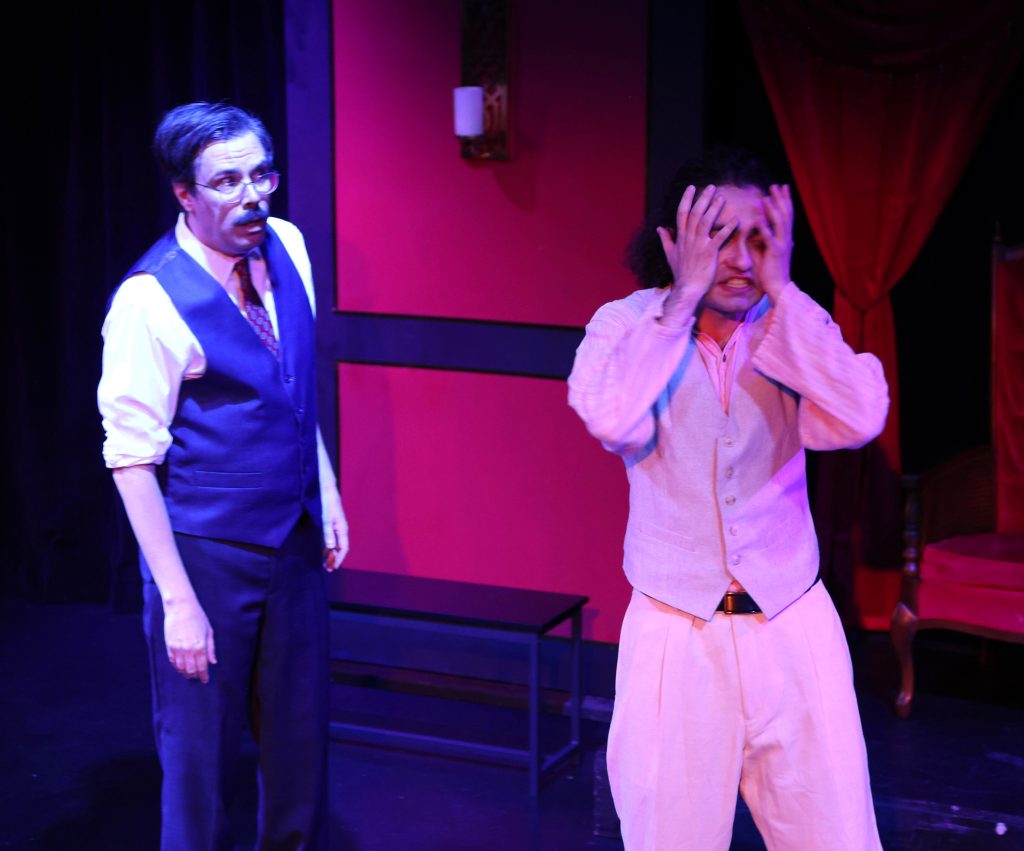
Joseph Garner, Andre Eslamian as Claudius and Hamlet. Photo by David Nonemaker.

The small company, with a modest budget, cleverly depicts the castle’s throne room, Claudius’ family sitting room, and the orchard where King Hamlet often napped. Vickie Delmas worked on the set design with Satterfield, and took care of props..

With its “Downtown Abbey” inspired Edwardian setting and period costumes, “Elsinore” creates an insular world where loyalty is demanded while secrets and lies are part of the growing corruption.

Costume designer Celeste Gardner paired different textures together to appropriately outfit the characters, with her work particularly noteworthy for Ophelia and Gertrude.

Bradley Rohlf’s atmospheric lighting design highlighted an impending doom, while giving the ghosts an other-worldly illumination. Satterfield’s outstanding sound design included imaginative needle drops and a regal music score to reflect the spreading darkness.

Other contributors were Ryan Lawson-Maeske, fight choreographer; Jen Kerner, accessibility consultant; Tress Kurzym, intimacy director; and Nikki Pilato, dramaturg (and also assistant director). Moira Healy was the stage manager.

With a castle community sensibility, the savvy cast transported us to a troubled time that has been examined through the ages, and managed to engage us with different, interesting angles. They skillfully conveyed Satterfield’s and Nonemaker’s intentions in a smart, entertaining presentation.
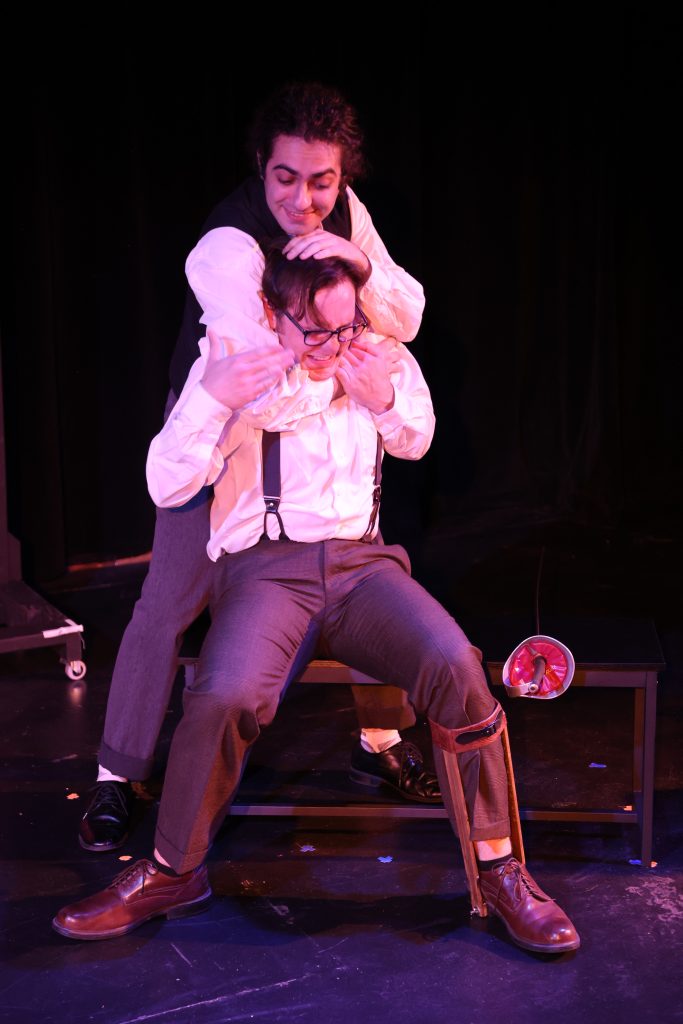
Andre Eslamian, Zach Pierson as the young Hamlet and young Claudius. Photo by David Nonemaker.

Chorus of Fools presents “Elsinore” Thursdays through Saturdays at 7:30 p.m. from Oct. 9 through Oct. 19 at The Greenfinch Theatre and Dive Bar, 2525 S. Jefferson. For more information: greenfinchstl.com/events

By Lynn Venhaus
Noteworthy for different perspectives and original approaches, a mostly female-forward selection of one-act plays are the highlights of this year’s LaBute New Theater Festival.

Another interesting development is a noticeable female and non-binary presenting team on stage and behind the scenes crew that offer crisp performances and assured contributions. And that’s no dig to the men’s expertise. It’s refreshing to see uncommon fresh voices involved.

The festival, now in its 11th year, and established in 2013, is a unique collaboration between St. Louis Actors’ Studio and Neil LaBute, the renowned playwright, screenwriter, and director of theater and film.

This innovative endeavor introduces and supports new work from across the country. LaBute not only lends his name, but he is part of a 10-member panel that selects the plays from hundreds of submissions, often emerging professional playwrights, and from a vast swath of locations.

This year’s most outstanding work is a gripping sci-fi horror thriller in the vein of the best “Twilight Zone” anthologies called “TEOTWAWKI.”

More than an acronym used by R.E.M. in a song about “The End of the World as We Know It (And I Feel Fine),” this panicky doomsday piece written by two-time finalist Aleks Merilo of Palo Alto, Calif., has taut, carefully crafted layers that have a palpable urgency.

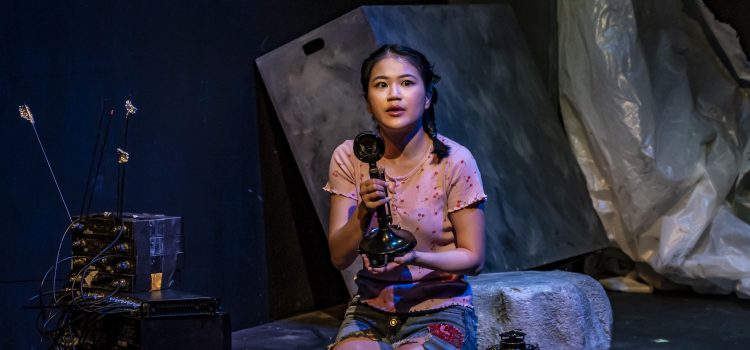
 Deftly directed by Bryn McLaughlin, she effectively builds suspense in a haunting and satisfying way. Sarah Wilkinson is pitch perfect as the spunky, scared, sweet young woman trying to find someone still alive. Every day, she talks on a ham radio, desperately trying to locate fellow survivors.

The likable Wilkinson, a St. Louis Theater Circle Award winner who continues to show her versatility on stage – in primarily musicals and comedies, now adds chilling drama to her growing list of credits.

This terrifying snapshot of a catastrophic event that has led to the collapse of modern society lingers, and Wilkinson is a standout in the introductory piece, and in two others.

Four of the one-acts that follow are uniformly solid, a potent mix of edgy whip-smart farce, audacious parody of corporate greed, cynical tone-deaf privilege on display during daily commutes to work, and a modern poignant reflection on human chemistry and connection.

The one that didn’t quite land in the way it was intended was a rather whiny two-hander, “Poor Me,” by Tracy Carns of New York, who pitted former roommates and supposed friends in the awkward position of one having to tell the other to vacate a residence.

Despite savvy performances from Claire Coffey as defiant Cleo and affable Xander Huber as a nervous, reluctant Tad, the play focuses on a self-absorbed laid-off marketer who is squatting in an apartment building owned by Tad’s father.

She used to live there with Tad and his girlfriend, her friend, but now they are expecting a baby and have since moved away. Cleo’s still there, despite nudges and pleadings, the apartment building is going to be renovated, and they need her to find another place.

She is adamant about staying. Refusing the ultimatum, it’s a frustrating standoff where you have little sympathy for either party, even with Huber’s hangdog expression, especially after revelation of some ugly truths. However, the ending, which appears tacked on, is a head-scratcher.

Coffey, effortlessly poised, excels in three other works – “Hungry Women,” “Carpool” and “Scenes from a Bookstore,” as do the other shrewd performers.

Reagan Posey-Mank, MacLean Banner and Claire Coffey in “Hungry Women.” Photo by Patrick Huber

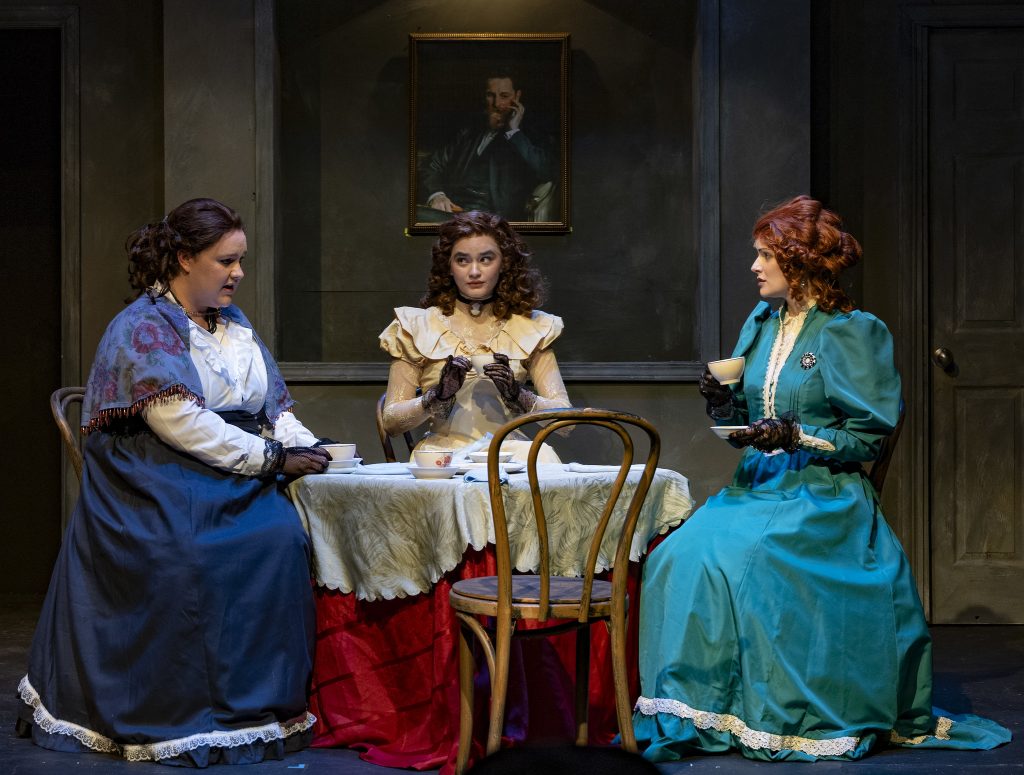
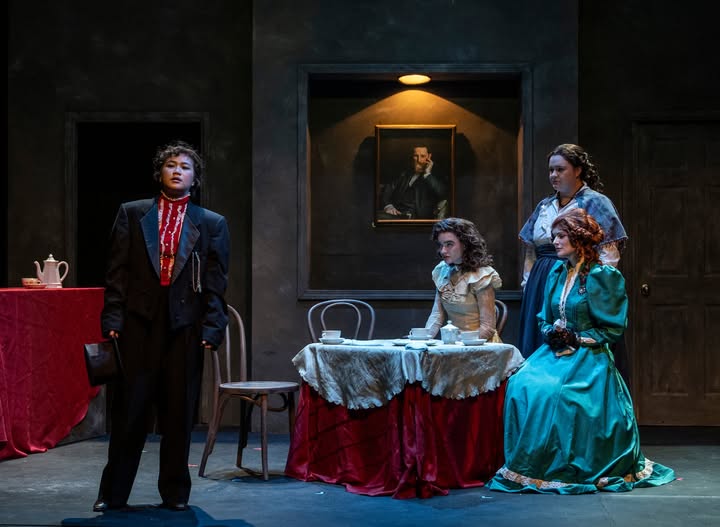
A cross between “The Gilded Age” and “Yellowjackets,” “Hungry Women” is an unusual satirical look at widows contending with being on their own and going through a famine. Four women, all in well-to-do finery, meet for lunch, and reveal the horrors that have upended their lives.

While explanations aren’t that much a part of Melissa Maney’s witty flip of gender expectations and feminism enlightenment, the quartet of amenable actresses are primed to be brave and fervent.

Maney, of Hillsborough, N.J., gives the actresses meaty roles to have fun with, and Wilkinson again confidently shines in the part of Vic, requiring moxie and swagger — big determined energy.

MacLean Banner and Reagan Posey-Mank are newcomers to the Gaslight Theatre, and as Mary and Eden, project congeniality with Wilkinson and Coffey as Ruth (also newbies) in their dressy layers and coiffed hairstyles. Special mention to costume and wig designer Abby Pastorello for the period pieces.

Sarah Wilkinson as Vic with Blanner, Posey-Mank and Coffey. Photo by Patrick Huber.

The mannered housewives have fun feigning shock at some morally outrageous developments and make their transformations believable.

Director Avery Harrison leaned into the pearl-clutching humor, and the performers boldly followed suit.

Banner, a formidable presence as Disney princesses in big splashy musicals and an insightful director of youth group summer productions, flexes different instruments in her toolbox in three of the one-acts.

Taylor Crandall and MacLean Blanner in “Scenes from a Bookstore.” Photo by Patrick Huber.

She is most impressive as a young wife and mother in Neil LaBute’s “Scenes from a Bookstore.” She and Tyler Crandall have convincing chemistry as two people who may share a history and unexpectedly reconnect in a Hudson Valley bookstore.

LaBute has slyly built a ‘will they or won’t they’ dynamic as the two keep running into each other, some obviously planned encounters. She has taken a part-time job there as the play unfolds.

The charismatic Crandall and naturally appealing Banner offer nuanced portraits of these two, coyly named “Him” and “Her.” Coffey, who easily fits into an elegant female role, plays ‘the’ wife, “She,” who drops into the business. Think of it as a relationship lens in the manner of Ingmar Bergman’s intimate “Scenes from a Marriage,” with much implied and less spoken aloud.

McLaughlin directed this layered work without ever tipping the scales. It may be a conversation-sparker afterwards, as it’s the last piece in this thought-provoking line-up. LaBute contributes a one-act every year.

The play also has precise technical cues too, and production manager Kristi Gunther, set and lighting designer Patrick Huber, and props designer Emma Glose seamlessly communicated the times and dates as the story progressed.

A laugh-out-loud audacious work is “A Modest Proposal” by David MacGregor of Howell, Mich. Smoothly helmed by Harrison in a nondescript office, MacGregor humorously ratchets up the out-of-control disparity between the haves and the have-nots.

A feisty self-assured consultant, played with relish by Wilkinson, proposes something so absurd as a solution to their bottom-line profitability that the egomaniac bosses, Crandall as an arrogant CEO and Posey-Mank as a condescending CFO, are seriously considering it.

Under Harrison’s distinctive direction, Wilkinson is smooth and silky as the persuasive salesman whose far-fetched plan is guaranteed to push buttons.

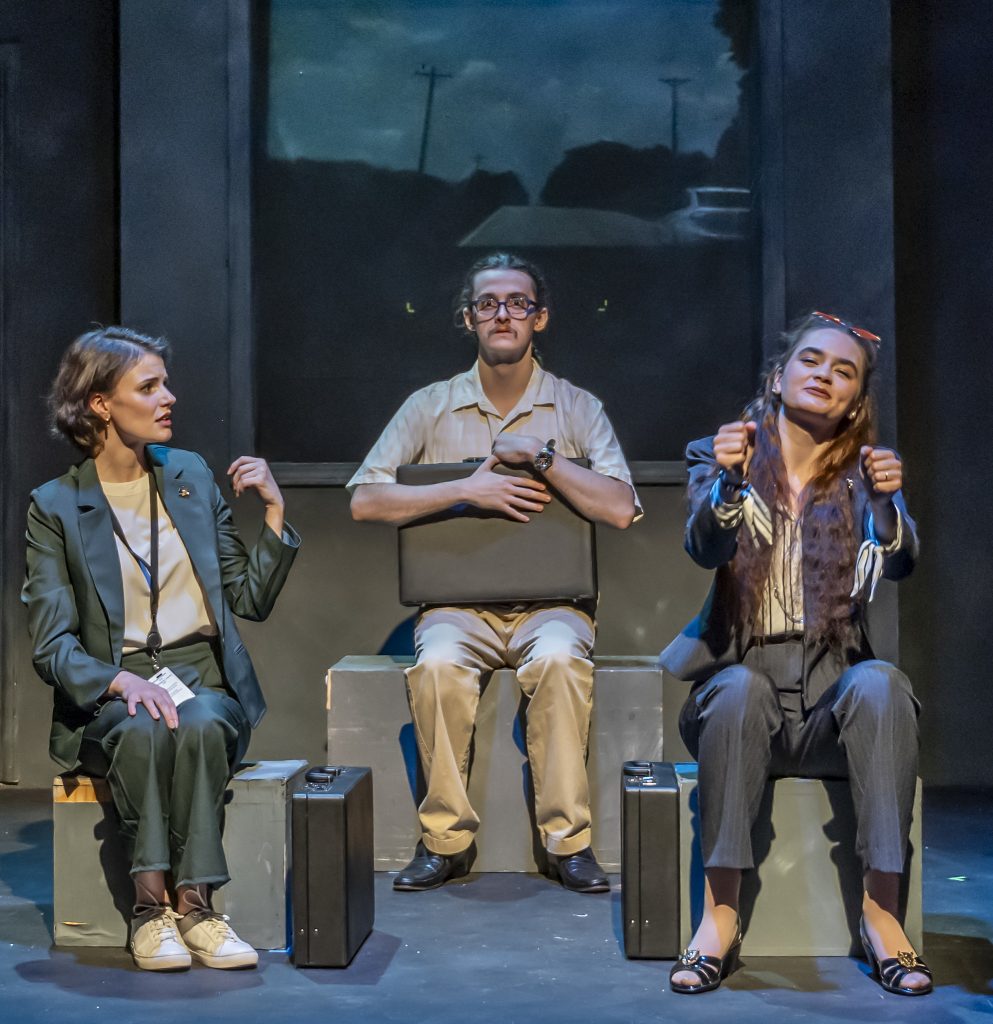
Claire Coffey, Xander Huber and MacLean Banner in “Carpool.” Photo by Patrick Huber.

Dave Carley’s script for “Carpool” is subtle, taking a familiar routine and enlivening it with co-worker interactions. Banner is the driver, known as A, Coffey is riding shotgun, known as B, and Huber is a mostly silent uncomfortable intern whose expressions speak volumes.

Then, Carley, from Ontario, Canada, adds some quirky twists, and director Harrison shapes it to be an amusing, off-beat piece.

A benchmark of this year’s festival is the quality of the performers and the writing, and these artists adroitly worked together.

Stage manager Amy J. Paige and her assistant Jayla Pruitt efficiently move things along, and the team pitches in for quick, minimal set changes, usually with splendid needle drops.

In the always intriguing festival’s annual execution, the contemporary pieces are stimulating, with authentic characters created by writers who have something to say, engagingly acted and modestly presented in The Gaslight Theatre’s intimate black box. This year’s offerings demand attention.

St. Louis Actors’ Studio presents the 11th annual LaBute New Theater Festival July 11 to 27, with performances at 8 p.m. Thursday through Saturday and at 3 p.m. on Sundays at The Gaslight Theater on North Boyle in the Central West End. General admission tickets are available via Ticketmaster or at the theater box office one hour before show time. For more information, visit www.stlas.org.

Tyler Crandall, Xander Huber, Sarah Wilkinson and Reagan Posey-Mank pose with playwright Aleks Merilo (center) at LaBute Festival. Photo by Patrick Huber.