By Alex McPherson

Furious and scattershot, director Gore Verbinski’s madcap sci-fi parable “Good Luck, Have Fun, Don’t Die” has numerous incisive ideas about humanity’s dependence on technology but muddles them with a heavy dosage of smug humor.

One cannot accuse Verbinski of not being ambitious, though, with his latest effort bringing to mind a range of films including “Groundhog Day,” “The Terminator,” and “Everything Everywhere All At Once.” The film takes place in a near-future in which humanity’s addiction to technology has created a society of apathetic, homogenous-seeming beings doing nothing to stop society’s descent into tech company servitude. 

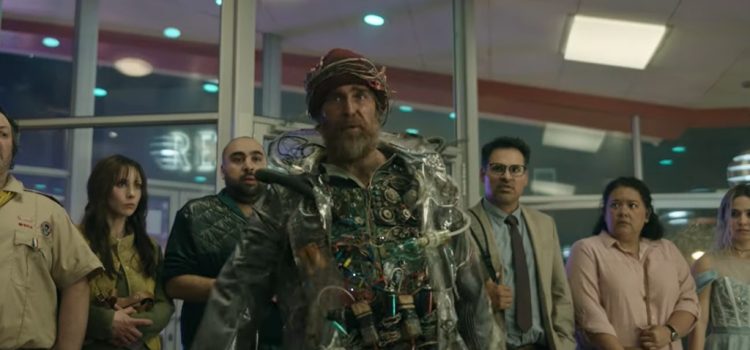
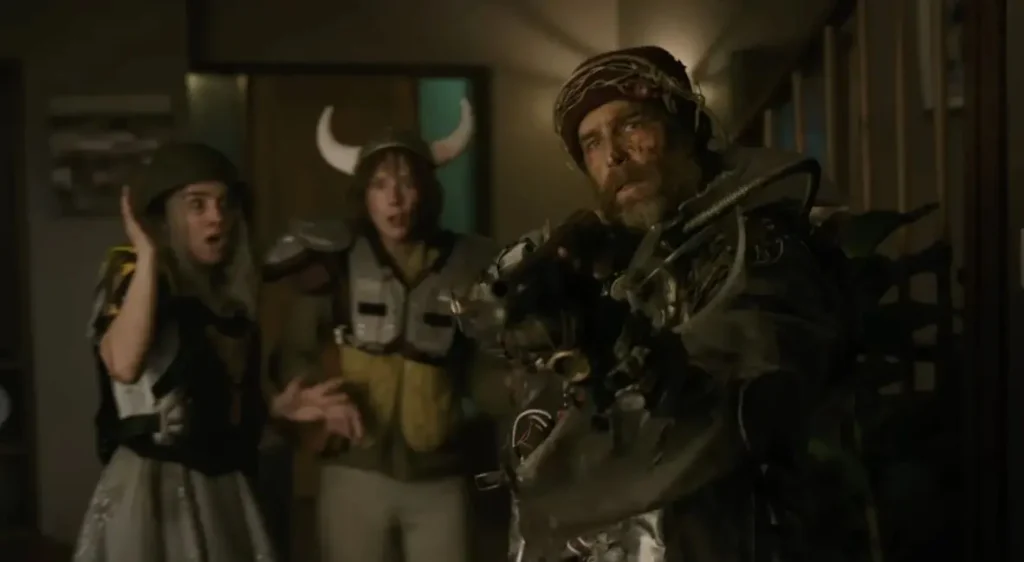
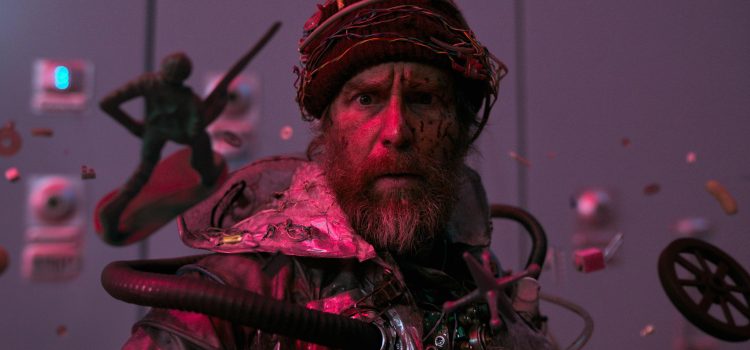
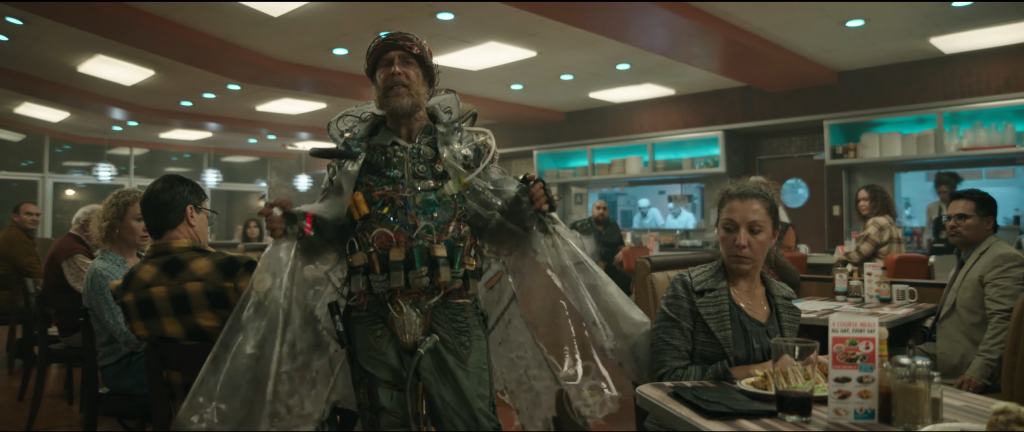
We open with an extended sequence featuring a disheveled, sardonic Man From the Future (Sam Rockwell) bursting into Norm’s Diner in Los Angeles in search of people to join him on an epic quest to prevent the AI apocalypse. He claims to have a bomb strapped beneath his transparent raincoat and launches into a speech about how technology has ruined modern life, insisting that time is of the absolute essence. 
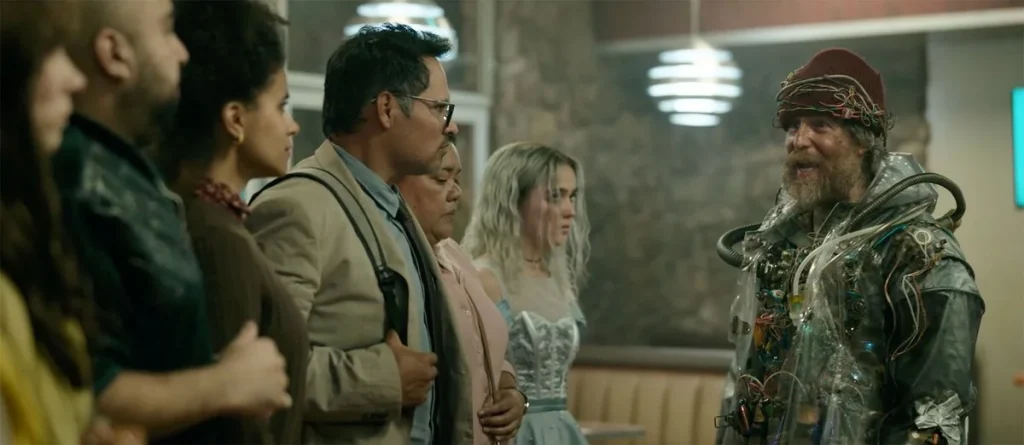
This isn’t the Man’s first rodeo, though; it’s actually his 117th attempt with this same batch of disbelieving patrons. All of his previous 116 attempts have ended in death for everyone involved (except him), with the Man “resetting” and trying to find the right combination of people necessary to complete his mission. This time could be different, though. 

The group the Man pseudo-forces to participate includes Mark (Michael Peña) and Janet (Zazie Beetz), a couple going through a rough patch who recently started new jobs as high school teachers. They are increasingly disturbed by their students’ obsession with their smartphones and cynical detachment from the outside world, even during a school shooting, which is treated like “just another day.”

There’s also Susan (Juno Temple), a mother who lost her son in that same shooting and whose grief is brushed away — there is, as a squad of local mothers tells her, a company that specializes in creating clones of children who died in school shootings. Yikes. 

There’s Ingrid (Haley Lu Richardson), a severely depressed woman wearing an off-brand Disney princess costume who is literally allergic to Wi-Fi and smartphones. Along with a few other people who aren’t given much meaningful character development, the Man and his team embark on an increasingly loony journey.
Mixing madcap sci-fi action with a decidedly nihilistic streak, “Good Luck, Have Fun, Don’t Die” is alternately amusing and exhausting over its 135-minute runtime. For all of Verbinski and screenwriter Matthew Robinson’s sharp thoughts on our technological hellscape (did you see how many SuperBowl ads were about AI?), there’s a shakiness to the film that draws you in and subsequently pushes you away. 

The film mines plentiful deadpan humor from the populace’s matter-of-fact reactions, whether it be judgy, entitled high schoolers glued to their phones, or Susan’s newly-cloned kid who is “ad-supported,” all while nobody is taking action to turn things around.

Even so, the film can’t decide between championing these idiosyncratic, reluctant heroes and reveling in the tech-addicted nastiness that surrounds them. Poignant moments are offset by edgelord, shock-value humor that is deeply proud of itself and leaves a cold aftertaste.

Rockwell is the perfect choice to play this snarky antihero. He’s goofy and sometimes callous but strong in his convictions, with an increasing desperation creeping in as he nears closer to finally stopping the horrors of an AI-controlled future.
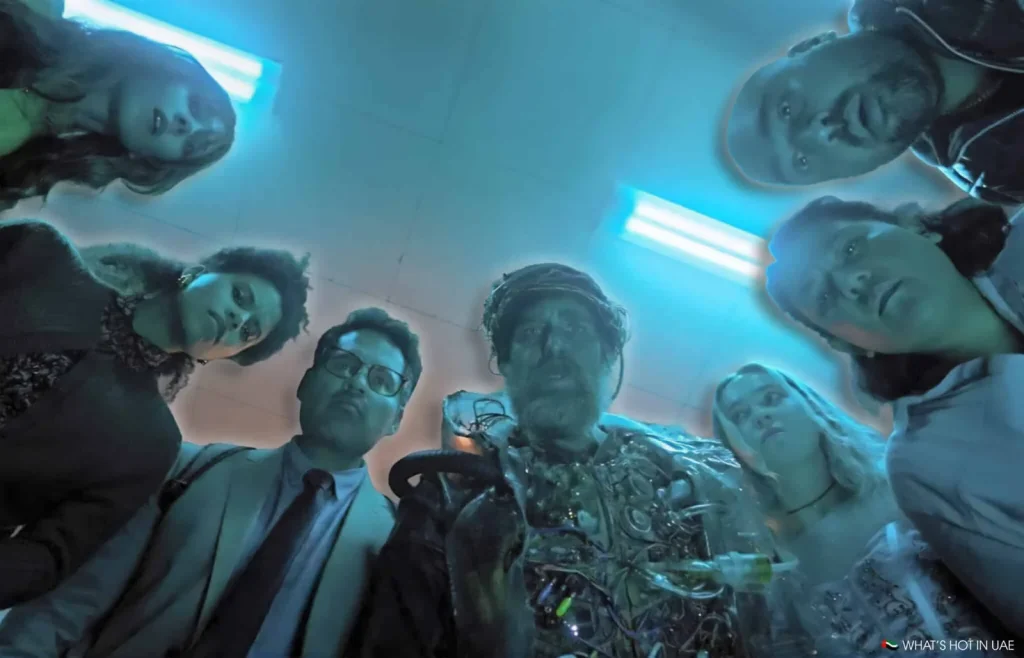
The rest of the cast aren’t anywhere near as dynamic to watch as Rockwell, but they get the job done, effectively emphasizing their feelings of displacement with an environment that refuses to recognize their empathy and, indeed, their humanity.

Verbinski and Robinson take ample time to provide backstory for the “core group,” structured in “Black Mirror” -esque flashbacks that periodically break up the immediate action of the Man and co. escaping from Norm’s and venturing to their next objectives.

This vignette structure works well enough (albeit padding the runtime to an excessive degree), and helps illuminate the personal costs of living in this reality that’s not all that dissimilar from our own. Less impactful are the labyrinthine multiversal shenanigans that arise in the finale, difficult to follow and messy in a decidedly hand-made way.

“Good Luck, Have Fun, Don’t Die,” then, is a rickety experience that’s still impossible to discount. Verbinski and Robinson take rightful aim at the devices and companies that are hijacking our attention and transforming us into passive, homogenous consumers rather than informed people with agency over our own lives.
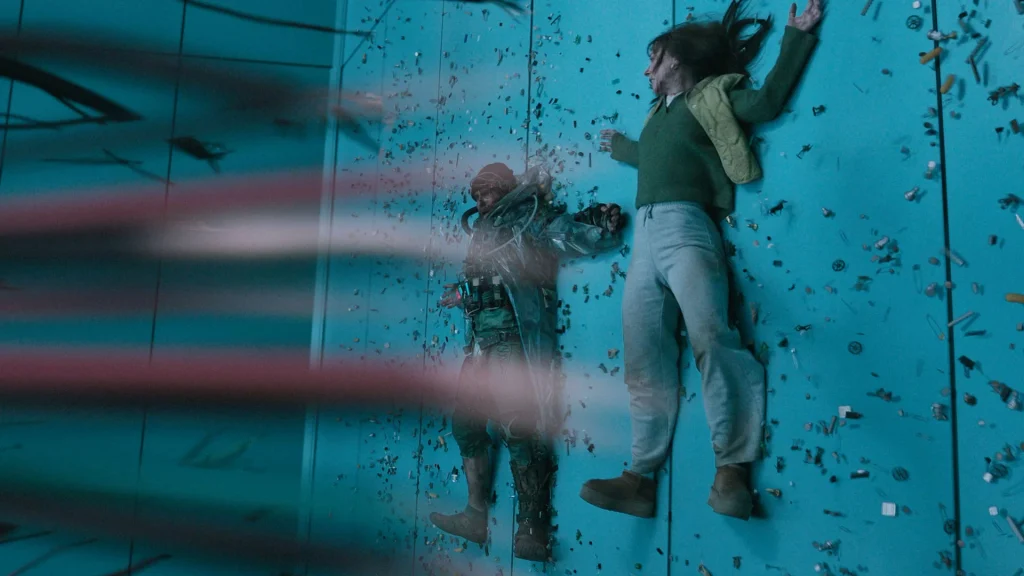
The crafts, too, are noteworthy, especially James Whitaker’s energetic cinematography and a techno score by Geoff Zanelli that pulses with rambunctious life.

Verbinski and Robinson are clearly interested in sounding a 5-alarm fire about doing something now rather than waiting until all hope is lost. The messiness of living in the real world, the film says, is worth fighting for, even when the digital one offers an illusion of safety and happiness.

There’s definitely merit to that message in 2026, although “Good Luck, Have Fun, Don’t Die” is ultimately a mildly entertaining, pitch-black yell at the Cloud.
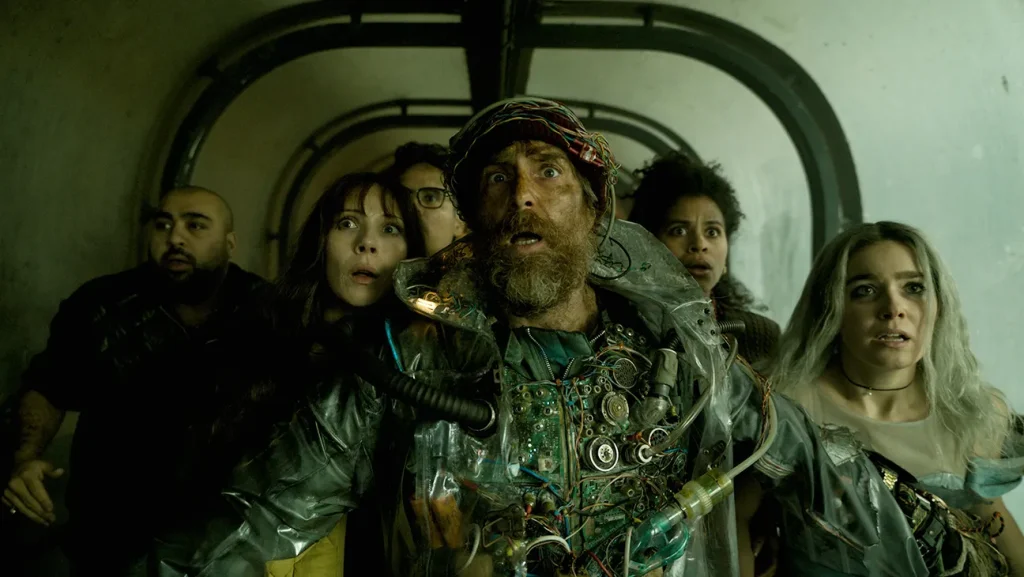
“Good Luck, Don’t Die, Have Fun” is a 2025 sci-fi action-adventure horror comedy directed by Gore Verbinski and starring Sam Rockwell, Juno Temple, Haley Lu Richardson, Michael Pena, Zazie Beetz, Georgia Goodman, and Asim Chaudhry. It is rated R for pervasive language, violence, some grisly images and brief sexual content and runs 2 hours, 14 minutes. Opens in theatres Feb. 13. Alex’s Grade: B-.

By Lynn Venhaus

A science fiction action-adventure horror comedy are many genres to cram into one anti-artificial intelligence film, but Sam Rockwell’s bonkers’ performance makes “Good Luck, Have Fun, Don’t Die” an interesting commentary for our time.

Rockwell plays a “Man from the Future” who walks into Norm’s Diner in Los Angeles to recruit patrons to join him on a one-night quest to save the world from the terminal threat of a rogue artificial intelligence.

Disheveled and wearing a clear plastic raincoat, he alarmed diners who think he’s crazy and he flings their phones around and warns of an upcoming apocalypse. Whoa.

The unnerving snarky satire by Matthew Robinson gives Rockwell the ball to slam-dunk, and his trademark fast-talking, high-energy goofiness is worth paying attention to as he cautions earthlings to put down their phones and focus on what is happening in the world.

As the “Man from the Future,” the eccentric Rockwell screams to a diner patron: “Progress is only progress if it makes things better! Otherwise, it’s a mistake!” and this is the film’s theme – that the human cost of technology obsession and unbridled AI will be loss of connection and mental health.

At what price are we willing to sacrifice what makes us human? People whose existential dread is fueled by society’s inability to shut off screens for any length of time may experience more anxiety about perpetual distraction ruining everything.

And it’s not subtle at all. This chaotic cautionary tale gets real about school shootings and teachers’ inability to educate rude, sarcastic and apathetic teenagers in unhinged scenarios.

Director Gore Verbinski is not afraid to take risks, for he’s made “The Ring,” the original trilogy of “The Pirates of the Caribbean” and the Oscar-winning animated film “Rango.” After a 10-year break, he’s back with his quirky visual style and maintains a manic pace, even though the message’s momentum eventually wanes.

A series of backstories on characters that Rockwell’s enlists “to save society” gives strong actors like Michael Pena (Mark), and Zazie Beetz (Janet) as teachers, Haley Lu Richardson (Ingrid) as a birthday party princess, Juno Temple (Susan) as a grieving mother, Georgia Goodman (Marie), and Asim Chaudhry (Scott) as a ride-share driver an opportunity to craft distinct personalities, but they aren’t given much time to develop any depth.

The lack of explanation on character behaviors and situations ultimately hurts the film’s reception, as does the unrelenting frenzy and the overall bleak attitude. The jokes stop being funny.

Composer Geoff Zanelli, production designer David Brisbin and costume designer Neil McClean all brought their A-game to this strange, trippy production that bears closer resemblance to a cocktail of “Terminator 3: Rise of the Machines,” “Alice in Wonderland,” “The Creator,” “The Mitchells vs. The Machines,” and “The Wizard of Oz” as the film unfolds.

Messy but relevant, and overlong at 2 hours, 14 minutes, “Good Luck, Have Fun, Don’t Die” is well-meaning about brain rot and hive minds, and benefits from a bizzaro star turn by Rockwell.

The Oscar-winning actor thrives on weirdness, and he merrily goes down Verbinski’s virtual reality rabbit hole. The director takes big swings that become visual overload as the clock runs out, but the point of view is original.

“Good Luck, Have Fun, Don’t Die” is a fidget spinner for our time, and forces us to pay attention.


“Good Luck, Don’t Die, Have Fun” is a 2025 sci-fi action-adventure horror comedy directed by Gore Verbinski and starring Sam Rockwell, Juno Temple, Haley Lu Richardson, Michael Pena, Zazie Beetz, Georgia Goodman, and Asim Chaudhry. It is rated R for pervasive language, violence, some grisly images and brief sexual content and runs 2 hours, 14 minutes. Opens in theatres Feb. 13. Lynn’s Grade: B.

By Lynn Venhaus
A good-looking film with a kicky soundtrack, “The Harder They Fall” comes across as a bloody western shot like a music video.

It’s no surprise, because first-time director Jeymes Samuel, a music producer and singer-songwriter known as The Bullitts, is a protégé of Jay-Z and worked with him on “The Great Gatsby” soundtrack for director Baz Luhrmann. Under his real name, Shawn Carter, Jay-Z is one of the film’s producers.

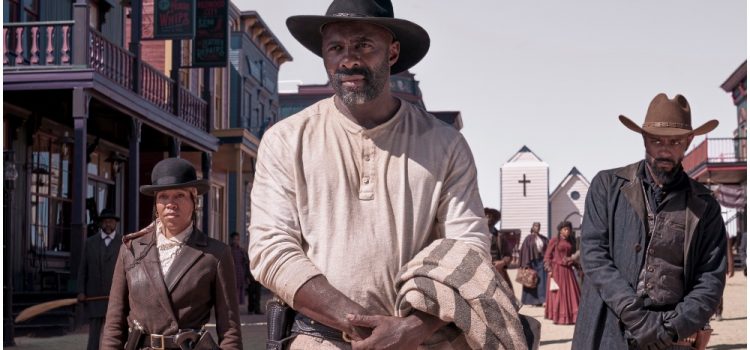
Samuel demonstrates an appealing slick style, but sadly the well-worn story lacks substance. Co-written by veteran screenwriter Boaz Yakin and Samuel as a tale of revenge and robbery, it’s merely ordinary – without much character development, squanders the talents of its extraordinary cast that includes solid-gold Idris Elba, Regina King and Delroy Lindo, with rising stars Jonathan Majors, Zazie Beetz and LaKeith Stanfield, who just gets better with every role.

The lethal shoot-outs and blood-spurting showdowns, an integral part of the western genre, are repetitive and do little to advance a gripping story. Overall, the plot is run-of-the-mill, mostly predictable, except for the third act revelation.

It’s unfortunate because you want to root for this type of new western that spotlights black cowboys. Supposedly, on the western frontier, one in four cowboys were black, and they haven’t been given proper due in America’s history on ‘go west’ and the great migration.

In the beginning, the director states that the story is fiction, but the people existed. Most of the action takes place in Redwood City, which was a primarily black community.

Faring well in this film are emerging stars Danielle Deadwyler as Cuffee, who identifies as him and would like a career in law enforcement, and Edi Gathegi as Bill Pickett, a young trigger-happy hotshot.

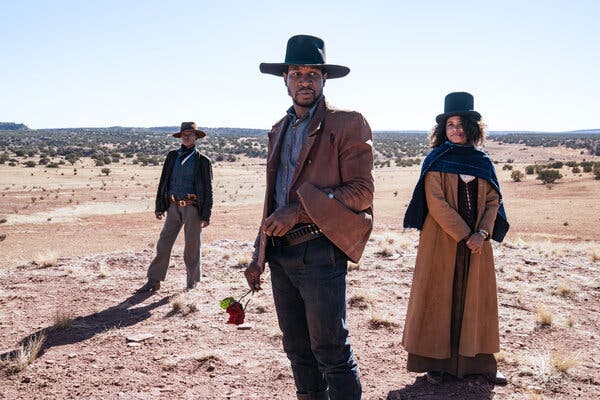
RJ Cyler has a solid turn as sharpshooter Jim Beckworth as does Deon Cole as Wiley Escoe, but it is Majors’ film. His outlaw Nat Love, no matter how many times he’s intimidated or dismissed, is driven and relentless.

Playing a man of few words who acts quickly, Elba’s physicality is felt throughout, a foreboding presence from the opening scene where he takes down a family, to breaking out of chains in prison stripes, and then as a feared frontier gang leader.

An interesting twist is how fierce the women are – Regina King as “Treacherous Trudy” and Zazie Beetz as Stagecoach Mary. They take the bullets out of their guns and use their fists and hand-held weapons for a rip-roaring knock-down drag-out brutal fight.

With its attractive production elements, the movie benefits from cinematographer Mihai Malaimare Jr.            ‘s framing of these newly constructed towns, showcasing the period production design by Martin Whist, with editing by Tom Eagles. The violence is graphic – a blown-off arm here, an exploding head there.

Amid the dusty outdoors and bullet-ripped clothes, Antoinette Messam’s costume design features a wide range of interesting vintage hats and lived-in frontier wear, with a few striking dusters and coats adding to the characters’ stature. You can always pick out Nat Love because of his jaunty red kerchief.

Not to be confused with a 1956 movie of the same name starring Humphrey Bogart, “The Harder They Fall” unfortunately lacks staying power because it preferred style over substance.

“The Harder They Fall” is a 2021 western directed by Jaymes Samuel and stars Idris Elba, Jonathan Majors, Regina King, Zazie Beets, LaKeith Stanfield, Delroy Lindo and Danielle Deadwyler. Rated R for strong violence and language, the run time is 2 hours and 16 minutes. In theaters Oct. 22 and streaming on Netflix on Nov. 3. Lynn’s Grade: C+

By Alex McPherson

A thoughtful, meditative, unabashedly far-out sci-fi gem, Edson Oda’s directorial debut, “Nine Days,” asks intriguing questions about the rollercoaster of life.

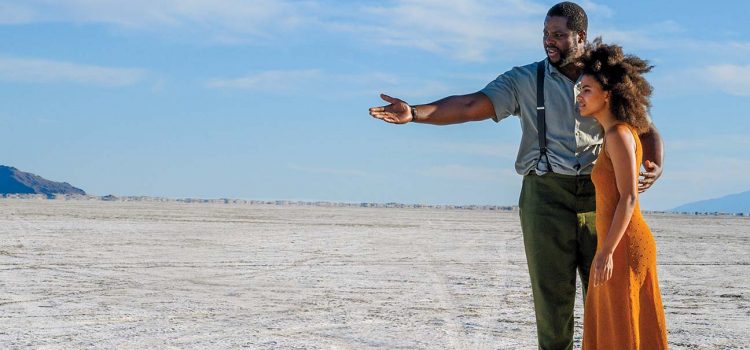
This quietly bonkers film centers around Will (Winston Duke), an individual deciding which souls get the privilege of being born in a human body. He watches present-day Point Of View footage from everyone he’s allowed into the “real world” from the comfort of his modest house in the middle of nowhere, a salt lake limbo, taking copious notes on their day-to-days in an attempt to understand humanity.

Sometimes accompanied by his good-hearted helper and friend, Kyo (Benedict Wong), Will takes pride in seeing them lead healthy, happy lives. One of them unexpectedly perishes, however, tearing Will apart inside as he struggles to make sense of what happened — vowing to never let it happen again. 

Thus, a vacancy opens that needs to be filled. Will meets a variety of applicants wishing to experience life. This archetypal group of souls includes the self-doubting Mike (David Rysdahl), the laid-back Alexander (Tony Hale), the hard-justice-driven Kane (Bill Skarsgård), the earnest, wide-eyed Maria (Arianna Ortiz), and the inquisitive, plot-altering Emma (Zazie Beetz), among others.

They are asked to watch the POV screens and to give answers to various questions examining their moral toughness over the course of nine days, with a victor announced at the end. Upon failing, some applicants get a chance to have a moment they’ve observed recreated for them before disappearing into nothingness. As the group winnows in the passing days, Will is forced to reckon with his own inner demons and consider the unknowable nature of life itself.

A captivating effort from everyone involved, “Nine Days” uses this bold premise to explore what it means to be alive. Oda’s unconventional allegory plays out in frequently powerful fashion — carried by excellent performances and an ethereal, at times mournful atmosphere pulsing with feeling. Along with methodical editing, arresting cinematography, and Antonio Pinto’s haunting score, the film brings viewers into this twisted median space in a manner mixing warmth with menace. 

Although the finer details of the film’s universe aren’t clarified (don’t think too much about how or why Will acquired his “job”), “Nine Days” sinks emotional hooks into viewers from the first frames onward. It’s somewhat of a downbeat watch, prizing patient reflection over bombast, but “Nine Days” knows when to strike lighter notes as well and occasionally poke fun at itself despite the bleakness.

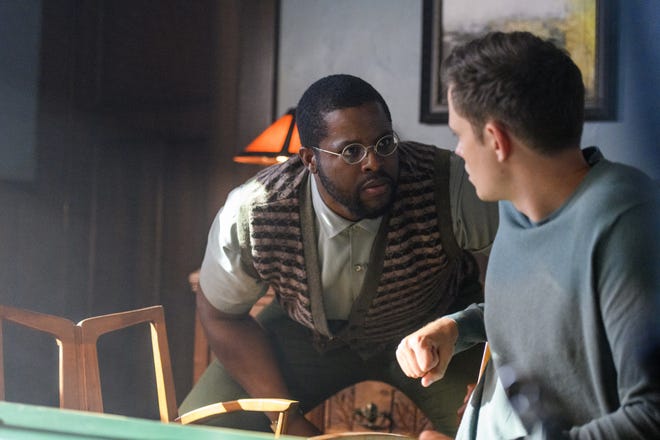
Duke does sterling work portraying a mysterious man playing God who’s trapped by his own cynical worldview, his decisions rooted in a desire to protect the applicants from a reality he views as cruel and demoralizing. Thanks to Duke’s pathos and the script’s empathy towards Will, his troubled mindset remains easy to connect with regardless of his flaws. Duke, with wire-rimmed glasses and a reserved demeanor, conveys Will’s inner tensions with a subtle performance that brilliantly showcases his severe facade gradually being chipped away.

Similarly effective is Beetz, a compassionate critical-thinker who doesn’t view human beings in a simplistic manner. Rather, she realizes the importance of relishing the good in the world, not letting negativity or nihilism corrupt her worldview. Her conversations with Will, inquiring into his own troubled past and encouraging him to reflect on what it all means, feature some of the most moving moments in “Nine Days,” tying into overarching takeaways. 

Wong is a lovable, comforting presence as Kyo, helping Will recognize his faults and his potential to grow as a human being, providing the bulk of the film’s unexpected humor. The other characters, brought to (sort-of) life by a wonderful cast, get less screen time and aren’t as well developed as the main three, but there’s more to most of them than meets the eye. Like every human soul, they cannot be simplified to a few characteristics — rendering their passage or failure all the more heartbreaking. Their “Last Moments” are masterfully directed and difficult to forget. 

Heavy without being dour, intricate yet accessible, “Nine Days” builds towards a conclusion that contains one of 2021’s best scenes. All the emotions felt throughout the film coalesce into a marvelous, life-affirming, slightly convenient resolution that’s aware of its own bizarreness while remaining highly impactful. 

An assured effort from everyone involved, “Nine Days” satisfies both the mind and the soul. The world is full of darkness, but there’s still rays of hope bursting through the shadows. Oda’s film is a provocative reminder to appreciate the light where we can and strive to see another day in our beautifully inexplicable existence. 

“Nine Days” is a 2020 sci-fi fantasy drama written and directed by Edson Oda and starring Winston Duke, Benedict Wong, Zazie Beetz, Tony Hale, David Rysdahl, Arianna Ortiz and Bill Skarsgard, Rated R for language, its runtime is 2 hours, 4 minutes. The film is available in theaters beginning on Aug. 6. Alex’s Grade: A-